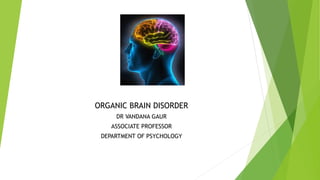
ORGANIC BRAIN DISORDER
DR VANDANA GAUR
ASSOCIATE PROFESSOR
DEPARTMENT OF PSYCHOLOGY
Definition
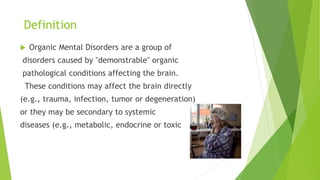
 Organic Mental Disorders are a group of
disorders caused by "demonstrable" organic
pathological conditions affecting the brain.
These conditions may affect the brain directly
(e.g., trauma, infection, tumor or degeneration)
or they may be secondary to systemic
diseases (e.g., metabolic, endocrine or toxic
Types of Organic Mental Disorder
 THERE ARE TWO MAJOR CATEGORIES OF O.M.D.:
 A. Cognitive disorders: 1 - Delirium 2- Dementia 3- Amnestic disorders
 B. Mental disorders secondary to general medical conditions:
 1-Organic hallucinosis,
 2-Organic mood disorders,
 3-Organic anxiety disorder,
 4-Organic delusional disorder,
 5-Organic personality and behavioral disorders
ETIOLOGY OF ORGANIC MENTAL
DISORDERS
 A wide range of organic pathological conditions can produce Organic Mental
Disorders, including:
 1- Head trauma
 2-Brain infections, tumors, cerebrovascular or degenerative diseases
 3- Endocrine disorders
 4- Metabolic disorders
 5- Nutritional deficiencies
 6- Toxins
 7- Substance-related disorders
DELIRIUM Definition
 Delirium is an acute reversible state of global cortical
dysfunction characterized by disturbance of
consciousness.
 It is associated with global impairment of cognitive
functions as well as other mood and behavioral changes
CLINICAL FEATURES OF DELIRIUM
 1. Disturbance of consciousness
 2. Global disturbance of cognitive functions including:
a. Attention
b. b. Memory
c. c. Perception
d. d. Orientation
 3. Other manifestations:
a. Emotional disturbances
b. Psychomotor behavior
c. Sleep-wake cycle
ONSET, COURSE AND PROGNOSIS OF
DELIRIUM
 Onset is acute or rapid (over hours or days).
 Course shows typical diurnal fluctuations of symptoms with nocturnal
worsening.
 Prognosis: It is a transient condition that resolves within days to few weeks if
the cause is treated
EPIDEMIOLOGY OF DELIRIUM
 10% of hospitalized surgical or medical patients
 30% of ICU patients
 Elderly and young children more susceptible
 Equal prevalence in males and females
ETIOLOGY
 . Head trauma
 2. Metabolic and endocrine disorders
 3. Substance related
 4. Medication induced
 5. Toxins
 6.Severe anemia and vitamin deficiency
 7. Postsurgical conditions
 8. Infections
 9. Cerebrovascular strokes
 10. Epilepsy
 11.Multifactorial
MANAGEMENT OF DELIRIUM
 1- Treatment of the cause
 2- Supportive measures
 3- Providing optimum sensory environment
 4- Symptomatic treatment for anxiety, agitation or psychotic symptoms
DEMENTIA
Definition
 A syndrome characterized by multiple cognitive defects including disturbance
of memory, without disturbance of consciousness.
 The syndrome results from organic diseases of the brain that are usually of a
chronic and progressive nature
CLINICAL FEATURES OF DEMENTIA
 1. Multiple cognitive defects: a. Memory impairment: b. Other
cognitive disturbances: Aphasia, Apraxia, Agnosia Disturbance of
executive functions Disturbed attention, perception and orientation
 2. Associated deterioration of other functions: a. Impaired emotional
control b. Depression and anxiety c. Impairment of judgment d.
Psychotic symptoms
 3. Associated neurological manifestations: a. Usually late b. Various
sensory and motor manifestations c. incontinence and bedridden
ONSET, COURSE AND PROGNOSIS OF DEMENTIA
 Onset is usually insidious, over months or years.
 Course is usually chronic and progressive (over years)
ending in death.
 Prognosis: irreversible. Some types may be reversible
(15%), if the cause is treatable (e.g., endocrine or
metabolic causes).
EPIDEMIOLOGY OF DEMENTIA
 5% of elderly over 65 years
 20% of elderly over 80 years
 15% are reversible if the cause is treatable
ETIOLOGY OF DEMENTIA
 1. Degenerative diseases: a. Alzheimer's disease b. Pick's disease c. Parkinson's
disease d. Wilson's disease
 2. Hereditary Dementia, e.g., Huntington's disease
 3. Demyelinating disease, e.g., multiple sclerosis
 4. Cerebrovascular disease
 5. Chronic Infections
 6. Trauma to brain
 7. Tumor
 8. Metabolic disorders,
 9. Drugs & toxins (chronic exposure
MANAGEMENT OF DEMENTIA
 Treatment of the cause in reversible types
 treatment for irreversible types. Some medications (anticholine-esterase
inhibitors) may help delay memory and cognitive decline.
 Supportive measures
 Symptomatic treatment for agitation, insomnia, psychotic
COMMON TYPES OF DEMENTIA
 Alzheimer disease (50-60% of all dementias)
 Vascular dementia(15-30% of all dementias)
ALZHEIMER DISEASE
 Alzheimer’s disease (AD) is a neurodegenerative disorder, characterized by
cognitive & behavioural impairment that significantly interferes with social &
occupational functioning. Alzheimer’s disease is also known as senile
dementia of the Alzheimer type (SDAT) or simply Alzheimer’s, the most
common form of dementia. It is an incurable, degenerative, terminal disease.
AD results from an increase in the production or accumulation of specific
protein (β-amyloid protein) in the brain that leads to nerve cell death.
 Course & Prognosis: Onset: may be late (after age 65) or early (before 65).
Gradual onset, progressive course and death within 2- 8 years from onset
 Clinical Features: gradual memory impairment followed by deterioration of
other cognitive aspects.
 Same symptoms of dementia.
PATHOLOGY OF ALZHEIMER DISEASE
 Degenerative changes, predominantly in parietal and temporal lobes (diffuse
cortical atrophy, amyloid plaques and neurofibrillary tangles)
 Decreased acetylcholine metabolism and degeneration of cholinergic
neurons
ETIOLOGY OF ALZHEIMER DISEASE
 The exact etiology of Alzheimer’s disease is not known and associated
with risk factors. But stated that there are several genetical and
environmental factors have been explored as potential causes of the
Alzheimer’s disease. Other factors include:
 1. Advancing age
 2. Family history
 3. Trauma
 4. Education
 5. Vascular disease like stroke etc.
RISK FACTORS
RISK FACTORS: The common risk factors for developing Alzheimer’s disease are:
➢Increased age (over 65 years of age)
➢Hypertension (high blood pressure)
➢Increased cholesterol levels
➢Coronary artery disease
➢Diabetes Other risk factors are:
➢Genetics
➢Smoking and alcohol use
➢Plasma homocysteine
➢Down syndrome
➢Mild cognitive impairment
PATHOPHYSIOLOGY
 The brain has billions of neurons, each with an axon and
many dendrites. To stay healthy, neurons must
communicate with each other, carry out metabolism and
repair themselves. AD disrupts all three of these essential
jobs. There are two signature lesions in Alzheimer’s
disease. They are: 1. Neurotic plaques/ β-amyloid
plaques, which are dense deposits of protein and cellular
material that accumulate outside and around nerve cells.
2. Neurofibrillary tangles (NFT’s), which are twisted fibers
that build up inside the nerve cell.
DIAGNOSIS
 These include;
 1. Blood studies
 2. Brain MRI/CT-scan
 3. SPECT (Single Positron Emission Computerized Tomography)/PET (Positron
Emission Tomography)
 4. Lumbar puncture
 5. Genotyping
 6. Electroencephalography
MANAGEMENT OF AD
Goals of therapy:
 1. To maintain patient’s brain function as far as possible.
 2. To treat patient’s psychiatric and behaviour sequelae.
 3. To decelerate the likelihood of progression into complications.
 4. To focus on emotional & supportive care for the concerned patient.
 5. To reduce morbidity & mortality as far as possible.
 6. To improve quality of life.
Organic Brain Syndrome.pptx

Organic Brain Syndrome.pptx

  • 1.
    ORGANIC BRAIN DISORDER DRVANDANA GAUR ASSOCIATE PROFESSOR DEPARTMENT OF PSYCHOLOGY
  • 2.
    Definition  Organic MentalDisorders are a group of disorders caused by "demonstrable" organic pathological conditions affecting the brain. These conditions may affect the brain directly (e.g., trauma, infection, tumor or degeneration) or they may be secondary to systemic diseases (e.g., metabolic, endocrine or toxic
  • 3.
    Types of OrganicMental Disorder  THERE ARE TWO MAJOR CATEGORIES OF O.M.D.:  A. Cognitive disorders: 1 - Delirium 2- Dementia 3- Amnestic disorders  B. Mental disorders secondary to general medical conditions:  1-Organic hallucinosis,  2-Organic mood disorders,  3-Organic anxiety disorder,  4-Organic delusional disorder,  5-Organic personality and behavioral disorders
  • 4.
    ETIOLOGY OF ORGANICMENTAL DISORDERS  A wide range of organic pathological conditions can produce Organic Mental Disorders, including:  1- Head trauma  2-Brain infections, tumors, cerebrovascular or degenerative diseases  3- Endocrine disorders  4- Metabolic disorders  5- Nutritional deficiencies  6- Toxins  7- Substance-related disorders
  • 5.
    DELIRIUM Definition  Deliriumis an acute reversible state of global cortical dysfunction characterized by disturbance of consciousness.  It is associated with global impairment of cognitive functions as well as other mood and behavioral changes
  • 6.
    CLINICAL FEATURES OFDELIRIUM  1. Disturbance of consciousness  2. Global disturbance of cognitive functions including: a. Attention b. b. Memory c. c. Perception d. d. Orientation  3. Other manifestations: a. Emotional disturbances b. Psychomotor behavior c. Sleep-wake cycle
  • 7.
    ONSET, COURSE ANDPROGNOSIS OF DELIRIUM  Onset is acute or rapid (over hours or days).  Course shows typical diurnal fluctuations of symptoms with nocturnal worsening.  Prognosis: It is a transient condition that resolves within days to few weeks if the cause is treated
  • 8.
    EPIDEMIOLOGY OF DELIRIUM 10% of hospitalized surgical or medical patients  30% of ICU patients  Elderly and young children more susceptible  Equal prevalence in males and females
  • 9.
    ETIOLOGY  . Headtrauma  2. Metabolic and endocrine disorders  3. Substance related  4. Medication induced  5. Toxins  6.Severe anemia and vitamin deficiency  7. Postsurgical conditions  8. Infections  9. Cerebrovascular strokes  10. Epilepsy  11.Multifactorial
  • 10.
    MANAGEMENT OF DELIRIUM 1- Treatment of the cause  2- Supportive measures  3- Providing optimum sensory environment  4- Symptomatic treatment for anxiety, agitation or psychotic symptoms
  • 11.
    DEMENTIA Definition  A syndromecharacterized by multiple cognitive defects including disturbance of memory, without disturbance of consciousness.  The syndrome results from organic diseases of the brain that are usually of a chronic and progressive nature
  • 12.
    CLINICAL FEATURES OFDEMENTIA  1. Multiple cognitive defects: a. Memory impairment: b. Other cognitive disturbances: Aphasia, Apraxia, Agnosia Disturbance of executive functions Disturbed attention, perception and orientation  2. Associated deterioration of other functions: a. Impaired emotional control b. Depression and anxiety c. Impairment of judgment d. Psychotic symptoms  3. Associated neurological manifestations: a. Usually late b. Various sensory and motor manifestations c. incontinence and bedridden
  • 13.
    ONSET, COURSE ANDPROGNOSIS OF DEMENTIA  Onset is usually insidious, over months or years.  Course is usually chronic and progressive (over years) ending in death.  Prognosis: irreversible. Some types may be reversible (15%), if the cause is treatable (e.g., endocrine or metabolic causes).
  • 14.
    EPIDEMIOLOGY OF DEMENTIA 5% of elderly over 65 years  20% of elderly over 80 years  15% are reversible if the cause is treatable
  • 15.
    ETIOLOGY OF DEMENTIA 1. Degenerative diseases: a. Alzheimer's disease b. Pick's disease c. Parkinson's disease d. Wilson's disease  2. Hereditary Dementia, e.g., Huntington's disease  3. Demyelinating disease, e.g., multiple sclerosis  4. Cerebrovascular disease  5. Chronic Infections  6. Trauma to brain  7. Tumor  8. Metabolic disorders,  9. Drugs & toxins (chronic exposure
  • 16.
    MANAGEMENT OF DEMENTIA Treatment of the cause in reversible types  treatment for irreversible types. Some medications (anticholine-esterase inhibitors) may help delay memory and cognitive decline.  Supportive measures  Symptomatic treatment for agitation, insomnia, psychotic
  • 17.
    COMMON TYPES OFDEMENTIA  Alzheimer disease (50-60% of all dementias)  Vascular dementia(15-30% of all dementias)
  • 18.
    ALZHEIMER DISEASE  Alzheimer’sdisease (AD) is a neurodegenerative disorder, characterized by cognitive & behavioural impairment that significantly interferes with social & occupational functioning. Alzheimer’s disease is also known as senile dementia of the Alzheimer type (SDAT) or simply Alzheimer’s, the most common form of dementia. It is an incurable, degenerative, terminal disease. AD results from an increase in the production or accumulation of specific protein (β-amyloid protein) in the brain that leads to nerve cell death.  Course & Prognosis: Onset: may be late (after age 65) or early (before 65). Gradual onset, progressive course and death within 2- 8 years from onset  Clinical Features: gradual memory impairment followed by deterioration of other cognitive aspects.  Same symptoms of dementia.
  • 19.
    PATHOLOGY OF ALZHEIMERDISEASE  Degenerative changes, predominantly in parietal and temporal lobes (diffuse cortical atrophy, amyloid plaques and neurofibrillary tangles)  Decreased acetylcholine metabolism and degeneration of cholinergic neurons
  • 20.
    ETIOLOGY OF ALZHEIMERDISEASE  The exact etiology of Alzheimer’s disease is not known and associated with risk factors. But stated that there are several genetical and environmental factors have been explored as potential causes of the Alzheimer’s disease. Other factors include:  1. Advancing age  2. Family history  3. Trauma  4. Education  5. Vascular disease like stroke etc.
  • 21.
    RISK FACTORS RISK FACTORS:The common risk factors for developing Alzheimer’s disease are: ➢Increased age (over 65 years of age) ➢Hypertension (high blood pressure) ➢Increased cholesterol levels ➢Coronary artery disease ➢Diabetes Other risk factors are: ➢Genetics ➢Smoking and alcohol use ➢Plasma homocysteine ➢Down syndrome ➢Mild cognitive impairment
  • 22.
    PATHOPHYSIOLOGY  The brainhas billions of neurons, each with an axon and many dendrites. To stay healthy, neurons must communicate with each other, carry out metabolism and repair themselves. AD disrupts all three of these essential jobs. There are two signature lesions in Alzheimer’s disease. They are: 1. Neurotic plaques/ β-amyloid plaques, which are dense deposits of protein and cellular material that accumulate outside and around nerve cells. 2. Neurofibrillary tangles (NFT’s), which are twisted fibers that build up inside the nerve cell.
  • 23.
    DIAGNOSIS  These include; 1. Blood studies  2. Brain MRI/CT-scan  3. SPECT (Single Positron Emission Computerized Tomography)/PET (Positron Emission Tomography)  4. Lumbar puncture  5. Genotyping  6. Electroencephalography
  • 24.
    MANAGEMENT OF AD Goalsof therapy:  1. To maintain patient’s brain function as far as possible.  2. To treat patient’s psychiatric and behaviour sequelae.  3. To decelerate the likelihood of progression into complications.  4. To focus on emotional & supportive care for the concerned patient.  5. To reduce morbidity & mortality as far as possible.  6. To improve quality of life.