Introduction
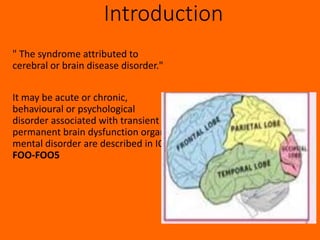
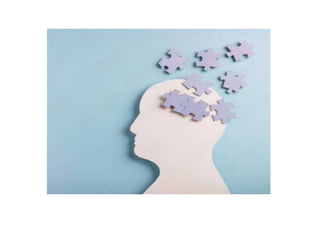
" The syndrome attributed to
cerebral or brain disease disorder."
It may be acute or chronic,
behavioural or psychological
disorder associated with transient or
permanent brain dysfunction organic
mental disorder are described in ICD
FOO-FOO5
Organic brain disorder
Defination- A pattern of organic psychological and behavioural
symptoms associated with permanent in tranasient brain
dysfunction but without refrence to etiology
DSM-3
Defination-"Organic mental disorder are behavioural or
psychological disorder associated with transient permanent
dysfunction. "
-Niraj ahuja(2006)
lncidentrate Rate-
The exact incidence and prevalence of organic mental disorder
are not known.
They are quite frequent among hospatilized mental patient
physical ill patients, psychiatric inpatient and outpatient. 5-15
percent of all patient in medical and surgical in patient units are
estimated to develop dilirium at some time in their lives.
Classification-
Organic mental disorder- orgnic brain diaorder can be divided
into four major subgroup.
a. Acute organic mental Disorder-" Acute " means of recent
onset and often temporary (Delirium).
b. Chronic organic mental disorder- persist for longer time
and may leads to permanent brain damage (Dementia).
a. Amnesia- It usully refers to the temporary loos of memory
and may cause by various organic conditions such as head
and brain injuries, drugs alcohal tramautic event etc.
b. Other organic mental disorders- It includes hallucination
dellusion, personality disorder, mood disorder,dissociative
caused by some underlying organic conditions.
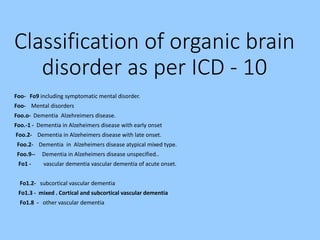
Classification of organic brain
disorder as per ICD - 10
Foo- Fo9 including symptomatic mental disorder.
Foo- Mental disorders
Foo.o- Dementia Alzehreimers disease.
Foo.-1 - Dementia in Alzeheimers disease with early onset
Foo.2- Dementia in Alzeheimers disease with late onset.
Foo.2- Dementia in Alzeheimers disease atypical mixed type.
Foo.9-- Dementia in Alzeheimers disease unspecified..
Fo1 - vascular dementia vascular dementia of acute onset.
Fo1.2- subcortical vascular dementia
Fo1.3 - mixed . Cortical and subcortical vascular dementia
Fo1.8 - other vascular dementia
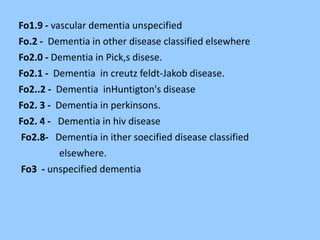
Fo1.9 - vascular dementia unspecified
Fo.2 - Dementia in other disease classified elsewhere
Fo2.0 - Dementia in Pick,s disese.
Fo2.1 - Dementia in creutz feldt-Jakob disease.
Fo2..2 - Dementia inHuntigton's disease
Fo2. 3 - Dementia in perkinsons.
Fo2. 4 - Dementia in hiv disease
Fo2.8- Dementia in ither soecified disease classified
elsewhere.
Fo3 - unspecified dementia
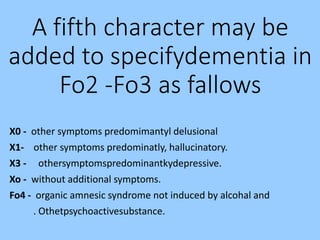
A fifth character may be
added to specifydementia in
Fo2 -Fo3 as fallows
X0 - other symptoms predomimantyl delusional
X1- other symptoms predominatly, hallucinatory.
X3 - othersymptomspredominantkydepressive.
Xo - without additional symptoms.
Fo4 - organic amnesic syndrome not induced by alcohal and
. Othetpsychoactivesubstance.
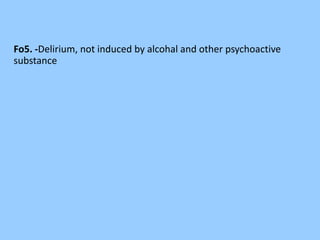
Fo5. -Delirium, not induced by alcohal and other psychoactive
substance
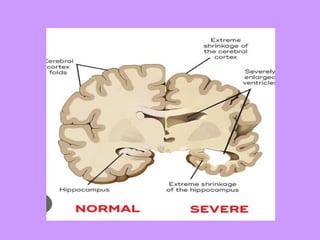
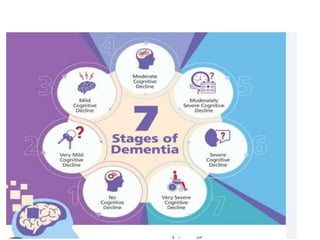
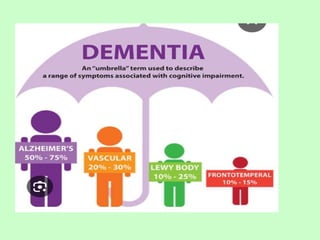
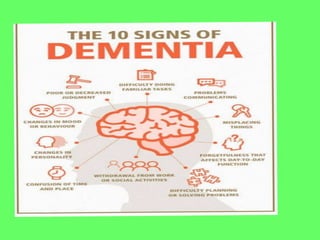
Dementia
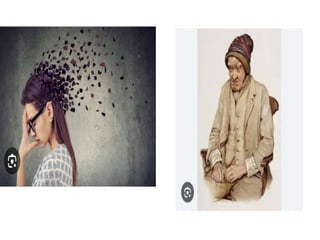
 Introduction - Dementia not disease by itsef but rather a group
of symptoms that are used by various disease condition.
 If it is a severe, it will iinterfere with a persons daily functioning.
 It has been described in ICD -10 (Foo -Fo7) ICD -9 (290-294) it is a
late life disease, as it tends to devlop mostly in early people.
 The, word ' Dementia'derived from two latin words ' de ' means '
apart ' or ' away and mean ' mentis ' (genative) means ' mind '
 In latin ' dementia ' means ' irrationality'.
Defination -
The progressive decline in cognitive functions
particularly affected area like thinking reosning memory attention
language, and problem solving due to damage or disease in the
brain beyond, what might be expected from normal aging.
Wikipedia Encylopedia
Incident Rate -
 World wide around million people are suffering from, dementia
with nearly 60 percent living in low and middle - income
countries.
 10 millioncases detected every Year.
 The estimated proportion of the general papulation age 5 percent
to 8 percent.
 The total number of people with dementia is protected to reach
82 million in 2023 and 150 million in 2050.
 Alzheimers disease is the most common from of dementia and
may contribute 60 - 70 percent of cases of dementia.
Types -
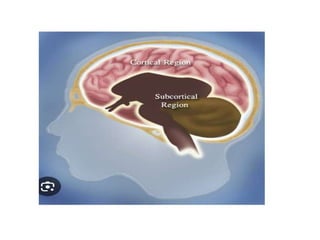
1. Cortical andsubcorticalDementia
2. Reversible dementia and nonreversible Dementia
3. Presenile dementia and dementia
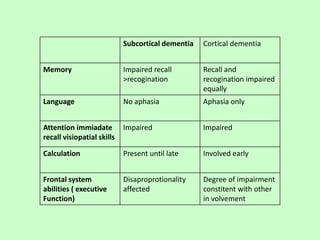
 Distinguish features of subcortical and cortical features- Non-
veg Alzeheimers dementia bsically means subcortical dementia
some distinguish of sub cortical abd cortical dementia.
Subcortical dementia Cortical dementia
Memory Impaired recall
>recogination
Recall and
recogination impaired
equally
Language No aphasia Aphasia only
Attention immiadate
recall visiopatial skills
Impaired Impaired
Calculation Present until late Involved early
Frontal system
abilities ( executive
Function)
Disaproprotionality
affected
Degree of impairment
constitent with other
in volvement
 Cortical and subcortical dementia - Dementia may be with
multiple subcortical or corticle infracts and clinical feature may
according -
 Reversible dementia and nonreversible dementia -
a. Reversible dementia - Is aterm used in the medical litrature
to describe a dementia that aspecific irritable cause. In the
past dementia that a specific irritable cause. In the past
dementia has implied aprogressive oe irreversible course.
Dementia syndrome include those arising - inflammatory
process encephlopathy caused by SLE .syphlic
hypothyroidism nutritional syndrome vit B12 defincies that
30%_40% persons disturbance have a reversible and that are
fore treatable dementia.
Non reversible dementia -
When a reversible dementia cause intellectual
impairment can't identified the clinical diagnosis is persumed to a non
reversible dementia may disease can produce a progressive and non-veg
reversible dementia..
Alzheimerss disease perkinsons disease, infract dementia
 Presenile dementia - It resemble that of senile dementia except that
Disorder occurs in younger age group. The onset of disease occurs in people
40s and 50s and people with live an average 11years after onaet Disease.
 senile dementia - It occurs usully after thebage of 65 years due to
degenrative brings changes as accompained by aclinical picture of mental
deterioration.
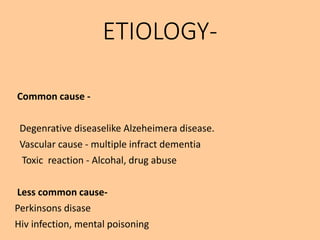
ETIOLOGY-
Common cause -
Degenrative diseaselike Alzeheimera disease.
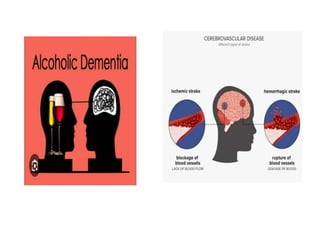
Vascular cause - multiple infract dementia
Toxic reaction - Alcohal, drug abuse
Less common cause-
Perkinsons disase
Hiv infection, mental poisoning
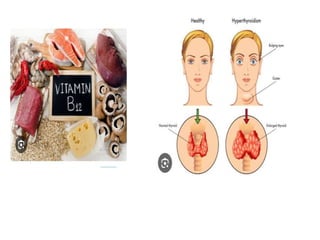
Potentially treatable cause -
Endocrine disorder
Vitamin defeciencies - vit B12
Depression - Depressive pseudo dementia hysteria, catonia
Brain tumors
Psychopathophysiology
ll
Formatiin of intaracellular neurifirillary tangles infrats and
extracellulary amloidal protein plaque.
ll
Accumulation of amloid plaques in the brain parenchyma and in
the cerbral blood vessels
ll
Degenrative neuronal loss seen particularly in the hippocampus,
amygdala, entrohinal cortex
ll
Alzeheimers Disease
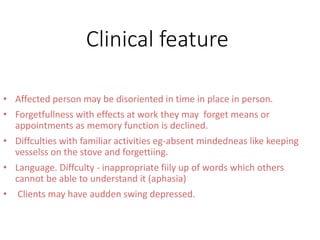
Clinical feature
• Affected person may be disoriented in time in place in person.
• Forgetfullness with effects at work they may forget means or
appointments as memory function is declined.
• Diffculties with familiar activities eg-absent mindedneas like keeping
vesselss on the stove and forgettiing.
• Language. Diffculty - inappropriate fiily up of words which others
cannot be able to understand it (aphasia)
• Clients may have audden swing depressed.
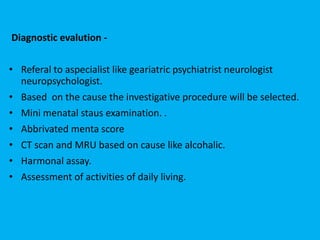
Diagnostic evalution -
• Referal to aspecialist like geariatric psychiatrist neurologist
neuropsychologist.
• Based on the cause the investigative procedure will be selected.
• Mini menatal staus examination. .
• Abbrivated menta score
• CT scan and MRU based on cause like alcohalic.
• Harmonal assay.
• Assessment of activities of daily living.
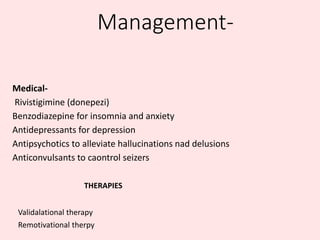
Management-
Medical-
Rivistigimine (donepezi)
Benzodiazepine for insomnia and anxiety
Antidepressants for depression
Antipsychotics to alleviate hallucinations nad delusions
Anticonvulsants to caontrol seizers
THERAPIES
Validalational therapy
Remotivational therpy
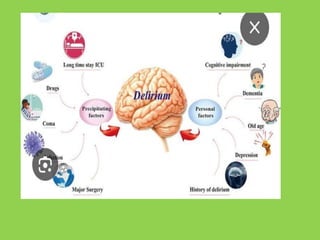
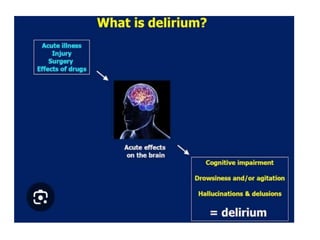
DELIRIUM
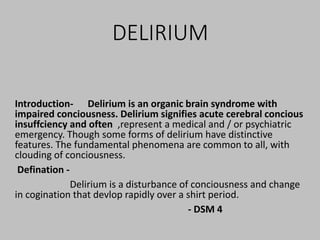
Introduction- Delirium is an organic brain syndrome with
impaired conciousness. Delirium signifies acute cerebral concious
insuffciency and often ,represent a medical and / or psychiatric
emergency. Though some forms of delirium have distinctive
features. The fundamental phenomena are common to all, with
clouding of conciousness.
Defination -
Delirium is a disturbance of conciousness and change
in cogination that devlop rapidly over a shirt period.
- DSM 4
Incident Rate -
20 -40 % of featric clientsin hospitalization
In postoperative cases incidence was noticed.
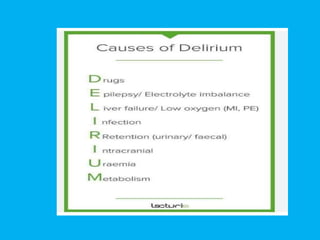
ETIOLOGY -
Mnemonic - " VINDICTIVE MAD "
a. Degenrative disease of CNS. - senile dementia, Alzheimers
disease,picks disease
b. Toxic causes- Alcohal, poisoning, CO2
c. Anoxia- Anemia,postanesthesia ,cardiacarrest ,Huntington,s
disease.
d. Intercranial cause - occuPying lesion - tumors chronic subdural
hematos chronic abscesses aneurysm.
• Vascular cause - multi infract dementia, occulsion of the carotiid
artery, stroke Hypertension, cranial artheritis.
• Metabolic and endocrine disorder - hepatic failure, Renal failure,
repiratory failure, hypoxia chronic electrolyte imbalance.
• Nutritional cause - sustained of B 12 pernicious Anemia, Niacin-
pellagra, Thiamine - wernicke - Korsakaff,s syndromes
• Traumatic cause - Head injury
• Infections related conditions - AIDS, neurosynphilic, encephlitis, of
any cause.
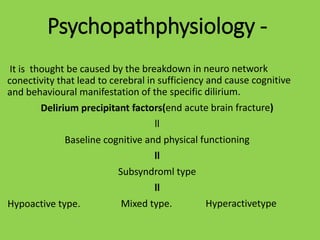
Psychopathphysiology -
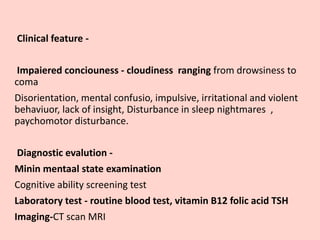
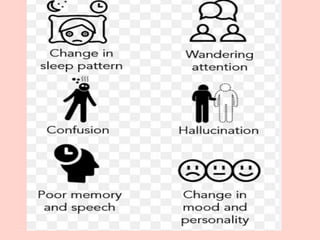
Clinical feature -
Impaiered conciouness - cloudiness ranging from drowsiness to
coma
Disorientation, mental confusio, impulsive, irritational and violent
behaviuor, lack of insight, Disturbance in sleep nightmares ,
paychomotor disturbance.
Diagnostic evalution -
Minin mentaal state examination
Cognitive ability screening test
Laboratory test - routine blood test, vitamin B12 folic acid TSH
Imaging-CT scan MRI
Management-
Medical -
Resipridone
Trazodone
Gabapentine
Benzodiazepine
Haloperidol
Therapies
Occupationale therapy
Nursing management
Nusing diagnosis -
1. Disturbed thought procedd related to impaired coginitive
abilities as evidnce by disorientation memory loss,.
2. Impaired verbal Communication related to impaired abstract
thinking as evidence by aphasia.
3. Self care deficit related to coginative impairment evidence by
inability to perform activities of daily life.
4. Impaired physical mobility related to perceptual impairment
and pain as evidence by immobility and decreased fine and
gross motor movement.
organic brain disorder.pptx its classification

organic brain disorder.pptx its classification

  • 2.
    Introduction " The syndromeattributed to cerebral or brain disease disorder." It may be acute or chronic, behavioural or psychological disorder associated with transient or permanent brain dysfunction organic mental disorder are described in ICD FOO-FOO5
  • 3.
  • 4.
    Defination- A patternof organic psychological and behavioural symptoms associated with permanent in tranasient brain dysfunction but without refrence to etiology DSM-3 Defination-"Organic mental disorder are behavioural or psychological disorder associated with transient permanent dysfunction. " -Niraj ahuja(2006)
  • 5.
    lncidentrate Rate- The exactincidence and prevalence of organic mental disorder are not known. They are quite frequent among hospatilized mental patient physical ill patients, psychiatric inpatient and outpatient. 5-15 percent of all patient in medical and surgical in patient units are estimated to develop dilirium at some time in their lives.
  • 7.
    Classification- Organic mental disorder-orgnic brain diaorder can be divided into four major subgroup. a. Acute organic mental Disorder-" Acute " means of recent onset and often temporary (Delirium). b. Chronic organic mental disorder- persist for longer time and may leads to permanent brain damage (Dementia).
  • 8.
    a. Amnesia- Itusully refers to the temporary loos of memory and may cause by various organic conditions such as head and brain injuries, drugs alcohal tramautic event etc. b. Other organic mental disorders- It includes hallucination dellusion, personality disorder, mood disorder,dissociative caused by some underlying organic conditions.
  • 9.
    Classification of organicbrain disorder as per ICD - 10 Foo- Fo9 including symptomatic mental disorder. Foo- Mental disorders Foo.o- Dementia Alzehreimers disease. Foo.-1 - Dementia in Alzeheimers disease with early onset Foo.2- Dementia in Alzeheimers disease with late onset. Foo.2- Dementia in Alzeheimers disease atypical mixed type. Foo.9-- Dementia in Alzeheimers disease unspecified.. Fo1 - vascular dementia vascular dementia of acute onset. Fo1.2- subcortical vascular dementia Fo1.3 - mixed . Cortical and subcortical vascular dementia Fo1.8 - other vascular dementia
  • 10.
    Fo1.9 - vasculardementia unspecified Fo.2 - Dementia in other disease classified elsewhere Fo2.0 - Dementia in Pick,s disese. Fo2.1 - Dementia in creutz feldt-Jakob disease. Fo2..2 - Dementia inHuntigton's disease Fo2. 3 - Dementia in perkinsons. Fo2. 4 - Dementia in hiv disease Fo2.8- Dementia in ither soecified disease classified elsewhere. Fo3 - unspecified dementia
  • 11.
    A fifth charactermay be added to specifydementia in Fo2 -Fo3 as fallows X0 - other symptoms predomimantyl delusional X1- other symptoms predominatly, hallucinatory. X3 - othersymptomspredominantkydepressive. Xo - without additional symptoms. Fo4 - organic amnesic syndrome not induced by alcohal and . Othetpsychoactivesubstance.
  • 12.
    Fo5. -Delirium, notinduced by alcohal and other psychoactive substance
  • 14.
    Dementia  Introduction -Dementia not disease by itsef but rather a group of symptoms that are used by various disease condition.  If it is a severe, it will iinterfere with a persons daily functioning.  It has been described in ICD -10 (Foo -Fo7) ICD -9 (290-294) it is a late life disease, as it tends to devlop mostly in early people.  The, word ' Dementia'derived from two latin words ' de ' means ' apart ' or ' away and mean ' mentis ' (genative) means ' mind '  In latin ' dementia ' means ' irrationality'.
  • 15.
    Defination - The progressivedecline in cognitive functions particularly affected area like thinking reosning memory attention language, and problem solving due to damage or disease in the brain beyond, what might be expected from normal aging. Wikipedia Encylopedia
  • 16.
    Incident Rate - World wide around million people are suffering from, dementia with nearly 60 percent living in low and middle - income countries.  10 millioncases detected every Year.  The estimated proportion of the general papulation age 5 percent to 8 percent.  The total number of people with dementia is protected to reach 82 million in 2023 and 150 million in 2050.  Alzheimers disease is the most common from of dementia and may contribute 60 - 70 percent of cases of dementia.
  • 19.
    Types - 1. CorticalandsubcorticalDementia 2. Reversible dementia and nonreversible Dementia 3. Presenile dementia and dementia  Distinguish features of subcortical and cortical features- Non- veg Alzeheimers dementia bsically means subcortical dementia some distinguish of sub cortical abd cortical dementia.
  • 20.
    Subcortical dementia Corticaldementia Memory Impaired recall >recogination Recall and recogination impaired equally Language No aphasia Aphasia only Attention immiadate recall visiopatial skills Impaired Impaired Calculation Present until late Involved early Frontal system abilities ( executive Function) Disaproprotionality affected Degree of impairment constitent with other in volvement
  • 21.
     Cortical andsubcortical dementia - Dementia may be with multiple subcortical or corticle infracts and clinical feature may according -  Reversible dementia and nonreversible dementia - a. Reversible dementia - Is aterm used in the medical litrature to describe a dementia that aspecific irritable cause. In the past dementia that a specific irritable cause. In the past dementia has implied aprogressive oe irreversible course. Dementia syndrome include those arising - inflammatory process encephlopathy caused by SLE .syphlic hypothyroidism nutritional syndrome vit B12 defincies that 30%_40% persons disturbance have a reversible and that are fore treatable dementia.
  • 22.
    Non reversible dementia- When a reversible dementia cause intellectual impairment can't identified the clinical diagnosis is persumed to a non reversible dementia may disease can produce a progressive and non-veg reversible dementia.. Alzheimerss disease perkinsons disease, infract dementia  Presenile dementia - It resemble that of senile dementia except that Disorder occurs in younger age group. The onset of disease occurs in people 40s and 50s and people with live an average 11years after onaet Disease.  senile dementia - It occurs usully after thebage of 65 years due to degenrative brings changes as accompained by aclinical picture of mental deterioration.
  • 24.
    ETIOLOGY- Common cause - Degenrativediseaselike Alzeheimera disease. Vascular cause - multiple infract dementia Toxic reaction - Alcohal, drug abuse Less common cause- Perkinsons disase Hiv infection, mental poisoning
  • 28.
    Potentially treatable cause- Endocrine disorder Vitamin defeciencies - vit B12 Depression - Depressive pseudo dementia hysteria, catonia Brain tumors
  • 29.
    Psychopathophysiology ll Formatiin of intaracellularneurifirillary tangles infrats and extracellulary amloidal protein plaque. ll Accumulation of amloid plaques in the brain parenchyma and in the cerbral blood vessels ll Degenrative neuronal loss seen particularly in the hippocampus, amygdala, entrohinal cortex ll Alzeheimers Disease
  • 31.
    Clinical feature • Affectedperson may be disoriented in time in place in person. • Forgetfullness with effects at work they may forget means or appointments as memory function is declined. • Diffculties with familiar activities eg-absent mindedneas like keeping vesselss on the stove and forgettiing. • Language. Diffculty - inappropriate fiily up of words which others cannot be able to understand it (aphasia) • Clients may have audden swing depressed.
  • 33.
    Diagnostic evalution - •Referal to aspecialist like geariatric psychiatrist neurologist neuropsychologist. • Based on the cause the investigative procedure will be selected. • Mini menatal staus examination. . • Abbrivated menta score • CT scan and MRU based on cause like alcohalic. • Harmonal assay. • Assessment of activities of daily living.
  • 34.
    Management- Medical- Rivistigimine (donepezi) Benzodiazepine forinsomnia and anxiety Antidepressants for depression Antipsychotics to alleviate hallucinations nad delusions Anticonvulsants to caontrol seizers THERAPIES Validalational therapy Remotivational therpy
  • 37.
    DELIRIUM Introduction- Delirium isan organic brain syndrome with impaired conciousness. Delirium signifies acute cerebral concious insuffciency and often ,represent a medical and / or psychiatric emergency. Though some forms of delirium have distinctive features. The fundamental phenomena are common to all, with clouding of conciousness. Defination - Delirium is a disturbance of conciousness and change in cogination that devlop rapidly over a shirt period. - DSM 4
  • 38.
    Incident Rate - 20-40 % of featric clientsin hospitalization In postoperative cases incidence was noticed. ETIOLOGY - Mnemonic - " VINDICTIVE MAD " a. Degenrative disease of CNS. - senile dementia, Alzheimers disease,picks disease b. Toxic causes- Alcohal, poisoning, CO2 c. Anoxia- Anemia,postanesthesia ,cardiacarrest ,Huntington,s disease. d. Intercranial cause - occuPying lesion - tumors chronic subdural hematos chronic abscesses aneurysm.
  • 39.
    • Vascular cause- multi infract dementia, occulsion of the carotiid artery, stroke Hypertension, cranial artheritis. • Metabolic and endocrine disorder - hepatic failure, Renal failure, repiratory failure, hypoxia chronic electrolyte imbalance. • Nutritional cause - sustained of B 12 pernicious Anemia, Niacin- pellagra, Thiamine - wernicke - Korsakaff,s syndromes • Traumatic cause - Head injury • Infections related conditions - AIDS, neurosynphilic, encephlitis, of any cause.
  • 42.
  • 43.
    Clinical feature - Impaieredconciouness - cloudiness ranging from drowsiness to coma Disorientation, mental confusio, impulsive, irritational and violent behaviuor, lack of insight, Disturbance in sleep nightmares , paychomotor disturbance. Diagnostic evalution - Minin mentaal state examination Cognitive ability screening test Laboratory test - routine blood test, vitamin B12 folic acid TSH Imaging-CT scan MRI
  • 45.
  • 47.
    Nursing management Nusing diagnosis- 1. Disturbed thought procedd related to impaired coginitive abilities as evidnce by disorientation memory loss,. 2. Impaired verbal Communication related to impaired abstract thinking as evidence by aphasia. 3. Self care deficit related to coginative impairment evidence by inability to perform activities of daily life. 4. Impaired physical mobility related to perceptual impairment and pain as evidence by immobility and decreased fine and gross motor movement.