
UNIT-9 SUBSTANCE
USE DISORDER
Presented by:
VIPIN CHANDRAN
1
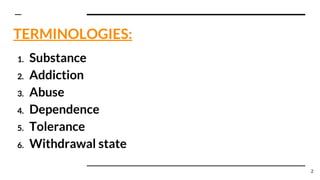
TERMINOLOGIES:
1. Substance
2. Addiction
3. Abuse
4. Dependence
5. Tolerance
6. Withdrawal state
2
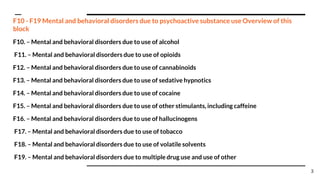
F10 - F19 Mental and behavioral disorders due to psychoactive substance use Overview of this
block
F10. – Mental and behavioral disorders due to use of alcohol
F11. – Mental and behavioral disorders due to use of opioids
F12. – Mental and behavioral disorders due to use of cannabinoids
F13. – Mental and behavioral disorders due to use of sedative hypnotics
F14. – Mental and behavioral disorders due to use of cocaine
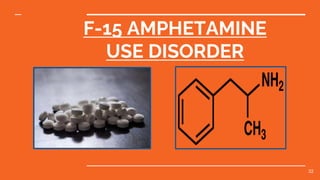
F15. – Mental and behavioral disorders due to use of other stimulants, including caffeine
F16. – Mental and behavioral disorders due to use of hallucinogens
F17. – Mental and behavioral disorders due to use of tobacco
F18. – Mental and behavioral disorders due to use of volatile solvents
F19. – Mental and behavioral disorders due to multiple drug use and use of other
3
ETIOLOGY:
1) Biological Factors
2) Psychological Factors
3) Social Factors
4
F-10 ALCOHOL USE
DISORDER
5
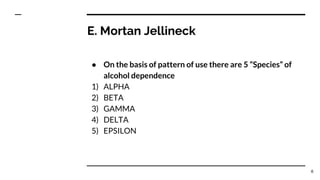
E. Mortan Jellineck
● On the basis of pattern of use there are 5 “Species” of
alcohol dependence
1) ALPHA
2) BETA
3) GAMMA
4) DELTA
5) EPSILON
6
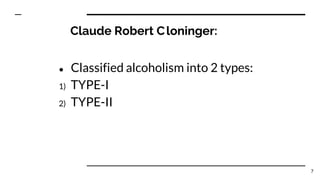
Claude Robert Cloninger:
● Classified alcoholism into 2 types:
1) TYPE-I
2) TYPE-II
7
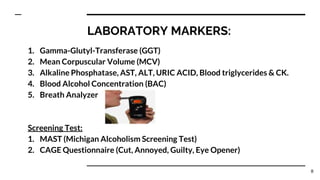
LABORATORY MARKERS:
1. Gamma-Glutyl-Transferase (GGT)
2. Mean Corpuscular Volume (MCV)
3. Alkaline Phosphatase, AST, ALT, URIC ACID, Blood triglycerides & CK.
4. Blood Alcohol Concentration (BAC)
5. Breath Analyzer
Screening Test:
1. MAST (Michigan Alcoholism Screening Test)
2. CAGE Questionnaire (Cut, Annoyed, Guilty, Eye Opener)
8
Acute Intoxication
 After a brief period of excitation, there is generalized CNS
depression, with increasing intoxication, there is increased reaction
time, slowed thinking, distractibility and poor motor control, later
dysarthria, ataxia and incoordination can occur
 Signs of Intoxication with blood levels of 150-200mg%.
 Death occur with Blood alcohol level 400 to 800mg%
9
Withdrawal Syndrome
1) Hangover on the next morning
2) Mild tremors, nausea, vomiting, weakness
3) Irritability, Insomnia and Anxiety
Severe withdrawal syndrome may be more severe characterized by one
of the following three disturbances:
1) Delirium Tremens
2) Alcoholic seizures
3) Alcoholic Hallucinosis
10
Complication of Alcohol Dependence:
I. Medical complications
a. Gastrointestinal System
b. Central Nervous system
c. Miscellaneous
II. Social Complications
 Accidents
 Marital Disharmony
 Divorce
 Occupational problems
 Criminality
 Financial difficulties
“BAC” : 30mg/100 ml in India
(Section 185 of the Motor Vehicle Act,
1988)
80mg/100ml legal limit for driving in UK
>400 mg/100ml Death may occur
11
Treatment :
● Before starting the treatment , it is important to follow the steps:
1) Ruling out any physical disorder
2) Ruling out any psychiatric disorder
3) Assessment of motivation for treatment
4) Assessment of social support system
5) Assessment of personality characteristics of the patient
6) Assessment of current and past social, interpersonal & occupational
functioning.
12
Treatment broadly divided into 2 categories:
1) Detoxification:
It is treatment of alcohol withdrawal symptoms i.e symptoms produced by the
removal of the ‘toxin’. Benzodiazepines (Chlordiazepoxide (80-200 mg/day)
and diazepam (40-80mg/day).
2) Treatment of Alcohol Dependence:
After the steps of detoxification is over, for further management some of the
important method include:
● Behavior therapy
● Psychotherapy
● Group therapy
● Deterrent agents( Alcohol Sensitizing Drugs)
13
Disulfiram (Tetra ethyl thiuram Disulfide):
● It is discovered in 1930’s, it develop unpleasant reactions to alcohol intake to
develop DER (Disulfiram- ethanol reaction).
○ Flushing
○ Tachycardia
○ Hypotension
○ Tachypnoea
○ Palpitation
○ Headache, sweating, nausea
○ Vomiting, severe anxiety
Usual dose of Disulfiram is 250-500mg/day
Other Deterrent Agents like Citrated calcium carbimide,
Metronidazole, Animal Charcoal, Anticraving agents
14
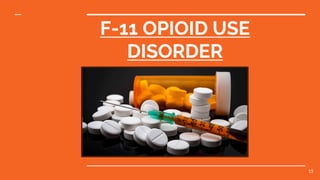
F-11 OPIOID USE
DISORDER
15
Opioid Use Disorder:
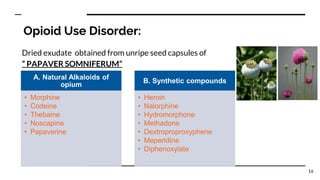
Dried exudate obtained from unripe seed capsules of
“ PAPAVER SOMNIFERUM”
A. Natural Alkaloids of
opium
• Morphine
• Codeine
• Thebaine
• Noscapine
• Papaverine
B. Synthetic compounds
• Heroin
• Nalorphine
• Hydromorphone
• Methadone
• Dextroproproxyphene
• Meperidine
• Diphenoxylate
16
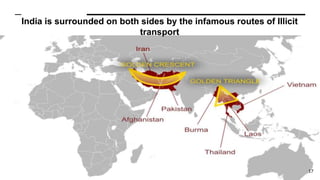
India is surrounded on both sides by the infamous routes of Illicit
transport
17
● Heroin or di-acetyl-morphine is about 2 times
more potent than morphine in injectable form.
● Heroin can be smoked or chased “chasing the
dragon”, impure form called “Smack” or “Brown
Sugar” in India.
18
Acute Intoxication:
● It is characterized by apathy, bradycardia, hypotension, respiratory depression,
fever, delayed reflexes, coma may occur in case of large overdose.
Withdrawal Syndrome:
● Onset of symptoms occurs within 12-24 hours, peak within 24-72 hours and
symptoms usually subside within 7-10 days.
- lacrimation
- rhinorrhoea
- pupillary dilation
- sweating
- diarrhoea
- yawning
19
Complications:
1. Complications due to illicit drug (contaminants):
- Parkinsonism, degeneration of globus pallidum, peripheral
neuropathy, amblyopia.
2. Complication due to intravenous use:
- AIDS, Skin infection, thrombophlebitis, pulmonary embolism, viral
hepatitis, tetatnus, endocarditis
3. Drug pedding and involvement in criminal activities (social complication)
20
Treatment:
● Before treatment a correct diagnosis must be made on the basis of history,
examination and lab test these are:
1. Naloxone challenge test
2. Urinary Opioids testing: RIA, FRAT, TLC, GLC, HPLC
Treatment can be divided into three main types:
1. Treatment of overdose (Naloxone, Naltrexone)
2. Detoxification (Methadone, Clonidine, Naltrexone, Levo-Alpha-Acetyl-
Methadol LAAM)
3. Maintenance therapy (Psychotherapy, Behavior therapy, interpersonal
therapy, CBT, Family therapy, group therapy etc)
21
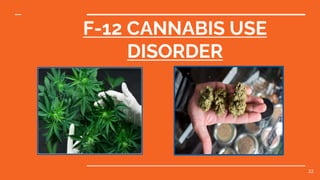
F-12 CANNABIS USE
DISORDER
22
Introduction:
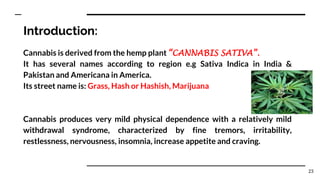
Cannabis is derived from the hemp plant “CANNABIS SATIVA”.
It has several names according to region e.g Sativa Indica in India &
Pakistan and Americana in America.
Its street name is: Grass, Hash or Hashish, Marijuana
Cannabis produces very mild physical dependence with a relatively mild
withdrawal syndrome, characterized by fine tremors, irritability,
restlessness, nervousness, insomnia, increase appetite and craving.
23
Acute Intoxication:
● Characterized by mild impairment of consciousness & orientation
● Light headedness, tachycardia, sense of floating in the air
● Euphoric dream like state, increase or decrease psychomotor
activity
● Perceptual disturbance are common and include depersonalization,
derealisation and increased sensitivity to sound.
24
Complications:
The complication of cannabis include:
1) Transient or Short-lasting Psychiatric Disorders:
Acute anxiety, Paranoid Psychosis, Hysterical Fugue-like state, Suicidal
ideation, Hypomania, Delusions and Hallucination.
2) Amotivational Syndrome:
Lethargy, Apathy, Loss of Interest, Anergia, Reduce drive and Lack of
Ambition.
3) “Hemp Insanity” or Cannabis Psychosis (Disorientation and Confusion)
4) Other Complication:
Memory impairment, COPD, Pulmonary Malignancies, Decreased
Testosterone levels.
25
Treatment :
Its withdrawal syndrome is usually very mild, management
consist of supportive and symptomatic treatment.
 Psychotherapy and Psycho education are very
important in this dependence
26
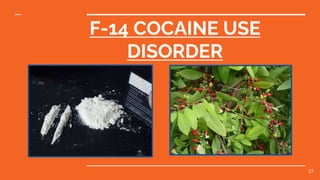
F-14 COCAINE USE
DISORDER
27
Introduction:
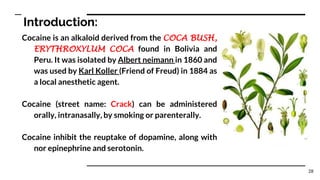
Cocaine is an alkaloid derived from the COCA BUSH,
ERYTHROXYLUM COCA found in Bolivia and
Peru. It was isolated by Albert neimann in 1860 and
was used by Karl Koller (Friend of Freud) in 1884 as
a local anesthetic agent.
Cocaine (street name: Crack) can be administered
orally, intranasally, by smoking or parenterally.
Cocaine inhibit the reuptake of dopamine, along with
nor epinephrine and serotonin.
28
Acute Intoxication:
● It is characterized by pupillary dilatation, tachycardia,
hypertension, sweating, nausea and vomiting,
grandiosity, elation of mood, increased speech.
● Later judgement is impaired and also impairment of
social and occupational functioning .
29
Withdrawal Syndrome:
It produces very mild physical but a strong psychological
dependence.
Complications:
It includes acute anxiety reaction, psychotic episodes,
seizures, respiratory depression, cardiac arrhythmias,
myocardial infarction, lung damage, gastrointestinal
necrosis etc.
30
Treatment :
● Treatment of cocaine overdose:
It consist of oxygenation, muscle relaxants, I/V thiopentone, I/V
Diazepam, I/V Propranolol, Haloperidol etc. these all must be
administered very carefully by an expert specialist.
● Treatment of chronic cocaine use:
1. Treatment includes use of Bromocriptine and Amantadine for
reducing cocaine craving.
2. Desipramine, Imipramine & Trazodone for total abstinence from
cocaine use.
3. Psychological management techniques such as supportive
psychotherapy, contingent behavior therapy are useful.
31
F-15 AMPHETAMINE
USE DISORDER
32
Introduction:
● Amphetamine refers to a unique chemical which is basically phenyl-
iso- propylamine or methylphenethylamine.
● It is powerful CNS stimulant. It acts primarily on nor-epinephrine
release in brain along with an action on the release of dopamine and
serotonin.
● Its street name is “ECSTASY or XTC”
33
Intoxication and Complication:
● Intoxication symptoms are tachycardia, hypertension,
haemorrhage, cardiac failure, seizures, hyperpyrexia, tremors,
ataxia, euphoria, tetany and coma etc.
● Chronic amphetamine intoxication leads to severe and compulsive
craving for the drug, tactile hallucination, in clear consciousness,
may sometimes occur in chronic amphetamine intoxication.
34
Treatment:
● Acute Intoxication is treated by symptomatic measures
e.g: Hyperpyrexia ( Cold sponging, Antipyretics), Seizures
(Diazepam), Psychotic symptoms (Antipsychotics), Hypertension
(Antihypertensives)
35
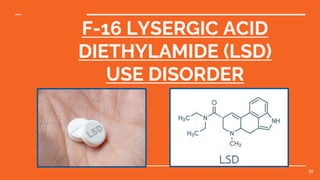
F-16 LYSERGIC ACID
DIETHYLAMIDE (LSD)
USE DISORDER
36
Lysergic acid diethylamide, first synthesized by Albert Hoffman in
1938 and popularly known as “ACID” is a powerful Hallucinogen.
Treatment:
● Treatment of acute LSD Intoxication consist of symptomatic
management with anti-anxiety, anti-depressants or antipsychotic
medication along with supportive psychotherapy.
37
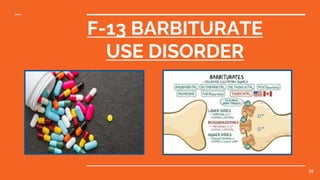
F-13 BARBITURATE
USE DISORDER
38
Introduction:
● Barbiturate have been used as SEDATIVES, HYPNOTICS,
ANTICONVULSANTS, ANAESTHETICS AND TRANSQUILIZERS.
● The Commonly abused barbiturates are Secobarbital, Pentobarbital
and Amobarbital.
39
Intoxication and Complication:
● It is characterized by Irritability, Increased Productivity of speech,
Lability of mood, Slurring of speech, in coordination attention and
memory impairment and ataxia.
Withdrawal symptoms:
● Barbiturates withdrawal syndrome can be very severe. It usually
occurs in individual who are taking more than 600-800—mg/day of
secobarbital for more than 1 months.
● Restlessness, tremors, hypertension, seizures, delirium tremens,
coma and even death.
40
Treatment :
● Pentobarbital substitution therapy for treatment of
withdrawal from short-acting barbiturates, after
detoxification regular follow up to prevent relapse.
41
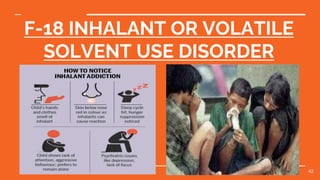
F-18 INHALANT OR VOLATILE
SOLVENT USE DISORDER
42
Introduction:
● Commonly used volatile solvents include GASOLINE (Petrol),
GLUES, AEROSOLS (spray paints), THINNERS, VARNISH REMOVER
and INDUSTRIAL SOLVENTS.
● The active ingredient usually include toulene, benzene, acetone and
halogenated hydrocarbons.
43
Intoxication and Complications:
● It leads to euphoria, excitement, belligerence, dizziness, slurring of
speech, apathy, impaired judgment, death can occur.
● Complication include irreversible damage to liver and kidney,
peripheral neuropathy, perceptual disturbances and brain damage.
Treatment:
● There is no specific treatment of inhalant use disorder there is often
an associated psychiatric disorder (usually schizophrenia or
personality disorder)
44
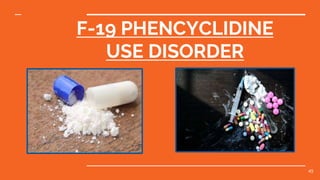
F-19 PHENCYCLIDINE
USE DISORDER
45
Introduction:
● PCP was introduced as a dissociative anaesthetic agent in 1950.
● Street name is “PEACE PILL, ANGEL DUST, LOVE BOAT, OZONE,
ROCKET FUEL, SUPER GRASS”
● PCP is selectively antagonises the neural action of NDMA (N-
Methyl-D- Aspartate)
46
Intoxication and Complication:
● It produces euphoria, dysphoria, impulsiveness, agitation, impaired
social judgment, feeling of numbness, inability to move, delirium,
stupor, hallucination, ataxia etc.
Withdrawal:
● No clear-cut withdrawal syndrome has been described, craving,
social withdrawal, anxiety, depression and impairment in cognitive
function
47
Treatment:
● Treatment of PCP Intoxication is symptomatic and usually involves
Gastric lavage, Isolation and use of anti-convulsants and anti-
psychotic.
● There is no specific treatment for Phencyclidine withdrawal
syndrome.
48
Assignment :
Write nursing management of patient including
nursing process of substance use disorder
49
50

Unit 9 substance use disorder

  • 1.
  • 2.
    TERMINOLOGIES: 1. Substance 2. Addiction 3.Abuse 4. Dependence 5. Tolerance 6. Withdrawal state 2
  • 3.
    F10 - F19Mental and behavioral disorders due to psychoactive substance use Overview of this block F10. – Mental and behavioral disorders due to use of alcohol F11. – Mental and behavioral disorders due to use of opioids F12. – Mental and behavioral disorders due to use of cannabinoids F13. – Mental and behavioral disorders due to use of sedative hypnotics F14. – Mental and behavioral disorders due to use of cocaine F15. – Mental and behavioral disorders due to use of other stimulants, including caffeine F16. – Mental and behavioral disorders due to use of hallucinogens F17. – Mental and behavioral disorders due to use of tobacco F18. – Mental and behavioral disorders due to use of volatile solvents F19. – Mental and behavioral disorders due to multiple drug use and use of other 3
  • 4.
    ETIOLOGY: 1) Biological Factors 2)Psychological Factors 3) Social Factors 4
  • 5.
  • 6.
    E. Mortan Jellineck ●On the basis of pattern of use there are 5 “Species” of alcohol dependence 1) ALPHA 2) BETA 3) GAMMA 4) DELTA 5) EPSILON 6
  • 7.
    Claude Robert Cloninger: ●Classified alcoholism into 2 types: 1) TYPE-I 2) TYPE-II 7
  • 8.
    LABORATORY MARKERS: 1. Gamma-Glutyl-Transferase(GGT) 2. Mean Corpuscular Volume (MCV) 3. Alkaline Phosphatase, AST, ALT, URIC ACID, Blood triglycerides & CK. 4. Blood Alcohol Concentration (BAC) 5. Breath Analyzer Screening Test: 1. MAST (Michigan Alcoholism Screening Test) 2. CAGE Questionnaire (Cut, Annoyed, Guilty, Eye Opener) 8
  • 9.
    Acute Intoxication  Aftera brief period of excitation, there is generalized CNS depression, with increasing intoxication, there is increased reaction time, slowed thinking, distractibility and poor motor control, later dysarthria, ataxia and incoordination can occur  Signs of Intoxication with blood levels of 150-200mg%.  Death occur with Blood alcohol level 400 to 800mg% 9
  • 10.
    Withdrawal Syndrome 1) Hangoveron the next morning 2) Mild tremors, nausea, vomiting, weakness 3) Irritability, Insomnia and Anxiety Severe withdrawal syndrome may be more severe characterized by one of the following three disturbances: 1) Delirium Tremens 2) Alcoholic seizures 3) Alcoholic Hallucinosis 10
  • 11.
    Complication of AlcoholDependence: I. Medical complications a. Gastrointestinal System b. Central Nervous system c. Miscellaneous II. Social Complications  Accidents  Marital Disharmony  Divorce  Occupational problems  Criminality  Financial difficulties “BAC” : 30mg/100 ml in India (Section 185 of the Motor Vehicle Act, 1988) 80mg/100ml legal limit for driving in UK >400 mg/100ml Death may occur 11
  • 12.
    Treatment : ● Beforestarting the treatment , it is important to follow the steps: 1) Ruling out any physical disorder 2) Ruling out any psychiatric disorder 3) Assessment of motivation for treatment 4) Assessment of social support system 5) Assessment of personality characteristics of the patient 6) Assessment of current and past social, interpersonal & occupational functioning. 12
  • 13.
    Treatment broadly dividedinto 2 categories: 1) Detoxification: It is treatment of alcohol withdrawal symptoms i.e symptoms produced by the removal of the ‘toxin’. Benzodiazepines (Chlordiazepoxide (80-200 mg/day) and diazepam (40-80mg/day). 2) Treatment of Alcohol Dependence: After the steps of detoxification is over, for further management some of the important method include: ● Behavior therapy ● Psychotherapy ● Group therapy ● Deterrent agents( Alcohol Sensitizing Drugs) 13
  • 14.
    Disulfiram (Tetra ethylthiuram Disulfide): ● It is discovered in 1930’s, it develop unpleasant reactions to alcohol intake to develop DER (Disulfiram- ethanol reaction). ○ Flushing ○ Tachycardia ○ Hypotension ○ Tachypnoea ○ Palpitation ○ Headache, sweating, nausea ○ Vomiting, severe anxiety Usual dose of Disulfiram is 250-500mg/day Other Deterrent Agents like Citrated calcium carbimide, Metronidazole, Animal Charcoal, Anticraving agents 14
  • 15.
  • 16.
    Opioid Use Disorder: Driedexudate obtained from unripe seed capsules of “ PAPAVER SOMNIFERUM” A. Natural Alkaloids of opium • Morphine • Codeine • Thebaine • Noscapine • Papaverine B. Synthetic compounds • Heroin • Nalorphine • Hydromorphone • Methadone • Dextroproproxyphene • Meperidine • Diphenoxylate 16
  • 17.
    India is surroundedon both sides by the infamous routes of Illicit transport 17
  • 18.
    ● Heroin ordi-acetyl-morphine is about 2 times more potent than morphine in injectable form. ● Heroin can be smoked or chased “chasing the dragon”, impure form called “Smack” or “Brown Sugar” in India. 18
  • 19.
    Acute Intoxication: ● Itis characterized by apathy, bradycardia, hypotension, respiratory depression, fever, delayed reflexes, coma may occur in case of large overdose. Withdrawal Syndrome: ● Onset of symptoms occurs within 12-24 hours, peak within 24-72 hours and symptoms usually subside within 7-10 days. - lacrimation - rhinorrhoea - pupillary dilation - sweating - diarrhoea - yawning 19
  • 20.
    Complications: 1. Complications dueto illicit drug (contaminants): - Parkinsonism, degeneration of globus pallidum, peripheral neuropathy, amblyopia. 2. Complication due to intravenous use: - AIDS, Skin infection, thrombophlebitis, pulmonary embolism, viral hepatitis, tetatnus, endocarditis 3. Drug pedding and involvement in criminal activities (social complication) 20
  • 21.
    Treatment: ● Before treatmenta correct diagnosis must be made on the basis of history, examination and lab test these are: 1. Naloxone challenge test 2. Urinary Opioids testing: RIA, FRAT, TLC, GLC, HPLC Treatment can be divided into three main types: 1. Treatment of overdose (Naloxone, Naltrexone) 2. Detoxification (Methadone, Clonidine, Naltrexone, Levo-Alpha-Acetyl- Methadol LAAM) 3. Maintenance therapy (Psychotherapy, Behavior therapy, interpersonal therapy, CBT, Family therapy, group therapy etc) 21
  • 22.
  • 23.
    Introduction: Cannabis is derivedfrom the hemp plant “CANNABIS SATIVA”. It has several names according to region e.g Sativa Indica in India & Pakistan and Americana in America. Its street name is: Grass, Hash or Hashish, Marijuana Cannabis produces very mild physical dependence with a relatively mild withdrawal syndrome, characterized by fine tremors, irritability, restlessness, nervousness, insomnia, increase appetite and craving. 23
  • 24.
    Acute Intoxication: ● Characterizedby mild impairment of consciousness & orientation ● Light headedness, tachycardia, sense of floating in the air ● Euphoric dream like state, increase or decrease psychomotor activity ● Perceptual disturbance are common and include depersonalization, derealisation and increased sensitivity to sound. 24
  • 25.
    Complications: The complication ofcannabis include: 1) Transient or Short-lasting Psychiatric Disorders: Acute anxiety, Paranoid Psychosis, Hysterical Fugue-like state, Suicidal ideation, Hypomania, Delusions and Hallucination. 2) Amotivational Syndrome: Lethargy, Apathy, Loss of Interest, Anergia, Reduce drive and Lack of Ambition. 3) “Hemp Insanity” or Cannabis Psychosis (Disorientation and Confusion) 4) Other Complication: Memory impairment, COPD, Pulmonary Malignancies, Decreased Testosterone levels. 25
  • 26.
    Treatment : Its withdrawalsyndrome is usually very mild, management consist of supportive and symptomatic treatment.  Psychotherapy and Psycho education are very important in this dependence 26
  • 27.
  • 28.
    Introduction: Cocaine is analkaloid derived from the COCA BUSH, ERYTHROXYLUM COCA found in Bolivia and Peru. It was isolated by Albert neimann in 1860 and was used by Karl Koller (Friend of Freud) in 1884 as a local anesthetic agent. Cocaine (street name: Crack) can be administered orally, intranasally, by smoking or parenterally. Cocaine inhibit the reuptake of dopamine, along with nor epinephrine and serotonin. 28
  • 29.
    Acute Intoxication: ● Itis characterized by pupillary dilatation, tachycardia, hypertension, sweating, nausea and vomiting, grandiosity, elation of mood, increased speech. ● Later judgement is impaired and also impairment of social and occupational functioning . 29
  • 30.
    Withdrawal Syndrome: It producesvery mild physical but a strong psychological dependence. Complications: It includes acute anxiety reaction, psychotic episodes, seizures, respiratory depression, cardiac arrhythmias, myocardial infarction, lung damage, gastrointestinal necrosis etc. 30
  • 31.
    Treatment : ● Treatmentof cocaine overdose: It consist of oxygenation, muscle relaxants, I/V thiopentone, I/V Diazepam, I/V Propranolol, Haloperidol etc. these all must be administered very carefully by an expert specialist. ● Treatment of chronic cocaine use: 1. Treatment includes use of Bromocriptine and Amantadine for reducing cocaine craving. 2. Desipramine, Imipramine & Trazodone for total abstinence from cocaine use. 3. Psychological management techniques such as supportive psychotherapy, contingent behavior therapy are useful. 31
  • 32.
  • 33.
    Introduction: ● Amphetamine refersto a unique chemical which is basically phenyl- iso- propylamine or methylphenethylamine. ● It is powerful CNS stimulant. It acts primarily on nor-epinephrine release in brain along with an action on the release of dopamine and serotonin. ● Its street name is “ECSTASY or XTC” 33
  • 34.
    Intoxication and Complication: ●Intoxication symptoms are tachycardia, hypertension, haemorrhage, cardiac failure, seizures, hyperpyrexia, tremors, ataxia, euphoria, tetany and coma etc. ● Chronic amphetamine intoxication leads to severe and compulsive craving for the drug, tactile hallucination, in clear consciousness, may sometimes occur in chronic amphetamine intoxication. 34
  • 35.
    Treatment: ● Acute Intoxicationis treated by symptomatic measures e.g: Hyperpyrexia ( Cold sponging, Antipyretics), Seizures (Diazepam), Psychotic symptoms (Antipsychotics), Hypertension (Antihypertensives) 35
  • 36.
    F-16 LYSERGIC ACID DIETHYLAMIDE(LSD) USE DISORDER 36
  • 37.
    Lysergic acid diethylamide,first synthesized by Albert Hoffman in 1938 and popularly known as “ACID” is a powerful Hallucinogen. Treatment: ● Treatment of acute LSD Intoxication consist of symptomatic management with anti-anxiety, anti-depressants or antipsychotic medication along with supportive psychotherapy. 37
  • 38.
  • 39.
    Introduction: ● Barbiturate havebeen used as SEDATIVES, HYPNOTICS, ANTICONVULSANTS, ANAESTHETICS AND TRANSQUILIZERS. ● The Commonly abused barbiturates are Secobarbital, Pentobarbital and Amobarbital. 39
  • 40.
    Intoxication and Complication: ●It is characterized by Irritability, Increased Productivity of speech, Lability of mood, Slurring of speech, in coordination attention and memory impairment and ataxia. Withdrawal symptoms: ● Barbiturates withdrawal syndrome can be very severe. It usually occurs in individual who are taking more than 600-800—mg/day of secobarbital for more than 1 months. ● Restlessness, tremors, hypertension, seizures, delirium tremens, coma and even death. 40
  • 41.
    Treatment : ● Pentobarbitalsubstitution therapy for treatment of withdrawal from short-acting barbiturates, after detoxification regular follow up to prevent relapse. 41
  • 42.
    F-18 INHALANT ORVOLATILE SOLVENT USE DISORDER 42
  • 43.
    Introduction: ● Commonly usedvolatile solvents include GASOLINE (Petrol), GLUES, AEROSOLS (spray paints), THINNERS, VARNISH REMOVER and INDUSTRIAL SOLVENTS. ● The active ingredient usually include toulene, benzene, acetone and halogenated hydrocarbons. 43
  • 44.
    Intoxication and Complications: ●It leads to euphoria, excitement, belligerence, dizziness, slurring of speech, apathy, impaired judgment, death can occur. ● Complication include irreversible damage to liver and kidney, peripheral neuropathy, perceptual disturbances and brain damage. Treatment: ● There is no specific treatment of inhalant use disorder there is often an associated psychiatric disorder (usually schizophrenia or personality disorder) 44
  • 45.
  • 46.
    Introduction: ● PCP wasintroduced as a dissociative anaesthetic agent in 1950. ● Street name is “PEACE PILL, ANGEL DUST, LOVE BOAT, OZONE, ROCKET FUEL, SUPER GRASS” ● PCP is selectively antagonises the neural action of NDMA (N- Methyl-D- Aspartate) 46
  • 47.
    Intoxication and Complication: ●It produces euphoria, dysphoria, impulsiveness, agitation, impaired social judgment, feeling of numbness, inability to move, delirium, stupor, hallucination, ataxia etc. Withdrawal: ● No clear-cut withdrawal syndrome has been described, craving, social withdrawal, anxiety, depression and impairment in cognitive function 47
  • 48.
    Treatment: ● Treatment ofPCP Intoxication is symptomatic and usually involves Gastric lavage, Isolation and use of anti-convulsants and anti- psychotic. ● There is no specific treatment for Phencyclidine withdrawal syndrome. 48
  • 49.
    Assignment : Write nursingmanagement of patient including nursing process of substance use disorder 49
  • 50.