Organic brain syndrome
Tai Zu Huang
Teoh Wee Loon
Introduction
• Brain dysfunction caused by organic pathology
inside or outside of the brain
• Can be classified by:
– Global syndromes
• Delirium
• Dementia
– Specific syndromes
• Amnesic syndrome
• Organic mood disorder
• Organic delusional state
• Organic personality disorder
Dementia
DEFINITION:
•An acquired, generalized and usually
progressive impairment of cognitive
functions (ie
memory, recall, orientation, language, abst
raction etc)
•Content being affected but not level of
consciousness
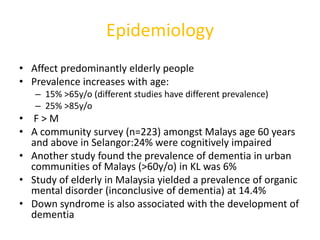
Epidemiology
• Affect predominantly elderly people
• Prevalence increases with age:
– 15% >65y/o (different studies have different prevalence)
– 25% >85y/o
• F > M
• A community survey (n=223) amongst Malays age 60 years
and above in Selangor:24% were cognitively impaired
• Another study found the prevalence of dementia in urban
communities of Malays (>60y/o) in KL was 6%
• Study of elderly in Malaysia yielded a prevalence of organic
mental disorder (inconclusive of dementia) at 14.4%
• Down syndrome is also associated with the development of
dementia
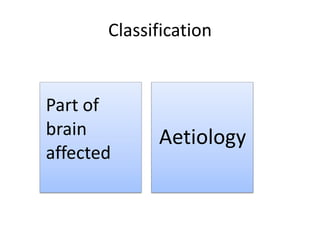
Classification
Part of
brain
affected
Aetiology
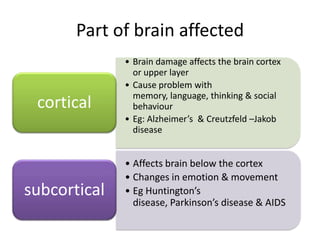
Part of brain affected
• Brain damage affects the brain cortex
or upper layer
• Cause problem with
memory, language, thinking & social
behaviour
• Eg: Alzheimer’s & Creutzfeld –Jakob
disease
cortical
• Affects brain below the cortex
• Changes in emotion & movement
• Eg Huntington’s
disease, Parkinson’s disease & AIDS
subcortical
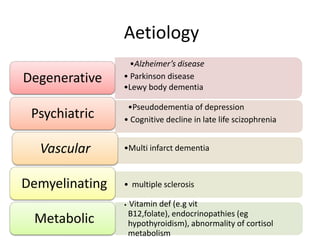
Aetiology
•Alzheimer’s disease
• Parkinson disease
•Lewy body dementia
Degenerative
•Pseudodementia of depression
• Cognitive decline in late life scizophreniaPsychiatric
•Multi infarct dementiaVascular
• multiple sclerosisDemyelinating
• Vitamin def (e.g vit
B12,folate), endocrinopathies (eg
hypothyroidism), abnormality of cortisol
metabolism
Metabolic
Aetiology
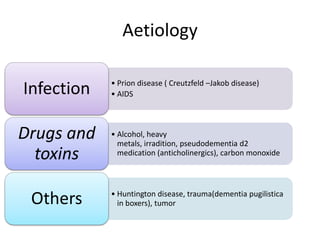
• Prion disease ( Creutzfeld –Jakob disease)
• AIDSInfection
• Alcohol, heavy
metals, irradition, pseudodementia d2
medication (anticholinergics), carbon monoxide
Drugs and
toxins
• Huntington disease, trauma(dementia pugilistica
in boxers), tumorOthers
VITAMIN D VEST
• V – Vitamin Deficiency [B12, folate and
thiamine(Wernicke-korsakoff)]
• I – Intracranial masses (tumour, abscess)
• T – Trauma (head injury, dementia pugilistica)
• A – Anoxia
• M- Metabolic (diabetes)
• I – Infection (HIV, syphilis, Creutzfeldt-Jakod)
• N- Normal pressure hydrocephalus
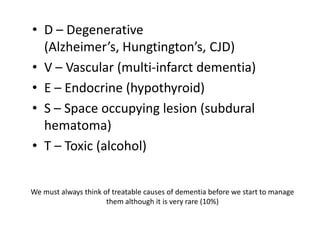
We must always think of treatable causes of dementia before we start to manage
them although it is very rare (10%)
• D – Degenerative
(Alzheimer’s, Hungtington’s, CJD)
• V – Vascular (multi-infarct dementia)
• E – Endocrine (hypothyroid)
• S – Space occupying lesion (subdural
hematoma)
• T – Toxic (alcohol)
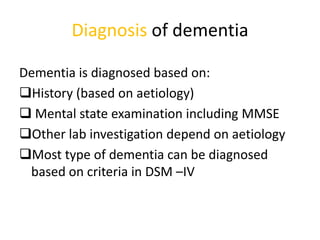
Diagnosis of dementia
Dementia is diagnosed based on:
History (based on aetiology)
 Mental state examination including MMSE
Other lab investigation depend on aetiology
Most type of dementia can be diagnosed
based on criteria in DSM –IV
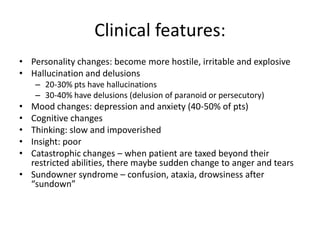
Clinical features:
• Personality changes: become more hostile, irritable and explosive
• Hallucination and delusions
– 20-30% pts have hallucinations
– 30-40% have delusions (delusion of paranoid or persecutory)
• Mood changes: depression and anxiety (40-50% of pts)
• Cognitive changes
• Thinking: slow and impoverished
• Insight: poor
• Catastrophic changes – when patient are taxed beyond their
restricted abilities, there maybe sudden change to anger and tears
• Sundowner syndrome – confusion, ataxia, drowsiness after
“sundown”
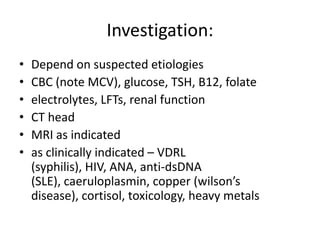
Investigation:
• Depend on suspected etiologies
• CBC (note MCV), glucose, TSH, B12, folate
• electrolytes, LFTs, renal function
• CT head
• MRI as indicated
• as clinically indicated – VDRL
(syphilis), HIV, ANA, anti-dsDNA
(SLE), caeruloplasmin, copper (wilson’s
disease), cortisol, toxicology, heavy metals
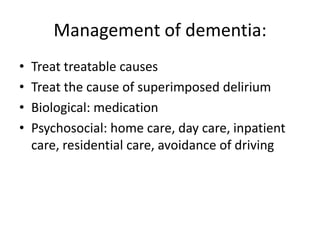
Management of dementia:
• Treat treatable causes
• Treat the cause of superimposed delirium
• Biological: medication
• Psychosocial: home care, day care, inpatient
care, residential care, avoidance of driving
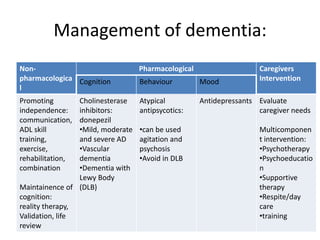
Management of dementia:
Non-
pharmacologica
l
Pharmacological Caregivers
InterventionCognition Behaviour Mood
Promoting
independence:
communication,
ADL skill
training,
exercise,
rehabilitation,
combination
Maintainence of
cognition:
reality therapy,
Validation, life
review
Cholinesterase
inhibitors:
donepezil
•Mild, moderate
and severe AD
•Vascular
dementia
•Dementia with
Lewy Body
(DLB)
Atypical
antipsycotics:
•can be used
agitation and
psychosis
•Avoid in DLB
Antidepressants Evaluate
caregiver needs
Multicomponen
t intervention:
•Psychotherapy
•Psychoeducatio
n
•Supportive
therapy
•Respite/day
care
•training
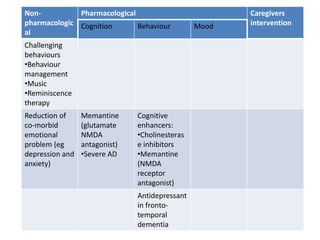
Non-
pharmacologic
al
Pharmacological Caregivers
interventionCognition Behaviour Mood
Challenging
behaviours
•Behaviour
management
•Music
•Reminiscence
therapy
Reduction of
co-morbid
emotional
problem (eg
depression and
anxiety)
Memantine
(glutamate
NMDA
antagonist)
•Severe AD
Cognitive
enhancers:
•Cholinesteras
e inhibitors
•Memantine
(NMDA
receptor
antagonist)
Antidepressant
in fronto-
temporal
dementia
Alzheimer disease
• First described by Alois Alzheimer in 1907
• Although cause remains unknown, progress had been made to try
to understand molecular basic of amyloid deposits
• genetic factors
– a minority (<7%) of AD cases are familial, autosomal dominant
– 3 major genes for autosomal dominant AD have been identified:
• amyloid precursor protein (chromosome 21)
• presenilin 1 (chromosome 14)
• presenilin 2 (chromosome 1)
– the E4 polymorphism of apolipoprotein E is a susceptibility genotype (E2 is
protective
• Biochemical factors
– Neurotransmitter such as Ach and Norepinephrine become hypoactive
– Neuroactive peptides somatostatin and corticotrophin also decreased in concentration
DSM-IV-TR diagnostic criteria for dementia of
Alzheimer’s type
• A. Development of multiple cognitive deficits
manifested by both:
– 1) memory impairment
– 2) ≥1 of the following cognitive disturbances:
• Aphasia
• Apraxia
• Agnosia
• Disturbances in executive functioning
• B. cognitive deficits in criteria A1 and A2 cause
significant impairment in social and occupational
functioning and represent a significant decline from
a previous level of functioning
• C. gradual onset and continuing cognitive decline
• D. not due to any other
– CNS conditions
– Systemic conditions
– Subtance-induced conditions
• E. Deficits do not occur during the course of
delirium
• F. Disturbance is not better accounted by other
Axis-I disorder (MDD, Schizophrenia)
Risk factors
• Aging (elderly people > 65 years of age)
• Female
• Family history
-Defective genes on chromosomes 1,14,21
• Hypothethical risk factor : aluminium toxicity
• Having history of head injury
• Low education level
• Smoking
• Down syndrome (y?)
Pathology
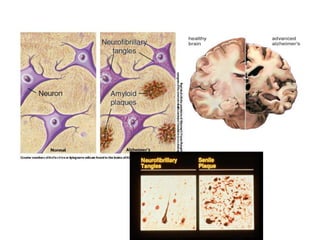
• Macroscopic appearance of brain : diffuse
atrophy, esp frontal, parietal and temporal
lobes, flattened sulci & enlarged cerebral
ventricles
• Microscopic findings : senile plaques (amyloid
plaques – amount indicates
severity), neurofibrillary tangles (composed of
cytoplasmic skeleton, mainly phosphorylated tau
protein), neuronal loss(in cortex &
hippocampus), synaptic loss ( 50 % in cortex) &
granulovascular degeneration of neurons
Course, prognosis & treatment
• Slowly progress memory impairment
• Aphasia, apraxia and agnosia also present
• May later develop motor & gait disturbances;
may become bedridden
• Mean survival is 7 years from onset
• Treatment : cholinesterase inhibitor (eg:
galantamine, rivastigmine, donepezil)
• There is a new case of dementia every 7
seconds in our world
• Alzheimer is the most common cause of
dementia and is not part of aging process
• There are currently no prevention and cure
for it
Vascular dementia
• Caused by blockage of in brain’s blood supply
• Leading to progressive decline in memory &
cognitive functioning
• > ,affects people between the ages of 60 and
75, HTN or CV dss
• Approximately 10-15% have coexisting vascular
dementia and dementia of Alzheimer’s type
• Pathology : a/w multiple infarcts coz by
thromboembolism fr extracranial arteries
arteriosclerosis in main vessels
Vascular dementia
• Clinical features:
-sx are fluctuating & episodes of confusion are common esp at
night
-Neurological signs is common
-in some cases emotional & personality changes may be
apparent b4 impairment of memory & intelect
• Diagnosis, other signs and symptoms are as according to DSM-
IV diagnostic criteria
• Prognosis
-lifespan averages is 4-5 years from time of diagnosis
Delirium
acute generalized impairment of
mental disorder
Hallmark symptoms :impairment
of consiousness, in association with
global impairment of cognitive
functions
Common psychiatric symptoms:
abnormalities of
perception, mood, behaviour
Common neurological symptoms:
tremor, nystagmus, incoordination, ur
inary incontinence, asterixis.
Epidemiology:
• general population: 1.1%
• medically ill patient who are hospitalized: 10-30%
• surgical intensive unit: 30%
• cardiac intensive care unit: 40-50%
• AIDS: 30-40%
Risk factor
• Hospitalization
• Nursing home resident
• Childhood (example: febrile illness)
• Old age especially male
• Severe illnesses like cancer, AIDS
• Pre-existing cognitive impairment or brain pahtology
• Recent anesthesia
• Substance abuse
Etiology:
• Common pathway to any brain insult.
• Is thought to involve dysfunction of the reticular
formation & acetylcholine transmission.
• Reticular formation→attention & arousal
• Study shown decrease in acetylcholinergic activity
• Other neurotransmitter: serotonin & glutamate
INTRACRANIAL CAUSES
• Epilepsy and postictal states
• Brain trauma (especially concussion)
• Infections
• Meningitis
• Encephalitis
• Neoplasms
• Vascular disorders
EXTRACRANIAL CAUSES
• Drugs (ingestion or withdrawal) and poisons
(Anticholinergic, anticonvulsants, antihypertensives, antiparki
nsonians, antipsychotics, cardiac
glycosides, insulin, opiates, sedatives and
hypnotics, steroids, alcohol)
• Endocrine dysfunction (hypofunction or hyperfunction)
(Pituitary, Pancreas, Adrenal, Parathyroid, Thyroid)
• Diseases of nonendocrine organs
(Hepatic encephalopathy, Uremic encephalopathy, Carbon
dioxide narcosis, Hypoxia, Cardiac
failure, Arrhythmias, Hypotension )
• Deficiency diseases
(Thiamine, nicotinic acid, B12, or folic acid deficiencies)
• Systemic infections with fever and sepsis
• Electrolyte imbalance of any cause
• Postoperative states
(postoperative pain, insomnia, pain medication, electrolyte
imbalance, infection, fever, blood loss)
• Trauma (head or general body)
Impaired delivery (of brain substrate eg. vascular
insufficiency due to stroke)
Metabolic
Drugs
Endocrinopathy
Liver disease
Infrastructure (structural disease of cortical
neurons)
Renal failure
Infection
Oxygen
Urinary tract infection
Sensory deprivation
CLINICAL FEATURES OF DELIRIUM
• Impairment of consciousness – disorientation & poor
concentration, fluctuating course & often worse in the evening.
• Behavior – overactive or underactive, sleep is often disturbed.
• Thinking – slow, muddled, ideas of reference & delusions are
transient and poorly elaborated.
• Mood – anxious, irritable or depressed, often labile.
• Perception – is distorted, misinterpretations of
illusions, hallucination (mainly visual). Tactile and auditory
hallucination can occur but less frequent.
• Memory – impaired.
• Insight – impaired
Diagnosis
• DSM-IV diagnostic criteria for delirium due to a general
medical condition
A. Disturbance of consciousness (i.e. reduced clarity of awareness
of the environment) with reduced ability to focus, sustain or shift
attention.
B. A change in cognition (such as memory
deficit, disorientation, language disturbance) or the development
of perceptual disturbance that is not better accounted for by a
preexisting, established or evolving dementia.
C. The disturbance develop over a short period of time (usually
hours to days) & tends to fluctuate during the course of the day.
D. There is evidence from the history, PE or laboratory findings
that the disturbance is caused by the direct physiologic
consequences of a general medical condition.
Course & prognosis
• Onset usually sudden.
• Symptoms persist as long as the causative factors are
present, although delirium generally lasts less than a
week.
• After removal of the causative factors, the symptoms
of delirium usually recede over a 3- to 7-day
period, although some symptoms may take up to 2
weeks to resolve completely.
• The older a patient and the longer the patient has been
delirious, the longer the delirium takes to resolve.
Differential diagnosis:
• Dementia
• Schizophrenia & mania
– No rapidly fluctuating course, do not impair the level of
consciousness or significantly impair cognition
• Acute amnesic syndrome
• Depression
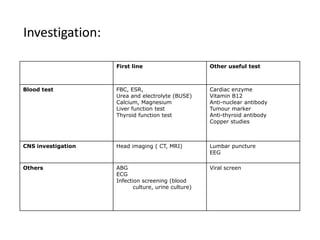
Investigation:
First line Other useful test
Blood test FBC, ESR,
Urea and electrolyte (BUSE)
Calcium, Magnesium
Liver function test
Thyroid function test
Cardiac enzyme
Vitamin B12
Anti-nuclear antibody
Tumour marker
Anti-thyroid antibody
Copper studies
CNS investigation Head imaging ( CT, MRI) Lumbar puncture
EEG
Others ABG
ECG
Infection screening (blood
culture, urine culture)
Viral screen
Amnesic syndrome
Characterized by a prominent disorder of recent memory
in the absence of generalized intellectual impairment
(dementia) or impaired of consciousness (delirium)
Clinical features:
• Recent memory severely impaired
• Remote memory spared
• Disorientation in time
• Confabulation
• Other cognitive function preserved
Organic Brain syndrome
Korsakoff syndrome
• Amnesic syndrome accompany with acute neurological
symptoms caused by neuronal damage that results from
thiamine deficiency in association with chronic alcohol
abuse.
• It usually is preceded by an episode of Wernicke
encephalitis (eg, ataxia, confusion, oculomotor palsy),
typically precipitated by administration of glucose to a
malnourished alcoholic without concomitant parenteral
thiamine.
• Confabulation is a hallmark finding of Korsakoff
syndrome (also called Korsakoff psychosis).
• Treatment: IV thiamine
Organic Brain syndrome
Organic personality disorder
• Frontal lobe damage
• Clinical features:
- behaviour is disinhibited
- overfamiliar
- overtalkative
- inappropriate jokes
- euphoria
- concentration and attention will be reduced
- insight impaired
Organic Brain syndrome
Head injury
major head injury has both immediate and long-term
neuropsychiatric consequences.
Acute psycholoqical effects of head injury:
• Impairment of consciousness
• Delirium
• Post-traumatic amnesia: transient amnesia with retrograde
(events prior to injury) and anterograde (events following
injury) features.
Long-term consequences:
• Personality changes
• Emotional symptoms
Organic Brain syndrome
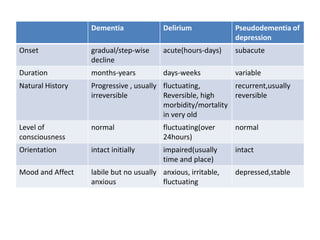
Dementia Delirium Pseudodementia of
depression
Onset gradual/step-wise
decline
acute(hours-days) subacute
Duration months-years days-weeks variable
Natural History Progressive , usually
irreversible
fluctuating,
Reversible, high
morbidity/mortality
in very old
recurrent,usually
reversible
Level of
consciousness
normal fluctuating(over
24hours)
normal
Orientation intact initially impaired(usually
time and place)
intact
Mood and Affect labile but no usually
anxious
anxious, irritable,
fluctuating
depressed,stable
Thank you!

Organic brain syndrome

  • 1.
    Organic brain syndrome TaiZu Huang Teoh Wee Loon
  • 2.
    Introduction • Brain dysfunctioncaused by organic pathology inside or outside of the brain • Can be classified by: – Global syndromes • Delirium • Dementia – Specific syndromes • Amnesic syndrome • Organic mood disorder • Organic delusional state • Organic personality disorder
  • 3.
    Dementia DEFINITION: •An acquired, generalizedand usually progressive impairment of cognitive functions (ie memory, recall, orientation, language, abst raction etc) •Content being affected but not level of consciousness
  • 4.
    Epidemiology • Affect predominantlyelderly people • Prevalence increases with age: – 15% >65y/o (different studies have different prevalence) – 25% >85y/o • F > M • A community survey (n=223) amongst Malays age 60 years and above in Selangor:24% were cognitively impaired • Another study found the prevalence of dementia in urban communities of Malays (>60y/o) in KL was 6% • Study of elderly in Malaysia yielded a prevalence of organic mental disorder (inconclusive of dementia) at 14.4% • Down syndrome is also associated with the development of dementia
  • 5.
  • 6.
    Part of brainaffected • Brain damage affects the brain cortex or upper layer • Cause problem with memory, language, thinking & social behaviour • Eg: Alzheimer’s & Creutzfeld –Jakob disease cortical • Affects brain below the cortex • Changes in emotion & movement • Eg Huntington’s disease, Parkinson’s disease & AIDS subcortical
  • 7.
    Aetiology •Alzheimer’s disease • Parkinsondisease •Lewy body dementia Degenerative •Pseudodementia of depression • Cognitive decline in late life scizophreniaPsychiatric •Multi infarct dementiaVascular • multiple sclerosisDemyelinating • Vitamin def (e.g vit B12,folate), endocrinopathies (eg hypothyroidism), abnormality of cortisol metabolism Metabolic
  • 8.
    Aetiology • Prion disease( Creutzfeld –Jakob disease) • AIDSInfection • Alcohol, heavy metals, irradition, pseudodementia d2 medication (anticholinergics), carbon monoxide Drugs and toxins • Huntington disease, trauma(dementia pugilistica in boxers), tumorOthers
  • 9.
    VITAMIN D VEST •V – Vitamin Deficiency [B12, folate and thiamine(Wernicke-korsakoff)] • I – Intracranial masses (tumour, abscess) • T – Trauma (head injury, dementia pugilistica) • A – Anoxia • M- Metabolic (diabetes) • I – Infection (HIV, syphilis, Creutzfeldt-Jakod) • N- Normal pressure hydrocephalus
  • 10.
    We must alwaysthink of treatable causes of dementia before we start to manage them although it is very rare (10%) • D – Degenerative (Alzheimer’s, Hungtington’s, CJD) • V – Vascular (multi-infarct dementia) • E – Endocrine (hypothyroid) • S – Space occupying lesion (subdural hematoma) • T – Toxic (alcohol)
  • 11.
    Diagnosis of dementia Dementiais diagnosed based on: History (based on aetiology)  Mental state examination including MMSE Other lab investigation depend on aetiology Most type of dementia can be diagnosed based on criteria in DSM –IV
  • 12.
    Clinical features: • Personalitychanges: become more hostile, irritable and explosive • Hallucination and delusions – 20-30% pts have hallucinations – 30-40% have delusions (delusion of paranoid or persecutory) • Mood changes: depression and anxiety (40-50% of pts) • Cognitive changes • Thinking: slow and impoverished • Insight: poor • Catastrophic changes – when patient are taxed beyond their restricted abilities, there maybe sudden change to anger and tears • Sundowner syndrome – confusion, ataxia, drowsiness after “sundown”
  • 13.
    Investigation: • Depend onsuspected etiologies • CBC (note MCV), glucose, TSH, B12, folate • electrolytes, LFTs, renal function • CT head • MRI as indicated • as clinically indicated – VDRL (syphilis), HIV, ANA, anti-dsDNA (SLE), caeruloplasmin, copper (wilson’s disease), cortisol, toxicology, heavy metals
  • 14.
    Management of dementia: •Treat treatable causes • Treat the cause of superimposed delirium • Biological: medication • Psychosocial: home care, day care, inpatient care, residential care, avoidance of driving
  • 15.
    Management of dementia: Non- pharmacologica l PharmacologicalCaregivers InterventionCognition Behaviour Mood Promoting independence: communication, ADL skill training, exercise, rehabilitation, combination Maintainence of cognition: reality therapy, Validation, life review Cholinesterase inhibitors: donepezil •Mild, moderate and severe AD •Vascular dementia •Dementia with Lewy Body (DLB) Atypical antipsycotics: •can be used agitation and psychosis •Avoid in DLB Antidepressants Evaluate caregiver needs Multicomponen t intervention: •Psychotherapy •Psychoeducatio n •Supportive therapy •Respite/day care •training
  • 16.
    Non- pharmacologic al Pharmacological Caregivers interventionCognition BehaviourMood Challenging behaviours •Behaviour management •Music •Reminiscence therapy Reduction of co-morbid emotional problem (eg depression and anxiety) Memantine (glutamate NMDA antagonist) •Severe AD Cognitive enhancers: •Cholinesteras e inhibitors •Memantine (NMDA receptor antagonist) Antidepressant in fronto- temporal dementia
  • 17.
    Alzheimer disease • Firstdescribed by Alois Alzheimer in 1907 • Although cause remains unknown, progress had been made to try to understand molecular basic of amyloid deposits • genetic factors – a minority (<7%) of AD cases are familial, autosomal dominant – 3 major genes for autosomal dominant AD have been identified: • amyloid precursor protein (chromosome 21) • presenilin 1 (chromosome 14) • presenilin 2 (chromosome 1) – the E4 polymorphism of apolipoprotein E is a susceptibility genotype (E2 is protective • Biochemical factors – Neurotransmitter such as Ach and Norepinephrine become hypoactive – Neuroactive peptides somatostatin and corticotrophin also decreased in concentration
  • 18.
    DSM-IV-TR diagnostic criteriafor dementia of Alzheimer’s type • A. Development of multiple cognitive deficits manifested by both: – 1) memory impairment – 2) ≥1 of the following cognitive disturbances: • Aphasia • Apraxia • Agnosia • Disturbances in executive functioning
  • 19.
    • B. cognitivedeficits in criteria A1 and A2 cause significant impairment in social and occupational functioning and represent a significant decline from a previous level of functioning • C. gradual onset and continuing cognitive decline • D. not due to any other – CNS conditions – Systemic conditions – Subtance-induced conditions • E. Deficits do not occur during the course of delirium • F. Disturbance is not better accounted by other Axis-I disorder (MDD, Schizophrenia)
  • 20.
    Risk factors • Aging(elderly people > 65 years of age) • Female • Family history -Defective genes on chromosomes 1,14,21 • Hypothethical risk factor : aluminium toxicity • Having history of head injury • Low education level • Smoking • Down syndrome (y?)
  • 21.
    Pathology • Macroscopic appearanceof brain : diffuse atrophy, esp frontal, parietal and temporal lobes, flattened sulci & enlarged cerebral ventricles • Microscopic findings : senile plaques (amyloid plaques – amount indicates severity), neurofibrillary tangles (composed of cytoplasmic skeleton, mainly phosphorylated tau protein), neuronal loss(in cortex & hippocampus), synaptic loss ( 50 % in cortex) & granulovascular degeneration of neurons
  • 23.
    Course, prognosis &treatment • Slowly progress memory impairment • Aphasia, apraxia and agnosia also present • May later develop motor & gait disturbances; may become bedridden • Mean survival is 7 years from onset • Treatment : cholinesterase inhibitor (eg: galantamine, rivastigmine, donepezil)
  • 24.
    • There isa new case of dementia every 7 seconds in our world • Alzheimer is the most common cause of dementia and is not part of aging process • There are currently no prevention and cure for it
  • 25.
    Vascular dementia • Causedby blockage of in brain’s blood supply • Leading to progressive decline in memory & cognitive functioning • > ,affects people between the ages of 60 and 75, HTN or CV dss • Approximately 10-15% have coexisting vascular dementia and dementia of Alzheimer’s type • Pathology : a/w multiple infarcts coz by thromboembolism fr extracranial arteries arteriosclerosis in main vessels
  • 26.
    Vascular dementia • Clinicalfeatures: -sx are fluctuating & episodes of confusion are common esp at night -Neurological signs is common -in some cases emotional & personality changes may be apparent b4 impairment of memory & intelect • Diagnosis, other signs and symptoms are as according to DSM- IV diagnostic criteria • Prognosis -lifespan averages is 4-5 years from time of diagnosis
  • 27.
    Delirium acute generalized impairmentof mental disorder Hallmark symptoms :impairment of consiousness, in association with global impairment of cognitive functions Common psychiatric symptoms: abnormalities of perception, mood, behaviour Common neurological symptoms: tremor, nystagmus, incoordination, ur inary incontinence, asterixis.
  • 28.
    Epidemiology: • general population:1.1% • medically ill patient who are hospitalized: 10-30% • surgical intensive unit: 30% • cardiac intensive care unit: 40-50% • AIDS: 30-40%
  • 29.
    Risk factor • Hospitalization •Nursing home resident • Childhood (example: febrile illness) • Old age especially male • Severe illnesses like cancer, AIDS • Pre-existing cognitive impairment or brain pahtology • Recent anesthesia • Substance abuse
  • 30.
    Etiology: • Common pathwayto any brain insult. • Is thought to involve dysfunction of the reticular formation & acetylcholine transmission. • Reticular formation→attention & arousal • Study shown decrease in acetylcholinergic activity • Other neurotransmitter: serotonin & glutamate
  • 31.
    INTRACRANIAL CAUSES • Epilepsyand postictal states • Brain trauma (especially concussion) • Infections • Meningitis • Encephalitis • Neoplasms • Vascular disorders
  • 32.
    EXTRACRANIAL CAUSES • Drugs(ingestion or withdrawal) and poisons (Anticholinergic, anticonvulsants, antihypertensives, antiparki nsonians, antipsychotics, cardiac glycosides, insulin, opiates, sedatives and hypnotics, steroids, alcohol) • Endocrine dysfunction (hypofunction or hyperfunction) (Pituitary, Pancreas, Adrenal, Parathyroid, Thyroid) • Diseases of nonendocrine organs (Hepatic encephalopathy, Uremic encephalopathy, Carbon dioxide narcosis, Hypoxia, Cardiac failure, Arrhythmias, Hypotension )
  • 33.
    • Deficiency diseases (Thiamine,nicotinic acid, B12, or folic acid deficiencies) • Systemic infections with fever and sepsis • Electrolyte imbalance of any cause • Postoperative states (postoperative pain, insomnia, pain medication, electrolyte imbalance, infection, fever, blood loss) • Trauma (head or general body)
  • 34.
    Impaired delivery (ofbrain substrate eg. vascular insufficiency due to stroke) Metabolic Drugs Endocrinopathy Liver disease Infrastructure (structural disease of cortical neurons) Renal failure Infection Oxygen Urinary tract infection Sensory deprivation
  • 35.
    CLINICAL FEATURES OFDELIRIUM • Impairment of consciousness – disorientation & poor concentration, fluctuating course & often worse in the evening. • Behavior – overactive or underactive, sleep is often disturbed. • Thinking – slow, muddled, ideas of reference & delusions are transient and poorly elaborated. • Mood – anxious, irritable or depressed, often labile. • Perception – is distorted, misinterpretations of illusions, hallucination (mainly visual). Tactile and auditory hallucination can occur but less frequent. • Memory – impaired. • Insight – impaired
  • 36.
    Diagnosis • DSM-IV diagnosticcriteria for delirium due to a general medical condition A. Disturbance of consciousness (i.e. reduced clarity of awareness of the environment) with reduced ability to focus, sustain or shift attention. B. A change in cognition (such as memory deficit, disorientation, language disturbance) or the development of perceptual disturbance that is not better accounted for by a preexisting, established or evolving dementia. C. The disturbance develop over a short period of time (usually hours to days) & tends to fluctuate during the course of the day. D. There is evidence from the history, PE or laboratory findings that the disturbance is caused by the direct physiologic consequences of a general medical condition.
  • 37.
    Course & prognosis •Onset usually sudden. • Symptoms persist as long as the causative factors are present, although delirium generally lasts less than a week. • After removal of the causative factors, the symptoms of delirium usually recede over a 3- to 7-day period, although some symptoms may take up to 2 weeks to resolve completely. • The older a patient and the longer the patient has been delirious, the longer the delirium takes to resolve.
  • 38.
    Differential diagnosis: • Dementia •Schizophrenia & mania – No rapidly fluctuating course, do not impair the level of consciousness or significantly impair cognition • Acute amnesic syndrome • Depression
  • 39.
    Investigation: First line Otheruseful test Blood test FBC, ESR, Urea and electrolyte (BUSE) Calcium, Magnesium Liver function test Thyroid function test Cardiac enzyme Vitamin B12 Anti-nuclear antibody Tumour marker Anti-thyroid antibody Copper studies CNS investigation Head imaging ( CT, MRI) Lumbar puncture EEG Others ABG ECG Infection screening (blood culture, urine culture) Viral screen
  • 41.
    Amnesic syndrome Characterized bya prominent disorder of recent memory in the absence of generalized intellectual impairment (dementia) or impaired of consciousness (delirium) Clinical features: • Recent memory severely impaired • Remote memory spared • Disorientation in time • Confabulation • Other cognitive function preserved Organic Brain syndrome
  • 42.
    Korsakoff syndrome • Amnesicsyndrome accompany with acute neurological symptoms caused by neuronal damage that results from thiamine deficiency in association with chronic alcohol abuse. • It usually is preceded by an episode of Wernicke encephalitis (eg, ataxia, confusion, oculomotor palsy), typically precipitated by administration of glucose to a malnourished alcoholic without concomitant parenteral thiamine. • Confabulation is a hallmark finding of Korsakoff syndrome (also called Korsakoff psychosis). • Treatment: IV thiamine Organic Brain syndrome
  • 43.
    Organic personality disorder •Frontal lobe damage • Clinical features: - behaviour is disinhibited - overfamiliar - overtalkative - inappropriate jokes - euphoria - concentration and attention will be reduced - insight impaired Organic Brain syndrome
  • 44.
    Head injury major headinjury has both immediate and long-term neuropsychiatric consequences. Acute psycholoqical effects of head injury: • Impairment of consciousness • Delirium • Post-traumatic amnesia: transient amnesia with retrograde (events prior to injury) and anterograde (events following injury) features. Long-term consequences: • Personality changes • Emotional symptoms Organic Brain syndrome
  • 45.
    Dementia Delirium Pseudodementiaof depression Onset gradual/step-wise decline acute(hours-days) subacute Duration months-years days-weeks variable Natural History Progressive , usually irreversible fluctuating, Reversible, high morbidity/mortality in very old recurrent,usually reversible Level of consciousness normal fluctuating(over 24hours) normal Orientation intact initially impaired(usually time and place) intact Mood and Affect labile but no usually anxious anxious, irritable, fluctuating depressed,stable
  • 46.