Protein Metabolism
Protein Digestion
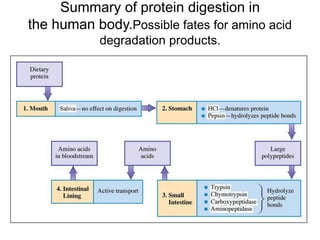
Protein breakdown begins in the stomach.
No protein hydrolyzing enzymes are found in saliva.
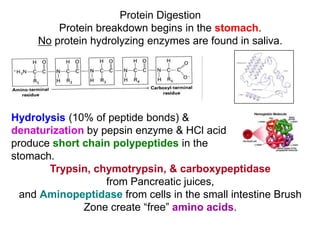
Hydrolysis (10% of peptide bonds) &
denaturization by pepsin enzyme & HCl acid
produce short chain polypeptides in the
stomach.
Trypsin, chymotrypsin, & carboxypeptidase
from Pancreatic juices,
and Aminopeptidase from cells in the small intestine Brush
Zone create “free” amino acids.
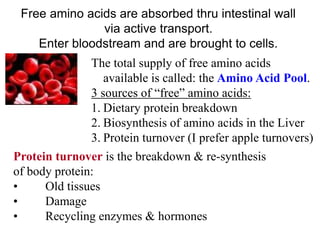
Free amino acids are absorbed thru intestinal wall
via active transport.
Enter bloodstream and are brought to cells.
The total supply of free amino acids
available is called: the Amino Acid Pool.
3 sources of “free” amino acids:
1. Dietary protein breakdown
2. Biosynthesis of amino acids in the Liver
3. Protein turnover (I prefer apple turnovers)
Protein turnover is the breakdown & re-synthesis
of body protein:
• Old tissues
• Damage
• Recycling enzymes & hormones
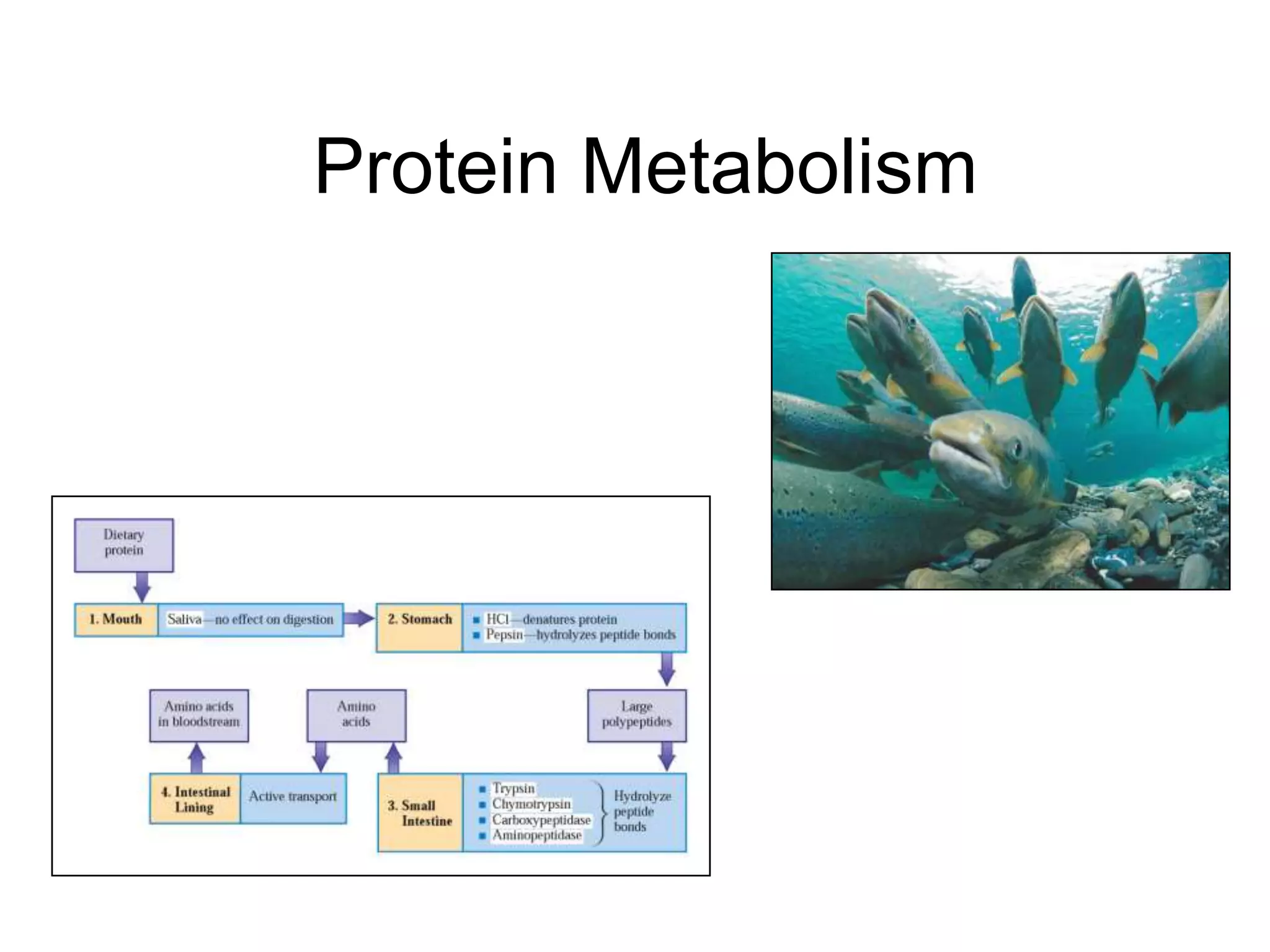
Summary of protein digestion in
the human body.Possible fates for amino acid
degradation products.
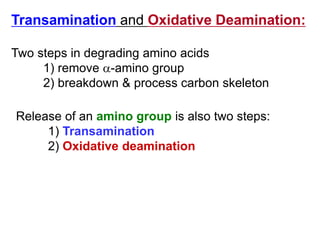
Transamination and Oxidative Deamination:
Two steps in degrading amino acids
1) remove -amino group
2) breakdown & process carbon skeleton
Release of an amino group is also two steps:
1) Transamination
2) Oxidative deamination
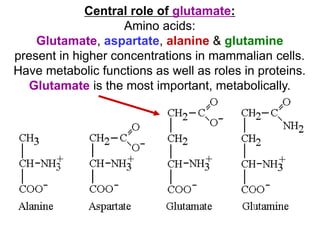
Central role of glutamate:
Amino acids:
Glutamate, aspartate, alanine & glutamine
present in higher concentrations in mammalian cells.
Have metabolic functions as well as roles in proteins.
Glutamate is the most important, metabolically.
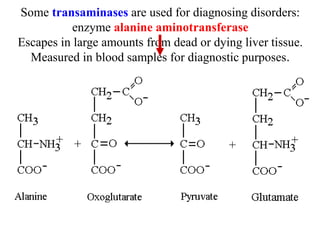
Some transaminases are used for diagnosing disorders:
enzyme alanine aminotransferase
Escapes in large amounts from dead or dying liver tissue.
Measured in blood samples for diagnostic purposes.
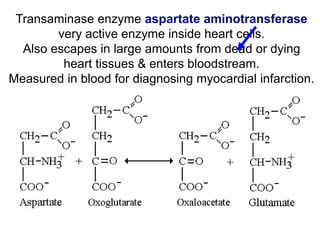
Transaminase enzyme aspartate aminotransferase
very active enzyme inside heart cells.
Also escapes in large amounts from dead or dying
heart tissues & enters bloodstream.
Measured in blood for diagnosing myocardial infarction.
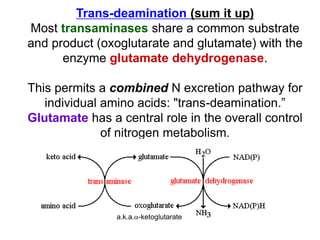
Trans-deamination (sum it up)
Most transaminases share a common substrate
and product (oxoglutarate and glutamate) with the
enzyme glutamate dehydrogenase.
This permits a combined N excretion pathway for
individual amino acids: "trans-deamination.”
Glutamate has a central role in the overall control
of nitrogen metabolism.
a.k.a.-ketoglutarate
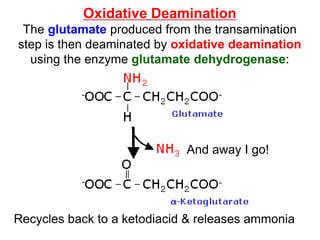
Oxidative Deamination
The glutamate produced from the transamination
step is then deaminated by oxidative deamination
using the enzyme glutamate dehydrogenase:
And away I go!
Recycles back to a ketodiacid & releases ammonia
Glutamate dehydrogenase [GluDH]
will reversibly convert
glutamate to -ketoglutarate
and -ketoglutarate to glutamate.
Deamination
reaction
uses NAD+
reverse reaction
uses NADPH
Uses both NAD+ and NADPH – how to regulate it?
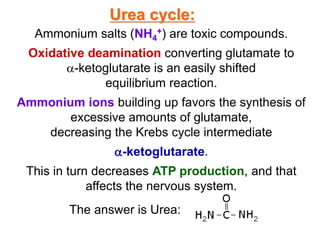
Urea cycle:
Ammonium salts (NH4
+) are toxic compounds.
Oxidative deamination converting glutamate to
-ketoglutarate is an easily shifted
equilibrium reaction.
Ammonium ions building up favors the synthesis of
excessive amounts of glutamate,
decreasing the Krebs cycle intermediate
-ketoglutarate.
This in turn decreases ATP production, and that
affects the nervous system.
The answer is Urea:
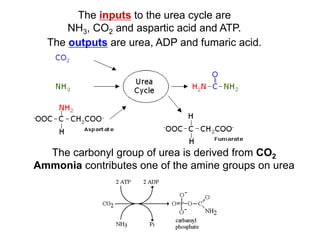
The inputs to the urea cycle are
NH3, CO2 and aspartic acid and ATP.
The outputs are urea, ADP and fumaric acid.
The carbonyl group of urea is derived from CO2
Ammonia contributes one of the amine groups on urea
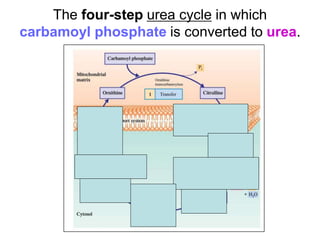
The four-step urea cycle in which
carbamoyl phosphate is converted to urea.
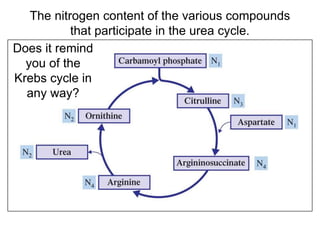
The nitrogen content of the various compounds
that participate in the urea cycle.
Does it remind
you of the
Krebs cycle in
any way?
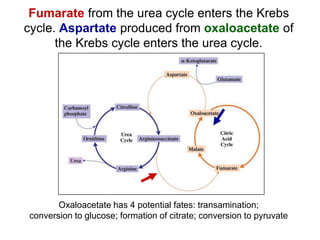
Fumarate from the urea cycle enters the Krebs
cycle. Aspartate produced from oxaloacetate of
the Krebs cycle enters the urea cycle.
Oxaloacetate has 4 potential fates: transamination;
conversion to glucose; formation of citrate; conversion to pyruvate
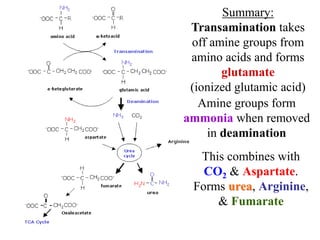
Summary:
Transamination takes
off amine groups from
amino acids and forms
glutamate
(ionized glutamic acid)
Amine groups form
ammonia when removed
in deamination
This combines with
CO2 & Aspartate.
Forms urea, Arginine,
& Fumarate
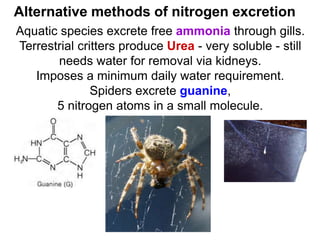
Alternative methods of nitrogen excretion
Aquatic species excrete free ammonia through gills.
Terrestrial critters produce Urea - very soluble - still
needs water for removal via kidneys.
Imposes a minimum daily water requirement.
Spiders excrete guanine,
5 nitrogen atoms in a small molecule.
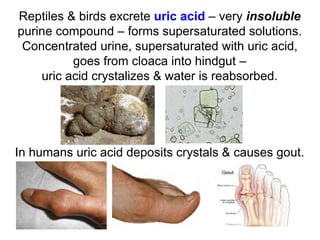
Reptiles & birds excrete uric acid – very insoluble
purine compound – forms supersaturated solutions.
Concentrated urine, supersaturated with uric acid,
goes from cloaca into hindgut –
uric acid crystalizes & water is reabsorbed.
In humans uric acid deposits crystals & causes gout.
Processing Amino Acid Carbon Skeletons
Transamination or Oxidative deamination both
produce -keto acids
Degradation of these carbon skeletons may take several
different pathways:
Amino acid C skeletons that degrade to form a Krebs
cycle intermediate can then be used to make glucose
via gluconeogenesis.
These are called Glucogenic Amino Acids.
Amino acid C skeletons that degrade to form
acetyl CoA or Acetoacetyl CoA
can form fatty acids or ketone bodies.
These are called Ketogenic Amino Acids.
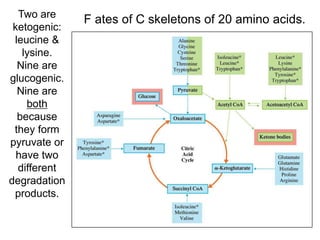
F ates of C skeletons of 20 amino acids.
Two are
ketogenic:
leucine &
lysine.
Nine are
glucogenic.
Nine are
both
because
they form
pyruvate or
have two
different
degradation
products.
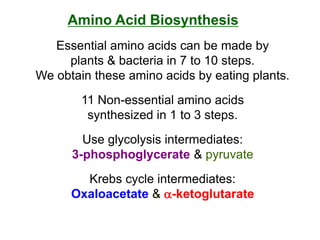
Amino Acid Biosynthesis
Essential amino acids can be made by
plants & bacteria in 7 to 10 steps.
We obtain these amino acids by eating plants.
11 Non-essential amino acids
synthesized in 1 to 3 steps.
Use glycolysis intermediates:
3-phosphoglycerate & pyruvate
Krebs cycle intermediates:
Oxaloacetate & -ketoglutarate
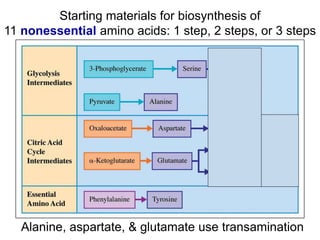
Starting materials for biosynthesis of
11 nonessential amino acids: 1 step, 2 steps, or 3 steps
Alanine, aspartate, & glutamate use transamination
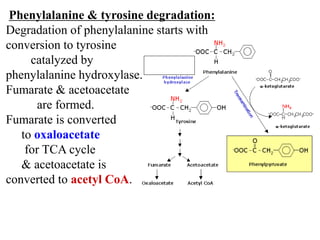
Phenylalanine & tyrosine degradation:
Degradation of phenylalanine starts with
conversion to tyrosine
catalyzed by
phenylalanine hydroxylase.
Fumarate & acetoacetate
are formed.
Fumarate is converted
to oxaloacetate
for TCA cycle
& acetoacetate is
converted to acetyl CoA.
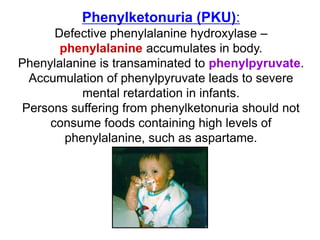
Phenylketonuria (PKU):
Defective phenylalanine hydroxylase –
phenylalanine accumulates in body.
Phenylalanine is transaminated to phenylpyruvate.
Accumulation of phenylpyruvate leads to severe
mental retardation in infants.
Persons suffering from phenylketonuria should not
consume foods containing high levels of
phenylalanine, such as aspartame.
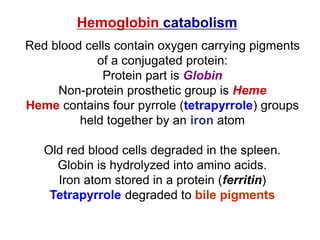
Hemoglobin catabolism
Red blood cells contain oxygen carrying pigments
of a conjugated protein:
Protein part is Globin
Non-protein prosthetic group is Heme
Heme contains four pyrrole (tetrapyrrole) groups
held together by an iron atom
Old red blood cells degraded in the spleen.
Globin is hydrolyzed into amino acids.
Iron atom stored in a protein (ferritin)
Tetrapyrrole degraded to bile pigments
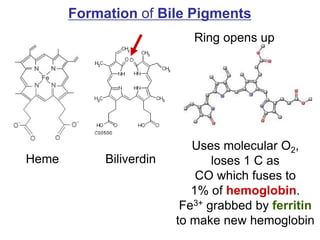
Formation of Bile Pigments
Heme Biliverdin
Uses molecular O2,
loses 1 C as
CO which fuses to
1% of hemoglobin.
Fe3+ grabbed by ferritin
to make new hemoglobin
Ring opens up
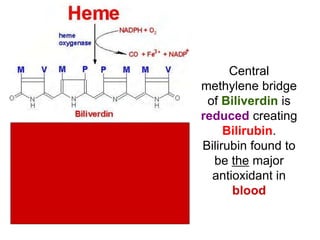
Central
methylene bridge
of Biliverdin is
reduced creating
Bilirubin.
Bilirubin found to
be the major
antioxidant in
blood
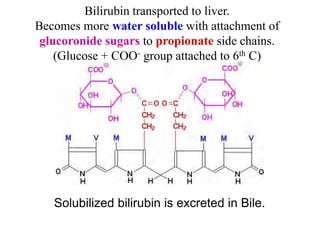
Bilirubin transported to liver.
Becomes more water soluble with attachment of
glucoronide sugars to propionate side chains.
(Glucose + COO- group attached to 6th C)
Solubilized bilirubin is excreted in Bile.
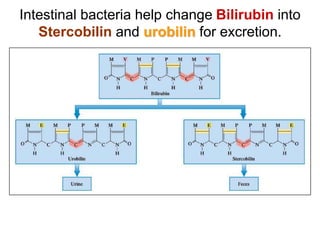
Intestinal bacteria help change Bilirubin into
Stercobilin and urobilin for excretion.
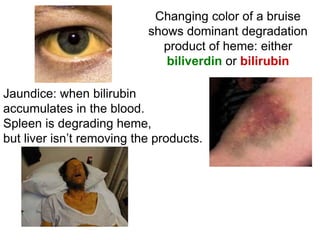
Jaundice: when bilirubin
accumulates in the blood.
Spleen is degrading heme,
but liver isn’t removing the products.
Changing color of a bruise
shows dominant degradation
product of heme: either
biliverdin or bilirubin
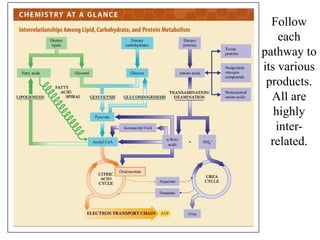
Follow
each
pathway to
its various
products.
All are
highly
inter-
related.
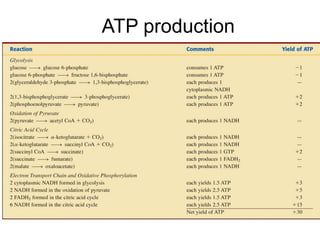
ATP production
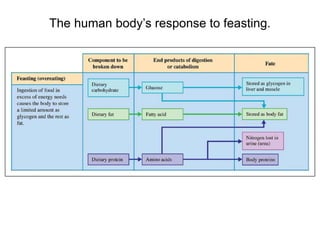
The human body’s response to feasting.
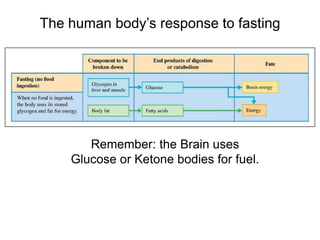
The human body’s response to fasting
Remember: the Brain uses
Glucose or Ketone bodies for fuel.
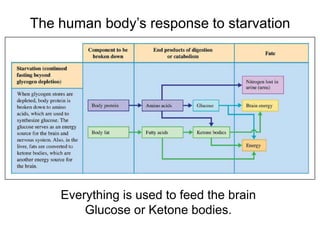
The human body’s response to starvation
Everything is used to feed the brain
Glucose or Ketone bodies.
Review: can you…
• Describe the steps in Protein digestion & absorption
• Explain how Amino Acids are utilized in the body
• Explain Transamination and Oxidative De-amination
• Describe The Urea Cycle – purpose and steps
• Describe how a.a. Carbon Skeletons are processed
• Define and explain Amino Acid Biosynthesis.
• Describe the chemical composition of urine.
• Explain the relationship and importance of Arginine,
Citrulline, and Nitric Oxide.
• Give a detailed description of Hemoglobin Catabolism
• Give an overview of the interrelationships among
Carbohydrate, Lipid, and Protein Metabolic Pathways.

Protein Metabolism .ppt

  • 1.
  • 2.
    Protein Digestion Protein breakdownbegins in the stomach. No protein hydrolyzing enzymes are found in saliva. Hydrolysis (10% of peptide bonds) & denaturization by pepsin enzyme & HCl acid produce short chain polypeptides in the stomach. Trypsin, chymotrypsin, & carboxypeptidase from Pancreatic juices, and Aminopeptidase from cells in the small intestine Brush Zone create “free” amino acids.
  • 3.
    Free amino acidsare absorbed thru intestinal wall via active transport. Enter bloodstream and are brought to cells. The total supply of free amino acids available is called: the Amino Acid Pool. 3 sources of “free” amino acids: 1. Dietary protein breakdown 2. Biosynthesis of amino acids in the Liver 3. Protein turnover (I prefer apple turnovers) Protein turnover is the breakdown & re-synthesis of body protein: • Old tissues • Damage • Recycling enzymes & hormones
  • 4.
    Summary of proteindigestion in the human body.Possible fates for amino acid degradation products.
  • 5.
    Transamination and OxidativeDeamination: Two steps in degrading amino acids 1) remove -amino group 2) breakdown & process carbon skeleton Release of an amino group is also two steps: 1) Transamination 2) Oxidative deamination
  • 6.
    Central role ofglutamate: Amino acids: Glutamate, aspartate, alanine & glutamine present in higher concentrations in mammalian cells. Have metabolic functions as well as roles in proteins. Glutamate is the most important, metabolically.
  • 7.
    Some transaminases areused for diagnosing disorders: enzyme alanine aminotransferase Escapes in large amounts from dead or dying liver tissue. Measured in blood samples for diagnostic purposes.
  • 8.
    Transaminase enzyme aspartateaminotransferase very active enzyme inside heart cells. Also escapes in large amounts from dead or dying heart tissues & enters bloodstream. Measured in blood for diagnosing myocardial infarction.
  • 9.
    Trans-deamination (sum itup) Most transaminases share a common substrate and product (oxoglutarate and glutamate) with the enzyme glutamate dehydrogenase. This permits a combined N excretion pathway for individual amino acids: "trans-deamination.” Glutamate has a central role in the overall control of nitrogen metabolism. a.k.a.-ketoglutarate
  • 10.
    Oxidative Deamination The glutamateproduced from the transamination step is then deaminated by oxidative deamination using the enzyme glutamate dehydrogenase: And away I go! Recycles back to a ketodiacid & releases ammonia
  • 11.
    Glutamate dehydrogenase [GluDH] willreversibly convert glutamate to -ketoglutarate and -ketoglutarate to glutamate. Deamination reaction uses NAD+ reverse reaction uses NADPH Uses both NAD+ and NADPH – how to regulate it?
  • 12.
    Urea cycle: Ammonium salts(NH4 +) are toxic compounds. Oxidative deamination converting glutamate to -ketoglutarate is an easily shifted equilibrium reaction. Ammonium ions building up favors the synthesis of excessive amounts of glutamate, decreasing the Krebs cycle intermediate -ketoglutarate. This in turn decreases ATP production, and that affects the nervous system. The answer is Urea:
  • 13.
    The inputs tothe urea cycle are NH3, CO2 and aspartic acid and ATP. The outputs are urea, ADP and fumaric acid. The carbonyl group of urea is derived from CO2 Ammonia contributes one of the amine groups on urea
  • 14.
    The four-step ureacycle in which carbamoyl phosphate is converted to urea.
  • 15.
    The nitrogen contentof the various compounds that participate in the urea cycle. Does it remind you of the Krebs cycle in any way?
  • 16.
    Fumarate from theurea cycle enters the Krebs cycle. Aspartate produced from oxaloacetate of the Krebs cycle enters the urea cycle. Oxaloacetate has 4 potential fates: transamination; conversion to glucose; formation of citrate; conversion to pyruvate
  • 17.
    Summary: Transamination takes off aminegroups from amino acids and forms glutamate (ionized glutamic acid) Amine groups form ammonia when removed in deamination This combines with CO2 & Aspartate. Forms urea, Arginine, & Fumarate
  • 18.
    Alternative methods ofnitrogen excretion Aquatic species excrete free ammonia through gills. Terrestrial critters produce Urea - very soluble - still needs water for removal via kidneys. Imposes a minimum daily water requirement. Spiders excrete guanine, 5 nitrogen atoms in a small molecule.
  • 19.
    Reptiles & birdsexcrete uric acid – very insoluble purine compound – forms supersaturated solutions. Concentrated urine, supersaturated with uric acid, goes from cloaca into hindgut – uric acid crystalizes & water is reabsorbed. In humans uric acid deposits crystals & causes gout.
  • 20.
    Processing Amino AcidCarbon Skeletons Transamination or Oxidative deamination both produce -keto acids Degradation of these carbon skeletons may take several different pathways: Amino acid C skeletons that degrade to form a Krebs cycle intermediate can then be used to make glucose via gluconeogenesis. These are called Glucogenic Amino Acids. Amino acid C skeletons that degrade to form acetyl CoA or Acetoacetyl CoA can form fatty acids or ketone bodies. These are called Ketogenic Amino Acids.
  • 21.
    F ates ofC skeletons of 20 amino acids. Two are ketogenic: leucine & lysine. Nine are glucogenic. Nine are both because they form pyruvate or have two different degradation products.
  • 22.
    Amino Acid Biosynthesis Essentialamino acids can be made by plants & bacteria in 7 to 10 steps. We obtain these amino acids by eating plants. 11 Non-essential amino acids synthesized in 1 to 3 steps. Use glycolysis intermediates: 3-phosphoglycerate & pyruvate Krebs cycle intermediates: Oxaloacetate & -ketoglutarate
  • 23.
    Starting materials forbiosynthesis of 11 nonessential amino acids: 1 step, 2 steps, or 3 steps Alanine, aspartate, & glutamate use transamination
  • 24.
    Phenylalanine & tyrosinedegradation: Degradation of phenylalanine starts with conversion to tyrosine catalyzed by phenylalanine hydroxylase. Fumarate & acetoacetate are formed. Fumarate is converted to oxaloacetate for TCA cycle & acetoacetate is converted to acetyl CoA.
  • 25.
    Phenylketonuria (PKU): Defective phenylalaninehydroxylase – phenylalanine accumulates in body. Phenylalanine is transaminated to phenylpyruvate. Accumulation of phenylpyruvate leads to severe mental retardation in infants. Persons suffering from phenylketonuria should not consume foods containing high levels of phenylalanine, such as aspartame.
  • 26.
    Hemoglobin catabolism Red bloodcells contain oxygen carrying pigments of a conjugated protein: Protein part is Globin Non-protein prosthetic group is Heme Heme contains four pyrrole (tetrapyrrole) groups held together by an iron atom Old red blood cells degraded in the spleen. Globin is hydrolyzed into amino acids. Iron atom stored in a protein (ferritin) Tetrapyrrole degraded to bile pigments
  • 27.
    Formation of BilePigments Heme Biliverdin Uses molecular O2, loses 1 C as CO which fuses to 1% of hemoglobin. Fe3+ grabbed by ferritin to make new hemoglobin Ring opens up
  • 28.
    Central methylene bridge of Biliverdinis reduced creating Bilirubin. Bilirubin found to be the major antioxidant in blood
  • 29.
    Bilirubin transported toliver. Becomes more water soluble with attachment of glucoronide sugars to propionate side chains. (Glucose + COO- group attached to 6th C) Solubilized bilirubin is excreted in Bile.
  • 30.
    Intestinal bacteria helpchange Bilirubin into Stercobilin and urobilin for excretion.
  • 31.
    Jaundice: when bilirubin accumulatesin the blood. Spleen is degrading heme, but liver isn’t removing the products. Changing color of a bruise shows dominant degradation product of heme: either biliverdin or bilirubin
  • 32.
  • 33.
  • 34.
    The human body’sresponse to feasting.
  • 35.
    The human body’sresponse to fasting Remember: the Brain uses Glucose or Ketone bodies for fuel.
  • 36.
    The human body’sresponse to starvation Everything is used to feed the brain Glucose or Ketone bodies.
  • 37.
    Review: can you… •Describe the steps in Protein digestion & absorption • Explain how Amino Acids are utilized in the body • Explain Transamination and Oxidative De-amination • Describe The Urea Cycle – purpose and steps • Describe how a.a. Carbon Skeletons are processed • Define and explain Amino Acid Biosynthesis. • Describe the chemical composition of urine. • Explain the relationship and importance of Arginine, Citrulline, and Nitric Oxide. • Give a detailed description of Hemoglobin Catabolism • Give an overview of the interrelationships among Carbohydrate, Lipid, and Protein Metabolic Pathways.