By :- NK
Goals
General introduction to Nutrients
Definition
Types
Carbohydrates
Proteins
Fats
Minerals
Vitamins
Water
Nutrient deficiency
Definition
Nutrients which are basically considered as organic materials in foods, help in
nourishing the body.
Chemical substances obtained from food and used in the body to provide
energy, to support growth, maintenance and reoair of the body’s tissues.
They may also reduce the risks of some degenerative diseases.
Essential nutrient is a nutrient that the body cannot sunthesize on its own oer
not to an adequate amount & must be provided by the diet. They are necessary
for the body to function properly.
Types
Macronutrients constitute the bulk of the diet & are needed in large quantities
& supply energy as well as essential nutrients needed for growth maintenance.
& activity. It includes – carbohydrates, proteins, fats & water.
Micronutrients are essential to the body in small quantities. It includes –
minerals and vitamins.
Carbohydrates
The main energy source for the brain.
Without carbohydrates, the body cannot function properly.
Made of carbon, hydrogen & oxygen and are a major source of fuel for the body.
Dietary sources :- fruits, breads and grains, starchy vegetables, legumes and
sugars.
Proteins
The major structural component of cells and are responsible for the building
and repair of body tissues.
Broken down into amino acids, which are building blocks of protein. 9 of the 20
amino acids, essential amino acids, must be provided in the diet as they cannot
be synthesized in the body.
120-35% of daily calories should come from lean protein sources such as low-fat
meat, diary, beans or eggs. Plant sources – grains, legumes.
Fats
The concentrated source of energy. They are the energy sources that whe
consumed, increases the absorption of fat-soluble vitamins A,D, E, K
20-35% pf daily intake should come from fat.
Healthy options like omega-3-rich foods like fish, walnuts and vegetable-
based oils, which help with development and growth, should be taken.
Limit intake of saturated fats such as high-fat meats and full-fat diary.
Vitamins
A group of organic substances required in trace amounts for the normal metabolic
functions, growth & maintenance of the body.
Are not energy source but play important roles in extracting energy from these
nutrients.
Work together to get their jobs done, so a deficiency of just one can cause profound
health problems.
Water soluble vitamins - Vitamin B (B1, B2, B3, B5, B6, B7, B9, B12) & vitamin C.
Fat soluble vitamins – Vitamin A, D, E & K
Sources – fruits, vegetables, grains, legumes, dairy products, meats & even fats.
Minerals
Inorganic elements which plays significant roles in ur body.
They are often grouped as major minerals & trace minerals, based on the
amount needed in the diet and the amount present in the body.
Major minerals – 7, sodium, potassoium, calcium, magnesium, chloride,
Sulphur and phosphorous.
Trace minerals – 9, iron, zinc, iodine, manganese, fluoride, chromium, copper,
molybdenum & selenium.
Sources – both plant and animal foods.
Water
An essential part of our body and constitutes to about 45-75% of a person’s
bpdy weight.
Helps to maintain homeostasis in the body and transports nutrients to celld.
Carries food through our digestive system, transports nutrients to the cells and
tissues and carries waste out of the body.
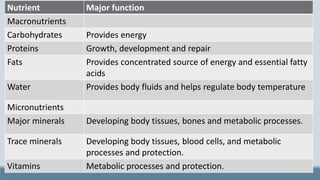
Nutrient Major function
Macronutrients
Carbohydrates Provides energy
Proteins Growth, development and repair
Fats Provides concentrated source of energy and essential fatty
acids
Water Provides body fluids and helps regulate body temperature
Micronutrients
Major minerals Developing body tissues, bones and metabolic processes.
Trace minerals Developing body tissues, blood cells, and metabolic
processes and protection.
Vitamins Metabolic processes and protection.
Nutritional deficiencies
Known as malnutrition, are the result of our body
not getting enough of the nutrients it needs.
Children are more at risk for serious
complications than adults.
Causes
Inadequate ingestion
Inadequate absorption
Inadequate utilization
Increased excretion
Increased requirement
Increased destruction
Thank you
for
attention!

NUTRIENTS - A quick introduction

  • 1.
  • 2.
    Goals General introduction toNutrients Definition Types Carbohydrates Proteins Fats Minerals Vitamins Water Nutrient deficiency
  • 3.
    Definition Nutrients which arebasically considered as organic materials in foods, help in nourishing the body. Chemical substances obtained from food and used in the body to provide energy, to support growth, maintenance and reoair of the body’s tissues. They may also reduce the risks of some degenerative diseases. Essential nutrient is a nutrient that the body cannot sunthesize on its own oer not to an adequate amount & must be provided by the diet. They are necessary for the body to function properly.
  • 4.
    Types Macronutrients constitute thebulk of the diet & are needed in large quantities & supply energy as well as essential nutrients needed for growth maintenance. & activity. It includes – carbohydrates, proteins, fats & water. Micronutrients are essential to the body in small quantities. It includes – minerals and vitamins.
  • 5.
    Carbohydrates The main energysource for the brain. Without carbohydrates, the body cannot function properly. Made of carbon, hydrogen & oxygen and are a major source of fuel for the body. Dietary sources :- fruits, breads and grains, starchy vegetables, legumes and sugars.
  • 6.
    Proteins The major structuralcomponent of cells and are responsible for the building and repair of body tissues. Broken down into amino acids, which are building blocks of protein. 9 of the 20 amino acids, essential amino acids, must be provided in the diet as they cannot be synthesized in the body. 120-35% of daily calories should come from lean protein sources such as low-fat meat, diary, beans or eggs. Plant sources – grains, legumes.
  • 7.
    Fats The concentrated sourceof energy. They are the energy sources that whe consumed, increases the absorption of fat-soluble vitamins A,D, E, K 20-35% pf daily intake should come from fat. Healthy options like omega-3-rich foods like fish, walnuts and vegetable- based oils, which help with development and growth, should be taken. Limit intake of saturated fats such as high-fat meats and full-fat diary.
  • 8.
    Vitamins A group oforganic substances required in trace amounts for the normal metabolic functions, growth & maintenance of the body. Are not energy source but play important roles in extracting energy from these nutrients. Work together to get their jobs done, so a deficiency of just one can cause profound health problems. Water soluble vitamins - Vitamin B (B1, B2, B3, B5, B6, B7, B9, B12) & vitamin C. Fat soluble vitamins – Vitamin A, D, E & K Sources – fruits, vegetables, grains, legumes, dairy products, meats & even fats.
  • 9.
    Minerals Inorganic elements whichplays significant roles in ur body. They are often grouped as major minerals & trace minerals, based on the amount needed in the diet and the amount present in the body. Major minerals – 7, sodium, potassoium, calcium, magnesium, chloride, Sulphur and phosphorous. Trace minerals – 9, iron, zinc, iodine, manganese, fluoride, chromium, copper, molybdenum & selenium. Sources – both plant and animal foods.
  • 10.
    Water An essential partof our body and constitutes to about 45-75% of a person’s bpdy weight. Helps to maintain homeostasis in the body and transports nutrients to celld. Carries food through our digestive system, transports nutrients to the cells and tissues and carries waste out of the body.
  • 11.
    Nutrient Major function Macronutrients CarbohydratesProvides energy Proteins Growth, development and repair Fats Provides concentrated source of energy and essential fatty acids Water Provides body fluids and helps regulate body temperature Micronutrients Major minerals Developing body tissues, bones and metabolic processes. Trace minerals Developing body tissues, blood cells, and metabolic processes and protection. Vitamins Metabolic processes and protection.
  • 12.
    Nutritional deficiencies Known asmalnutrition, are the result of our body not getting enough of the nutrients it needs. Children are more at risk for serious complications than adults.
  • 13.
    Causes Inadequate ingestion Inadequate absorption Inadequateutilization Increased excretion Increased requirement Increased destruction
  • 14.