Mitochondrial DNA
Inheritance: A Journey into
the Heart of Our Cells
Heena V Mehta
Seminar Presentation
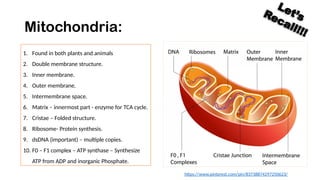
Mitochondria:
1. Found in both plants and animals
2. Double membrane structure.
3. Inner membrane.
4. Outer membrane.
5. Intermembrane space.
6. Matrix – innermost part - enzyme for TCA cycle.
7. Cristae – Folded structure.
8. Ribosome- Protein synthesis.
9. dsDNA (important) – multiple copies.
10. F0 – F1 complex – ATP synthase – Synthesize
ATP from ADP and inorganic Phosphate.
Let’s
Recall!!!
https://www.pinterest.com/pin/83738874297250623/
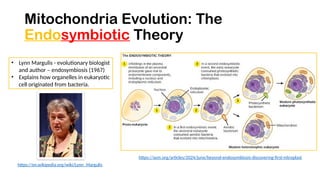
Mitochondria Evolution: The
Endosymbiotic Theory
• Lynn Margulis - evolutionary biologist
and author – endosymbiosis (1967)
• Explains how organelles in eukaryotic
cell originated from bacteria.
https://asm.org/articles/2024/june/beyond-endosymbiosis-discovering-first-nitroplast
https://en.wikipedia.org/wiki/Lynn_Margulis
Need proof!!!!
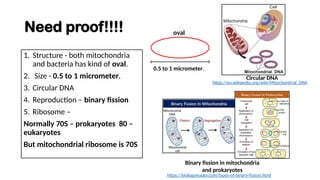
1. Structure - both mitochondria
and bacteria has kind of oval.
2. Size - 0.5 to 1 micrometer.
3. Circular DNA
4. Reproduction – binary fission
5. Ribosome –
Normally 70S – prokaryotes 80 –
eukaryotes
But mitochondrial ribosome is 70S
0.5 to 1 micrometer.
oval
Circular DNA
Binary fission in mitochondria
and prokaryotes
https://biologyreader.com/types-of-binary-fission.html
https://en.wikipedia.org/wiki/Mitochondrial_DNA
Mitochondrial DNA:
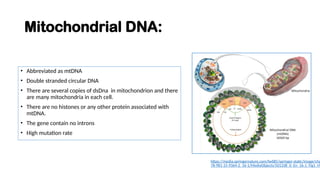
• Abbreviated as mtDNA
• Double stranded circular DNA
• There are several copies of dsDna in mitochondrion and there
are many mitochondria in each cell.
• There are no histones or any other protein associated with
mtDNA.
• The gene contain no introns
• High mutation rate
https://media.springernature.com/lw685/springer-static/image/chp
78-981-15-9364-2_16-1/MediaObjects/501338_0_En_16-1_Fig1_HT
Mitochondrial DNA
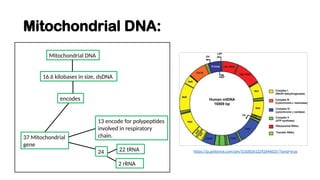
16.6 kilobases in size, dsDNA
encodes
37 Mitochondrial
gene
13 encode for polypeptides
involved in respiratory
chain.
24 22 tRNA
2 rRNA
Mitochondrial DNA:
https://jp.pinterest.com/pin/531002612292646025/?send=true
Mitochondrial DNA Inheritance:
Maternal or Paternal????
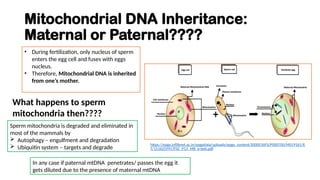
• During fertilization, only nucleus of sperm
enters the egg cell and fuses with eggs
nucleus.
• Therefore, Mitochondrial DNA is inherited
from one’s mother.
In any case if paternal mtDNA penetrates/ passes the egg it
gets diluted due to the presence of maternal mtDNA
Sperm mitochondria is degraded and eliminated in
most of the mammals by
 Autophagy – engulfment and degradation
 Ubiquitin system – targets and degrade
What happens to sperm
mitochondria then????
https://epgp.inflibnet.ac.in/epgpdata/uploads/epgp_content/S000016FS/P000700/M019161/E
T/1516259917FSC_P13_M8_e-text.pdf
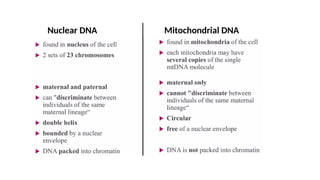
Nuclear DNA Mitochondrial DNA
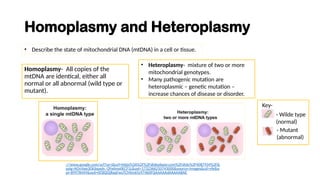
Homoplasmy and Heteroplasmy
Homoplasmy- All copies of the
mtDNA are identical, either all
normal or all abnormal (wild type or
mutant).
• Describe the state of mitochondrial DNA (mtDNA) in a cell or tissue.
• Heteroplasmy- mixture of two or more
mitochondrial genotypes.
• Many pathogenic mutation are
heteroplasmic – genetic mutation –
increase chances of disease or disorder.
- Wilde type
(normal)
- Mutant
(abnormal)
Key-
://www.google.com/url?sa=i&url=https%3A%2F%2Fslideplayer.com%2Fslide%2F4087934%2F&
psig=AOvVaw3OE6qayIs_QYwbno0ECF1L&ust=1732366210743000&source=images&cd=vfe&o
pi=89978449&ved=0CBQQjRxqFwoTCMim65z974kDFQAAAAAdAAAAABAE
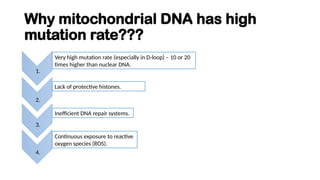
Why mitochondrial DNA has high
mutation rate???
1.
Very high mutation rate (especially in D-loop) – 10 or 20
times higher than nuclear DNA.
Lack of protective histones.
2.
3.
Inefficient DNA repair systems.
4.
Continuous exposure to reactive
oxygen species (ROS).
Mitochondrial diseases:
1. Leber Hereditary Optic Neuropathy (LHON) –
- Caused by defect in the complex 1 (NADH dehydrogenase), leads- mitochondrial dysfunctioning and
oxidative damage.
- Symptom- vision loss.
- More males are affected than female.
2. Kearns-Sayre syndrome (KSS)-
- caused by deletions in mitochondrial DNA
- affects heart and eyes
3. MELAS (Mitochondrial encephalomyopathy, lactic acidosis, and stroke-like episodes)-
- caused by pathogenic variants in mitochondrial DNA (mtDNA)
- symptom- lactic acid accumulation in blood – leads to vomiting, abdominal pain, fatigue, muscle
weakness and difficulty breathing.
Reference:
•
https://www.nature.com/scitable/topicpage/mtdna-and-mitochondrial-diseases-903/#:~:text=As%20previ
ously%20mentioned%2C%20mitochondrial%20DNA,uncles%2C%20and%20other%20maternal%20relative
s.
• https://medlineplus.gov/genetics/chromosome/mitochondrial-dna/#:~:text=This%20genetic%20material
%20is%20known,essential%20for%20normal%20mitochondrial%20function.
• https://my.clevelandclinic.org/health/diseases/15612-mitochondrial-diseases
• https://www.youtube.com/watch?v=kyxF0cyyzTE&t=1131s
• https://www.youtube.com/watch?v=rg7GrJVEyek&t=792s
Thankyou!!!

Mitochondrial DNA Inheritance PPT12.pptx

  • 1.
    Mitochondrial DNA Inheritance: AJourney into the Heart of Our Cells Heena V Mehta Seminar Presentation
  • 2.
    Mitochondria: 1. Found inboth plants and animals 2. Double membrane structure. 3. Inner membrane. 4. Outer membrane. 5. Intermembrane space. 6. Matrix – innermost part - enzyme for TCA cycle. 7. Cristae – Folded structure. 8. Ribosome- Protein synthesis. 9. dsDNA (important) – multiple copies. 10. F0 – F1 complex – ATP synthase – Synthesize ATP from ADP and inorganic Phosphate. Let’s Recall!!! https://www.pinterest.com/pin/83738874297250623/
  • 3.
    Mitochondria Evolution: The EndosymbioticTheory • Lynn Margulis - evolutionary biologist and author – endosymbiosis (1967) • Explains how organelles in eukaryotic cell originated from bacteria. https://asm.org/articles/2024/june/beyond-endosymbiosis-discovering-first-nitroplast https://en.wikipedia.org/wiki/Lynn_Margulis
  • 4.
    Need proof!!!! 1. Structure- both mitochondria and bacteria has kind of oval. 2. Size - 0.5 to 1 micrometer. 3. Circular DNA 4. Reproduction – binary fission 5. Ribosome – Normally 70S – prokaryotes 80 – eukaryotes But mitochondrial ribosome is 70S 0.5 to 1 micrometer. oval Circular DNA Binary fission in mitochondria and prokaryotes https://biologyreader.com/types-of-binary-fission.html https://en.wikipedia.org/wiki/Mitochondrial_DNA
  • 5.
    Mitochondrial DNA: • Abbreviatedas mtDNA • Double stranded circular DNA • There are several copies of dsDna in mitochondrion and there are many mitochondria in each cell. • There are no histones or any other protein associated with mtDNA. • The gene contain no introns • High mutation rate https://media.springernature.com/lw685/springer-static/image/chp 78-981-15-9364-2_16-1/MediaObjects/501338_0_En_16-1_Fig1_HT
  • 6.
    Mitochondrial DNA 16.6 kilobasesin size, dsDNA encodes 37 Mitochondrial gene 13 encode for polypeptides involved in respiratory chain. 24 22 tRNA 2 rRNA Mitochondrial DNA: https://jp.pinterest.com/pin/531002612292646025/?send=true
  • 7.
    Mitochondrial DNA Inheritance: Maternalor Paternal???? • During fertilization, only nucleus of sperm enters the egg cell and fuses with eggs nucleus. • Therefore, Mitochondrial DNA is inherited from one’s mother. In any case if paternal mtDNA penetrates/ passes the egg it gets diluted due to the presence of maternal mtDNA Sperm mitochondria is degraded and eliminated in most of the mammals by  Autophagy – engulfment and degradation  Ubiquitin system – targets and degrade What happens to sperm mitochondria then???? https://epgp.inflibnet.ac.in/epgpdata/uploads/epgp_content/S000016FS/P000700/M019161/E T/1516259917FSC_P13_M8_e-text.pdf
  • 8.
  • 9.
    Homoplasmy and Heteroplasmy Homoplasmy-All copies of the mtDNA are identical, either all normal or all abnormal (wild type or mutant). • Describe the state of mitochondrial DNA (mtDNA) in a cell or tissue. • Heteroplasmy- mixture of two or more mitochondrial genotypes. • Many pathogenic mutation are heteroplasmic – genetic mutation – increase chances of disease or disorder. - Wilde type (normal) - Mutant (abnormal) Key- ://www.google.com/url?sa=i&url=https%3A%2F%2Fslideplayer.com%2Fslide%2F4087934%2F& psig=AOvVaw3OE6qayIs_QYwbno0ECF1L&ust=1732366210743000&source=images&cd=vfe&o pi=89978449&ved=0CBQQjRxqFwoTCMim65z974kDFQAAAAAdAAAAABAE
  • 10.
    Why mitochondrial DNAhas high mutation rate??? 1. Very high mutation rate (especially in D-loop) – 10 or 20 times higher than nuclear DNA. Lack of protective histones. 2. 3. Inefficient DNA repair systems. 4. Continuous exposure to reactive oxygen species (ROS).
  • 11.
    Mitochondrial diseases: 1. LeberHereditary Optic Neuropathy (LHON) – - Caused by defect in the complex 1 (NADH dehydrogenase), leads- mitochondrial dysfunctioning and oxidative damage. - Symptom- vision loss. - More males are affected than female. 2. Kearns-Sayre syndrome (KSS)- - caused by deletions in mitochondrial DNA - affects heart and eyes 3. MELAS (Mitochondrial encephalomyopathy, lactic acidosis, and stroke-like episodes)- - caused by pathogenic variants in mitochondrial DNA (mtDNA) - symptom- lactic acid accumulation in blood – leads to vomiting, abdominal pain, fatigue, muscle weakness and difficulty breathing.
  • 12.
  • 13.