Orchestrating Transformation:
the Campaign for Change
An archestra notebook.
© 2013 Malcolm Ryder / archestra
Solving The Right Problem
Management is the key to success, right? But even though organizational changes are explicitly managed,
some changes fail. Complexity is certainly a typical culprit. But one cause of failed changes that may be even
more important can be neglecting what is really most necessary to manage in the change: transition.

Managing the transition, from the current state to the desired future state, is sometimes overwhelmed by a
cult of results: a preoccupation with an endpoint and with the compromises of it that may occur due to
complexity in the effort. This focus on the endpoint increases the risks that shortcuts and exceptions will be
employed in reaction, without a disciplined connection to other key factors, effectively corrupting the
transition. The consequence is that the intended change is unstable and does not actually survive.
Bringing the focus back to the transition itself re-establishes the point of view that gives the most important
perspective. Namely, when a departure from the current state is being attempted, what differences are
expected or occurring, that inhibit or encourage progress towards the target future state? How should the
differences be treated in order to fortify a good logic of the transition, or to overcome a bad logic?

The following descriptions and sketches survey the perspective of managing differences, not outcomes. The
point is not to discount the importance of achieving good results, but instead to highlight the role and goal
required to specifically manage change.
Point A to Point B: the logic of the transition
We are all familiar with the strong but sometimes ironic nature of a legal trial. The institution and process
that is employed to render judgment spends as much time protecting its own integrity as it does on anything
else. The importance of that self-referential attitude is in its ability to assure that the result of the process is
“valid”, regardless of what the specific result turns out to be.
The same emphasis on procedural integrity exists, of course, in the scientific method. No principle is more
important than that the experiments and tests serving as the foundation for a claim or discovery can be
repeated by a disinterested third party to provide the same accountability of whatever results occur. In fact,
it is not unusual that such a repetition of process may not come up with the same result but will carry the
same, if not better, degree of accountability.
A final familiar reference to the focus on procedure is the common experience of playing ordinary games by
their rules. Although it is never the case that two games unintentionally duplicate each other, they can
wholly share the same rules and objectives – and each game’s progress is always governed by the effect of
the rules on their intermittently occurring events.
So it is that managing a trial, managing an experiment, or managing a game exhibits the essential paradigm
for managing change. Independent of the results, the validity of the procedure is paramount, while also
establishing the basis for comparisons, improvement, and prescribed effectiveness.
The Concept Of A “Valid” Change
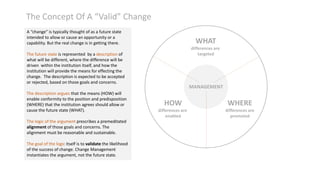
A “change” is typically thought of as a future state
intended to allow or cause an opportunity or a
capability. But the real change is in getting there.

WHAT
differences are
targeted

The future state is represented by a description of
what will be different, where the difference will be
driven within the institution itself, and how the
institution will provide the means for effecting the
change. The description is expected to be accepted
or rejected, based on those goals and concerns.
The description argues that the means (HOW) will
enable conformity to the position and predisposition
(WHERE) that the institution agrees should allow or
cause the future state (WHAT).
The logic of the argument prescribes a premeditated
alignment of those goals and concerns. The
alignment must be reasonable and sustainable.
The goal of the logic itself is to validate the likelihood
of the success of change. Change Management
instantiates the argument, not the future state.

MANAGEMENT

HOW

WHERE

differences are
enabled

differences are
promoted
The Validating Culture
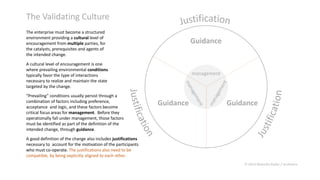
The enterprise must become a structured
environment providing a cultural level of
encouragement from multiple parties, for
the catalysts, prerequisites and agents of
the intended change.

Guidance

A cultural level of encouragement is one
where prevailing environmental conditions
typically favor the type of interactions
necessary to realize and maintain the state
targeted by the change.

management

“Prevailing” conditions usually persist through a
combination of factors including preference,
acceptance and logic, and these factors become
critical focus areas for management. Before they
operationally fall under management, those factors
must be identified as part of the definition of the
intended change, through guidance.

Guidance

Guidance

A good definition of the change also includes justifications
necessary to account for the motivation of the participants
who must co-operate. The justifications also need to be
compatible, by being explicitly aligned to each other.
© 2013 Malcolm Ryder / archestra
Stakeholder Justifications
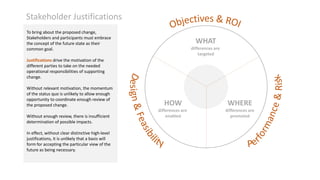
To bring about the proposed change,
Stakeholders and participants must embrace
the concept of the future state as their
common goal.

WHAT
differences are
targeted

Justifications drive the motivation of the
different parties to take on the needed
operational responsibilities of supporting
change.
Without relevant motivation, the momentum
of the status quo is unlikely to allow enough
opportunity to coordinate enough review of
the proposed change.
Without enough review, there is insufficient
determination of possible impacts.
In effect, without clear distinctive high-level
justifications, it is unlikely that a basis will
form for accepting the particular view of the
future as being necessary.

HOW

WHERE

differences are
enabled

differences are
promoted
Stakeholder Guidance
With Justifications
Value
&
Roadmap

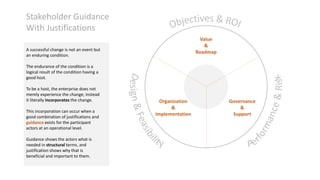
A successful change is not an event but
an enduring condition.
The endurance of the condition is a
logical result of the condition having a
good host.
To be a host, the enterprise does not
merely experience the change; instead
it literally incorporates the change.
This incorporation can occur when a
good combination of justifications and
guidance exists for the participant
actors at an operational level.
Guidance shows the actors what is
needed in structural terms, and
justification shows why that is
beneficial and important to them.

Organization
&
Implementation

Governance
&
Support
Managing Co-Operation
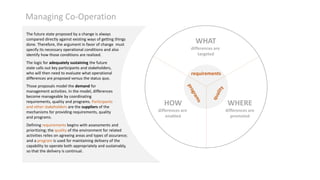
The future state proposed by a change is always
compared directly against existing ways of getting things
done. Therefore, the argument in favor of change must
specify its necessary operational conditions and also
identify how those conditions are realized.

WHAT
differences are
targeted

The logic for adequately sustaining the future
state calls out key participants and stakeholders,
who will then need to evaluate what operational
differences are proposed versus the status quo.
Those proposals model the demand for
management activities. In the model, differences
become manageable by coordinating
requirements, quality and programs. Participants
and other stakeholders are the suppliers of the
mechanisms for providing requirements, quality
and programs.
Defining requirements begins with assessments and
prioritizing; the quality of the environment for related
activities relies on agreeing areas and types of assurance;
and a program is used for maintaining delivery of the
capability to operate both appropriately and sustainably,
so that the delivery is continual.

requirements

HOW

WHERE

differences are
enabled

differences are
promoted
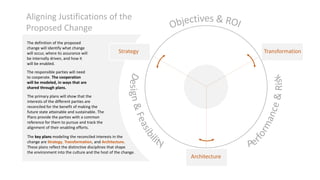
Aligning Justifications of the
Proposed Change
The definition of the proposed
change will identify what change
will occur, where its assurance will
be internally driven, and how it
will be enabled.

Strategy

Transformation

The responsible parties will need
to cooperate. The cooperation
will be modeled, in ways that are
shared through plans.
The primary plans will show that the
interests of the different parties are
reconciled for the benefit of making the
future state attainable and sustainable. The
Plans provide the parties with a common
reference for them to pursue and track the
alignment of their enabling efforts.
The key plans modeling the reconciled interests in the
change are Strategy, Transformation, and Architecture.
These plans reflect the distinctive disciplines that shape
the environment into the culture and the host of the change.

Architecture
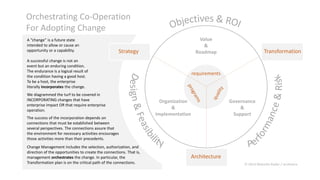
Orchestrating Co-Operation
For Adopting Change
A “change” is a future state
intended to allow or cause an
opportunity or a capability.

Value
&
Roadmap

Strategy

A successful change is not an
event but an enduring condition.
The endurance is a logical result of
the condition having a good host.
To be a host, the enterprise
literally incorporates the change.
We diagrammed the turf to be covered in
INCORPORATING changes that have
enterprise impact OR that require enterprise
operation.
The success of the incorporation depends on
connections that must be established between
several perspectives. The connections assure that
the environment for necessary activities encourages
those activities more than their precedents.
Change Management includes the selection, authorization, and
direction of the opportunities to create the connections. That is,
management orchestrates the change. In particular, the
Transformation plan is on the critical path of the connections.

Transformation

requirements

Organization
&
Implementation

Governance
&
Support

Architecture
© 2013 Malcolm Ryder / archestra
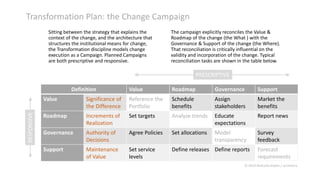
Transformation Plan: the Change Campaign
Sitting between the strategy that explains the
context of the change, and the architecture that
structures the institutional means for change,
the Transformation discipline models change
execution as a Campaign. Planned Campaigns
are both prescriptive and responsive.

The campaign explicitly reconciles the Value &
Roadmap of the change (the What ) with the
Governance & Support of the change (the Where).
That reconciliation is critically influential on the
validity and incorporation of the change. Typical
reconciliation tasks are shown in the table below.

PRESCRIPTIVE
Definition

Value

Roadmap

Governance

Support

RESPONSIVE

Value

Significance of
the Difference

Reference the
Portfolio

Schedule
benefits

Assign
stakeholders

Market the
benefits

Roadmap

Increments of
Realization

Set targets

Analyze trends

Educate
expectations

Report news

Governance

Authority of
Decisions

Agree Policies

Set allocations

Model
transparency

Survey
feedback

Support

Maintenance
of Value

Set service
levels

Define releases Define reports

Forecast
requirements

© 2013 Malcolm Ryder / archestra
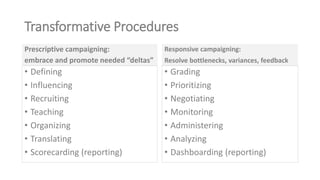
Transformative Procedures
Prescriptive campaigning:
embrace and promote needed “deltas”

Responsive campaigning:

• Defining
• Influencing
• Recruiting
• Teaching
• Organizing
• Translating
• Scorecarding (reporting)

• Grading
• Prioritizing
• Negotiating
• Monitoring
• Administering
• Analyzing
• Dashboarding (reporting)

Resolve bottlenecks, variances, feedback
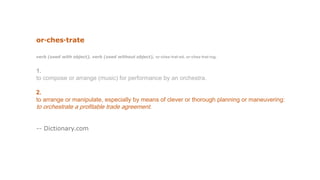
or·ches·trate
verb (used with object), verb (used without object), or·ches·trat·ed, or·ches·trat·ing.

1.
to compose or arrange (music) for performance by an orchestra.
2.
to arrange or manipulate, especially by means of clever or thorough planning or maneuvering:

to orchestrate a profitable trade agreement.
-- Dictionary.com

Orchestrating Change with Campaigns

  • 1.
    Orchestrating Transformation: the Campaignfor Change An archestra notebook. © 2013 Malcolm Ryder / archestra
  • 2.
    Solving The RightProblem Management is the key to success, right? But even though organizational changes are explicitly managed, some changes fail. Complexity is certainly a typical culprit. But one cause of failed changes that may be even more important can be neglecting what is really most necessary to manage in the change: transition. Managing the transition, from the current state to the desired future state, is sometimes overwhelmed by a cult of results: a preoccupation with an endpoint and with the compromises of it that may occur due to complexity in the effort. This focus on the endpoint increases the risks that shortcuts and exceptions will be employed in reaction, without a disciplined connection to other key factors, effectively corrupting the transition. The consequence is that the intended change is unstable and does not actually survive. Bringing the focus back to the transition itself re-establishes the point of view that gives the most important perspective. Namely, when a departure from the current state is being attempted, what differences are expected or occurring, that inhibit or encourage progress towards the target future state? How should the differences be treated in order to fortify a good logic of the transition, or to overcome a bad logic? The following descriptions and sketches survey the perspective of managing differences, not outcomes. The point is not to discount the importance of achieving good results, but instead to highlight the role and goal required to specifically manage change.
  • 3.
    Point A toPoint B: the logic of the transition We are all familiar with the strong but sometimes ironic nature of a legal trial. The institution and process that is employed to render judgment spends as much time protecting its own integrity as it does on anything else. The importance of that self-referential attitude is in its ability to assure that the result of the process is “valid”, regardless of what the specific result turns out to be. The same emphasis on procedural integrity exists, of course, in the scientific method. No principle is more important than that the experiments and tests serving as the foundation for a claim or discovery can be repeated by a disinterested third party to provide the same accountability of whatever results occur. In fact, it is not unusual that such a repetition of process may not come up with the same result but will carry the same, if not better, degree of accountability. A final familiar reference to the focus on procedure is the common experience of playing ordinary games by their rules. Although it is never the case that two games unintentionally duplicate each other, they can wholly share the same rules and objectives – and each game’s progress is always governed by the effect of the rules on their intermittently occurring events. So it is that managing a trial, managing an experiment, or managing a game exhibits the essential paradigm for managing change. Independent of the results, the validity of the procedure is paramount, while also establishing the basis for comparisons, improvement, and prescribed effectiveness.
  • 4.
    The Concept OfA “Valid” Change A “change” is typically thought of as a future state intended to allow or cause an opportunity or a capability. But the real change is in getting there. WHAT differences are targeted The future state is represented by a description of what will be different, where the difference will be driven within the institution itself, and how the institution will provide the means for effecting the change. The description is expected to be accepted or rejected, based on those goals and concerns. The description argues that the means (HOW) will enable conformity to the position and predisposition (WHERE) that the institution agrees should allow or cause the future state (WHAT). The logic of the argument prescribes a premeditated alignment of those goals and concerns. The alignment must be reasonable and sustainable. The goal of the logic itself is to validate the likelihood of the success of change. Change Management instantiates the argument, not the future state. MANAGEMENT HOW WHERE differences are enabled differences are promoted
  • 5.
    The Validating Culture Theenterprise must become a structured environment providing a cultural level of encouragement from multiple parties, for the catalysts, prerequisites and agents of the intended change. Guidance A cultural level of encouragement is one where prevailing environmental conditions typically favor the type of interactions necessary to realize and maintain the state targeted by the change. management “Prevailing” conditions usually persist through a combination of factors including preference, acceptance and logic, and these factors become critical focus areas for management. Before they operationally fall under management, those factors must be identified as part of the definition of the intended change, through guidance. Guidance Guidance A good definition of the change also includes justifications necessary to account for the motivation of the participants who must co-operate. The justifications also need to be compatible, by being explicitly aligned to each other. © 2013 Malcolm Ryder / archestra
  • 6.
    Stakeholder Justifications To bringabout the proposed change, Stakeholders and participants must embrace the concept of the future state as their common goal. WHAT differences are targeted Justifications drive the motivation of the different parties to take on the needed operational responsibilities of supporting change. Without relevant motivation, the momentum of the status quo is unlikely to allow enough opportunity to coordinate enough review of the proposed change. Without enough review, there is insufficient determination of possible impacts. In effect, without clear distinctive high-level justifications, it is unlikely that a basis will form for accepting the particular view of the future as being necessary. HOW WHERE differences are enabled differences are promoted
  • 7.
    Stakeholder Guidance With Justifications Value & Roadmap Asuccessful change is not an event but an enduring condition. The endurance of the condition is a logical result of the condition having a good host. To be a host, the enterprise does not merely experience the change; instead it literally incorporates the change. This incorporation can occur when a good combination of justifications and guidance exists for the participant actors at an operational level. Guidance shows the actors what is needed in structural terms, and justification shows why that is beneficial and important to them. Organization & Implementation Governance & Support
  • 8.
    Managing Co-Operation The futurestate proposed by a change is always compared directly against existing ways of getting things done. Therefore, the argument in favor of change must specify its necessary operational conditions and also identify how those conditions are realized. WHAT differences are targeted The logic for adequately sustaining the future state calls out key participants and stakeholders, who will then need to evaluate what operational differences are proposed versus the status quo. Those proposals model the demand for management activities. In the model, differences become manageable by coordinating requirements, quality and programs. Participants and other stakeholders are the suppliers of the mechanisms for providing requirements, quality and programs. Defining requirements begins with assessments and prioritizing; the quality of the environment for related activities relies on agreeing areas and types of assurance; and a program is used for maintaining delivery of the capability to operate both appropriately and sustainably, so that the delivery is continual. requirements HOW WHERE differences are enabled differences are promoted
  • 9.
    Aligning Justifications ofthe Proposed Change The definition of the proposed change will identify what change will occur, where its assurance will be internally driven, and how it will be enabled. Strategy Transformation The responsible parties will need to cooperate. The cooperation will be modeled, in ways that are shared through plans. The primary plans will show that the interests of the different parties are reconciled for the benefit of making the future state attainable and sustainable. The Plans provide the parties with a common reference for them to pursue and track the alignment of their enabling efforts. The key plans modeling the reconciled interests in the change are Strategy, Transformation, and Architecture. These plans reflect the distinctive disciplines that shape the environment into the culture and the host of the change. Architecture
  • 10.
    Orchestrating Co-Operation For AdoptingChange A “change” is a future state intended to allow or cause an opportunity or a capability. Value & Roadmap Strategy A successful change is not an event but an enduring condition. The endurance is a logical result of the condition having a good host. To be a host, the enterprise literally incorporates the change. We diagrammed the turf to be covered in INCORPORATING changes that have enterprise impact OR that require enterprise operation. The success of the incorporation depends on connections that must be established between several perspectives. The connections assure that the environment for necessary activities encourages those activities more than their precedents. Change Management includes the selection, authorization, and direction of the opportunities to create the connections. That is, management orchestrates the change. In particular, the Transformation plan is on the critical path of the connections. Transformation requirements Organization & Implementation Governance & Support Architecture © 2013 Malcolm Ryder / archestra
  • 11.
    Transformation Plan: theChange Campaign Sitting between the strategy that explains the context of the change, and the architecture that structures the institutional means for change, the Transformation discipline models change execution as a Campaign. Planned Campaigns are both prescriptive and responsive. The campaign explicitly reconciles the Value & Roadmap of the change (the What ) with the Governance & Support of the change (the Where). That reconciliation is critically influential on the validity and incorporation of the change. Typical reconciliation tasks are shown in the table below. PRESCRIPTIVE Definition Value Roadmap Governance Support RESPONSIVE Value Significance of the Difference Reference the Portfolio Schedule benefits Assign stakeholders Market the benefits Roadmap Increments of Realization Set targets Analyze trends Educate expectations Report news Governance Authority of Decisions Agree Policies Set allocations Model transparency Survey feedback Support Maintenance of Value Set service levels Define releases Define reports Forecast requirements © 2013 Malcolm Ryder / archestra
  • 12.
    Transformative Procedures Prescriptive campaigning: embraceand promote needed “deltas” Responsive campaigning: • Defining • Influencing • Recruiting • Teaching • Organizing • Translating • Scorecarding (reporting) • Grading • Prioritizing • Negotiating • Monitoring • Administering • Analyzing • Dashboarding (reporting) Resolve bottlenecks, variances, feedback
  • 13.
    or·ches·trate verb (used withobject), verb (used without object), or·ches·trat·ed, or·ches·trat·ing. 1. to compose or arrange (music) for performance by an orchestra. 2. to arrange or manipulate, especially by means of clever or thorough planning or maneuvering: to orchestrate a profitable trade agreement. -- Dictionary.com