CHANGE
              MANAGEMENT

“THE GREATEST DISCOVERY OF
 ANY GENERATION IS THAT A
HUMAN BEING CAN ALTER HIS
   LIFE BY ALTERING HIS
        ATTITUDE.”
• In 1997, Jack Welch General Electric CEO then,
  decided to send some mortgage and insurance
  application work to a small team in Gurgaon.
• By 2002, that work had expanded to 10000
  people company and was biggest part of GE
  Capital.
• Genpact, the BPO, today is a $1.5 billion
  industry. Last estimates, some 2/3 of
  outsourced BPO work in the world is serviced
  from India by 1.5 million workers.
Change & Change Management.

• Adoption of a new idea or behavior by an
  organization.
  – Organizations need to continuously adapt to new
    situations if they are to survive and prosper
  – Constant change keeps organizations agile
  – Indicative of “learning” organizations
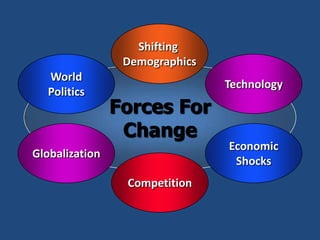
Shifting
                 Demographics
  World
                                Technology
  Politics
                Forces For
                 Change
                                Economic
Globalization
                                 Shocks
                 Competition
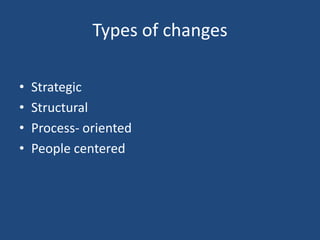
Types of changes

•   Strategic
•   Structural
•   Process- oriented
•   People centered
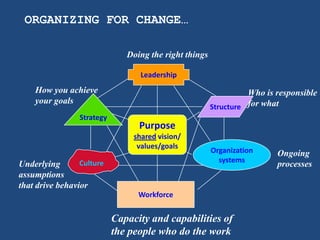
ORGANIZING FOR CHANGE…

                               Doing the right things

                                   Leadership
    How you achieve                                               Who is responsible
    your goals
                                                        Structure for what
                 Strategy
                                  Purpose
                                 shared vision/
                                  values/goals
                                                        Organization     Ongoing
                 Culture                                  systems
Underlying                                                               processes
assumptions
that drive behavior
                                  Workforce


                            Capacity and capabilities of
                            the people who do the work
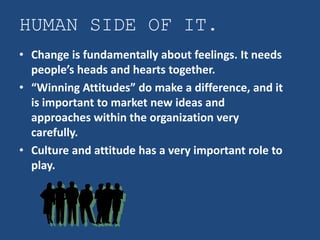
HUMAN SIDE OF IT.
• Change is fundamentally about feelings. It needs
  people’s heads and hearts together.
• “Winning Attitudes” do make a difference, and it
  is important to market new ideas and
  approaches within the organization very
  carefully.
• Culture and attitude has a very important role to
  play.
Issues in Managing Change
• Changing Organizational Cultures
  – Cultures are naturally resistant to change.
  – Conditions that facilitate cultural change:
     •   The occurrence of a dramatic crisis
     •   Leadership changing hands
     •   A young, flexible, and small organization
     •   A weak organizational culture
The Road to Cultural Change
• Conduct a cultural analysis to identify cultural elements needing
  change.
• Make it clear to employees that the organization’s survival is
  legitimately threatened if change is not forthcoming.
• Appoint new leadership with a new vision.
• Initiate a reorganization.
• Introduce new stories and rituals to convey the new vision.
• Change the selection and socialization processes and the evaluation
  and reward systems to support the new values.
Issues in Managing Change
• Handling Employee Stress due to Change
  – Stress
     • The physical and psychological tension an individual
       feels when confronted with extraordinary demands,
       constraints, or opportunities and their associated
       importance and uncertainties.
     • Functional Stress
        – Stress that has a positive effect on performance.
  – How Potential Stress Becomes Actual Stress
     • When there is uncertainty over the outcome.
     • When the outcome is important.
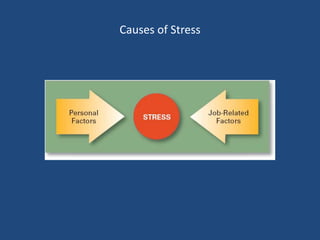
Causes of Stress
Issues in Managing Change
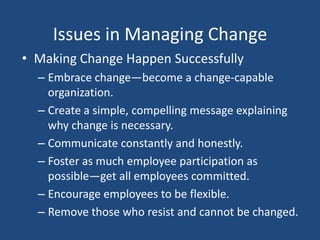
• Making Change Happen Successfully
  – Embrace change—become a change-capable
    organization.
  – Create a simple, compelling message explaining
    why change is necessary.
  – Communicate constantly and honestly.
  – Foster as much employee participation as
    possible—get all employees committed.
  – Encourage employees to be flexible.
  – Remove those who resist and cannot be changed.
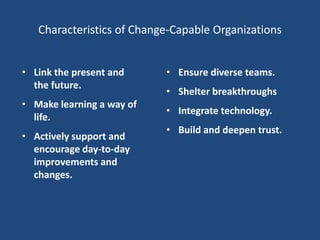
Characteristics of Change-Capable Organizations


• Link the present and     • Ensure diverse teams.
  the future.
                           • Shelter breakthroughs
• Make learning a way of
                           • Integrate technology.
  life.
                           • Build and deepen trust.
• Actively support and
  encourage day-to-day
  improvements and
  changes.
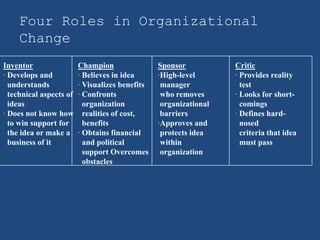
Four Roles in Organizational
     Change
Inventor                 Champion                Sponsor           Critic
· Develops and           · Believes in idea      ·High-level       · Provides reality
  understands            · Visualizes benefits    manager            test
  technical aspects of   · Confronts              who removes      · Looks for short-
  ideas                    organization           organizational     comings
· Does not know how        realities of cost,     barriers         · Defines hard-
  to win support for       benefits              ·Approves and       nosed
  the idea or make a     · Obtains financial      protects idea      criteria that idea
  business of it           and political          within             must pass
                           support Overcomes      organization
                           obstacles
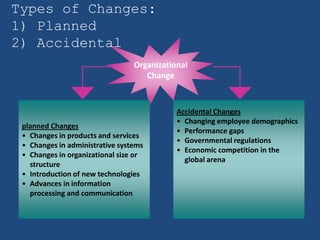
Types of Changes:
1) Planned
2) Accidental
                                 Organizational
                                    Change


                                            Accidental Changes
                                            • Changing employee demographics
 planned Changes
                                            • Performance gaps
 • Changes in products and services
                                            • Governmental regulations
 • Changes in administrative systems
                                            • Economic competition in the
 • Changes in organizational size or
                                              global arena
   structure
 • Introduction of new technologies
 • Advances in information
   processing and communication
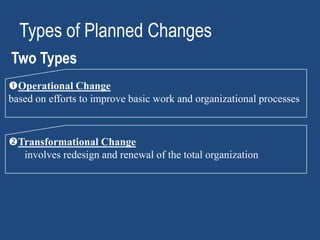
Types of Planned Changes
Two Types
Operational Change
based on efforts to improve basic work and organizational processes


Transformational Change
  involves redesign and renewal of the total organization
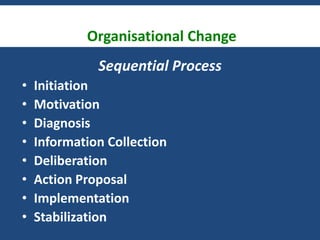
Organisational Change
              Sequential Process
•   Initiation
•   Motivation
•   Diagnosis
•   Information Collection
•   Deliberation
•   Action Proposal
•   Implementation
•   Stabilization
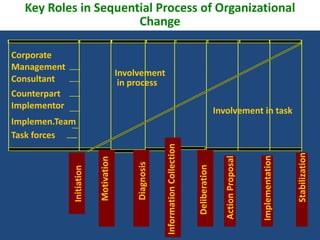
Key Roles in Sequential Process of Organizational
                      Change

Corporate
Management
                                        Involvement
Consultant                               in process
Counterpart
Implementor
                                                                                                 Involvement in task
Implemen.Team
Task forces


                                                         Information Collection


                                                                                                                                       Stabilization
                                                                                                                      Implementation
                                                                                                    Action Proposal
                           Motivation


                                             Diagnosis


                                                                                  Deliberation
              Initiation
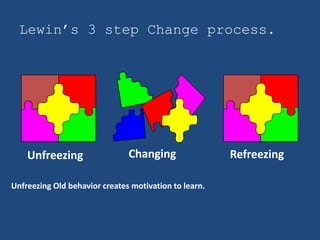
Lewin’s 3 step Change process.


    Unfreezing                 Changing                Refreezing

Unfreezing Old behavior creates motivation to learn.
Lewin’s Three-Step Process

• The first step, “unfreeze” involves the process
  of letting go of certain restricting attitudes
  during the initial stages of an outdoor
  education experience.
• The second step, "change" involves alteration
  of self-conceptions and ways of thinking
  during the experience.
• The third step, "refreeze" involves solidifying
  or crystallizing the changes into a
  new, permanent form for the individual
Unfreezing Techniques
people are taken from a state of being unready to change to
being ready and willing to make the first step.

• Burning platform: Expose or create a crisis.
• Challenge: Inspire them to achieve remarkable
  things.
• Evidence: Cold, hard data is difficult to ignore.
• Education: Learn them to change.
• Management by Objectives (MBO): Tell people what
  to do, but not how.
• Visioning: Form Visions. Visions work to create
  change.
Burning Platform

• Show how staying where you are is not an
  option, and that doing nothing will result in
  disaster.
• Look for a crisis that you can highlight. They
  are often lurking nearby, forlorn and
  unnoticed.
• You can also engineer your own
  crisis that forces change.
Challenge
• Stimulate people into change by challenging
  them to achieve something remarkable. Show
  confidence in their ability to get out of their
  comfort zone and do what has not been done
  before.
• Once the group has bought the
  challenge, then they will bounce off each
  other to make it happen.
Evidence
• Find evidence that supports the need for
  change.
• Use data and statistics to create impressive
  graphs and charts.
• Cold, hard evidence is a good way of changing
  minds as counter-arguments require better
  data.
Education

• Teach people about the need for change and
  how embracing change is a far more effective
  life strategy than staying where they are or
  resisting.
• Teach people the methods of change, about
  how to be logical and creative in improving
  processes and organizations.
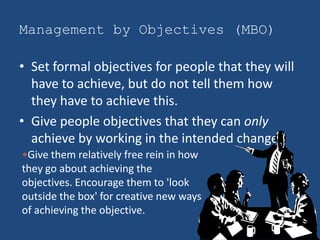
Management by Objectives (MBO)

• Set formal objectives for people that they will
  have to achieve, but do not tell them how
  they have to achieve this.
• Give people objectives that they can only
  achieve by working in the intended change.
•Give them relatively free rein in how
they go about achieving the
objectives. Encourage them to 'look
outside the box' for creative new ways
of achieving the objective.
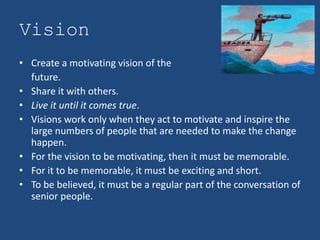
Vision
• Create a motivating vision of the
  future.
• Share it with others.
• Live it until it comes true.
• Visions work only when they act to motivate and inspire the
  large numbers of people that are needed to make the change
  happen.
• For the vision to be motivating, then it must be memorable.
• For it to be memorable, it must be exciting and short.
• To be believed, it must be a regular part of the conversation of
  senior people.
Changing Techniques
      Once you have unfrozen the people, the next
         question is how you keep them going.

•   Coaching: Psychological support for executives.
•   Facilitation: Use a facilitator to guide team meetings.
•   First steps: Make it easy to get going.
•   Involvement: Give them an important role.
•   Open Space: People talk about what concerns them.
•   Step wise change: Break the work into packages.
Coaching
• When you have individual people who are
  having difficulty in managing to adapt to
  change, be a Coach to them.
• Coaching helps explore deeper motivations
  and beliefs about other people, and find
  practical ways to change these.
Facilitation
• Use skilled facilitators (HR) to support change
  activities.
• Facilitators can be used to guide various group
  events, from brainstorming and planning to
  improvement projects and change activities.
• Facilitators can also act as team
  coaches, helping people to improve within
  themselves and work together in better ways.
First Steps.
• Actually starting something is often the
  hardest thing. The Greek poet Horace said, ‘He
  has half the deed done who has made a
  beginning.’
• Make the first steps of change particularly
  easy. Make them the most obvious thing to
  do.
• Then make the next steps easy that it takes
  away all reasonable objections to enacting it.
Involvement
•   Get them involved in the change.
•   Invite them to participate in discussions.
•   Give them things to do.
•   When people are a part of something, they
    bond with it, making it a part of their identity.
Open space
• It started when Harrison Owen was running conferences and
  found that people preferred talking to others during the
  breaks than listening to speakers. He then began running
  conferences without speakers.
• The underlying philosophy is that trying to control a naturally
  chaotic universe just makes things worse. If you want people
  to collaborate, the basic principle is to bring them together
  and then get out of the way. For managers and facilitators
  this can be a very difficult part of the Open Space process. Yet
  the most successful Open Spaces are managed with but a very
  light touch.
• In change, this is useful for getting people talking together. For
  example, you can use it to get people to talk about their fears
  and concerns.
Stepwise Change
• Have clear steps in the change. Break the work
  into distinct packages and talk about each
  separately.
• Communicate about the change not as a
  single, but as a set of activities, each of which
  gains specific value.
Refreezing techniques
  people are taken from a state of being in transition and
         moved to a stable and productive state

• Burning bridges: Ensure there is no way back.
• Evidence stream: Show them time and again
  that the change is real.
• Institutionalization: Building change into the
  formal systems and structures.
• Reward alignment: Align rewards with desired
  behaviors.
• Socializing: Build it into the social fabric
Burning the bridges
• When changes are instituted, it is not uncommon for
  people to seek ways to go back the old way of
  working, hence ensure that there is no way back to
  previous ways of working.
• 'Burning bridges' is a deliberate way of preventing
  any backsliding by removing any method by which
  people can go back.
• Managers who may be not fully committed to the
  change are now strongly motivated to continue.
Evidence Stream
• Get people to accept that a change is real by providing a
  steady stream of evidence to demonstrate that the
  change has happened and is successful.
• Communicate through a range of media. Get people who
  have been involved to stand up and tell their stories of
  challenge and overcoming adversity.
• Evidence is a powerful tool for persuasion, particularly
  when people are doubtful whether something is real.
  This is particularly powerful when presented by people
  who are trusted by the audience for the information.
• A steady stream of evidence is needed because people
  are not always convinced by a few pieces of early
  evidence.
Institutionalization
• Make changes stick by building them into the formal
  fabric of the organization.
• Make them an organizational standard, building them
  into the systems of standards.
• Put them or aspects of them into the primary strategic
  plan.
• Build them into people personal objectives.
• Ensure people are assessed against them in personal
  reviews.
• The formal systems and structures within the
  organization are those which are not optional. People do
  them because they are 'business as usual‘.
Reward Alignment.
• When you make a change, ensure that you
  align the reward system with the changes that
  you want to happen.
• The saying 'Show me how I'm paid and I'll
  show you how I behave' is surprisingly
  common.
Socialize.
• Seal changes by building them into the social
  structures.
• Give social leaders prominent positions in the
  change. When they feel ownership for it, they
  will talk about it and sell it to others.
Kotter’s Eight-Step Plan for Implementing Change


1.   Establish a sense of urgency by creating a compelling reason for why
     change is needed.
2.   Form a coalition with enough power to lead the change.
3.   Create a new vision to direct the change and strategies for achieving the
     vision.
4.   Communicate the vision throughout the organization.
5.   Empower others to act on the vision by removing barriers to change and
     encouraging risk taking and creative problem solving.
6.   Plan for, create, and reward short-term “wins” that move the organization
     toward the new vision.
7.   Consolidate improvements, reassess changes, and make necessary
     adjustments in the new programs.
8.   Reinforce the changes by demonstrating the relationship between new
     behaviors and organizational success.
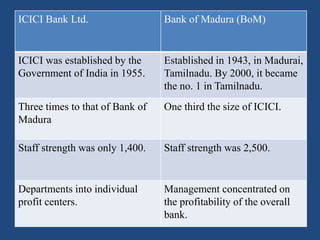
Case Example

ICICI Bank merger with Bank of Madura (December 2000)

What does it reveal ?

 It reveals the importance of change management for the Bank
  of Madura and how effective management of change could
  bring out best results from the employees in the Bank of
  Madura.
ICICI Bank Ltd.                  Bank of Madura (BoM)


ICICI was established by the     Established in 1943, in Madurai,
Government of India in 1955.     Tamilnadu. By 2000, it became
                                 the no. 1 in Tamilnadu.
Three times to that of Bank of   One third the size of ICICI.
Madura

Staff strength was only 1,400.   Staff strength was 2,500.


Departments into individual      Management concentrated on
profit centers.                  the profitability of the overall
                                 bank.
Change management

  • 1.
    CHANGE MANAGEMENT “THE GREATEST DISCOVERY OF ANY GENERATION IS THAT A HUMAN BEING CAN ALTER HIS LIFE BY ALTERING HIS ATTITUDE.”
  • 2.
    • In 1997,Jack Welch General Electric CEO then, decided to send some mortgage and insurance application work to a small team in Gurgaon. • By 2002, that work had expanded to 10000 people company and was biggest part of GE Capital. • Genpact, the BPO, today is a $1.5 billion industry. Last estimates, some 2/3 of outsourced BPO work in the world is serviced from India by 1.5 million workers.
  • 3.
    Change & ChangeManagement. • Adoption of a new idea or behavior by an organization. – Organizations need to continuously adapt to new situations if they are to survive and prosper – Constant change keeps organizations agile – Indicative of “learning” organizations
  • 4.
    Shifting Demographics World Technology Politics Forces For Change Economic Globalization Shocks Competition
  • 5.
    Types of changes • Strategic • Structural • Process- oriented • People centered
  • 6.
    ORGANIZING FOR CHANGE… Doing the right things Leadership How you achieve Who is responsible your goals Structure for what Strategy Purpose shared vision/ values/goals Organization Ongoing Culture systems Underlying processes assumptions that drive behavior Workforce Capacity and capabilities of the people who do the work
  • 7.
    HUMAN SIDE OFIT. • Change is fundamentally about feelings. It needs people’s heads and hearts together. • “Winning Attitudes” do make a difference, and it is important to market new ideas and approaches within the organization very carefully. • Culture and attitude has a very important role to play.
  • 8.
    Issues in ManagingChange • Changing Organizational Cultures – Cultures are naturally resistant to change. – Conditions that facilitate cultural change: • The occurrence of a dramatic crisis • Leadership changing hands • A young, flexible, and small organization • A weak organizational culture
  • 9.
    The Road toCultural Change • Conduct a cultural analysis to identify cultural elements needing change. • Make it clear to employees that the organization’s survival is legitimately threatened if change is not forthcoming. • Appoint new leadership with a new vision. • Initiate a reorganization. • Introduce new stories and rituals to convey the new vision. • Change the selection and socialization processes and the evaluation and reward systems to support the new values.
  • 10.
    Issues in ManagingChange • Handling Employee Stress due to Change – Stress • The physical and psychological tension an individual feels when confronted with extraordinary demands, constraints, or opportunities and their associated importance and uncertainties. • Functional Stress – Stress that has a positive effect on performance. – How Potential Stress Becomes Actual Stress • When there is uncertainty over the outcome. • When the outcome is important.
  • 11.
  • 12.
    Issues in ManagingChange • Making Change Happen Successfully – Embrace change—become a change-capable organization. – Create a simple, compelling message explaining why change is necessary. – Communicate constantly and honestly. – Foster as much employee participation as possible—get all employees committed. – Encourage employees to be flexible. – Remove those who resist and cannot be changed.
  • 13.
    Characteristics of Change-CapableOrganizations • Link the present and • Ensure diverse teams. the future. • Shelter breakthroughs • Make learning a way of • Integrate technology. life. • Build and deepen trust. • Actively support and encourage day-to-day improvements and changes.
  • 14.
    Four Roles inOrganizational Change Inventor Champion Sponsor Critic · Develops and · Believes in idea ·High-level · Provides reality understands · Visualizes benefits manager test technical aspects of · Confronts who removes · Looks for short- ideas organization organizational comings · Does not know how realities of cost, barriers · Defines hard- to win support for benefits ·Approves and nosed the idea or make a · Obtains financial protects idea criteria that idea business of it and political within must pass support Overcomes organization obstacles
  • 15.
    Types of Changes: 1)Planned 2) Accidental Organizational Change Accidental Changes • Changing employee demographics planned Changes • Performance gaps • Changes in products and services • Governmental regulations • Changes in administrative systems • Economic competition in the • Changes in organizational size or global arena structure • Introduction of new technologies • Advances in information processing and communication
  • 16.
    Types of PlannedChanges Two Types Operational Change based on efforts to improve basic work and organizational processes Transformational Change involves redesign and renewal of the total organization
  • 17.
    Organisational Change Sequential Process • Initiation • Motivation • Diagnosis • Information Collection • Deliberation • Action Proposal • Implementation • Stabilization
  • 18.
    Key Roles inSequential Process of Organizational Change Corporate Management Involvement Consultant in process Counterpart Implementor Involvement in task Implemen.Team Task forces Information Collection Stabilization Implementation Action Proposal Motivation Diagnosis Deliberation Initiation
  • 19.
    Lewin’s 3 stepChange process. Unfreezing Changing Refreezing Unfreezing Old behavior creates motivation to learn.
  • 20.
    Lewin’s Three-Step Process •The first step, “unfreeze” involves the process of letting go of certain restricting attitudes during the initial stages of an outdoor education experience. • The second step, "change" involves alteration of self-conceptions and ways of thinking during the experience. • The third step, "refreeze" involves solidifying or crystallizing the changes into a new, permanent form for the individual
  • 21.
    Unfreezing Techniques people aretaken from a state of being unready to change to being ready and willing to make the first step. • Burning platform: Expose or create a crisis. • Challenge: Inspire them to achieve remarkable things. • Evidence: Cold, hard data is difficult to ignore. • Education: Learn them to change. • Management by Objectives (MBO): Tell people what to do, but not how. • Visioning: Form Visions. Visions work to create change.
  • 22.
    Burning Platform • Showhow staying where you are is not an option, and that doing nothing will result in disaster. • Look for a crisis that you can highlight. They are often lurking nearby, forlorn and unnoticed. • You can also engineer your own crisis that forces change.
  • 23.
    Challenge • Stimulate peopleinto change by challenging them to achieve something remarkable. Show confidence in their ability to get out of their comfort zone and do what has not been done before. • Once the group has bought the challenge, then they will bounce off each other to make it happen.
  • 24.
    Evidence • Find evidencethat supports the need for change. • Use data and statistics to create impressive graphs and charts. • Cold, hard evidence is a good way of changing minds as counter-arguments require better data.
  • 25.
    Education • Teach peopleabout the need for change and how embracing change is a far more effective life strategy than staying where they are or resisting. • Teach people the methods of change, about how to be logical and creative in improving processes and organizations.
  • 26.
    Management by Objectives(MBO) • Set formal objectives for people that they will have to achieve, but do not tell them how they have to achieve this. • Give people objectives that they can only achieve by working in the intended change. •Give them relatively free rein in how they go about achieving the objectives. Encourage them to 'look outside the box' for creative new ways of achieving the objective.
  • 27.
    Vision • Create amotivating vision of the future. • Share it with others. • Live it until it comes true. • Visions work only when they act to motivate and inspire the large numbers of people that are needed to make the change happen. • For the vision to be motivating, then it must be memorable. • For it to be memorable, it must be exciting and short. • To be believed, it must be a regular part of the conversation of senior people.
  • 28.
    Changing Techniques Once you have unfrozen the people, the next question is how you keep them going. • Coaching: Psychological support for executives. • Facilitation: Use a facilitator to guide team meetings. • First steps: Make it easy to get going. • Involvement: Give them an important role. • Open Space: People talk about what concerns them. • Step wise change: Break the work into packages.
  • 29.
    Coaching • When youhave individual people who are having difficulty in managing to adapt to change, be a Coach to them. • Coaching helps explore deeper motivations and beliefs about other people, and find practical ways to change these.
  • 30.
    Facilitation • Use skilledfacilitators (HR) to support change activities. • Facilitators can be used to guide various group events, from brainstorming and planning to improvement projects and change activities. • Facilitators can also act as team coaches, helping people to improve within themselves and work together in better ways.
  • 31.
    First Steps. • Actuallystarting something is often the hardest thing. The Greek poet Horace said, ‘He has half the deed done who has made a beginning.’ • Make the first steps of change particularly easy. Make them the most obvious thing to do. • Then make the next steps easy that it takes away all reasonable objections to enacting it.
  • 32.
    Involvement • Get them involved in the change. • Invite them to participate in discussions. • Give them things to do. • When people are a part of something, they bond with it, making it a part of their identity.
  • 33.
    Open space • Itstarted when Harrison Owen was running conferences and found that people preferred talking to others during the breaks than listening to speakers. He then began running conferences without speakers. • The underlying philosophy is that trying to control a naturally chaotic universe just makes things worse. If you want people to collaborate, the basic principle is to bring them together and then get out of the way. For managers and facilitators this can be a very difficult part of the Open Space process. Yet the most successful Open Spaces are managed with but a very light touch. • In change, this is useful for getting people talking together. For example, you can use it to get people to talk about their fears and concerns.
  • 34.
    Stepwise Change • Haveclear steps in the change. Break the work into distinct packages and talk about each separately. • Communicate about the change not as a single, but as a set of activities, each of which gains specific value.
  • 35.
    Refreezing techniques people are taken from a state of being in transition and moved to a stable and productive state • Burning bridges: Ensure there is no way back. • Evidence stream: Show them time and again that the change is real. • Institutionalization: Building change into the formal systems and structures. • Reward alignment: Align rewards with desired behaviors. • Socializing: Build it into the social fabric
  • 36.
    Burning the bridges •When changes are instituted, it is not uncommon for people to seek ways to go back the old way of working, hence ensure that there is no way back to previous ways of working. • 'Burning bridges' is a deliberate way of preventing any backsliding by removing any method by which people can go back. • Managers who may be not fully committed to the change are now strongly motivated to continue.
  • 37.
    Evidence Stream • Getpeople to accept that a change is real by providing a steady stream of evidence to demonstrate that the change has happened and is successful. • Communicate through a range of media. Get people who have been involved to stand up and tell their stories of challenge and overcoming adversity. • Evidence is a powerful tool for persuasion, particularly when people are doubtful whether something is real. This is particularly powerful when presented by people who are trusted by the audience for the information. • A steady stream of evidence is needed because people are not always convinced by a few pieces of early evidence.
  • 38.
    Institutionalization • Make changesstick by building them into the formal fabric of the organization. • Make them an organizational standard, building them into the systems of standards. • Put them or aspects of them into the primary strategic plan. • Build them into people personal objectives. • Ensure people are assessed against them in personal reviews. • The formal systems and structures within the organization are those which are not optional. People do them because they are 'business as usual‘.
  • 39.
    Reward Alignment. • Whenyou make a change, ensure that you align the reward system with the changes that you want to happen. • The saying 'Show me how I'm paid and I'll show you how I behave' is surprisingly common.
  • 40.
    Socialize. • Seal changesby building them into the social structures. • Give social leaders prominent positions in the change. When they feel ownership for it, they will talk about it and sell it to others.
  • 41.
    Kotter’s Eight-Step Planfor Implementing Change 1. Establish a sense of urgency by creating a compelling reason for why change is needed. 2. Form a coalition with enough power to lead the change. 3. Create a new vision to direct the change and strategies for achieving the vision. 4. Communicate the vision throughout the organization. 5. Empower others to act on the vision by removing barriers to change and encouraging risk taking and creative problem solving. 6. Plan for, create, and reward short-term “wins” that move the organization toward the new vision. 7. Consolidate improvements, reassess changes, and make necessary adjustments in the new programs. 8. Reinforce the changes by demonstrating the relationship between new behaviors and organizational success.
  • 42.
    Case Example ICICI Bankmerger with Bank of Madura (December 2000) What does it reveal ? It reveals the importance of change management for the Bank of Madura and how effective management of change could bring out best results from the employees in the Bank of Madura.
  • 43.
    ICICI Bank Ltd. Bank of Madura (BoM) ICICI was established by the Established in 1943, in Madurai, Government of India in 1955. Tamilnadu. By 2000, it became the no. 1 in Tamilnadu. Three times to that of Bank of One third the size of ICICI. Madura Staff strength was only 1,400. Staff strength was 2,500. Departments into individual Management concentrated on profit centers. the profitability of the overall bank.