Change Management
Key Features of Successful
Transformational Change
• It is designed around the business
drivers
• It wins emotional and intellectual
support
• It models and reinforces the new way
of working
• It puts significant investment into
communications
• It creates experiences that shape
future behaviour
• It aligns all the dimensions of
management behind the change
• It releases talent, creativity and
ingenuity – often in unexpected ways
• Incorporate the drivers into the project
plan
• Develop clear engagement / involvement
strategies
• Accomplished before, during and after
implementation
• Communicate from the very start of the
project
• Align and engage all levels of
management behind the change
• Allow for processing resistance and
conflict – natural during change
• Provide processes that emotionally
support people through all parts of the
change
Key Features Implications
Ten Points of Potential Failure
1. A continued discrepancy between top management statements of values or styles
and their actual managerial behaviour – Saying one thing and doing another
2. A big programme of activities without any clear goals for change
3. Confusion between ends and means – the question of ‘training for what’ must be
answered
4. Short-term perspective. Three to five years is a realistic time framework for
organisational change
5. Lack of coordination between a number of different activities aimed at increasing
organisational effectiveness
6. Overdependence on others – either outside consultants or inside specialists
7. Large gap between the commitment to change at the top of the organisation and
the transfer of this interest to the middle of the organisation
8. Trying to fit a major organisational change into an old organisational structure
9. The constant search for cookbook solutions
10. Applying an intervention or strategy inappropriately. The tendency to apply
someone else’s package
The Need for a Compelling
Business Case
Strong data-driven rationale
• A specific research-based reason for change
• Linked directly to performance goals
Clarification and communication of vision
Compelling reason and urgency behind change activities
Focused strategy for stakeholder engagement
Identification of critical audiences and gap analysis
Realistic understanding of organisational implications
Formal; informal; people; tasks
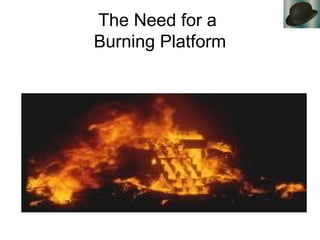
The Need for a
Burning Platform
The Need for a
Strong Foundation
Create a shared, defined and
robust view of the imperatives
for change and performance
requirement
Decide on the vehicle for
change (e.g. process
redesign, cost reduction,
culture change, closer
alignment with customers)
Assess the organisation’s
readiness and capability for
change
Identify stakeholders
The Change Equation
(Beckhard)
Information
about what is
happening to
the IFC and me,
and why
Changing individual behaviour requires both new information and new
experiences
Vision Dissatisfaction 1ST
Steps Costs
$$$
Emotional
++ >
Information Experience Behaviour+ =PerceptionX( )
Experience of
doing my work
in new ways
which reinforces
the change and
engages me
potentially
My perceptions
of the
organisation, its
management
and my own
capability
A shift in
my
behaviour
and
attitudes
Leadership
Moving one or more people from where they happen to
be to some other place
Clear committed leadership is vital to the success of any
change
Key Features of
Leading Change
• Making the journey and destination compellingly attractive
• Helping people see a future they want to be part of
• Helping people find a purpose and meaning for themselves
• Requesting commitment
Enrolling
Enabling
Energising
Exemplifying
• Helping people see possibilities for their contribution
• Challenging self-limiting beliefs
• Setting (together) stretching targets
• Building self-esteem, confidence and trust
• Putting into action
• Building and sustaining people’s energy
• Celebrating successes
• Giving recognition
• Expressing optimism
• Demonstrating the behaviours and values that are being
required of others
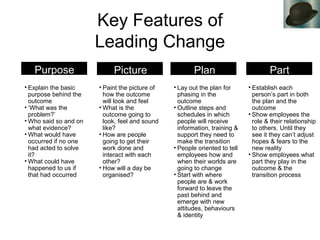
Key Features of
Leading Change
• Explain the basic
purpose behind the
outcome
• ‘What was the
problem?’
• Who said so and on
what evidence?
• What would have
occurred if no one
had acted to solve
it?
• What could have
happened to us if
that had occurred
Purpose Picture Plan Part
• Paint the picture of
how the outcome
will look and feel
• What is the
outcome going to
look, feel and sound
like?
• How are people
going to get their
work done and
interact with each
other?
• How will a day be
organised?
• Lay out the plan for
phasing in the
outcome
• Outline steps and
schedules in which
people will receive
information, training &
support they need to
make the transition
• People oriented to tell
employees how and
when their worlds are
going to change
• Start with where
people are & work
forward to leave the
past behind and
emerge with new
attitudes, behaviours
& identity
• Establish each
person’s part in both
the plan and the
outcome
• Show employees the
role & their relationship
to others. Until they
see it they can’t adjust
hopes & fears to the
new reality
• Show employees what
part they play in the
outcome & the
transition process
Transformation Process
Set the
direction
Create the
desire & will
to change
Phase
Content
Outcomes
Part
Unfreeze Mobilise Realise Reinforce Sustain
Make early
changes & build
confidence
Secure
widespread
shift in
behaviour
Underpin
with
changes in
structure &
people
processes
Strive for
continuous
performance
improvement
Break
with
the
past
Build
the
energy
Perfor
m-ance
lift-off
Embed
new
culture
Push
the
limits
Plan from the Perspective
of the Recipients of Change
Board
Senior Mgmt Team
• Where do we want them to be?
• What initiatives will help them get there?
• Is the ‘load’ of change reasonable & within capabilities?
• What projects do we need to provide the initiatives
Customer Facing Staff
Front-line Managers
Middle Managers
Support Teams
Part
Unfreeze Mobilise Realise Reinforce Sustain
Plotting Shifts in Commitment
(Example)
Line Managers
Senior Team
Board
HR
Employees
Project Sponsor
Key Players No Commitment Let It Happen Help It Happen Make It Happen
Key:
X = Present state
O = Minimum commitment needed
X
X
X
X
X
X
O
O
O
O
O
O
Surfacing Potential
Barriers Early On
• Strategy
• Structure
• Process
• Operating principles
• Culture/behaviour
• Jobs
• People
• Change gets bogged because barriers are not dealt with soon
enough or openly enough to keep the change process moving
• Barriers may exist anywhere and everywhere – even the difficult-
to-see places…
• Leadership
• Management
• Resources
• Systems
• Rewards
• Values/Beliefs
• Capabilities
Consider: How will this
change effort affect…?
Identify Strategies for Closing
Critical Gaps
Organisational Dimension Gap Strategy
Strategy
Structure
Process
Operating Principles
Culture/Behaviour
People
Leadership
Management
Resources
Systems
Rewards
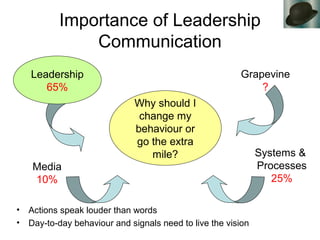
Importance of Leadership
Communication
• Actions speak louder than words
• Day-to-day behaviour and signals need to live the vision
Why should I
change my
behaviour or
go the extra
mile?
Leadership
65%
Grapevine
?
Systems &
Processes
25%
Media
10%
The Transition Curve:
How Attitudes & Feelings Change
Confidence
Time
“I’m not sure I know
what’s going on”
“I feel overwhelmed”
“I can handle this”
“We can’t do this. It won’t work. We’re not allowed”
“Actually, things might get better”
“This could be a better way of doing it”
“This way is more effective”
“S/he really made the effort to help us
implement this change”
Making Sense of the Journey
The information they receive
Their work and how they do it
The context in which they do their work
The needs of the organisation
To change their behaviour, employees need to see the link between:
Link between desired result &
communication approach
Levelofchange
Level of involvement
Tell Sell Consult Join
Awareness
Understanding
(and Action)
Acceptance/
Alignment
Ownership/
Engagement
Choosing the Right
Communications Tools & Channels
Levelofchange
Level of involvement
Tell Sell Consult Join
Awareness
Understanding
(and Action)
Acceptance/
Alignment
Ownership/
Engagement
Newsletters,
emails, memos,
letters, notices
Booklets, plenary
sessions, presentations,
videos, intranets
Focus groups, working
parties, suggestions
schemes, consultative
presentations
Working sessions, 1-to-1
conversations, workshops,
coaching
Information + Involvement
to Build Commitment & Change
Increasing Commitment
Awareness
of desired change
Understanding
of change direction
Translation
to the work setting
Commitment
to personal change
Internalisation
of new behaviour
“Yeah, I saw the memo”
“I understand where we
need to go”
“I know how we need to
do our jobs differently”
“OK, I’m ready to do it the
new way”
“This is the way we do things
here”
Stages of Individual
Behaviour Change
Information with some
involvement sufficient here
Significant
involvement
needed
Ten Strategies for Employee
Involvement
1. Meet regularly with employees and openly discuss the organisational changes and
why they occurred
2. Recognise that employees understand that you may not have the answers to
everything, but it’s important for them to feel the communications are open and
honest
3. Constantly communicate clear goals and vision of the new situation
4. Encourage people to discuss fears and concerns in teams
5. Open ‘suggestion boxes’ for employees to raise questions in anonymity
6. Set up weekly lunches or other informal meetings to discuss the progress of the
restructuring process
7. Whenever possible, assign roles and responsibilities in line with peoples interests
8. Develop rituals and marker events that allow people to connect
9. Involve employees affected by the changes in making decisions about what’s best
for them
10. Discuss realistic career options with employees and ensure training is available for
any new skills that are needed
Coaching Others in Building
Employee Commitment
1. Identify individuals or groups whose commitment is necessary to
the success of the change effort
2. Create and follow a departmental plan to increase commitment of
all players
3. Continually encourage and enable employee involvement
4. Continually communicate the goals of the change process
5. Turn covert resistance to overt resistance and then to
commitment
6. WALK THE TALK!
What People Pay Attention To:
1. Leader attention, measurement, rewards and controls
2. Leader reaction to critical incidents
3. Leader role modelling, coaching
4. Criteria for recruitment, promotion, retirement and excommunication
5. Formal and informal socialisation
6. Recurring systems and procedures
7. Organisation design and structure
8. Design of physical space
9. Stories and myths about key people and events
10. Formal statements, charters, creeds, codes of ethics etc
Between 80-90% of behaviour is determined by
the first three points
• Presenter :
Vishvas Yadav
Senior Manager
Codoca Mtvcola Marketing Advertising and
Outsourcing Private Limited .
Mail id : info@codocamtvcola.co.in
Mobile : 08884782639

Change management-28477

  • 1.
  • 2.
    Key Features ofSuccessful Transformational Change • It is designed around the business drivers • It wins emotional and intellectual support • It models and reinforces the new way of working • It puts significant investment into communications • It creates experiences that shape future behaviour • It aligns all the dimensions of management behind the change • It releases talent, creativity and ingenuity – often in unexpected ways • Incorporate the drivers into the project plan • Develop clear engagement / involvement strategies • Accomplished before, during and after implementation • Communicate from the very start of the project • Align and engage all levels of management behind the change • Allow for processing resistance and conflict – natural during change • Provide processes that emotionally support people through all parts of the change Key Features Implications
  • 3.
    Ten Points ofPotential Failure 1. A continued discrepancy between top management statements of values or styles and their actual managerial behaviour – Saying one thing and doing another 2. A big programme of activities without any clear goals for change 3. Confusion between ends and means – the question of ‘training for what’ must be answered 4. Short-term perspective. Three to five years is a realistic time framework for organisational change 5. Lack of coordination between a number of different activities aimed at increasing organisational effectiveness 6. Overdependence on others – either outside consultants or inside specialists 7. Large gap between the commitment to change at the top of the organisation and the transfer of this interest to the middle of the organisation 8. Trying to fit a major organisational change into an old organisational structure 9. The constant search for cookbook solutions 10. Applying an intervention or strategy inappropriately. The tendency to apply someone else’s package
  • 4.
    The Need fora Compelling Business Case Strong data-driven rationale • A specific research-based reason for change • Linked directly to performance goals Clarification and communication of vision Compelling reason and urgency behind change activities Focused strategy for stakeholder engagement Identification of critical audiences and gap analysis Realistic understanding of organisational implications Formal; informal; people; tasks
  • 5.
    The Need fora Burning Platform
  • 6.
    The Need fora Strong Foundation Create a shared, defined and robust view of the imperatives for change and performance requirement Decide on the vehicle for change (e.g. process redesign, cost reduction, culture change, closer alignment with customers) Assess the organisation’s readiness and capability for change Identify stakeholders
  • 7.
    The Change Equation (Beckhard) Information aboutwhat is happening to the IFC and me, and why Changing individual behaviour requires both new information and new experiences Vision Dissatisfaction 1ST Steps Costs $$$ Emotional ++ > Information Experience Behaviour+ =PerceptionX( ) Experience of doing my work in new ways which reinforces the change and engages me potentially My perceptions of the organisation, its management and my own capability A shift in my behaviour and attitudes
  • 8.
    Leadership Moving one ormore people from where they happen to be to some other place Clear committed leadership is vital to the success of any change
  • 9.
    Key Features of LeadingChange • Making the journey and destination compellingly attractive • Helping people see a future they want to be part of • Helping people find a purpose and meaning for themselves • Requesting commitment Enrolling Enabling Energising Exemplifying • Helping people see possibilities for their contribution • Challenging self-limiting beliefs • Setting (together) stretching targets • Building self-esteem, confidence and trust • Putting into action • Building and sustaining people’s energy • Celebrating successes • Giving recognition • Expressing optimism • Demonstrating the behaviours and values that are being required of others
  • 10.
    Key Features of LeadingChange • Explain the basic purpose behind the outcome • ‘What was the problem?’ • Who said so and on what evidence? • What would have occurred if no one had acted to solve it? • What could have happened to us if that had occurred Purpose Picture Plan Part • Paint the picture of how the outcome will look and feel • What is the outcome going to look, feel and sound like? • How are people going to get their work done and interact with each other? • How will a day be organised? • Lay out the plan for phasing in the outcome • Outline steps and schedules in which people will receive information, training & support they need to make the transition • People oriented to tell employees how and when their worlds are going to change • Start with where people are & work forward to leave the past behind and emerge with new attitudes, behaviours & identity • Establish each person’s part in both the plan and the outcome • Show employees the role & their relationship to others. Until they see it they can’t adjust hopes & fears to the new reality • Show employees what part they play in the outcome & the transition process
  • 11.
    Transformation Process Set the direction Createthe desire & will to change Phase Content Outcomes Part Unfreeze Mobilise Realise Reinforce Sustain Make early changes & build confidence Secure widespread shift in behaviour Underpin with changes in structure & people processes Strive for continuous performance improvement Break with the past Build the energy Perfor m-ance lift-off Embed new culture Push the limits
  • 12.
    Plan from thePerspective of the Recipients of Change Board Senior Mgmt Team • Where do we want them to be? • What initiatives will help them get there? • Is the ‘load’ of change reasonable & within capabilities? • What projects do we need to provide the initiatives Customer Facing Staff Front-line Managers Middle Managers Support Teams Part Unfreeze Mobilise Realise Reinforce Sustain
  • 13.
    Plotting Shifts inCommitment (Example) Line Managers Senior Team Board HR Employees Project Sponsor Key Players No Commitment Let It Happen Help It Happen Make It Happen Key: X = Present state O = Minimum commitment needed X X X X X X O O O O O O
  • 14.
    Surfacing Potential Barriers EarlyOn • Strategy • Structure • Process • Operating principles • Culture/behaviour • Jobs • People • Change gets bogged because barriers are not dealt with soon enough or openly enough to keep the change process moving • Barriers may exist anywhere and everywhere – even the difficult- to-see places… • Leadership • Management • Resources • Systems • Rewards • Values/Beliefs • Capabilities Consider: How will this change effort affect…?
  • 15.
    Identify Strategies forClosing Critical Gaps Organisational Dimension Gap Strategy Strategy Structure Process Operating Principles Culture/Behaviour People Leadership Management Resources Systems Rewards
  • 16.
    Importance of Leadership Communication •Actions speak louder than words • Day-to-day behaviour and signals need to live the vision Why should I change my behaviour or go the extra mile? Leadership 65% Grapevine ? Systems & Processes 25% Media 10%
  • 17.
    The Transition Curve: HowAttitudes & Feelings Change Confidence Time “I’m not sure I know what’s going on” “I feel overwhelmed” “I can handle this” “We can’t do this. It won’t work. We’re not allowed” “Actually, things might get better” “This could be a better way of doing it” “This way is more effective” “S/he really made the effort to help us implement this change”
  • 18.
    Making Sense ofthe Journey The information they receive Their work and how they do it The context in which they do their work The needs of the organisation To change their behaviour, employees need to see the link between:
  • 19.
    Link between desiredresult & communication approach Levelofchange Level of involvement Tell Sell Consult Join Awareness Understanding (and Action) Acceptance/ Alignment Ownership/ Engagement
  • 20.
    Choosing the Right CommunicationsTools & Channels Levelofchange Level of involvement Tell Sell Consult Join Awareness Understanding (and Action) Acceptance/ Alignment Ownership/ Engagement Newsletters, emails, memos, letters, notices Booklets, plenary sessions, presentations, videos, intranets Focus groups, working parties, suggestions schemes, consultative presentations Working sessions, 1-to-1 conversations, workshops, coaching
  • 21.
    Information + Involvement toBuild Commitment & Change Increasing Commitment Awareness of desired change Understanding of change direction Translation to the work setting Commitment to personal change Internalisation of new behaviour “Yeah, I saw the memo” “I understand where we need to go” “I know how we need to do our jobs differently” “OK, I’m ready to do it the new way” “This is the way we do things here” Stages of Individual Behaviour Change Information with some involvement sufficient here Significant involvement needed
  • 22.
    Ten Strategies forEmployee Involvement 1. Meet regularly with employees and openly discuss the organisational changes and why they occurred 2. Recognise that employees understand that you may not have the answers to everything, but it’s important for them to feel the communications are open and honest 3. Constantly communicate clear goals and vision of the new situation 4. Encourage people to discuss fears and concerns in teams 5. Open ‘suggestion boxes’ for employees to raise questions in anonymity 6. Set up weekly lunches or other informal meetings to discuss the progress of the restructuring process 7. Whenever possible, assign roles and responsibilities in line with peoples interests 8. Develop rituals and marker events that allow people to connect 9. Involve employees affected by the changes in making decisions about what’s best for them 10. Discuss realistic career options with employees and ensure training is available for any new skills that are needed
  • 23.
    Coaching Others inBuilding Employee Commitment 1. Identify individuals or groups whose commitment is necessary to the success of the change effort 2. Create and follow a departmental plan to increase commitment of all players 3. Continually encourage and enable employee involvement 4. Continually communicate the goals of the change process 5. Turn covert resistance to overt resistance and then to commitment 6. WALK THE TALK!
  • 24.
    What People PayAttention To: 1. Leader attention, measurement, rewards and controls 2. Leader reaction to critical incidents 3. Leader role modelling, coaching 4. Criteria for recruitment, promotion, retirement and excommunication 5. Formal and informal socialisation 6. Recurring systems and procedures 7. Organisation design and structure 8. Design of physical space 9. Stories and myths about key people and events 10. Formal statements, charters, creeds, codes of ethics etc Between 80-90% of behaviour is determined by the first three points
  • 25.
    • Presenter : VishvasYadav Senior Manager Codoca Mtvcola Marketing Advertising and Outsourcing Private Limited . Mail id : info@codocamtvcola.co.in Mobile : 08884782639