Coping with uncertainty – how managers can
understand complex, dynamic and unpredictable
uncertainties within their macro-environment
2015
STEVEN TOMLINSON
STUDENT NUMBER ID: 630044285
UNIVERSITY OF EXETER | BUSINESSSCHOOL
Word count:1800
Executive Summary
The report setsoutto criticallyanalyse a
numberof concepts inorder to identify
uncertaintieswithin anorganisationsmacro-
environmentinthe followingways.
 Definingakeyissue thatisof concern
to managers
 Proposingtwosolutions
 Usingspecificexamplesandsources
to supporteachsolution
Finally,makesrecommendationsusingone of
the solutionsdiscussed,advisingmanagersto
adoptthe conceptstocope withuncertainties
intheirmacro-environment.
Definitionof the issue
Thisreportidentifiesthe traditional PESTEL
1960’s frameworkas an insufficientapproach
for organisationsandindustries,particularly
withinenvironments withlowlevelsof
uncertainty,suchasthe digital musicindustry.
Thisproblemhas increasingly becomemore
apparentto CEO’s whoare recognisingtheir
role has changed (Heidrick&struggles,2015)
as the environmentinwhichtheyoperatehas
become more dynamic,complex and
unpredictable.
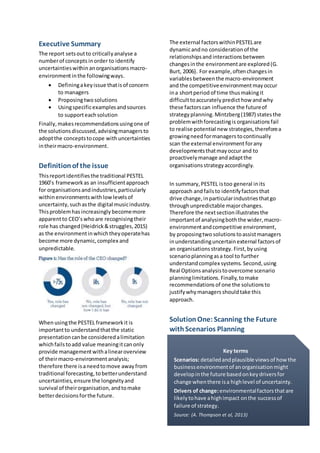
Whenusingthe PESTEL frameworkit is
importantto understandthatthe static
presentationcanbe consideredalimitation
whichfailstoadd value meaningitcanonly
provide managementwithalinearoverview
of theirmacro-environmentanalysis;
therefore there isaneedtomove away from
traditional forecasting,tobetterunderstand
uncertainties, ensure the longevityand
survival of theirorganisation,andtomake
betterdecisionsforthe future.
The external factorswithinPESTELare
dynamicandno considerationof the
relationshipsand interactionsbetween
changesinthe environmentare explored(G.
Burt, 2006). For example,oftenchangesin
variables betweenthe macro-environment
and the competitiveenvironmentmayoccur
ina shortperiod of time thusmakingit
difficulttoaccurately predicthow andwhy
these factorscan influence the futureof
strategy planning.Mintzberg(1987) statesthe
problemwithforecastingis organisationsfail
to realise potential new strategies,thereforea
growingneedformanagers tocontinually
scan the external environment forany
developmentsthatmayoccur and to
proactivelymanage andadaptthe
organisationsstrategyaccordingly.
In summary,PESTEL istoo general inits
approach andfailsto identifyfactorsthat
drive change,inparticularindustriesthatgo
throughunpredictable majorchanges.
Therefore the nextsectionillustratesthe
importantof analysingboththe wider,macro-
environmentandcompetitive environment,
by proposingtwo solutionstoassistmanagers
inunderstandinguncertainexternal factorsof
an organisationsstrategy. First,byusing
scenarioplanningasa tool to further
understandcomplex systems. Second,using
Real Optionsanalysistoovercome scenario
planninglimitations. Finally, tomake
recommendations of one the solutionsto
justifywhymanagersshouldtake this
approach.
SolutionOne: Scanning the Future
withScenarios Planning
Key terms
Scenarios: detailedandplausible viewsof howthe
businessenvironmentof anorganisationmight
developinthe future basedonkeydriversfor
change whenthere isa highlevel of uncertainty.
Drivers of change:environmentalfactorsthatare
likelytohave ahighimpact onthe successof
failure of strategy.
Source: (A. Thompson et al, 2013)
There are manytoolsmanagementcanuse to
improve theirstrategicplanning,however,
scenarioplanning isseenbymanagersas
much betterthanothersimilarconceptsasit
factors inan extensive range of variablesused
to take intoaccount uncertaintiesandbasic
trendsoccurringin the macro-environment.
Organisationsthatare susceptibletothe
followingconditionswill gaincompetitive
advantagesbyusingscenarioplanning (P.
Schoemaker,1995):
 Uncertaintyishighinrelationtoa
manager’sabilitytoadjustorpredict.
 Whencostlysurpriseshave happened
inthe past.
 Strategicthinkingwithinthe
organisationislow.
 The competitive industryhasgone
throughmajor change or ispredicted
to.
 The organisationwantsa common
language andframeworkwithout
suffocatingdiversity
 If there are compellingdifferencesof
opinionswherebymanyopinions
havingmerit
 Whencompetitorsare alsousing
scenarioplanningwithinthe macro-
environment
Managers have foundscenarioplanningakey
tool inidentifying driversof change within
theirenvironment.Thereforeallowingan
organisationsmacro-environmenttomove
beyondsingularforecaststhatcreate
coherentstoriesusedtoidentifyarange of
plausible eventsandtoenhance strategic
decisionmaking(A.Thompson etal,2013).
For example,Royal Dutch ShellGroupused
scenarioplanningtopredictthe oil crisisby
identifyingthe interactions betweenfactorsin
the macro-environment. Indoingso,Shell
builtscenariosthatidentifiedinteractions
betweenvariables withintheireconomic
environmentthatdirectlyimpactedthe
business.
OrganisationssuchasNorthernRockduring
the housingbubble failedtointerpretthe
weaksignalswithintheirenvironmentwhich
significantly contributedtotheirdownfall.
20% of organisationsfail tointerpret weak
signalsoract upon themappropriately which
ispredominatelydue to individual biasesand
organisational biases(P.Schoemaker,G.S.
Day, 2009). For example, managersare simply
not aware that emotional andcognitivebiases
distorttheirabilitytoidentifyweaksignals.
Therefore itiskey managers learnto
overcome suchbiasesbyusingthe following
approaches (Source:MIT SloanManagement
Review):
 Tap local intelligence
 Leverage extendednetworks
 Mobilise searchparties
 Testmultiple hypotheses
 Canvassthe wisdomof the crowd
 Developdiverse scenarios
 Confrontreality
 Encourage constructive conflict
 Trust seasonedintuition
BuildingScenarios
A. Thompsonetal (2013) statesthere are
three levelsof scenario anduncertainties:
1. Global scenarios&general environment
uncertainties
2. Focusedscenarios&Industry
uncertainties
3. Projectscenarios&company
uncertainties
It isimportantmanagersmake use of the
trendsthat appearwithinthe macro-
environmentanalysisandthe driversof
change;keyuncertaintiesandthe various
interactions inordertobuildplausible
scenarios,whichcanbe achieved by
identifyingtwoextremes byoff-settingthem
togetherinorderto come to conclusionson
“By considering a range of alternatives
managers become more tuned to what
Paul Schoemaker refers to as ‘Weak
Signals’ in the environment”
the positive andnegative keyuncertainties(A.
Thompsonetal,2013). Further,decision
makerscan quickly identifyglobaltrends by
usingripple intelligence asanearlywarning
systemtopredictinteractions inthe
environment(Heidrick&struggles,2015). By
usingthismethodmanagersare able to sense
newopportunitiesfromemerging trends.
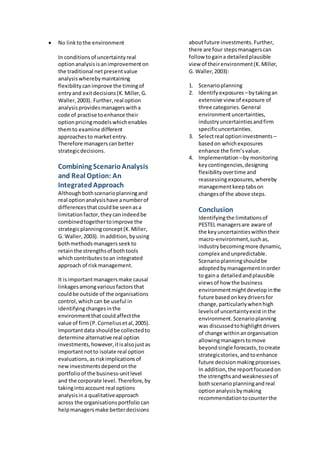
Figure 2: The Two Axes Method
From the setof developedscenarios,stories
can be created whichcan thenbe usedto test
the bestpossible scenariosforforward
thinkingstrategicplanning. Asdepictedin
figure 2, a confectionarycompanyhas usedan
impact/predictabilitymatrixtogauge highand
lowpredictabilityoutcomeswithintheir
environment. Whatiskeyto thismethodis
managersare assisted inhelpingtheir
organisationunderstandandidentifypossible
futuresbymappingthe drivingforces tofit
scenarioplanninginto the widerstrategic
managementsystem.
Scenario planninglimitations
Source: (K.Miller,G.Waller,2003)
 Potentiallyunwieldy –withoutlegal,
logical consistencyand rigorous
examination,scenarios canbe nothing
more than imaginative speculations
 Notquantifiable–as many of the
inputstoa scenarioprocessare not
quantifiable,the outputislikewise
not quantifiable
 Biases– envisionedscenariosmay
reflectcurrentcircumstancesrather
than future possibilities;dominant
personalitiesorgroupthink canlimit
the possibilitiesconsidered
 Lack of consensus –scenarioplanning
allowsfordivergentperspectives,
participantsmaynot converge on
sharedunderstandingsoracommon
strategy
SolutionTwo: Real Option
analysis
Real optionanalysisisanotherwidely
acceptedanduseful tool formanagers
to betteruncertaintieswithintheir
environment(K.Miller,G.Waller,
2003). However, unlikescenario
planning,whichisaqualitative
method, real optionanalysistakesa
quantitative approachwherebyit
assistsdecisionmakers toidentify
investmentprojectsavailabletothe
organisation. Forexample, option
analysis candetermine valuecreation,
ensuringflexibility inuncertain
environments byspreadingafirms
investments (byusingoption
valuationmodels) overtime which
enablesmanagementtominimise
unpredictablefinancial risksthat
cannot be fullypredicted.
Strengths (K.Miller,G.Waller,2003)
 Valuesflexibility –managerscan
acquire,divest,andchange resources
as and whenthe strategyneeds
 Quantitative rigour–provides
financial formulasforcalculatingreal
optionvaluesotherthanjustnet
presentvalue
 Timing– can informmanagerswhen
entryand exitshouldoccur
Weaknesses(K.Miller,G.Waller,
2003)
 Difficulttovalue inpractise
 Unrealisticassumptionsabout
managersand organisations
 Evaluative,notgenerative
 Isolatesoptions
 No linktothe environment
In conditionsof uncertaintyreal
optionanalysisisanimprovementon
the traditional netpresentvalue
analysiswherebymaintaining
flexibilitycanimprove the timingof
entryand exitdecisions(K.Miller,G.
Waller,2003). Further,real option
analysisprovidesmanagerswitha
code of practise toenhance their
optionpricingmodelswhichenables
themto examine different
approachesto marketentry.
Therefore managerscanbetter
strategicdecisions.
Combining ScenarioAnalysis
and Real Option: An
IntegratedApproach
Althoughbothscenarioplanningand
real optionanalysishave anumberof
differencesthatcouldbe seenasa
limitationfactor, theycanindeedbe
combinedtogethertoimprove the
strategicplanningconcept(K.Miller,
G. Waller,2003). Inaddition, byusing
bothmethodsmanagers seekto
retainthe strengthsof bothtools
whichcontributestoan integrated
approach of riskmanagement.
It isimportantmanagersmake causal
linkagesamongvariousfactors that
couldbe outside of the organisations
control,whichcan be useful in
identifyingchangesinthe
environmentthatcouldaffectthe
value of firm(P.Corneliusetal,2005).
Importantdata shouldbe collectedto
determine alternative real option
investments,however,itisalsojustas
importantnotto isolate real option
evaluations,asriskimplicationsof
newinvestmentsdependon the
portfolio of the business-unitlevel
and the corporate level. Therefore, by
takingintoaccount real options
analysisina qualitativeapproach
across the organisationsportfolio can
helpmanagersmake betterdecisions
aboutfuture investments. Further,
there are four stepsmanagerscan
follow togaina detailedplausible
view of theirenvironment(K.Miller,
G. Waller,2003):
1. Scenarioplanning
2. Identifyexposures –bytakingan
extensive view of exposure of
three categories.General
environmentuncertainties,
industryuncertaintiesandfirm
specificuncertainties.
3. Selectreal optioninvestments –
basedon whichexposures
enhance the firm’svalue.
4. Implementation –by monitoring
keycontingencies,designing
flexibilityovertime and
reassessingexposures,whereby
managementkeep tabson
changesof the above steps.
Conclusion
Identifyingthe limitationsof
PESTEL managersare aware of
the keyuncertaintieswithintheir
macro-environment,suchas,
industrybecomingmore dynamic,
complex and unpredictable.
Scenarioplanningshouldbe
adoptedbymanagementinorder
to gaina detailedandplausible
viewsof how the business
environmentmightdevelopinthe
future basedonkeydriversfor
change,particularlywhenhigh
levelsof uncertaintyexistinthe
environment.Scenarioplanning
was discussedtohighlightdrivers
of change withinanorganisation
allowingmanagerstomove
beyondsingle forecasts,tocreate
strategicstories,andtoenhance
future decisionmakingprocesses.
In addition,the reportfocusedon
the strengthsandweaknessesof
bothscenarioplanningandreal
optionanalysisbymaking
recommendationtocounterthe
limitationsfoundinthe
frameworks.
References
Burt, G., Wright,G., Bradfield,R.,Cairns,G.
and VanDer Heijden,K.(2006) “The role of
scenarioplanninginexploringthe
environmentinviewof the limitationsof PEST
and itsderivatives”International Studiesof
ManagementandOrganisation,Vol.36,No.3,
pp.50-76
Cornelius,P.,Vande Putte,A.andRomani,M.
(2005) “Three decadesof scenarioplanningin
Shell”California ManagementReview,Vol.48,
No.1 pp.92-109
Heidrick& struggles.(2015). The CEO Report.
Retrieved01,December,2015, from
http://www.heidrick.com/Knowledge-
Center/Publication/The-CEO-Report
Miller,K.andWaller,H. (2003) “Scenario
Planning,Real OptionsandIntegratedRisk
Planning”, Long RangePlanning,Vol.36,
pp.93-107
Mintzberg,H. (1987). CraftingStrategy.
Harvard BusinessReview,65(4), 66-75.
Schoemaker,P.(1995) “ScenarioPlanning:A
Tool for StrategicThinking”Sloan
ManagementReview,Vol.36,No.2, pp. 25-40
Schoemaker,P.andDay, G. (2009) “How to
make sense of weaksignals”MIT Sloan
ManagementReview,Vol.50,No.3,pp.81-89
Thompson,A.Strickland,L.,Gamble,J.,
Peteraf,M.,Janes,A.and Sutton,C.(2013)
Crafting and Executing Strategy:Thequestfor
CompetitiveAdvantage,1stEuropeanedition,
McGraw-Hill,Maidenhead.
My White Paper Report

My White Paper Report

  • 1.
    Coping with uncertainty– how managers can understand complex, dynamic and unpredictable uncertainties within their macro-environment 2015 STEVEN TOMLINSON STUDENT NUMBER ID: 630044285 UNIVERSITY OF EXETER | BUSINESSSCHOOL Word count:1800
  • 2.
    Executive Summary The reportsetsoutto criticallyanalyse a numberof concepts inorder to identify uncertaintieswithin anorganisationsmacro- environmentinthe followingways.  Definingakeyissue thatisof concern to managers  Proposingtwosolutions  Usingspecificexamplesandsources to supporteachsolution Finally,makesrecommendationsusingone of the solutionsdiscussed,advisingmanagersto adoptthe conceptstocope withuncertainties intheirmacro-environment. Definitionof the issue Thisreportidentifiesthe traditional PESTEL 1960’s frameworkas an insufficientapproach for organisationsandindustries,particularly withinenvironments withlowlevelsof uncertainty,suchasthe digital musicindustry. Thisproblemhas increasingly becomemore apparentto CEO’s whoare recognisingtheir role has changed (Heidrick&struggles,2015) as the environmentinwhichtheyoperatehas become more dynamic,complex and unpredictable. Whenusingthe PESTEL frameworkit is importantto understandthatthe static presentationcanbe consideredalimitation whichfailstoadd value meaningitcanonly provide managementwithalinearoverview of theirmacro-environmentanalysis; therefore there isaneedtomove away from traditional forecasting,tobetterunderstand uncertainties, ensure the longevityand survival of theirorganisation,andtomake betterdecisionsforthe future. The external factorswithinPESTELare dynamicandno considerationof the relationshipsand interactionsbetween changesinthe environmentare explored(G. Burt, 2006). For example,oftenchangesin variables betweenthe macro-environment and the competitiveenvironmentmayoccur ina shortperiod of time thusmakingit difficulttoaccurately predicthow andwhy these factorscan influence the futureof strategy planning.Mintzberg(1987) statesthe problemwithforecastingis organisationsfail to realise potential new strategies,thereforea growingneedformanagers tocontinually scan the external environment forany developmentsthatmayoccur and to proactivelymanage andadaptthe organisationsstrategyaccordingly. In summary,PESTEL istoo general inits approach andfailsto identifyfactorsthat drive change,inparticularindustriesthatgo throughunpredictable majorchanges. Therefore the nextsectionillustratesthe importantof analysingboththe wider,macro- environmentandcompetitive environment, by proposingtwo solutionstoassistmanagers inunderstandinguncertainexternal factorsof an organisationsstrategy. First,byusing scenarioplanningasa tool to further understandcomplex systems. Second,using Real Optionsanalysistoovercome scenario planninglimitations. Finally, tomake recommendations of one the solutionsto justifywhymanagersshouldtake this approach. SolutionOne: Scanning the Future withScenarios Planning Key terms Scenarios: detailedandplausible viewsof howthe businessenvironmentof anorganisationmight developinthe future basedonkeydriversfor change whenthere isa highlevel of uncertainty. Drivers of change:environmentalfactorsthatare likelytohave ahighimpact onthe successof failure of strategy. Source: (A. Thompson et al, 2013)
  • 3.
    There are manytoolsmanagementcanuseto improve theirstrategicplanning,however, scenarioplanning isseenbymanagersas much betterthanothersimilarconceptsasit factors inan extensive range of variablesused to take intoaccount uncertaintiesandbasic trendsoccurringin the macro-environment. Organisationsthatare susceptibletothe followingconditionswill gaincompetitive advantagesbyusingscenarioplanning (P. Schoemaker,1995):  Uncertaintyishighinrelationtoa manager’sabilitytoadjustorpredict.  Whencostlysurpriseshave happened inthe past.  Strategicthinkingwithinthe organisationislow.  The competitive industryhasgone throughmajor change or ispredicted to.  The organisationwantsa common language andframeworkwithout suffocatingdiversity  If there are compellingdifferencesof opinionswherebymanyopinions havingmerit  Whencompetitorsare alsousing scenarioplanningwithinthe macro- environment Managers have foundscenarioplanningakey tool inidentifying driversof change within theirenvironment.Thereforeallowingan organisationsmacro-environmenttomove beyondsingularforecaststhatcreate coherentstoriesusedtoidentifyarange of plausible eventsandtoenhance strategic decisionmaking(A.Thompson etal,2013). For example,Royal Dutch ShellGroupused scenarioplanningtopredictthe oil crisisby identifyingthe interactions betweenfactorsin the macro-environment. Indoingso,Shell builtscenariosthatidentifiedinteractions betweenvariables withintheireconomic environmentthatdirectlyimpactedthe business. OrganisationssuchasNorthernRockduring the housingbubble failedtointerpretthe weaksignalswithintheirenvironmentwhich significantly contributedtotheirdownfall. 20% of organisationsfail tointerpret weak signalsoract upon themappropriately which ispredominatelydue to individual biasesand organisational biases(P.Schoemaker,G.S. Day, 2009). For example, managersare simply not aware that emotional andcognitivebiases distorttheirabilitytoidentifyweaksignals. Therefore itiskey managers learnto overcome suchbiasesbyusingthe following approaches (Source:MIT SloanManagement Review):  Tap local intelligence  Leverage extendednetworks  Mobilise searchparties  Testmultiple hypotheses  Canvassthe wisdomof the crowd  Developdiverse scenarios  Confrontreality  Encourage constructive conflict  Trust seasonedintuition BuildingScenarios A. Thompsonetal (2013) statesthere are three levelsof scenario anduncertainties: 1. Global scenarios&general environment uncertainties 2. Focusedscenarios&Industry uncertainties 3. Projectscenarios&company uncertainties It isimportantmanagersmake use of the trendsthat appearwithinthe macro- environmentanalysisandthe driversof change;keyuncertaintiesandthe various interactions inordertobuildplausible scenarios,whichcanbe achieved by identifyingtwoextremes byoff-settingthem togetherinorderto come to conclusionson “By considering a range of alternatives managers become more tuned to what Paul Schoemaker refers to as ‘Weak Signals’ in the environment”
  • 4.
    the positive andnegativekeyuncertainties(A. Thompsonetal,2013). Further,decision makerscan quickly identifyglobaltrends by usingripple intelligence asanearlywarning systemtopredictinteractions inthe environment(Heidrick&struggles,2015). By usingthismethodmanagersare able to sense newopportunitiesfromemerging trends. Figure 2: The Two Axes Method From the setof developedscenarios,stories can be created whichcan thenbe usedto test the bestpossible scenariosforforward thinkingstrategicplanning. Asdepictedin figure 2, a confectionarycompanyhas usedan impact/predictabilitymatrixtogauge highand lowpredictabilityoutcomeswithintheir environment. Whatiskeyto thismethodis managersare assisted inhelpingtheir organisationunderstandandidentifypossible futuresbymappingthe drivingforces tofit scenarioplanninginto the widerstrategic managementsystem. Scenario planninglimitations Source: (K.Miller,G.Waller,2003)  Potentiallyunwieldy –withoutlegal, logical consistencyand rigorous examination,scenarios canbe nothing more than imaginative speculations  Notquantifiable–as many of the inputstoa scenarioprocessare not quantifiable,the outputislikewise not quantifiable  Biases– envisionedscenariosmay reflectcurrentcircumstancesrather than future possibilities;dominant personalitiesorgroupthink canlimit the possibilitiesconsidered  Lack of consensus –scenarioplanning allowsfordivergentperspectives, participantsmaynot converge on sharedunderstandingsoracommon strategy SolutionTwo: Real Option analysis Real optionanalysisisanotherwidely acceptedanduseful tool formanagers to betteruncertaintieswithintheir environment(K.Miller,G.Waller, 2003). However, unlikescenario planning,whichisaqualitative method, real optionanalysistakesa quantitative approachwherebyit assistsdecisionmakers toidentify investmentprojectsavailabletothe organisation. Forexample, option analysis candetermine valuecreation, ensuringflexibility inuncertain environments byspreadingafirms investments (byusingoption valuationmodels) overtime which enablesmanagementtominimise unpredictablefinancial risksthat cannot be fullypredicted. Strengths (K.Miller,G.Waller,2003)  Valuesflexibility –managerscan acquire,divest,andchange resources as and whenthe strategyneeds  Quantitative rigour–provides financial formulasforcalculatingreal optionvaluesotherthanjustnet presentvalue  Timing– can informmanagerswhen entryand exitshouldoccur Weaknesses(K.Miller,G.Waller, 2003)  Difficulttovalue inpractise  Unrealisticassumptionsabout managersand organisations  Evaluative,notgenerative  Isolatesoptions
  • 5.
     No linktotheenvironment In conditionsof uncertaintyreal optionanalysisisanimprovementon the traditional netpresentvalue analysiswherebymaintaining flexibilitycanimprove the timingof entryand exitdecisions(K.Miller,G. Waller,2003). Further,real option analysisprovidesmanagerswitha code of practise toenhance their optionpricingmodelswhichenables themto examine different approachesto marketentry. Therefore managerscanbetter strategicdecisions. Combining ScenarioAnalysis and Real Option: An IntegratedApproach Althoughbothscenarioplanningand real optionanalysishave anumberof differencesthatcouldbe seenasa limitationfactor, theycanindeedbe combinedtogethertoimprove the strategicplanningconcept(K.Miller, G. Waller,2003). Inaddition, byusing bothmethodsmanagers seekto retainthe strengthsof bothtools whichcontributestoan integrated approach of riskmanagement. It isimportantmanagersmake causal linkagesamongvariousfactors that couldbe outside of the organisations control,whichcan be useful in identifyingchangesinthe environmentthatcouldaffectthe value of firm(P.Corneliusetal,2005). Importantdata shouldbe collectedto determine alternative real option investments,however,itisalsojustas importantnotto isolate real option evaluations,asriskimplicationsof newinvestmentsdependon the portfolio of the business-unitlevel and the corporate level. Therefore, by takingintoaccount real options analysisina qualitativeapproach across the organisationsportfolio can helpmanagersmake betterdecisions aboutfuture investments. Further, there are four stepsmanagerscan follow togaina detailedplausible view of theirenvironment(K.Miller, G. Waller,2003): 1. Scenarioplanning 2. Identifyexposures –bytakingan extensive view of exposure of three categories.General environmentuncertainties, industryuncertaintiesandfirm specificuncertainties. 3. Selectreal optioninvestments – basedon whichexposures enhance the firm’svalue. 4. Implementation –by monitoring keycontingencies,designing flexibilityovertime and reassessingexposures,whereby managementkeep tabson changesof the above steps. Conclusion Identifyingthe limitationsof PESTEL managersare aware of the keyuncertaintieswithintheir macro-environment,suchas, industrybecomingmore dynamic, complex and unpredictable. Scenarioplanningshouldbe adoptedbymanagementinorder to gaina detailedandplausible viewsof how the business environmentmightdevelopinthe future basedonkeydriversfor change,particularlywhenhigh levelsof uncertaintyexistinthe environment.Scenarioplanning was discussedtohighlightdrivers of change withinanorganisation allowingmanagerstomove beyondsingle forecasts,tocreate strategicstories,andtoenhance future decisionmakingprocesses. In addition,the reportfocusedon the strengthsandweaknessesof bothscenarioplanningandreal optionanalysisbymaking recommendationtocounterthe
  • 6.
    limitationsfoundinthe frameworks. References Burt, G., Wright,G.,Bradfield,R.,Cairns,G. and VanDer Heijden,K.(2006) “The role of scenarioplanninginexploringthe environmentinviewof the limitationsof PEST and itsderivatives”International Studiesof ManagementandOrganisation,Vol.36,No.3, pp.50-76 Cornelius,P.,Vande Putte,A.andRomani,M. (2005) “Three decadesof scenarioplanningin Shell”California ManagementReview,Vol.48, No.1 pp.92-109 Heidrick& struggles.(2015). The CEO Report. Retrieved01,December,2015, from http://www.heidrick.com/Knowledge- Center/Publication/The-CEO-Report Miller,K.andWaller,H. (2003) “Scenario Planning,Real OptionsandIntegratedRisk Planning”, Long RangePlanning,Vol.36, pp.93-107 Mintzberg,H. (1987). CraftingStrategy. Harvard BusinessReview,65(4), 66-75. Schoemaker,P.(1995) “ScenarioPlanning:A Tool for StrategicThinking”Sloan ManagementReview,Vol.36,No.2, pp. 25-40 Schoemaker,P.andDay, G. (2009) “How to make sense of weaksignals”MIT Sloan ManagementReview,Vol.50,No.3,pp.81-89 Thompson,A.Strickland,L.,Gamble,J., Peteraf,M.,Janes,A.and Sutton,C.(2013) Crafting and Executing Strategy:Thequestfor CompetitiveAdvantage,1stEuropeanedition, McGraw-Hill,Maidenhead.