Recognising the need for change and
starting the change process

THE THEORY & PRACTICE OF CHANGE MANAGEMENT 3 rd Edition,
1
John Hayes, Palgrave, 2010
Recognising the need for change
• Managers may fail to recognise the need for change because
they pay insufficient attention to the wider environment
or
• fail to recognise the implications of what is happening around
them

2

THE THEORY & PRACTICE OF CHANGE MANAGEMENT 3rd Edition, John Hayes, Palgrave, 2010
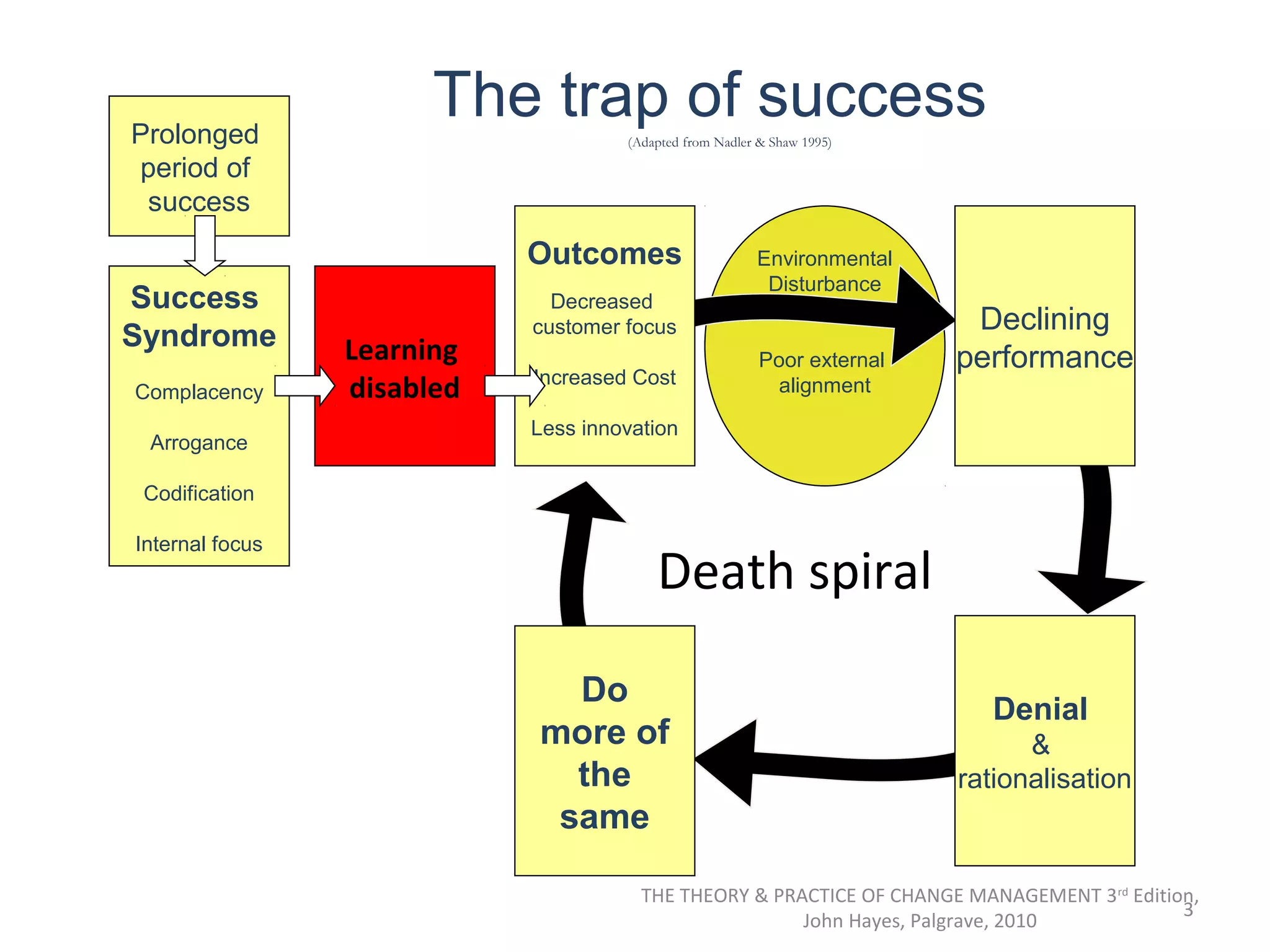
Prolonged
period of
success

The trap of success
(Adapted from Nadler & Shaw 1995)

Outcomes
Success
Syndrome
Complacency
Arrogance

Learning
disabled

Decreased
customer focus
Increased Cost

Environmental
Disturbance
Poor external
alignment

Declining
performance

Less innovation

Codification
Internal focus

Death spiral
Do
more of
the
same

Denial
&
rationalisation

THE THEORY & PRACTICE OF CHANGE MANAGEMENT 3rd Edition,
3
John Hayes, Palgrave, 2010
Sensing the need for change and formulating a
change agenda
Begins when individuals notice and respond to
what they perceive to be significant internal
and external events

4

THE THEORY & PRACTICE OF CHANGE MANAGEMENT 3rd Edition, John Hayes, Palgrave, 2010
Top team may not always notice significant
events
Recognition may be hampered by:
• Lack of diversity in functional background and
experience of members of top team
• Their commitment to a strong ideology (mental
model) that marginalises dissenting views.

5

THE THEORY & PRACTICE OF CHANGE MANAGEMENT 3rd Edition, John Hayes, Palgrave, 2010
Playmakers
Top managers can encourage other
organizational members to perform
“playmaker” roles by seeking out relevant
opinion from those close to the operating
environment
Pitt et al (2002) borrow the term playmaker from football where it refers
to the restless, energetic, midfield role that links play, energises the team
and makes things happen.
6

THE THEORY & PRACTICE OF CHANGE MANAGEMENT 3rd Edition, John Hayes, Palgrave, 2010
Democratic brokers
Democratic brokers are playmakers who facilitate lateral
communication among peers.
They tend to be respected organizational members with perceived
expertise who function as interpreters, ideas brokers, and opinion
canvassers. They use their nodal position in communication
networks to originate and trade concerns with peers.
Because they bring together different groups and interests, brokers can
help promote diverse interpretations of situations and point to
opportunities and threats that might not be identified by a narrow group
of senior managers acting alone.

7

THE THEORY & PRACTICE OF CHANGE MANAGEMENT 3rd Edition, John Hayes, Palgrave, 2010
Sensing the need for change
Widening the opportunity for organizational members to
engage in playmaking can greatly improve an organization’s
ability to recognise the need for change
Actively seeking out and debating alternative perspectives
and interpretations can help ensure that the possibility of
new threats or opportunities are properly considered

THE THEORY & PRACTICE OF CHANGE MANAGEMENT 3rd Edition, John Hayes, Palgrave, 2010

8
Failure to recognise the need for
change in good time
•

promotes a reactive approach to change

•

limits the possibilities for planning and involving others in
the change process

THE THEORY & PRACTICE OF CHANGE MANAGEMENT 3rd Edition,
9
John Hayes, Palgrave, 2010
Performance indicators
Discrepancies between actual and desired
performance can signal a need for change

THE THEORY & PRACTICE OF CHANGE MANAGEMENT 3rd Edition,
10
John Hayes, Palgrave, 2010
Effectiveness can be considered from a number of
different perspectives
1. Purpose
2. Stakeholder perspective
3. Level of assessment
4. Alignment
5. Time perspective
6. External bench mark
7. Constraints and enabling factors

THE THEORY & PRACTICE OF CHANGE MANAGEMENT 3rd Edition,
11
John Hayes, Palgrave, 2010
1. Purpose
• Religious orders and charities have to be financially viable but
their purpose is not to make a profit.
• Indicators of effectiveness need to be related to the purpose
of the unit or the organization.

12

THE THEORY & PRACTICE OF CHANGE MANAGEMENT 3rd Edition, John Hayes, Palgrave, 2010
2. Stakeholder perspective
• Different stakeholders (senior managers, other workers,
customers, suppliers, shareholders, local residents, regulatory
bodies) may use different indicators to assess the
effectiveness of an organization.

THE THEORY & PRACTICE OF CHANGE MANAGEMENT 3rd Edition, John Hayes, Palgrave, 201013
3. Level of assessment
• Different criteria may be used to assess effectiveness at
different levels (individual, work group, department, strategic
business unit, total organization).
• Criteria might relate to linkages (e.g. at the individual level,
good citizen behaviour might be as important as task
performance).

THE THEORY & PRACTICE OF CHANGE MANAGEMENT 3rd Edition, John Hayes, Palgrave, 2010

14
4. Alignment

Up, down and across the organization

15

THE THEORY & PRACTICE OF CHANGE MANAGEMENT 3rd Edition, John Hayes, Palgrave, 2010
5. Time perspective
• An organization that is not very profitable today may be
incurring higher costs in order to invest in new plant, product
development and training to guarantee greater profits over
the long term.

16

THE THEORY & PRACTICE OF CHANGE MANAGEMENT 3rd Edition, John Hayes, Palgrave, 2010
6. External bench mark
• Performance in one unit may need to be bench marked
against performance elsewhere in order to assess how
effective it is.

17

THE THEORY & PRACTICE OF CHANGE MANAGEMENT 3rd Edition, John Hayes, Palgrave, 2010
7. Constraints and enabling factors
• For example, a budget airline’s decision to open a route to
one location rather than another might have a positive effect
on the performance of the local area unit of a car hire firm
that has little to do with factors internal to that unit. This
might need to be taken into account when assessing the
effectiveness of that unit relative to other units.

THE THEORY & PRACTICE OF CHANGE MANAGEMENT 3rd Edition, John Hayes, Palgrave, 2010
18
Discussion topic
• How is the effectiveness of your unit/department assessed.
Share views with colleagues and identify common themes
and important differences.
• Are the most appropriate criteria used to assess the
effectiveness of your unit? If not, explain why.
• Do they help to signal the need for change?

THE THEORY & PRACTICE OF CHANGE MANAGEMENT 3rd Edition, John Hayes, Palgrave, 2010
19
Change agency
To what extent can managers intervene and make a real
difference to the effectiveness of your organization?
One view holds that managers are constrained by external
factors.
Second view emphasises the role of human agency and asserts
that managers can make an important difference.

20

THE THEORY & PRACTICE OF CHANGE MANAGEMENT 3rd Edition, John Hayes, Palgrave, 2010
Beliefs about change agency
Sometimes the limiting factor on change agency is not
conceptual knowledge or familiarity with appropriate
intervention tools. It is rooted in the beliefs about the ability
to make a difference:
Locus of control
Learned helplessness

THE THEORY & PRACTICE OF CHANGE MANAGEMENT 3rd Edition, John Hayes, Palgrave, 2010
21
Discussion topic
• To what extent can managers at your level make a
difference?
• What are the main factors that affect their ability to make a
difference?

THE THEORY & PRACTICE OF CHANGE MANAGEMENT 3rd Edition, John Hayes, Palgrave, 2010
22
Translating recognition into a desire
for change
• “Those who are most likely to want to change are those
who are basically successful but who are experiencing
particular problems.
• Next are those who are always successful
• The least likely to understand and accept the need for
change are the unsuccessful”
Pugh 1993

23
THE THEORY & PRACTICE OF CHANGE MANAGEMENT 3rd Edition, John Hayes, Palgrave, 2010
Starting the change process
• Selecting the change agent
• Developing the change relationship
• Identifying the client/target group
• Clarifying the issues

24

THE THEORY & PRACTICE OF CHANGE MANAGEMENT 3rd Edition, John Hayes, Palgrave, 2010
Selecting the change agent: insider or
outsider?
Insiders may take on the role when:
• They have the required competence and commitment
• There are insufficient resources to buy-in an outsider
• Issues of confidentiality and trust prohibit use of an
outsider
• It proves difficult to identify a suitable outsider

25

THE THEORY & PRACTICE OF CHANGE MANAGEMENT 3rd Edition, John Hayes, Palgrave, 2010
Outsiders may be invited to take on the role of
change agent when:
• There is nobody on the inside who has the time and
competence to act as the facilitator of change
• It is felt that all of the competent insiders have a vested
interest and are less acceptable to all parties than a neutral
outsider.

26

THE THEORY & PRACTICE OF CHANGE MANAGEMENT 3rd Edition, John Hayes, Palgrave, 2010
The development of a change relationship is
affected by:
• The client’s need for sympathy versus objectivity
• Perceptions of the change agent’s motives and loyalties
• Perceptions of the change agent’s competence

27

THE THEORY & PRACTICE OF CHANGE MANAGEMENT 3rd Edition, John Hayes, Palgrave, 2010
Identifying the client and/or the target
group for change
• Who owns the problem and is responsible for doing
something about it?
• Who can have a direct impact on the change issue?

28

THE THEORY & PRACTICE OF CHANGE MANAGEMENT 3rd Edition, John Hayes, Palgrave, 2010
Clarifying the issues
• The presenting problem may only be a symptom of an
underlying problem
• The presenting problem may be proffered in terms of
solutions (we need help with team building)
Exercise
Group 1. With reference to the paper by Pitt et al:
• Do managers in your organization make appropriate assumptions about how the
agenda for change should be formulated?
• Is there sufficient diversity among active playmakers in your organization?
• To what extent is effective playmaking undermined by lack of networking skills,
political competence, advocacy and the ability to inspire others?

Group 2. Based on your experience, list any problems you have encountered in the early
stages of the change process that have been associated with:
• choice of change agent,
• quality of the change relationship,
• identification of the group to be targeted for change,
• specification of the change issues.

30

Recognising the need for change and starting the change process

  • 1.
    Recognising the needfor change and starting the change process THE THEORY & PRACTICE OF CHANGE MANAGEMENT 3 rd Edition, 1 John Hayes, Palgrave, 2010
  • 2.
    Recognising the needfor change • Managers may fail to recognise the need for change because they pay insufficient attention to the wider environment or • fail to recognise the implications of what is happening around them 2 THE THEORY & PRACTICE OF CHANGE MANAGEMENT 3rd Edition, John Hayes, Palgrave, 2010
  • 3.
    Prolonged period of success The trapof success (Adapted from Nadler & Shaw 1995) Outcomes Success Syndrome Complacency Arrogance Learning disabled Decreased customer focus Increased Cost Environmental Disturbance Poor external alignment Declining performance Less innovation Codification Internal focus Death spiral Do more of the same Denial & rationalisation THE THEORY & PRACTICE OF CHANGE MANAGEMENT 3rd Edition, 3 John Hayes, Palgrave, 2010
  • 4.
    Sensing the needfor change and formulating a change agenda Begins when individuals notice and respond to what they perceive to be significant internal and external events 4 THE THEORY & PRACTICE OF CHANGE MANAGEMENT 3rd Edition, John Hayes, Palgrave, 2010
  • 5.
    Top team maynot always notice significant events Recognition may be hampered by: • Lack of diversity in functional background and experience of members of top team • Their commitment to a strong ideology (mental model) that marginalises dissenting views. 5 THE THEORY & PRACTICE OF CHANGE MANAGEMENT 3rd Edition, John Hayes, Palgrave, 2010
  • 6.
    Playmakers Top managers canencourage other organizational members to perform “playmaker” roles by seeking out relevant opinion from those close to the operating environment Pitt et al (2002) borrow the term playmaker from football where it refers to the restless, energetic, midfield role that links play, energises the team and makes things happen. 6 THE THEORY & PRACTICE OF CHANGE MANAGEMENT 3rd Edition, John Hayes, Palgrave, 2010
  • 7.
    Democratic brokers Democratic brokersare playmakers who facilitate lateral communication among peers. They tend to be respected organizational members with perceived expertise who function as interpreters, ideas brokers, and opinion canvassers. They use their nodal position in communication networks to originate and trade concerns with peers. Because they bring together different groups and interests, brokers can help promote diverse interpretations of situations and point to opportunities and threats that might not be identified by a narrow group of senior managers acting alone. 7 THE THEORY & PRACTICE OF CHANGE MANAGEMENT 3rd Edition, John Hayes, Palgrave, 2010
  • 8.
    Sensing the needfor change Widening the opportunity for organizational members to engage in playmaking can greatly improve an organization’s ability to recognise the need for change Actively seeking out and debating alternative perspectives and interpretations can help ensure that the possibility of new threats or opportunities are properly considered THE THEORY & PRACTICE OF CHANGE MANAGEMENT 3rd Edition, John Hayes, Palgrave, 2010 8
  • 9.
    Failure to recognisethe need for change in good time • promotes a reactive approach to change • limits the possibilities for planning and involving others in the change process THE THEORY & PRACTICE OF CHANGE MANAGEMENT 3rd Edition, 9 John Hayes, Palgrave, 2010
  • 10.
    Performance indicators Discrepancies betweenactual and desired performance can signal a need for change THE THEORY & PRACTICE OF CHANGE MANAGEMENT 3rd Edition, 10 John Hayes, Palgrave, 2010
  • 11.
    Effectiveness can beconsidered from a number of different perspectives 1. Purpose 2. Stakeholder perspective 3. Level of assessment 4. Alignment 5. Time perspective 6. External bench mark 7. Constraints and enabling factors THE THEORY & PRACTICE OF CHANGE MANAGEMENT 3rd Edition, 11 John Hayes, Palgrave, 2010
  • 12.
    1. Purpose • Religiousorders and charities have to be financially viable but their purpose is not to make a profit. • Indicators of effectiveness need to be related to the purpose of the unit or the organization. 12 THE THEORY & PRACTICE OF CHANGE MANAGEMENT 3rd Edition, John Hayes, Palgrave, 2010
  • 13.
    2. Stakeholder perspective •Different stakeholders (senior managers, other workers, customers, suppliers, shareholders, local residents, regulatory bodies) may use different indicators to assess the effectiveness of an organization. THE THEORY & PRACTICE OF CHANGE MANAGEMENT 3rd Edition, John Hayes, Palgrave, 201013
  • 14.
    3. Level ofassessment • Different criteria may be used to assess effectiveness at different levels (individual, work group, department, strategic business unit, total organization). • Criteria might relate to linkages (e.g. at the individual level, good citizen behaviour might be as important as task performance). THE THEORY & PRACTICE OF CHANGE MANAGEMENT 3rd Edition, John Hayes, Palgrave, 2010 14
  • 15.
    4. Alignment Up, downand across the organization 15 THE THEORY & PRACTICE OF CHANGE MANAGEMENT 3rd Edition, John Hayes, Palgrave, 2010
  • 16.
    5. Time perspective •An organization that is not very profitable today may be incurring higher costs in order to invest in new plant, product development and training to guarantee greater profits over the long term. 16 THE THEORY & PRACTICE OF CHANGE MANAGEMENT 3rd Edition, John Hayes, Palgrave, 2010
  • 17.
    6. External benchmark • Performance in one unit may need to be bench marked against performance elsewhere in order to assess how effective it is. 17 THE THEORY & PRACTICE OF CHANGE MANAGEMENT 3rd Edition, John Hayes, Palgrave, 2010
  • 18.
    7. Constraints andenabling factors • For example, a budget airline’s decision to open a route to one location rather than another might have a positive effect on the performance of the local area unit of a car hire firm that has little to do with factors internal to that unit. This might need to be taken into account when assessing the effectiveness of that unit relative to other units. THE THEORY & PRACTICE OF CHANGE MANAGEMENT 3rd Edition, John Hayes, Palgrave, 2010 18
  • 19.
    Discussion topic • Howis the effectiveness of your unit/department assessed. Share views with colleagues and identify common themes and important differences. • Are the most appropriate criteria used to assess the effectiveness of your unit? If not, explain why. • Do they help to signal the need for change? THE THEORY & PRACTICE OF CHANGE MANAGEMENT 3rd Edition, John Hayes, Palgrave, 2010 19
  • 20.
    Change agency To whatextent can managers intervene and make a real difference to the effectiveness of your organization? One view holds that managers are constrained by external factors. Second view emphasises the role of human agency and asserts that managers can make an important difference. 20 THE THEORY & PRACTICE OF CHANGE MANAGEMENT 3rd Edition, John Hayes, Palgrave, 2010
  • 21.
    Beliefs about changeagency Sometimes the limiting factor on change agency is not conceptual knowledge or familiarity with appropriate intervention tools. It is rooted in the beliefs about the ability to make a difference: Locus of control Learned helplessness THE THEORY & PRACTICE OF CHANGE MANAGEMENT 3rd Edition, John Hayes, Palgrave, 2010 21
  • 22.
    Discussion topic • Towhat extent can managers at your level make a difference? • What are the main factors that affect their ability to make a difference? THE THEORY & PRACTICE OF CHANGE MANAGEMENT 3rd Edition, John Hayes, Palgrave, 2010 22
  • 23.
    Translating recognition intoa desire for change • “Those who are most likely to want to change are those who are basically successful but who are experiencing particular problems. • Next are those who are always successful • The least likely to understand and accept the need for change are the unsuccessful” Pugh 1993 23 THE THEORY & PRACTICE OF CHANGE MANAGEMENT 3rd Edition, John Hayes, Palgrave, 2010
  • 24.
    Starting the changeprocess • Selecting the change agent • Developing the change relationship • Identifying the client/target group • Clarifying the issues 24 THE THEORY & PRACTICE OF CHANGE MANAGEMENT 3rd Edition, John Hayes, Palgrave, 2010
  • 25.
    Selecting the changeagent: insider or outsider? Insiders may take on the role when: • They have the required competence and commitment • There are insufficient resources to buy-in an outsider • Issues of confidentiality and trust prohibit use of an outsider • It proves difficult to identify a suitable outsider 25 THE THEORY & PRACTICE OF CHANGE MANAGEMENT 3rd Edition, John Hayes, Palgrave, 2010
  • 26.
    Outsiders may beinvited to take on the role of change agent when: • There is nobody on the inside who has the time and competence to act as the facilitator of change • It is felt that all of the competent insiders have a vested interest and are less acceptable to all parties than a neutral outsider. 26 THE THEORY & PRACTICE OF CHANGE MANAGEMENT 3rd Edition, John Hayes, Palgrave, 2010
  • 27.
    The development ofa change relationship is affected by: • The client’s need for sympathy versus objectivity • Perceptions of the change agent’s motives and loyalties • Perceptions of the change agent’s competence 27 THE THEORY & PRACTICE OF CHANGE MANAGEMENT 3rd Edition, John Hayes, Palgrave, 2010
  • 28.
    Identifying the clientand/or the target group for change • Who owns the problem and is responsible for doing something about it? • Who can have a direct impact on the change issue? 28 THE THEORY & PRACTICE OF CHANGE MANAGEMENT 3rd Edition, John Hayes, Palgrave, 2010
  • 29.
    Clarifying the issues •The presenting problem may only be a symptom of an underlying problem • The presenting problem may be proffered in terms of solutions (we need help with team building)
  • 30.
    Exercise Group 1. Withreference to the paper by Pitt et al: • Do managers in your organization make appropriate assumptions about how the agenda for change should be formulated? • Is there sufficient diversity among active playmakers in your organization? • To what extent is effective playmaking undermined by lack of networking skills, political competence, advocacy and the ability to inspire others? Group 2. Based on your experience, list any problems you have encountered in the early stages of the change process that have been associated with: • choice of change agent, • quality of the change relationship, • identification of the group to be targeted for change, • specification of the change issues. 30