Liquid Dosage Forms
• Solutions
• Suspensions.
• Emulsions
Oral Solution Dosage Form Technology
• Definition :
liquid preparations in which the therapeutic agent and the various
excipients are dissolved in the chosen solvent system.
• Types of pharmaceutical solutions:
- Oral solutions.
- Oral syrups.
- Oral elixirs
- Linctuses
- Mouth wash and gargles
- Enemas
Advantages of oral pharmaceutical solutions
• Easily to administered.
• Readily available for absorption.
• Taste masking may be achieved.
Disadvantages
• Stability
• Poorly soluble drugs.
• Shipment
Excipients
• Functions:
- Pourability
- Palatability
- Regulating stability
- Enhance the solubility
Excipients
• The vehicle, usually purified water.
• Co-solvent, propylene glycol, glycerol, alcohol.
• Surface-active agent.
• Preservative, parahydroxybenzoate esters( methyl hydroxyl benzoate and propyl
hydroxyl benzoate), boric acid and borates, sorbic acid and sorbates, phenolics.
• Sweetener, glucose, saccharin, aspartame.
• Rheology modifier, hydrophilic polymer ( cellulose derivatives, alginic acid,
polyvinylpyrrolidone)
• Antioxidant; sodium formaldehyde sulphoxylate, butylated hydroxyanisole,
butylated hydroxytolene.
• Colours
• Flavours
• Buffer
The Vehicle – Purified water
• Prepared by distillation, ion exchange and by reverse osmosis.
• The solid residue obtained after evaporation is less than 1 mg per 100
ml of evaporated sample.
• Must not be used for the preparation of parenteral formulation.
Formulation methods to enhance solubility
• Appropriate selection of drug salt
• Optimizing the pH.
• Use of co-solvents.
Co-Solvent
• Glycerol
• Ethanol, single or with glycerol.
• Propylene Glycol
• Polyethylene glycol – lower m.weight is preferred.
• Use of surface active agent –
the concentration at which the interface become saturated with
surface active agent and aqueous molecules phase orient themselves
to shield the hydrophobic regions of the surface active agent , this is
the Critical Micelle Concentration.
• Use of complexation by hydrophilic polymer.
Buffers
• To maintain the solubility of the active agent in the formulated
product.
• To enhance the stability for products which are stability pH-
dependent.
- acetates
- Citrates
- Phosphates
Sweeting agents
• Sucrose, glucose,
• glycerol, sorbitol,
• saccharin sodium, aspartame.
Viscosity – enhancing agent
• Syrups do not need viscosity enhancing agents.
• Nonionic neutral polymers as cellulose derivatives ; methyl cellulose,
hydroxyethylcellulose, hydroxypropylcellulose. Polyvinylpyrrolidone.
• Ionic polymers
- Sodium carboxymethylcellulose ( anionic)
- Sodium alginate (anionic)
Antioxidants
• Antioxidants are molecules that are redox systems which exhibit higher oxidative
potential than the therapeutic agent or compounds that inhibit free radical-
induced drug decomposition.
• For aqueous formulations: Sodium sulphite, sodium metabisulphite, sodium
formaldehyde sulphoxylate, ascorbic acid.
• For oil-based formulations: butylated hydroxytoluene, butylated hydroxyanisole
and propyl gallate.
• Used in low concentration < 0.2% w/w.
• May be used with chelating agent as ethylenediamine tetracetic acid , citric acid.
Preservatives
• Should be broad spectrum antimicrobial activity.
• Should be chemically and physically stable over the entire shelf-life.
• Low toxicity.
- Benzoic acid and its salts 0.1- 0.3%
- Sorbic acid and its salts 0.05 – 0.2%
- Alkyl esters of parahydroxybenzoic acid ( 0.001 – 0.2%, methyl and
propyl parahydroxybenzoate in ratios 9:1. this combination enhances
the antimicrobial spectrum.
• The antimicrobial activity of the preservative is affected by the pH and
the presence of micelles and presence of hydrophilic polymer.
• Cationic hydrophilic polymers should not be used with acidic
preservatives.
Flavours and colourants
• Masking salty taste; butterscotch, apricot, peach, vanilla, wintergreen mint.
• Masking bitter taste; cherry, mint, anise.
• Masking sweet taste; vanilla, fruit and berry.
• Masking sour taste; citrus flavours, raspberry.
• Usually combination is used.
• Menthol , chloroform may be used to desensitize the taste receptors
• Colours should match the flavor used; green with mint, red with strawberry.
Types of Oral pharmaceutical solutions
• Oral solutions
• Oral syrups
• Oral elixirs
------ mouth wash, gargles, enemas
Oral solutions
• Usual pH is 7.
• Excipients used are;
- Buffers ( citrate, phosphate)
- Preservative (parabens, benzoic, sorbic acid)
- Water soluble antioxidant; sodium metabisulphite 0.01 – 15 W/W.
- Flavours and colourants
- Viscosity modifying agents as sodium alginate, hydroxyethylcellulose.
• All should be soluble and no evidence of precipitation.
Oral syrup
• Purified water
• Sugar 60 – 80%
• It may contain flavours and colourant but no need for sweetener, viscosity
modifier nor preservative.
• Sorbitol may replace sucrose. Or sorbitol and glycerol.
• Sugar free syrups; methylcellulose and sweetener and sodium benzoate.
• Flavours; peppermint, lemon, anise, banana.
• Colour should match the flavor.
• All excipients should not interact with other component of the formulation.
Oral elixirs
• elixir is a clear, hydroalcoholic solution that is formulated for oral use.
• Components are:
- Purified water.
- Alcohol employed as co-solvent. Generally 10%v/v but may reach 40% v/v.
- Polyols to reduce the concentration of alcohol.
- Sweetening agent; sorbitol solution, saccharin sodium. High concentration
of alcohol prohibit high concentration of sucrose due to limitation of
solubility. In this case saccharin is used.
- Flavour and colour.
- Preservative is not required in elixir containing more than 12% alcohol.
- Elixirs should be stored tied at low temperature.
- Viscosity modifier as hydrophilic polymer may be required.
Linctuses
• Viscous preparations containing the therapeutic agent dissolved in
high concentration of sucrose.
• Mainly for cough due to their soothing action on the inflamed
mucous membrane.
• May be formulated as sugar free using sorbitol and required
concentration of sweetening agent.
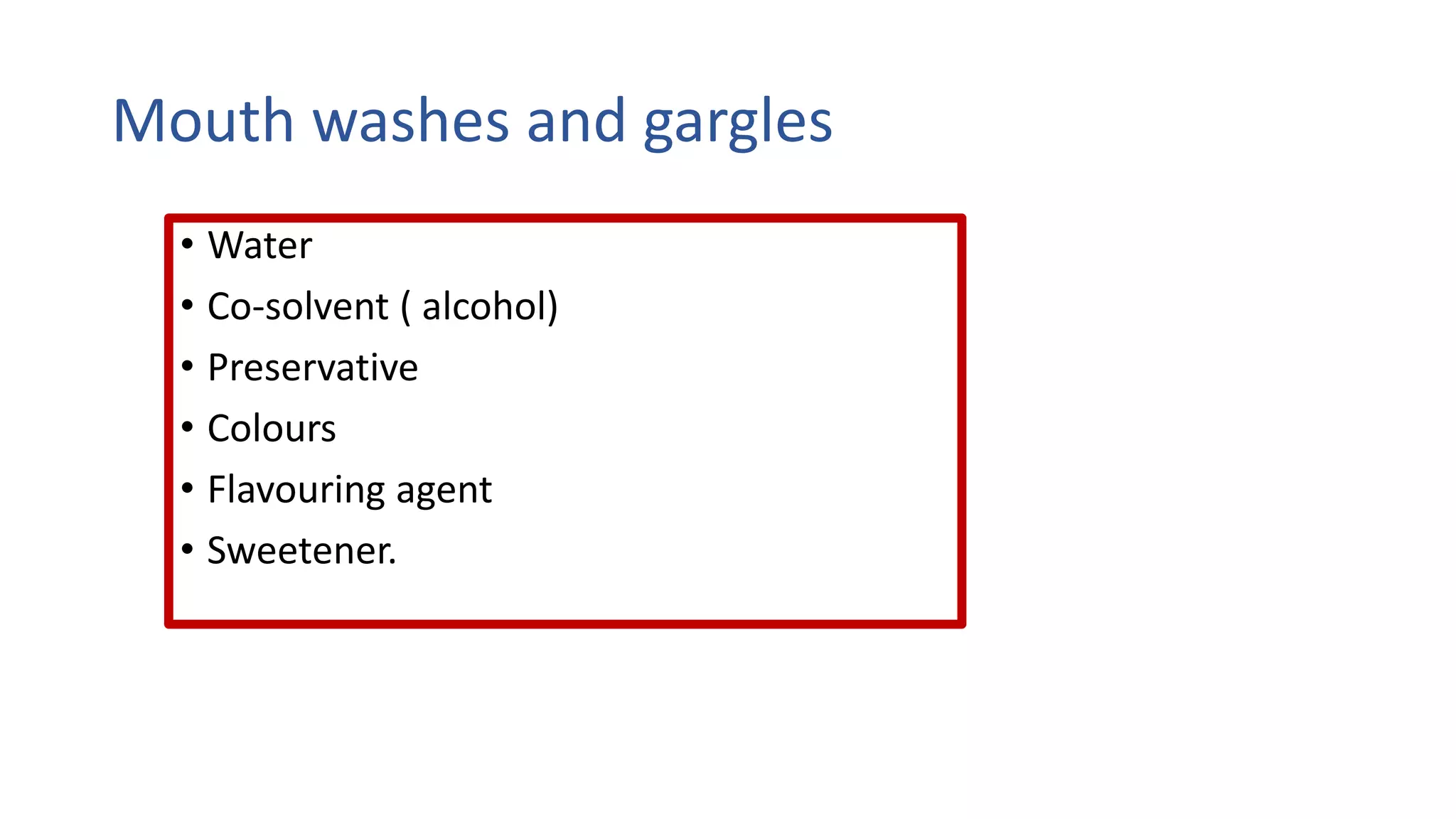
Mouth washes and gargles
• Water
• Co-solvent ( alcohol)
• Preservative
• Colours
• Flavouring agent
• Sweetener.
Enemas
• May be aqueous or oil
• Arachis oil
• Aqueous usually contains phosphates
• They contain viscosity enhancing agent as glycerol.
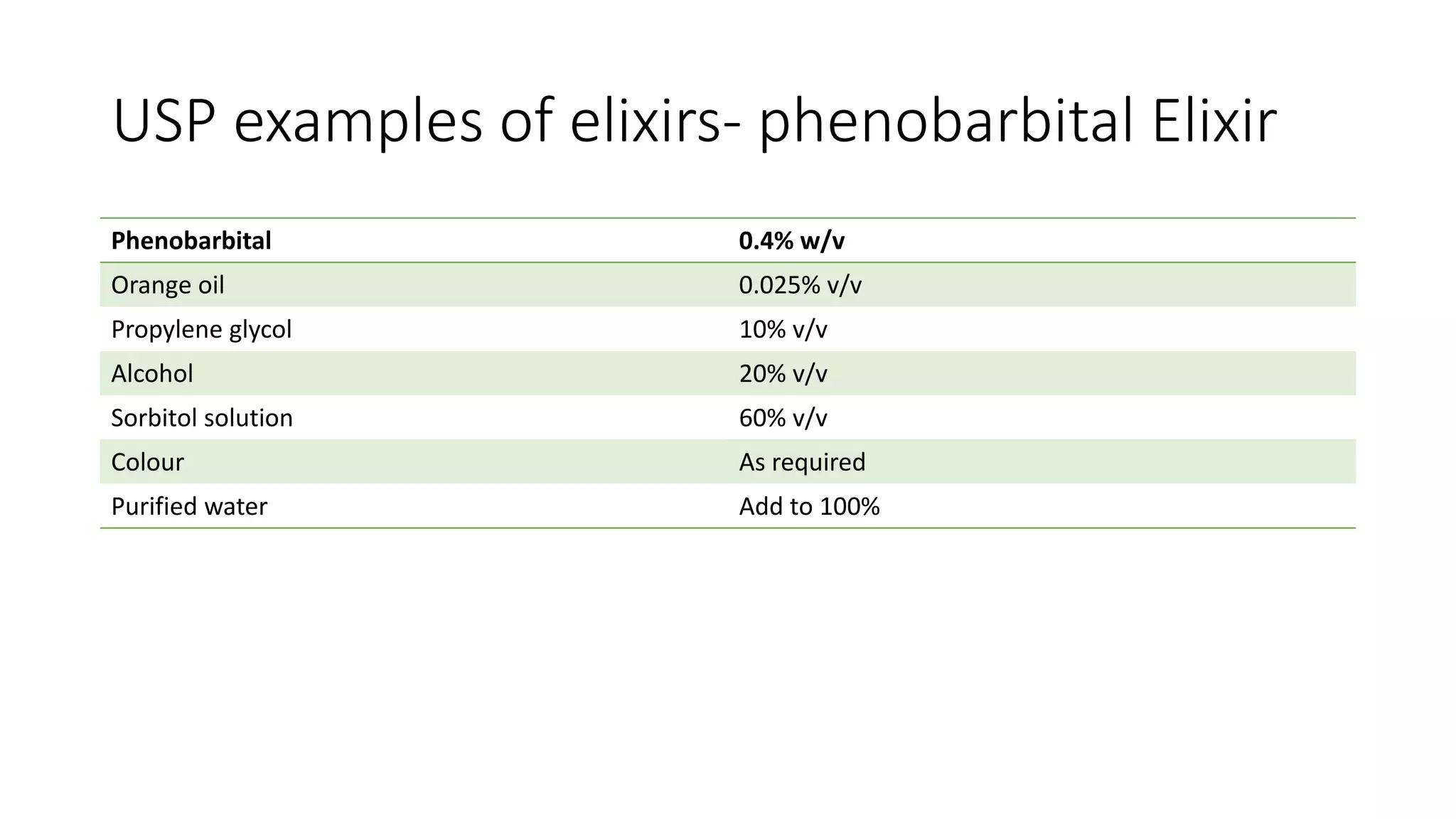
USP examples of elixirs- phenobarbital Elixir
Phenobarbital 0.4% w/v
Orange oil 0.025% v/v
Propylene glycol 10% v/v
Alcohol 20% v/v
Sorbitol solution 60% v/v
Colour As required
Purified water Add to 100%
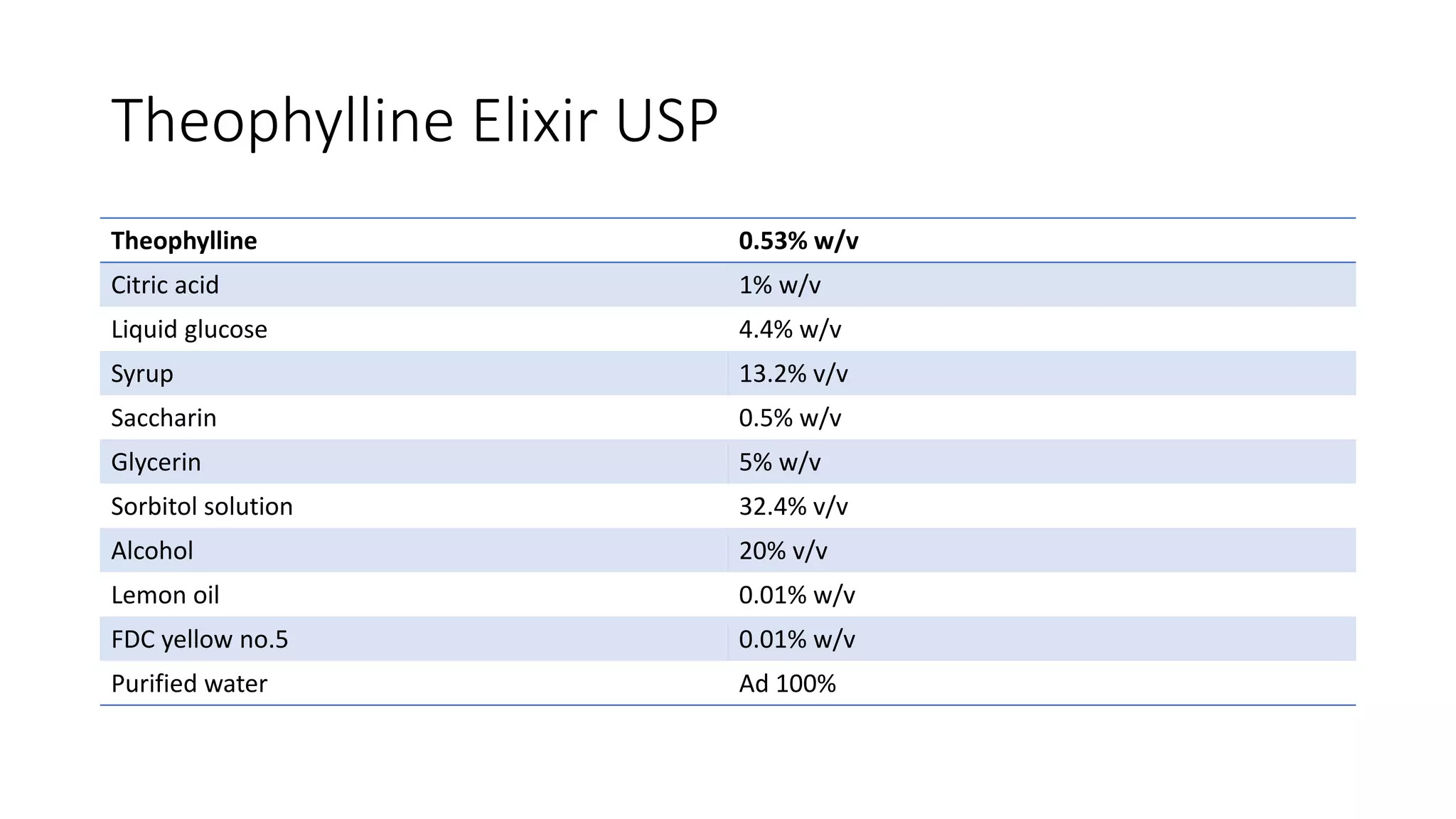
Theophylline Elixir USP
Theophylline 0.53% w/v
Citric acid 1% w/v
Liquid glucose 4.4% w/v
Syrup 13.2% v/v
Saccharin 0.5% w/v
Glycerin 5% w/v
Sorbitol solution 32.4% v/v
Alcohol 20% v/v
Lemon oil 0.01% w/v
FDC yellow no.5 0.01% w/v
Purified water Ad 100%
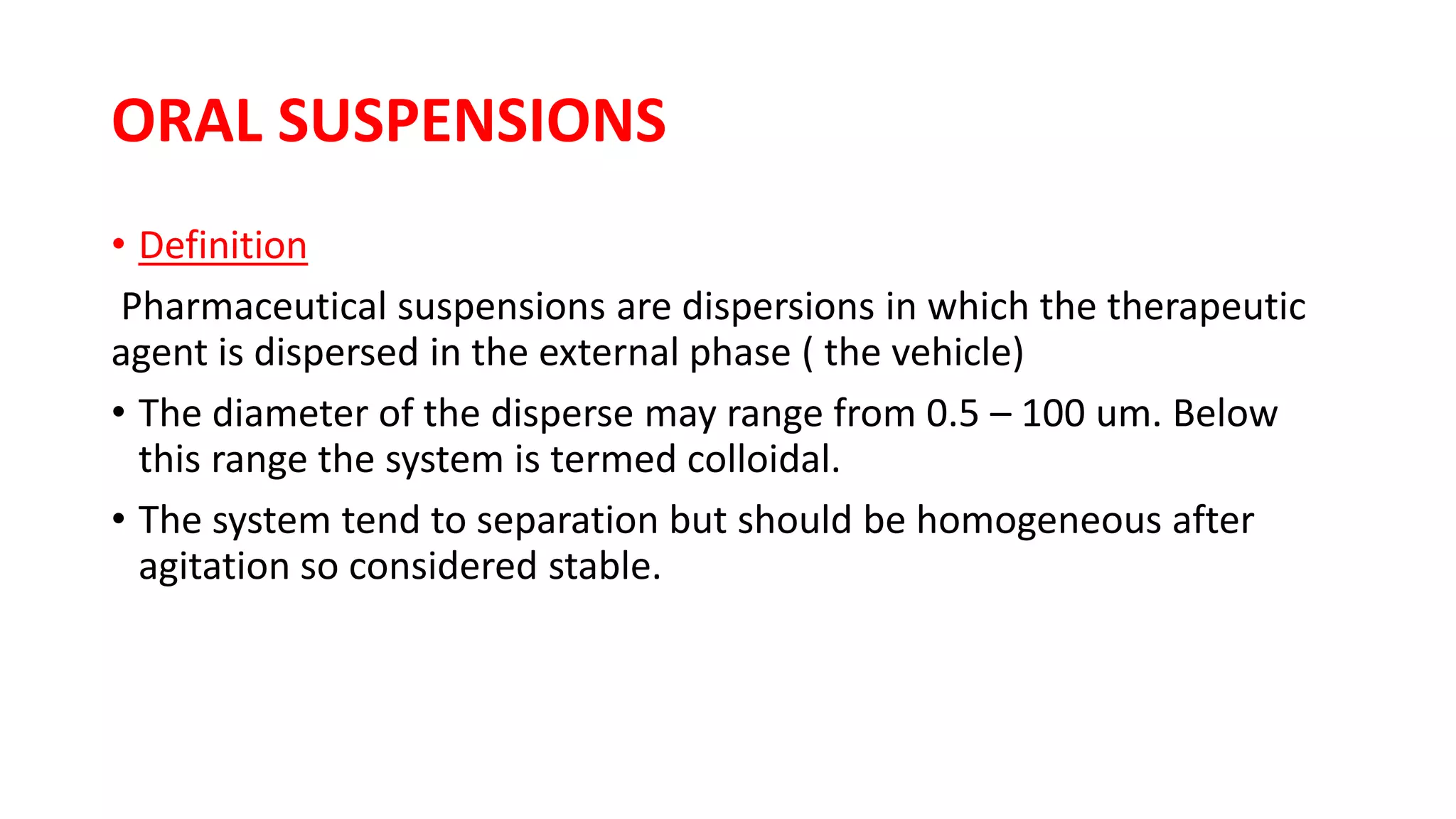
ORAL SUSPENSIONS
• Definition
Pharmaceutical suspensions are dispersions in which the therapeutic
agent is dispersed in the external phase ( the vehicle)
• The diameter of the disperse may range from 0.5 – 100 um. Below
this range the system is termed colloidal.
• The system tend to separation but should be homogeneous after
agitation so considered stable.
• Characteristics of acceptable suspension:
- A low rate of sedimentation.
- The disperse phase must be redispersed with gentle shaking.
- The flow properties of the suspension should enable the formulation
to be easily removed from the container.
- Aesthetically pleasing.
Advantages
• Delivery system for low solubility agents.
• Solutions with co solvent may exhibit precipitation.
• Used to mask the taste of therapeutic agent.
• May be used for patient having difficulty to swallowing solid dosage
form..
• May be used to formulate controlled drug delivery.
Disadvantages
• Stability problems.
• Formulation is difficult.
• Bulky and difficult to carry.
Formulation considerations for suspensions for
Oral Use
• Stability of excipients and the therapeutic agent.
• Suitability for the patient.
The therapeutic agent
• Particle size:
- The rate of sedimentation is practically decreased by reducing the
average particle size.
- The rate of sedimentation is directly proportional to the square of the
average diameter of the particles d²
- Reduced particle size may achieved by chemically by ………… and
physically by ……………..
- Particle size below 10 µm , the energy required should be compromised.
• The particle size in suspension is influenced by crystal growth;
Ostwald ripening.
• This requires inclusion of hydrophilic polymer.
• Temperature cycling.
Wetting properties of the therapeutic agent
• The contact angle θ may be defined in terms of the interfacial tension
between the three phases; solid ( drug) vapour Ꝩs/v , liquid vapour ꝨL/v
and solid-liquid vapour Ꝩs/L
• Young equation ꝨL/v cos θ = Ꝩs/v - Ꝩs/L
• Decreasing the interfacial tensions between the vehicle and the
vapour and between the solid and the vehicle may reduce the contact
angle.
• In practice this is achieved by incorporation of a ……………………
• Poorly wetted drug particles will tend to aggregate resulting in
physical stability problems.
Excipients
• Vehicle.
• Excipients to enhance the physical stability.
- Electrolytes
- Surface-active agents.
- Hydrophilic polymers
• Preservatives
• Sweeting agents / flavours
• Antioxidants
Vehicles
•Purified water USP
•Buffer usually citrate buffer
( ……../………….)
Excipients to enhance physical stability –
addition of electrolytes
• Employed to control flocculation by reducing the zeta
potential and hence the electrical repulsion that exist
between the particles. Facilitating the interactions between
the particles at a definite distance.
• Buffers may be used for this purpose or other salts.
• Insufficient or excess electrolyte will produce caking.
• To assure correct ionic strength a series of formulations are
prepared.
Surface-active agents
• Decreases the contact angle enabling greater wetting by the vehicle.
• Reduce the zeta potential facilitating flocculation.
• Non-ionic surfactants are preferred for oral suspensions; polyethylene
fatty acid sorbitan esters, sorbitan esters, lecithin
• Concentration less than 0.5% w/v are generally used.
Hydrophilic polymers
• Hydrophilic polymer may adsorb on to the surface of suspended
particles and leaving the remainder of the chain to extend into the
vehicle.
• This will prevent the particles coming into close contact.
• The action of the polymer depends on :
1. The concentration, the required concentration of the polymer
should be that which enhances repulsion but not preventing
interaction of the particles in flocculation. Generally flocculation
occurs at a distance which is twice the thickness of the adsorbed
polymer layer.
2. The type of the polymer:
- The chemical structure influences the nature of the adsorption on to
the surface of drug particles which influence the thickness and
integrity.
- Interactions between specific groups on adjacent polymer chain is
responsible for the stearic stabilization.
- Anionic polymer in the presence of divalent cations make bridging
between two particles preventing their interaction.
- Hydrophilic polymer when added to aqueous solvent, increases the
viscosity , reduce the rate of sedimentation and thus enhancing the
physical stability.
3. Effect of the rheological properties,
- Increasing the concentration of the polymer increases the viscosity
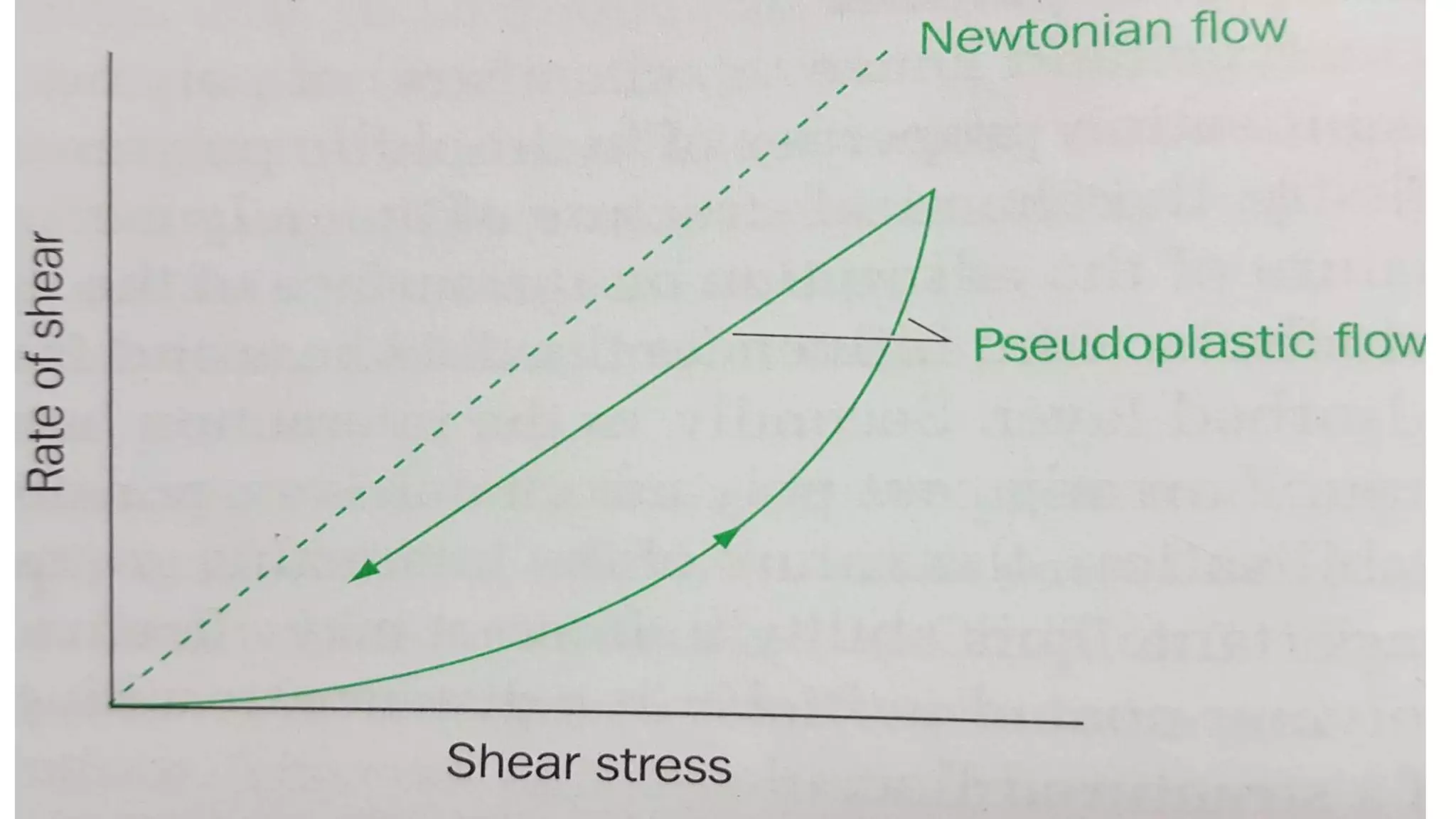
- Low concentration <0.01% the aqueous vehicle behaves as Newtonian
systems in which the shearing stress and rate of shear are proportional.
- In oral suspensions use higher polymer concentration, the flow properties
will be pseudoplastic ( shear thinning). This useful, the apparent viscosity will
be high under low shear stress ( during storage) and viscosity will be low
under high shear stress ( shaken for use).
- Pseudoplastic formulations exhibit thixotropy.( time-dependent recovery)
• Methyl cellulose, hydroxyethylcelluose, hydroxypropylmethylcelluose, <3%.,
polyvinylpyrrolidone, sodium alginate, Acacia, tragacanth, xanthan gum.
• Hydrated silicates; magnesium aluminium silicate 5%
Preservatives
sweeting agents & flavours
Antioxidants
Manufacturing
•Direct incorporation method.
•Precipitation method
Direct incorporation method
• Soluble components are dissolved in a an appropriate volume of vehicle.
• Solid therapeutic agent is dispersed into part of vehicle with aid of
mixing prior to correction of volume.
• Mixing rate during addition is important. If the suspension is flocculated,
high-speed mixing may be employed as the flow properties are
pseudoplastic. If the formulation is poor, high speed mixing will result in
an increase in the viscosity ( dilatant flow) this render the product
difficult to mix homogeneously.
• The particle size of the suspended drug may be reduced using a ball mill
and ………………………………… .
Precipitation method
• The drug dissolved in a portion of the vehicle, then addition of a
counterion; the salt formed is insoluble.
• This system is frequently deflocculated and so need low shear mixing.
• Excipients are dissolved in portion of vehicle then added to the
suspension of drug.
• At this stage, to ensure homogeneity , expose to high shear rates.
• Volume is then corrected.
• Potential problem on this technique is the production of ionic
byproduct which requires aqueous wash.
Assignment
• In not more than 4 pages compose a brief description in:
The Physical Stability of Pharmaceutical
Suspensions
Pharmaceutical Disperse Systems
Emulsions and Creams
• Emulsion and creams refer to disperse systems in which an insoluble
is dispersed as droplets within a liquid phase.
• Creams are pseudoplastic systems with more consistency than
emulsions.
• Creams and emulsions may be o/w or w/o
• Generally o/w emulsions may be administered topically and orally
while w/o creams are for topical applications.
Characteristics of acceptable preparation
• Physical stability, no phase separation.
• The flow properties ; should be easily removed from the container, if
intended for topical use it should be easily spread over the affected
area.
• Formulation must be aesthetically and texturally pleasing.
Advantages of pharmaceutical emulsions
• Incorporation of drugs with low aqueous solubility.
• May be used to mask the taste of therapeutic agents, the external
phase may be formulated to contain sweetening and flavouring
agents.
• May be used to administer oils.
• Irritancy may be reduced by formulating the drug within the internal
phase of o/w emulsion.
• May be employed to patients having difficulty to swallow.
• Employed for total parenteral nutrition.
Disadvantages
• Thermodynamically unstable.
• Difficult to manufacture.
Emulsions instability and theories of
emulsification – Role of surface-active agents
• The oil phase is in droplets, spherical in shape as this is minimum surface
area.
• If droplet contact another droplet will provide a big droplet of surface area
less than that of the two droplets prior to coalescence. This process will
continue till complete phase separation. Then there are two layers of the
two phases.
• An interfacial tension exists at the interface between the two layers due to
imbalance between the two layers.
• Thermodynamically this situation may be described in terms of the change
in the interfacial Gibbs free energy ∆G, interfacial tension between the two
phases ᵧo/w and the change in the surface area of the disperse phase when
this is dispersed ∆A.
∆G= ᵧo/w ∆A
• Dispersion of one phase into the other will cause increase in the interfacial
surface area = increase in the Gibbs free energy = instability.
• Correction of this instability lead to coalescence.
• Stabilization of the dispersion system is by emulsifying agents which tend to
reduce the interfacial tension and hence negate to some extend the
destabilizing effect of the increased surface area.
• Sodium cetyl sulphate and cholesterol when used, form a stable film due to
their interaction at the interphase. The mechanical properties of this adsorbed
interfacial film is sufficient to prevent disruption even when the shape of the
droplets is changed.
• The close-packed nature of the surface-active agent at the interface resulted in
a greater lowering of the interfacial tension.
• Oleyl alcohol ( cis isomer of cholestraol ) result in a poor emulsion but the trans
isomer of oleyl alcohol, elaidyl alcohol produce stable emulsion.
• Adsorbed layer may carry electrical charges leading to repulsion between
adjacent droplets especially when using ionic surface-active agents.
• Hydrophilic polymers is used as emulsions stabilizer.
• It has no effect in the interfacial tension.
• They have the ability to adsorb at the interface between the dispersed phase
and the external phase to produce multilayers that are highly viscoelastic (gel-
like) and can therefore withstand applied stresses without deformation and
hence preventing coalescence.
• Ionic polymers ( gelatin, sodium alginate, sodium carboxymethylcellulose) then
the multimolecular adsorbed film will be charged and therefore will exhibit zeta
potential.
• Due to the presence of the adsorbed polymeric layer , stearic stabilization of
the droplets occurs.
• Hydrophilic polymer will increase the viscosity of the external phase of o/w
emulsion and so will affect the sedimentation rate of the droplets.
Emulsions instability and theories of
emulsification – Role of hydrophilic polymers
• Addition of finely divided solid particles will stabilize the
emulsion.
• If the particles is wetted by the aqueous phase more than
the oil phase it will produce o/w emulsion ( aluminium
hydroxide, magnesium hydroxide, bentonite, kaolin)
• If the particles wetted by the oil phase more than the
aqueous phase it will produce w/o emulsion ( talc, carbon
black)
Emulsions instability and theories of
emulsification – Role of adsorbed particles
Types of emulsions
• The type of emulsion depend on several factors:
1. The volume of the internal phase.
2. The chemical properties of the film surrounding the
internal phase.
3. The viscosity of the internal and external phases.
The volume of the internal phase
• The critical value of the internal phase is 74% for o/w emulsions but
in practice phase volume ratio is 50%.
• The higher the phase volume of the internal phase , the greater the
probability of droplet coalescence.
• The critical value for w/o emulsion is 40%
The chemical properties of the film surrounding
the internal phase.
• The chemical composition of the surface-active agent and hydrophilic
polymer at the external phase ( droplet) dictate the whether w/o or
o/w is formed.
• Oil droplets are stabilized by an adsorbed film composed non-ionic
and specially ionic surfactants or hydrated hydrophilic polymer chain.
• The surface-active agents and polymers are therefore predominantly
aqueous but also processing hydrophobic groups.
• Conversely in w/o emulsions, the droplets are stabilized by the non-
polar portion of the surface-active agent, which protrudes into the
non-aqueous external phase and so enhancing the mechanical
integrity and reducing the tendency for internal phase to coalesce.
• Surface-active agents and polymers that are predominantly hydrophilic will
form o/w and those are predominantly hydrophobic will form w/o
emulsion.
• Surface active agents contain both hydrophilic and lipophilic groups,
therefore the contribution of these groups determine whether the agent is
hydrophilic or hydrophobic.
• This ratio of contribution is termed as hydrophile-lipophile balance HLB .
• The HLB from 1 – 40, the water solubility of the surface-active agent
increases as the HLB increases.
• Surface active agent exhibiting HLB 3-6 are used to produce w/o emulsion.
- Sorbitan sesquioleate ( Arlcel 83) : HLB 3.7
- Sorbitan monooleate ( Span 80) : HLB 4.3
- Sorbitan monostearate ( Span 60) : HLB 4.7
- Glyceryl monostearate HLB 4.7
• Surface-active agents that exhibit an HLB 6 – 9, form non-stable
milky dispersions in water
- Sorbitan monopalmitate ( span40) HLB 6.7 and Sorbitan monlaurate
(Span20) HLB 8.6.
• Surface-sctive agents exhibiting HLB 9-16 are used to produce o/w
emulsions the agents form stable milky dispersions ( HLB 9 – 10.5)
and translucent clear dispersion in water (HLB 10.5 -13) and clear
solution when HLB is 13 – 16).
- Polyoxyethylene sorbitan tristearate, monostearate (Tween 65, 60)
HLB 10.5
- Polyoxyethylene sorbitan monooleate (Tween 80) HLB 15
- Polyoxyethylene sorbitan monolaurate (Tween 20)HLB 16.7
• The HLB value of ionic surfactant is grater than 16.
• Bancroft rule: the phase in which the emulsifying agent more soluble
being the continuous phase.
Griffin HLB: HLB = (E+P)/5
E: percentage by weight of the oxyethylene chain
P: percentage by weight of polyhydric alcohol groups.
Types of surfactants “ Emulgents”
1- Naturally occurring surfactants
2- Synthetic and Semisynthetic
Naturally Occurring surfactants
• Polysaccharides: Accaia
• Semipolysaccharides: Carmellose sodium
• Sterol containing substances: Beeswax, Wool fat, Wool alcohol.
Synthetic and Semisynthetic Surfactants
• Sodium stearate
• Calcium oleate
• Trimethanolamine stearate
• Sodium Lauryl sulphate.
Anionic
• Cetrimide
Cationic
• Glyceryl esters: Glyceryl monooleate.
• Sorbitan esters: Sorbitan monostearate.
• Polysorbates: Polysorbate 80 and Tweens.
• Fatty alcohol polyglycolesters: Cetomacrogol.
• Fatty acid polyglycol esters: Polyoxyethylene 40 stearate.
• Higher fatty alcohols: Cetosterarylalcohol.
Nonionic
• Lecithen
Amphoteric surfactants
Viscosity of internal and external phases
• As the viscosity is high, the diffusion of the surface-active agent into
the droplet will be reduced.
• The viscosity is inversely proportional to the diffusion coeffiecient of
the surface-active agent.
• The increased viscosity will affect the process of coalescence of the
droplet of the external phase.
• If the viscosity of one phase is increased there is a greater chance for
this phase to be the external phase of the emulsion.
Tests to identify the type of emulsion
• Electrical conductivity, o/w can conduct electrical current
while w/o can not.
• Dilution with water; o/w can be diluted with water while w/o
cannot be diluted.
• Use of dyes; oil-soluble dyes will stain the internal phase if
the emulsion is o/w where water-soluble dyes will dye the
internal phase of w/o emulsion.
Emulsion instability
• Cracking.
• Flocculation
• Creaming
• Phase inversion.
• Oxidation.
• Microbial contamination.
Cracking – irreversible instability
• Complete phase separation.
• Reasons:
- Incorrect selection of emulsifying agent
- Presence of incompatible excipients. ( addition of cationic surfactant as
cetrimide to emulsion stabilized by anionic surfactant as sodium oleate).
- Temperature heating above 70 or freezing will destroy the emulsion. .
- Microbial spoilage.
- Prevention: addition of monolayer of hydrophilic and lipophilic emulgent.
Flocculation
• In the flocculated state the secondary interactions( van der
waals forces) maintain the droplets at a definite distance of
separation.
• Application of shearing stress will redisperse these droplets
to form homogeneous formulation.
• There is a possibility that the close location of the droplets at
the secondary minimum would enable droplet coalescence
to occur if the mechanical properties of the interfacial film
are compromised.
• Prevented by presence of high energy barrier on the droplets
Creaming
• Either sedimentation or elevation of the droplets of the internal phase
producing a layer of concentrated emulsion either at the top or at the
bottom of the container but not coalesces.
• Upon shaking a homogeneous emulsion will result.
• The rate of creaming may be described by Stocks' equation and can be
reduced by: where, v is the velocity of creaming, a is the radius, η is the viscosity
of the dispersion medium, ρσ id the densities of the disperse medium and the dispersed phase.
- Particle size reduction by colloidal mill.
- Increase viscosity by addition of hydrophilic polymer to the external
phase of o/w emulsion or non-aqueous viscosity enhancer ( aluminium
stearate salts Thixin)into w/o emulsions.
- Prevention is controlled by Stocks' Law.
ν=
𝟐𝒂 𝟐 𝒈(σ−ρ)
𝟗η
Phase inversion
• Occurs whenever the critical value of the phase volume ratio has
been exceeded.
• In o/w the ratio is 74:26
• In w/o the ratio is 40:60
• Addition of a substance that alter the HLB; Mg salt to emulsion
stabilized by Na Oleate.
• Addition of electrolyte to emulsion stabilized by anionic or cationic
surfactant due the effect of the common ion.
• Heating emulsion stabilized by nonionic surfactant.
Factors affecting the consistency of emulsion
• Volume concentration of the dispersed phase.
• Particle size of the dispersed phase.
• Viscosity of the continuous phase.
• Viscosity of the dispersed phase.
• Nature and concentration of the emulgent.
Formulation of pharmaceutical emulsions
• Type of emulsion?
• Volume of internal phase?
• Droplet size?
• Viscosity of the internal and external phases?
• Selection of type and concentration of emulsifying
agents?
Type of emulsion?
• Emulsion for oral and intravenous administration is o/w.
• For topical application ( creams) may be o/w or w/o
• Most moisturizing formulations are w/o emulsions.
Volume of internal phase?
• Volume of the internal phase according to the type of
emulsion should be within the applied ratio.
Droplet size?
• The rate of creaming may be reduced by droplet size reduction.
• Colloidal mill.
Viscosity of the internal and external phases?
• The difference between oral or parenteral emulsion and
cream is the increased viscosity of creams.
• Viscosity also affects the stability , controlling the rate of
upward/downward sedimentation.
Selection of type and concentration of emulsifying
agents?
• Anionic surfactants are restricted to external formulations.
• To determine the type of emulsifying agent refer to the HLB
requirements of the internal phase of the formulation.
• If HLB is not known, a series of emulsions using a mixture of surface-
active agents is to be prepared.
• Practically a mixture of different surface-active agents is used and
calculated on the basis of HLB.
• The concentration of surface-active agent should be the lowest
possible to ensure stability.
Types of surface-active agents
• Anionic surfactants,
• Cationic surfactants.
• Non-ionic surfactants.
• Amphoteric surfactants,
• Miscellaneous ; lanolin wool fat, wool alcohols, cetosteryl alcohol and
sodium lauryl sulphate, cetomacrogol emulsifying wax, beeswax
…etc.
Vehicles
• Purified water and sterile water for injection.
• Non-aqueous phase:
- Vegetable oils
- Petrolatum and mineral oils.
- Isopropyl myristate.
- Antioxidant; lipophilic as butalylated hydroxyl anisole 0.02 – 0.5% w/w.
- Favours and sweetening agents.
- Viscosity modifier, hydrophilic polymer.
- Preservative calculation of preservative in emulsion ( practical)
Manufacture of emulsions
1. Dissolution of the oil-soluble components in the oil vehicle.
2. Dissolution of the water-soluble components in the aqueous vehicle.
3. Mixing the two phase under turbulent mixing conditions.
• Manufacture of creams involves mixing of the two heated phases using
a mortar and pestle and in industry using homogenizer or ultrasonifier.
Assessment of Emulsion
• Macroscopic examination.
• Globule size analysis
• Viscosity change.
• Microbial examination.

Oral liquid dosage form technology

  • 1.
    Liquid Dosage Forms •Solutions • Suspensions. • Emulsions
  • 2.
    Oral Solution DosageForm Technology • Definition : liquid preparations in which the therapeutic agent and the various excipients are dissolved in the chosen solvent system. • Types of pharmaceutical solutions: - Oral solutions. - Oral syrups. - Oral elixirs - Linctuses - Mouth wash and gargles - Enemas
  • 3.
    Advantages of oralpharmaceutical solutions • Easily to administered. • Readily available for absorption. • Taste masking may be achieved.
  • 4.
    Disadvantages • Stability • Poorlysoluble drugs. • Shipment
  • 5.
    Excipients • Functions: - Pourability -Palatability - Regulating stability - Enhance the solubility
  • 6.
    Excipients • The vehicle,usually purified water. • Co-solvent, propylene glycol, glycerol, alcohol. • Surface-active agent. • Preservative, parahydroxybenzoate esters( methyl hydroxyl benzoate and propyl hydroxyl benzoate), boric acid and borates, sorbic acid and sorbates, phenolics. • Sweetener, glucose, saccharin, aspartame. • Rheology modifier, hydrophilic polymer ( cellulose derivatives, alginic acid, polyvinylpyrrolidone) • Antioxidant; sodium formaldehyde sulphoxylate, butylated hydroxyanisole, butylated hydroxytolene. • Colours • Flavours • Buffer
  • 7.
    The Vehicle –Purified water • Prepared by distillation, ion exchange and by reverse osmosis. • The solid residue obtained after evaporation is less than 1 mg per 100 ml of evaporated sample. • Must not be used for the preparation of parenteral formulation.
  • 8.
    Formulation methods toenhance solubility • Appropriate selection of drug salt • Optimizing the pH. • Use of co-solvents.
  • 9.
    Co-Solvent • Glycerol • Ethanol,single or with glycerol. • Propylene Glycol • Polyethylene glycol – lower m.weight is preferred. • Use of surface active agent – the concentration at which the interface become saturated with surface active agent and aqueous molecules phase orient themselves to shield the hydrophobic regions of the surface active agent , this is the Critical Micelle Concentration. • Use of complexation by hydrophilic polymer.
  • 10.
    Buffers • To maintainthe solubility of the active agent in the formulated product. • To enhance the stability for products which are stability pH- dependent. - acetates - Citrates - Phosphates
  • 11.
    Sweeting agents • Sucrose,glucose, • glycerol, sorbitol, • saccharin sodium, aspartame.
  • 12.
    Viscosity – enhancingagent • Syrups do not need viscosity enhancing agents. • Nonionic neutral polymers as cellulose derivatives ; methyl cellulose, hydroxyethylcellulose, hydroxypropylcellulose. Polyvinylpyrrolidone. • Ionic polymers - Sodium carboxymethylcellulose ( anionic) - Sodium alginate (anionic)
  • 13.
    Antioxidants • Antioxidants aremolecules that are redox systems which exhibit higher oxidative potential than the therapeutic agent or compounds that inhibit free radical- induced drug decomposition. • For aqueous formulations: Sodium sulphite, sodium metabisulphite, sodium formaldehyde sulphoxylate, ascorbic acid. • For oil-based formulations: butylated hydroxytoluene, butylated hydroxyanisole and propyl gallate. • Used in low concentration < 0.2% w/w. • May be used with chelating agent as ethylenediamine tetracetic acid , citric acid.
  • 14.
    Preservatives • Should bebroad spectrum antimicrobial activity. • Should be chemically and physically stable over the entire shelf-life. • Low toxicity. - Benzoic acid and its salts 0.1- 0.3% - Sorbic acid and its salts 0.05 – 0.2% - Alkyl esters of parahydroxybenzoic acid ( 0.001 – 0.2%, methyl and propyl parahydroxybenzoate in ratios 9:1. this combination enhances the antimicrobial spectrum. • The antimicrobial activity of the preservative is affected by the pH and the presence of micelles and presence of hydrophilic polymer. • Cationic hydrophilic polymers should not be used with acidic preservatives.
  • 15.
    Flavours and colourants •Masking salty taste; butterscotch, apricot, peach, vanilla, wintergreen mint. • Masking bitter taste; cherry, mint, anise. • Masking sweet taste; vanilla, fruit and berry. • Masking sour taste; citrus flavours, raspberry. • Usually combination is used. • Menthol , chloroform may be used to desensitize the taste receptors • Colours should match the flavor used; green with mint, red with strawberry.
  • 16.
    Types of Oralpharmaceutical solutions • Oral solutions • Oral syrups • Oral elixirs ------ mouth wash, gargles, enemas
  • 17.
    Oral solutions • UsualpH is 7. • Excipients used are; - Buffers ( citrate, phosphate) - Preservative (parabens, benzoic, sorbic acid) - Water soluble antioxidant; sodium metabisulphite 0.01 – 15 W/W. - Flavours and colourants - Viscosity modifying agents as sodium alginate, hydroxyethylcellulose. • All should be soluble and no evidence of precipitation.
  • 18.
    Oral syrup • Purifiedwater • Sugar 60 – 80% • It may contain flavours and colourant but no need for sweetener, viscosity modifier nor preservative. • Sorbitol may replace sucrose. Or sorbitol and glycerol. • Sugar free syrups; methylcellulose and sweetener and sodium benzoate. • Flavours; peppermint, lemon, anise, banana. • Colour should match the flavor. • All excipients should not interact with other component of the formulation.
  • 19.
    Oral elixirs • elixiris a clear, hydroalcoholic solution that is formulated for oral use. • Components are: - Purified water. - Alcohol employed as co-solvent. Generally 10%v/v but may reach 40% v/v. - Polyols to reduce the concentration of alcohol. - Sweetening agent; sorbitol solution, saccharin sodium. High concentration of alcohol prohibit high concentration of sucrose due to limitation of solubility. In this case saccharin is used. - Flavour and colour. - Preservative is not required in elixir containing more than 12% alcohol. - Elixirs should be stored tied at low temperature. - Viscosity modifier as hydrophilic polymer may be required.
  • 20.
    Linctuses • Viscous preparationscontaining the therapeutic agent dissolved in high concentration of sucrose. • Mainly for cough due to their soothing action on the inflamed mucous membrane. • May be formulated as sugar free using sorbitol and required concentration of sweetening agent.
  • 21.
    Mouth washes andgargles • Water • Co-solvent ( alcohol) • Preservative • Colours • Flavouring agent • Sweetener.
  • 22.
    Enemas • May beaqueous or oil • Arachis oil • Aqueous usually contains phosphates • They contain viscosity enhancing agent as glycerol.
  • 23.
    USP examples ofelixirs- phenobarbital Elixir Phenobarbital 0.4% w/v Orange oil 0.025% v/v Propylene glycol 10% v/v Alcohol 20% v/v Sorbitol solution 60% v/v Colour As required Purified water Add to 100%
  • 24.
    Theophylline Elixir USP Theophylline0.53% w/v Citric acid 1% w/v Liquid glucose 4.4% w/v Syrup 13.2% v/v Saccharin 0.5% w/v Glycerin 5% w/v Sorbitol solution 32.4% v/v Alcohol 20% v/v Lemon oil 0.01% w/v FDC yellow no.5 0.01% w/v Purified water Ad 100%
  • 25.
    ORAL SUSPENSIONS • Definition Pharmaceuticalsuspensions are dispersions in which the therapeutic agent is dispersed in the external phase ( the vehicle) • The diameter of the disperse may range from 0.5 – 100 um. Below this range the system is termed colloidal. • The system tend to separation but should be homogeneous after agitation so considered stable.
  • 26.
    • Characteristics ofacceptable suspension: - A low rate of sedimentation. - The disperse phase must be redispersed with gentle shaking. - The flow properties of the suspension should enable the formulation to be easily removed from the container. - Aesthetically pleasing.
  • 27.
    Advantages • Delivery systemfor low solubility agents. • Solutions with co solvent may exhibit precipitation. • Used to mask the taste of therapeutic agent. • May be used for patient having difficulty to swallowing solid dosage form.. • May be used to formulate controlled drug delivery.
  • 28.
    Disadvantages • Stability problems. •Formulation is difficult. • Bulky and difficult to carry.
  • 29.
    Formulation considerations forsuspensions for Oral Use • Stability of excipients and the therapeutic agent. • Suitability for the patient.
  • 30.
    The therapeutic agent •Particle size: - The rate of sedimentation is practically decreased by reducing the average particle size. - The rate of sedimentation is directly proportional to the square of the average diameter of the particles d² - Reduced particle size may achieved by chemically by ………… and physically by …………….. - Particle size below 10 µm , the energy required should be compromised.
  • 31.
    • The particlesize in suspension is influenced by crystal growth; Ostwald ripening. • This requires inclusion of hydrophilic polymer. • Temperature cycling.
  • 32.
    Wetting properties ofthe therapeutic agent • The contact angle θ may be defined in terms of the interfacial tension between the three phases; solid ( drug) vapour Ꝩs/v , liquid vapour ꝨL/v and solid-liquid vapour Ꝩs/L • Young equation ꝨL/v cos θ = Ꝩs/v - Ꝩs/L • Decreasing the interfacial tensions between the vehicle and the vapour and between the solid and the vehicle may reduce the contact angle. • In practice this is achieved by incorporation of a …………………… • Poorly wetted drug particles will tend to aggregate resulting in physical stability problems.
  • 33.
    Excipients • Vehicle. • Excipientsto enhance the physical stability. - Electrolytes - Surface-active agents. - Hydrophilic polymers • Preservatives • Sweeting agents / flavours • Antioxidants
  • 34.
    Vehicles •Purified water USP •Bufferusually citrate buffer ( ……../………….)
  • 35.
    Excipients to enhancephysical stability – addition of electrolytes • Employed to control flocculation by reducing the zeta potential and hence the electrical repulsion that exist between the particles. Facilitating the interactions between the particles at a definite distance. • Buffers may be used for this purpose or other salts. • Insufficient or excess electrolyte will produce caking. • To assure correct ionic strength a series of formulations are prepared.
  • 36.
    Surface-active agents • Decreasesthe contact angle enabling greater wetting by the vehicle. • Reduce the zeta potential facilitating flocculation. • Non-ionic surfactants are preferred for oral suspensions; polyethylene fatty acid sorbitan esters, sorbitan esters, lecithin • Concentration less than 0.5% w/v are generally used.
  • 37.
    Hydrophilic polymers • Hydrophilicpolymer may adsorb on to the surface of suspended particles and leaving the remainder of the chain to extend into the vehicle. • This will prevent the particles coming into close contact. • The action of the polymer depends on : 1. The concentration, the required concentration of the polymer should be that which enhances repulsion but not preventing interaction of the particles in flocculation. Generally flocculation occurs at a distance which is twice the thickness of the adsorbed polymer layer.
  • 38.
    2. The typeof the polymer: - The chemical structure influences the nature of the adsorption on to the surface of drug particles which influence the thickness and integrity. - Interactions between specific groups on adjacent polymer chain is responsible for the stearic stabilization. - Anionic polymer in the presence of divalent cations make bridging between two particles preventing their interaction. - Hydrophilic polymer when added to aqueous solvent, increases the viscosity , reduce the rate of sedimentation and thus enhancing the physical stability.
  • 39.
    3. Effect ofthe rheological properties, - Increasing the concentration of the polymer increases the viscosity - Low concentration <0.01% the aqueous vehicle behaves as Newtonian systems in which the shearing stress and rate of shear are proportional. - In oral suspensions use higher polymer concentration, the flow properties will be pseudoplastic ( shear thinning). This useful, the apparent viscosity will be high under low shear stress ( during storage) and viscosity will be low under high shear stress ( shaken for use). - Pseudoplastic formulations exhibit thixotropy.( time-dependent recovery) • Methyl cellulose, hydroxyethylcelluose, hydroxypropylmethylcelluose, <3%., polyvinylpyrrolidone, sodium alginate, Acacia, tragacanth, xanthan gum. • Hydrated silicates; magnesium aluminium silicate 5%
  • 41.
    Preservatives sweeting agents &flavours Antioxidants
  • 42.
  • 43.
    Direct incorporation method •Soluble components are dissolved in a an appropriate volume of vehicle. • Solid therapeutic agent is dispersed into part of vehicle with aid of mixing prior to correction of volume. • Mixing rate during addition is important. If the suspension is flocculated, high-speed mixing may be employed as the flow properties are pseudoplastic. If the formulation is poor, high speed mixing will result in an increase in the viscosity ( dilatant flow) this render the product difficult to mix homogeneously. • The particle size of the suspended drug may be reduced using a ball mill and ………………………………… .
  • 44.
    Precipitation method • Thedrug dissolved in a portion of the vehicle, then addition of a counterion; the salt formed is insoluble. • This system is frequently deflocculated and so need low shear mixing. • Excipients are dissolved in portion of vehicle then added to the suspension of drug. • At this stage, to ensure homogeneity , expose to high shear rates. • Volume is then corrected. • Potential problem on this technique is the production of ionic byproduct which requires aqueous wash.
  • 45.
    Assignment • In notmore than 4 pages compose a brief description in: The Physical Stability of Pharmaceutical Suspensions
  • 46.
    Pharmaceutical Disperse Systems Emulsionsand Creams • Emulsion and creams refer to disperse systems in which an insoluble is dispersed as droplets within a liquid phase. • Creams are pseudoplastic systems with more consistency than emulsions. • Creams and emulsions may be o/w or w/o • Generally o/w emulsions may be administered topically and orally while w/o creams are for topical applications.
  • 47.
    Characteristics of acceptablepreparation • Physical stability, no phase separation. • The flow properties ; should be easily removed from the container, if intended for topical use it should be easily spread over the affected area. • Formulation must be aesthetically and texturally pleasing.
  • 48.
    Advantages of pharmaceuticalemulsions • Incorporation of drugs with low aqueous solubility. • May be used to mask the taste of therapeutic agents, the external phase may be formulated to contain sweetening and flavouring agents. • May be used to administer oils. • Irritancy may be reduced by formulating the drug within the internal phase of o/w emulsion. • May be employed to patients having difficulty to swallow. • Employed for total parenteral nutrition.
  • 49.
  • 50.
    Emulsions instability andtheories of emulsification – Role of surface-active agents • The oil phase is in droplets, spherical in shape as this is minimum surface area. • If droplet contact another droplet will provide a big droplet of surface area less than that of the two droplets prior to coalescence. This process will continue till complete phase separation. Then there are two layers of the two phases. • An interfacial tension exists at the interface between the two layers due to imbalance between the two layers. • Thermodynamically this situation may be described in terms of the change in the interfacial Gibbs free energy ∆G, interfacial tension between the two phases ᵧo/w and the change in the surface area of the disperse phase when this is dispersed ∆A. ∆G= ᵧo/w ∆A
  • 51.
    • Dispersion ofone phase into the other will cause increase in the interfacial surface area = increase in the Gibbs free energy = instability. • Correction of this instability lead to coalescence. • Stabilization of the dispersion system is by emulsifying agents which tend to reduce the interfacial tension and hence negate to some extend the destabilizing effect of the increased surface area. • Sodium cetyl sulphate and cholesterol when used, form a stable film due to their interaction at the interphase. The mechanical properties of this adsorbed interfacial film is sufficient to prevent disruption even when the shape of the droplets is changed. • The close-packed nature of the surface-active agent at the interface resulted in a greater lowering of the interfacial tension. • Oleyl alcohol ( cis isomer of cholestraol ) result in a poor emulsion but the trans isomer of oleyl alcohol, elaidyl alcohol produce stable emulsion. • Adsorbed layer may carry electrical charges leading to repulsion between adjacent droplets especially when using ionic surface-active agents.
  • 52.
    • Hydrophilic polymersis used as emulsions stabilizer. • It has no effect in the interfacial tension. • They have the ability to adsorb at the interface between the dispersed phase and the external phase to produce multilayers that are highly viscoelastic (gel- like) and can therefore withstand applied stresses without deformation and hence preventing coalescence. • Ionic polymers ( gelatin, sodium alginate, sodium carboxymethylcellulose) then the multimolecular adsorbed film will be charged and therefore will exhibit zeta potential. • Due to the presence of the adsorbed polymeric layer , stearic stabilization of the droplets occurs. • Hydrophilic polymer will increase the viscosity of the external phase of o/w emulsion and so will affect the sedimentation rate of the droplets. Emulsions instability and theories of emulsification – Role of hydrophilic polymers
  • 53.
    • Addition offinely divided solid particles will stabilize the emulsion. • If the particles is wetted by the aqueous phase more than the oil phase it will produce o/w emulsion ( aluminium hydroxide, magnesium hydroxide, bentonite, kaolin) • If the particles wetted by the oil phase more than the aqueous phase it will produce w/o emulsion ( talc, carbon black) Emulsions instability and theories of emulsification – Role of adsorbed particles
  • 54.
    Types of emulsions •The type of emulsion depend on several factors: 1. The volume of the internal phase. 2. The chemical properties of the film surrounding the internal phase. 3. The viscosity of the internal and external phases.
  • 55.
    The volume ofthe internal phase • The critical value of the internal phase is 74% for o/w emulsions but in practice phase volume ratio is 50%. • The higher the phase volume of the internal phase , the greater the probability of droplet coalescence. • The critical value for w/o emulsion is 40%
  • 56.
    The chemical propertiesof the film surrounding the internal phase. • The chemical composition of the surface-active agent and hydrophilic polymer at the external phase ( droplet) dictate the whether w/o or o/w is formed. • Oil droplets are stabilized by an adsorbed film composed non-ionic and specially ionic surfactants or hydrated hydrophilic polymer chain. • The surface-active agents and polymers are therefore predominantly aqueous but also processing hydrophobic groups. • Conversely in w/o emulsions, the droplets are stabilized by the non- polar portion of the surface-active agent, which protrudes into the non-aqueous external phase and so enhancing the mechanical integrity and reducing the tendency for internal phase to coalesce.
  • 57.
    • Surface-active agentsand polymers that are predominantly hydrophilic will form o/w and those are predominantly hydrophobic will form w/o emulsion. • Surface active agents contain both hydrophilic and lipophilic groups, therefore the contribution of these groups determine whether the agent is hydrophilic or hydrophobic. • This ratio of contribution is termed as hydrophile-lipophile balance HLB . • The HLB from 1 – 40, the water solubility of the surface-active agent increases as the HLB increases. • Surface active agent exhibiting HLB 3-6 are used to produce w/o emulsion. - Sorbitan sesquioleate ( Arlcel 83) : HLB 3.7 - Sorbitan monooleate ( Span 80) : HLB 4.3 - Sorbitan monostearate ( Span 60) : HLB 4.7 - Glyceryl monostearate HLB 4.7
  • 58.
    • Surface-active agentsthat exhibit an HLB 6 – 9, form non-stable milky dispersions in water - Sorbitan monopalmitate ( span40) HLB 6.7 and Sorbitan monlaurate (Span20) HLB 8.6. • Surface-sctive agents exhibiting HLB 9-16 are used to produce o/w emulsions the agents form stable milky dispersions ( HLB 9 – 10.5) and translucent clear dispersion in water (HLB 10.5 -13) and clear solution when HLB is 13 – 16). - Polyoxyethylene sorbitan tristearate, monostearate (Tween 65, 60) HLB 10.5 - Polyoxyethylene sorbitan monooleate (Tween 80) HLB 15 - Polyoxyethylene sorbitan monolaurate (Tween 20)HLB 16.7 • The HLB value of ionic surfactant is grater than 16.
  • 59.
    • Bancroft rule:the phase in which the emulsifying agent more soluble being the continuous phase. Griffin HLB: HLB = (E+P)/5 E: percentage by weight of the oxyethylene chain P: percentage by weight of polyhydric alcohol groups.
  • 60.
    Types of surfactants“ Emulgents” 1- Naturally occurring surfactants 2- Synthetic and Semisynthetic
  • 61.
    Naturally Occurring surfactants •Polysaccharides: Accaia • Semipolysaccharides: Carmellose sodium • Sterol containing substances: Beeswax, Wool fat, Wool alcohol.
  • 62.
    Synthetic and SemisyntheticSurfactants • Sodium stearate • Calcium oleate • Trimethanolamine stearate • Sodium Lauryl sulphate. Anionic
  • 63.
  • 64.
    • Glyceryl esters:Glyceryl monooleate. • Sorbitan esters: Sorbitan monostearate. • Polysorbates: Polysorbate 80 and Tweens. • Fatty alcohol polyglycolesters: Cetomacrogol. • Fatty acid polyglycol esters: Polyoxyethylene 40 stearate. • Higher fatty alcohols: Cetosterarylalcohol. Nonionic
  • 65.
  • 66.
    Viscosity of internaland external phases • As the viscosity is high, the diffusion of the surface-active agent into the droplet will be reduced. • The viscosity is inversely proportional to the diffusion coeffiecient of the surface-active agent. • The increased viscosity will affect the process of coalescence of the droplet of the external phase. • If the viscosity of one phase is increased there is a greater chance for this phase to be the external phase of the emulsion.
  • 67.
    Tests to identifythe type of emulsion • Electrical conductivity, o/w can conduct electrical current while w/o can not. • Dilution with water; o/w can be diluted with water while w/o cannot be diluted. • Use of dyes; oil-soluble dyes will stain the internal phase if the emulsion is o/w where water-soluble dyes will dye the internal phase of w/o emulsion.
  • 68.
    Emulsion instability • Cracking. •Flocculation • Creaming • Phase inversion. • Oxidation. • Microbial contamination.
  • 69.
    Cracking – irreversibleinstability • Complete phase separation. • Reasons: - Incorrect selection of emulsifying agent - Presence of incompatible excipients. ( addition of cationic surfactant as cetrimide to emulsion stabilized by anionic surfactant as sodium oleate). - Temperature heating above 70 or freezing will destroy the emulsion. . - Microbial spoilage. - Prevention: addition of monolayer of hydrophilic and lipophilic emulgent.
  • 70.
    Flocculation • In theflocculated state the secondary interactions( van der waals forces) maintain the droplets at a definite distance of separation. • Application of shearing stress will redisperse these droplets to form homogeneous formulation. • There is a possibility that the close location of the droplets at the secondary minimum would enable droplet coalescence to occur if the mechanical properties of the interfacial film are compromised. • Prevented by presence of high energy barrier on the droplets
  • 71.
    Creaming • Either sedimentationor elevation of the droplets of the internal phase producing a layer of concentrated emulsion either at the top or at the bottom of the container but not coalesces. • Upon shaking a homogeneous emulsion will result. • The rate of creaming may be described by Stocks' equation and can be reduced by: where, v is the velocity of creaming, a is the radius, η is the viscosity of the dispersion medium, ρσ id the densities of the disperse medium and the dispersed phase. - Particle size reduction by colloidal mill. - Increase viscosity by addition of hydrophilic polymer to the external phase of o/w emulsion or non-aqueous viscosity enhancer ( aluminium stearate salts Thixin)into w/o emulsions. - Prevention is controlled by Stocks' Law. ν= 𝟐𝒂 𝟐 𝒈(σ−ρ) 𝟗η
  • 72.
    Phase inversion • Occurswhenever the critical value of the phase volume ratio has been exceeded. • In o/w the ratio is 74:26 • In w/o the ratio is 40:60 • Addition of a substance that alter the HLB; Mg salt to emulsion stabilized by Na Oleate. • Addition of electrolyte to emulsion stabilized by anionic or cationic surfactant due the effect of the common ion. • Heating emulsion stabilized by nonionic surfactant.
  • 73.
    Factors affecting theconsistency of emulsion • Volume concentration of the dispersed phase. • Particle size of the dispersed phase. • Viscosity of the continuous phase. • Viscosity of the dispersed phase. • Nature and concentration of the emulgent.
  • 74.
    Formulation of pharmaceuticalemulsions • Type of emulsion? • Volume of internal phase? • Droplet size? • Viscosity of the internal and external phases? • Selection of type and concentration of emulsifying agents?
  • 75.
    Type of emulsion? •Emulsion for oral and intravenous administration is o/w. • For topical application ( creams) may be o/w or w/o • Most moisturizing formulations are w/o emulsions.
  • 76.
    Volume of internalphase? • Volume of the internal phase according to the type of emulsion should be within the applied ratio.
  • 77.
    Droplet size? • Therate of creaming may be reduced by droplet size reduction. • Colloidal mill.
  • 78.
    Viscosity of theinternal and external phases? • The difference between oral or parenteral emulsion and cream is the increased viscosity of creams. • Viscosity also affects the stability , controlling the rate of upward/downward sedimentation.
  • 79.
    Selection of typeand concentration of emulsifying agents? • Anionic surfactants are restricted to external formulations. • To determine the type of emulsifying agent refer to the HLB requirements of the internal phase of the formulation. • If HLB is not known, a series of emulsions using a mixture of surface- active agents is to be prepared. • Practically a mixture of different surface-active agents is used and calculated on the basis of HLB. • The concentration of surface-active agent should be the lowest possible to ensure stability.
  • 80.
    Types of surface-activeagents • Anionic surfactants, • Cationic surfactants. • Non-ionic surfactants. • Amphoteric surfactants, • Miscellaneous ; lanolin wool fat, wool alcohols, cetosteryl alcohol and sodium lauryl sulphate, cetomacrogol emulsifying wax, beeswax …etc.
  • 81.
    Vehicles • Purified waterand sterile water for injection. • Non-aqueous phase: - Vegetable oils - Petrolatum and mineral oils. - Isopropyl myristate. - Antioxidant; lipophilic as butalylated hydroxyl anisole 0.02 – 0.5% w/w. - Favours and sweetening agents. - Viscosity modifier, hydrophilic polymer. - Preservative calculation of preservative in emulsion ( practical)
  • 82.
    Manufacture of emulsions 1.Dissolution of the oil-soluble components in the oil vehicle. 2. Dissolution of the water-soluble components in the aqueous vehicle. 3. Mixing the two phase under turbulent mixing conditions. • Manufacture of creams involves mixing of the two heated phases using a mortar and pestle and in industry using homogenizer or ultrasonifier.
  • 83.
    Assessment of Emulsion •Macroscopic examination. • Globule size analysis • Viscosity change. • Microbial examination.