Monophasic Liquid Dosage Forms
Miss. Pallavi M. Sangave
Shri. Balasaheb Mane Shikshan Prasarak
Mandal Ambap
Womens College of
Pharmacy, Peth Vadgaon
Kolhapur 416112
 Monophasic liquid dosage form is a liquid preparation
containing two or more components in one phase system. It is
represented by a true solution.
 True solution is a clear homogenous mixture that is prepared
by dissolving a solid, liquid or gas in a liquid.
 The component of the solution which is present in a large
quantity is known as “SOLVENT” where as the component
present in small quantity is termed as “SOLUTE”.
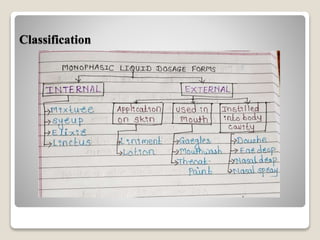
Classification
MIXTURES
 Definition:
A mixture is a liquid preparation meant for oral administration in
which medicament or medicaments are dissolved or suspended in a
suitable vehicle.
Mixtures are mainly prescribed for acute conditions such as cough,
indigestion,diarrhoea, constipation etc.so it should be
extemporaneously prepared and supplied only for small number of
doses which can be used up within a short period.
CLASSIFICATION OF MIXTURES
 Simple mixture containing soluble substances : these
mixtures containing only soluble ingredients.
 Mixture containing diffusible solids: diffusible solids are
those which do not dissolve in water, but may be mixed there
with so that upon shaking, the powder drug is evenly diffused
throughout the liquid for sufficient time to ensure uniform
distribution in each dose
 Mixture containing indiffusible solids: indiffusible solids
are those solids which are not soluble in water and do not
remain uniformly distributed in the vehicle for sufficiently
long time. Therefore, to suspend the drug suspending agents
are added in this type of mixture.
 Commonly used suspending agents in mixture containing
indiffusible solids are-
a) Compound Tragacanth Powder: in proportion of
2g/100ml of mixture. It is used when vehicle is other than
water or chloroform water.
b) Tragacanth mucilage: in the proportion of 1/4 th of the
volume of mixture. It is used when the vehicle is water or
chloroform water.
 Mixture containing precipitates forming liquid: certain
liquid preparation contain resinous matter, when mixed with
water, the resin is precipitated which will not re- diffuse upon
shaking.
 Mixture containing slightly soluble liquids: the insoluble
portion of slightly soluble liquids is not readily diffusible
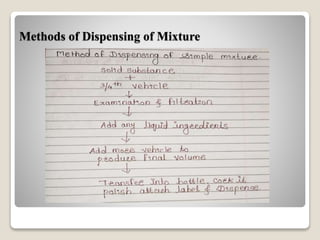
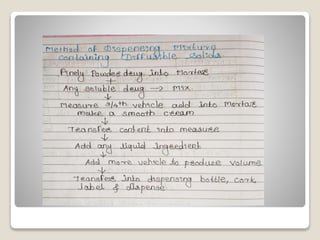
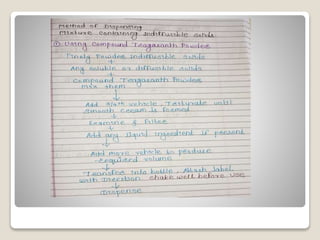
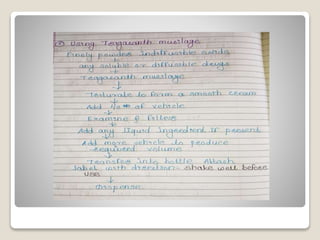
Methods of Dispensing of Mixture
FORMULATION OF MIXTURES
 Vehicles: the vehicle commonly used for the preparation of
mixtures are
i. Water- e.g. Purified water
ii. Aromatic water : e.g. camphor water, cinnamon water
chloroform water & peppermint water
iii. Medicated vehicle: sometimes a vehicle with definite
therapeutic activity is prescribed e.g. orange peel infusion
which act as a bitter & Carminative.
 Adjuncts: following adjuncts are used to improve the stability , colour &
flavour of the mixtures:
a) Chemical stabilizers: e.g. antioxidants like ascorbic acid (0.1%) &
sodium metabisulphite (0.1%)
b) Coloring agents: No special coloring agents are added because many
mixtures contain colored medicaments.
c) Flavoring agents: e.g. aromatic water , syrup, glycerol, liquid extract of
liquorice, sprit lemon orange syrup compound orange spirit etc.
d) Preservatives: e.g. Chloroform (0.25%v/v) benzoic acid (0.1% w/v)
Storage of Mixture
 Mixtures are dispensed in plain glass bottles with uniform
internal diameter.
 Mixtures should be placed in cool & dry place.
SYRUP
 Syrup is a concentrated or nearly saturated solution of sucrose
in purified water. Concentration of sugar is 66.7% w/w. they
are sweet viscous preparation.
 Two types of syrup:
a. Medicated syrup – which contain medicinal substance.
b. Flavored syrup – which contains flavored or aromatic
substances.
Advantages
 Syrup retards oxidation because it partly hydrolysed into
reducing sugars such as levulose & dextrose.
 It prevents decomposition of many vegetable substances.
Syrup have high osmotic pressure which prevents growth of
bacteria, fungi & moulds.
 They are palatable. Due to sweetness of sugar.
Methods of preparation
 Simple solution method
 Process of extraction
 Syrup made by chemical interaction
FORMULATION OF SYRUP
 Vehicles: e.g. Purified water.
 Adjuncts:
a. Chemical stabilizers: Glycerin, sorbitol, propylene glycol
is added in small quantity to prevent the crystallization of
sucrose. Surfactants like Tween.
b. Coloring agents: e.g. amaranth, compound tartrazine &
green S.
c. Flavoring agents:
i) Tinctures: e.g. tincture lemon, tincture ginger
ii) Fruit juices: e.g. Raspberry juice, wild cherry
iii)Essence: e.g. Vanilla, orange.
d. Preservatives: syrup containing 66.7%w/w sucrose have
high osmotic pressure which prevents growth of bacteria,
fungi mould. So no preservative is needed. Generally
benzoic acid, sodium benzoate , methyl paraben are
commonly used.
Storage of Syrups
 Syrup should be stored in well dried completely filled and
well stoppered bottles in a cool dark place.
ELIXIRS
Elixirs are clear, sweetened, aromatic, hydro alcoholic liquids
intended for oral use.
The main ingredients of elixirs are ethyl alcohol (5-40%), water
glycerin or propylene glycol, flavoring agents, coloring agents
and suitable preservatives.
Medicated Elixirs usually contain a potent drugs such as
antibiotics, antihistamines or sedatives.
Formulation of Elixirs
 Vehicles: e.g. water, Alcohol, syrup, glycerin, Sorbitol,
propylene glycol.
 Adjuncts:
i. Chemical Stabilizers: e.g. citric acid, disodium edetate
ii. Coloring agents: e.g. amaranth, compound tartrazine, green
S
iii. Flavoring agents: e.g. black current syrup, raspberry syrup,
lemon syrup & orange syrup.
iv. Preservatives: e.g. Alcohol 20%, propylene glycol or
glycerol, double strength chloroform water, benzoic acid &
methyl paraben.
Storage
 Elixirs are supplied in well filled, well closed, air tight glass
bottles having screw caps.
 Elixirs are stored in a cool place, protected from light.
LINCTUSES
 These are viscous, liquid and oral preparation that are
generally prescribed for the relief of cough.
 Linctuses generally contain medicaments which have
demulcent, sedative or expectorant action.
 It should be taken in small doses, sipped & swallowed slowly
without diluting with water to have maximum and prolonged
effect of medicaments.
FORMULATION OF LINCTUSES
 Vehicles: e.g. simple syrup, syrup tolu,invert syrup, glycerol
& Sorbitol.
 Adjuncts:
i. Chemical stabilizers: majority of linctuses are stable
because of simple syrup
ii. Colouring agents: Coal tar dyes e.g. compound
tartrazine solution.
iii. Flavoring agents: e.g. lemon syrup, black current syrup,
oxymel, benzaldehyde
iv. Preservatives: when syrup is used as vehicle , no
preservative is needed for the preservation of linctuses.
The linctuses which are made in sorbitol solution or
diluted with water are preserved by adding spirit of
chloroform & benzoic acid.
Storage
 Linctuses are supplied in well filled, well closed airtight glass
bottles having screw caps.
 It should be stored in a cool place, protected from light.
Liquids to be applied to the skin
 Liniments: Liniments are liquid or semi- liquid
preparations meant for application to the skin. These are
usually applied to the skin with friction & rubbing.
 Generally liniments contain medicaments which
possessing analgesic, rubefacient, soothing & counter
irritant or stimulation properties.
 Containers: The liniments should be dispensed in coloured
fluted bottles.
 Labelling: The label must state “FOR EXTERNAL USE
ONLY” & SHAKE WELL BEFORE USE. Also state the
warning Not to be applied to open wound or broken skin.
 Storage: liniments should be stored in tightly closed airtight
containers in a cool place.
 Lotion: lotions are liquid preparation meant for external
application without friction.
 These are applied direct to the skin with the help of absorbent
material, such as cotton wool or gauze soaked in it.
 It may be used for local action cooling, soothing or protective.
 Containers: it should be dispensed in coloured fluted bottles .
 Labelling: the containers should be stated FOR EXTERNAL
USE ONLY.
 Storage: lotion should be stored in a well filled, well closed
in an airtight container in a cool place.
Liquids to be used in the mouth
 Gargles: these are aqueous solutions used to prevent or treat
throat infections.
 Gargles are available in concentrated form with direction for
the dilution with warm water before use.
 They are used to relieve soreness in mild throat infection. It
also stimulates secretion of saliva which relieves dryness.
 Containers: Gargles should be dispensed in clear, fluted glass
bottles closed with a plastic screw cap.
 Labelling: containers should be labelled For external use
only.
 Mouthwashes: These are aqueous solutions with a pleasant
taste & odour used to make clean and deodorise the buccal
cavity.
 Generally it contain antibacterial agents alcohol, glycerin,
sweetening agents, flavoring agents & coloring agents.
 Containers: these are dispensed in white fluted bottles.
 Label should clearly indicate the proper directions for diluting
before use.
 Throat paints: these are viscous liquid preparations used for
mouth & throat infections.
 Glycerin is commonly used base in throat paint, because it is
viscous nature, it adheres to mucus membrane for long period & it
also provide sweet taste to the preparation.
 Containers: It should be dispensed in airtight, coloured fluted
bottles.
 Label: For External use only
 Storage: Should be stored in airtight container & in cool place.
Liquids to be instilled into body cavities
 Douches: A Douche is a medicated solution meant for rinsing a
body cavity. Douches are also used to irrigate the other body
cavities such as eyes, ear or nasal cavities for cleaning or removing
the foreign particles or discharges from them.
 Containers: these are supplied in narrow mouthed, coloured fluted
bottles.
 Labelling: For external use only.
 Storage: Douche should be stored in a cool place.
Ear drops
 These are solutions of drops that are instilled into the ear with a
dropper.
 The solution is generally prepared in water, glycerin, propylene
glycol or dilute alcohol.
 Ear drops are generally used for cleaning the ear, softening the wax
& for treating the mild infection.
 Containers: These are dispensed in coloured, fluted glass bottles
with dropper in the cap.
 Labelling: For external use only & store in cool place.
NASAL DROPS
 These are aqueous solutions of drops that are instilled into the
nose with dropper.
 Nasal drops must be isotonic with nasal secretion.
 Containers: these are dispensed in coloured fluted bottles
fitted with suitable dropper.
 Labelling: For external use only.
 Storage: Nasal drops should be stored in a cool place.
NASAL SPRAYS
 Nasal sprays are used to reduce nasal congestion and to treat
infections.
 They may contain antibiotics & antihistamines.
 Containers: Nasal sprays are stored in small, coloured, fluted
glass bottles.
 Storage: It should be stored in well- filled air tight containers,
protected from light.
Monophasic liquid dosage forms

Monophasic liquid dosage forms

  • 1.
    Monophasic Liquid DosageForms Miss. Pallavi M. Sangave Shri. Balasaheb Mane Shikshan Prasarak Mandal Ambap Womens College of Pharmacy, Peth Vadgaon Kolhapur 416112
  • 2.
     Monophasic liquiddosage form is a liquid preparation containing two or more components in one phase system. It is represented by a true solution.  True solution is a clear homogenous mixture that is prepared by dissolving a solid, liquid or gas in a liquid.  The component of the solution which is present in a large quantity is known as “SOLVENT” where as the component present in small quantity is termed as “SOLUTE”.
  • 3.
  • 4.
    MIXTURES  Definition: A mixtureis a liquid preparation meant for oral administration in which medicament or medicaments are dissolved or suspended in a suitable vehicle. Mixtures are mainly prescribed for acute conditions such as cough, indigestion,diarrhoea, constipation etc.so it should be extemporaneously prepared and supplied only for small number of doses which can be used up within a short period.
  • 5.
    CLASSIFICATION OF MIXTURES Simple mixture containing soluble substances : these mixtures containing only soluble ingredients.  Mixture containing diffusible solids: diffusible solids are those which do not dissolve in water, but may be mixed there with so that upon shaking, the powder drug is evenly diffused throughout the liquid for sufficient time to ensure uniform distribution in each dose
  • 6.
     Mixture containingindiffusible solids: indiffusible solids are those solids which are not soluble in water and do not remain uniformly distributed in the vehicle for sufficiently long time. Therefore, to suspend the drug suspending agents are added in this type of mixture.
  • 7.
     Commonly usedsuspending agents in mixture containing indiffusible solids are- a) Compound Tragacanth Powder: in proportion of 2g/100ml of mixture. It is used when vehicle is other than water or chloroform water. b) Tragacanth mucilage: in the proportion of 1/4 th of the volume of mixture. It is used when the vehicle is water or chloroform water.
  • 8.
     Mixture containingprecipitates forming liquid: certain liquid preparation contain resinous matter, when mixed with water, the resin is precipitated which will not re- diffuse upon shaking.  Mixture containing slightly soluble liquids: the insoluble portion of slightly soluble liquids is not readily diffusible
  • 9.
  • 13.
    FORMULATION OF MIXTURES Vehicles: the vehicle commonly used for the preparation of mixtures are i. Water- e.g. Purified water ii. Aromatic water : e.g. camphor water, cinnamon water chloroform water & peppermint water iii. Medicated vehicle: sometimes a vehicle with definite therapeutic activity is prescribed e.g. orange peel infusion which act as a bitter & Carminative.
  • 14.
     Adjuncts: followingadjuncts are used to improve the stability , colour & flavour of the mixtures: a) Chemical stabilizers: e.g. antioxidants like ascorbic acid (0.1%) & sodium metabisulphite (0.1%) b) Coloring agents: No special coloring agents are added because many mixtures contain colored medicaments. c) Flavoring agents: e.g. aromatic water , syrup, glycerol, liquid extract of liquorice, sprit lemon orange syrup compound orange spirit etc. d) Preservatives: e.g. Chloroform (0.25%v/v) benzoic acid (0.1% w/v)
  • 15.
    Storage of Mixture Mixtures are dispensed in plain glass bottles with uniform internal diameter.  Mixtures should be placed in cool & dry place.
  • 16.
    SYRUP  Syrup isa concentrated or nearly saturated solution of sucrose in purified water. Concentration of sugar is 66.7% w/w. they are sweet viscous preparation.  Two types of syrup: a. Medicated syrup – which contain medicinal substance. b. Flavored syrup – which contains flavored or aromatic substances.
  • 17.
    Advantages  Syrup retardsoxidation because it partly hydrolysed into reducing sugars such as levulose & dextrose.  It prevents decomposition of many vegetable substances. Syrup have high osmotic pressure which prevents growth of bacteria, fungi & moulds.  They are palatable. Due to sweetness of sugar.
  • 18.
    Methods of preparation Simple solution method  Process of extraction  Syrup made by chemical interaction
  • 19.
    FORMULATION OF SYRUP Vehicles: e.g. Purified water.  Adjuncts: a. Chemical stabilizers: Glycerin, sorbitol, propylene glycol is added in small quantity to prevent the crystallization of sucrose. Surfactants like Tween. b. Coloring agents: e.g. amaranth, compound tartrazine & green S.
  • 20.
    c. Flavoring agents: i)Tinctures: e.g. tincture lemon, tincture ginger ii) Fruit juices: e.g. Raspberry juice, wild cherry iii)Essence: e.g. Vanilla, orange. d. Preservatives: syrup containing 66.7%w/w sucrose have high osmotic pressure which prevents growth of bacteria, fungi mould. So no preservative is needed. Generally benzoic acid, sodium benzoate , methyl paraben are commonly used.
  • 21.
    Storage of Syrups Syrup should be stored in well dried completely filled and well stoppered bottles in a cool dark place.
  • 22.
    ELIXIRS Elixirs are clear,sweetened, aromatic, hydro alcoholic liquids intended for oral use. The main ingredients of elixirs are ethyl alcohol (5-40%), water glycerin or propylene glycol, flavoring agents, coloring agents and suitable preservatives. Medicated Elixirs usually contain a potent drugs such as antibiotics, antihistamines or sedatives.
  • 23.
    Formulation of Elixirs Vehicles: e.g. water, Alcohol, syrup, glycerin, Sorbitol, propylene glycol.  Adjuncts: i. Chemical Stabilizers: e.g. citric acid, disodium edetate ii. Coloring agents: e.g. amaranth, compound tartrazine, green S iii. Flavoring agents: e.g. black current syrup, raspberry syrup, lemon syrup & orange syrup. iv. Preservatives: e.g. Alcohol 20%, propylene glycol or glycerol, double strength chloroform water, benzoic acid & methyl paraben.
  • 24.
    Storage  Elixirs aresupplied in well filled, well closed, air tight glass bottles having screw caps.  Elixirs are stored in a cool place, protected from light.
  • 25.
    LINCTUSES  These areviscous, liquid and oral preparation that are generally prescribed for the relief of cough.  Linctuses generally contain medicaments which have demulcent, sedative or expectorant action.  It should be taken in small doses, sipped & swallowed slowly without diluting with water to have maximum and prolonged effect of medicaments.
  • 26.
    FORMULATION OF LINCTUSES Vehicles: e.g. simple syrup, syrup tolu,invert syrup, glycerol & Sorbitol.  Adjuncts: i. Chemical stabilizers: majority of linctuses are stable because of simple syrup ii. Colouring agents: Coal tar dyes e.g. compound tartrazine solution.
  • 27.
    iii. Flavoring agents:e.g. lemon syrup, black current syrup, oxymel, benzaldehyde iv. Preservatives: when syrup is used as vehicle , no preservative is needed for the preservation of linctuses. The linctuses which are made in sorbitol solution or diluted with water are preserved by adding spirit of chloroform & benzoic acid.
  • 28.
    Storage  Linctuses aresupplied in well filled, well closed airtight glass bottles having screw caps.  It should be stored in a cool place, protected from light.
  • 29.
    Liquids to beapplied to the skin  Liniments: Liniments are liquid or semi- liquid preparations meant for application to the skin. These are usually applied to the skin with friction & rubbing.  Generally liniments contain medicaments which possessing analgesic, rubefacient, soothing & counter irritant or stimulation properties.
  • 30.
     Containers: Theliniments should be dispensed in coloured fluted bottles.  Labelling: The label must state “FOR EXTERNAL USE ONLY” & SHAKE WELL BEFORE USE. Also state the warning Not to be applied to open wound or broken skin.  Storage: liniments should be stored in tightly closed airtight containers in a cool place.
  • 31.
     Lotion: lotionsare liquid preparation meant for external application without friction.  These are applied direct to the skin with the help of absorbent material, such as cotton wool or gauze soaked in it.  It may be used for local action cooling, soothing or protective.  Containers: it should be dispensed in coloured fluted bottles .  Labelling: the containers should be stated FOR EXTERNAL USE ONLY.  Storage: lotion should be stored in a well filled, well closed in an airtight container in a cool place.
  • 32.
    Liquids to beused in the mouth  Gargles: these are aqueous solutions used to prevent or treat throat infections.  Gargles are available in concentrated form with direction for the dilution with warm water before use.  They are used to relieve soreness in mild throat infection. It also stimulates secretion of saliva which relieves dryness.
  • 33.
     Containers: Garglesshould be dispensed in clear, fluted glass bottles closed with a plastic screw cap.  Labelling: containers should be labelled For external use only.
  • 34.
     Mouthwashes: Theseare aqueous solutions with a pleasant taste & odour used to make clean and deodorise the buccal cavity.  Generally it contain antibacterial agents alcohol, glycerin, sweetening agents, flavoring agents & coloring agents.  Containers: these are dispensed in white fluted bottles.  Label should clearly indicate the proper directions for diluting before use.
  • 35.
     Throat paints:these are viscous liquid preparations used for mouth & throat infections.  Glycerin is commonly used base in throat paint, because it is viscous nature, it adheres to mucus membrane for long period & it also provide sweet taste to the preparation.  Containers: It should be dispensed in airtight, coloured fluted bottles.  Label: For External use only  Storage: Should be stored in airtight container & in cool place.
  • 36.
    Liquids to beinstilled into body cavities  Douches: A Douche is a medicated solution meant for rinsing a body cavity. Douches are also used to irrigate the other body cavities such as eyes, ear or nasal cavities for cleaning or removing the foreign particles or discharges from them.  Containers: these are supplied in narrow mouthed, coloured fluted bottles.  Labelling: For external use only.  Storage: Douche should be stored in a cool place.
  • 37.
    Ear drops  Theseare solutions of drops that are instilled into the ear with a dropper.  The solution is generally prepared in water, glycerin, propylene glycol or dilute alcohol.  Ear drops are generally used for cleaning the ear, softening the wax & for treating the mild infection.  Containers: These are dispensed in coloured, fluted glass bottles with dropper in the cap.  Labelling: For external use only & store in cool place.
  • 38.
    NASAL DROPS  Theseare aqueous solutions of drops that are instilled into the nose with dropper.  Nasal drops must be isotonic with nasal secretion.  Containers: these are dispensed in coloured fluted bottles fitted with suitable dropper.  Labelling: For external use only.  Storage: Nasal drops should be stored in a cool place.
  • 39.
    NASAL SPRAYS  Nasalsprays are used to reduce nasal congestion and to treat infections.  They may contain antibiotics & antihistamines.  Containers: Nasal sprays are stored in small, coloured, fluted glass bottles.  Storage: It should be stored in well- filled air tight containers, protected from light.