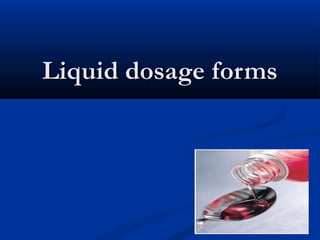
Liquid dosage formsLiquid dosage forms
IntroductionIntroduction Oral Liquids are homogeneous liquid preparations, usually consisting of aOral Liquids are homogeneous liquid preparations, usually consisting of a
solution, an emulsion or a suspension of one or more medicaments in asolution, an emulsion or a suspension of one or more medicaments in a
suitable vehicle. They are intended for oral administration either undilutedsuitable vehicle. They are intended for oral administration either undiluted
or after dilution.or after dilution.
 They may contain auxiliary substances such as suitable dispersing,They may contain auxiliary substances such as suitable dispersing,
emulsifying, suspending, wetting, solubilising, thickening, stabilizingemulsifying, suspending, wetting, solubilising, thickening, stabilizing
agents and antimicrobial preservatives.agents and antimicrobial preservatives.
 They may also contain suitable sweetening, flavoring and permittedThey may also contain suitable sweetening, flavoring and permitted
coloring agents; if saccharin, including its sodium and potassium salts, iscoloring agents; if saccharin, including its sodium and potassium salts, is
used as a sweetening agent, its concentration in preparations meant forused as a sweetening agent, its concentration in preparations meant for
pediatric use should be restricted so as to limit its intake to 5 mg per kg ofpediatric use should be restricted so as to limit its intake to 5 mg per kg of
body weight.body weight.
 During manufacture, packaging, storage and distribution of oral liquids,During manufacture, packaging, storage and distribution of oral liquids,
suitable means shall be taken to ensure their microbial quality; acceptancesuitable means shall be taken to ensure their microbial quality; acceptance
criteria for microbial quality are given in Chapter 5.9 Microbial Quality ofcriteria for microbial quality are given in Chapter 5.9 Microbial Quality of
PreparationsPreparations
 Oral Liquids are variously known as Elixirs, Linctuses Mixtures, Oral Drops,Oral Liquids are variously known as Elixirs, Linctuses Mixtures, Oral Drops,
Oral Emulsions, Oral Solutions, Oral Suspensions and Syrups. These termsOral Emulsions, Oral Solutions, Oral Suspensions and Syrups. These terms
are defined beloware defined below
Different form of oral liquidDifferent form of oral liquid
 Elixirs:Elixirs: Elixirs are clear, flavored Oral Liquids containing one or moreElixirs are clear, flavored Oral Liquids containing one or more
active ingredients dissolved in a vehicle that usually contains a highactive ingredients dissolved in a vehicle that usually contains a high
proportion of Sucrose or a suitable polyhydric alcohol or alcohols and mayproportion of Sucrose or a suitable polyhydric alcohol or alcohols and may
also contain Ethanol (95 per cent) or a dilute Ethanol.also contain Ethanol (95 per cent) or a dilute Ethanol.
 Linctuses:Linctuses: Linctuses are viscous Oral Liquids containing one or moreLinctuses are viscous Oral Liquids containing one or more
active ingredients dissolved in a vehicle that usually contains a highactive ingredients dissolved in a vehicle that usually contains a high
proportion of sucrose, other sugars or a suitable polyhydric alcohol orproportion of sucrose, other sugars or a suitable polyhydric alcohol or
alcohols. Linctuses are intended for use in the treatment or relief of cough,alcohols. Linctuses are intended for use in the treatment or relief of cough,
and are sipped and swallowed slowly without the addition of water.and are sipped and swallowed slowly without the addition of water.
 Mixtures:Mixtures: Mixtures are Oral Liquids containing one or more activeMixtures are Oral Liquids containing one or more active
ingredients dissolved, suspended or dispersed in a suitable vehicle.ingredients dissolved, suspended or dispersed in a suitable vehicle.
Suspended solids may separate slowly on keeping but are easilySuspended solids may separate slowly on keeping but are easily
redispersed on shaking.redispersed on shaking.
Different form of oral liquidDifferent form of oral liquid Cont.Cont.
 Oral Emulsions:Oral Emulsions: Oral Emulsions are Oral Liquids containing one or moreOral Emulsions are Oral Liquids containing one or more
active ingredients and are stabilized oil-in-water dispersions, either or bothactive ingredients and are stabilized oil-in-water dispersions, either or both
phases of which may contain dissolved solids. Solids may also bephases of which may contain dissolved solids. Solids may also be
suspended in Oral Emulsions. Emulsions may exhibit phase separation butsuspended in Oral Emulsions. Emulsions may exhibit phase separation but
are easily reformed on shaking. The preparation remains sufficiently stableare easily reformed on shaking. The preparation remains sufficiently stable
to permit a homogeneous dose to be withdrawn.to permit a homogeneous dose to be withdrawn.
 Oral Solutions:Oral Solutions: Oral Solutions are Oral Liquids containing one or moreOral Solutions are Oral Liquids containing one or more
active ingredients dissolved in a suitable vehicle.active ingredients dissolved in a suitable vehicle.
 Oral Suspensions:Oral Suspensions: Oral Suspensions are Oral Liquids containing one orOral Suspensions are Oral Liquids containing one or
more active ingredients suspended in a suitable vehicle. Suspended solidsmore active ingredients suspended in a suitable vehicle. Suspended solids
may slowly separate on keeping but are easily redispersed. In themay slowly separate on keeping but are easily redispersed. In the
manufacture of oral suspensions containing dispersed particles, measuresmanufacture of oral suspensions containing dispersed particles, measures
shall be taken to ensure a suitable and controlled particle size with regardshall be taken to ensure a suitable and controlled particle size with regard
to the intended use of the product.to the intended use of the product.
Different form of oral liquidDifferent form of oral liquid Cont.Cont.
 Syrups:Syrups: Syrups are viscous Oral Liquids that may contain one or moreSyrups are viscous Oral Liquids that may contain one or more
active ingredients in solution. The vehicle usually contains large amountsactive ingredients in solution. The vehicle usually contains large amounts
of Sucrose or other sugars to which certain polyhydric alcohols may beof Sucrose or other sugars to which certain polyhydric alcohols may be
added to inhibit crystallization or to modify solubilisation, taste and otheradded to inhibit crystallization or to modify solubilisation, taste and other
vehicle properties. Sugarless syrups may contain sweetening agents andvehicle properties. Sugarless syrups may contain sweetening agents and
thickening agents. Syrups may contain Ethanol (95%) as a preservative orthickening agents. Syrups may contain Ethanol (95%) as a preservative or
as a solvent to incorporate flavoring agents. Antimicrobial agents may alsoas a solvent to incorporate flavoring agents. Antimicrobial agents may also
be added to Syrups.be added to Syrups.
 Oral Drops:Oral Drops: Oral Drops are Oral Liquids that are intended to beOral Drops are Oral Liquids that are intended to be
administered in small volumes with the aid of a suitable measuring deviceadministered in small volumes with the aid of a suitable measuring device
such as a dropper.such as a dropper.
Liquid dosage formsLiquid dosage forms
Monophasic liquid D.F
Solutions
Polyphasic liquid D.F
Aqueous solutions Non-aqueous solutions
Suspensions Colloids
Emulsions
Liquid dosage formsLiquid dosage forms
■■ Solutions: solutions are clear liquid preparationsSolutions: solutions are clear liquid preparations
containing one or more active ingredients dissolved in acontaining one or more active ingredients dissolved in a
suitable vehicle.suitable vehicle.
■■ Suspensions (Solid in liquid dispersion): liquidSuspensions (Solid in liquid dispersion): liquid
preparations containing one or more active ingredientspreparations containing one or more active ingredients
suspended in a suitable vehicle.suspended in a suitable vehicle.
■■ Emulsions (liquid in liquid dispersion): emulsions are twoEmulsions (liquid in liquid dispersion): emulsions are two
phase system in which one liquid is dispersed throughoutphase system in which one liquid is dispersed throughout
another liquid in the form of small particles.another liquid in the form of small particles.
■■ Colloids: A system in which finely divided particles, whichColloids: A system in which finely divided particles, which
are approximately less than 1 µm in size, are dispersed withinare approximately less than 1 µm in size, are dispersed within
a continuous medium in a manner that prevents them froma continuous medium in a manner that prevents them from
being filtered easily or settled rapidly.being filtered easily or settled rapidly.
Liquid dosage formsLiquid dosage forms
Advantages of liquid dosage formAdvantages of liquid dosage form
 Liquids are easier to swallow therefore easier for children,Liquids are easier to swallow therefore easier for children,
old age and unconscious people.old age and unconscious people.
 A drug must be in solution before it can be absorbed (moreA drug must be in solution before it can be absorbed (more
quickly effective than and oral liquids)quickly effective than and oral liquids)
 AA solutionsolution is an homogenous system, the drug will beis an homogenous system, the drug will be
uniformly distributed throughout the preparation (uniformuniformly distributed throughout the preparation (uniform
dose than suspension and emulsion which need shaking)dose than suspension and emulsion which need shaking)
 Some drugs can irritate the gastric mucosa if localized in oneSome drugs can irritate the gastric mucosa if localized in one
area. Irritation is reduced by administration of a solution ofarea. Irritation is reduced by administration of a solution of
the drugthe drug
Problem associated with the manufacturing of solutionsProblem associated with the manufacturing of solutions
disadvantages of solutionsdisadvantages of solutions
 Liquids areLiquids are bulkybulky and inconvenient to transport and storeand inconvenient to transport and store
 TheThe stabilitystability of ingredients in aqueous solution is oftenof ingredients in aqueous solution is often
poor than in solid dosage formpoor than in solid dosage form
 Solution provide suitable media for the growth of micro-Solution provide suitable media for the growth of micro-
organisms and may require the addition oforganisms and may require the addition of preservativepreservative
 Accurate dose measuring depends on the ability of patientAccurate dose measuring depends on the ability of patient
to measure the dose (needs an accurate spoon to measureto measure the dose (needs an accurate spoon to measure
the dose)the dose)
 TheThe tastetaste of a drug is always pronounced when it inof a drug is always pronounced when it in
solution (unpleasant taste or odours are difficult to mask)solution (unpleasant taste or odours are difficult to mask)
Major signs of instability: color change, precipitation,Major signs of instability: color change, precipitation,
microbial growth, chemical gas formation.microbial growth, chemical gas formation.
TestsTests
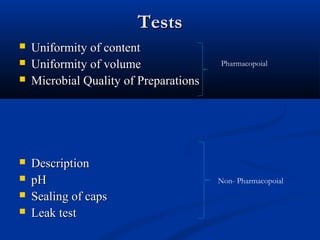
 Uniformity of contentUniformity of content
 Uniformity of volumeUniformity of volume
 Microbial Quality of PreparationsMicrobial Quality of Preparations
 DescriptionDescription
 pHpH
 Sealing of capsSealing of caps
 Leak testLeak test
Pharmacopoial
Non- Pharmacopoial
 This test is applicable to single dose liquid in suspension form or liquid thatThis test is applicable to single dose liquid in suspension form or liquid that
containcontain less thanless than 10 mg or less than 10 per cent w/w of active ingredient (As10 mg or less than 10 per cent w/w of active ingredient (As
per IP)per IP)..
 This test is applicable to oral liquid that containThis test is applicable to oral liquid that contain less than 25 mg or less thanless than 25 mg or less than
25 per cent w/w of active ingredient (As per BP/USP )25 per cent w/w of active ingredient (As per BP/USP )..
 For oral liquid containing more than one active ingredient carry out the testFor oral liquid containing more than one active ingredient carry out the test
for each active ingredient that corresponds to the aforementioned conditions.for each active ingredient that corresponds to the aforementioned conditions.
 The test for Uniformity of content should be carried out only after the contentThe test for Uniformity of content should be carried out only after the content
of active ingredient(s) in a pooled sample of the oral liquid has been shown toof active ingredient(s) in a pooled sample of the oral liquid has been shown to
be within accepted limits of the stated content.be within accepted limits of the stated content.
 The test for Uniformity of content is not applicable to capsule containingThe test for Uniformity of content is not applicable to capsule containing
multivitamins and trace elementsmultivitamins and trace elements (BP/(BP/
Uniformity of content (IP/BP)Uniformity of content (IP/BP)
 Method.Method.
 Determine the content of active ingredient(s) in each of 10 dosage units takenDetermine the content of active ingredient(s) in each of 10 dosage units taken
at random using the method given in the monograph or by any other suitableat random using the method given in the monograph or by any other suitable
analytical method.analytical method.
 Acceptance limitsAcceptance limits
 The preparation complies with the test if the individual values thus obtainedThe preparation complies with the test if the individual values thus obtained
are all between 85 to 115 per cent of the average value.are all between 85 to 115 per cent of the average value.
 The preparation fails to comply with the test if more than one individualThe preparation fails to comply with the test if more than one individual
contents are outside the limits of 85 to 115 per cent of the average value or ifcontents are outside the limits of 85 to 115 per cent of the average value or if
one individual contents are outside the limits of 75 to 125 per cent of theone individual contents are outside the limits of 75 to 125 per cent of the
average content.average content.
Uniformity of content (IP/BP)Uniformity of content (IP/BP)
 If one individual contents are outside the limits of 85 to 115 per cent of theIf one individual contents are outside the limits of 85 to 115 per cent of the
average content but within the limits of 75 to 125 per cent, repeat theaverage content but within the limits of 75 to 125 per cent, repeat the
determination using another 20 dosage units.determination using another 20 dosage units.
 The preparation complies with the test if not more than three individualThe preparation complies with the test if not more than three individual
contents of the total sample of 30 dosage units are outside the limits of 85 tocontents of the total sample of 30 dosage units are outside the limits of 85 to
115 per cent of the average content and not more than one is outside the limits115 per cent of the average content and not more than one is outside the limits
of 75 to 125 per cent of the average content.of 75 to 125 per cent of the average content.
Uniformity of contents (IP/BP)Uniformity of contents (IP/BP)
Uniformity of container contents /Uniformity of container contents /
Contents of Packaged Dosage Forms (IP)Contents of Packaged Dosage Forms (IP)
 The following tests and specifications apply to oral dosage forms andThe following tests and specifications apply to oral dosage forms and
preparations intended for topical use that are packaged in containers inpreparations intended for topical use that are packaged in containers in
which the labeled net quantity is not more thanwhich the labeled net quantity is not more than 100 g or 300 ml or 1000100 g or 300 ml or 1000
units,units, as the case may beas the case may be
 For higher labeled quantities the test and limits given in the standards ofFor higher labeled quantities the test and limits given in the standards of
Weights and Measures (Packaged commodities) Rules, 1977 may beWeights and Measures (Packaged commodities) Rules, 1977 may be
followed.followed.
Contents of Packaged Dosage FormsContents of Packaged Dosage Forms
 Test MethodTest Method
 For Viscous preparations:For Viscous preparations: Select a sample of 10 filled containers andSelect a sample of 10 filled containers and
determine the weightdetermine the weight of the contents of each container as directed underof the contents of each container as directed under
Ointments, Creams, Pastes, Granules and Powders for Oral Liquids.Ointments, Creams, Pastes, Granules and Powders for Oral Liquids.
Determine the weight per mlDetermine the weight per ml and calculate the net volume of the contents ofand calculate the net volume of the contents of
each container.each container.
 Non-viscous and free-flowing liquids:Non-viscous and free-flowing liquids: Pour completely the contents of eachPour completely the contents of each
container into calibrated volume measures of the appropriate size andcontainer into calibrated volume measures of the appropriate size and
determine the volume of the contents of the 10 containers.determine the volume of the contents of the 10 containers.
Contents of Packaged Dosage FormsContents of Packaged Dosage Forms
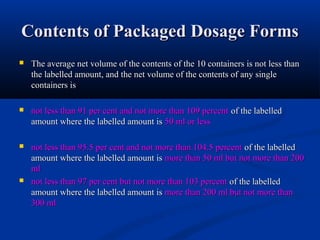
 The average net volume of the contents of the 10 containers is not less thanThe average net volume of the contents of the 10 containers is not less than
the labelled amount, and the net volume of the contents of any singlethe labelled amount, and the net volume of the contents of any single
containers iscontainers is
 not less than 91 per cent and not more than 109 percentnot less than 91 per cent and not more than 109 percent of the labelledof the labelled
amount where the labelled amount isamount where the labelled amount is 50 ml or less50 ml or less
 not less than 95.5 per cent and not more than 104.5 percentnot less than 95.5 per cent and not more than 104.5 percent of the labelledof the labelled
amount where the labelled amount isamount where the labelled amount is more than 50 ml but not more than 200more than 50 ml but not more than 200
mlml
 not less than 97 per cent but not more than 103 percentnot less than 97 per cent but not more than 103 percent of the labelledof the labelled
amount where the labelled amount isamount where the labelled amount is more than 200 ml but not more thanmore than 200 ml but not more than
300 ml300 ml
Test as per USPTest as per USP
 Deliverable volumeDeliverable volume
 To ensure that deliver the volume of dosageTo ensure that deliver the volume of dosage
form that is declared on the labelform that is declared on the label
 Apply for both liquid preparation and liquidApply for both liquid preparation and liquid
preparation that are constituted from soild uponpreparation that are constituted from soild upon
addition of a designated volume of specificaddition of a designated volume of specific
diluentsdiluents
 Not for single unit containers when monographNot for single unit containers when monograph
include the test for uniformity of unitinclude the test for uniformity of unit
Deliverable volumeDeliverable volume cont.cont.
 Method:Method:
 First determine the density of the liquid (ifFirst determine the density of the liquid (if
required )required )
 Select NLT 30 containers and proceedSelect NLT 30 containers and proceed
o For oral solution and oral susp.: shakeFor oral solution and oral susp.: shake
o For powder : reconstitute as directedFor powder : reconstitute as directed
 Discharge the containers contents into suitableDischarge the containers contents into suitable
tared container (5s unit dosage, 10s multitared container (5s unit dosage, 10s multi
dosage)dosage)
 Determine mass and determine volume usingDetermine mass and determine volume using
densitydensity
Deliverable volumeDeliverable volume cont.cont.
 Method:Method:
 Determine volume by pouring content into dry graduatedDetermine volume by pouring content into dry graduated
measuring cylindermeasuring cylinder
 Acceptance criteriaAcceptance criteria
 For multiple –unit container: 10 unitFor multiple –unit container: 10 unit
 AVG: NLT 100 %AVG: NLT 100 %
 Any container NLT 95 %Any container NLT 95 %
 If A avg vol is less than 100 % but contain of all 10 is moreIf A avg vol is less than 100 % but contain of all 10 is more
than 95 %than 95 %
 B if avg. vol. is NLT 100 % & vol of NMT 1 container is LessB if avg. vol. is NLT 100 % & vol of NMT 1 container is Less
than 95 % but not less than 90 %than 95 % but not less than 90 %
 Perform test of additional 20 containerPerform test of additional 20 container
 Avg of 30 is NLT 100 % & vol of NMT 1 out of 30 containerAvg of 30 is NLT 100 % & vol of NMT 1 out of 30 container
is Less than 95 % but not less than 90 %is Less than 95 % but not less than 90 %
Deliverable volumeDeliverable volume cont.cont.
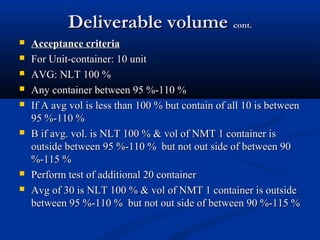
 Acceptance criteriaAcceptance criteria
 For Unit-container: 10 unitFor Unit-container: 10 unit
 AVG: NLT 100 %AVG: NLT 100 %
 Any container between 95 %-110 %Any container between 95 %-110 %
 If A avg vol is less than 100 % but contain of all 10 is betweenIf A avg vol is less than 100 % but contain of all 10 is between
95 %-110 %95 %-110 %
 B if avg. vol. is NLT 100 % & vol of NMT 1 container isB if avg. vol. is NLT 100 % & vol of NMT 1 container is
outside between 95 %-110 % but not out side of between 90outside between 95 %-110 % but not out side of between 90
%-115 %%-115 %
 Perform test of additional 20 containerPerform test of additional 20 container
 Avg of 30 is NLT 100 % & vol of NMT 1 container is outsideAvg of 30 is NLT 100 % & vol of NMT 1 container is outside
between 95 %-110 % but not out side of between 90 %-115 %between 95 %-110 % but not out side of between 90 %-115 %
Test as per BPTest as per BP
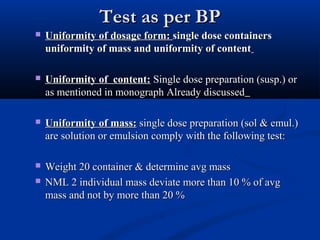
 Uniformity of dosage form:Uniformity of dosage form: single dose containerssingle dose containers
uniformity of mass and uniformity of contentuniformity of mass and uniformity of content
 Uniformity of content:Uniformity of content: Single dose preparation (susp.) orSingle dose preparation (susp.) or
as mentioned in monograph Already discussedas mentioned in monograph Already discussed
 Uniformity of mass:Uniformity of mass: single dose preparation (sol & emul.)single dose preparation (sol & emul.)
are solution or emulsion comply with the following test:are solution or emulsion comply with the following test:
 Weight 20 container & determine avg massWeight 20 container & determine avg mass
 NML 2 individual mass deviate more than 10 % of avgNML 2 individual mass deviate more than 10 % of avg
mass and not by more than 20 %mass and not by more than 20 %
Dose and uniformity of dose ofDose and uniformity of dose of
oral dropsoral drops
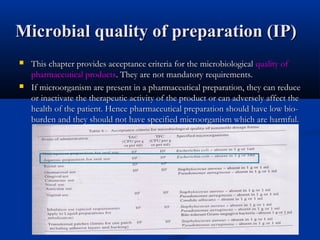
Microbial quality of preparation (IP)Microbial quality of preparation (IP)
 This chapter provides acceptance criteria for the microbiologicalThis chapter provides acceptance criteria for the microbiological quality ofquality of
pharmaceutical productspharmaceutical products. They are not mandatory requirements.. They are not mandatory requirements.
 If microorganism are present in a pharmaceutical preparation, they can reduceIf microorganism are present in a pharmaceutical preparation, they can reduce
or inactivate the therapeutic activity of the product or can adversely affect theor inactivate the therapeutic activity of the product or can adversely affect the
health of the patient. Hence pharmaceutical preparation should have low bio-health of the patient. Hence pharmaceutical preparation should have low bio-
burden and they should not have specified microorganism which are harmful.burden and they should not have specified microorganism which are harmful.
Microbial quality of preparationMicrobial quality of preparation
(BP/USP)(BP/USP) The presence of certain micro-organisms in non-sterile preparations may haveThe presence of certain micro-organisms in non-sterile preparations may have
the potential to reduce or even inactivate the therapeutic activity of the productthe potential to reduce or even inactivate the therapeutic activity of the product
and has a potential to adversely affect the health of the patient. Manufacturersand has a potential to adversely affect the health of the patient. Manufacturers
therefore have to ensure a low bio-burden of finished dosage forms bytherefore have to ensure a low bio-burden of finished dosage forms by
implementing current guidelines on Good Manufacturing Practice during theimplementing current guidelines on Good Manufacturing Practice during the
manufacture, storage and distribution of pharmaceutical preparations.manufacture, storage and distribution of pharmaceutical preparations.
 Acceptance criteria for non-sterile pharmaceutical products based upon theAcceptance criteria for non-sterile pharmaceutical products based upon the
total aerobic microbial count (TAMC) and the total combined yeasts/mouldstotal aerobic microbial count (TAMC) and the total combined yeasts/moulds
count (TYMC) are given in Tablescount (TYMC) are given in Tables
 When an acceptance criterion for microbiological quality is prescribed it isWhen an acceptance criterion for microbiological quality is prescribed it is
interpreted as follows:interpreted as follows:
 — —  101011
CFU: maximum acceptable count = 20;CFU: maximum acceptable count = 20;
 — —  101022
CFU: maximum acceptable count = 200;CFU: maximum acceptable count = 200;
 — —  101033
CFU: maximum acceptable count = 2000, and so forthCFU: maximum acceptable count = 2000, and so forth

Inprocess as per usp ip bp liquid dosage forms

  • 1.
  • 2.
    IntroductionIntroduction Oral Liquidsare homogeneous liquid preparations, usually consisting of aOral Liquids are homogeneous liquid preparations, usually consisting of a solution, an emulsion or a suspension of one or more medicaments in asolution, an emulsion or a suspension of one or more medicaments in a suitable vehicle. They are intended for oral administration either undilutedsuitable vehicle. They are intended for oral administration either undiluted or after dilution.or after dilution.  They may contain auxiliary substances such as suitable dispersing,They may contain auxiliary substances such as suitable dispersing, emulsifying, suspending, wetting, solubilising, thickening, stabilizingemulsifying, suspending, wetting, solubilising, thickening, stabilizing agents and antimicrobial preservatives.agents and antimicrobial preservatives.  They may also contain suitable sweetening, flavoring and permittedThey may also contain suitable sweetening, flavoring and permitted coloring agents; if saccharin, including its sodium and potassium salts, iscoloring agents; if saccharin, including its sodium and potassium salts, is used as a sweetening agent, its concentration in preparations meant forused as a sweetening agent, its concentration in preparations meant for pediatric use should be restricted so as to limit its intake to 5 mg per kg ofpediatric use should be restricted so as to limit its intake to 5 mg per kg of body weight.body weight.  During manufacture, packaging, storage and distribution of oral liquids,During manufacture, packaging, storage and distribution of oral liquids, suitable means shall be taken to ensure their microbial quality; acceptancesuitable means shall be taken to ensure their microbial quality; acceptance criteria for microbial quality are given in Chapter 5.9 Microbial Quality ofcriteria for microbial quality are given in Chapter 5.9 Microbial Quality of PreparationsPreparations  Oral Liquids are variously known as Elixirs, Linctuses Mixtures, Oral Drops,Oral Liquids are variously known as Elixirs, Linctuses Mixtures, Oral Drops, Oral Emulsions, Oral Solutions, Oral Suspensions and Syrups. These termsOral Emulsions, Oral Solutions, Oral Suspensions and Syrups. These terms are defined beloware defined below
  • 3.
    Different form oforal liquidDifferent form of oral liquid  Elixirs:Elixirs: Elixirs are clear, flavored Oral Liquids containing one or moreElixirs are clear, flavored Oral Liquids containing one or more active ingredients dissolved in a vehicle that usually contains a highactive ingredients dissolved in a vehicle that usually contains a high proportion of Sucrose or a suitable polyhydric alcohol or alcohols and mayproportion of Sucrose or a suitable polyhydric alcohol or alcohols and may also contain Ethanol (95 per cent) or a dilute Ethanol.also contain Ethanol (95 per cent) or a dilute Ethanol.  Linctuses:Linctuses: Linctuses are viscous Oral Liquids containing one or moreLinctuses are viscous Oral Liquids containing one or more active ingredients dissolved in a vehicle that usually contains a highactive ingredients dissolved in a vehicle that usually contains a high proportion of sucrose, other sugars or a suitable polyhydric alcohol orproportion of sucrose, other sugars or a suitable polyhydric alcohol or alcohols. Linctuses are intended for use in the treatment or relief of cough,alcohols. Linctuses are intended for use in the treatment or relief of cough, and are sipped and swallowed slowly without the addition of water.and are sipped and swallowed slowly without the addition of water.  Mixtures:Mixtures: Mixtures are Oral Liquids containing one or more activeMixtures are Oral Liquids containing one or more active ingredients dissolved, suspended or dispersed in a suitable vehicle.ingredients dissolved, suspended or dispersed in a suitable vehicle. Suspended solids may separate slowly on keeping but are easilySuspended solids may separate slowly on keeping but are easily redispersed on shaking.redispersed on shaking.
  • 4.
    Different form oforal liquidDifferent form of oral liquid Cont.Cont.  Oral Emulsions:Oral Emulsions: Oral Emulsions are Oral Liquids containing one or moreOral Emulsions are Oral Liquids containing one or more active ingredients and are stabilized oil-in-water dispersions, either or bothactive ingredients and are stabilized oil-in-water dispersions, either or both phases of which may contain dissolved solids. Solids may also bephases of which may contain dissolved solids. Solids may also be suspended in Oral Emulsions. Emulsions may exhibit phase separation butsuspended in Oral Emulsions. Emulsions may exhibit phase separation but are easily reformed on shaking. The preparation remains sufficiently stableare easily reformed on shaking. The preparation remains sufficiently stable to permit a homogeneous dose to be withdrawn.to permit a homogeneous dose to be withdrawn.  Oral Solutions:Oral Solutions: Oral Solutions are Oral Liquids containing one or moreOral Solutions are Oral Liquids containing one or more active ingredients dissolved in a suitable vehicle.active ingredients dissolved in a suitable vehicle.  Oral Suspensions:Oral Suspensions: Oral Suspensions are Oral Liquids containing one orOral Suspensions are Oral Liquids containing one or more active ingredients suspended in a suitable vehicle. Suspended solidsmore active ingredients suspended in a suitable vehicle. Suspended solids may slowly separate on keeping but are easily redispersed. In themay slowly separate on keeping but are easily redispersed. In the manufacture of oral suspensions containing dispersed particles, measuresmanufacture of oral suspensions containing dispersed particles, measures shall be taken to ensure a suitable and controlled particle size with regardshall be taken to ensure a suitable and controlled particle size with regard to the intended use of the product.to the intended use of the product.
  • 5.
    Different form oforal liquidDifferent form of oral liquid Cont.Cont.  Syrups:Syrups: Syrups are viscous Oral Liquids that may contain one or moreSyrups are viscous Oral Liquids that may contain one or more active ingredients in solution. The vehicle usually contains large amountsactive ingredients in solution. The vehicle usually contains large amounts of Sucrose or other sugars to which certain polyhydric alcohols may beof Sucrose or other sugars to which certain polyhydric alcohols may be added to inhibit crystallization or to modify solubilisation, taste and otheradded to inhibit crystallization or to modify solubilisation, taste and other vehicle properties. Sugarless syrups may contain sweetening agents andvehicle properties. Sugarless syrups may contain sweetening agents and thickening agents. Syrups may contain Ethanol (95%) as a preservative orthickening agents. Syrups may contain Ethanol (95%) as a preservative or as a solvent to incorporate flavoring agents. Antimicrobial agents may alsoas a solvent to incorporate flavoring agents. Antimicrobial agents may also be added to Syrups.be added to Syrups.  Oral Drops:Oral Drops: Oral Drops are Oral Liquids that are intended to beOral Drops are Oral Liquids that are intended to be administered in small volumes with the aid of a suitable measuring deviceadministered in small volumes with the aid of a suitable measuring device such as a dropper.such as a dropper.
  • 6.
    Liquid dosage formsLiquiddosage forms Monophasic liquid D.F Solutions Polyphasic liquid D.F Aqueous solutions Non-aqueous solutions Suspensions Colloids Emulsions
  • 7.
    Liquid dosage formsLiquiddosage forms ■■ Solutions: solutions are clear liquid preparationsSolutions: solutions are clear liquid preparations containing one or more active ingredients dissolved in acontaining one or more active ingredients dissolved in a suitable vehicle.suitable vehicle. ■■ Suspensions (Solid in liquid dispersion): liquidSuspensions (Solid in liquid dispersion): liquid preparations containing one or more active ingredientspreparations containing one or more active ingredients suspended in a suitable vehicle.suspended in a suitable vehicle. ■■ Emulsions (liquid in liquid dispersion): emulsions are twoEmulsions (liquid in liquid dispersion): emulsions are two phase system in which one liquid is dispersed throughoutphase system in which one liquid is dispersed throughout another liquid in the form of small particles.another liquid in the form of small particles.
  • 8.
    ■■ Colloids: Asystem in which finely divided particles, whichColloids: A system in which finely divided particles, which are approximately less than 1 µm in size, are dispersed withinare approximately less than 1 µm in size, are dispersed within a continuous medium in a manner that prevents them froma continuous medium in a manner that prevents them from being filtered easily or settled rapidly.being filtered easily or settled rapidly. Liquid dosage formsLiquid dosage forms
  • 9.
    Advantages of liquiddosage formAdvantages of liquid dosage form  Liquids are easier to swallow therefore easier for children,Liquids are easier to swallow therefore easier for children, old age and unconscious people.old age and unconscious people.  A drug must be in solution before it can be absorbed (moreA drug must be in solution before it can be absorbed (more quickly effective than and oral liquids)quickly effective than and oral liquids)  AA solutionsolution is an homogenous system, the drug will beis an homogenous system, the drug will be uniformly distributed throughout the preparation (uniformuniformly distributed throughout the preparation (uniform dose than suspension and emulsion which need shaking)dose than suspension and emulsion which need shaking)  Some drugs can irritate the gastric mucosa if localized in oneSome drugs can irritate the gastric mucosa if localized in one area. Irritation is reduced by administration of a solution ofarea. Irritation is reduced by administration of a solution of the drugthe drug
  • 10.
    Problem associated withthe manufacturing of solutionsProblem associated with the manufacturing of solutions disadvantages of solutionsdisadvantages of solutions  Liquids areLiquids are bulkybulky and inconvenient to transport and storeand inconvenient to transport and store  TheThe stabilitystability of ingredients in aqueous solution is oftenof ingredients in aqueous solution is often poor than in solid dosage formpoor than in solid dosage form  Solution provide suitable media for the growth of micro-Solution provide suitable media for the growth of micro- organisms and may require the addition oforganisms and may require the addition of preservativepreservative  Accurate dose measuring depends on the ability of patientAccurate dose measuring depends on the ability of patient to measure the dose (needs an accurate spoon to measureto measure the dose (needs an accurate spoon to measure the dose)the dose)  TheThe tastetaste of a drug is always pronounced when it inof a drug is always pronounced when it in solution (unpleasant taste or odours are difficult to mask)solution (unpleasant taste or odours are difficult to mask) Major signs of instability: color change, precipitation,Major signs of instability: color change, precipitation, microbial growth, chemical gas formation.microbial growth, chemical gas formation.
  • 11.
    TestsTests  Uniformity ofcontentUniformity of content  Uniformity of volumeUniformity of volume  Microbial Quality of PreparationsMicrobial Quality of Preparations  DescriptionDescription  pHpH  Sealing of capsSealing of caps  Leak testLeak test Pharmacopoial Non- Pharmacopoial
  • 12.
     This testis applicable to single dose liquid in suspension form or liquid thatThis test is applicable to single dose liquid in suspension form or liquid that containcontain less thanless than 10 mg or less than 10 per cent w/w of active ingredient (As10 mg or less than 10 per cent w/w of active ingredient (As per IP)per IP)..  This test is applicable to oral liquid that containThis test is applicable to oral liquid that contain less than 25 mg or less thanless than 25 mg or less than 25 per cent w/w of active ingredient (As per BP/USP )25 per cent w/w of active ingredient (As per BP/USP )..  For oral liquid containing more than one active ingredient carry out the testFor oral liquid containing more than one active ingredient carry out the test for each active ingredient that corresponds to the aforementioned conditions.for each active ingredient that corresponds to the aforementioned conditions.  The test for Uniformity of content should be carried out only after the contentThe test for Uniformity of content should be carried out only after the content of active ingredient(s) in a pooled sample of the oral liquid has been shown toof active ingredient(s) in a pooled sample of the oral liquid has been shown to be within accepted limits of the stated content.be within accepted limits of the stated content.  The test for Uniformity of content is not applicable to capsule containingThe test for Uniformity of content is not applicable to capsule containing multivitamins and trace elementsmultivitamins and trace elements (BP/(BP/ Uniformity of content (IP/BP)Uniformity of content (IP/BP)
  • 13.
     Method.Method.  Determinethe content of active ingredient(s) in each of 10 dosage units takenDetermine the content of active ingredient(s) in each of 10 dosage units taken at random using the method given in the monograph or by any other suitableat random using the method given in the monograph or by any other suitable analytical method.analytical method.  Acceptance limitsAcceptance limits  The preparation complies with the test if the individual values thus obtainedThe preparation complies with the test if the individual values thus obtained are all between 85 to 115 per cent of the average value.are all between 85 to 115 per cent of the average value.  The preparation fails to comply with the test if more than one individualThe preparation fails to comply with the test if more than one individual contents are outside the limits of 85 to 115 per cent of the average value or ifcontents are outside the limits of 85 to 115 per cent of the average value or if one individual contents are outside the limits of 75 to 125 per cent of theone individual contents are outside the limits of 75 to 125 per cent of the average content.average content. Uniformity of content (IP/BP)Uniformity of content (IP/BP)
  • 14.
     If oneindividual contents are outside the limits of 85 to 115 per cent of theIf one individual contents are outside the limits of 85 to 115 per cent of the average content but within the limits of 75 to 125 per cent, repeat theaverage content but within the limits of 75 to 125 per cent, repeat the determination using another 20 dosage units.determination using another 20 dosage units.  The preparation complies with the test if not more than three individualThe preparation complies with the test if not more than three individual contents of the total sample of 30 dosage units are outside the limits of 85 tocontents of the total sample of 30 dosage units are outside the limits of 85 to 115 per cent of the average content and not more than one is outside the limits115 per cent of the average content and not more than one is outside the limits of 75 to 125 per cent of the average content.of 75 to 125 per cent of the average content. Uniformity of contents (IP/BP)Uniformity of contents (IP/BP)
  • 15.
    Uniformity of containercontents /Uniformity of container contents / Contents of Packaged Dosage Forms (IP)Contents of Packaged Dosage Forms (IP)  The following tests and specifications apply to oral dosage forms andThe following tests and specifications apply to oral dosage forms and preparations intended for topical use that are packaged in containers inpreparations intended for topical use that are packaged in containers in which the labeled net quantity is not more thanwhich the labeled net quantity is not more than 100 g or 300 ml or 1000100 g or 300 ml or 1000 units,units, as the case may beas the case may be  For higher labeled quantities the test and limits given in the standards ofFor higher labeled quantities the test and limits given in the standards of Weights and Measures (Packaged commodities) Rules, 1977 may beWeights and Measures (Packaged commodities) Rules, 1977 may be followed.followed.
  • 16.
    Contents of PackagedDosage FormsContents of Packaged Dosage Forms  Test MethodTest Method  For Viscous preparations:For Viscous preparations: Select a sample of 10 filled containers andSelect a sample of 10 filled containers and determine the weightdetermine the weight of the contents of each container as directed underof the contents of each container as directed under Ointments, Creams, Pastes, Granules and Powders for Oral Liquids.Ointments, Creams, Pastes, Granules and Powders for Oral Liquids. Determine the weight per mlDetermine the weight per ml and calculate the net volume of the contents ofand calculate the net volume of the contents of each container.each container.  Non-viscous and free-flowing liquids:Non-viscous and free-flowing liquids: Pour completely the contents of eachPour completely the contents of each container into calibrated volume measures of the appropriate size andcontainer into calibrated volume measures of the appropriate size and determine the volume of the contents of the 10 containers.determine the volume of the contents of the 10 containers.
  • 17.
    Contents of PackagedDosage FormsContents of Packaged Dosage Forms  The average net volume of the contents of the 10 containers is not less thanThe average net volume of the contents of the 10 containers is not less than the labelled amount, and the net volume of the contents of any singlethe labelled amount, and the net volume of the contents of any single containers iscontainers is  not less than 91 per cent and not more than 109 percentnot less than 91 per cent and not more than 109 percent of the labelledof the labelled amount where the labelled amount isamount where the labelled amount is 50 ml or less50 ml or less  not less than 95.5 per cent and not more than 104.5 percentnot less than 95.5 per cent and not more than 104.5 percent of the labelledof the labelled amount where the labelled amount isamount where the labelled amount is more than 50 ml but not more than 200more than 50 ml but not more than 200 mlml  not less than 97 per cent but not more than 103 percentnot less than 97 per cent but not more than 103 percent of the labelledof the labelled amount where the labelled amount isamount where the labelled amount is more than 200 ml but not more thanmore than 200 ml but not more than 300 ml300 ml
  • 18.
    Test as perUSPTest as per USP  Deliverable volumeDeliverable volume  To ensure that deliver the volume of dosageTo ensure that deliver the volume of dosage form that is declared on the labelform that is declared on the label  Apply for both liquid preparation and liquidApply for both liquid preparation and liquid preparation that are constituted from soild uponpreparation that are constituted from soild upon addition of a designated volume of specificaddition of a designated volume of specific diluentsdiluents  Not for single unit containers when monographNot for single unit containers when monograph include the test for uniformity of unitinclude the test for uniformity of unit
  • 19.
    Deliverable volumeDeliverable volumecont.cont.  Method:Method:  First determine the density of the liquid (ifFirst determine the density of the liquid (if required )required )  Select NLT 30 containers and proceedSelect NLT 30 containers and proceed o For oral solution and oral susp.: shakeFor oral solution and oral susp.: shake o For powder : reconstitute as directedFor powder : reconstitute as directed  Discharge the containers contents into suitableDischarge the containers contents into suitable tared container (5s unit dosage, 10s multitared container (5s unit dosage, 10s multi dosage)dosage)  Determine mass and determine volume usingDetermine mass and determine volume using densitydensity
  • 20.
    Deliverable volumeDeliverable volumecont.cont.  Method:Method:  Determine volume by pouring content into dry graduatedDetermine volume by pouring content into dry graduated measuring cylindermeasuring cylinder  Acceptance criteriaAcceptance criteria  For multiple –unit container: 10 unitFor multiple –unit container: 10 unit  AVG: NLT 100 %AVG: NLT 100 %  Any container NLT 95 %Any container NLT 95 %  If A avg vol is less than 100 % but contain of all 10 is moreIf A avg vol is less than 100 % but contain of all 10 is more than 95 %than 95 %  B if avg. vol. is NLT 100 % & vol of NMT 1 container is LessB if avg. vol. is NLT 100 % & vol of NMT 1 container is Less than 95 % but not less than 90 %than 95 % but not less than 90 %  Perform test of additional 20 containerPerform test of additional 20 container  Avg of 30 is NLT 100 % & vol of NMT 1 out of 30 containerAvg of 30 is NLT 100 % & vol of NMT 1 out of 30 container is Less than 95 % but not less than 90 %is Less than 95 % but not less than 90 %
  • 21.
    Deliverable volumeDeliverable volumecont.cont.  Acceptance criteriaAcceptance criteria  For Unit-container: 10 unitFor Unit-container: 10 unit  AVG: NLT 100 %AVG: NLT 100 %  Any container between 95 %-110 %Any container between 95 %-110 %  If A avg vol is less than 100 % but contain of all 10 is betweenIf A avg vol is less than 100 % but contain of all 10 is between 95 %-110 %95 %-110 %  B if avg. vol. is NLT 100 % & vol of NMT 1 container isB if avg. vol. is NLT 100 % & vol of NMT 1 container is outside between 95 %-110 % but not out side of between 90outside between 95 %-110 % but not out side of between 90 %-115 %%-115 %  Perform test of additional 20 containerPerform test of additional 20 container  Avg of 30 is NLT 100 % & vol of NMT 1 container is outsideAvg of 30 is NLT 100 % & vol of NMT 1 container is outside between 95 %-110 % but not out side of between 90 %-115 %between 95 %-110 % but not out side of between 90 %-115 %
  • 22.
    Test as perBPTest as per BP  Uniformity of dosage form:Uniformity of dosage form: single dose containerssingle dose containers uniformity of mass and uniformity of contentuniformity of mass and uniformity of content  Uniformity of content:Uniformity of content: Single dose preparation (susp.) orSingle dose preparation (susp.) or as mentioned in monograph Already discussedas mentioned in monograph Already discussed  Uniformity of mass:Uniformity of mass: single dose preparation (sol & emul.)single dose preparation (sol & emul.) are solution or emulsion comply with the following test:are solution or emulsion comply with the following test:  Weight 20 container & determine avg massWeight 20 container & determine avg mass  NML 2 individual mass deviate more than 10 % of avgNML 2 individual mass deviate more than 10 % of avg mass and not by more than 20 %mass and not by more than 20 %
  • 23.
    Dose and uniformityof dose ofDose and uniformity of dose of oral dropsoral drops
  • 24.
    Microbial quality ofpreparation (IP)Microbial quality of preparation (IP)  This chapter provides acceptance criteria for the microbiologicalThis chapter provides acceptance criteria for the microbiological quality ofquality of pharmaceutical productspharmaceutical products. They are not mandatory requirements.. They are not mandatory requirements.  If microorganism are present in a pharmaceutical preparation, they can reduceIf microorganism are present in a pharmaceutical preparation, they can reduce or inactivate the therapeutic activity of the product or can adversely affect theor inactivate the therapeutic activity of the product or can adversely affect the health of the patient. Hence pharmaceutical preparation should have low bio-health of the patient. Hence pharmaceutical preparation should have low bio- burden and they should not have specified microorganism which are harmful.burden and they should not have specified microorganism which are harmful.
  • 25.
    Microbial quality ofpreparationMicrobial quality of preparation (BP/USP)(BP/USP) The presence of certain micro-organisms in non-sterile preparations may haveThe presence of certain micro-organisms in non-sterile preparations may have the potential to reduce or even inactivate the therapeutic activity of the productthe potential to reduce or even inactivate the therapeutic activity of the product and has a potential to adversely affect the health of the patient. Manufacturersand has a potential to adversely affect the health of the patient. Manufacturers therefore have to ensure a low bio-burden of finished dosage forms bytherefore have to ensure a low bio-burden of finished dosage forms by implementing current guidelines on Good Manufacturing Practice during theimplementing current guidelines on Good Manufacturing Practice during the manufacture, storage and distribution of pharmaceutical preparations.manufacture, storage and distribution of pharmaceutical preparations.  Acceptance criteria for non-sterile pharmaceutical products based upon theAcceptance criteria for non-sterile pharmaceutical products based upon the total aerobic microbial count (TAMC) and the total combined yeasts/mouldstotal aerobic microbial count (TAMC) and the total combined yeasts/moulds count (TYMC) are given in Tablescount (TYMC) are given in Tables  When an acceptance criterion for microbiological quality is prescribed it isWhen an acceptance criterion for microbiological quality is prescribed it is interpreted as follows:interpreted as follows:  — —  101011 CFU: maximum acceptable count = 20;CFU: maximum acceptable count = 20;  — —  101022 CFU: maximum acceptable count = 200;CFU: maximum acceptable count = 200;  — —  101033 CFU: maximum acceptable count = 2000, and so forthCFU: maximum acceptable count = 2000, and so forth