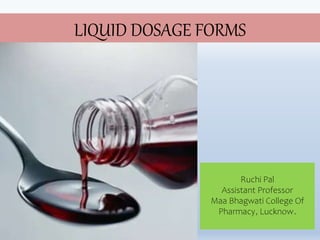
LIQUID DOSAGE FORMS
Ruchi Pal
Assistant Professor
Maa Bhagwati College Of
Pharmacy, Lucknow.
CONTENT
• Introduction
• Advantages & Disadvantages
• Pharmaceutical Additives used in liquid dosage form
• Classification of Liquid dosages forms
• Monophasic liquid dosage forms
• Biphasic liquid dosage forms
• Pharmaceutical Emulsion
 Introduction
 Classification
 Uses
 Advantages & Disadvantages
 Methods of preparation
• Pharmaceutical Suspension
 Introduction
 Advantages & Disadvantages
 Classification
 Flocculated & Deflocculated suspension
 Evaluation of suspension
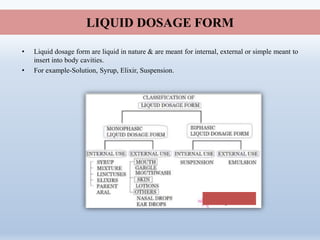
LIQUID DOSAGE FORM
• Liquid dosage form are liquid in nature & are meant for internal, external or simple meant to
insert into body cavities.
• For example-Solution, Syrup, Elixir, Suspension.
• Syrup: A viscous oral liquid that contains one or more active ingredients in
solution. The base generally contains large amounts of sucrose, other sugars, or
sweetening agents. Syrups may contain ethanol (95%) as a preservative or as a
solvent for flavors. Antimicrobial agents may also be added to syrups to maintain
the microbial quality of preparation.
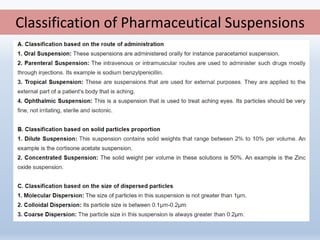
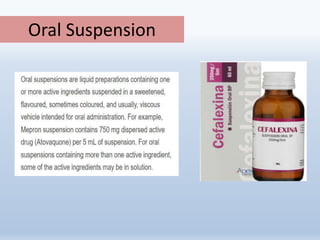
• Oral Suspension: an oral liquid that contains one or more active ingredients
suspended in a suitable base.
• Oral Solution: an oral liquid that contains one or more active ingredients dissolved
in a suitable base.
• Oral Drop: an oral liquid that is prepared to take in small quantity with the help of
a suitable measuring device such as a dropper.
• Oral Emulsion: an oral liquid that contains one or more active ingredients that are
unstable in the water phase and is stabilized oil-in-water dispersions; either or both
phases of the preparation may contain dissolved solids.
• Mixtures: an oral liquid containing one or more active ingredients suspended or
dispersed in a suitable base.
• Linctus: a viscous oral liquid that contains one or more active ingredients dissolved
in a suitable base that generally contains a higher concentration of sucrose or other
sugars.
• Elixir: a clear, flavored oral liquid containing one or more active ingredients
dissolved in a suitable base that contains a high proportion of sucrose and may also
contain ethanol (95%) or a diluted ethanol.
 Advantages of liquid dosage form-
• Most convenient dosage form for
infants and childrens.
• Possible to formulate drugs with
bitter odour & taste in liquid dosage
form by addition of sweetning &
flavouring agent.
• Adjustment of dose as per the
requirment, need & nature of patient
is possible.
• Liquid dosage form have good
absorption as compared to solids.
 Disadvantages of liquid
dosage form-
• They are difficult to
handle, carry, store and
transport.
• Liquid dosage form
containing alcohol as
vehicle in various cup
syrup, & may account to
severe toxicity when
administered in children.
• Accuracy of dose is major
issue in case of liquid
dosage form.
• Two incompatible drug
cannot be formulated as
liquid dosage forms.
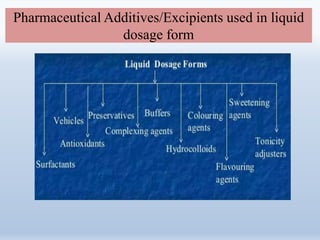
Pharmaceutical Additives/Excipients used in liquid
dosage form
• Antioxidants-Vitamin A,C, E, Beta carotene, Lutein, Lycopene
• Solvents- Water, Polyhydric alcohol, Hydro-alcoholic solution etc.
• Surfactants- SLS, Tween, Span
• Preservatives- Benzoic acid, Potassium Nitrate, Sodium Benzoate
• Coloring agents- Turmeric, Safaranin.
• Flavouring agents- Lemon, Mango, Strawberry.
• Sweetning agents- Glucose, Sucrose, Saccharin.
• Solubilizing agents- Glycerine.
Methods of Solubility Enhancement
• Solubility- The ability to be dissolved, especially in
water.
• The maximum amount of a substance that will dissolve
in a given amount of solvent at a specified
temperature.
• METHODS-
a) Particle size reduction
b) Surfactant
c) PH adjustment
d) Salt formation
e) Solid dispersion
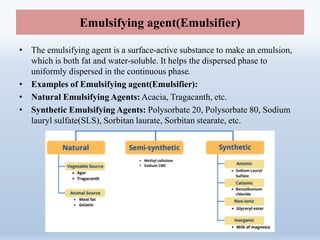
Emulsifying agent(Emulsifier)
• The emulsifying agent is a surface-active substance to make an emulsion,
which is both fat and water-soluble. It helps the dispersed phase to
uniformly dispersed in the continuous phase.
• Examples of Emulsifying agent(Emulsifier):
• Natural Emulsifying Agents: Acacia, Tragacanth, etc.
• Synthetic Emulsifying Agents: Polysorbate 20, Polysorbate 80, Sodium
lauryl sulfate(SLS), Sorbitan laurate, Sorbitan stearate, etc.
Pharmaceutical Emulsion
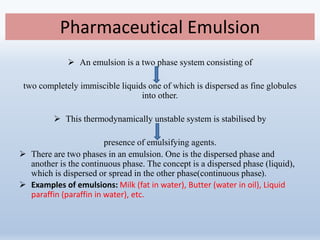
 An emulsion is a two phase system consisting of
two completely immiscible liquids one of which is dispersed as fine globules
into other.
 This thermodynamically unstable system is stabilised by
presence of emulsifying agents.
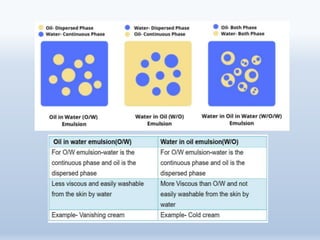
 There are two phases in an emulsion. One is the dispersed phase and
another is the continuous phase. The concept is a dispersed phase (liquid),
which is dispersed or spread in the other phase(continuous phase).
 Examples of emulsions: Milk (fat in water), Butter (water in oil), Liquid
paraffin (paraffin in water), etc.
 Advantages-
 Cover up the unpleasant taste.
 Increase the bioavailability of the dose.
 Sustained release medication.
 Very cost-effective.
 Disadvantages-
 Problem of creaming and sedimentation
 Phase inversion
 problem of handling.
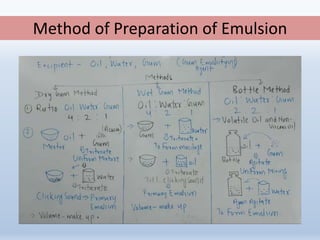
Method of Preparation of Emulsion
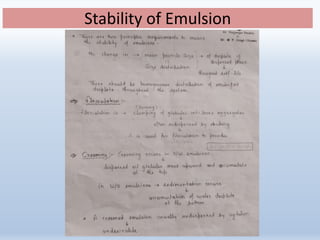
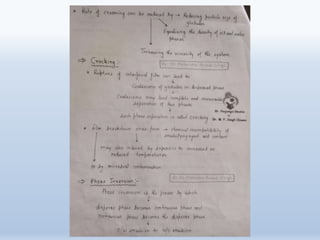
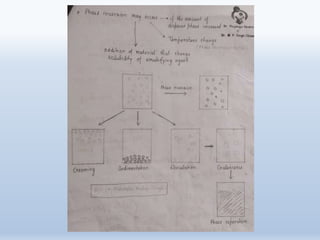
Stability of Emulsion
Uses of Emulsion
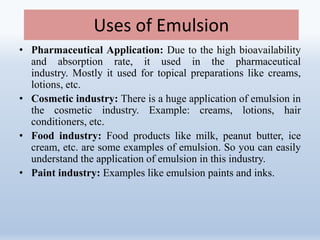
• Pharmaceutical Application: Due to the high bioavailability
and absorption rate, it used in the pharmaceutical
industry. Mostly it used for topical preparations like creams,
lotions, etc.
• Cosmetic industry: There is a huge application of emulsion in
the cosmetic industry. Example: creams, lotions, hair
conditioners, etc.
• Food industry: Food products like milk, peanut butter, ice
cream, etc. are some examples of emulsion. So you can easily
understand the application of emulsion in this industry.
• Paint industry: Examples like emulsion paints and inks.
Pharmaceutical Suspension
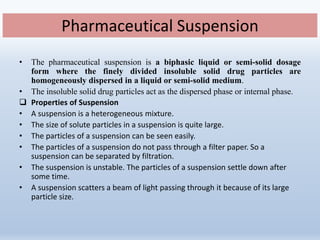
• The pharmaceutical suspension is a biphasic liquid or semi-solid dosage
form where the finely divided insoluble solid drug particles are
homogeneously dispersed in a liquid or semi-solid medium.
• The insoluble solid drug particles act as the dispersed phase or internal phase.
 Properties of Suspension
• A suspension is a heterogeneous mixture.
• The size of solute particles in a suspension is quite large.
• The particles of a suspension can be seen easily.
• The particles of a suspension do not pass through a filter paper. So a
suspension can be separated by filtration.
• The suspension is unstable. The particles of a suspension settle down after
some time.
• A suspension scatters a beam of light passing through it because of its large
particle size.
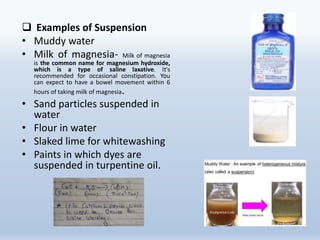
 Examples of Suspension
• Muddy water
• Milk of magnesia- Milk of magnesia
is the common name for magnesium hydroxide,
which is a type of saline laxative. It's
recommended for occasional constipation. You
can expect to have a bowel movement within 6
hours of taking milk of magnesia.
• Sand particles suspended in
water
• Flour in water
• Slaked lime for whitewashing
• Paints in which dyes are
suspended in turpentine oil.
Classification of Pharmaceutical Suspensions
Oral Suspension
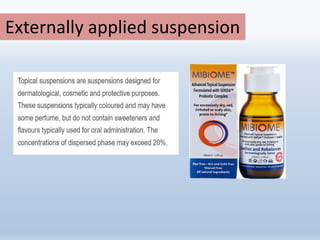
Externally applied suspension
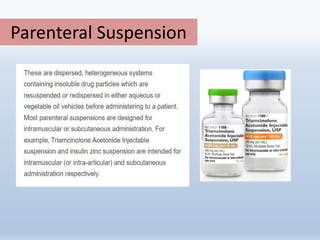
Parenteral Suspension
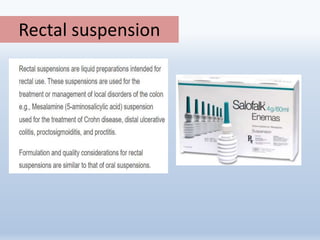
Rectal suspension
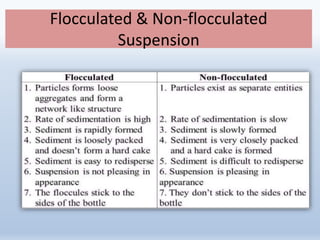
Flocculated & Non-flocculated
Suspension
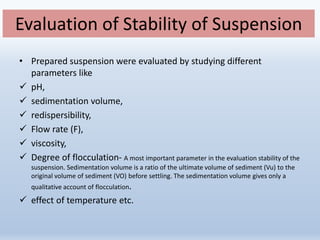
Evaluation of Stability of Suspension
• Prepared suspension were evaluated by studying different
parameters like
 pH,
 sedimentation volume,
 redispersibility,
 Flow rate (F),
 viscosity,
 Degree of flocculation- A most important parameter in the evaluation stability of the
suspension. Sedimentation volume is a ratio of the ultimate volume of sediment (Vu) to the
original volume of sediment (VO) before settling. The sedimentation volume gives only a
qualitative account of flocculation.
 effect of temperature etc.
Liquid dosage forms, (Emulsion & Suspension)

Liquid dosage forms, (Emulsion & Suspension)

  • 1.
    LIQUID DOSAGE FORMS RuchiPal Assistant Professor Maa Bhagwati College Of Pharmacy, Lucknow.
  • 2.
    CONTENT • Introduction • Advantages& Disadvantages • Pharmaceutical Additives used in liquid dosage form • Classification of Liquid dosages forms • Monophasic liquid dosage forms • Biphasic liquid dosage forms • Pharmaceutical Emulsion  Introduction  Classification  Uses  Advantages & Disadvantages  Methods of preparation • Pharmaceutical Suspension  Introduction  Advantages & Disadvantages  Classification  Flocculated & Deflocculated suspension  Evaluation of suspension
  • 3.
    LIQUID DOSAGE FORM •Liquid dosage form are liquid in nature & are meant for internal, external or simple meant to insert into body cavities. • For example-Solution, Syrup, Elixir, Suspension.
  • 4.
    • Syrup: Aviscous oral liquid that contains one or more active ingredients in solution. The base generally contains large amounts of sucrose, other sugars, or sweetening agents. Syrups may contain ethanol (95%) as a preservative or as a solvent for flavors. Antimicrobial agents may also be added to syrups to maintain the microbial quality of preparation. • Oral Suspension: an oral liquid that contains one or more active ingredients suspended in a suitable base. • Oral Solution: an oral liquid that contains one or more active ingredients dissolved in a suitable base. • Oral Drop: an oral liquid that is prepared to take in small quantity with the help of a suitable measuring device such as a dropper. • Oral Emulsion: an oral liquid that contains one or more active ingredients that are unstable in the water phase and is stabilized oil-in-water dispersions; either or both phases of the preparation may contain dissolved solids. • Mixtures: an oral liquid containing one or more active ingredients suspended or dispersed in a suitable base. • Linctus: a viscous oral liquid that contains one or more active ingredients dissolved in a suitable base that generally contains a higher concentration of sucrose or other sugars. • Elixir: a clear, flavored oral liquid containing one or more active ingredients dissolved in a suitable base that contains a high proportion of sucrose and may also contain ethanol (95%) or a diluted ethanol.
  • 5.
     Advantages ofliquid dosage form- • Most convenient dosage form for infants and childrens. • Possible to formulate drugs with bitter odour & taste in liquid dosage form by addition of sweetning & flavouring agent. • Adjustment of dose as per the requirment, need & nature of patient is possible. • Liquid dosage form have good absorption as compared to solids.  Disadvantages of liquid dosage form- • They are difficult to handle, carry, store and transport. • Liquid dosage form containing alcohol as vehicle in various cup syrup, & may account to severe toxicity when administered in children. • Accuracy of dose is major issue in case of liquid dosage form. • Two incompatible drug cannot be formulated as liquid dosage forms.
  • 6.
  • 7.
    • Antioxidants-Vitamin A,C,E, Beta carotene, Lutein, Lycopene • Solvents- Water, Polyhydric alcohol, Hydro-alcoholic solution etc. • Surfactants- SLS, Tween, Span • Preservatives- Benzoic acid, Potassium Nitrate, Sodium Benzoate • Coloring agents- Turmeric, Safaranin. • Flavouring agents- Lemon, Mango, Strawberry. • Sweetning agents- Glucose, Sucrose, Saccharin. • Solubilizing agents- Glycerine.
  • 8.
    Methods of SolubilityEnhancement • Solubility- The ability to be dissolved, especially in water. • The maximum amount of a substance that will dissolve in a given amount of solvent at a specified temperature. • METHODS- a) Particle size reduction b) Surfactant c) PH adjustment d) Salt formation e) Solid dispersion
  • 9.
    Emulsifying agent(Emulsifier) • Theemulsifying agent is a surface-active substance to make an emulsion, which is both fat and water-soluble. It helps the dispersed phase to uniformly dispersed in the continuous phase. • Examples of Emulsifying agent(Emulsifier): • Natural Emulsifying Agents: Acacia, Tragacanth, etc. • Synthetic Emulsifying Agents: Polysorbate 20, Polysorbate 80, Sodium lauryl sulfate(SLS), Sorbitan laurate, Sorbitan stearate, etc.
  • 10.
    Pharmaceutical Emulsion  Anemulsion is a two phase system consisting of two completely immiscible liquids one of which is dispersed as fine globules into other.  This thermodynamically unstable system is stabilised by presence of emulsifying agents.  There are two phases in an emulsion. One is the dispersed phase and another is the continuous phase. The concept is a dispersed phase (liquid), which is dispersed or spread in the other phase(continuous phase).  Examples of emulsions: Milk (fat in water), Butter (water in oil), Liquid paraffin (paraffin in water), etc.
  • 12.
     Advantages-  Coverup the unpleasant taste.  Increase the bioavailability of the dose.  Sustained release medication.  Very cost-effective.  Disadvantages-  Problem of creaming and sedimentation  Phase inversion  problem of handling.
  • 13.
  • 14.
  • 17.
    Uses of Emulsion •Pharmaceutical Application: Due to the high bioavailability and absorption rate, it used in the pharmaceutical industry. Mostly it used for topical preparations like creams, lotions, etc. • Cosmetic industry: There is a huge application of emulsion in the cosmetic industry. Example: creams, lotions, hair conditioners, etc. • Food industry: Food products like milk, peanut butter, ice cream, etc. are some examples of emulsion. So you can easily understand the application of emulsion in this industry. • Paint industry: Examples like emulsion paints and inks.
  • 18.
    Pharmaceutical Suspension • Thepharmaceutical suspension is a biphasic liquid or semi-solid dosage form where the finely divided insoluble solid drug particles are homogeneously dispersed in a liquid or semi-solid medium. • The insoluble solid drug particles act as the dispersed phase or internal phase.  Properties of Suspension • A suspension is a heterogeneous mixture. • The size of solute particles in a suspension is quite large. • The particles of a suspension can be seen easily. • The particles of a suspension do not pass through a filter paper. So a suspension can be separated by filtration. • The suspension is unstable. The particles of a suspension settle down after some time. • A suspension scatters a beam of light passing through it because of its large particle size.
  • 20.
     Examples ofSuspension • Muddy water • Milk of magnesia- Milk of magnesia is the common name for magnesium hydroxide, which is a type of saline laxative. It's recommended for occasional constipation. You can expect to have a bowel movement within 6 hours of taking milk of magnesia. • Sand particles suspended in water • Flour in water • Slaked lime for whitewashing • Paints in which dyes are suspended in turpentine oil.
  • 21.
  • 22.
  • 23.
  • 24.
  • 25.
  • 26.
  • 27.
    Evaluation of Stabilityof Suspension • Prepared suspension were evaluated by studying different parameters like  pH,  sedimentation volume,  redispersibility,  Flow rate (F),  viscosity,  Degree of flocculation- A most important parameter in the evaluation stability of the suspension. Sedimentation volume is a ratio of the ultimate volume of sediment (Vu) to the original volume of sediment (VO) before settling. The sedimentation volume gives only a qualitative account of flocculation.  effect of temperature etc.