CHAPTER 10: LIQUID
PREPARATIONS
Angco, Shann Reexchel
Caindoc, Ruby Ann
Alvor, Carmina
Lapinid, Ella Ann Patricia
Sangkula, Nafiesa
Preformulation
- The process of optimizing a drug through the
determination and/or definition of those physical and
chemical properties considered important in the
formulation of a stable effective and safe dosage form.
•Safe handling of ingredients and equipment
•Proper sequence of addition of ingredients
•Optimum environmental conditions
•Precautions to be observed
•Expected interactions
•Need for overages
Solutions - when a solid, liquid or gas is dissolved in
another liquid, a homogeneous mixture is formed which
is called a solution
Homogeneous liquid – has the same uniform
appearance and composition throughout
Heterogeneous liquid - consists of visibly different
substances or phases
Mixtures (or suspensions) – liquid preparations
containing suspended, insoluble, solid substances
Purified water – major ingredient or vehicle in most
liquid preparations
Solutions (Single phase systems)
1.Simple solution – dissolving the solute in a suitable solvent which
may contain other ingredients which stabilize or solubilize the active
ingredient
2.Solution by chemical reaction – reacting two or more solutes
with each other in a suitable solvent
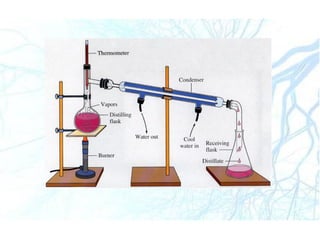
3.Solution by distillation – distilling the volatile principles from a
drug inside a copper wire cage which allows the free passage of
vapors and boiling water
4.Solution by extraction – extraction from vegetable or animal
origin with water or with water containing other substances
Principal methods of extraction
a.Maceration – the solid ingredients are placed in a stoppered
container with the whole of the solvent and allowed to stand for a
period of at least 3 days (until the soluble matter is dissolved) with
frequent agitation -The mixture is strained, the mark, pressed and
combined liquids are classified by filtration or decantation after
standing.
b.Percolation – the active ingredient is extracted from a
macerated drug mass in a narrow cone-shaped vessel open at
both ends (percolator) through the passage of an extracting
liquidated menstruum.
c.Digestion – form of maceration in which gentle heat is used
during the process of extraction
d.Infusion – dilute solution of the readily soluble
constituents of crude drugs. Fresh infusions are
prepared by macerating the drugs for a short period of
time with either cold or boiling water
e.Decoction – this process extracts water soluble and
heat stable constituents from crude drugs by boiling in
water for 15 minutes, cooling, straining, and passing
sufficient cold water through the drug to produce the
required volume
f.Complex solution – combination of at least two of the
above procedures with or without controlled application
of heat
Solutions
-may be classified into aqueous solution and non-
aqueous solutions.
AQUEOUS SOLUTIONS
1. Aromatic Waters
Medicated Waters are clear, saturated aqueous
solutions of volatile oils or other aromatic or volatile
substances. They do not contain preservatives.
Aromatic Water is prepared by distillation (e.g. Stronger
Rose Water) or by solution (e.g. Camphor Water)
2. Aqueous Acids
Derived into two groups:
a. Hydracids – do not contain oxygen (e.g., hydroiodic ,
hydrobromic, hydrochloric, and hydrofluoric acids.
b. Oxygen-containing acids , e.g. hypophosphorus,
nitric, phosphoric and sulfuric acids.
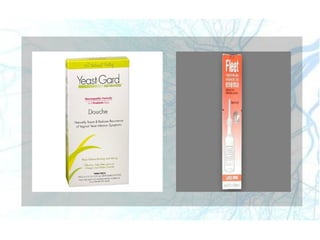
3. Douches
- Are aqueous solutions used as a cleansing or antiseptic agent
directed against part or into cavity of the body such as the eye,
pharynx, nasal passage and vagina. Douches are most frequently
dispensed in the form of a powder with directions for dissolving in a
specified quantity of water, usually warm
4. Enemas
- are rectal injections employed to evacuate the bowel, to influence
the general system by absorption, or to affect locally the seat of
disease. Official enemas are those of aminophylline, hydrocortisone
and methyl prednisolone acetate. Other enemas are starch, barium
sulfate and soap.
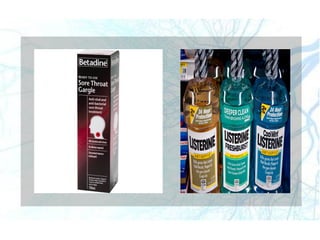
5. Gargles
-used to treat the pharynx and nasopharynx by forcing the air from
the lungs through the gargle which is held in the throat. E.g. Phenol
Gargle and Potassium Chlorate and Phenol Gargle
6. Washes
-most often used for its deodorant, refreshing or antiseptic effect. It
may contain alcohol, local anti-infective agents such as hexetidine
and cetylpyrindinum chlorine, glycerin, synthetic sweeteners and
surface active, flavoring and coloring agents. Well known commercial
mouth washes are Listerine, Astringosol.
7. Juices
-prepared from fresh ripe fruits. Used in making syrup which are
employed as vehicles. The freshly expressed juice is preserved with
benzoic acid and is allowed to stand at room temperature for several
days, until the pectins which as naturally present are destroyed by
enzymatic action of pectinase as indicated by the filtered juice
yielding a clear solution with alcohol. Sulfurous acids as sodium
metabisulfite is added as preservatives
8. Sprays
-are solutions of various drugs in aqueous vehicles are applied to
other mucous membranes of the nose and the throat by means of
nebulizer. It’s an isotonic with nasal secretions and approximately
same pH. Such sprays may contain antibiotics. Antihistamine,
vasoconstrictors alcohol, suitable solubilizing and wetting agents.
SWEET OR OTHER VISCID AQUEOUS SOLUTIONS
Viscous liquids or semi-solids
Basic sweet/ viscid substances:
sugars,
polyols,
or polysaccharides (gums)
Viscid sweetened sugar-free solutions- vehicle for drugs used by
diabetics
TYPES OF PREPARATIONS
1. Syrups
2. Honeys
3. Mucilages
4. Jellies
SYRUPS
Concentrated solution of sugar
• Syrup or simple syrup - 65% or more retard growth
of microorganisms
•Medicated syrup
•Flavored syrup- aromatic oils, vehicle, flavor
Preparation of Syrups
a. Solution with heat
b. Agitation without heat
c. Percolation
d. Addition of medicating liquid such as fluid extracts,
tinctures
Addition of preservatives- glycerin, methylparaben,
prophylparaben, benzoic acid, sodium benzolfate
Combination of alkylesters of p-hydroxybenzoic acid-
effective inhibitors of yeast
Storage: tight, light resistance containers in a cool place
Cannot be sterilized in an autoclave without
Caramelization- caramer: yellowish or brownish color
by the action of heat upon sucrose
Polyols ( such as glycerin or sorbitol)- retard
crystallization; increase solubility
Inversion- invert sugars (dextrose plus levulose)
Invert Sugars:
More readily fermentable
Tends to darken in color due to levulose
Its two reducing sugars retard exidation
Sucrose: Invert sugar - 1:23
Levulose:Sucrose: Dextrose- 173:100:74
In British Pharmaceutical Codex (BPC)- prepared by hydrolyzing
sucrose with HCl and neutralizing with Ca or NaCO3.
The sucrose in 66% w/w solution must be atleast 95% inverted
HONEYS
Use of honey instead of syrup as a base
Oxymell and Squill Oxymel given in BPC
MUCILAGES
Thick, viscid, adhesive liquids
JELLIES
Nonaqueous solutions
1.Alcoholic or Hydroalcoholic solutions:
a.Elixirs – are clear pleasantly flavoured, sweetened hydro-
alcoho-liquids intended for oral use. Main ingredient are
ethanol and water but glycerine sorbitol,mpropylene glycol,
flavouring agents, preservatives and syrup are often used in
preparation of the final product.
- Prepared by simple solution or admixture of
several ingredients.
b. Spirits – popularly known as essences; are alcoholic
solutions of volatile substances prepared usually by simple
Solutions or by admixture of the ingredients.
Other ways of preparing spirits:
By solution with maceration (e.g. Peppermint Spirit)
Chemical reaction (e.g. Ethyl Nitrate)
Distillation (e.g. brandy and whisky)
- Serve as flavouring agents while others are used for the
therapeutic effect of the medicinal substance they contain.
- Reduction of high alcoholic content of spirits by
admixture with aqueous preparations often cause turbidity.
- spirits require storage in tight, light-resistance containers
to prevent evaporation and to limit oxidative changes.
2.Ethereal solutions
a.Collodions – are liquid preparations containing pyroxylin (a.
nitrocellulose) in a mixture of ethyl ether and ethanol.
- they are applied to the skin by means of a soft brush and when the
ether and ethanol have evaporated leaves a film of pyroxilin on the
surface.
Ex. Salicylic Acid Collodion USP – keratolytic agent
Collodion USP, and flexible collodion – water-repellant protectives,
minor cuts and scratches
3.Glycerin solutions – are solutions or mixtures of medicinal
substances in not less than 50% glycerine.
Glycerin – it is used to dilute a glycerite, Phenol Glycerin BPC to form
the pharmaceutical preparation.
Glycerites – are hydroscopic and should be stored in highly closed
containers.
4.Oleaginous solutions:
a.Liniments – are solutions of various substances in oil,
they are usually applied with friction and rubbing of the
skin.
- alcoholic elements are used generally for their
rubefacient, counter-irritant, mildly astringent and
penetrating effect.
b.Oleovitamins – are fish liver oils diluted with edible
vegetable oil of solutions of the indicated vitamins or
vitamin concentrates (usually vit. A and D) in fish liver
oil.
- A popular commercial dosage form is the soft geletin
capsule.
c.Toothache drops – are preparations used for
temporary relief of toothache by application of a small
cotton saturated with product into the tooth cavity.
- Clove oil and mixture of phenols with camphor are
probably the most frequently used toothache remedies.
MIXTURES (TWO-PHASE
SYSTEMS)
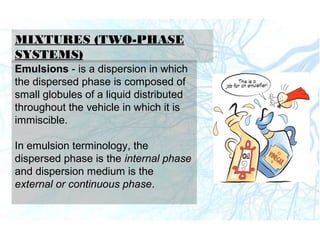
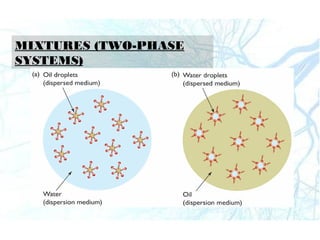
Emulsions - is a dispersion in which
the dispersed phase is composed of
small globules of a liquid distributed
throughout the vehicle in which it is
immiscible.
In emulsion terminology, the
dispersed phase is the internal phase
and dispersion medium is the
external or continuous phase.
MIXTURES (TWO-PHASE
SYSTEMS)
2 types of Emulsion:
1. Oil-in-water (o/w) - these are emulsions with an
oleaginous internal phase and an aqueous external phase. It
may be diluted or extended with water or an aqueous
preparation
2. Water-in-oil (w/o) - these are emulsions having an
aqueous internal phase and an oleaginous external phase. It
may be diluted with an oleaginous or oil-miscible liquid.
MIXTURES (TWO-PHASE
SYSTEMS)
MIXTURES (TWO-PHASE
SYSTEMS)
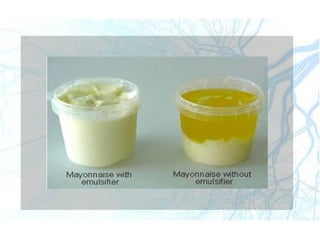
Emulsifying agent - prevents the separation of the two phases.
Classified of Emulsifying Agents:
 NATURAL EMULSIFYING AGENTS
 PURELY DIVIDED SOLIDS
 SYNTHETIC EMULSIFYING AGENT
a. Anionic
b. Cationic
c. Nonionic
MIXTURES (TWO-PHASE
SYSTEMS)
PURPOSE OF EMULSIONS AND EMULSIFICATION:
 Emulsification enables the pharmacist to prepare relatively
stable and homogenous mixtures of two immiscible liquids.
 It permits the administration of a liquid drug in the form of minute
globules rather than in bulk.
 For orally administered emulsions, the o/w type permits palatable
administration of an otherwise distasteful oil by dispersing it in a
sweetend, flavored aqueous vehicle.
MIXTURES (TWO-PHASE
SYSTEMS)
Four methods of preparation based on the mode of addition of the
ingredients are described as follows:
 EMULSIFIER - IN WATER METHOD: the emulsiying agent is
dissolved in the water and the oil is added, with agitation, to the
aqueous solution.
 EMULSIFIER - IN OIL METHOD or CONTINENTAL/DRY GUM
METHOD: also referred to as 4:2:1 method because for every 4
parts by volume of oil, 2 parts of water and 1 part of gum are added
in preparing the initial or primary emulsion.
MIXTURES (TWO-PHASE
SYSTEMS)
 SOAP METHOD: the two types of soaps developed
by this method are calcium soaps and soft soaps.
Calcium soaps are w/o in emulsions that contain certain
vegetable oils, such as oleic acid, in combination with
limewater. They are prepared simply by mixing equal
volumes of oil and limewater.
MIXTURES (TWO-PHASE
SYSTEMS)
 ALTERNATE ADDITION METHOD: the emulsion is
prepared by adding water and oil alternately to the
emulsifying agent. Also called the "English or Wet Gum
Method" for the preparation of emulsions.
By this method, the same proportions of oil, water, and
gum are used as in the continental or dry gum method,
but the order of mixing is different, and the proportion of
ingredients may be varied during the preparation of the
primary emulsion as is deemed necessary by the
operator.
MIXTURES (TWO-PHASE
SYSTEMS)
Equipments for breaking up the internal phase into
droplets can be divided into four broad categories:
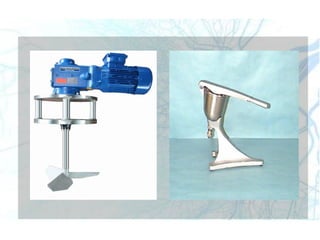
1. Agitator or mechanical stirrers e.g propeller shaft
stirrers - immersed in a tank of self-contained units with
propeller and paddle systems.
2. Homogenizers - the dispersion of two liquids is
achieved by forcing their mixture through a small inlet
orifice at high pressures.
MIXTURES (TWO-PHASE
SYSTEMS)
3. Ultrasonifiers - the dispersion is forced through an
orifice at modest pressures and is allowed to impinge
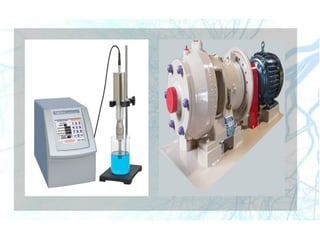
upon a blade which vibrates rapidly to produce an ultra
sonic note.
4. Colloid Mills - Consist of a rotor and stator with conical
milling surfaces. Dispersion is affected as it passes
between the milling surfaces.
A suspension is a two-phase system which consists of a finely divided
solid and dispersed in a solid, liquid or gas. It should possess certain
basic desirable properties:
PROPERTIES OF AN EFFECTIVE SUSPENSION
1. Slow sedimentation rate the dispersed phase should settle slowly
without forming a hard cake.
2. Resuspendable or redispersable after standing for sometime, the
dispersed phade should be uniformly redispensible on shaking.
3. Purable: the viscosity should be such that the preparation pours
easily and freely.
4. Chemically stable.
5. Acceptable to the consumer on the basic of its taste, color, and
cosmetic qualities.
CLASSIFICATIONS OF SUSPENSION
1. Gels are semisolid systems of either suspensions made
up of small inorganic particles or large organic molecules
interpenetrated by a liquid. They may be a thixotropic
forming semisolids on standing and becoming liquid on
agitation. To ensure homogeneity, they should be shaken
before use. An example of this type of preparation is the
aluminum Hydroxide Gel.
2. Magma and Milks are aqueous suspensions of insoluble,
inorganic drugs and differ mainly from gels mainly in that the
suspended particles are larger. Since they are thick and
viscous, there is no need to add a suspending agent to the
preparation. Like the gels, all magmas require a label
directing that they be shaken well before use. Freezing must
be avoided. Some official preparations are prepared by
simple hydration like Bentonite Magma USP or by chemical
reaction like Milk of Magnesia USP and Milk of Bismuth.
3. Lotions are usually liquid suspension intended for
external application to the body. They may be prepared by
triturating the ingredients to a smooth paste and then
cautiosly adding the remaining liquid phase. Some important
points to be to be considered during manufacture of lotions
are:
a. Lotions are usually applied without friction. Therefore, the
insoluble matter should be very finely divided approaching
colloidal dimensions,for more soothing and satisfactoy
effect.
b. A wide variety of ingredients may be added to the
preparation to produce better dispensions or to accentuate
the cooling, soothing, drying, moisturizing or protective
properties of the lotion.
c. Cosmetic aspect is of great importance.
d. Lotions tend to separate or stratify on long standing. They
require a shake well label.
e. Lotions should be labeled "For External Use Only".
f. Care should be taken to avoid contamination during
manufacturing, even if presevatives are present.
4. Mixtures are aqueous liquid preparations which contain
suspended, insoluble, solid substances and are intended for
internal use. The insoluble substance does not make the
mixture very viscous and the particles may be suspended by
the use of suitable suspending or thickening agents. They
should have a "Shake Well" label affixed to the container in
which they are dispensed. Since they are subject tomic-
robial contamination, a preservative should be added to the
formulation. An example of this type of preparation is Kaolin
Mixture and Pectin and Brown Mixture NFXII.
GALENCIALS(EXTRACTIVES)
Extraction involves the separation of medicinally active
portions of plant or animal tissues from the inactive or inert
components by use of selective solvents in standard
extraction procedures. Such extratives are relatively impure
liquids, semisolids or powders which may be used perse or
maybe processed further ford oral or external use. Such
preparations have been popularly called galencials, after
Galen, the 2nd century Greek physician. They include
classes of preparation such as:
Decoctions
These are preparations containing water soluble and heat-
stable constituents extracted form crude drugs by boiling the
latter in water infusions.
These are dilute solutions of readily soluble constituents of
crude drugs prepared by short maceration of the drugs with
either cold or boiling water.
Tinctures
Tinctures are alcoholic or hydroalcoholic solutions prepared
from vegetable materials or from chemical substances (e.g.
iodine tincture). Traditionally, the tinctures of potent
vegetable drugs essentially represent the activity of 10
grams of the drug in each 100 mL of tincture, the potency
being adjusted following assay. Most other tincture of
vegetable drugs represents the extractive from 20 grams of
the drug in 100 mL of tincture.
Tinctures prepared from vegetable drugs are made by two
processes:
1. Process P: percolation whih included a modification so
that tinctures that require assay for adjustment to specified
potency may be thus tested before dillution to final volume.
An example of this is Belladonna Tincture.
2. Process M: maceration e.g. Compound Benzoin Tincture
and Sweet Orange Peel Tincture.
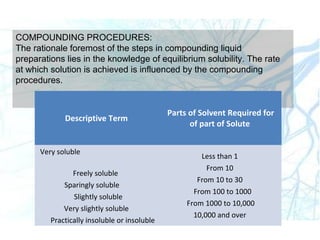
COMPOUNDING PROCEDURES:
The rationale foremost of the steps in compounding liquid
preparations lies in the knowledge of equilibrium solubility. The rate
at which solution is achieved is influenced by the compounding
procedures.
Descriptive Term
Parts of Solvent Required for
of part of Solute
Very soluble
Freely soluble
Sparingly soluble
Slightly soluble
Very slightly soluble
Practically insoluble or insoluble
Less than 1
From 10
From 10 to 30
From 100 to 1000
From 1000 to 10,000
10,000 and over
Guidelines :
As the proportion of solvents required increases or more
concentrated solutions are being made, it may be advantageous to
employ heat.
Solutes present in small concentrations should be pre-dissolved prior
to mixing to main portion of the batch to ensure complete solution of
the substance before the batch is further processed.
To produce a clear liquid preparation, the final bulk product is
clarified by cycling through a filtration system with or without prior
addition of a filter aid. The polished solutions then stored in a holding
tank until released by Quality Control.

Pharmaceutical Manufacturing Lecture: Liquid Preparations (CHAPTER 10)

  • 1.
    CHAPTER 10: LIQUID PREPARATIONS Angco,Shann Reexchel Caindoc, Ruby Ann Alvor, Carmina Lapinid, Ella Ann Patricia Sangkula, Nafiesa
  • 2.
    Preformulation - The processof optimizing a drug through the determination and/or definition of those physical and chemical properties considered important in the formulation of a stable effective and safe dosage form. •Safe handling of ingredients and equipment •Proper sequence of addition of ingredients •Optimum environmental conditions •Precautions to be observed •Expected interactions •Need for overages
  • 3.
    Solutions - whena solid, liquid or gas is dissolved in another liquid, a homogeneous mixture is formed which is called a solution Homogeneous liquid – has the same uniform appearance and composition throughout Heterogeneous liquid - consists of visibly different substances or phases Mixtures (or suspensions) – liquid preparations containing suspended, insoluble, solid substances Purified water – major ingredient or vehicle in most liquid preparations
  • 4.
    Solutions (Single phasesystems) 1.Simple solution – dissolving the solute in a suitable solvent which may contain other ingredients which stabilize or solubilize the active ingredient 2.Solution by chemical reaction – reacting two or more solutes with each other in a suitable solvent 3.Solution by distillation – distilling the volatile principles from a drug inside a copper wire cage which allows the free passage of vapors and boiling water 4.Solution by extraction – extraction from vegetable or animal origin with water or with water containing other substances
  • 6.
    Principal methods ofextraction a.Maceration – the solid ingredients are placed in a stoppered container with the whole of the solvent and allowed to stand for a period of at least 3 days (until the soluble matter is dissolved) with frequent agitation -The mixture is strained, the mark, pressed and combined liquids are classified by filtration or decantation after standing. b.Percolation – the active ingredient is extracted from a macerated drug mass in a narrow cone-shaped vessel open at both ends (percolator) through the passage of an extracting liquidated menstruum. c.Digestion – form of maceration in which gentle heat is used during the process of extraction
  • 7.
    d.Infusion – dilutesolution of the readily soluble constituents of crude drugs. Fresh infusions are prepared by macerating the drugs for a short period of time with either cold or boiling water e.Decoction – this process extracts water soluble and heat stable constituents from crude drugs by boiling in water for 15 minutes, cooling, straining, and passing sufficient cold water through the drug to produce the required volume f.Complex solution – combination of at least two of the above procedures with or without controlled application of heat
  • 8.
    Solutions -may be classifiedinto aqueous solution and non- aqueous solutions. AQUEOUS SOLUTIONS 1. Aromatic Waters Medicated Waters are clear, saturated aqueous solutions of volatile oils or other aromatic or volatile substances. They do not contain preservatives. Aromatic Water is prepared by distillation (e.g. Stronger Rose Water) or by solution (e.g. Camphor Water)
  • 9.
    2. Aqueous Acids Derivedinto two groups: a. Hydracids – do not contain oxygen (e.g., hydroiodic , hydrobromic, hydrochloric, and hydrofluoric acids. b. Oxygen-containing acids , e.g. hypophosphorus, nitric, phosphoric and sulfuric acids.
  • 10.
    3. Douches - Areaqueous solutions used as a cleansing or antiseptic agent directed against part or into cavity of the body such as the eye, pharynx, nasal passage and vagina. Douches are most frequently dispensed in the form of a powder with directions for dissolving in a specified quantity of water, usually warm 4. Enemas - are rectal injections employed to evacuate the bowel, to influence the general system by absorption, or to affect locally the seat of disease. Official enemas are those of aminophylline, hydrocortisone and methyl prednisolone acetate. Other enemas are starch, barium sulfate and soap.
  • 12.
    5. Gargles -used totreat the pharynx and nasopharynx by forcing the air from the lungs through the gargle which is held in the throat. E.g. Phenol Gargle and Potassium Chlorate and Phenol Gargle 6. Washes -most often used for its deodorant, refreshing or antiseptic effect. It may contain alcohol, local anti-infective agents such as hexetidine and cetylpyrindinum chlorine, glycerin, synthetic sweeteners and surface active, flavoring and coloring agents. Well known commercial mouth washes are Listerine, Astringosol.
  • 14.
    7. Juices -prepared fromfresh ripe fruits. Used in making syrup which are employed as vehicles. The freshly expressed juice is preserved with benzoic acid and is allowed to stand at room temperature for several days, until the pectins which as naturally present are destroyed by enzymatic action of pectinase as indicated by the filtered juice yielding a clear solution with alcohol. Sulfurous acids as sodium metabisulfite is added as preservatives 8. Sprays -are solutions of various drugs in aqueous vehicles are applied to other mucous membranes of the nose and the throat by means of nebulizer. It’s an isotonic with nasal secretions and approximately same pH. Such sprays may contain antibiotics. Antihistamine, vasoconstrictors alcohol, suitable solubilizing and wetting agents.
  • 15.
    SWEET OR OTHERVISCID AQUEOUS SOLUTIONS Viscous liquids or semi-solids Basic sweet/ viscid substances: sugars, polyols, or polysaccharides (gums) Viscid sweetened sugar-free solutions- vehicle for drugs used by diabetics
  • 16.
    TYPES OF PREPARATIONS 1.Syrups 2. Honeys 3. Mucilages 4. Jellies
  • 17.
    SYRUPS Concentrated solution ofsugar • Syrup or simple syrup - 65% or more retard growth of microorganisms •Medicated syrup •Flavored syrup- aromatic oils, vehicle, flavor Preparation of Syrups a. Solution with heat b. Agitation without heat c. Percolation d. Addition of medicating liquid such as fluid extracts, tinctures
  • 18.
    Addition of preservatives-glycerin, methylparaben, prophylparaben, benzoic acid, sodium benzolfate Combination of alkylesters of p-hydroxybenzoic acid- effective inhibitors of yeast Storage: tight, light resistance containers in a cool place Cannot be sterilized in an autoclave without Caramelization- caramer: yellowish or brownish color by the action of heat upon sucrose
  • 19.
    Polyols ( suchas glycerin or sorbitol)- retard crystallization; increase solubility Inversion- invert sugars (dextrose plus levulose) Invert Sugars: More readily fermentable Tends to darken in color due to levulose Its two reducing sugars retard exidation Sucrose: Invert sugar - 1:23 Levulose:Sucrose: Dextrose- 173:100:74
  • 20.
    In British PharmaceuticalCodex (BPC)- prepared by hydrolyzing sucrose with HCl and neutralizing with Ca or NaCO3. The sucrose in 66% w/w solution must be atleast 95% inverted HONEYS Use of honey instead of syrup as a base Oxymell and Squill Oxymel given in BPC MUCILAGES Thick, viscid, adhesive liquids JELLIES
  • 21.
    Nonaqueous solutions 1.Alcoholic orHydroalcoholic solutions: a.Elixirs – are clear pleasantly flavoured, sweetened hydro- alcoho-liquids intended for oral use. Main ingredient are ethanol and water but glycerine sorbitol,mpropylene glycol, flavouring agents, preservatives and syrup are often used in preparation of the final product. - Prepared by simple solution or admixture of several ingredients.
  • 22.
    b. Spirits –popularly known as essences; are alcoholic solutions of volatile substances prepared usually by simple Solutions or by admixture of the ingredients. Other ways of preparing spirits: By solution with maceration (e.g. Peppermint Spirit) Chemical reaction (e.g. Ethyl Nitrate) Distillation (e.g. brandy and whisky)
  • 23.
    - Serve asflavouring agents while others are used for the therapeutic effect of the medicinal substance they contain. - Reduction of high alcoholic content of spirits by admixture with aqueous preparations often cause turbidity. - spirits require storage in tight, light-resistance containers to prevent evaporation and to limit oxidative changes.
  • 24.
    2.Ethereal solutions a.Collodions –are liquid preparations containing pyroxylin (a. nitrocellulose) in a mixture of ethyl ether and ethanol. - they are applied to the skin by means of a soft brush and when the ether and ethanol have evaporated leaves a film of pyroxilin on the surface. Ex. Salicylic Acid Collodion USP – keratolytic agent Collodion USP, and flexible collodion – water-repellant protectives, minor cuts and scratches 3.Glycerin solutions – are solutions or mixtures of medicinal substances in not less than 50% glycerine. Glycerin – it is used to dilute a glycerite, Phenol Glycerin BPC to form the pharmaceutical preparation. Glycerites – are hydroscopic and should be stored in highly closed containers.
  • 25.
    4.Oleaginous solutions: a.Liniments –are solutions of various substances in oil, they are usually applied with friction and rubbing of the skin. - alcoholic elements are used generally for their rubefacient, counter-irritant, mildly astringent and penetrating effect. b.Oleovitamins – are fish liver oils diluted with edible vegetable oil of solutions of the indicated vitamins or vitamin concentrates (usually vit. A and D) in fish liver oil. - A popular commercial dosage form is the soft geletin capsule.
  • 26.
    c.Toothache drops –are preparations used for temporary relief of toothache by application of a small cotton saturated with product into the tooth cavity. - Clove oil and mixture of phenols with camphor are probably the most frequently used toothache remedies.
  • 27.
    MIXTURES (TWO-PHASE SYSTEMS) Emulsions -is a dispersion in which the dispersed phase is composed of small globules of a liquid distributed throughout the vehicle in which it is immiscible. In emulsion terminology, the dispersed phase is the internal phase and dispersion medium is the external or continuous phase.
  • 28.
    MIXTURES (TWO-PHASE SYSTEMS) 2 typesof Emulsion: 1. Oil-in-water (o/w) - these are emulsions with an oleaginous internal phase and an aqueous external phase. It may be diluted or extended with water or an aqueous preparation 2. Water-in-oil (w/o) - these are emulsions having an aqueous internal phase and an oleaginous external phase. It may be diluted with an oleaginous or oil-miscible liquid.
  • 29.
  • 30.
    MIXTURES (TWO-PHASE SYSTEMS) Emulsifying agent- prevents the separation of the two phases. Classified of Emulsifying Agents:  NATURAL EMULSIFYING AGENTS  PURELY DIVIDED SOLIDS  SYNTHETIC EMULSIFYING AGENT a. Anionic b. Cationic c. Nonionic
  • 32.
    MIXTURES (TWO-PHASE SYSTEMS) PURPOSE OFEMULSIONS AND EMULSIFICATION:  Emulsification enables the pharmacist to prepare relatively stable and homogenous mixtures of two immiscible liquids.  It permits the administration of a liquid drug in the form of minute globules rather than in bulk.  For orally administered emulsions, the o/w type permits palatable administration of an otherwise distasteful oil by dispersing it in a sweetend, flavored aqueous vehicle.
  • 33.
    MIXTURES (TWO-PHASE SYSTEMS) Four methodsof preparation based on the mode of addition of the ingredients are described as follows:  EMULSIFIER - IN WATER METHOD: the emulsiying agent is dissolved in the water and the oil is added, with agitation, to the aqueous solution.  EMULSIFIER - IN OIL METHOD or CONTINENTAL/DRY GUM METHOD: also referred to as 4:2:1 method because for every 4 parts by volume of oil, 2 parts of water and 1 part of gum are added in preparing the initial or primary emulsion.
  • 34.
    MIXTURES (TWO-PHASE SYSTEMS)  SOAPMETHOD: the two types of soaps developed by this method are calcium soaps and soft soaps. Calcium soaps are w/o in emulsions that contain certain vegetable oils, such as oleic acid, in combination with limewater. They are prepared simply by mixing equal volumes of oil and limewater.
  • 35.
    MIXTURES (TWO-PHASE SYSTEMS)  ALTERNATEADDITION METHOD: the emulsion is prepared by adding water and oil alternately to the emulsifying agent. Also called the "English or Wet Gum Method" for the preparation of emulsions. By this method, the same proportions of oil, water, and gum are used as in the continental or dry gum method, but the order of mixing is different, and the proportion of ingredients may be varied during the preparation of the primary emulsion as is deemed necessary by the operator.
  • 36.
    MIXTURES (TWO-PHASE SYSTEMS) Equipments forbreaking up the internal phase into droplets can be divided into four broad categories: 1. Agitator or mechanical stirrers e.g propeller shaft stirrers - immersed in a tank of self-contained units with propeller and paddle systems. 2. Homogenizers - the dispersion of two liquids is achieved by forcing their mixture through a small inlet orifice at high pressures.
  • 38.
    MIXTURES (TWO-PHASE SYSTEMS) 3. Ultrasonifiers- the dispersion is forced through an orifice at modest pressures and is allowed to impinge upon a blade which vibrates rapidly to produce an ultra sonic note. 4. Colloid Mills - Consist of a rotor and stator with conical milling surfaces. Dispersion is affected as it passes between the milling surfaces.
  • 40.
    A suspension isa two-phase system which consists of a finely divided solid and dispersed in a solid, liquid or gas. It should possess certain basic desirable properties: PROPERTIES OF AN EFFECTIVE SUSPENSION 1. Slow sedimentation rate the dispersed phase should settle slowly without forming a hard cake. 2. Resuspendable or redispersable after standing for sometime, the dispersed phade should be uniformly redispensible on shaking. 3. Purable: the viscosity should be such that the preparation pours easily and freely. 4. Chemically stable. 5. Acceptable to the consumer on the basic of its taste, color, and cosmetic qualities.
  • 41.
    CLASSIFICATIONS OF SUSPENSION 1.Gels are semisolid systems of either suspensions made up of small inorganic particles or large organic molecules interpenetrated by a liquid. They may be a thixotropic forming semisolids on standing and becoming liquid on agitation. To ensure homogeneity, they should be shaken before use. An example of this type of preparation is the aluminum Hydroxide Gel.
  • 42.
    2. Magma andMilks are aqueous suspensions of insoluble, inorganic drugs and differ mainly from gels mainly in that the suspended particles are larger. Since they are thick and viscous, there is no need to add a suspending agent to the preparation. Like the gels, all magmas require a label directing that they be shaken well before use. Freezing must be avoided. Some official preparations are prepared by simple hydration like Bentonite Magma USP or by chemical reaction like Milk of Magnesia USP and Milk of Bismuth.
  • 43.
    3. Lotions areusually liquid suspension intended for external application to the body. They may be prepared by triturating the ingredients to a smooth paste and then cautiosly adding the remaining liquid phase. Some important points to be to be considered during manufacture of lotions are: a. Lotions are usually applied without friction. Therefore, the insoluble matter should be very finely divided approaching colloidal dimensions,for more soothing and satisfactoy effect. b. A wide variety of ingredients may be added to the preparation to produce better dispensions or to accentuate the cooling, soothing, drying, moisturizing or protective properties of the lotion.
  • 44.
    c. Cosmetic aspectis of great importance. d. Lotions tend to separate or stratify on long standing. They require a shake well label. e. Lotions should be labeled "For External Use Only". f. Care should be taken to avoid contamination during manufacturing, even if presevatives are present.
  • 45.
    4. Mixtures areaqueous liquid preparations which contain suspended, insoluble, solid substances and are intended for internal use. The insoluble substance does not make the mixture very viscous and the particles may be suspended by the use of suitable suspending or thickening agents. They should have a "Shake Well" label affixed to the container in which they are dispensed. Since they are subject tomic- robial contamination, a preservative should be added to the formulation. An example of this type of preparation is Kaolin Mixture and Pectin and Brown Mixture NFXII.
  • 46.
    GALENCIALS(EXTRACTIVES) Extraction involves theseparation of medicinally active portions of plant or animal tissues from the inactive or inert components by use of selective solvents in standard extraction procedures. Such extratives are relatively impure liquids, semisolids or powders which may be used perse or maybe processed further ford oral or external use. Such preparations have been popularly called galencials, after Galen, the 2nd century Greek physician. They include classes of preparation such as:
  • 47.
    Decoctions These are preparationscontaining water soluble and heat- stable constituents extracted form crude drugs by boiling the latter in water infusions. These are dilute solutions of readily soluble constituents of crude drugs prepared by short maceration of the drugs with either cold or boiling water.
  • 48.
    Tinctures Tinctures are alcoholicor hydroalcoholic solutions prepared from vegetable materials or from chemical substances (e.g. iodine tincture). Traditionally, the tinctures of potent vegetable drugs essentially represent the activity of 10 grams of the drug in each 100 mL of tincture, the potency being adjusted following assay. Most other tincture of vegetable drugs represents the extractive from 20 grams of the drug in 100 mL of tincture.
  • 49.
    Tinctures prepared fromvegetable drugs are made by two processes: 1. Process P: percolation whih included a modification so that tinctures that require assay for adjustment to specified potency may be thus tested before dillution to final volume. An example of this is Belladonna Tincture. 2. Process M: maceration e.g. Compound Benzoin Tincture and Sweet Orange Peel Tincture.
  • 50.
    COMPOUNDING PROCEDURES: The rationaleforemost of the steps in compounding liquid preparations lies in the knowledge of equilibrium solubility. The rate at which solution is achieved is influenced by the compounding procedures. Descriptive Term Parts of Solvent Required for of part of Solute Very soluble Freely soluble Sparingly soluble Slightly soluble Very slightly soluble Practically insoluble or insoluble Less than 1 From 10 From 10 to 30 From 100 to 1000 From 1000 to 10,000 10,000 and over
  • 51.
    Guidelines : As theproportion of solvents required increases or more concentrated solutions are being made, it may be advantageous to employ heat. Solutes present in small concentrations should be pre-dissolved prior to mixing to main portion of the batch to ensure complete solution of the substance before the batch is further processed. To produce a clear liquid preparation, the final bulk product is clarified by cycling through a filtration system with or without prior addition of a filter aid. The polished solutions then stored in a holding tank until released by Quality Control.