Presented by;-
Mr. Tejas Mahendra Bhatia.
Third Year (Fifth Semester) B.Pharmacy,
Appasaheb Birnale College of Pharmacy, Sangli.
Tablets
Industrial Pharmacy-1
Contents;-
 Tablets:- Definition & General Introduction.
 Tablets:- Ideal Characteristics.
 Tablets:- Advantages & Disadvantages.
 Tablets:- Classification.
Definition & General Introduction.
 Various Route of Administration (RoA) are Oral,
Parenteral, Topical, Rectal & Nasal.
 Amongst these, ORAL is most preferred RoA as it is
easily self administered and no skilled medical staff is
required for drug administration. It also therefore
provides widen potential market for PHARMA
companies globally.
 Solids which includes, (Powders, Capsules &
Tablets) and Liquids which
includes(Solution,Syrups,
Elixirs,Emulsion,Suspension) are the two types of
ORAL DOSAGE FORMS.
ADANTAGES OF SOLID OVER
LIQUIDS:-
 Unit Dosage Forms.
 Accurate Dose.
 Greater Dose Precision.
 Least Content Variability.
 Easy Packaging & Transport.
 Easier Taste Masking.
 Easy handling by Pharmacist & Patients.
 Drugs are more stable in dry solid state
and thus don’t require Preservatives.
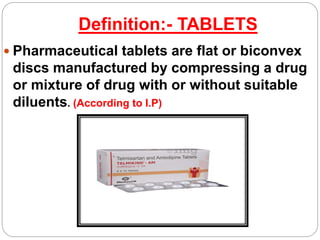
Definition:- TABLETS
 Pharmaceutical tablets are flat or biconvex
discs manufactured by compressing a drug
or mixture of drug with or without suitable
diluents. (According to I.P)
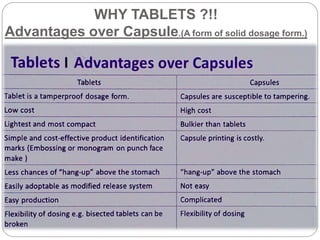
WHY TABLETS ?!!
Advantages over Capsule.(A form of solid dosage form.)
Disadvantages over Capsules.
Difficult Compression if;-
Amorphous or flocculated drug.
Low density material.
 Bioavailability issues:-
Hydrophobic drug(Poor wetting).
Slow dissolution.
Higher Doses.
 Coating is an Extra Step if:-
Bitter tasting drug.
Drug with objectionable odor and drug sensitive to oxygen
and atmospheric pressure.
 Capsule may offer best and lowest cost approach in
such cases.
Ideal Characteristics of a Tablet.
 1. The tablet should include the correct dose of the
drug.
 2. The appearance of the tablet should be elegant and
its weight, size and appearance should be consistent.
 3. The drug should be released from the tablet in a
controlled and reproducible way.
 4. The tablet should be biocompatible, i.e. not include
excipients, contaminants and microorganisms that could
cause harm to patients.
 5. The tablet should be of sufficient mechanical strength
to withstand fracture and erosion during handling.
 6. The tablet should be chemically, physically and
microbiologically stable during the lifetime of the
Advantages of Tablets:-
 They are a unit dose form, and they offer the greatest
capabilities of all oral dosage forms for the greatest dose
precision and the least content variability.
 Their cost is lowest of all oral dosage forms.
 They are the lightest and most compact of all dosage forms.
 They are in general the easiest and cheapest to package and
ship of all
 oral dosage forms.
 Product identification is potentially the simplest and cheapest,
requiring no additional processing steps when employing an
embossed or monogrammed punch face.
 They lend themselves to certain special-release profile
products, such as enteric or delayed-release products.
 They are better suited to large-scale production than other
dosage forms.
Disadvantages of Tablets:-
 Some drugs resist compression into dense compacts,
owing to their amorphous nature or flocculent, low-
density character.
 Drugs with poor wetting, slow dissolution properties,
intermediate to large dosages, optimum absorption
high in the gastrointestinal tract, or any combination
of these features may be difficult or impossible to
formulate and manufacture as a tablet that will still
provide adequate or full drug bioavailability.
 Bitter-tasting drugs, drugs with an objectionable odor,
or drugs that are sensitive to oxygen or atmospheric
moisture may require encapsulation or entrapment
prior to compression (if feasible or practical), or the
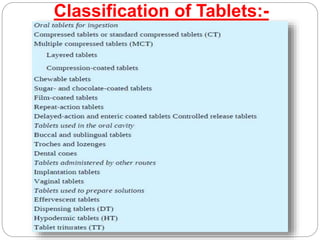
Classification of Tablets:-
Classification of Tablets;-
 Based on Route of administration:-
 ORAL, SUBLINGUAL BUCCAL.
 Based on Type of Drug Delivery System:-
 IMMEDIATE RELEASE & SUSTAINED RELEASE.
 Based on Form and method of Manufacture:-
 COMPRESSED,MOLDED, 3-D PRINTED TABLET.
Compressed Tablet/Standard
Compressed Tablets.
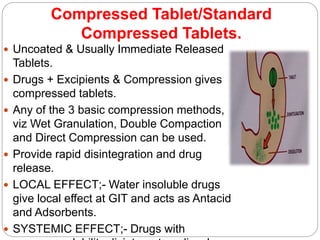
 Uncoated & Usually Immediate Released
Tablets.
 Drugs + Excipients & Compression gives
compressed tablets.
 Any of the 3 basic compression methods,
viz Wet Granulation, Double Compaction
and Direct Compression can be used.
 Provide rapid disintegration and drug
release.
 LOCAL EFFECT;- Water insoluble drugs
give local effect at GIT and acts as Antacid
and Adsorbents.
 SYSTEMIC EFFECT;- Drugs with
Multiple Compressed Tablets
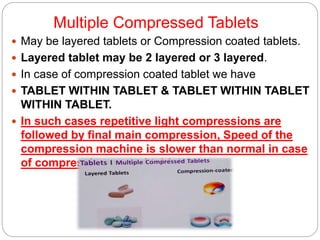
 May be layered tablets or Compression coated tablets.
 Layered tablet may be 2 layered or 3 layered.
 In case of compression coated tablet we have
 TABLET WITHIN TABLET & TABLET WITHIN TABLET
WITHIN TABLET.
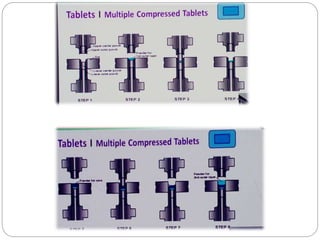
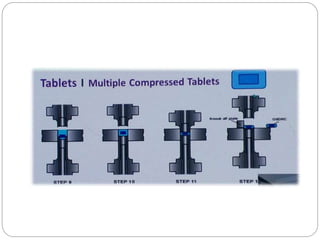
 In such cases repetitive light compressions are
followed by final main compression, Speed of the
compression machine is slower than normal in case
of compression coated tablets.
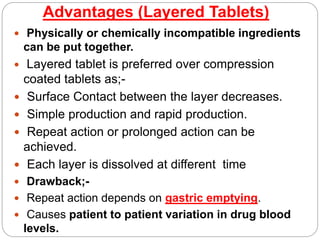
Advantages (Layered Tablets)
 Physically or chemically incompatible ingredients
can be put together.
 Layered tablet is preferred over compression
coated tablets as;-
 Surface Contact between the layer decreases.
 Simple production and rapid production.
 Repeat action or prolonged action can be
achieved.
 Each layer is dissolved at different time
 Drawback;-
 Repeat action depends on gastric emptying.
 Causes patient to patient variation in drug blood
levels.
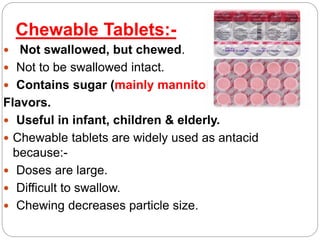
Chewable Tablets:-
 Not swallowed, but chewed.
 Not to be swallowed intact.
 Contains sugar (mainly mannitol) &
Flavors.
 Useful in infant, children & elderly.
 Chewable tablets are widely used as antacid
because:-
 Doses are large.
 Difficult to swallow.
 Chewing decreases particle size.
 Chocolate coated Tablet:-
Not used due to high chances of mistaking by children.
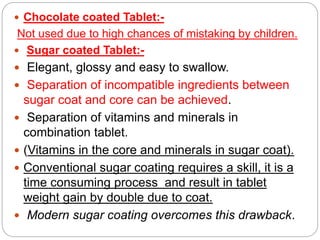
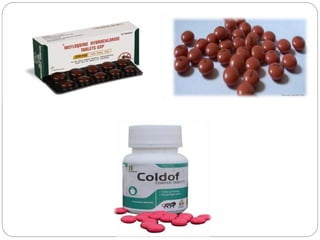
 Sugar coated Tablet:-
 Elegant, glossy and easy to swallow.
 Separation of incompatible ingredients between
sugar coat and core can be achieved.
 Separation of vitamins and minerals in
combination tablet.
 (Vitamins in the core and minerals in sugar coat).
 Conventional sugar coating requires a skill, it is a
time consuming process and result in tablet
weight gain by double due to coat.
 Modern sugar coating overcomes this drawback.
Film Coated Tablets;-
 Coating solution contains:-
 One or more polymers to make film.
 Plasticizer to impart elasticity to polymer film.
 Surfactant to achieve spreading.
 Solvent as a vehicle (Aqueous of Organic).
 Water soluble polymer:-
 Hydroxypropylmethyl cellulose (HPMC).
 It is the most widely used polymer in film coating.
 Water insoluble Polymer:-
 Ethyl Cellulose.
 PHYSICAL APPERANCE OF SUGAR COATED
TABLET ARE BETTER THAN FLIM COATED
TABLETS.
Solvents to be used;-
Aqueous/Polymer ?
 There are specific guidelines by OSHA
(OCCUPATIONAL SAFETY & HEALTH
ADMINISTRATION) and EPA (US
ENVIRONMENT PROTECTION AGENCY) if the
organic solvent is used, as they harm the
environment when coating is evaporated.
 Ethyl Cellulose polymer is an COLLOIDAL
DISPERSION of Ethyl Cellulose, with brand name
AQUACOAT manufactured by FMC Corporation.
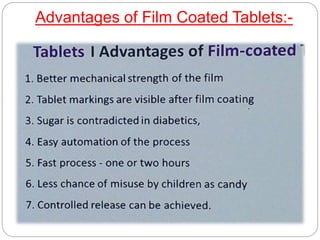
Advantages of Film Coated Tablets:-
Repeat Action Tablet:-
 Includes Multiple Compressed tablet and sugar
coated tablet.
 One dose is included in sugar coat and the other
coated with shellac or enteric polymer.
 COATING OPERATION MAY BE INTERRUPTED
BETWEEN TO CHECK THAT CORRECT AMOUNT
OF DRUG HAS BEEN APPLIED IN COATING.
Delayed Action & Enteric Coated Tablets:-
 Usually Veterinary tablets.
 Used to treat infection in lower GI region, may
pass through stomach or through small Intestine
and release drug in cecum or large bowel.
 Enteric Coating polymers:-
 Acid or esters functional groups.
 Cellulose acetate phthalate (CAP)-used since
long.
 Polyvinyl acetate phthalate.
 Hydroxypropylmethylcellulose phthalate.
 Applications;-
 Safety, avoid gastric irritation.
 Avoid Nausea and vomiting when not relased in
stomach.
 Drug degrades in acidic pH of stomach e.g.
Erythromycin.
 Avoid dilution of drug e.g. Intestinal antibacterial
Drug.
Controlled Release Tablets:-
 Tablet are most economic for this application.
 Examples are THEO-DUR & OROS.
 THEO-DUR;-
 Active Ingredient:- Theophylline.
 Key PharmaceuticalsAstra Zeneca.
 Action:- In gastric pH, tablets erodes slowly, in small
intestine it disintegrates fast to release coated
particles, which in turn slowly dissolves to release
drug.
 MECHANISM:- EROSION FOLLOWED BY
DISSOLUTION.
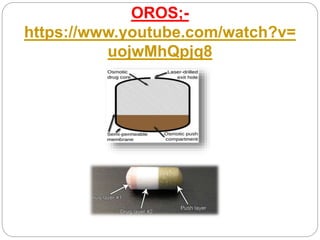
 OROS:-
 Manufactured by:- Alza Corporation.
 APPLIED FOR MANY DRUGS, PLATFORM
OROS;-
https://www.youtube.com/watch?v=
uojwMhQpjq8
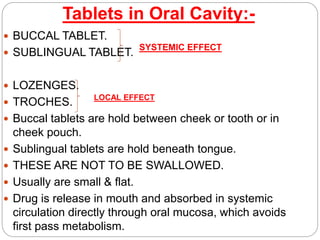
Tablets in Oral Cavity:-
 BUCCAL TABLET.
 SUBLINGUAL TABLET.
 LOZENGES.
 TROCHES.
 Buccal tablets are hold between cheek or tooth or in
cheek pouch.
 Sublingual tablets are hold beneath tongue.
 THESE ARE NOT TO BE SWALLOWED.
 Usually are small & flat.
 Drug is release in mouth and absorbed in systemic
circulation directly through oral mucosa, which avoids
first pass metabolism.
SYSTEMIC EFFECT
LOCAL EFFECT
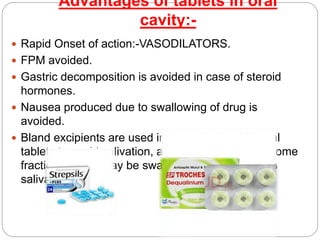
Advantages of tablets in oral
cavity:-
 Rapid Onset of action:-VASODILATORS.
 FPM avoided.
 Gastric decomposition is avoided in case of steroid
hormones.
 Nausea produced due to swallowing of drug is
avoided.
 Bland excipients are used in buccal and sublingual
tablets to avoid salivation, as if salivation occurs some
fraction of drug may be swallowed through excess
saliva.
TROCHES & LOZENGES,
 Local effect to mouth or throat.
 Active Ingredient may be,
 Local Anesthetics.
 Antiseptic.
 Antibacterial.
 Demulcent.
 Astringent & Antitussive.
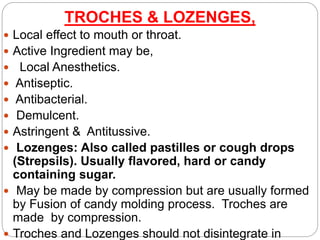
 Lozenges: Also called pastilles or cough drops
(Strepsils). Usually flavored, hard or candy
containing sugar.
 May be made by compression but are usually formed
by Fusion of candy molding process. Troches are
made by compression.
 Troches and Lozenges should not disintegrate in
Dental Cones:-
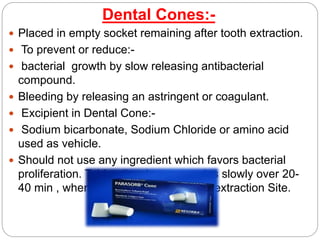
 Placed in empty socket remaining after tooth extraction.
 To prevent or reduce:-
 bacterial growth by slow releasing antibacterial
compound.
 Bleeding by releasing an astringent or coagulant.
 Excipient in Dental Cone:-
 Sodium bicarbonate, Sodium Chloride or amino acid
used as vehicle.
 Should not use any ingredient which favors bacterial
proliferation. Tablet dissolves or erodes slowly over 20-
40 min , when loosely packed in teeth extraction Site.
Tablets by other routes;-
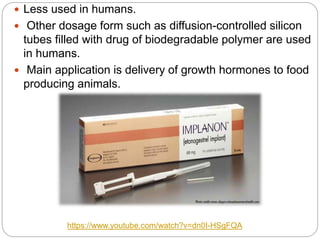
 1) Implants (Depot tablet);-
 Act as a depot to be released slowly.
 Placed beneath skin by in subcutaneous part by
microsurgery where they remain for long time and
released drug by constant rate to give prolonged
effect.
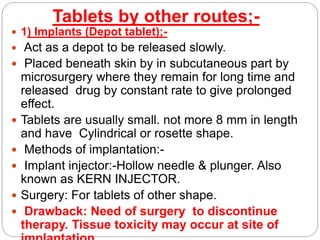
 Tablets are usually small. not more 8 mm in length
and have Cylindrical or rosette shape.
 Methods of implantation:-
 Implant injector:-Hollow needle & plunger. Also
known as KERN INJECTOR.
 Surgery: For tablets of other shape.
 Drawback: Need of surgery to discontinue
therapy. Tissue toxicity may occur at site of
 Less used in humans.
 Other dosage form such as diffusion-controlled silicon
tubes filled with drug of biodegradable polymer are used
in humans.
 Main application is delivery of growth hormones to food
producing animals.
https://www.youtube.com/watch?v=dn0I-HSgFQA
2) Vaginal Tablets:-
 Dissolve slowly to release drug in vaginal cavity.
 Vehicle is slowly soluble in material.
 Tablet should be compatible with some type of
plastic tube inserter which is usually employed to
place tablet in upper regional of vaginal track.
 Shape of tablet may be ovoid or pear shaped.
 Uses:
 To release antibacterial agents antiseptic, or
astringent to treat vaginal infection.
 To release steroid for systemic absorption.
SOLUTION:-
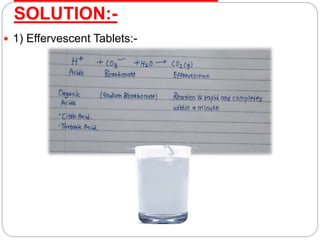
 1) Effervescent Tablets:-
 Produce clean solution.
 Pleasant flavored carbonated drink, help mask taste of
drug. Extemporaneous preparation with accurate dose.
 Enhanced drug dissolution in alkaline pH of effervescent
solution. Neutralization of gastric content by effervescent
solution.
 Limitation:-
 Systemic antacid effect with appreciable dose of sodium
or potassium.
 Not recommended method of producing routine gastric
neutralization.
 Disadvantage:-
 Less chemical stability to moisture in air.
 Need of careful dry storage, difficult for consumers.
 Usually are soft, hence difficult to pack and handle . As
are soft they are. packed in Hermatic type foil pouches
& stack packed in cylinder tubes with minimum air space.
2) Dispensing Tablets;-
 NOT USED NOW DAYS.
 Added to WATER by pharmacist or patient to
make solution.
 Buffers and isotonicity agents may be added if
solution is to be used in contact with mucous
membrane or on wounds.
 Should be completely soluble in water.
 Excipient should be stable in solution.
 Challenge;- Water quality.
 •Some are toxic, extremely hazardous and even
lethal, if swallowed.
 Great care is required in packaging and labeling to
prevent oral consumption.
3) Hypodermic Tablets & Tablet Triturates:-
 Used to make inject able solution extemporaneously
by adding tablets in sterile water or in water for
injection.
 Readily water soluble ingredient are used.
 Tablet Triturates:-
 Small, cylindrical, molded or compressed tablet
prepared by pharmacist.
 Usually potent drug were formulated as triturate.
 NOT USED NOW.
 Drawback:-
 Soft and filable after drying due to use of alcohol.
Drug migration, during alcohol evaporation, which
Hypodermic
tablets:-
References:-
 1) LachmanLieberman’s The Theory and
Practice of INDUSTRIAL PHARMACY. Section 3:-
13. TABLETS:-
PART-1;- Tablet Design.
 2) A textbook of Industrial Pharmacy, Third Year
B.Pharm. -Nirali Prakashan, Dr. B. Prakash Rao,
S. Rajarajan. Page No 2.1 to 2.3.
 3) www.google.com .
Thank you.
When
PHARMACIST
gives us life,
we give it to
our patients.
Keep
Working!

Tablets; General Introduction & Classification ;_By Tejas Bhatia.

  • 1.
    Presented by;- Mr. TejasMahendra Bhatia. Third Year (Fifth Semester) B.Pharmacy, Appasaheb Birnale College of Pharmacy, Sangli. Tablets Industrial Pharmacy-1
  • 2.
    Contents;-  Tablets:- Definition& General Introduction.  Tablets:- Ideal Characteristics.  Tablets:- Advantages & Disadvantages.  Tablets:- Classification.
  • 3.
    Definition & GeneralIntroduction.  Various Route of Administration (RoA) are Oral, Parenteral, Topical, Rectal & Nasal.  Amongst these, ORAL is most preferred RoA as it is easily self administered and no skilled medical staff is required for drug administration. It also therefore provides widen potential market for PHARMA companies globally.  Solids which includes, (Powders, Capsules & Tablets) and Liquids which includes(Solution,Syrups, Elixirs,Emulsion,Suspension) are the two types of ORAL DOSAGE FORMS.
  • 4.
    ADANTAGES OF SOLIDOVER LIQUIDS:-  Unit Dosage Forms.  Accurate Dose.  Greater Dose Precision.  Least Content Variability.  Easy Packaging & Transport.  Easier Taste Masking.  Easy handling by Pharmacist & Patients.  Drugs are more stable in dry solid state and thus don’t require Preservatives.
  • 5.
    Definition:- TABLETS  Pharmaceuticaltablets are flat or biconvex discs manufactured by compressing a drug or mixture of drug with or without suitable diluents. (According to I.P)
  • 6.
    WHY TABLETS ?!! Advantagesover Capsule.(A form of solid dosage form.)
  • 7.
    Disadvantages over Capsules. DifficultCompression if;- Amorphous or flocculated drug. Low density material.  Bioavailability issues:- Hydrophobic drug(Poor wetting). Slow dissolution. Higher Doses.  Coating is an Extra Step if:- Bitter tasting drug. Drug with objectionable odor and drug sensitive to oxygen and atmospheric pressure.  Capsule may offer best and lowest cost approach in such cases.
  • 8.
    Ideal Characteristics ofa Tablet.  1. The tablet should include the correct dose of the drug.  2. The appearance of the tablet should be elegant and its weight, size and appearance should be consistent.  3. The drug should be released from the tablet in a controlled and reproducible way.  4. The tablet should be biocompatible, i.e. not include excipients, contaminants and microorganisms that could cause harm to patients.  5. The tablet should be of sufficient mechanical strength to withstand fracture and erosion during handling.  6. The tablet should be chemically, physically and microbiologically stable during the lifetime of the
  • 9.
    Advantages of Tablets:- They are a unit dose form, and they offer the greatest capabilities of all oral dosage forms for the greatest dose precision and the least content variability.  Their cost is lowest of all oral dosage forms.  They are the lightest and most compact of all dosage forms.  They are in general the easiest and cheapest to package and ship of all  oral dosage forms.  Product identification is potentially the simplest and cheapest, requiring no additional processing steps when employing an embossed or monogrammed punch face.  They lend themselves to certain special-release profile products, such as enteric or delayed-release products.  They are better suited to large-scale production than other dosage forms.
  • 10.
    Disadvantages of Tablets:- Some drugs resist compression into dense compacts, owing to their amorphous nature or flocculent, low- density character.  Drugs with poor wetting, slow dissolution properties, intermediate to large dosages, optimum absorption high in the gastrointestinal tract, or any combination of these features may be difficult or impossible to formulate and manufacture as a tablet that will still provide adequate or full drug bioavailability.  Bitter-tasting drugs, drugs with an objectionable odor, or drugs that are sensitive to oxygen or atmospheric moisture may require encapsulation or entrapment prior to compression (if feasible or practical), or the
  • 11.
  • 12.
    Classification of Tablets;- Based on Route of administration:-  ORAL, SUBLINGUAL BUCCAL.  Based on Type of Drug Delivery System:-  IMMEDIATE RELEASE & SUSTAINED RELEASE.  Based on Form and method of Manufacture:-  COMPRESSED,MOLDED, 3-D PRINTED TABLET.
  • 13.
    Compressed Tablet/Standard Compressed Tablets. Uncoated & Usually Immediate Released Tablets.  Drugs + Excipients & Compression gives compressed tablets.  Any of the 3 basic compression methods, viz Wet Granulation, Double Compaction and Direct Compression can be used.  Provide rapid disintegration and drug release.  LOCAL EFFECT;- Water insoluble drugs give local effect at GIT and acts as Antacid and Adsorbents.  SYSTEMIC EFFECT;- Drugs with
  • 14.
    Multiple Compressed Tablets May be layered tablets or Compression coated tablets.  Layered tablet may be 2 layered or 3 layered.  In case of compression coated tablet we have  TABLET WITHIN TABLET & TABLET WITHIN TABLET WITHIN TABLET.  In such cases repetitive light compressions are followed by final main compression, Speed of the compression machine is slower than normal in case of compression coated tablets.
  • 17.
    Advantages (Layered Tablets) Physically or chemically incompatible ingredients can be put together.  Layered tablet is preferred over compression coated tablets as;-  Surface Contact between the layer decreases.  Simple production and rapid production.  Repeat action or prolonged action can be achieved.  Each layer is dissolved at different time  Drawback;-  Repeat action depends on gastric emptying.  Causes patient to patient variation in drug blood levels.
  • 18.
    Chewable Tablets:-  Notswallowed, but chewed.  Not to be swallowed intact.  Contains sugar (mainly mannitol) & Flavors.  Useful in infant, children & elderly.  Chewable tablets are widely used as antacid because:-  Doses are large.  Difficult to swallow.  Chewing decreases particle size.
  • 19.
     Chocolate coatedTablet:- Not used due to high chances of mistaking by children.  Sugar coated Tablet:-  Elegant, glossy and easy to swallow.  Separation of incompatible ingredients between sugar coat and core can be achieved.  Separation of vitamins and minerals in combination tablet.  (Vitamins in the core and minerals in sugar coat).  Conventional sugar coating requires a skill, it is a time consuming process and result in tablet weight gain by double due to coat.  Modern sugar coating overcomes this drawback.
  • 21.
    Film Coated Tablets;- Coating solution contains:-  One or more polymers to make film.  Plasticizer to impart elasticity to polymer film.  Surfactant to achieve spreading.  Solvent as a vehicle (Aqueous of Organic).  Water soluble polymer:-  Hydroxypropylmethyl cellulose (HPMC).  It is the most widely used polymer in film coating.  Water insoluble Polymer:-  Ethyl Cellulose.  PHYSICAL APPERANCE OF SUGAR COATED TABLET ARE BETTER THAN FLIM COATED TABLETS.
  • 22.
    Solvents to beused;- Aqueous/Polymer ?  There are specific guidelines by OSHA (OCCUPATIONAL SAFETY & HEALTH ADMINISTRATION) and EPA (US ENVIRONMENT PROTECTION AGENCY) if the organic solvent is used, as they harm the environment when coating is evaporated.  Ethyl Cellulose polymer is an COLLOIDAL DISPERSION of Ethyl Cellulose, with brand name AQUACOAT manufactured by FMC Corporation.
  • 23.
    Advantages of FilmCoated Tablets:-
  • 24.
    Repeat Action Tablet:- Includes Multiple Compressed tablet and sugar coated tablet.  One dose is included in sugar coat and the other coated with shellac or enteric polymer.  COATING OPERATION MAY BE INTERRUPTED BETWEEN TO CHECK THAT CORRECT AMOUNT OF DRUG HAS BEEN APPLIED IN COATING.
  • 25.
    Delayed Action &Enteric Coated Tablets:-  Usually Veterinary tablets.  Used to treat infection in lower GI region, may pass through stomach or through small Intestine and release drug in cecum or large bowel.  Enteric Coating polymers:-  Acid or esters functional groups.  Cellulose acetate phthalate (CAP)-used since long.  Polyvinyl acetate phthalate.  Hydroxypropylmethylcellulose phthalate.
  • 26.
     Applications;-  Safety,avoid gastric irritation.  Avoid Nausea and vomiting when not relased in stomach.  Drug degrades in acidic pH of stomach e.g. Erythromycin.  Avoid dilution of drug e.g. Intestinal antibacterial Drug.
  • 27.
    Controlled Release Tablets:- Tablet are most economic for this application.  Examples are THEO-DUR & OROS.  THEO-DUR;-  Active Ingredient:- Theophylline.  Key PharmaceuticalsAstra Zeneca.  Action:- In gastric pH, tablets erodes slowly, in small intestine it disintegrates fast to release coated particles, which in turn slowly dissolves to release drug.  MECHANISM:- EROSION FOLLOWED BY DISSOLUTION.  OROS:-  Manufactured by:- Alza Corporation.  APPLIED FOR MANY DRUGS, PLATFORM
  • 28.
  • 29.
    Tablets in OralCavity:-  BUCCAL TABLET.  SUBLINGUAL TABLET.  LOZENGES.  TROCHES.  Buccal tablets are hold between cheek or tooth or in cheek pouch.  Sublingual tablets are hold beneath tongue.  THESE ARE NOT TO BE SWALLOWED.  Usually are small & flat.  Drug is release in mouth and absorbed in systemic circulation directly through oral mucosa, which avoids first pass metabolism. SYSTEMIC EFFECT LOCAL EFFECT
  • 30.
    Advantages of tabletsin oral cavity:-  Rapid Onset of action:-VASODILATORS.  FPM avoided.  Gastric decomposition is avoided in case of steroid hormones.  Nausea produced due to swallowing of drug is avoided.  Bland excipients are used in buccal and sublingual tablets to avoid salivation, as if salivation occurs some fraction of drug may be swallowed through excess saliva.
  • 31.
    TROCHES & LOZENGES, Local effect to mouth or throat.  Active Ingredient may be,  Local Anesthetics.  Antiseptic.  Antibacterial.  Demulcent.  Astringent & Antitussive.  Lozenges: Also called pastilles or cough drops (Strepsils). Usually flavored, hard or candy containing sugar.  May be made by compression but are usually formed by Fusion of candy molding process. Troches are made by compression.  Troches and Lozenges should not disintegrate in
  • 32.
    Dental Cones:-  Placedin empty socket remaining after tooth extraction.  To prevent or reduce:-  bacterial growth by slow releasing antibacterial compound.  Bleeding by releasing an astringent or coagulant.  Excipient in Dental Cone:-  Sodium bicarbonate, Sodium Chloride or amino acid used as vehicle.  Should not use any ingredient which favors bacterial proliferation. Tablet dissolves or erodes slowly over 20- 40 min , when loosely packed in teeth extraction Site.
  • 33.
    Tablets by otherroutes;-  1) Implants (Depot tablet);-  Act as a depot to be released slowly.  Placed beneath skin by in subcutaneous part by microsurgery where they remain for long time and released drug by constant rate to give prolonged effect.  Tablets are usually small. not more 8 mm in length and have Cylindrical or rosette shape.  Methods of implantation:-  Implant injector:-Hollow needle & plunger. Also known as KERN INJECTOR.  Surgery: For tablets of other shape.  Drawback: Need of surgery to discontinue therapy. Tissue toxicity may occur at site of
  • 34.
     Less usedin humans.  Other dosage form such as diffusion-controlled silicon tubes filled with drug of biodegradable polymer are used in humans.  Main application is delivery of growth hormones to food producing animals. https://www.youtube.com/watch?v=dn0I-HSgFQA
  • 35.
    2) Vaginal Tablets:- Dissolve slowly to release drug in vaginal cavity.  Vehicle is slowly soluble in material.  Tablet should be compatible with some type of plastic tube inserter which is usually employed to place tablet in upper regional of vaginal track.  Shape of tablet may be ovoid or pear shaped.  Uses:  To release antibacterial agents antiseptic, or astringent to treat vaginal infection.  To release steroid for systemic absorption.
  • 36.
  • 37.
     Produce cleansolution.  Pleasant flavored carbonated drink, help mask taste of drug. Extemporaneous preparation with accurate dose.  Enhanced drug dissolution in alkaline pH of effervescent solution. Neutralization of gastric content by effervescent solution.  Limitation:-  Systemic antacid effect with appreciable dose of sodium or potassium.  Not recommended method of producing routine gastric neutralization.  Disadvantage:-  Less chemical stability to moisture in air.  Need of careful dry storage, difficult for consumers.  Usually are soft, hence difficult to pack and handle . As are soft they are. packed in Hermatic type foil pouches & stack packed in cylinder tubes with minimum air space.
  • 38.
    2) Dispensing Tablets;- NOT USED NOW DAYS.  Added to WATER by pharmacist or patient to make solution.  Buffers and isotonicity agents may be added if solution is to be used in contact with mucous membrane or on wounds.  Should be completely soluble in water.  Excipient should be stable in solution.  Challenge;- Water quality.  •Some are toxic, extremely hazardous and even lethal, if swallowed.  Great care is required in packaging and labeling to prevent oral consumption.
  • 39.
    3) Hypodermic Tablets& Tablet Triturates:-  Used to make inject able solution extemporaneously by adding tablets in sterile water or in water for injection.  Readily water soluble ingredient are used.  Tablet Triturates:-  Small, cylindrical, molded or compressed tablet prepared by pharmacist.  Usually potent drug were formulated as triturate.  NOT USED NOW.  Drawback:-  Soft and filable after drying due to use of alcohol. Drug migration, during alcohol evaporation, which Hypodermic tablets:-
  • 40.
    References:-  1) LachmanLieberman’sThe Theory and Practice of INDUSTRIAL PHARMACY. Section 3:- 13. TABLETS:- PART-1;- Tablet Design.  2) A textbook of Industrial Pharmacy, Third Year B.Pharm. -Nirali Prakashan, Dr. B. Prakash Rao, S. Rajarajan. Page No 2.1 to 2.3.  3) www.google.com .
  • 41.
    Thank you. When PHARMACIST gives uslife, we give it to our patients. Keep Working!