PoonamNikam
AssistantProfessor
PharmaceuticsDepartment
LIQUID ORALS
Oral Liquids-
• Oral Liquids are homogeneous liquid preparations, usually
consisting of a solution, an emulsion or a suspension of one or
more medicaments in a suitable vehicle. Liquid dosage forms are
either monophasic or biphasic.
• A monophasic liquid dosage form is one which contains only one
phase. A biphasic liquid dosage form contains two phases.
• The vehicle for any liquid preparation for oral use is chosen
having regard to the nature of the active ingredient(s) and to
provide organoleptic characteristics appropriate to the intended
use of the preparation.
• Liquid preparations for oral use may contain suitable
antimicrobial preservatives, antioxidants and other excipients
such as dispersing, suspending, thickening, emulsifying,
buffering, wetting, solubilizing, stabilizing, flavouring and
sweetening agents and authorized colouring matter.
Classification of Liquid Orals
Liquid dosage forms are broadly classified into two groups:
a) Monophasic liquid dosage forms
b) Biphasic liquid dosage forms
1. Monophasic liquids dosage forms are mixtures, elixirs, syrups,
linctuses, draughts and drops etc.
2. Biphasic liquids dosage forms are suspensions and emulsions.
Advantages of Liquid Dosage Forms
i) They are the most suitable dosage form for infants, children and
geriatric patients.
ii) The unpleasant taste of the drugs can be masked by adding
sweetening and flavouring agents.
iii) It is attractive in appearance and gives beneficial psychological
effects.
iv) The drug is rapidly available for absorption.
Disadvantages of Liquid Dosage Forms
i) The liquid dosage forms have less stability when compared to solid
dosage forms.
ii) Liquids are bulky and therefore inconvenient to transport and
store
iv) Accidental breakage of the container results in loss of whole
dosage form.
Formulation consideration:
The common excipients used in liquid formulation are
(1) Vehicles
(2) Solubilizers
(3) Preservatives
(4) Stabilizers
(5) Organoleptic agents
(1) Vehicles
Solvents:
• Base in which drugs and other excipients are dissolved or dispersed.
• They function by breaking of bond and reducing effective charge on ions
thus increasing solute-solvent forces of attraction which are eventually
greater than solute-solute and solvent-solvent forces of attraction.
• Eg: water, hydro-alcoholic liquid systems, polyhydric alcohols, acetic acid,
ethyl acetate and buffers. These may be thin liquids, thick syrupy liquids,
mucilage or hydrocolloid bases.
• The oily vehicles include vegetable oils, mineral oils, organic oily bases or
emulsified bases etc.
Co-solvent:
• are defined as water- miscible organic solvents that are used in
liquid drug formulations to increase the solubility of poorly water
soluble substances or to enhance the chemical stability of a drug.
• An ideal co-solvent should possess values of dielectric constant
between 25 and 80. The most widely used system that will cover
this range is a water/ethanol blend.
• It should not cause toxicity or irritancy when administrated for oral
or parental use. Other co-solvents are sorbitol, glycerol, propylene
glycol and syrup.
Water:
For the preparation in pharmaceutical formulation IP refers water as
clear, odorless, colorless and neutral with slight deviation in pH due
to dissolved solids and gases. Purified water IP is commonly used as
vehicle or as a component of vehicle for aqueous liquid formulations
but not for those intended for parenteral administration.
Ethanol
• Ethanol, frequently referred as alcohol is the most commonly used
solvent in liquid pharmaceutical formulation next to water.
• It is generally used as hydro-alcoholic mixture to dissolve water and
soluble drugs and excipients.
• Diluted ethanol is prepared by mixing equal volumes of ethanol IP
and purified water IP is a most useful solvent in various
pharmaceutical processes and formulations to dissolve poorly
soluble substances.
Glycerol
• Glycerol is called glycerin is a clear, colorless liquid with thick, syrupy
consistency, oily to the touch, odorless, very sweet and slightly
warm to taste.
• They are prepared by the decomposition of vegetable or animal fats
or fixed oils and containing not less than 95% of absolute glycerin.
• It is soluble in all proportions, in water or alcohol; also soluble in a
mixture of 3 parts of alcohol and 1 part of ether, but insoluble in
ether, chloroform, carbon di-sulphide, benzene, benzoyl, and fixed
or volatile oils.
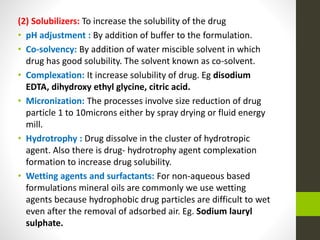
(2) Solubilizers: To increase the solubility of the drug
• pH adjustment : By addition of buffer to the formulation.
• Co-solvency: By addition of water miscible solvent in which
drug has good solubility. The solvent known as co-solvent.
• Complexation: It increase solubility of drug. Eg disodium
EDTA, dihydroxy ethyl glycine, citric acid.
• Micronization: The processes involve size reduction of drug
particle 1 to 10microns either by spray drying or fluid energy
mill.
• Hydrotrophy : Drug dissolve in the cluster of hydrotropic
agent. Also there is drug- hydrotrophy agent complexation
formation to increase drug solubility.
• Wetting agents and surfactants: For non-aqueous based
formulations mineral oils are commonly we use wetting
agents because hydrophobic drug particles are difficult to wet
even after the removal of adsorbed air. Eg. Sodium lauryl
sulphate.
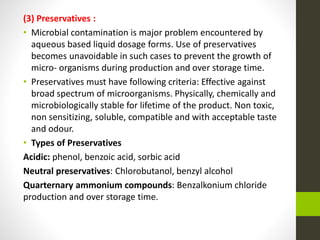
(3) Preservatives :
• Microbial contamination is major problem encountered by
aqueous based liquid dosage forms. Use of preservatives
becomes unavoidable in such cases to prevent the growth of
micro- organisms during production and over storage time.
• Preservatives must have following criteria: Effective against
broad spectrum of microorganisms. Physically, chemically and
microbiologically stable for lifetime of the product. Non toxic,
non sensitizing, soluble, compatible and with acceptable taste
and odour.
• Types of Preservatives
Acidic: phenol, benzoic acid, sorbic acid
Neutral preservatives: Chlorobutanol, benzyl alcohol
Quarternary ammonium compounds: Benzalkonium chloride
production and over storage time.
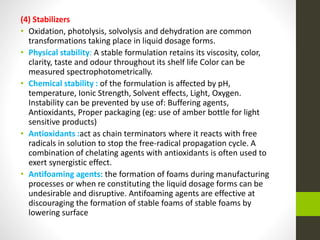
(4) Stabilizers
• Oxidation, photolysis, solvolysis and dehydration are common
transformations taking place in liquid dosage forms.
• Physical stability: A stable formulation retains its viscosity, color,
clarity, taste and odour throughout its shelf life Color can be
measured spectrophotometrically.
• Chemical stability : of the formulation is affected by pH,
temperature, Ionic Strength, Solvent effects, Light, Oxygen.
Instability can be prevented by use of: Buffering agents,
Antioxidants, Proper packaging (eg: use of amber bottle for light
sensitive products)
• Antioxidants :act as chain terminators where it reacts with free
radicals in solution to stop the free-radical propagation cycle. A
combination of chelating agents with antioxidants is often used to
exert synergistic effect.
• Antifoaming agents: the formation of foams during manufacturing
processes or when re constituting the liquid dosage forms can be
undesirable and disruptive. Antifoaming agents are effective at
discouraging the formation of stable foams of stable foams by
lowering surface
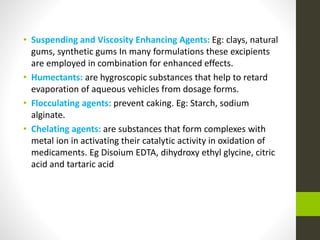
• Suspending and Viscosity Enhancing Agents: Eg: clays, natural
gums, synthetic gums In many formulations these excipients
are employed in combination for enhanced effects.
• Humectants: are hygroscopic substances that help to retard
evaporation of aqueous vehicles from dosage forms.
• Flocculating agents: prevent caking. Eg: Starch, sodium
alginate.
• Chelating agents: are substances that form complexes with
metal ion in activating their catalytic activity in oxidation of
medicaments. Eg Disoium EDTA, dihydroxy ethyl glycine, citric
acid and tartaric acid
(5) Organoleptic properties
• Flavouring agents:
• Sweetening agents: Sucrose enhances viscosity of liquids and
also gives a pleasant texture in the mouth. The term sugar
free solution include sweetening agents such as sorbitol,
mannitol, saccharin and aspartame as alternative to sugar
such as sucrose, fructose.
• Coloring agent: A distinction should be made between agents
that have inherent color and those that are employed as
colorants. Colors used in liquid dosage form must be certified
by FDA as per D&C Act 1940. Certain agents- sulphur (yellow),
riboflavin (yellow), cupric sulfate (blue), ferrous sulfate (bluish
green) cyanocobalamin (red) and red mercuric iodide (vivid
red) have inherent color and not thought of as pharmaceutical
colorants in the usual sense of the term.
Manufacturing Consideration-
The manufacturing process for liquid preparations for oral use
should meet the requirements of Good Manufacturing Practice
(GMP). The following information is intended to provide broad
guidelines concerning the critical steps to be followed during
production of liquid preparations for oral use.
In the manufacture of liquid preparations for oral use, measures
are taken to:
• ensure that all ingredients are of appropriate quality
• minimize the risk of microbial contamination
• minimize the risk of cross-contamination
Steps of Liquids ManufacturingProcess
1. Planning of Material Requirements:
Raw Materials : Incoming raw materials should be tested as per
specifications that is identity, purity, uniformity and microbial
contamination .
Equipments : The following types of equipments may be used in
the manufacture of liquid formulations:
1. Mixing tanks (SS 316 Stainless Steel) equipped with an agitator.
2. Measuring devices for large and small amount of solids and
liquids. 3. A filtration system e.g. filter press Cleaning of
equipments
• All equipments must be thoroughly cleaned and sanitized before
use.
• Disinfectants used: Dilute solutions of H2O2, phenol derivatives.
• Sterilized by: Alcohol, boiling water, autoclaving, steam or dry
heat.
2. Liquid Preparation:
Research and development of protocols concerning liquid
compounding; scale - up of the bulk product compounding;
physical plant control and maintenance; equipment
maintenance and renovation; continuous training of personnel
and personnel compensation plan; and supervision of system
reports.
3. Filling and Packing:
Research and development of protocols concerning filling and
packing; scale-up of the finished drug product filling and
packing; physical plant control and maintenance; equipment
maintenance and renovation; continuous training of personnel
and personnel compensation plan; and supervision of system
reports.
4. Sales of Drug Products: Research and development of
protocols concerning product storage; distribution process;
continuous training of personnel and personnel compensation
plan; and supervision of system reports.
5. Vendor Handling: Research and development protocols
concerning precautions to maintain product stability; control of
vendor stock; and sales system reports.
6. Customer Service: Research and development of protocols
concerning home storage and handling to maintain product
stability; relations with health insurance companies and health
care professionals; educational materials for patient counseling;
and customer service system reports.
Elixirs
Elixirs are clear, flavoured, sweetened, hydroalcoholic
preparations for oral administration. They are more stable than
mixtures. Elixirs are classified into two classes.
a) Non medicated elixirs: These elixirs do not contain any
medicament but contain some aromatic or pleasantly flavoured
substances. These are used as solvents for other liquid
preparations.
b) Medicated elixirs: These elixirs contain some medicinal
substance along with other ingredients.
Syrups
Syrups are liquid oral preparations in which the vehicle is a
concentrated solution of sucrose or other sugars in water. The
concentration of sugar in syrup is 66.7 % W/W. Syrups are further
classified into 2 classes.
a) Simple syrups: The simple syrups do not contain any medicament,
but contains some pleasantly flavoured substances. These syrups are
used as a medium for other liquid preparations.
b) Medicated syrups: These syrups contain some medicinal substance
along with other ingredients.
Advantages of syrups
• Syrups prevent oxidation and decomposition of drugs.
• Syrups are sweet in taste and therefore bitter taste of drugs can be
reduced.
Disadvantages of syrups
• Syrups are not preferred for diabetic patients.
• On continuous take syrup promote dental decay.
Suspensions
Suspensions are the biphasic liquid dosage form of medicament in which
the finely divided solid particles are suspended or dispersed in a liquid or
semisolid vehicle with the help of suspending agent. The solid particle is
the ‘dispersed phase’ or ‘discontinuous phase’ whereas the liquid vehicle
is the ‘continuous phase’.
a) Oral suspensions: These suspensions are to be consumed by oral route.
b) Parenteral suspensions: The suspensions which are administered by
parenteral route are called parenteral suspensions.
c) Ophthalmic suspensions: These are used for instilling into the eye.
d) Suspensions for external use: These are used for external applications.
Advantages:
Can improve chemical stability of certain drugs.
Higher rate of bioavailability, as order of bioavailability is:
Solution>Suspension>Capsules>Compressed tablets
Disadvantages:
Physical stability, sedimentation and compaction.
Bulky, handling require care.
Uniform drug delivery cannot be achieved sometimes.
Ideal properties of suspensions:
1. The dispersed particles should not settle readily and the settled
particles should redisperse immediately on shaking.
2. The particles shouldn‘t form a cake on settling.
3. The viscosity should be such that the preparation can be easily poured.
4. It should be chemically stable.
5. Suspensions for internal use must be palatable and suspension for
external use must be free from gritty particles.
Types of suspensions:
Depending upon particle nature/dispersed particle nature the suspensions
are of two types:
1. Flocculated suspensions
2. Non-flocculated/deflocculated suspensions.
Flocculated suspensions:
Suspension in which particles are weakly bonded, settle rapidly, don’t form
a cake and are easily resuspended with a minimum of agitation.
Deflocculated suspensions:
Suspension in which particles settle slowly and eventually form a sediment
in which aggregation occurs with the resultant formation of a hard cake
which is difficult to resuspend.
Stability of suspensions:
A stable suspension can be redispersed homogenously
throughout its shelf life.The more stable pharmaceutical
suspensions are flocculated i.e.,the suspended particles are
bonded together physically to form a loose cake.
Packing of Suspensions
Suspensions can be packed in narrow mouth screw caped colour
less plain bottle. Suspensions that are very thick require a
container with wide mouth. Suspensions should be stored in a
cool place.
Evaluation of suspension stability:
The following are commonly used for evaluating the physical
stability of suspensions:
1.Sedimentation method. 2.Rheological method.
3.Electrokinetic method. 4.Micromeritic method.
1.Sedimentation method:
It is determined by keeping a measured volume of suspension in
a graduated cylinder in an undisturbed position for a definite
period of time, the ultimate volume (V0) and the initial volume
(Vu) of the sediment is to be noted. Sedimentation volume is a
ratio of the ultimate volume of sediment (V0) to the original
volume of the sediment (VU) before settling.
Sedimentation volume F=V0/VU
2. Rheological method:
• It provides information about settling behaviour.
• The arrangement of the vehicle and the particle structural
features.
• Brookfield viscometer is used to study the viscosity of the
suspension. If viscosity of the suspension increases, the
stability of the suspension increases.
3. Electrokinetic method:
The determination of surface electric charge or zeta potential is
helpful to find out the stability of suspension. Zeta potential can
be calculated from the migration of particle measured by the
electrophoretic method.
4. Micromeritic method:
The stability of suspension depends on the particle size of the
disperse phase. The size of the particle in a suspension may
grow and ultimately leads to the formation of clumps or caking.
So, any change in particle size distribution with reference to
time gives a stable suspension. The particle size can be studied
by microscopy or coulter countered method.
Emulsion
An emulsion is defined as a dibasic or heterogenous liquid preparation
immiscible liquids which is dispersed as a minute globules in another liquid by
adding emulsifying agent.
Medicines having an unpleasant taste and order can be made more palatable for
oral administration in the form of an emulsion. Emulsions protect drugs against
oxidation or hydrolysis.
• Emulsions are less stable.
• They are susceptible to microbial growth.
Classification of emulsions:
Emulsions can be classified into the following types:
1. Oil in water (o/w) type of emulsion.
2. Water in oil (w/o) type of emulsion.
3. Microemulsions
4. Multiple/double emulsion.
Advantages:
Mask the unpleasant taste.
Sustained release medication.
Inert and chemically non-reactive.
Reasonably odourless & cost effective.
Disadvantages:
Packing, handling & storage is difficult.
Thermodynamically unstable & have short shelf life.
Leads to creaming & cracking.
Leads to phase inversion.
Packing of Emulsions
Emulsions can be packed in narrow mouth screw caped
colourless plain bottle. Emulsions that are very thick require a
container with wide mouth. Emulsions should be stored in a
cool place.
a) Oil in water type: This type of emulsion is the one in which
the oil is dispersed in the water
b) Water in oil type: This type of emulsion is the one in which
the water is dispersed in the oil. Emulsions may be liquid or
semi-solid. Liquid emulsions can be classified as i) emulsions for
oral administration, ii) emulsion for external uses, iii) emulsion
for parenteral uses, and iv) emulsion for rectal use.
i) Emulsions for oral administration
Some medicaments are unpleasant in taste. For example fish liver oil, we
can mask this unpleasant taste by converting it into an emulsion and can
be given orally.
ii) Emulsions for external use
The external preparation of emulsion consists of three classes.
Applications, lotions and liniments, these emulsions can be either oil in
water or water in oil.
iii) Emulsions for parenteral use
Some patients are unable to ingest food in the normal way. We can
administer oil in water emulsions of nutritive oils and fats to these
patients. Vitamin K that prevents blood clotting is injected in this form.
iv) Emulsions for rectal use
Some emulsions are given by rectal route. Semi-solid emulsions are water
in oil or oil in water type. The water in oil type semi-solid emulsions are
oily creams while the oil in water semi- solid emulsions are aqueous
creams. Creams are easy to apply and are less greasy.
Preparation of emulsions:
The emulsions are prepared by two methods:
1. Small scale method
a) Dry gum method
b) Wet gum method
c) Bottle method.
2. Large scale method.
Identification tests:
The type of emulsion can be determined by the following tests:
1. Dilution test.
2. Conductivity test.
3. Dye test.
4. Fluorescence test.
5. Cobalt chloride test (CoCl2).
1. Dilution test: This test is based on the solubility of external
phase of emulsion.
• o/w emulsion can be diluted with water.
• w/o emulsion can be diluted with oil.
2. Conductivity test: The basic principle of this test is that water
is a good conductor of electricity. Therefore in case of o/w
emulsion this test will be +ve as water is the external phase. In
this test, an assembly is used in which a pair of electrodes
connected to an electric bulb is dipped into an emulsion. If the
emulsion is o/w type, the electric bulb glows.
3. Dye test: When an emulsion is mixed with a water soluble dye
such as amaranth and observed under the microscope.
If the continuous phase appears red, then it means that the
emulsion is o/w type as water is the external phase.
If the scattered globules appear red and continuous phase is
colourless, then it is w/o type.
4. Fluorescence test:
Oil gives fluorescence under UV light, while water doesn't.
Therefore, o/w emulsion shows spotty pattern when observed
under UV, while w/o emulsion fluoresces.
5. Cobalt chloride test:
When a filter paper soaked in cobalt chloride solution is dipped
into an emulsion and dried, it turns from blue to pink, indicating
that the emulsion is o/w type.
Evaluation of emulsions:
1. Size distribution analysis.
2. Rate of phase separation.
3. Viscosity & rheological study.
4. Measurement of dielectric constant.
5. Conductivity measurement.
6. Influence of temperature.
7. Microwave radiation.
8. Microelectrophoretic measurement.
Stability of emulsions:
The following three changes usually occurs during the storage of
emulsion:
1. Creaming.
2. Cracking.
3. Phase inversion.
1. Creaming:
Creaming may be defined as the upward movement of dispersed
globules to form a thick layer at the surface of emulsion. The creaming
depends on “Stokes law”, the rate of creaming depends on the various
factors.
2. Cracking:
Cracking means the separation of two layers of dispersed phase and
continuous phase due to coalescence of dispersed phase globules.
Cracking may be due to the following reasons:
a) By addition of emulsifying agent of opposite type.
b) By decomposition of emulsifying agent.
c) By addition of common solvent.
d) By microorganisms.
e) Changes in temperature.
3. Phase inversion:
Phase inversion means change of one type of emulsion into the
other type i.e., o/w emulsion changes into w/o type and vice
versa. It may be due to following reasons:
a) By the addition of an electrolyte.
b) By changing the phase volume ratio.
c) By temperature change.
d) By changing the emulsifying agent.
Reference
1. Lieberman HA, Rieger MM, Banker GS. “Pharmaceutical Dosage
Forms: Disperse System”, vol.3; Second Edition,473-511
2. The theory and practice of industrial pharmacy by Leon Lachman,
Herbert A. Liberman, Joseph L. Kanig; Third edition
3. Aulton, ME. “Pharmaceutics, The Science of Dosage Form Design”,
2nd edition, Churchill Livingstone, London, 2002, pp 309-322.
4. Lachman L, Lieberman HA, Kanig JL. “The Theory and Practice of
Industrial Pharmacy”, 3rd edition, Varghese Publishing House, Bombay,
1991, pp 457-477.
5. Niazi SK. “Handbook of Pharmaceutical Manufacturing Formulation:
Liquid products”, CRC Press LLC, 2004.
6. Remington-The science and practice of pharmacy 21st edition pg
323,740-744.
7. Lachman L, Lieberman HA, Kanig JL. ‘Theory and Practice of Industrial
pharmacy’- Varghese publishing house, third edition-pg no-511.
8. Edward J, Pittsburgh B, Pennsylvania,’ Pharmaceutical Packaging
Handbook’ USA Informa health care.

Liquid orals.pptx

  • 1.
  • 2.
    Oral Liquids- • OralLiquids are homogeneous liquid preparations, usually consisting of a solution, an emulsion or a suspension of one or more medicaments in a suitable vehicle. Liquid dosage forms are either monophasic or biphasic. • A monophasic liquid dosage form is one which contains only one phase. A biphasic liquid dosage form contains two phases. • The vehicle for any liquid preparation for oral use is chosen having regard to the nature of the active ingredient(s) and to provide organoleptic characteristics appropriate to the intended use of the preparation. • Liquid preparations for oral use may contain suitable antimicrobial preservatives, antioxidants and other excipients such as dispersing, suspending, thickening, emulsifying, buffering, wetting, solubilizing, stabilizing, flavouring and sweetening agents and authorized colouring matter.
  • 3.
    Classification of LiquidOrals Liquid dosage forms are broadly classified into two groups: a) Monophasic liquid dosage forms b) Biphasic liquid dosage forms 1. Monophasic liquids dosage forms are mixtures, elixirs, syrups, linctuses, draughts and drops etc. 2. Biphasic liquids dosage forms are suspensions and emulsions.
  • 4.
    Advantages of LiquidDosage Forms i) They are the most suitable dosage form for infants, children and geriatric patients. ii) The unpleasant taste of the drugs can be masked by adding sweetening and flavouring agents. iii) It is attractive in appearance and gives beneficial psychological effects. iv) The drug is rapidly available for absorption. Disadvantages of Liquid Dosage Forms i) The liquid dosage forms have less stability when compared to solid dosage forms. ii) Liquids are bulky and therefore inconvenient to transport and store iv) Accidental breakage of the container results in loss of whole dosage form.
  • 5.
    Formulation consideration: The commonexcipients used in liquid formulation are (1) Vehicles (2) Solubilizers (3) Preservatives (4) Stabilizers (5) Organoleptic agents (1) Vehicles Solvents: • Base in which drugs and other excipients are dissolved or dispersed. • They function by breaking of bond and reducing effective charge on ions thus increasing solute-solvent forces of attraction which are eventually greater than solute-solute and solvent-solvent forces of attraction. • Eg: water, hydro-alcoholic liquid systems, polyhydric alcohols, acetic acid, ethyl acetate and buffers. These may be thin liquids, thick syrupy liquids, mucilage or hydrocolloid bases. • The oily vehicles include vegetable oils, mineral oils, organic oily bases or emulsified bases etc.
  • 6.
    Co-solvent: • are definedas water- miscible organic solvents that are used in liquid drug formulations to increase the solubility of poorly water soluble substances or to enhance the chemical stability of a drug. • An ideal co-solvent should possess values of dielectric constant between 25 and 80. The most widely used system that will cover this range is a water/ethanol blend. • It should not cause toxicity or irritancy when administrated for oral or parental use. Other co-solvents are sorbitol, glycerol, propylene glycol and syrup. Water: For the preparation in pharmaceutical formulation IP refers water as clear, odorless, colorless and neutral with slight deviation in pH due to dissolved solids and gases. Purified water IP is commonly used as vehicle or as a component of vehicle for aqueous liquid formulations but not for those intended for parenteral administration.
  • 7.
    Ethanol • Ethanol, frequentlyreferred as alcohol is the most commonly used solvent in liquid pharmaceutical formulation next to water. • It is generally used as hydro-alcoholic mixture to dissolve water and soluble drugs and excipients. • Diluted ethanol is prepared by mixing equal volumes of ethanol IP and purified water IP is a most useful solvent in various pharmaceutical processes and formulations to dissolve poorly soluble substances. Glycerol • Glycerol is called glycerin is a clear, colorless liquid with thick, syrupy consistency, oily to the touch, odorless, very sweet and slightly warm to taste. • They are prepared by the decomposition of vegetable or animal fats or fixed oils and containing not less than 95% of absolute glycerin. • It is soluble in all proportions, in water or alcohol; also soluble in a mixture of 3 parts of alcohol and 1 part of ether, but insoluble in ether, chloroform, carbon di-sulphide, benzene, benzoyl, and fixed or volatile oils.
  • 8.
    (2) Solubilizers: Toincrease the solubility of the drug • pH adjustment : By addition of buffer to the formulation. • Co-solvency: By addition of water miscible solvent in which drug has good solubility. The solvent known as co-solvent. • Complexation: It increase solubility of drug. Eg disodium EDTA, dihydroxy ethyl glycine, citric acid. • Micronization: The processes involve size reduction of drug particle 1 to 10microns either by spray drying or fluid energy mill. • Hydrotrophy : Drug dissolve in the cluster of hydrotropic agent. Also there is drug- hydrotrophy agent complexation formation to increase drug solubility. • Wetting agents and surfactants: For non-aqueous based formulations mineral oils are commonly we use wetting agents because hydrophobic drug particles are difficult to wet even after the removal of adsorbed air. Eg. Sodium lauryl sulphate.
  • 9.
    (3) Preservatives : •Microbial contamination is major problem encountered by aqueous based liquid dosage forms. Use of preservatives becomes unavoidable in such cases to prevent the growth of micro- organisms during production and over storage time. • Preservatives must have following criteria: Effective against broad spectrum of microorganisms. Physically, chemically and microbiologically stable for lifetime of the product. Non toxic, non sensitizing, soluble, compatible and with acceptable taste and odour. • Types of Preservatives Acidic: phenol, benzoic acid, sorbic acid Neutral preservatives: Chlorobutanol, benzyl alcohol Quarternary ammonium compounds: Benzalkonium chloride production and over storage time.
  • 10.
    (4) Stabilizers • Oxidation,photolysis, solvolysis and dehydration are common transformations taking place in liquid dosage forms. • Physical stability: A stable formulation retains its viscosity, color, clarity, taste and odour throughout its shelf life Color can be measured spectrophotometrically. • Chemical stability : of the formulation is affected by pH, temperature, Ionic Strength, Solvent effects, Light, Oxygen. Instability can be prevented by use of: Buffering agents, Antioxidants, Proper packaging (eg: use of amber bottle for light sensitive products) • Antioxidants :act as chain terminators where it reacts with free radicals in solution to stop the free-radical propagation cycle. A combination of chelating agents with antioxidants is often used to exert synergistic effect. • Antifoaming agents: the formation of foams during manufacturing processes or when re constituting the liquid dosage forms can be undesirable and disruptive. Antifoaming agents are effective at discouraging the formation of stable foams of stable foams by lowering surface
  • 11.
    • Suspending andViscosity Enhancing Agents: Eg: clays, natural gums, synthetic gums In many formulations these excipients are employed in combination for enhanced effects. • Humectants: are hygroscopic substances that help to retard evaporation of aqueous vehicles from dosage forms. • Flocculating agents: prevent caking. Eg: Starch, sodium alginate. • Chelating agents: are substances that form complexes with metal ion in activating their catalytic activity in oxidation of medicaments. Eg Disoium EDTA, dihydroxy ethyl glycine, citric acid and tartaric acid
  • 12.
    (5) Organoleptic properties •Flavouring agents: • Sweetening agents: Sucrose enhances viscosity of liquids and also gives a pleasant texture in the mouth. The term sugar free solution include sweetening agents such as sorbitol, mannitol, saccharin and aspartame as alternative to sugar such as sucrose, fructose. • Coloring agent: A distinction should be made between agents that have inherent color and those that are employed as colorants. Colors used in liquid dosage form must be certified by FDA as per D&C Act 1940. Certain agents- sulphur (yellow), riboflavin (yellow), cupric sulfate (blue), ferrous sulfate (bluish green) cyanocobalamin (red) and red mercuric iodide (vivid red) have inherent color and not thought of as pharmaceutical colorants in the usual sense of the term.
  • 13.
    Manufacturing Consideration- The manufacturingprocess for liquid preparations for oral use should meet the requirements of Good Manufacturing Practice (GMP). The following information is intended to provide broad guidelines concerning the critical steps to be followed during production of liquid preparations for oral use. In the manufacture of liquid preparations for oral use, measures are taken to: • ensure that all ingredients are of appropriate quality • minimize the risk of microbial contamination • minimize the risk of cross-contamination
  • 14.
    Steps of LiquidsManufacturingProcess 1. Planning of Material Requirements: Raw Materials : Incoming raw materials should be tested as per specifications that is identity, purity, uniformity and microbial contamination . Equipments : The following types of equipments may be used in the manufacture of liquid formulations: 1. Mixing tanks (SS 316 Stainless Steel) equipped with an agitator. 2. Measuring devices for large and small amount of solids and liquids. 3. A filtration system e.g. filter press Cleaning of equipments • All equipments must be thoroughly cleaned and sanitized before use. • Disinfectants used: Dilute solutions of H2O2, phenol derivatives. • Sterilized by: Alcohol, boiling water, autoclaving, steam or dry heat.
  • 15.
    2. Liquid Preparation: Researchand development of protocols concerning liquid compounding; scale - up of the bulk product compounding; physical plant control and maintenance; equipment maintenance and renovation; continuous training of personnel and personnel compensation plan; and supervision of system reports. 3. Filling and Packing: Research and development of protocols concerning filling and packing; scale-up of the finished drug product filling and packing; physical plant control and maintenance; equipment maintenance and renovation; continuous training of personnel and personnel compensation plan; and supervision of system reports.
  • 18.
    4. Sales ofDrug Products: Research and development of protocols concerning product storage; distribution process; continuous training of personnel and personnel compensation plan; and supervision of system reports. 5. Vendor Handling: Research and development protocols concerning precautions to maintain product stability; control of vendor stock; and sales system reports. 6. Customer Service: Research and development of protocols concerning home storage and handling to maintain product stability; relations with health insurance companies and health care professionals; educational materials for patient counseling; and customer service system reports.
  • 19.
    Elixirs Elixirs are clear,flavoured, sweetened, hydroalcoholic preparations for oral administration. They are more stable than mixtures. Elixirs are classified into two classes. a) Non medicated elixirs: These elixirs do not contain any medicament but contain some aromatic or pleasantly flavoured substances. These are used as solvents for other liquid preparations. b) Medicated elixirs: These elixirs contain some medicinal substance along with other ingredients.
  • 20.
    Syrups Syrups are liquidoral preparations in which the vehicle is a concentrated solution of sucrose or other sugars in water. The concentration of sugar in syrup is 66.7 % W/W. Syrups are further classified into 2 classes. a) Simple syrups: The simple syrups do not contain any medicament, but contains some pleasantly flavoured substances. These syrups are used as a medium for other liquid preparations. b) Medicated syrups: These syrups contain some medicinal substance along with other ingredients. Advantages of syrups • Syrups prevent oxidation and decomposition of drugs. • Syrups are sweet in taste and therefore bitter taste of drugs can be reduced. Disadvantages of syrups • Syrups are not preferred for diabetic patients. • On continuous take syrup promote dental decay.
  • 21.
    Suspensions Suspensions are thebiphasic liquid dosage form of medicament in which the finely divided solid particles are suspended or dispersed in a liquid or semisolid vehicle with the help of suspending agent. The solid particle is the ‘dispersed phase’ or ‘discontinuous phase’ whereas the liquid vehicle is the ‘continuous phase’. a) Oral suspensions: These suspensions are to be consumed by oral route. b) Parenteral suspensions: The suspensions which are administered by parenteral route are called parenteral suspensions. c) Ophthalmic suspensions: These are used for instilling into the eye. d) Suspensions for external use: These are used for external applications. Advantages: Can improve chemical stability of certain drugs. Higher rate of bioavailability, as order of bioavailability is: Solution>Suspension>Capsules>Compressed tablets Disadvantages: Physical stability, sedimentation and compaction. Bulky, handling require care. Uniform drug delivery cannot be achieved sometimes.
  • 22.
    Ideal properties ofsuspensions: 1. The dispersed particles should not settle readily and the settled particles should redisperse immediately on shaking. 2. The particles shouldn‘t form a cake on settling. 3. The viscosity should be such that the preparation can be easily poured. 4. It should be chemically stable. 5. Suspensions for internal use must be palatable and suspension for external use must be free from gritty particles. Types of suspensions: Depending upon particle nature/dispersed particle nature the suspensions are of two types: 1. Flocculated suspensions 2. Non-flocculated/deflocculated suspensions. Flocculated suspensions: Suspension in which particles are weakly bonded, settle rapidly, don’t form a cake and are easily resuspended with a minimum of agitation. Deflocculated suspensions: Suspension in which particles settle slowly and eventually form a sediment in which aggregation occurs with the resultant formation of a hard cake which is difficult to resuspend.
  • 23.
    Stability of suspensions: Astable suspension can be redispersed homogenously throughout its shelf life.The more stable pharmaceutical suspensions are flocculated i.e.,the suspended particles are bonded together physically to form a loose cake. Packing of Suspensions Suspensions can be packed in narrow mouth screw caped colour less plain bottle. Suspensions that are very thick require a container with wide mouth. Suspensions should be stored in a cool place. Evaluation of suspension stability: The following are commonly used for evaluating the physical stability of suspensions: 1.Sedimentation method. 2.Rheological method. 3.Electrokinetic method. 4.Micromeritic method.
  • 24.
    1.Sedimentation method: It isdetermined by keeping a measured volume of suspension in a graduated cylinder in an undisturbed position for a definite period of time, the ultimate volume (V0) and the initial volume (Vu) of the sediment is to be noted. Sedimentation volume is a ratio of the ultimate volume of sediment (V0) to the original volume of the sediment (VU) before settling. Sedimentation volume F=V0/VU 2. Rheological method: • It provides information about settling behaviour. • The arrangement of the vehicle and the particle structural features. • Brookfield viscometer is used to study the viscosity of the suspension. If viscosity of the suspension increases, the stability of the suspension increases.
  • 25.
    3. Electrokinetic method: Thedetermination of surface electric charge or zeta potential is helpful to find out the stability of suspension. Zeta potential can be calculated from the migration of particle measured by the electrophoretic method. 4. Micromeritic method: The stability of suspension depends on the particle size of the disperse phase. The size of the particle in a suspension may grow and ultimately leads to the formation of clumps or caking. So, any change in particle size distribution with reference to time gives a stable suspension. The particle size can be studied by microscopy or coulter countered method.
  • 26.
    Emulsion An emulsion isdefined as a dibasic or heterogenous liquid preparation immiscible liquids which is dispersed as a minute globules in another liquid by adding emulsifying agent. Medicines having an unpleasant taste and order can be made more palatable for oral administration in the form of an emulsion. Emulsions protect drugs against oxidation or hydrolysis. • Emulsions are less stable. • They are susceptible to microbial growth. Classification of emulsions: Emulsions can be classified into the following types: 1. Oil in water (o/w) type of emulsion. 2. Water in oil (w/o) type of emulsion. 3. Microemulsions 4. Multiple/double emulsion. Advantages: Mask the unpleasant taste. Sustained release medication. Inert and chemically non-reactive. Reasonably odourless & cost effective.
  • 27.
    Disadvantages: Packing, handling &storage is difficult. Thermodynamically unstable & have short shelf life. Leads to creaming & cracking. Leads to phase inversion. Packing of Emulsions Emulsions can be packed in narrow mouth screw caped colourless plain bottle. Emulsions that are very thick require a container with wide mouth. Emulsions should be stored in a cool place. a) Oil in water type: This type of emulsion is the one in which the oil is dispersed in the water b) Water in oil type: This type of emulsion is the one in which the water is dispersed in the oil. Emulsions may be liquid or semi-solid. Liquid emulsions can be classified as i) emulsions for oral administration, ii) emulsion for external uses, iii) emulsion for parenteral uses, and iv) emulsion for rectal use.
  • 28.
    i) Emulsions fororal administration Some medicaments are unpleasant in taste. For example fish liver oil, we can mask this unpleasant taste by converting it into an emulsion and can be given orally. ii) Emulsions for external use The external preparation of emulsion consists of three classes. Applications, lotions and liniments, these emulsions can be either oil in water or water in oil. iii) Emulsions for parenteral use Some patients are unable to ingest food in the normal way. We can administer oil in water emulsions of nutritive oils and fats to these patients. Vitamin K that prevents blood clotting is injected in this form. iv) Emulsions for rectal use Some emulsions are given by rectal route. Semi-solid emulsions are water in oil or oil in water type. The water in oil type semi-solid emulsions are oily creams while the oil in water semi- solid emulsions are aqueous creams. Creams are easy to apply and are less greasy.
  • 29.
    Preparation of emulsions: Theemulsions are prepared by two methods: 1. Small scale method a) Dry gum method b) Wet gum method c) Bottle method. 2. Large scale method. Identification tests: The type of emulsion can be determined by the following tests: 1. Dilution test. 2. Conductivity test. 3. Dye test. 4. Fluorescence test. 5. Cobalt chloride test (CoCl2).
  • 30.
    1. Dilution test:This test is based on the solubility of external phase of emulsion. • o/w emulsion can be diluted with water. • w/o emulsion can be diluted with oil. 2. Conductivity test: The basic principle of this test is that water is a good conductor of electricity. Therefore in case of o/w emulsion this test will be +ve as water is the external phase. In this test, an assembly is used in which a pair of electrodes connected to an electric bulb is dipped into an emulsion. If the emulsion is o/w type, the electric bulb glows. 3. Dye test: When an emulsion is mixed with a water soluble dye such as amaranth and observed under the microscope. If the continuous phase appears red, then it means that the emulsion is o/w type as water is the external phase. If the scattered globules appear red and continuous phase is colourless, then it is w/o type.
  • 31.
    4. Fluorescence test: Oilgives fluorescence under UV light, while water doesn't. Therefore, o/w emulsion shows spotty pattern when observed under UV, while w/o emulsion fluoresces. 5. Cobalt chloride test: When a filter paper soaked in cobalt chloride solution is dipped into an emulsion and dried, it turns from blue to pink, indicating that the emulsion is o/w type. Evaluation of emulsions: 1. Size distribution analysis. 2. Rate of phase separation. 3. Viscosity & rheological study. 4. Measurement of dielectric constant. 5. Conductivity measurement. 6. Influence of temperature. 7. Microwave radiation. 8. Microelectrophoretic measurement.
  • 32.
    Stability of emulsions: Thefollowing three changes usually occurs during the storage of emulsion: 1. Creaming. 2. Cracking. 3. Phase inversion. 1. Creaming: Creaming may be defined as the upward movement of dispersed globules to form a thick layer at the surface of emulsion. The creaming depends on “Stokes law”, the rate of creaming depends on the various factors. 2. Cracking: Cracking means the separation of two layers of dispersed phase and continuous phase due to coalescence of dispersed phase globules. Cracking may be due to the following reasons: a) By addition of emulsifying agent of opposite type. b) By decomposition of emulsifying agent. c) By addition of common solvent. d) By microorganisms. e) Changes in temperature.
  • 33.
    3. Phase inversion: Phaseinversion means change of one type of emulsion into the other type i.e., o/w emulsion changes into w/o type and vice versa. It may be due to following reasons: a) By the addition of an electrolyte. b) By changing the phase volume ratio. c) By temperature change. d) By changing the emulsifying agent.
  • 34.
    Reference 1. Lieberman HA,Rieger MM, Banker GS. “Pharmaceutical Dosage Forms: Disperse System”, vol.3; Second Edition,473-511 2. The theory and practice of industrial pharmacy by Leon Lachman, Herbert A. Liberman, Joseph L. Kanig; Third edition 3. Aulton, ME. “Pharmaceutics, The Science of Dosage Form Design”, 2nd edition, Churchill Livingstone, London, 2002, pp 309-322. 4. Lachman L, Lieberman HA, Kanig JL. “The Theory and Practice of Industrial Pharmacy”, 3rd edition, Varghese Publishing House, Bombay, 1991, pp 457-477. 5. Niazi SK. “Handbook of Pharmaceutical Manufacturing Formulation: Liquid products”, CRC Press LLC, 2004. 6. Remington-The science and practice of pharmacy 21st edition pg 323,740-744. 7. Lachman L, Lieberman HA, Kanig JL. ‘Theory and Practice of Industrial pharmacy’- Varghese publishing house, third edition-pg no-511. 8. Edward J, Pittsburgh B, Pennsylvania,’ Pharmaceutical Packaging Handbook’ USA Informa health care.