Unit Design:
Big Ideas, EQs, & EUs
Essential Questions Not Essential Questions
Good Essential Questions
• Open-ended
• Thought-provoking, intellectually engaging
• Require higher-order thinking
• About important, transferable ideas
• Raise additional questions, spark inquiry
• Require support and justification
• Recur over time
“Essential”
• Important and timeless
• Elemental or foundational
• Vital or necessary for personal understanding
Why use essential questions?
• Signal that inquiry is the goal of education
• Make it more likely that the unit will be
intellectually engaging
• Help to clarify and prioritize standards
• Provide transparency for students
• Encourage and model metacognition for students
• Provide opportunities for intra- and
interdisciplinary connections
• Support meaningful differentiation
Designing Essential Questions
• By unpacking standards
• Based on skills and strategies
• Overarching  topical; topical  overarching
• From big ideas/enduring understandings
• From possible or predictable misconceptions
• Around facets of understanding
Big Ideas
• Concepts
• Themes
• Issues and debates
• Paradox
• Complex processes
• Persistent problems and
challenges
• Influential theories
• Established policies
• Key assumptions
• Differing perspectives
Identifying Truly Big Ideas
• Does it have many layers and nuances, not obvious to
the naïve or inexperienced person?
• Can it yield great depth and breadth of insight into the
subject? Can it be used throughout K-12?
• Do you have to dig deep to really understand its subtle
meanings and implications even if anyone can have a
surface grasp of it?
• Is it (therefore) prone to misunderstanding as well as
disagreement?
• Are you likely to change your mind about its meaning
and importance over a lifetime?
• Does it reflect the core ideas as judged by experts?
Example Big Ideas in ELAR
• audience and purpose in writing
• a story, as opposed to merely a list of events
linked by “and then…”
• reading between the lines
• writing as revision
• a non-rhyming poem vs. prose
• fiction as a window into truth
• a critical yet empathetic reader
• a writer’s voice
Enduring Understandings
• Important ideas and core processes
• Central to the discipline
• Have lasting value beyond the classroom
• Go beyond facts and skills to larger concepts,
principles, or processes
• Synthesize what students should understand (not
just know or do) as a result of study
• Articulate what students should revisit over
course of lifetime
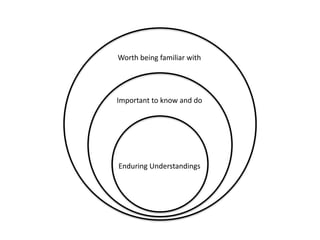
Worth being familiar with
Important to know and do
Enduring Understandings
Designing EUs
• What do you want students to really remember
long after they have forgotten the discrete facts?
• What is your goal for student understanding
based on the standards?
• What is the essence of this particular unit of
study?
• How can you help students make connections?
• How can you help students transfer learning?
Draft Question Revised Question
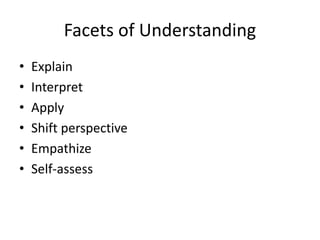
Facets of Understanding
• Explain
• Interpret
• Apply
• Shift perspective
• Empathize
• Self-assess
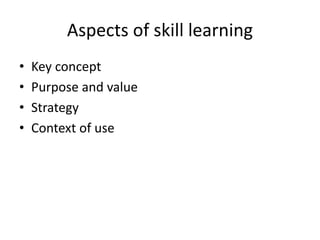
Aspects of skill learning
• Key concept
• Purpose and value
• Strategy
• Context of use
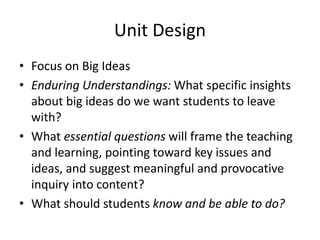
Unit Design
• Focus on Big Ideas
• Enduring Understandings: What specific insights
about big ideas do we want students to leave
with?
• What essential questions will frame the teaching
and learning, pointing toward key issues and
ideas, and suggest meaningful and provocative
inquiry into content?
• What should students know and be able to do?
Essential Questions
• Asked to stimulate ongoing thinking and inquiry
• Raise more question
• Spark discussion and debate
• Asked and reasked throughout the unit (and
maybe the year)
• Demand justification and support
• “Answers” may change as understanding deepens
Enduring Understandings
• Provide the learning context that anchor unit of
study
• Are the BIG IDEAS that reside at the heart of the
discipline
• Have value beyond the classroom
• Require uncoverage of abstract or often
misunderstood ideas

Unit Design: Big Ideas EQs & EUs

  • 1.
  • 2.
    Essential Questions NotEssential Questions
  • 3.
    Good Essential Questions •Open-ended • Thought-provoking, intellectually engaging • Require higher-order thinking • About important, transferable ideas • Raise additional questions, spark inquiry • Require support and justification • Recur over time
  • 4.
    “Essential” • Important andtimeless • Elemental or foundational • Vital or necessary for personal understanding
  • 5.
    Why use essentialquestions? • Signal that inquiry is the goal of education • Make it more likely that the unit will be intellectually engaging • Help to clarify and prioritize standards • Provide transparency for students • Encourage and model metacognition for students • Provide opportunities for intra- and interdisciplinary connections • Support meaningful differentiation
  • 6.
    Designing Essential Questions •By unpacking standards • Based on skills and strategies • Overarching  topical; topical  overarching • From big ideas/enduring understandings • From possible or predictable misconceptions • Around facets of understanding
  • 7.
    Big Ideas • Concepts •Themes • Issues and debates • Paradox • Complex processes • Persistent problems and challenges • Influential theories • Established policies • Key assumptions • Differing perspectives
  • 8.
    Identifying Truly BigIdeas • Does it have many layers and nuances, not obvious to the naïve or inexperienced person? • Can it yield great depth and breadth of insight into the subject? Can it be used throughout K-12? • Do you have to dig deep to really understand its subtle meanings and implications even if anyone can have a surface grasp of it? • Is it (therefore) prone to misunderstanding as well as disagreement? • Are you likely to change your mind about its meaning and importance over a lifetime? • Does it reflect the core ideas as judged by experts?
  • 9.
    Example Big Ideasin ELAR • audience and purpose in writing • a story, as opposed to merely a list of events linked by “and then…” • reading between the lines • writing as revision • a non-rhyming poem vs. prose • fiction as a window into truth • a critical yet empathetic reader • a writer’s voice
  • 10.
    Enduring Understandings • Importantideas and core processes • Central to the discipline • Have lasting value beyond the classroom • Go beyond facts and skills to larger concepts, principles, or processes • Synthesize what students should understand (not just know or do) as a result of study • Articulate what students should revisit over course of lifetime
  • 11.
    Worth being familiarwith Important to know and do Enduring Understandings
  • 12.
    Designing EUs • Whatdo you want students to really remember long after they have forgotten the discrete facts? • What is your goal for student understanding based on the standards? • What is the essence of this particular unit of study? • How can you help students make connections? • How can you help students transfer learning?
  • 13.
  • 14.
    Facets of Understanding •Explain • Interpret • Apply • Shift perspective • Empathize • Self-assess
  • 15.
    Aspects of skilllearning • Key concept • Purpose and value • Strategy • Context of use
  • 16.
    Unit Design • Focuson Big Ideas • Enduring Understandings: What specific insights about big ideas do we want students to leave with? • What essential questions will frame the teaching and learning, pointing toward key issues and ideas, and suggest meaningful and provocative inquiry into content? • What should students know and be able to do?
  • 17.
    Essential Questions • Askedto stimulate ongoing thinking and inquiry • Raise more question • Spark discussion and debate • Asked and reasked throughout the unit (and maybe the year) • Demand justification and support • “Answers” may change as understanding deepens
  • 18.
    Enduring Understandings • Providethe learning context that anchor unit of study • Are the BIG IDEAS that reside at the heart of the discipline • Have value beyond the classroom • Require uncoverage of abstract or often misunderstood ideas