Department of Education
Bureau of Learning Delivery
Teaching and Learning Division
National Training
on Literacy Instruction
Bohol Tropics, BoholCity
November 18 - 22, 2019
National Training on Literacy Instruction
Teaching Phonics and Word
Recognition for Successful
Decoding Skills
Presented by:
VALERIA FIDES G. CORTEZA, PhD.
Education Program Supervisor
Zamboanga City Division
Session 4
Objectives
*Understand how Phonics for Reading directly
connects to the science of teaching reading
*Discuss the basics of phonics.
*Identify the steps in teaching phonics, using the
fuller approach.
*Discuss the fuller technique in teaching
beginning reading.
*Write activities in teaching beginning reading
using the fuller technique/ explicit teaching.
National Training on Literacy Instruction
Phonics
Pneumonoultramicroscopicsiliconovolcanoniosis
National Training on Literacy Instruction
video presentation:
National Training on Literacy Instruction
https://www.readingrockets.org/teaching/reading101-course/modules/phonics/phonics-practice
1. How do we teach reading using the
Fuller Approach?
2. What are the different steps?
3. What are the guidelines to follow
when presenting the word family?
4. Steps to follow after teaching word
family,
example: the short /e/ family – (et)
Phonics
pretty
National Training on Literacy Instruction
Phonics involves recognizing the relationship between
letters and sounds (Alphabetic Principles).
Phonics
• Phonics is a method of instruction that helps
children learn and be able to use the alphabetic
principle – the concept that words are made up of
letters, and letters represent sounds.
Phonics instruction does this by teaching children
to decode words by sounds – showing them how
to make connections between the letters of
written texts (graphemes, or letter symbols) and
the sounds of spoken language.
https://readingeggs.com/about/phonics/
National Training on Literacy Instruction
Phonics
Phonics involves the relationship between sounds and
their spellings. The goal of phonics instruction is to
teach students the most common sound-spelling
relationships so that they can decode, or sound out,
words.
This decoding ability is a crucial element in reading
success.
https://readingeggs.com/about/phonics/
National Training on Literacy Instruction
Phonics
Pneumonoultramicroscopicsiliconovolcanoniosis
A word that refers to a lung disease contracted from
the inhalation of very silica particles, specifically from
a volcano, it is the same as silicosis.
https://en.m.wikipedia
National Training on Literacy Instruction
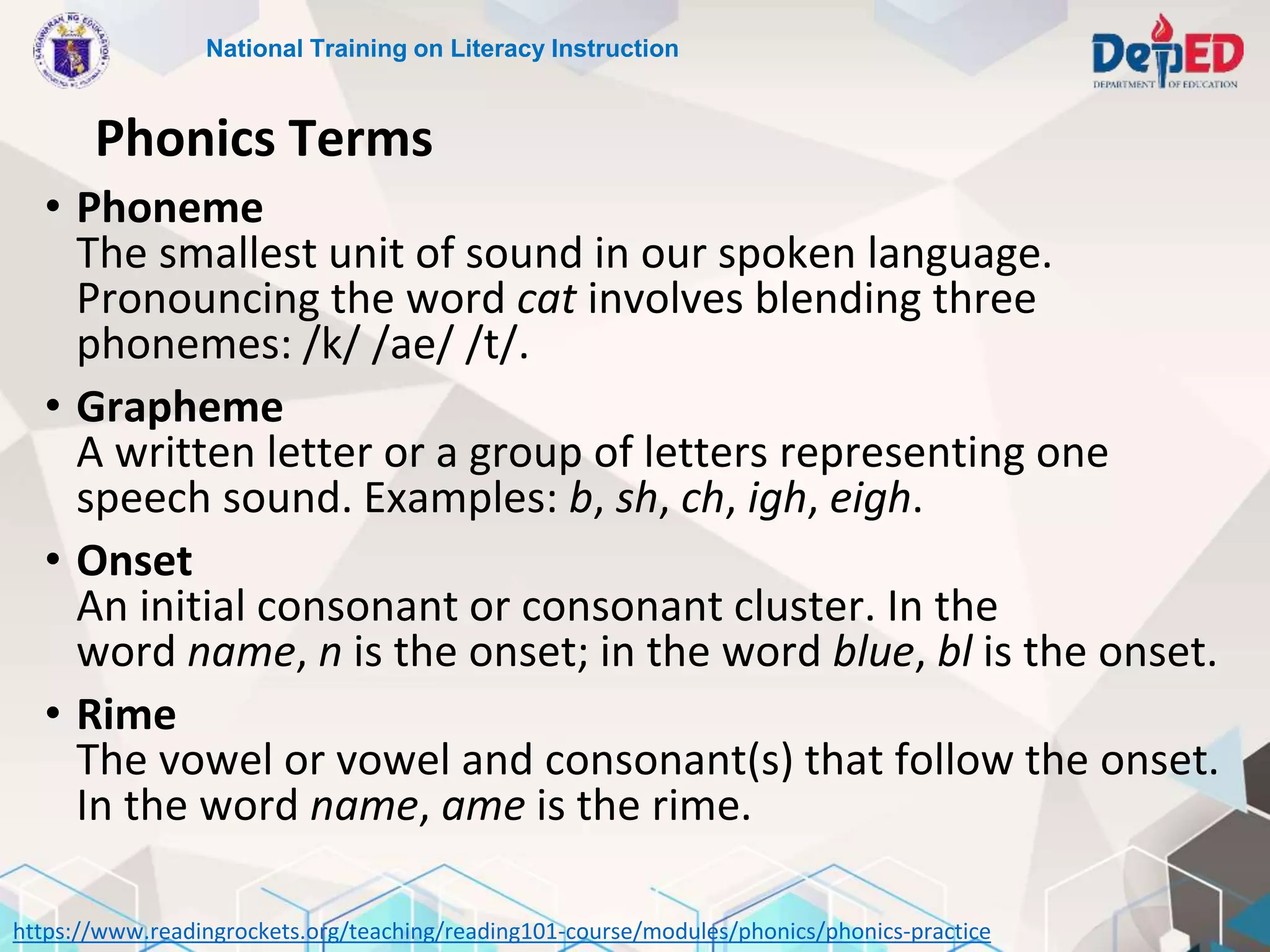
Connect: Oral and Phonological
Awareness (word awareness)
What is you name?
My name is Rosalina.
National Training on Literacy Instruction
Phonics- involves recognizing the relationship
between letters and sounds
Why are phonics important?
• Phonics allows children to be able to learn words they
have never seen before by sounding out the word letter
by letter.
• When children learn to read a word by sight it means
that they will be able to remember how to pronounce
that word when they see it again. But if they see a word
they don’t recognize they won’t have the skills needed
to decode how to pronounce it. This is why phonics is
important.
National Training on Literacy Instruction
https://bilingualkidspot.com/2018/07/02/how-to-teach-kids-to-read-using-phonics/
Why are phonics important?
• Teaching children to read with phonics means not only
teaching them the decoding skills needed to look at a
word and pronounce it correctly but also giving them
the skills to know what to do when they discover a new
word.
• After a while, as children become more skilled readers,
all of the phonics sounds will become automatic and
your child will be able to read fluently.
supercalifragilisticexpialidocious
National Training on Literacy Instruction
https://bilingualkidspot.com/2018/07/02/how-to-teach-kids-to-read-using-phonics/
Why are phonics important?
supercalifragilisticexpialidocious
National Training on Literacy Instruction
https://bilingualkidspot.com/2018/07/02/how-to-teach-kids-to-read-using-phonics/
How should we structure phonics
instruction?
Phonics instruction should be explicit rather than implicit.
• Implicit instruction relies on readers "discovering" clues
about sound-spelling relationships; good readers can do
this, but poor readers are not likely to do so.
• Explicit instruction is the most effective type of phonics
instruction, especially for children at risk for reading
difficulties.
https://www.scholastic.com/teachers/articles/teaching-content/understanding-phonics/
National Training on Literacy Instruction
• Explicit phonics is part of the structured
literacy approach, also referred to as
synthetic phonics, builds from part to
whole. It begins with the instruction of the
letters (graphemes) with their associated
sounds (phonemes). Next, explicit phonics
teaches blending and building, beginning
with blending the sounds into syllables and
then into words. Explicit phonics is
scientifically proven and research based.
Implicit and Explicit Phonics Instruction
https://www.readinghorizons.com/reading-strategies/teaching/phonics-instruction/explicit-vs-implicit
National Training on Literacy Instruction
• Implicit phonics, also referred to as analytical phonics,
moves from the whole to the smallest part. Phonemes
associated with particular graphemes are not
pronounced in isolation. Students analyze words and
look for the common phoneme in a set of words.
Through comparison and identification, they deduce
which grapheme to write or which phoneme to read.
Blending and building are not usually taught, and
students identify new words by their shape, beginning
and ending letters, and context clues. This analysis
(breaking down) of the whole word to its parts is
necessary only when a child cannot read it as a whole
word. This is a whole-language approach.
Implicit and Explicit Phonics Instruction
https://www.readinghorizons.com/reading-strategies/teaching/phonics-instruction/explicit-vs-implicit
National Training on Literacy Instruction
Different Types of Phonics—What Are They?
https://soundbytesreading.com/different-types-of-phonics-what-are-they.html
ANALYTIC PHONICS EMBEDDED PHONICS SYNTHETIC PHONICS
Begins with a whole word and
analyzes it
Phonics taught in context of
reading stories or when
problems arise; used when
students have difficulty
reading a particular word.
Begins by teaching the code-
the sounds of the letter
Notice the first letter or
letters in the word
Notice the first letter in the
word
Notice every letter in the
word, left to right
Students taught to compare a
sound pattern within the
words
Taught along with the whole
word method
Learn to blend the sounds
into words
Taught along with the whole
word method
Not systematic; not all
phonics elements are taught-
only what is needed within
the context of a lesson
Read decodable stories
National Training on Literacy Instruction
Different Types of Phonics—What Are They?
https://soundbytesreading.com/different-types-of-phonics-what-are-they.html
ANALYTIC PHONICS EMBEDDED PHONICS SYNTHETIC PHONICS
Includes analogy phonics: by
teaching onset and rime or
word families
Example: How the word
bl-ock like the word cl-ock
Incidental learning Learn to segment words to
spell them
Blending word is not taught Some vowel sounds are often
left untaught
Some common spelling words
are taught
Reading and spelling are
taught simultaneously
Systematic
No guessing from pictures,
initial letter, context, or word
shapes
How is phonics different from phonemic
awareness?
• Phonics involves the relationship between
sounds and written symbols, whereas phonemic
awareness involves sounds in spoken words.
• Therefore, phonics instruction focuses on
teaching sound-spelling relationships and is
associated with print. Most phonemic
awareness tasks are oral.
https://www.scholastic.com/teachers/articles/teaching-content/understanding-phonics/
National Training on Literacy Instruction
https://www.readingrockets.org/teaching/reading101-course/modules/phonics/phonics-practice
If children are to benefit from phonics
instruction, they need phonemic
awareness.
National Training on Literacy Instruction
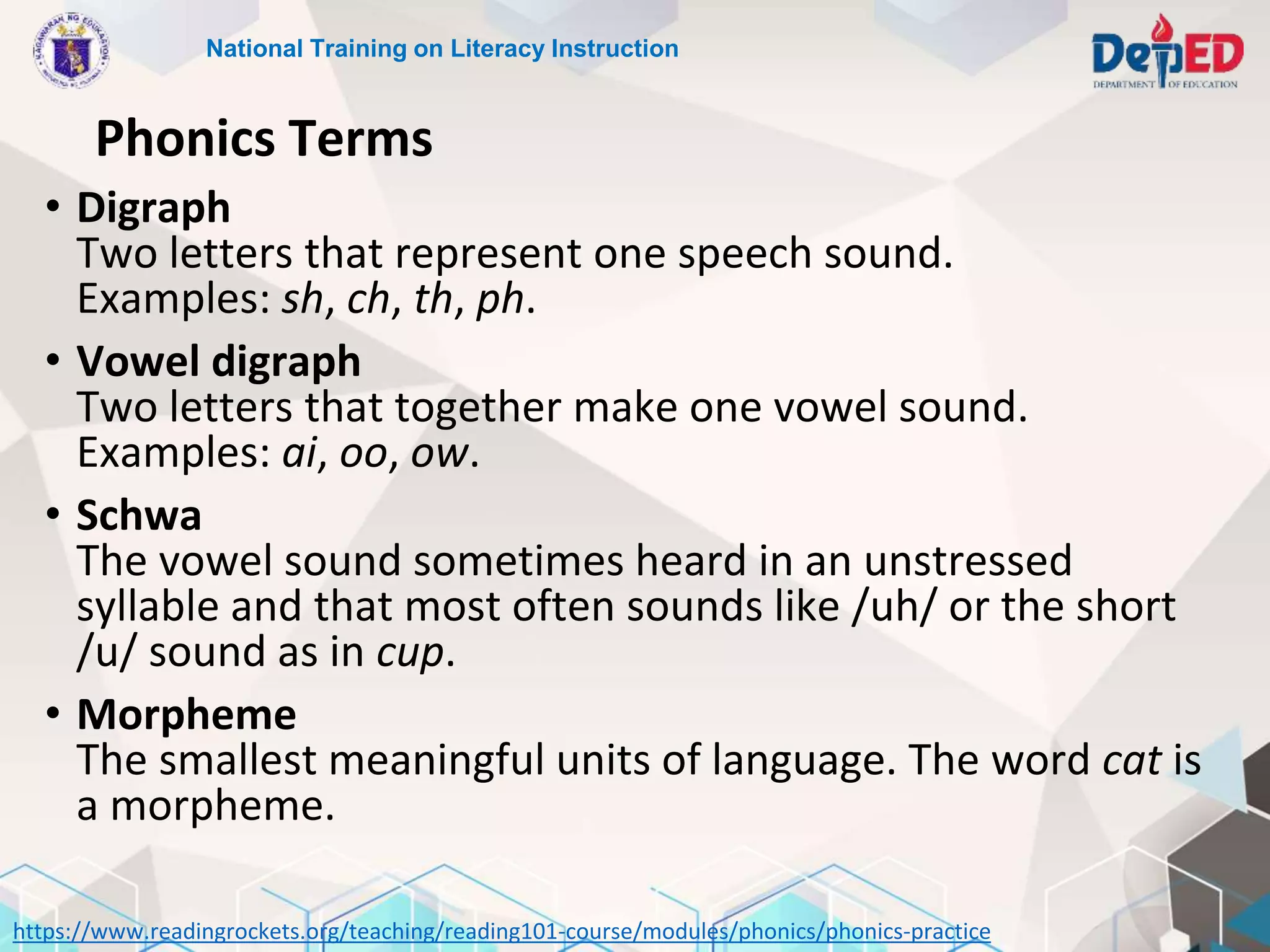
Phonics Terms
• Phoneme
The smallest unit of sound in our spoken language.
Pronouncing the word cat involves blending three
phonemes: /k/ /ae/ /t/.
• Grapheme
A written letter or a group of letters representing one
speech sound. Examples: b, sh, ch, igh, eigh.
• Onset
An initial consonant or consonant cluster. In the
word name, n is the onset; in the word blue, bl is the onset.
• Rime
The vowel or vowel and consonant(s) that follow the onset.
In the word name, ame is the rime.
https://www.readingrockets.org/teaching/reading101-course/modules/phonics/phonics-practice
National Training on Literacy Instruction
Phonics Terms
• Digraph
Two letters that represent one speech sound.
Examples: sh, ch, th, ph.
• Vowel digraph
Two letters that together make one vowel sound.
Examples: ai, oo, ow.
• Schwa
The vowel sound sometimes heard in an unstressed
syllable and that most often sounds like /uh/ or the short
/u/ sound as in cup.
• Morpheme
The smallest meaningful units of language. The word cat is
a morpheme.
https://www.readingrockets.org/teaching/reading101-course/modules/phonics/phonics-practice
National Training on Literacy Instruction
https://www.readingrockets.org/teaching/reading101-course/modules/phonics/phonics-practice
Insert video of mam rose
video teaching phonics/ IXL
Learn Phonics
National Training on Literacy Instruction
https://www.readingrockets.org/teaching/reading101-course/modules/phonics/phonics-practice
In pairs teach the following rime using the explicit
method.
-ag
-ap
-an
-in
-at
National Training on Literacy Instruction
The learners’
ability to
read is in our
hands.
R. Villaneza

Session_Presentation_-_Teaching_Phonics_and_Word_Recognition_for_Successful_Decoding_Skills.pptx

  • 1.
    Department of Education Bureauof Learning Delivery Teaching and Learning Division National Training on Literacy Instruction Bohol Tropics, BoholCity November 18 - 22, 2019
  • 2.
    National Training onLiteracy Instruction Teaching Phonics and Word Recognition for Successful Decoding Skills Presented by: VALERIA FIDES G. CORTEZA, PhD. Education Program Supervisor Zamboanga City Division Session 4
  • 3.
    Objectives *Understand how Phonicsfor Reading directly connects to the science of teaching reading *Discuss the basics of phonics. *Identify the steps in teaching phonics, using the fuller approach. *Discuss the fuller technique in teaching beginning reading. *Write activities in teaching beginning reading using the fuller technique/ explicit teaching. National Training on Literacy Instruction
  • 4.
  • 5.
    video presentation: National Trainingon Literacy Instruction https://www.readingrockets.org/teaching/reading101-course/modules/phonics/phonics-practice 1. How do we teach reading using the Fuller Approach? 2. What are the different steps? 3. What are the guidelines to follow when presenting the word family? 4. Steps to follow after teaching word family, example: the short /e/ family – (et)
  • 6.
  • 7.
    Phonics involves recognizingthe relationship between letters and sounds (Alphabetic Principles).
  • 8.
    Phonics • Phonics isa method of instruction that helps children learn and be able to use the alphabetic principle – the concept that words are made up of letters, and letters represent sounds. Phonics instruction does this by teaching children to decode words by sounds – showing them how to make connections between the letters of written texts (graphemes, or letter symbols) and the sounds of spoken language. https://readingeggs.com/about/phonics/ National Training on Literacy Instruction
  • 9.
    Phonics Phonics involves therelationship between sounds and their spellings. The goal of phonics instruction is to teach students the most common sound-spelling relationships so that they can decode, or sound out, words. This decoding ability is a crucial element in reading success. https://readingeggs.com/about/phonics/ National Training on Literacy Instruction
  • 10.
    Phonics Pneumonoultramicroscopicsiliconovolcanoniosis A word thatrefers to a lung disease contracted from the inhalation of very silica particles, specifically from a volcano, it is the same as silicosis. https://en.m.wikipedia National Training on Literacy Instruction
  • 11.
    Connect: Oral andPhonological Awareness (word awareness) What is you name? My name is Rosalina. National Training on Literacy Instruction Phonics- involves recognizing the relationship between letters and sounds
  • 12.
    Why are phonicsimportant? • Phonics allows children to be able to learn words they have never seen before by sounding out the word letter by letter. • When children learn to read a word by sight it means that they will be able to remember how to pronounce that word when they see it again. But if they see a word they don’t recognize they won’t have the skills needed to decode how to pronounce it. This is why phonics is important. National Training on Literacy Instruction https://bilingualkidspot.com/2018/07/02/how-to-teach-kids-to-read-using-phonics/
  • 13.
    Why are phonicsimportant? • Teaching children to read with phonics means not only teaching them the decoding skills needed to look at a word and pronounce it correctly but also giving them the skills to know what to do when they discover a new word. • After a while, as children become more skilled readers, all of the phonics sounds will become automatic and your child will be able to read fluently. supercalifragilisticexpialidocious National Training on Literacy Instruction https://bilingualkidspot.com/2018/07/02/how-to-teach-kids-to-read-using-phonics/
  • 14.
    Why are phonicsimportant? supercalifragilisticexpialidocious National Training on Literacy Instruction https://bilingualkidspot.com/2018/07/02/how-to-teach-kids-to-read-using-phonics/
  • 15.
    How should westructure phonics instruction? Phonics instruction should be explicit rather than implicit. • Implicit instruction relies on readers "discovering" clues about sound-spelling relationships; good readers can do this, but poor readers are not likely to do so. • Explicit instruction is the most effective type of phonics instruction, especially for children at risk for reading difficulties. https://www.scholastic.com/teachers/articles/teaching-content/understanding-phonics/ National Training on Literacy Instruction
  • 16.
    National Training onLiteracy Instruction • Explicit phonics is part of the structured literacy approach, also referred to as synthetic phonics, builds from part to whole. It begins with the instruction of the letters (graphemes) with their associated sounds (phonemes). Next, explicit phonics teaches blending and building, beginning with blending the sounds into syllables and then into words. Explicit phonics is scientifically proven and research based. Implicit and Explicit Phonics Instruction https://www.readinghorizons.com/reading-strategies/teaching/phonics-instruction/explicit-vs-implicit
  • 17.
    National Training onLiteracy Instruction • Implicit phonics, also referred to as analytical phonics, moves from the whole to the smallest part. Phonemes associated with particular graphemes are not pronounced in isolation. Students analyze words and look for the common phoneme in a set of words. Through comparison and identification, they deduce which grapheme to write or which phoneme to read. Blending and building are not usually taught, and students identify new words by their shape, beginning and ending letters, and context clues. This analysis (breaking down) of the whole word to its parts is necessary only when a child cannot read it as a whole word. This is a whole-language approach. Implicit and Explicit Phonics Instruction https://www.readinghorizons.com/reading-strategies/teaching/phonics-instruction/explicit-vs-implicit
  • 18.
    National Training onLiteracy Instruction Different Types of Phonics—What Are They? https://soundbytesreading.com/different-types-of-phonics-what-are-they.html ANALYTIC PHONICS EMBEDDED PHONICS SYNTHETIC PHONICS Begins with a whole word and analyzes it Phonics taught in context of reading stories or when problems arise; used when students have difficulty reading a particular word. Begins by teaching the code- the sounds of the letter Notice the first letter or letters in the word Notice the first letter in the word Notice every letter in the word, left to right Students taught to compare a sound pattern within the words Taught along with the whole word method Learn to blend the sounds into words Taught along with the whole word method Not systematic; not all phonics elements are taught- only what is needed within the context of a lesson Read decodable stories
  • 19.
    National Training onLiteracy Instruction Different Types of Phonics—What Are They? https://soundbytesreading.com/different-types-of-phonics-what-are-they.html ANALYTIC PHONICS EMBEDDED PHONICS SYNTHETIC PHONICS Includes analogy phonics: by teaching onset and rime or word families Example: How the word bl-ock like the word cl-ock Incidental learning Learn to segment words to spell them Blending word is not taught Some vowel sounds are often left untaught Some common spelling words are taught Reading and spelling are taught simultaneously Systematic No guessing from pictures, initial letter, context, or word shapes
  • 20.
    How is phonicsdifferent from phonemic awareness? • Phonics involves the relationship between sounds and written symbols, whereas phonemic awareness involves sounds in spoken words. • Therefore, phonics instruction focuses on teaching sound-spelling relationships and is associated with print. Most phonemic awareness tasks are oral. https://www.scholastic.com/teachers/articles/teaching-content/understanding-phonics/ National Training on Literacy Instruction
  • 21.
    National Training onLiteracy Instruction https://www.readingrockets.org/teaching/reading101-course/modules/phonics/phonics-practice If children are to benefit from phonics instruction, they need phonemic awareness.
  • 22.
    National Training onLiteracy Instruction Phonics Terms • Phoneme The smallest unit of sound in our spoken language. Pronouncing the word cat involves blending three phonemes: /k/ /ae/ /t/. • Grapheme A written letter or a group of letters representing one speech sound. Examples: b, sh, ch, igh, eigh. • Onset An initial consonant or consonant cluster. In the word name, n is the onset; in the word blue, bl is the onset. • Rime The vowel or vowel and consonant(s) that follow the onset. In the word name, ame is the rime. https://www.readingrockets.org/teaching/reading101-course/modules/phonics/phonics-practice
  • 23.
    National Training onLiteracy Instruction Phonics Terms • Digraph Two letters that represent one speech sound. Examples: sh, ch, th, ph. • Vowel digraph Two letters that together make one vowel sound. Examples: ai, oo, ow. • Schwa The vowel sound sometimes heard in an unstressed syllable and that most often sounds like /uh/ or the short /u/ sound as in cup. • Morpheme The smallest meaningful units of language. The word cat is a morpheme. https://www.readingrockets.org/teaching/reading101-course/modules/phonics/phonics-practice
  • 24.
    National Training onLiteracy Instruction https://www.readingrockets.org/teaching/reading101-course/modules/phonics/phonics-practice Insert video of mam rose
  • 25.
    video teaching phonics/IXL Learn Phonics
  • 26.
    National Training onLiteracy Instruction https://www.readingrockets.org/teaching/reading101-course/modules/phonics/phonics-practice In pairs teach the following rime using the explicit method. -ag -ap -an -in -at
  • 27.
    National Training onLiteracy Instruction The learners’ ability to read is in our hands. R. Villaneza