Introduction to
Project-Based Global Learning
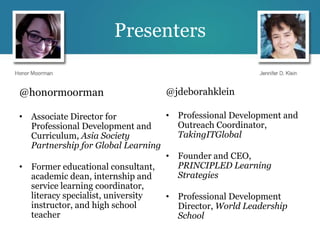
Presenters


@honormoorman                    @jdeborahklein

• Associate Director for          • Professional Development and
  Professional Development and      Outreach Coordinator,
  Curriculum, Asia Society          TakingITGlobal
  Partnership for Global Learning
                                  • Founder and CEO,
• Former educational consultant,    PRINCIPLED Learning
  academic dean, internship and     Strategies
  service learning coordinator,
  literacy specialist, university • Professional Development
  instructor, and high school       Director, World Leadership
  teacher                           School
Mission: To present ideas, examples, and
projects related to connecting educators
and classrooms with a strong emphasis
on promoting global awareness, fostering
global competence, and inspiring action
towards solving real–world problems.
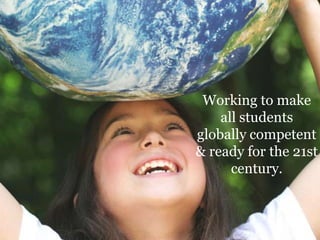
Working to make
    all students
globally competent
& ready for the 21st
      century.
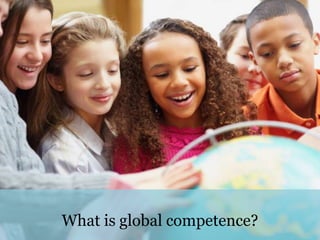
What is global competence?
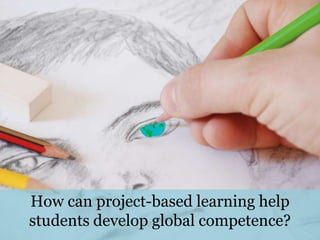
How can project-based learning help
students develop global competence?
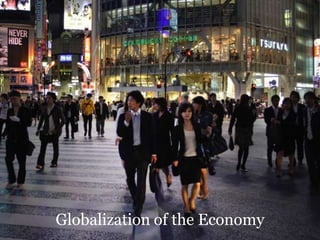
Globalization of the Economy
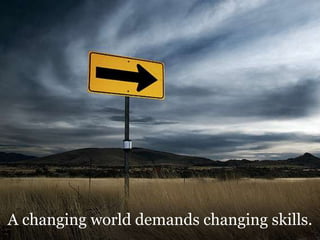
A changing world demands changing skills.
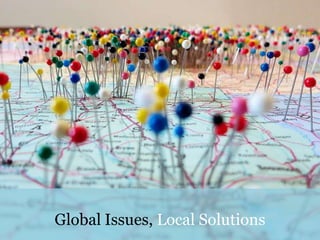
Global Issues, Local Solutions
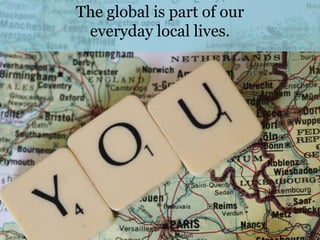
The global is part of our
 everyday local lives.
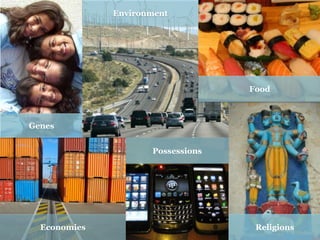
Environment


                                   Food


Genes


                     Possessions


  Economies                         Religions
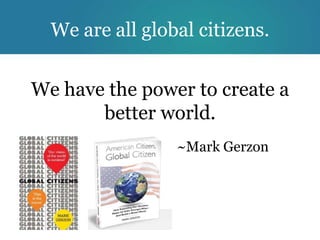
We are all global citizens.


We have the power to create a
       better world.
                 ~Mark Gerzon
“Global competence is the capacity
and disposition to understand and act
on issues of global significance.”
Share your thoughts:


 What are the knowledge, skills, and
dispositions students need to develop
 in order to be globally competent?
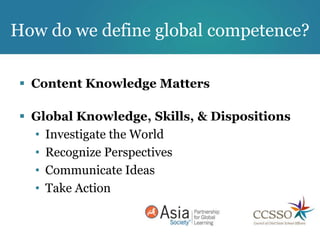
How do we define global competence?
  Content Knowledge Matters

  Global Knowledge, Skills, & Dispositions
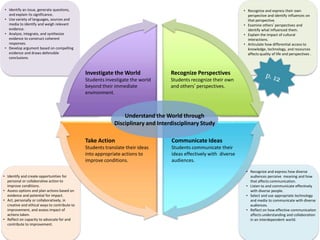
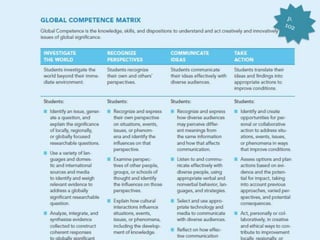
   • Investigate the World
   • Recognize Perspectives
   • Communicate Ideas
   • Take Action
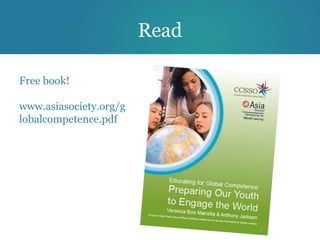
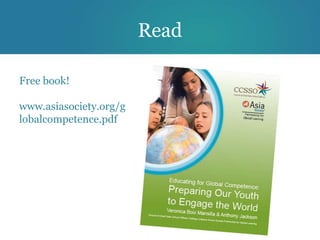
Read

Free book!

www.asiasociety.org/g
lobalcompetence.pdf
• Identify an issue, generate questions,                                                                           • Recognize and express their own
  and explain its significance.                                                                                      perspective and identify influences on
• Use variety of languages, sources and                                                                              that perspective.
  media to identify and weigh relevant                                                                             • Examine others’ perspectives and
  evidence.                                                                                                          identify what influenced them.
• Analyze, integrate, and synthesize                                                                               • Explain the impact of cultural
  evidence to construct coherent                                                                                     interactions.
  responses.                                                                                                       • Articulate how differential access to
• Develop argument based on compelling                                                                               knowledge, technology, and resources
  evidence and draws defensible                                                                                      affects quality of life and perspectives .
  conclusions.


                                               Investigate the World              Recognize Perspectives
                                               Students investigate the world     Students recognize their own
                                               beyond their immediate             and others’ perspectives.
                                               environment.


                                                                Understand the World through
                                                            Disciplinary and Interdisciplinary Study

                                               Take Action                        Communicate Ideas
                                               Students translate their ideas     Students communicate their
                                               into appropriate actions to        ideas effectively with diverse
                                               improve conditions.                audiences.

                                                                                                                    • Recognize and express how diverse
• Identify and create opportunities for                                                                               audiences perceive meaning and how
  personal or collaborative action to                                                                                 that affects communication.
  improve conditions.                                                                                               • Listen to and communicate effectively
• Assess options and plan actions based on                                                                            with diverse people.
  evidence and potential for impact.                                                                                • Select and use appropriate technology
• Act, personally or collaboratively, in                                                                              and media to communicate with diverse
  creative and ethical ways to contribute to                                                                          audiences.
  improvement, and assess impact of                                                                                 • Reflect on how effective communication
  actions taken.                                                                                                      affects understanding and collaboration
• Reflect on capacity to advocate for and                                                                             in an interdependent world.
  contribute to improvement.
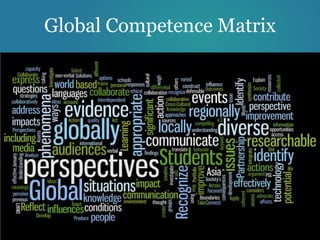
Global Competence Matrix
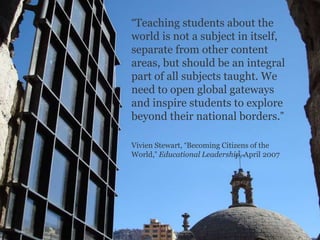
“Teaching students about the
world is not a subject in itself,
separate from other content
areas, but should be an integral
part of all subjects taught. We
need to open global gateways
and inspire students to explore
beyond their national borders.”

Vivien Stewart, “Becoming Citizens of the
World,” Educational Leadership, April 2007
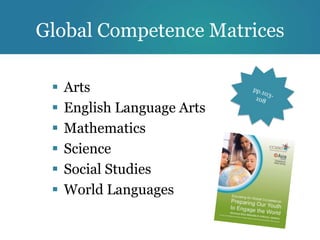
Global Competence Matrices

    Arts
    English Language Arts
    Mathematics
    Science
    Social Studies
    World Languages
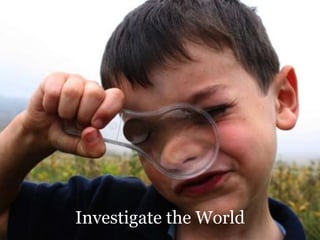
Investigate the World
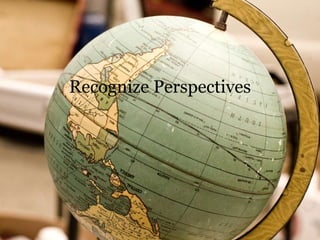
Recognize Perspectives
Communicate Ideas
Take Action
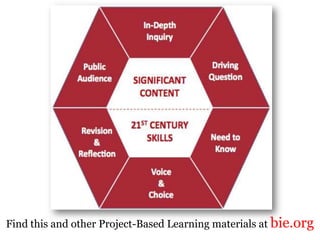
Find this and other Project-Based Learning materials at bie.org
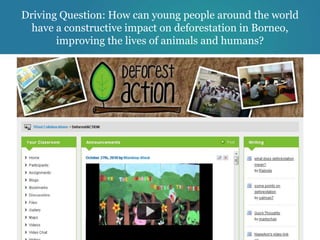
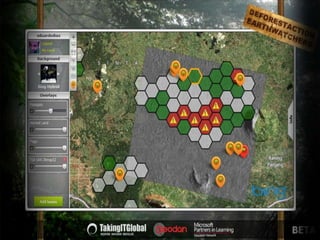
Driving Question: How can young people around the world
  have a constructive impact on deforestation in Borneo,
       improving the lives of animals and humans?
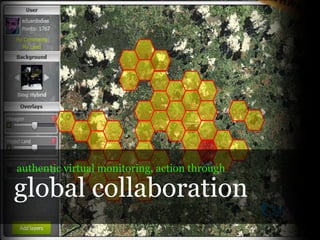
authentic virtual monitoring, action through

global collaboration
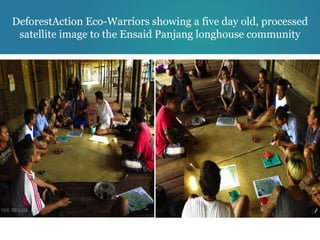
DeforestAction Eco-Warriors showing a five day old, processed
 satellite image to the Ensaid Panjang longhouse community
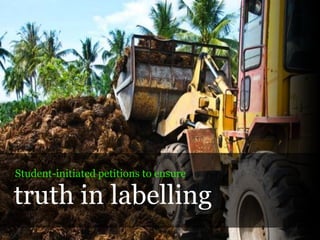
Student-initiated petitions to ensure

truth in labelling
PBL and the
Common Core

  “The high school
 standards call on
students to practice
applying… ways of
  thinking to real
  world issues and
    challenges”
Features of Transformative
          Global Education
 More Internal/Immersive than
  External/Observational

 Student-driven via global technologies

 Problems- or Challenge-based (solution-driven)

 Action-oriented and “Glocal”

 Collaborative (beyond the classroom and/or across
  cultural lines)
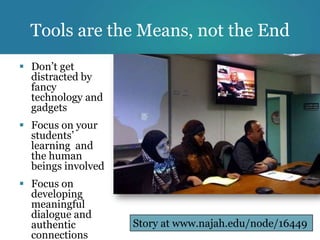
Tools are the Means, not the End
 Don’t get
  distracted by
  fancy
  technology and
  gadgets
 Focus on your
  students’
  learning and
  the human
  beings involved
 Focus on
  developing
  meaningful
  dialogue and
  authentic         Story at www.najah.edu/node/16449
  connections
Connecting Local and Global

   Who else around the world is affected by the issues,
    concerns, and trends that affect our community?

   How does this global issue, concern, or trend affect
    our community?

   What are some of the familiar aspects of all
    cultures, and how are they addressed similarly or
    differently in our community and in communities
    around the world?

                     “Connect Local and Global,” Asia Society Education
                   http://asiasociety.org/education-learning/afterschool/connect-local-and-global
Global Approaches to Curriculum

 Engaging students by addressing global challenges.

 Globalizing the context for learning.

 Connecting to universal themes.

 Illuminating the global history of knowledge.

 Learning through international collaboration.
Qualities of a Good Project

 Is the project guided by relevant driving questions?

 Does it take into account perspectives from beyond
  the United States? How?

 Does it use primary sources from around the world,
  as appropriate?

 Does it have real-world outcomes?
                          “Simulations: Real-World Practice,” Asia Society Education
    http://asiasociety.org/education-learning/resources-schools/partnership-ideas/simulations-real-world-practice
A strong driving question in global
        learning should . . .
 Invite multiple answers

 Be un-Googleable

 Be more “kid friendly” than “teacher happy”

 Require an answer (in the global context)

 Be authentic and grounded in real-world problems
  (as unsimulated as possible)

 Give students a real-world role
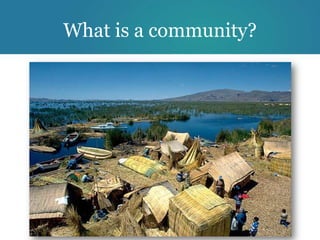
What is a community?


  What can we learn about
              ?
    how to improve our
community by exploring the
way other people in the world
     think about theirs?
What is human trafficking and
  where is it happening?
What is human trafficking and
   where is it happening?


How can we, as?representatives
of the various nations involved
in and/or impacted by human
trafficking, collaborate to end
         the practice?
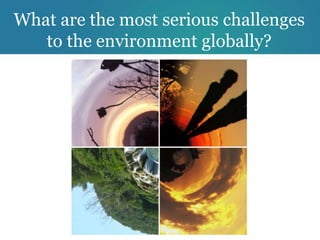
What are the most serious challenges
   to the environment globally?
What are the most serious challenges
   to the environment globally?


 As young environmentalists,
              ?
how can we help people in our
   community change their
  behavior to help solve our
  environmental challenges?
S.A.G.E.

 Student choice

 Authentic work

 Global significance

 Exhibition to real-world audiences
Resources

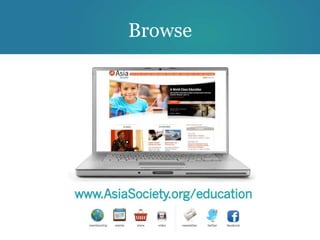
 Asia Society Education:
  www.AsiaSociety.org/education

 Taking IT Global: www.tigweb.org

 TIGed: www.tigweb.org/tiged

 Buck Institute for Education: www.bie.org

 Edutopia: www.edutopia.org/project-based-
  learning
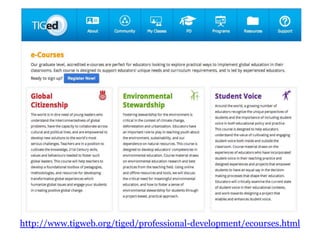
http://www.tigweb.org/tiged/professional-development/ecourses.html
Read

Free book!

www.asiasociety.org/g
lobalcompetence.pdf
Browse
Participate
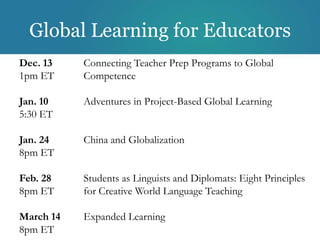
Global Learning for Educators
Dec. 13    Connecting Teacher Prep Programs to Global
1pm ET     Competence

Jan. 10    Adventures in Project-Based Global Learning
5:30 ET

Jan. 24    China and Globalization
8pm ET

Feb. 28    Students as Linguists and Diplomats: Eight Principles
8pm ET     for Creative World Language Teaching

March 14   Expanded Learning
8pm ET
Connect


@honormoorman    @jdeborahklein
Image Credits – CC on Flickr
•   “Tokyo1950” by tokyoform
•   “Fargone” by iammikeb
•   “Alegria” by ruurmo
•   “Wind farm and greenhouse gas” by kevin dooley
•   “Sushi! (again)” by Kyoto Song
•   “Imogen” by Edo Bertran
•   “Nexus One Blackberry iPod Touch” by Katsushiro
•   “I-con” by Lightmash
Image Credits – CC on Flickr
• “Pinteresting” by Dave77459
• “You Paris and Me” by Nina Matthews Photography
• “Earth at Night” by cote
• “Open Gate in La Paz” by jaytkendall
• “not quite clear on the concept” by
  woodleywonderworks
• “Sometimes the world seems upside down” by
  jen_maiser
• “42601677.10” by torres21
• “On the other side” by EmsiProduction

Intro to Global PBL - GEC 2012

  • 1.
  • 2.
    Presenters @honormoorman @jdeborahklein • Associate Director for • Professional Development and Professional Development and Outreach Coordinator, Curriculum, Asia Society TakingITGlobal Partnership for Global Learning • Founder and CEO, • Former educational consultant, PRINCIPLED Learning academic dean, internship and Strategies service learning coordinator, literacy specialist, university • Professional Development instructor, and high school Director, World Leadership teacher School
  • 3.
    Mission: To presentideas, examples, and projects related to connecting educators and classrooms with a strong emphasis on promoting global awareness, fostering global competence, and inspiring action towards solving real–world problems.
  • 4.
    Working to make all students globally competent & ready for the 21st century.
  • 5.
    What is globalcompetence?
  • 6.
    How can project-basedlearning help students develop global competence?
  • 7.
  • 8.
    A changing worlddemands changing skills.
  • 9.
  • 10.
    The global ispart of our everyday local lives.
  • 11.
    Environment Food Genes Possessions Economies Religions
  • 12.
    We are allglobal citizens. We have the power to create a better world. ~Mark Gerzon
  • 13.
    “Global competence isthe capacity and disposition to understand and act on issues of global significance.”
  • 14.
    Share your thoughts: What are the knowledge, skills, and dispositions students need to develop in order to be globally competent?
  • 15.
    How do wedefine global competence?  Content Knowledge Matters  Global Knowledge, Skills, & Dispositions • Investigate the World • Recognize Perspectives • Communicate Ideas • Take Action
  • 16.
  • 17.
    • Identify anissue, generate questions, • Recognize and express their own and explain its significance. perspective and identify influences on • Use variety of languages, sources and that perspective. media to identify and weigh relevant • Examine others’ perspectives and evidence. identify what influenced them. • Analyze, integrate, and synthesize • Explain the impact of cultural evidence to construct coherent interactions. responses. • Articulate how differential access to • Develop argument based on compelling knowledge, technology, and resources evidence and draws defensible affects quality of life and perspectives . conclusions. Investigate the World Recognize Perspectives Students investigate the world Students recognize their own beyond their immediate and others’ perspectives. environment. Understand the World through Disciplinary and Interdisciplinary Study Take Action Communicate Ideas Students translate their ideas Students communicate their into appropriate actions to ideas effectively with diverse improve conditions. audiences. • Recognize and express how diverse • Identify and create opportunities for audiences perceive meaning and how personal or collaborative action to that affects communication. improve conditions. • Listen to and communicate effectively • Assess options and plan actions based on with diverse people. evidence and potential for impact. • Select and use appropriate technology • Act, personally or collaboratively, in and media to communicate with diverse creative and ethical ways to contribute to audiences. improvement, and assess impact of • Reflect on how effective communication actions taken. affects understanding and collaboration • Reflect on capacity to advocate for and in an interdependent world. contribute to improvement.
  • 19.
  • 20.
    “Teaching students aboutthe world is not a subject in itself, separate from other content areas, but should be an integral part of all subjects taught. We need to open global gateways and inspire students to explore beyond their national borders.” Vivien Stewart, “Becoming Citizens of the World,” Educational Leadership, April 2007
  • 21.
    Global Competence Matrices  Arts  English Language Arts  Mathematics  Science  Social Studies  World Languages
  • 22.
  • 23.
  • 24.
  • 25.
  • 26.
    Find this andother Project-Based Learning materials at bie.org
  • 27.
    Driving Question: Howcan young people around the world have a constructive impact on deforestation in Borneo, improving the lives of animals and humans?
  • 28.
    authentic virtual monitoring,action through global collaboration
  • 30.
    DeforestAction Eco-Warriors showinga five day old, processed satellite image to the Ensaid Panjang longhouse community
  • 31.
    Student-initiated petitions toensure truth in labelling
  • 32.
    PBL and the CommonCore “The high school standards call on students to practice applying… ways of thinking to real world issues and challenges”
  • 33.
    Features of Transformative Global Education  More Internal/Immersive than External/Observational  Student-driven via global technologies  Problems- or Challenge-based (solution-driven)  Action-oriented and “Glocal”  Collaborative (beyond the classroom and/or across cultural lines)
  • 34.
    Tools are theMeans, not the End  Don’t get distracted by fancy technology and gadgets  Focus on your students’ learning and the human beings involved  Focus on developing meaningful dialogue and authentic Story at www.najah.edu/node/16449 connections
  • 35.
    Connecting Local andGlobal  Who else around the world is affected by the issues, concerns, and trends that affect our community?  How does this global issue, concern, or trend affect our community?  What are some of the familiar aspects of all cultures, and how are they addressed similarly or differently in our community and in communities around the world? “Connect Local and Global,” Asia Society Education http://asiasociety.org/education-learning/afterschool/connect-local-and-global
  • 36.
    Global Approaches toCurriculum  Engaging students by addressing global challenges.  Globalizing the context for learning.  Connecting to universal themes.  Illuminating the global history of knowledge.  Learning through international collaboration.
  • 37.
    Qualities of aGood Project  Is the project guided by relevant driving questions?  Does it take into account perspectives from beyond the United States? How?  Does it use primary sources from around the world, as appropriate?  Does it have real-world outcomes? “Simulations: Real-World Practice,” Asia Society Education http://asiasociety.org/education-learning/resources-schools/partnership-ideas/simulations-real-world-practice
  • 38.
    A strong drivingquestion in global learning should . . .  Invite multiple answers  Be un-Googleable  Be more “kid friendly” than “teacher happy”  Require an answer (in the global context)  Be authentic and grounded in real-world problems (as unsimulated as possible)  Give students a real-world role
  • 39.
    What is acommunity?
  • 40.
    What is acommunity? What can we learn about ? how to improve our community by exploring the way other people in the world think about theirs?
  • 41.
    What is humantrafficking and where is it happening?
  • 42.
    What is humantrafficking and where is it happening? How can we, as?representatives of the various nations involved in and/or impacted by human trafficking, collaborate to end the practice?
  • 43.
    What are themost serious challenges to the environment globally?
  • 44.
    What are themost serious challenges to the environment globally? As young environmentalists, ? how can we help people in our community change their behavior to help solve our environmental challenges?
  • 45.
    S.A.G.E.  Student choice Authentic work  Global significance  Exhibition to real-world audiences
  • 46.
    Resources  Asia SocietyEducation: www.AsiaSociety.org/education  Taking IT Global: www.tigweb.org  TIGed: www.tigweb.org/tiged  Buck Institute for Education: www.bie.org  Edutopia: www.edutopia.org/project-based- learning
  • 47.
  • 48.
  • 49.
  • 50.
  • 51.
    Global Learning forEducators Dec. 13 Connecting Teacher Prep Programs to Global 1pm ET Competence Jan. 10 Adventures in Project-Based Global Learning 5:30 ET Jan. 24 China and Globalization 8pm ET Feb. 28 Students as Linguists and Diplomats: Eight Principles 8pm ET for Creative World Language Teaching March 14 Expanded Learning 8pm ET
  • 52.
    Connect @honormoorman @jdeborahklein
  • 53.
    Image Credits –CC on Flickr • “Tokyo1950” by tokyoform • “Fargone” by iammikeb • “Alegria” by ruurmo • “Wind farm and greenhouse gas” by kevin dooley • “Sushi! (again)” by Kyoto Song • “Imogen” by Edo Bertran • “Nexus One Blackberry iPod Touch” by Katsushiro • “I-con” by Lightmash
  • 54.
    Image Credits –CC on Flickr • “Pinteresting” by Dave77459 • “You Paris and Me” by Nina Matthews Photography • “Earth at Night” by cote • “Open Gate in La Paz” by jaytkendall • “not quite clear on the concept” by woodleywonderworks • “Sometimes the world seems upside down” by jen_maiser • “42601677.10” by torres21 • “On the other side” by EmsiProduction