OPTOMETRY
INTRODUCTION
ER. FARUK BIN POYEN
DEPT. OF AEIE, UIT, BU, BURDWAN, WB, INDIA
FARUK.POYEN@GMAIL.COM
Contents:
1. Optics
2. Radiometry
3. Photometry
4. Theories about Light
5. Terms related to Radiometry
6. Terms related to Photometry
7. Laws of Illumination
8. Principle of Superposition
9. Wave Property of Particles
10. Wave Particle Duality
2
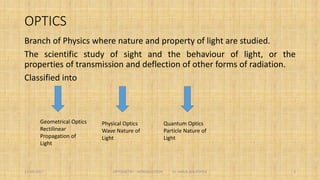
OPTICS
Branch of Physics where nature and property of light are studied.
The scientific study of sight and the behaviour of light, or the properties of transmission
and deflection of other forms of radiation.
Classified into
3
Geometrical Optics
Rectilinear
Propagation of
Light
Physical Optics
Wave Nature of
Light
Quantum Optics
Particle Nature of
Light
Radiometry & Photometry
Radiometry: Measurement of electromagnetic radiation, including visible light. Radiometric
techniques in optics characterize the distribution of the radiation's power in space.
Photometry: Measurement of light, in terms of its perceived brightness to the human eye.
Photopic Vision: Response of eyes under normal light conditions (555 nm).
Scotopic Vision: Response of eyes under low light conditions (507 nm).
4
Different Theories about Light
 Corpuscular Theory of Light
Newton proposed this theory that treats light as being composed of tiny
particles having no mass and high speed. Failed to explain refraction.
 Wave Theory of Light
Huygens proposed light as waves that spread out from the source that
generates the light. Each colour is a different wavelength. Supernumerary
bows are explained by assuming that light is a wave. Failed to explain
propagation in vacuum and existence of aether medium.
5
Different Theories about Light
 The Electromagnetic Theory of Light
Maxwell proposed light as electromagnetic waves. Propagation in vacuum
explained.
 Quantum (Photon) Theory of Light
Light is energy particle named photon. The energy of the photon
determines the colour.
 Dual Theory of Light
Light behaves both as a particle and as a wave.
6
Terms related to Radiometry
 Radiant Energy
 Radiant Flux
 Radiant Intensity
 Radiance
 Radiant Sterance
 Emittance
 Radiant Excitance
 Irradiance
 Radiant Incidence
7
Terms related to Photometry
 Point Source
 Solid Angle
 Lumen
 Luminous Intensity
 Illumination
 Luminance
 Luminous Excitance
 Luminous Sterance
8
Laws of Illumination
 Inverse Square Law
Intensity is inversely proportional to the square of the distance from the source.
𝐸 =
𝐼
𝑟2
 Lambert’s Cosine Law
Radiant intensity or luminous intensity directly proportional to the cosine of the angle θ
between the direction of the incident light and the surface normal.
𝐸 =
𝐼𝑐𝑜𝑠𝜃
𝑟2
9
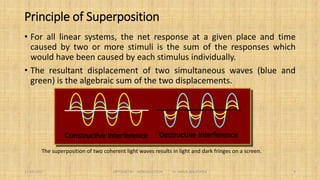
Principle of Superposition
 For all linear systems, the net response at a given place and time caused by two or
more stimuli is the sum of the responses which would have been caused by each
stimulus individually.
 The resultant displacement of two simultaneous waves (blue and green) is the
algebraic sum of the two displacements.
10
Constructive Interference Destructive Interference
The superposition of two coherent light waves results in light and dark fringes on a screen.
Wave Property of Particles
 De Broglie Wave
A moving body behaves in ways as if it has a wave nature.
The momentum of particle of mass “m” and velocity “v” is
𝑝 = 𝛾𝑚𝑣
And its de Broglie wavelength is
𝜆 =
ℎ
𝛾𝑚𝑣
Every elementary particle or quantic entity may be partly described in terms not only of
particles, but also of waves. It expresses the inability of the classical concepts "particle" or
"wave" to fully describe the behaviour of quantum-scale objects.
11
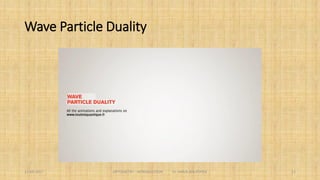
Wave Particle Duality 12
13

Optical Instrumentation - Part I Optometry Introduction - A

  • 1.
    OPTOMETRY INTRODUCTION ER. FARUK BINPOYEN DEPT. OF AEIE, UIT, BU, BURDWAN, WB, INDIA FARUK.POYEN@GMAIL.COM
  • 2.
    Contents: 1. Optics 2. Radiometry 3.Photometry 4. Theories about Light 5. Terms related to Radiometry 6. Terms related to Photometry 7. Laws of Illumination 8. Principle of Superposition 9. Wave Property of Particles 10. Wave Particle Duality 2
  • 3.
    OPTICS Branch of Physicswhere nature and property of light are studied. The scientific study of sight and the behaviour of light, or the properties of transmission and deflection of other forms of radiation. Classified into 3 Geometrical Optics Rectilinear Propagation of Light Physical Optics Wave Nature of Light Quantum Optics Particle Nature of Light
  • 4.
    Radiometry & Photometry Radiometry:Measurement of electromagnetic radiation, including visible light. Radiometric techniques in optics characterize the distribution of the radiation's power in space. Photometry: Measurement of light, in terms of its perceived brightness to the human eye. Photopic Vision: Response of eyes under normal light conditions (555 nm). Scotopic Vision: Response of eyes under low light conditions (507 nm). 4
  • 5.
    Different Theories aboutLight  Corpuscular Theory of Light Newton proposed this theory that treats light as being composed of tiny particles having no mass and high speed. Failed to explain refraction.  Wave Theory of Light Huygens proposed light as waves that spread out from the source that generates the light. Each colour is a different wavelength. Supernumerary bows are explained by assuming that light is a wave. Failed to explain propagation in vacuum and existence of aether medium. 5
  • 6.
    Different Theories aboutLight  The Electromagnetic Theory of Light Maxwell proposed light as electromagnetic waves. Propagation in vacuum explained.  Quantum (Photon) Theory of Light Light is energy particle named photon. The energy of the photon determines the colour.  Dual Theory of Light Light behaves both as a particle and as a wave. 6
  • 7.
    Terms related toRadiometry  Radiant Energy  Radiant Flux  Radiant Intensity  Radiance  Radiant Sterance  Emittance  Radiant Excitance  Irradiance  Radiant Incidence 7
  • 8.
    Terms related toPhotometry  Point Source  Solid Angle  Lumen  Luminous Intensity  Illumination  Luminance  Luminous Excitance  Luminous Sterance 8
  • 9.
    Laws of Illumination Inverse Square Law Intensity is inversely proportional to the square of the distance from the source. 𝐸 = 𝐼 𝑟2  Lambert’s Cosine Law Radiant intensity or luminous intensity directly proportional to the cosine of the angle θ between the direction of the incident light and the surface normal. 𝐸 = 𝐼𝑐𝑜𝑠𝜃 𝑟2 9
  • 10.
    Principle of Superposition For all linear systems, the net response at a given place and time caused by two or more stimuli is the sum of the responses which would have been caused by each stimulus individually.  The resultant displacement of two simultaneous waves (blue and green) is the algebraic sum of the two displacements. 10 Constructive Interference Destructive Interference The superposition of two coherent light waves results in light and dark fringes on a screen.
  • 11.
    Wave Property ofParticles  De Broglie Wave A moving body behaves in ways as if it has a wave nature. The momentum of particle of mass “m” and velocity “v” is 𝑝 = 𝛾𝑚𝑣 And its de Broglie wavelength is 𝜆 = ℎ 𝛾𝑚𝑣 Every elementary particle or quantic entity may be partly described in terms not only of particles, but also of waves. It expresses the inability of the classical concepts "particle" or "wave" to fully describe the behaviour of quantum-scale objects. 11
  • 12.
  • 13.