OPTOMETRY – Part II
BASICS OF OPTICS
ER. FARUK BIN POYEN
DEPT. OF AEIE, UIT, BU, BURDWAN, WB, INDIA
FARUK.POYEN@GMAIL.COM
Contents:
1. Radiometry & Photometry – Terms
2. Theories on Light
3. Laws related to Light
4. Optical Phenomenon
5. Interference – Experimental Validation
6. Diffraction – Experimental Validation
7. Polarization – Experimental Validation
2
Optics – Geometrical & Physical:
 Geometric optics studies refraction and reflection of rays of light without considering
the wave or physical nature of light.
 This branch of optics uses geometric and graphical methods to find the positions of
images formed by mirrors, lenses, prisms , etc.
 Physical optics tries to explain the objective phenomena of light.
 This branch of optics studies phenomena such as interference , diffraction , polarization,
etc. , which are viewed from the standpoint of the wave theory of light .
3
Radiometry - Definition:
 Radiometry is the science of measuring light in any portion of the electromagnetic
spectrum.
 In practice, the term is usually limited to the measurement of infrared, visible, and
ultraviolet light using optical instruments.
 Irradiance is the intensity of light and is measured in watts per square meter.
4
Photometry - Definition:
 Photometry is the science of measuring visible light in units that are weighted according
to the sensitivity of the human eye.
 It is a quantitative science based on a statistical model of the human visual response to
light – i.e. our perception of light - under carefully controlled conditions.
 The photometric equivalent of Radiance is called Illuminance and is measured in
Lumens per square meter (Lux).
5
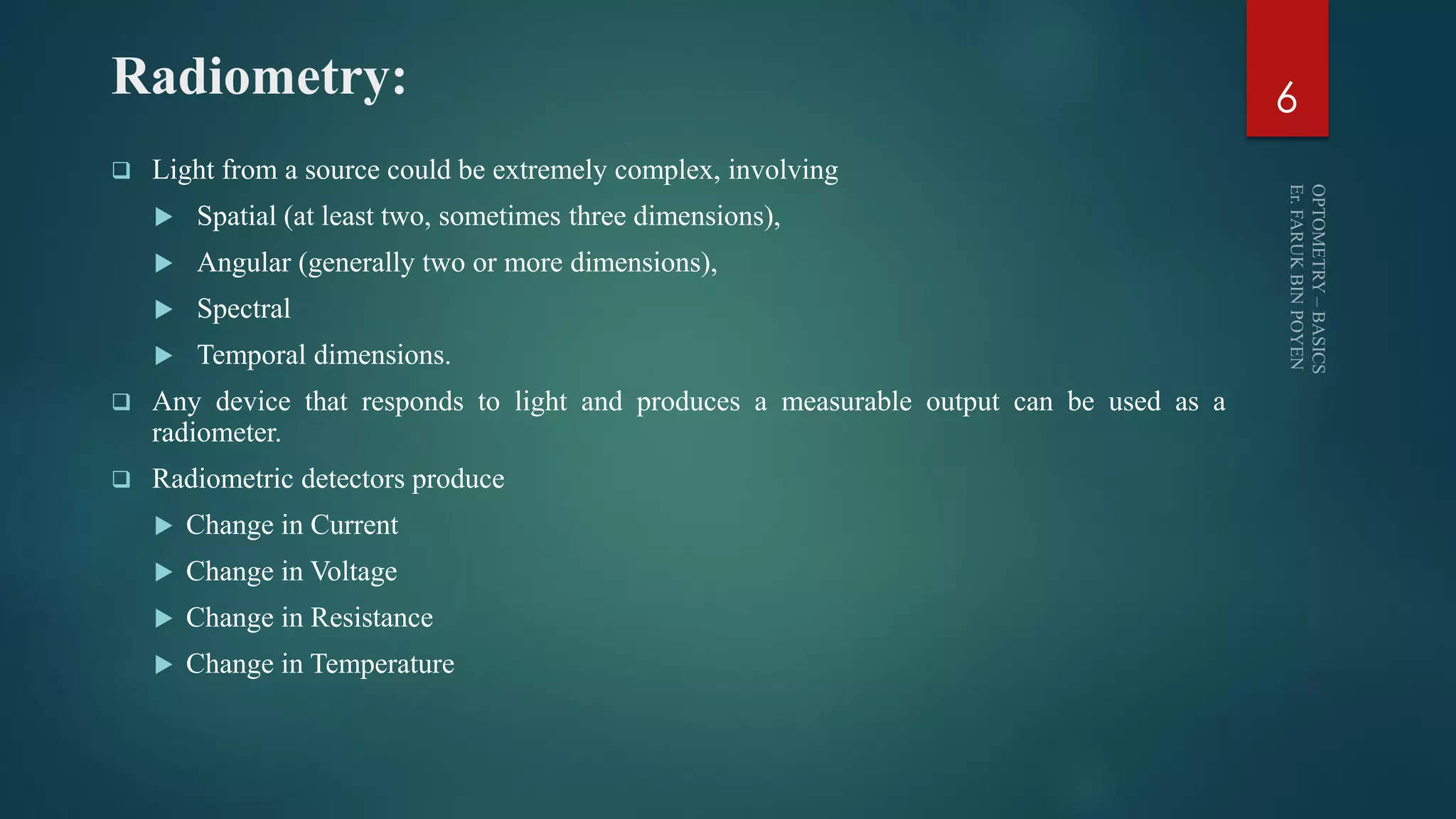
Radiometry:
 Light from a source could be extremely complex, involving
 Spatial (at least two, sometimes three dimensions),
 Angular (generally two or more dimensions),
 Spectral
 Temporal dimensions.
 Any device that responds to light and produces a measurable output can be used as a
radiometer.
 Radiometric detectors produce
 Change in Current
 Change in Voltage
 Change in Resistance
 Change in Temperature
6
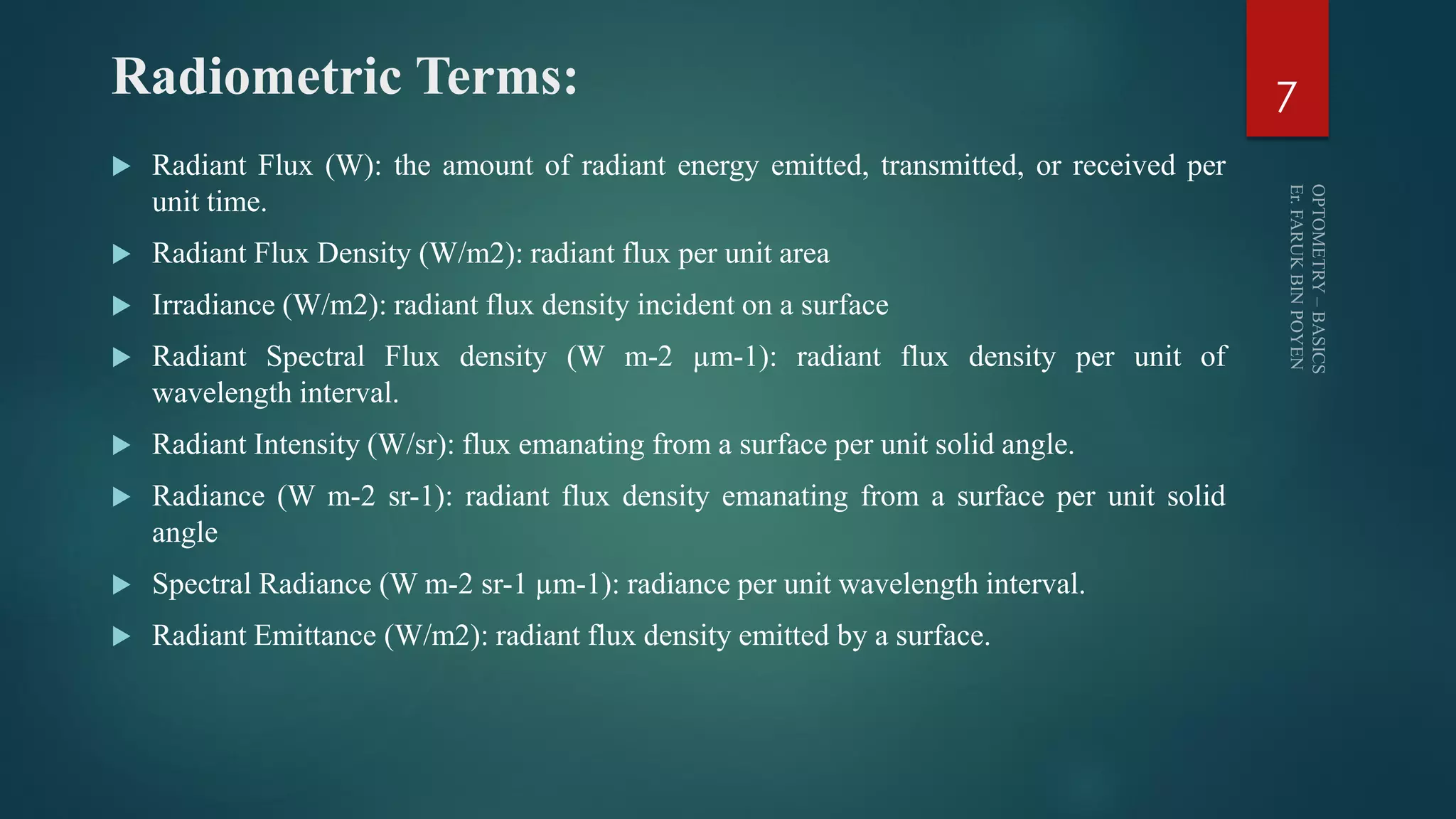
Radiometric Terms:
 Radiant Flux (W): the amount of radiant energy emitted, transmitted, or received per
unit time.
 Radiant Flux Density (W/m2): radiant flux per unit area
 Irradiance (W/m2): radiant flux density incident on a surface
 Radiant Spectral Flux density (W m-2 µm-1): radiant flux density per unit of
wavelength interval.
 Radiant Intensity (W/sr): flux emanating from a surface per unit solid angle.
 Radiance (W m-2 sr-1): radiant flux density emanating from a surface per unit solid
angle
 Spectral Radiance (W m-2 sr-1 µm-1): radiance per unit wavelength interval.
 Radiant Emittance (W/m2): radiant flux density emitted by a surface.
7
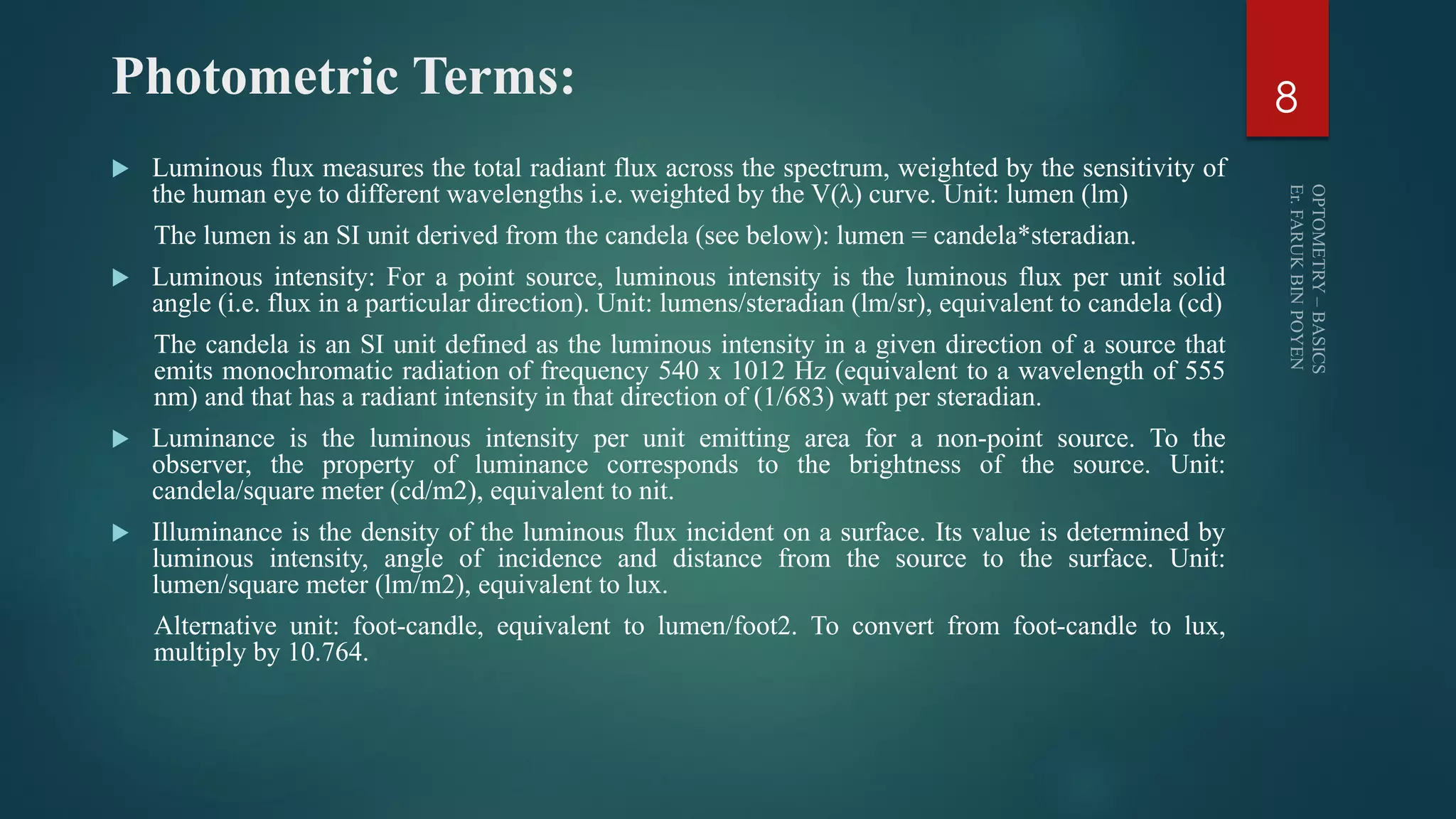
Photometric Terms:
 Luminous flux measures the total radiant flux across the spectrum, weighted by the sensitivity of
the human eye to different wavelengths i.e. weighted by the V(λ) curve. Unit: lumen (lm)
The lumen is an SI unit derived from the candela (see below): lumen = candela*steradian.
 Luminous intensity: For a point source, luminous intensity is the luminous flux per unit solid
angle (i.e. flux in a particular direction). Unit: lumens/steradian (lm/sr), equivalent to candela (cd)
The candela is an SI unit defined as the luminous intensity in a given direction of a source that
emits monochromatic radiation of frequency 540 x 1012 Hz (equivalent to a wavelength of 555
nm) and that has a radiant intensity in that direction of (1/683) watt per steradian.
 Luminance is the luminous intensity per unit emitting area for a non-point source. To the
observer, the property of luminance corresponds to the brightness of the source. Unit:
candela/square meter (cd/m2), equivalent to nit.
 Illuminance is the density of the luminous flux incident on a surface. Its value is determined by
luminous intensity, angle of incidence and distance from the source to the surface. Unit:
lumen/square meter (lm/m2), equivalent to lux.
Alternative unit: foot-candle, equivalent to lumen/foot2. To convert from foot-candle to lux,
multiply by 10.764.
8
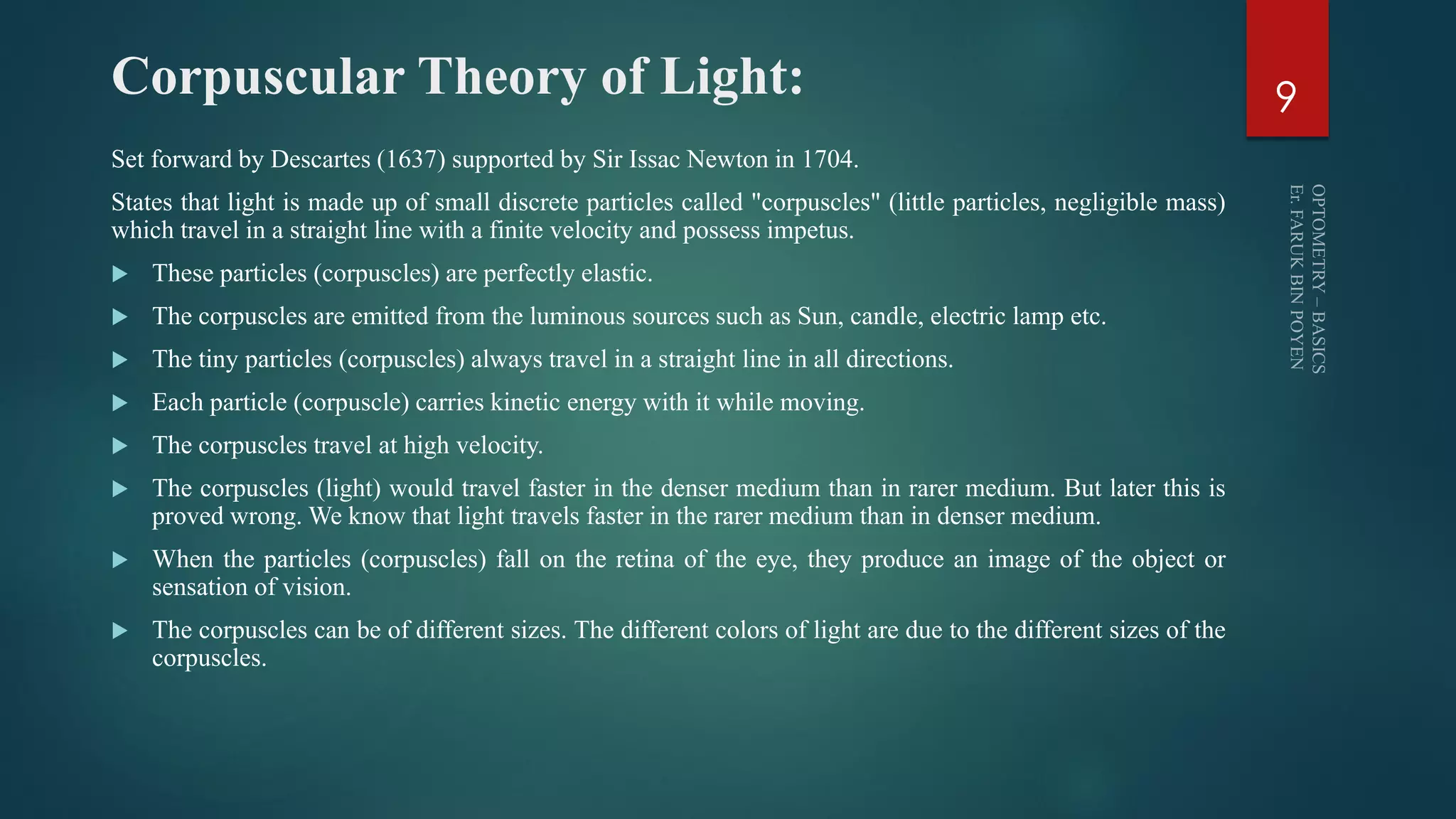
Corpuscular Theory of Light:
Set forward by Descartes (1637) supported by Sir Issac Newton in 1704.
States that light is made up of small discrete particles called "corpuscles" (little particles, negligible mass)
which travel in a straight line with a finite velocity and possess impetus.
 These particles (corpuscles) are perfectly elastic.
 The corpuscles are emitted from the luminous sources such as Sun, candle, electric lamp etc.
 The tiny particles (corpuscles) always travel in a straight line in all directions.
 Each particle (corpuscle) carries kinetic energy with it while moving.
 The corpuscles travel at high velocity.
 The corpuscles (light) would travel faster in the denser medium than in rarer medium. But later this is
proved wrong. We know that light travels faster in the rarer medium than in denser medium.
 When the particles (corpuscles) fall on the retina of the eye, they produce an image of the object or
sensation of vision.
 The corpuscles can be of different sizes. The different colors of light are due to the different sizes of the
corpuscles.
9
Wave Theory of Light:
 In 1678, Dutch physicist, Christian Huygens proposed this theory.
 Light was made up of waves vibrating up and down perpendicular to the direction of the
light travels, and therefore formulated a way of visualizing wave propagation.
 Light behaves as a wave - it undergoes reflection, refraction, diffraction & interference.
10
Quantum (Dual) Theory of Light:
 In 1924, French physicist, Louis de Broglie proposed that all particles have wave nature.
 Wave-particle duality holds that light and matter exhibit properties of both waves and of
particles.
 De Broglie’s equation: λ = h/mv.
 Wave behavior of light: Reflection, Refraction, Diffraction, Interference.
 Particle Behavior of light: Photoelectric Effect.
h = 6.63 × 10⁻³⁴ J · s ← Planck’s Constant; m is the mass of a particle, moving at a velocity v.
11
Few Laws related to Light - Plank’s Law:
Plank’s Law:
 Planck's law describes the spectral density of electromagnetic radiation emitted by a
black body in thermal equilibrium at a given temperature T.
 The law is named after Max Planck, who proposed it in 1900.
 This law is generalized to mean that all objects have some internal temperature, and
given that temperature, they all glow.
 Max Planck was able to establish the dependence of the spectral emissive energy of a
blackbody for all wavelengths of light (E λ,b), given a known equilibrium temperature of
the blackbody.
𝐸λ,𝑏 =
2𝜋ℎ𝑐2
λ5[𝑒
ℎ𝑐
λ𝑘𝑇 − 1]
12
Few Laws related to Light - Wien’s Displacement Law:
Wien’s Displacement Law:
 Wien's displacement law states that the black body radiation curve for different
temperature peaks at a wavelength and is inversely proportional to the temperature.
 The Wien's displacement law provides us with expected values for the most probable
wavelengths in the Bose-Einstein distribution of blackbody radiation.
 The law implies that the distribution of photons emitted from a surface at any
temperature will have the same form or shape as a distribution of photons emitted from
a surface at any other temperature.
λ 𝑚𝑎𝑥 =
2.8978 ∗ 106 𝑛𝑚𝐾
𝑇(𝐾)
13
Few Laws related to Light - Stefan – Boltzman Law:
Stefan – Boltzman Law:
 The total radiant heat energy emitted from a surface is proportional to the fourth power
of its absolute temperature.
 The law applies only to blackbodies, theoretical surfaces that absorb all incident heat
radiation.
 The Stefan-Boltzmann Law shows that if we were to integrate all the energies from the
wavelengths in Planck's Law, we have an analytical solution of the form below:
𝐸 𝑏 =
0
∞
𝐸λ,𝑏 𝑑λ = 𝜎𝑇4
where σ = Stefan-Boltzmann constant 5.67 ∗ 10−8
𝑊 𝑚2
𝐾4
14
Few Laws related to Light – Fermat’s Principle:
 Fermat's Principle or the Principle of Least Time states that the path taken between two
points by a ray of light is the path that can be traversed in the least time.
15
Few Laws related to Light – Huygen’s Principle:
Huygen’s Principle:
 Huygen’s Principle of wave propagation states that every point on a wave-front may be
considered a source of secondary spherical wavelets which spread out in the forward
direction at the speed of light.
 The new wave-front is the tangential surface to all of these secondary wavelets.
16
Light Phenomenon:
 Diffraction of Light: Diffraction is the slight bending of light as it passes around the
edge of an object. The amount of bending depends on the relative size of the wavelength
of light to the size of the opening.
 Interference of Light: When two light waves superpose with each other in such away
that the crest of one wave falls on the crest of the second wave, and trough of one wave
falls on the trough of the second wave, then the resultant wave has larger amplitude and
it is called constructive interference.
 Polarization of Light: A light wave that is vibrating in more than one plane is referred
to as un-polarized light. ... Polarized light waves are light waves in which the vibrations
occur in a single plane. The process of transforming unpolarized light into polarized
light is known as polarization.
17
References:
1. http://www.andor.com/learning-academy/radiometry-and-photometry-an-overview-of-
the-science-of-measuring-light
2. https://www.emedicalprep.com/study-material/physics/wave-optics/interference-light-
waves-youngs-experiment/
3. https://physicsabout.com/diffraction-of-light/
4. https://physicsabout.com/polarization-of-light/
5. http://www.physicsclassroom.com/class/light/Lesson-1/Polarization
6. http://hyperphysics.phy-astr.gsu.edu/hbase/hframe.html
18

Optical Instrumentation - 2. Basics of Optics

  • 1.
    OPTOMETRY – PartII BASICS OF OPTICS ER. FARUK BIN POYEN DEPT. OF AEIE, UIT, BU, BURDWAN, WB, INDIA FARUK.POYEN@GMAIL.COM
  • 2.
    Contents: 1. Radiometry &Photometry – Terms 2. Theories on Light 3. Laws related to Light 4. Optical Phenomenon 5. Interference – Experimental Validation 6. Diffraction – Experimental Validation 7. Polarization – Experimental Validation 2
  • 3.
    Optics – Geometrical& Physical:  Geometric optics studies refraction and reflection of rays of light without considering the wave or physical nature of light.  This branch of optics uses geometric and graphical methods to find the positions of images formed by mirrors, lenses, prisms , etc.  Physical optics tries to explain the objective phenomena of light.  This branch of optics studies phenomena such as interference , diffraction , polarization, etc. , which are viewed from the standpoint of the wave theory of light . 3
  • 4.
    Radiometry - Definition: Radiometry is the science of measuring light in any portion of the electromagnetic spectrum.  In practice, the term is usually limited to the measurement of infrared, visible, and ultraviolet light using optical instruments.  Irradiance is the intensity of light and is measured in watts per square meter. 4
  • 5.
    Photometry - Definition: Photometry is the science of measuring visible light in units that are weighted according to the sensitivity of the human eye.  It is a quantitative science based on a statistical model of the human visual response to light – i.e. our perception of light - under carefully controlled conditions.  The photometric equivalent of Radiance is called Illuminance and is measured in Lumens per square meter (Lux). 5
  • 6.
    Radiometry:  Light froma source could be extremely complex, involving  Spatial (at least two, sometimes three dimensions),  Angular (generally two or more dimensions),  Spectral  Temporal dimensions.  Any device that responds to light and produces a measurable output can be used as a radiometer.  Radiometric detectors produce  Change in Current  Change in Voltage  Change in Resistance  Change in Temperature 6
  • 7.
    Radiometric Terms:  RadiantFlux (W): the amount of radiant energy emitted, transmitted, or received per unit time.  Radiant Flux Density (W/m2): radiant flux per unit area  Irradiance (W/m2): radiant flux density incident on a surface  Radiant Spectral Flux density (W m-2 µm-1): radiant flux density per unit of wavelength interval.  Radiant Intensity (W/sr): flux emanating from a surface per unit solid angle.  Radiance (W m-2 sr-1): radiant flux density emanating from a surface per unit solid angle  Spectral Radiance (W m-2 sr-1 µm-1): radiance per unit wavelength interval.  Radiant Emittance (W/m2): radiant flux density emitted by a surface. 7
  • 8.
    Photometric Terms:  Luminousflux measures the total radiant flux across the spectrum, weighted by the sensitivity of the human eye to different wavelengths i.e. weighted by the V(λ) curve. Unit: lumen (lm) The lumen is an SI unit derived from the candela (see below): lumen = candela*steradian.  Luminous intensity: For a point source, luminous intensity is the luminous flux per unit solid angle (i.e. flux in a particular direction). Unit: lumens/steradian (lm/sr), equivalent to candela (cd) The candela is an SI unit defined as the luminous intensity in a given direction of a source that emits monochromatic radiation of frequency 540 x 1012 Hz (equivalent to a wavelength of 555 nm) and that has a radiant intensity in that direction of (1/683) watt per steradian.  Luminance is the luminous intensity per unit emitting area for a non-point source. To the observer, the property of luminance corresponds to the brightness of the source. Unit: candela/square meter (cd/m2), equivalent to nit.  Illuminance is the density of the luminous flux incident on a surface. Its value is determined by luminous intensity, angle of incidence and distance from the source to the surface. Unit: lumen/square meter (lm/m2), equivalent to lux. Alternative unit: foot-candle, equivalent to lumen/foot2. To convert from foot-candle to lux, multiply by 10.764. 8
  • 9.
    Corpuscular Theory ofLight: Set forward by Descartes (1637) supported by Sir Issac Newton in 1704. States that light is made up of small discrete particles called "corpuscles" (little particles, negligible mass) which travel in a straight line with a finite velocity and possess impetus.  These particles (corpuscles) are perfectly elastic.  The corpuscles are emitted from the luminous sources such as Sun, candle, electric lamp etc.  The tiny particles (corpuscles) always travel in a straight line in all directions.  Each particle (corpuscle) carries kinetic energy with it while moving.  The corpuscles travel at high velocity.  The corpuscles (light) would travel faster in the denser medium than in rarer medium. But later this is proved wrong. We know that light travels faster in the rarer medium than in denser medium.  When the particles (corpuscles) fall on the retina of the eye, they produce an image of the object or sensation of vision.  The corpuscles can be of different sizes. The different colors of light are due to the different sizes of the corpuscles. 9
  • 10.
    Wave Theory ofLight:  In 1678, Dutch physicist, Christian Huygens proposed this theory.  Light was made up of waves vibrating up and down perpendicular to the direction of the light travels, and therefore formulated a way of visualizing wave propagation.  Light behaves as a wave - it undergoes reflection, refraction, diffraction & interference. 10
  • 11.
    Quantum (Dual) Theoryof Light:  In 1924, French physicist, Louis de Broglie proposed that all particles have wave nature.  Wave-particle duality holds that light and matter exhibit properties of both waves and of particles.  De Broglie’s equation: λ = h/mv.  Wave behavior of light: Reflection, Refraction, Diffraction, Interference.  Particle Behavior of light: Photoelectric Effect. h = 6.63 × 10⁻³⁴ J · s ← Planck’s Constant; m is the mass of a particle, moving at a velocity v. 11
  • 12.
    Few Laws relatedto Light - Plank’s Law: Plank’s Law:  Planck's law describes the spectral density of electromagnetic radiation emitted by a black body in thermal equilibrium at a given temperature T.  The law is named after Max Planck, who proposed it in 1900.  This law is generalized to mean that all objects have some internal temperature, and given that temperature, they all glow.  Max Planck was able to establish the dependence of the spectral emissive energy of a blackbody for all wavelengths of light (E λ,b), given a known equilibrium temperature of the blackbody. 𝐸λ,𝑏 = 2𝜋ℎ𝑐2 λ5[𝑒 ℎ𝑐 λ𝑘𝑇 − 1] 12
  • 13.
    Few Laws relatedto Light - Wien’s Displacement Law: Wien’s Displacement Law:  Wien's displacement law states that the black body radiation curve for different temperature peaks at a wavelength and is inversely proportional to the temperature.  The Wien's displacement law provides us with expected values for the most probable wavelengths in the Bose-Einstein distribution of blackbody radiation.  The law implies that the distribution of photons emitted from a surface at any temperature will have the same form or shape as a distribution of photons emitted from a surface at any other temperature. λ 𝑚𝑎𝑥 = 2.8978 ∗ 106 𝑛𝑚𝐾 𝑇(𝐾) 13
  • 14.
    Few Laws relatedto Light - Stefan – Boltzman Law: Stefan – Boltzman Law:  The total radiant heat energy emitted from a surface is proportional to the fourth power of its absolute temperature.  The law applies only to blackbodies, theoretical surfaces that absorb all incident heat radiation.  The Stefan-Boltzmann Law shows that if we were to integrate all the energies from the wavelengths in Planck's Law, we have an analytical solution of the form below: 𝐸 𝑏 = 0 ∞ 𝐸λ,𝑏 𝑑λ = 𝜎𝑇4 where σ = Stefan-Boltzmann constant 5.67 ∗ 10−8 𝑊 𝑚2 𝐾4 14
  • 15.
    Few Laws relatedto Light – Fermat’s Principle:  Fermat's Principle or the Principle of Least Time states that the path taken between two points by a ray of light is the path that can be traversed in the least time. 15
  • 16.
    Few Laws relatedto Light – Huygen’s Principle: Huygen’s Principle:  Huygen’s Principle of wave propagation states that every point on a wave-front may be considered a source of secondary spherical wavelets which spread out in the forward direction at the speed of light.  The new wave-front is the tangential surface to all of these secondary wavelets. 16
  • 17.
    Light Phenomenon:  Diffractionof Light: Diffraction is the slight bending of light as it passes around the edge of an object. The amount of bending depends on the relative size of the wavelength of light to the size of the opening.  Interference of Light: When two light waves superpose with each other in such away that the crest of one wave falls on the crest of the second wave, and trough of one wave falls on the trough of the second wave, then the resultant wave has larger amplitude and it is called constructive interference.  Polarization of Light: A light wave that is vibrating in more than one plane is referred to as un-polarized light. ... Polarized light waves are light waves in which the vibrations occur in a single plane. The process of transforming unpolarized light into polarized light is known as polarization. 17
  • 18.
    References: 1. http://www.andor.com/learning-academy/radiometry-and-photometry-an-overview-of- the-science-of-measuring-light 2. https://www.emedicalprep.com/study-material/physics/wave-optics/interference-light- waves-youngs-experiment/ 3.https://physicsabout.com/diffraction-of-light/ 4. https://physicsabout.com/polarization-of-light/ 5. http://www.physicsclassroom.com/class/light/Lesson-1/Polarization 6. http://hyperphysics.phy-astr.gsu.edu/hbase/hframe.html 18