
Date:7/12/2015 Anand Patankar
Optimising Combustion
using a
Flue Gas Analyser
2/15Testo IN,
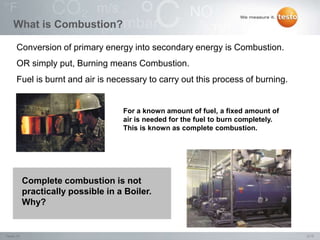
What is Combustion?
Conversion of primary energy into secondary energy is Combustion.
OR simply put, Burning means Combustion.
Fuel is burnt and air is necessary to carry out this process of burning.
For a known amount of fuel, a fixed amount of
air is needed for the fuel to burn completely.
This is known as complete combustion.
Complete combustion is not
practically possible in a Boiler.
Why?
3/15Testo IN,
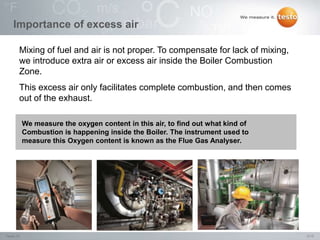
Importance of excess air
Mixing of fuel and air is not proper. To compensate for lack of mixing,
we introduce extra air or excess air inside the Boiler Combustion
Zone.
This excess air only facilitates complete combustion, and then comes
out of the exhaust.
We measure the oxygen content in this air, to find out what kind of
Combustion is happening inside the Boiler. The instrument used to
measure this Oxygen content is known as the Flue Gas Analyser.
4/15Testo IN,
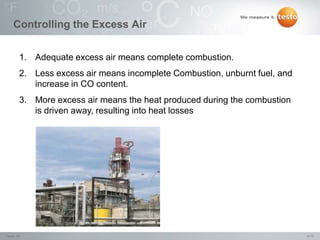
Controlling the Excess Air
1. Adequate excess air means complete combustion.
2. Less excess air means incomplete Combustion, unburnt fuel, and
increase in CO content.
3. More excess air means the heat produced during the combustion
is driven away, resulting into heat losses
5/15Testo IN,
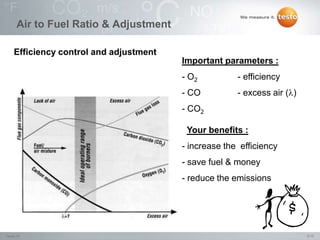
Efficiency control and adjustment
Important parameters :
- O2 - efficiency
- CO - excess air ()
- CO2
Your benefits :
- increase the efficiency
- save fuel & money
- reduce the emissions
Air to Fuel Ratio & Adjustment
6/15Testo IN,
Selecting the right Instrument
1. Which gases?
2. Stack Diameter?
3. Stack Temperature?
4. Fuel Type?
5. Dust Content?
6. dP? Velocity?
7. Software?
Testo Flue Gas Analysers
8/15Testo IN,
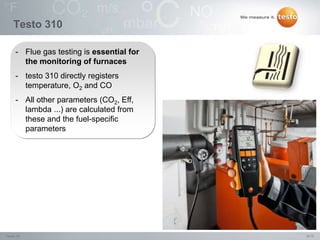
Testo 310
- Flue gas testing is essential for
the monitoring of furnaces
- testo 310 directly registers
temperature, O2 and CO
- All other parameters (CO2, Eff,
lambda ...) are calculated from
these and the fuel-specific
parameters
9/15Testo IN,
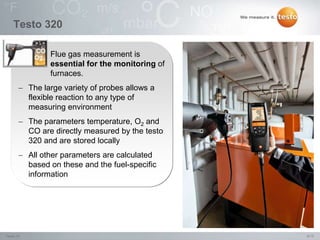
Testo 320
Flue gas measurement is
essential for the monitoring of
furnaces.
 The large variety of probes allows a
flexible reaction to any type of
measuring environment
 The parameters temperature, O2 and
CO are directly measured by the testo
320 and are stored locally
 All other parameters are calculated
based on these and the fuel-specific
information
10/15Testo IN,
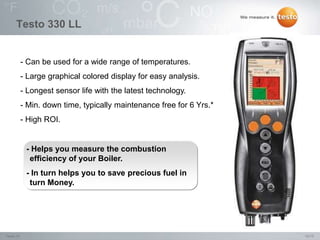
Testo 330 LL
- Can be used for a wide range of temperatures.
- Large graphical colored display for easy analysis.
- Longest sensor life with the latest technology.
- Min. down time, typically maintenance free for 6 Yrs.*
- High ROI.
- Helps you measure the combustion
efficiency of your Boiler.
- In turn helps you to save precious fuel in
turn Money.
11/15Testo IN,
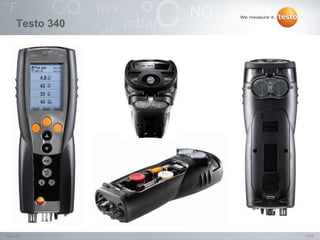
Testo 340
12/15Testo IN,
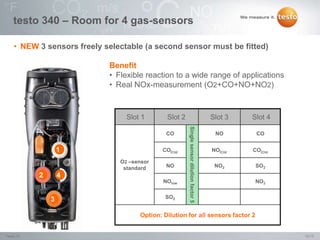
testo 340 – Room for 4 gas-sensors
1
2
3
4
Benefit
• Flexible reaction to a wide range of applications
• Real NOx-measurement (O2+CO+NO+NO2)
Slot 1 Slot 2 Slot 3 Slot 4
O2 –sensor
standard
CO
Singlesensordilutionfactor5
NO CO
COlow NOlow COlow
NO NO2 SO2
NOlow NO2
SO2
Option: Dilution for all sensors factor 2
• NEW 3 sensors freely selectable (a second sensor must be fitted)
13/15Testo IN,
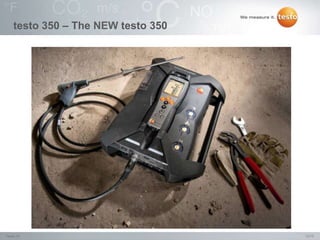
testo 350 – The NEW testo 350
14/15Testo IN,
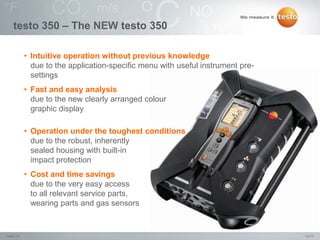
testo 350 – The NEW testo 350
• Intuitive operation without previous knowledge
due to the application-specific menu with useful instrument pre-
settings
• Fast and easy analysis
due to the new clearly arranged colour
graphic display
• Operation under the toughest conditions
due to the robust, inherently
sealed housing with built-in
impact protection
• Cost and time savings
due to the very easy access
to all relevant service parts,
wearing parts and gas sensors
15/15Testo IN,
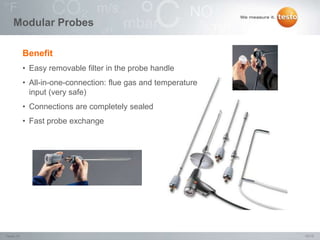
Modular Probes
Benefit
• Easy removable filter in the probe handle
• All-in-one-connection: flue gas and temperature
input (very safe)
• Connections are completely sealed
• Fast probe exchange
Thank you
For more details log on to -
www.testo.in
Or write to us at:
info@testoindia.com
Follow us on :

Optimizing Combustion using a Flue Gas Analyser

  • 1.
    Date:7/12/2015 Anand Patankar OptimisingCombustion using a Flue Gas Analyser
  • 2.
    2/15Testo IN, What isCombustion? Conversion of primary energy into secondary energy is Combustion. OR simply put, Burning means Combustion. Fuel is burnt and air is necessary to carry out this process of burning. For a known amount of fuel, a fixed amount of air is needed for the fuel to burn completely. This is known as complete combustion. Complete combustion is not practically possible in a Boiler. Why?
  • 3.
    3/15Testo IN, Importance ofexcess air Mixing of fuel and air is not proper. To compensate for lack of mixing, we introduce extra air or excess air inside the Boiler Combustion Zone. This excess air only facilitates complete combustion, and then comes out of the exhaust. We measure the oxygen content in this air, to find out what kind of Combustion is happening inside the Boiler. The instrument used to measure this Oxygen content is known as the Flue Gas Analyser.
  • 4.
    4/15Testo IN, Controlling theExcess Air 1. Adequate excess air means complete combustion. 2. Less excess air means incomplete Combustion, unburnt fuel, and increase in CO content. 3. More excess air means the heat produced during the combustion is driven away, resulting into heat losses
  • 5.
    5/15Testo IN, Efficiency controland adjustment Important parameters : - O2 - efficiency - CO - excess air () - CO2 Your benefits : - increase the efficiency - save fuel & money - reduce the emissions Air to Fuel Ratio & Adjustment
  • 6.
    6/15Testo IN, Selecting theright Instrument 1. Which gases? 2. Stack Diameter? 3. Stack Temperature? 4. Fuel Type? 5. Dust Content? 6. dP? Velocity? 7. Software?
  • 7.
    Testo Flue GasAnalysers
  • 8.
    8/15Testo IN, Testo 310 -Flue gas testing is essential for the monitoring of furnaces - testo 310 directly registers temperature, O2 and CO - All other parameters (CO2, Eff, lambda ...) are calculated from these and the fuel-specific parameters
  • 9.
    9/15Testo IN, Testo 320 Fluegas measurement is essential for the monitoring of furnaces.  The large variety of probes allows a flexible reaction to any type of measuring environment  The parameters temperature, O2 and CO are directly measured by the testo 320 and are stored locally  All other parameters are calculated based on these and the fuel-specific information
  • 10.
    10/15Testo IN, Testo 330LL - Can be used for a wide range of temperatures. - Large graphical colored display for easy analysis. - Longest sensor life with the latest technology. - Min. down time, typically maintenance free for 6 Yrs.* - High ROI. - Helps you measure the combustion efficiency of your Boiler. - In turn helps you to save precious fuel in turn Money.
  • 11.
  • 12.
    12/15Testo IN, testo 340– Room for 4 gas-sensors 1 2 3 4 Benefit • Flexible reaction to a wide range of applications • Real NOx-measurement (O2+CO+NO+NO2) Slot 1 Slot 2 Slot 3 Slot 4 O2 –sensor standard CO Singlesensordilutionfactor5 NO CO COlow NOlow COlow NO NO2 SO2 NOlow NO2 SO2 Option: Dilution for all sensors factor 2 • NEW 3 sensors freely selectable (a second sensor must be fitted)
  • 13.
    13/15Testo IN, testo 350– The NEW testo 350
  • 14.
    14/15Testo IN, testo 350– The NEW testo 350 • Intuitive operation without previous knowledge due to the application-specific menu with useful instrument pre- settings • Fast and easy analysis due to the new clearly arranged colour graphic display • Operation under the toughest conditions due to the robust, inherently sealed housing with built-in impact protection • Cost and time savings due to the very easy access to all relevant service parts, wearing parts and gas sensors
  • 15.
    15/15Testo IN, Modular Probes Benefit •Easy removable filter in the probe handle • All-in-one-connection: flue gas and temperature input (very safe) • Connections are completely sealed • Fast probe exchange
  • 16.
    Thank you For moredetails log on to - www.testo.in Or write to us at: info@testoindia.com Follow us on :