ROLE OF CHEMISTRY IN
POWER PLANT
FEB
24/2004
CONTENTS OF THE PRESENTATION
FEB
24/2004
Feed water treatment
FEB
24/2004
Insoluble impuritiesInsoluble impurities are very largely
metal oxidesmetal oxides derived from corrosion of
the plant itself, particularly the materials
of construction of the condenser and
feed systems. Such corrosion is
minimised by maintaining the feed water
at an alkaline pH and by removing
dissolved oxygen down to very low
concentrations.
Soluble impuritiesSoluble impurities in feed water most
frequently arise from in leakage of
cooling water from condensers and other
coolers, but can also results from poor
quality of make-up water.
Parameters 200 MW 500 MW
Boiler Pressure, Kg/cm2
150-170 185-195
pH at 25°C 8.8-9.0 9.0-9.2
ACC Cond. µm/cm, 0.2 0.2
Silica, ppb, (Max) 20 10
DO, ppb, (Max) 5.0 5.0
Res. N2H4, ppb 10-20 12-20
Total Fe, ppb, (Max.) 10 10
Total Cu, ppb, (Max.) 5 3
Ref: Code of Practice on Power Plant chemistry, by (OS) COS-ISO-00-OGN-OPS-
CHEM/015, Oct.2003
o Feed water pH- the use of volatile
alkalis (NH3
)
o By making the pH of feed water slightly alkaline (9.0-
9.2) the corrosion rate of ferrous alloys can be
minimised. Where the system is also contain copper
based alloys similar benefits can be obtained
o Oxygen Control
o Physical de-aeration
o Chemical de-aeration
There is no excessive accumulation of alkali in the
boiler water, the volatile alkali passing out the
boiler with the steam.
As condensate are formed in the lower pressure
section of the turbine, in the condensers and on
the steam side of the feed heaters, the alkali
immediately available in these parts of the
steam/water system, raising the ph of the
condensates and hence suppressing corrosion.
Ammonia (NH3) is the most widely used volatile
alkali because of its low cost, ready available
and its stability at high temperatures
Physical de-aeration
De-aerator
40 ppb D.O. in
Condensate
Water
5 ppb D.O
Solubility Law & Henry
Law
Chemical de-aeration
The most widely used agent is Hydrazine (N2H4).
It is steam volatile, slightly basic and reacting readily to
remove even traces of dissolve oxygen at temperature
above 1500
C producing only volatile or gaseous
products, i.e.,
NN22 HH44 + O+ O22 NN22 + H+ H22 OO
At higher temperature hydrazine itself decomposes
to produce ammonia and nitrogen, i.e.,
NN22 HH44 4NH4NH33 + N+ N22
It is assumed that the reduction of oxygen by hydrazine probably
follows a heterogeneous reaction mechanism. It is common
experience to find that two or four weeks elapse after initiating
hydrazine treatment before a residual can be detected in the
boiler water. This is because of following reactions
6 Fe2O3 + N2H4 N2 + 2 H2O + 4 Fe3O4
4 CuO + N2H4 N2 + 2 H2O + 4
Fe3O4
likely that the actual reduction of oxygen takes place in two steps
involving the oxidation and reduction of oxides of iron.
4 Fe3O4 + O2 6 Fe2O3
6 Fe O + N H 4 Fe O + N + 2 H O
To maintain boilers and turbines at a
high level of availability and efficiency,
the chemical control of water and steam
purity is aimed at the prevention of:
1.Corrosion of feed, boiler and steam
systems.
2.Scale and deposit formation on heat
transfer surfaces.
3.Deposition and corrosion of turbines.
Parameters 200 MW 500 MW
Boiler Pressure, Kg/cm2
150-170 185-195
pH at 25°C 9.2-9.5 9.1-9.4
Cond. µS/cm, (Max) 30 30
Silica, ppm, (Max) 0.2 0.1
Phosphate, ppm 2-4 1-2
Chloride, ppm, (Max.) 1.0 0.5
Ref: Code of Practice on Power Plant chemistry, by (OS) COS-ISO-00-OGN-OPS-
CHEM/015, Oct.2003
Trisodium phosphate (Na3PO4) and disodium phosphate
(Na2HPO4) can both effectively produce alkalinity by hydrolysis
in water:
Na3PO4 + H2O Na2HPO4 +
NaOH
Na2HPO4 + 2 H2O NaH2PO4 +
NaOH
The important difference between this source of
alkalinity and that produced by free caustic soda lies
in the reversibility of the above reactions. If acid
species appear in the boiler water they will be
neutralised by the sodium hydroxide:
Recommended parameters of Super heated
Steam Purity Guidelines
Parameters 200 MW 500 MW
pH at 25°C 8.8-9.0 9.0-9.2
ACC Cond. µm/cm, 0.2 0.2
Silica, ppb, (max) 20 10
Sodium, ppb, (max) 5.0 5.0
NH3, ppm, (max) 0.5 1.0
Total Fe, ppb, (max.) 10 10
Total Cu, ppb, (max.) 5 3
Ref: Code of Practice on Power Plant chemistry, by (OS) COS-ISO-00-OGN-OPS-
CHEM/015, Oct.2003
o Solubility of impurities in steam decreases as
steam expands in turbine
o NaCl and NaOH most corrosive chemicals
o Solubility of caustic exceeds 100 ppb at HP
turbine pressure and temp.
o In LP turbine, caustic solubility in steam
decreases and deposit concentration goes
up to 90%.
o 15 Conductivity analysers
o 5-6 pH analysers
o 1 multi-channel Silica analyser (@ 5
channels)
o 1 Hydrazine analyser
o 2-3 D.O. analysers
o 1-2 Sodium analysers
o 1 Phosphate analyser + some more...
 CEP dischargeCEP discharge
Direct and after cation conductivity
measurements, supplemented by
sodium monitoring, to provide warning
of condenser leakage. Dissolved oxygen
measurements are also required in
order to establish the adequacy of
oxygen removal at the condenser.
 Condensate Polishing Plant outletCondensate Polishing Plant outlet
Conductivity, ACC, Reactive Silica, Na+
in
outlet water are required to monitor the
performance of the plant and for need
of resin bed regeneration. Additionally,
the measurement of Chloride &
sulphate in the outlet water has
assumed increasing importance.
 De-aeratorDe-aerator
D.O. measurement at Inlet & Outlet of de-
aerator.
For testing purposes it is necessary to
have the facility to sample and monitor
oxygen at both inlet and outlet of the
de-aerator to insure satisfactory
performance.
 Final Feed WaterFinal Feed Water
Conductivity, ACC, D.O, pH, Na+
, Cl-
, SO--
4 &
Total Iron.
Comprehensive chemical monitoring of
feed water just before it enters the
boiler, to provide a final check on
quality and acceptability.
 Boiler WaterBoiler Water
Conductivity, pH, Phosphate, Cl-
, reactive
silica are required to conform the
correct boiler water conditions are
being maintained.
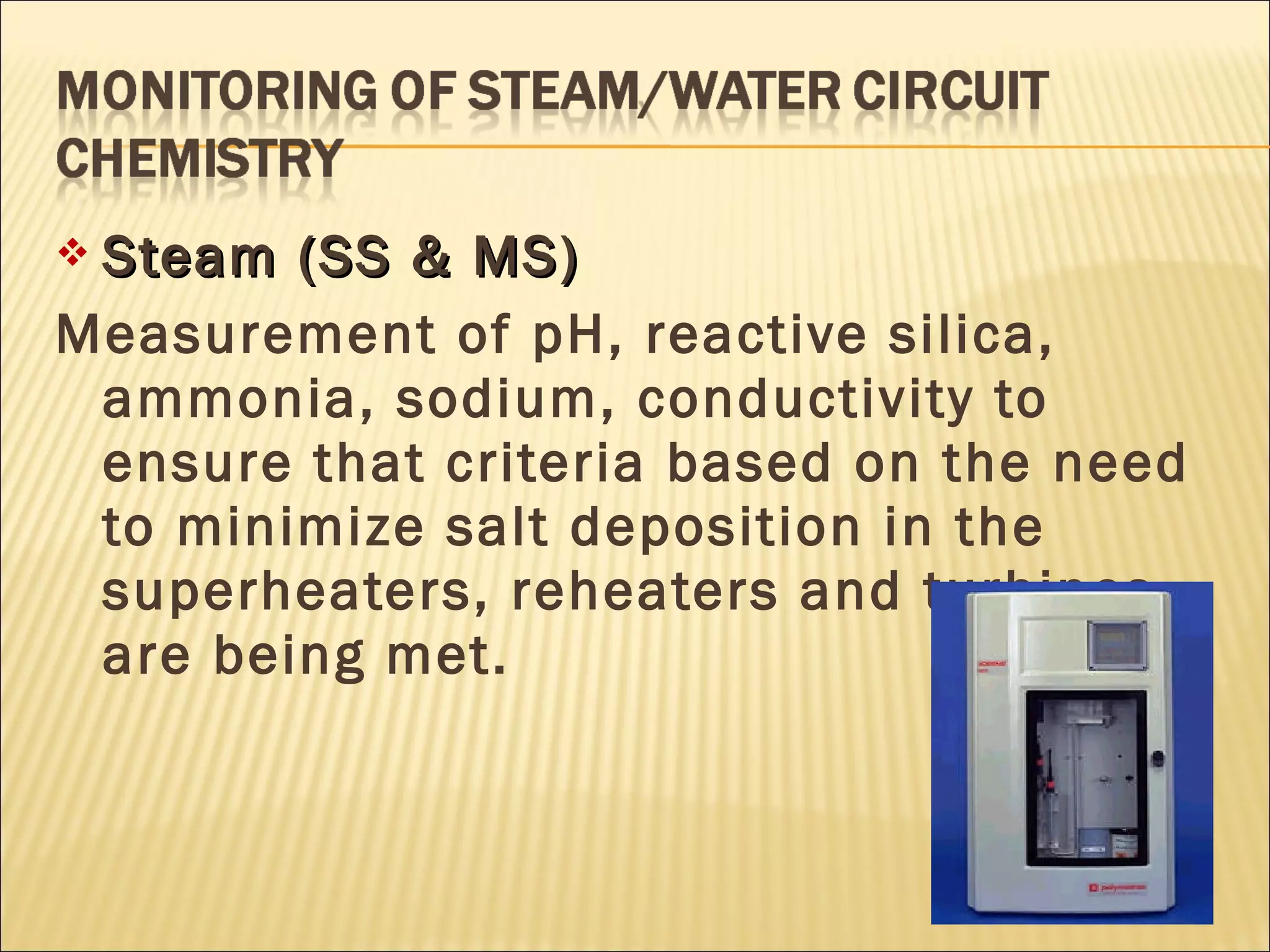
 Steam (SS & MS)Steam (SS & MS)
Measurement of pH, reactive silica,
ammonia, sodium, conductivity to
ensure that criteria based on the need
to minimize salt deposition in the
superheaters, reheaters and turbines
are being met.
A potential major source of ingress of
impurity into the boiler water system is
from leakage of cooling water into the
main condenser steam space (because,
steam space is maintained by vacuum)
which is called condenser leakage
o Online sodium increases (normal <2ppb).
o After Cation Conductivity increases
( normal value <0.2 µS/cm for 500MW
plant)
o Total hardness of condensate will be high.
o Boiler and condensate silica will go on
increasing and cannot be controlled
without CBD and/or CPU.
o Hot well makeup will be low as well as
level will be high.
o De-aerator level will go high.
1. Open CBD 100%, makeup will go high.
(Heat as well as DM water loss)
2. Increase the concentration of phosphate
and free alkalinity in boiler.
3. Limit as for as possible the boiler de-
superheater spray water to prevent
contamination of the system.
4. Isolate one path of condenser, and see
the results and vice versa.
5. Put CPU into service if available.
If the leak is in minor in nature:If the leak is in minor in nature:
o In running units, isolate one half the
condenser at a time and minor the
chemical parameters and find out
which half is leaking.
o Isolate the leaky half portion.
o Plug or repair the leak.
o Normalise and comeback to full load.
 First is path detection
 Flood test
 Candle Test
 Dye test
 Foam Test
 Bubbler Method
Parameters 200 MW 500 MW
pH at 25°C 8.8-9.0 9.0-9.2
ACC Cond. µm/cm, 0.3 0.2
Silica, ppb, (max) 20 10
DO, ppb, (max) 40 40
NH3, ppm, (max) 0.5 1.0
Total Fe, ppb, (max.) 10 10
Total Cu, ppb, (max.) 5 3
Sodium, ppb, max - 5
Ref: Code of Practice on Power Plant chemistry, by (OS) COS-ISO-00-OGN-OPS-
CHEM/015, Oct.2003
Condensate polishing is employed to
purify the return steam condensate in
order to meet the quality requirements of
high pressure thermal cycles and
minimize consumption of make-up water.
 Improvement in the quality of
condensate and "cycle" clean up
 Reduced blow down & make up
requirements
 Improvement in boiler water quality for
drum type boilers
 Quick start up and as a result, full load
conditions are reached early giving
economics
S.NO. PARAMETER CONTROL LIMITS FREQUENCY
OF TESTING
WITHOUT
ALKALIZER
WITH
ALKALIZER
1. Conductivity at
25oC, µS/cm
<1.5
(preferably below
0.5)
<2.2 Continuous
2. Dissolved oxygen,
µg/l
<100 <10 Continuous
3. Total copper, µg/l <20 <20 Once in 2-months
4. Total iron, µg/l <20 <20 Once in 2-months
5. pH at 25oC 6.0-8.0 8.5-9.0 Once in 2-months
Conductivity is the basic criteria of quality for the
stator cooling water and a low level must be
maintained to eliminate the possibility of
flashover.
Dissolved oxygen in stator water is the main
reason for corrosion.
Dissolved oxygen in stator cooling water is
generally removed by purging with nitrogen gas of
high purity (99.99%, min.). Removal of dissolved
oxygen depends on the nitrogen pressure which is
normally maintained at 0.2 kg/cm2
with alarm for
nitrogen pressure in primary water tank set at 0.4
kg/cm2
for better efficiency.
 A bypass ion exchange polishing plant is
commonly installed to control the conductivity
of the stator water and can also trap some of
the suspended matter in water.
 Polishing plant is generally designed to treat
about 2-5% of total stator water flow. The
polisher contains a bed of mixed resins
consisting of strong cation resin in h-form and
strong anion resin in oh-form. Analysis of the
exhausted resin can be used to know how
much corrosion products are removed by the
mixed bed.
THANKS
SAVE ELECTRICITY N
SAVE ELECTRICITY N
PROTECT ENVIRONMENT
PROTECT ENVIRONMENT

POWER PLANT CHEMISTRY

  • 1.
    ROLE OF CHEMISTRYIN POWER PLANT FEB 24/2004
  • 2.
    CONTENTS OF THEPRESENTATION FEB 24/2004
  • 3.
  • 4.
    Insoluble impuritiesInsoluble impuritiesare very largely metal oxidesmetal oxides derived from corrosion of the plant itself, particularly the materials of construction of the condenser and feed systems. Such corrosion is minimised by maintaining the feed water at an alkaline pH and by removing dissolved oxygen down to very low concentrations.
  • 5.
    Soluble impuritiesSoluble impuritiesin feed water most frequently arise from in leakage of cooling water from condensers and other coolers, but can also results from poor quality of make-up water.
  • 7.
    Parameters 200 MW500 MW Boiler Pressure, Kg/cm2 150-170 185-195 pH at 25°C 8.8-9.0 9.0-9.2 ACC Cond. µm/cm, 0.2 0.2 Silica, ppb, (Max) 20 10 DO, ppb, (Max) 5.0 5.0 Res. N2H4, ppb 10-20 12-20 Total Fe, ppb, (Max.) 10 10 Total Cu, ppb, (Max.) 5 3 Ref: Code of Practice on Power Plant chemistry, by (OS) COS-ISO-00-OGN-OPS- CHEM/015, Oct.2003
  • 8.
    o Feed waterpH- the use of volatile alkalis (NH3 ) o By making the pH of feed water slightly alkaline (9.0- 9.2) the corrosion rate of ferrous alloys can be minimised. Where the system is also contain copper based alloys similar benefits can be obtained o Oxygen Control o Physical de-aeration o Chemical de-aeration
  • 9.
    There is noexcessive accumulation of alkali in the boiler water, the volatile alkali passing out the boiler with the steam. As condensate are formed in the lower pressure section of the turbine, in the condensers and on the steam side of the feed heaters, the alkali immediately available in these parts of the steam/water system, raising the ph of the condensates and hence suppressing corrosion. Ammonia (NH3) is the most widely used volatile alkali because of its low cost, ready available and its stability at high temperatures
  • 11.
    Physical de-aeration De-aerator 40 ppbD.O. in Condensate Water 5 ppb D.O Solubility Law & Henry Law
  • 12.
    Chemical de-aeration The mostwidely used agent is Hydrazine (N2H4). It is steam volatile, slightly basic and reacting readily to remove even traces of dissolve oxygen at temperature above 1500 C producing only volatile or gaseous products, i.e., NN22 HH44 + O+ O22 NN22 + H+ H22 OO At higher temperature hydrazine itself decomposes to produce ammonia and nitrogen, i.e., NN22 HH44 4NH4NH33 + N+ N22
  • 13.
    It is assumedthat the reduction of oxygen by hydrazine probably follows a heterogeneous reaction mechanism. It is common experience to find that two or four weeks elapse after initiating hydrazine treatment before a residual can be detected in the boiler water. This is because of following reactions 6 Fe2O3 + N2H4 N2 + 2 H2O + 4 Fe3O4 4 CuO + N2H4 N2 + 2 H2O + 4 Fe3O4 likely that the actual reduction of oxygen takes place in two steps involving the oxidation and reduction of oxides of iron. 4 Fe3O4 + O2 6 Fe2O3 6 Fe O + N H 4 Fe O + N + 2 H O
  • 14.
    To maintain boilersand turbines at a high level of availability and efficiency, the chemical control of water and steam purity is aimed at the prevention of: 1.Corrosion of feed, boiler and steam systems. 2.Scale and deposit formation on heat transfer surfaces. 3.Deposition and corrosion of turbines.
  • 15.
    Parameters 200 MW500 MW Boiler Pressure, Kg/cm2 150-170 185-195 pH at 25°C 9.2-9.5 9.1-9.4 Cond. µS/cm, (Max) 30 30 Silica, ppm, (Max) 0.2 0.1 Phosphate, ppm 2-4 1-2 Chloride, ppm, (Max.) 1.0 0.5 Ref: Code of Practice on Power Plant chemistry, by (OS) COS-ISO-00-OGN-OPS- CHEM/015, Oct.2003
  • 16.
    Trisodium phosphate (Na3PO4)and disodium phosphate (Na2HPO4) can both effectively produce alkalinity by hydrolysis in water: Na3PO4 + H2O Na2HPO4 + NaOH Na2HPO4 + 2 H2O NaH2PO4 + NaOH The important difference between this source of alkalinity and that produced by free caustic soda lies in the reversibility of the above reactions. If acid species appear in the boiler water they will be neutralised by the sodium hydroxide:
  • 17.
    Recommended parameters ofSuper heated Steam Purity Guidelines Parameters 200 MW 500 MW pH at 25°C 8.8-9.0 9.0-9.2 ACC Cond. µm/cm, 0.2 0.2 Silica, ppb, (max) 20 10 Sodium, ppb, (max) 5.0 5.0 NH3, ppm, (max) 0.5 1.0 Total Fe, ppb, (max.) 10 10 Total Cu, ppb, (max.) 5 3 Ref: Code of Practice on Power Plant chemistry, by (OS) COS-ISO-00-OGN-OPS- CHEM/015, Oct.2003
  • 18.
    o Solubility ofimpurities in steam decreases as steam expands in turbine o NaCl and NaOH most corrosive chemicals o Solubility of caustic exceeds 100 ppb at HP turbine pressure and temp. o In LP turbine, caustic solubility in steam decreases and deposit concentration goes up to 90%.
  • 20.
    o 15 Conductivityanalysers o 5-6 pH analysers o 1 multi-channel Silica analyser (@ 5 channels) o 1 Hydrazine analyser o 2-3 D.O. analysers o 1-2 Sodium analysers o 1 Phosphate analyser + some more...
  • 21.
     CEP dischargeCEPdischarge Direct and after cation conductivity measurements, supplemented by sodium monitoring, to provide warning of condenser leakage. Dissolved oxygen measurements are also required in order to establish the adequacy of oxygen removal at the condenser.
  • 22.
     Condensate PolishingPlant outletCondensate Polishing Plant outlet Conductivity, ACC, Reactive Silica, Na+ in outlet water are required to monitor the performance of the plant and for need of resin bed regeneration. Additionally, the measurement of Chloride & sulphate in the outlet water has assumed increasing importance.
  • 23.
     De-aeratorDe-aerator D.O. measurementat Inlet & Outlet of de- aerator. For testing purposes it is necessary to have the facility to sample and monitor oxygen at both inlet and outlet of the de-aerator to insure satisfactory performance.
  • 24.
     Final FeedWaterFinal Feed Water Conductivity, ACC, D.O, pH, Na+ , Cl- , SO-- 4 & Total Iron. Comprehensive chemical monitoring of feed water just before it enters the boiler, to provide a final check on quality and acceptability.
  • 25.
     Boiler WaterBoilerWater Conductivity, pH, Phosphate, Cl- , reactive silica are required to conform the correct boiler water conditions are being maintained.
  • 26.
     Steam (SS& MS)Steam (SS & MS) Measurement of pH, reactive silica, ammonia, sodium, conductivity to ensure that criteria based on the need to minimize salt deposition in the superheaters, reheaters and turbines are being met.
  • 27.
    A potential majorsource of ingress of impurity into the boiler water system is from leakage of cooling water into the main condenser steam space (because, steam space is maintained by vacuum) which is called condenser leakage
  • 28.
    o Online sodiumincreases (normal <2ppb). o After Cation Conductivity increases ( normal value <0.2 µS/cm for 500MW plant) o Total hardness of condensate will be high. o Boiler and condensate silica will go on increasing and cannot be controlled without CBD and/or CPU. o Hot well makeup will be low as well as level will be high. o De-aerator level will go high.
  • 29.
    1. Open CBD100%, makeup will go high. (Heat as well as DM water loss) 2. Increase the concentration of phosphate and free alkalinity in boiler. 3. Limit as for as possible the boiler de- superheater spray water to prevent contamination of the system. 4. Isolate one path of condenser, and see the results and vice versa. 5. Put CPU into service if available.
  • 30.
    If the leakis in minor in nature:If the leak is in minor in nature: o In running units, isolate one half the condenser at a time and minor the chemical parameters and find out which half is leaking. o Isolate the leaky half portion. o Plug or repair the leak. o Normalise and comeback to full load.
  • 31.
     First ispath detection  Flood test  Candle Test  Dye test  Foam Test  Bubbler Method
  • 32.
    Parameters 200 MW500 MW pH at 25°C 8.8-9.0 9.0-9.2 ACC Cond. µm/cm, 0.3 0.2 Silica, ppb, (max) 20 10 DO, ppb, (max) 40 40 NH3, ppm, (max) 0.5 1.0 Total Fe, ppb, (max.) 10 10 Total Cu, ppb, (max.) 5 3 Sodium, ppb, max - 5 Ref: Code of Practice on Power Plant chemistry, by (OS) COS-ISO-00-OGN-OPS- CHEM/015, Oct.2003
  • 33.
    Condensate polishing isemployed to purify the return steam condensate in order to meet the quality requirements of high pressure thermal cycles and minimize consumption of make-up water.
  • 34.
     Improvement inthe quality of condensate and "cycle" clean up  Reduced blow down & make up requirements  Improvement in boiler water quality for drum type boilers  Quick start up and as a result, full load conditions are reached early giving economics
  • 36.
    S.NO. PARAMETER CONTROLLIMITS FREQUENCY OF TESTING WITHOUT ALKALIZER WITH ALKALIZER 1. Conductivity at 25oC, µS/cm <1.5 (preferably below 0.5) <2.2 Continuous 2. Dissolved oxygen, µg/l <100 <10 Continuous 3. Total copper, µg/l <20 <20 Once in 2-months 4. Total iron, µg/l <20 <20 Once in 2-months 5. pH at 25oC 6.0-8.0 8.5-9.0 Once in 2-months
  • 37.
    Conductivity is thebasic criteria of quality for the stator cooling water and a low level must be maintained to eliminate the possibility of flashover. Dissolved oxygen in stator water is the main reason for corrosion. Dissolved oxygen in stator cooling water is generally removed by purging with nitrogen gas of high purity (99.99%, min.). Removal of dissolved oxygen depends on the nitrogen pressure which is normally maintained at 0.2 kg/cm2 with alarm for nitrogen pressure in primary water tank set at 0.4 kg/cm2 for better efficiency.
  • 39.
     A bypassion exchange polishing plant is commonly installed to control the conductivity of the stator water and can also trap some of the suspended matter in water.  Polishing plant is generally designed to treat about 2-5% of total stator water flow. The polisher contains a bed of mixed resins consisting of strong cation resin in h-form and strong anion resin in oh-form. Analysis of the exhausted resin can be used to know how much corrosion products are removed by the mixed bed.
  • 42.
    THANKS SAVE ELECTRICITY N SAVEELECTRICITY N PROTECT ENVIRONMENT PROTECT ENVIRONMENT