Dr. S. Satpati
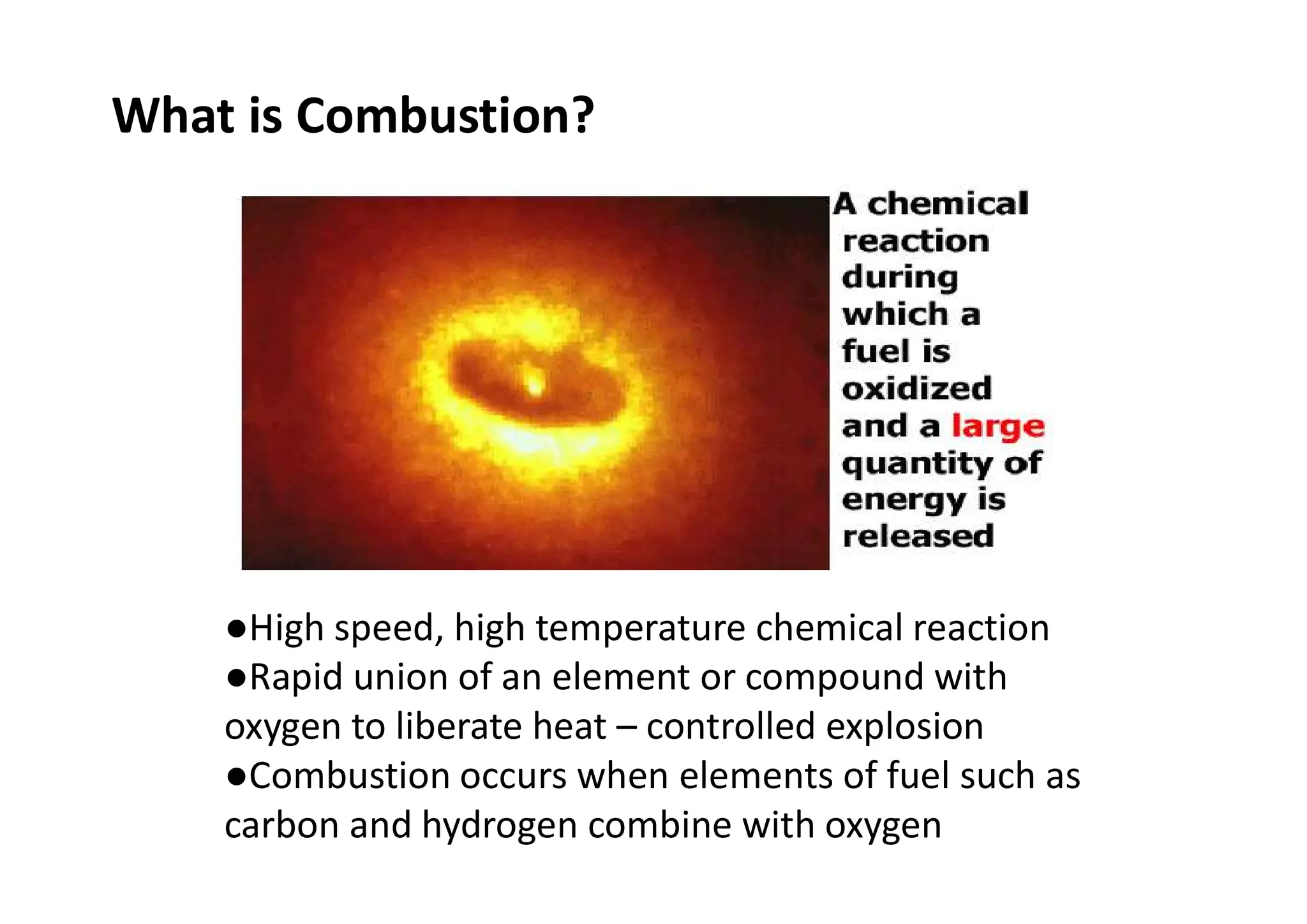
What is Combustion?
●High speed, high temperature chemical reaction
●Rapid union of an element or compound with
oxygen to liberate heat – controlled explosion
●Combustion occurs when elements of fuel such as
carbon and hydrogen combine with oxygen
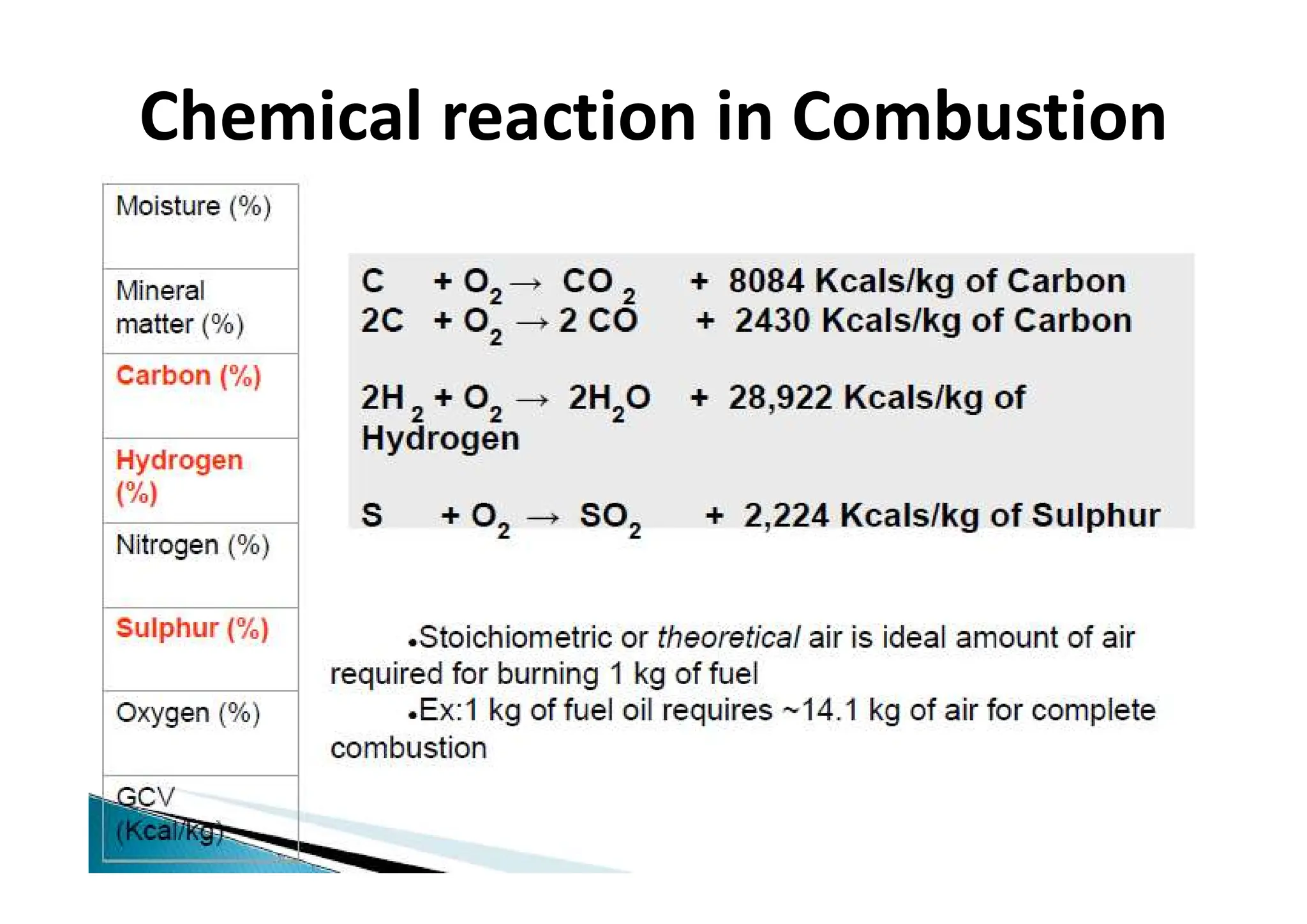
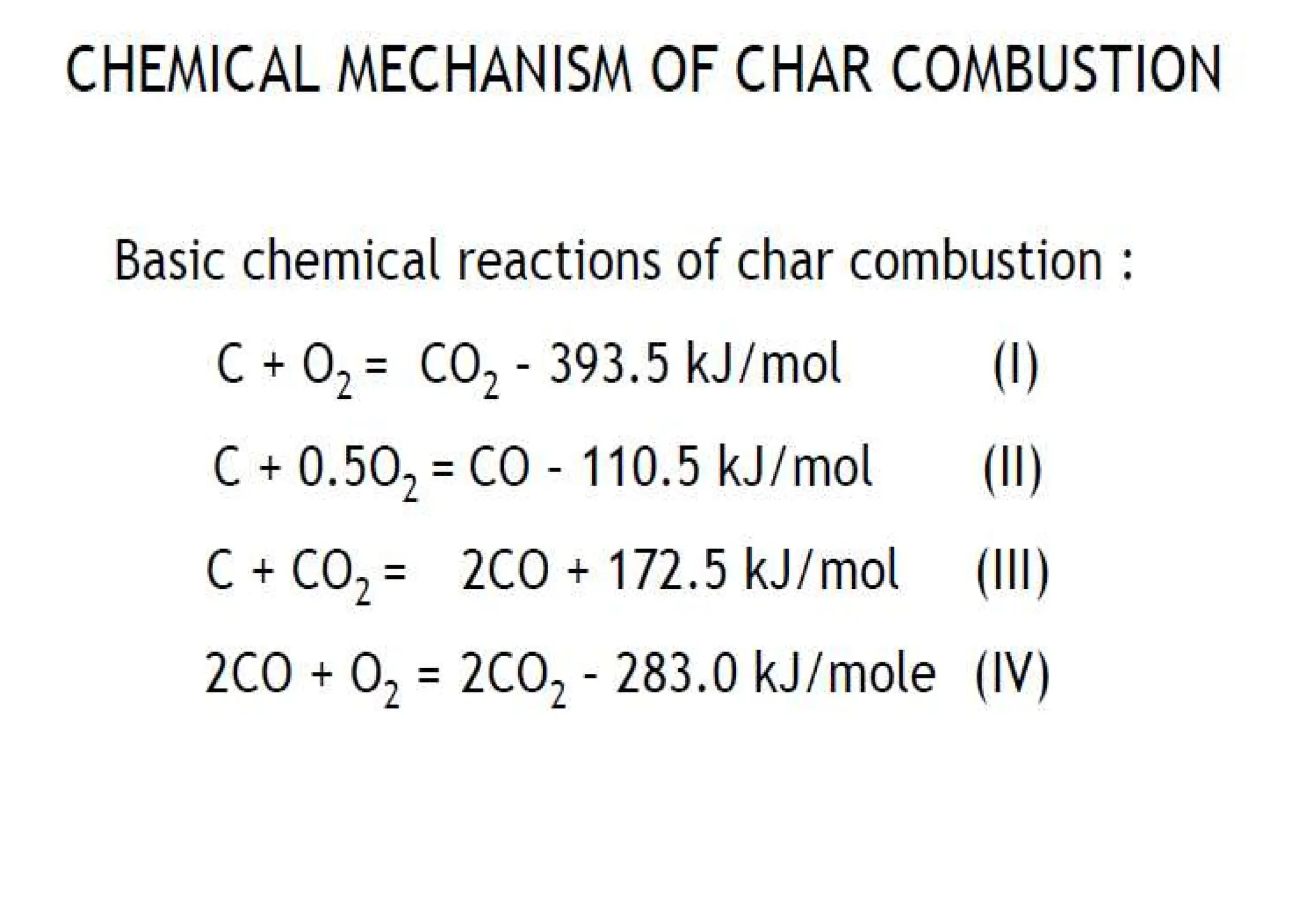
Chemical reaction in Combustion
3 Ts of Combustion
TEMPERATURE
• Temperature must be more than ignition temperature
TURBULENCE
• Proper turbulence helps in bringing the fuel and air in
intimate contact
• and gives them enough time to complete reaction.
TIME
• All combustion requires sufficient Time which depends
upon type of Reaction
3 Ts of Combustion contd….
• Ignition Time and Residence Time-Furnace
volume to be large enough to give the mixture
time for complete combustion.
• Ignition Temperature- Fuel-Air Mixture
maintained at or above the Ignition
Temperature
• Oxygen and Fuel thoroughly mixed.
What are the three types of combustion?
• Perfect Combustion is achieved when all the fuel is burned
using only the theoretical amount of air, but perfect
combustion cannot be achieved in a boiler.
• Good / Complete Combustion is achieved when all the fuel is
burned using the minimal amount of air above the theoretical
amount of air needed to burn the fuel.
• Complete combustion is always our goal. With complete
combustion, the fuel is burned at the highest combustion
efficiency with low pollution.
• Incomplete Combustion occurs when all the fuel is not
burned, which results in the formation of soot and smoke.
Combustion of C in air
Inefficient Combustion
Calculation of Stoichiometric Air
12 kg of carbon requires 32 kg of oxygen to form 44 kg of
carbon dioxide
Therefore1 kg of carbon requires 32/12 kg i.e 2.67 kg of
oxygen
Constituents of Fuel
Calculation of oxygen required for C
Calculation of Oxygen required for H
4 kg of hydrogen requires 32 kg of oxygen to form 36 kg of water,
therefore 1 kg of hydrogen requires 32/4 kg i.e 8 kg of oxygen
32 kg of sulphur requires 32 kg of oxygen to form 64 kg of SO2,
therefore 1 kg of sulphur requires 32/32 kg i.e 1 kg of oxygen
Calculation of O2 for Sulfur
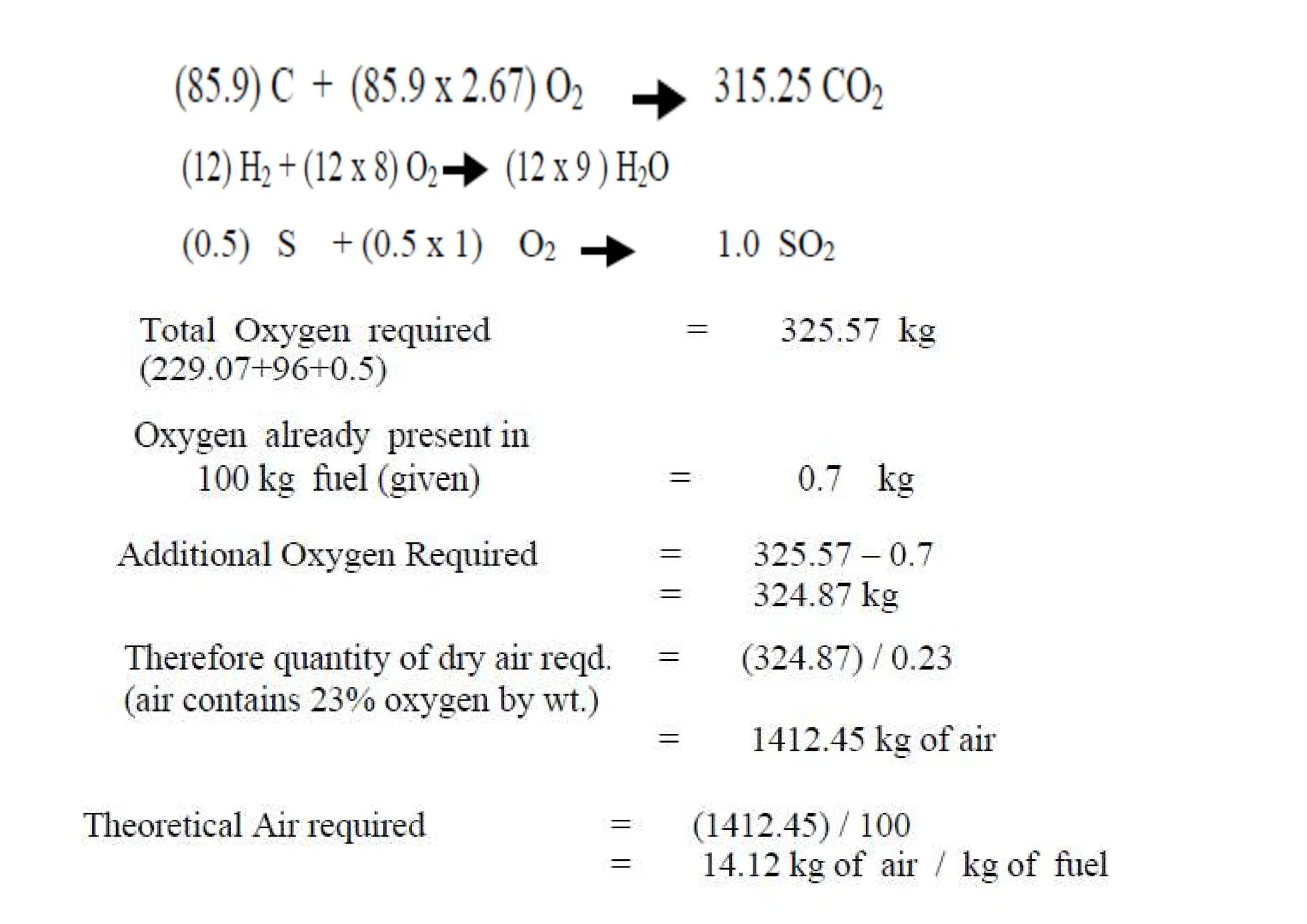
• Now lets consider a fuel with the following
characteristics:
Optimizing Excess Air and Combustion
• Theoretical air gives the amount of air required for complete
combustion of every one kg of fuel.
• In practice, mixing is never perfect, a certain amount of excess
air is needed to complete combustion and ensure that release
of the entire heat contained in fuel.
• If too much air than what is required for completing combustion
were allowed to enter, additional heat would be lost in heating
the surplus air to the chimney temperature. This would result in
increased stack losses.
• Less air would lead to the incomplete combustion and smoke.
Hence, there is an optimum excess air level for each type of
fuel.
• Hence, there is an optimum excess air level for each type of
fuel.
Control of Air and Analysis of Flue Gas
• In actual practice, the amount of combustion air
required will be much higher than optimally
needed.
• Therefore some of the air gets heated in the
furnace boiler and leaves through the stack
• The combustion efficiency increases with
increased excess air - until the heat loss in the
excess air is larger than the heat provided by
more efficient combustion
• For optimum combustion of fuel, the CO2 or O2 in
flue gases should be maintained at 14 -15%
participating in the combustion.
OPTIMIZATION OF EXCESS AIR
Unburnt Gas
Loss
C.V. Liberated in
Furnace
Unburnt Carbon
in Ash
% of Excess Air
CO2, O2, N2,
H2O, CO, CH4(15
%)
75 %
10 %
0 %
CO2, O2, N2, H2,
CO(1 %)
97 %
2 %
15 %
CO2, O2, N2
99.5 %
0.5 %
100 %
The following table compares the % of excess air with unburnt C
in ash , heat liberated and unburnt gas loss
• Third process is unsatisfactory for extra fan power and
convey huge amount of heat
IMPACTS OF POOR COMBUSTION
Reasons for improper combustion
• Significant quantities of air in-leakage or “tramp”
air into the furnace
• Improper turbulence
• Improper fuel sizing
• Inadequate fuel flows
• Inadequate fuel velocities
• Improper temperatures
• Consequences: significant loss of boiler efficiency,
caused by high furnace exit gas temperatures.
CO2 sensing as combustion control
• CO2 - is a combustion product and the content
of CO2 in a flue gas is an important indication
of the combustion efficiency.
• Rate of change of CO2is rather small at the
point of optimum excess air.
• In fact, the CO2 curve is at its maximum point
when the combustion process is optimized.
• CO2 is not a very sensitive measurement.
Carbon dioxide
Excess Air and Combustion Products –
The Empirical Relationship
How to assess healthiness of fuel burning
-Measurements
Measurements
• Excess Oxygen only : For substoichiometric burning the extent of
incomplete burning cannot be measured.
• Carbon Dioxide only : It cannot indicate to which side of
stoichiometric, combustion is taking place
• Carbon monoxide only : For superstoichiometric burning, extent
of excess air cannot be assessed.
• Oxygen and Carbondioxide: It covers entire range of combustion,
but the extent of incomplete combustion cannot be measured.
• Oxygen and Carbon monoxide: It covers entire range of
combustion, and also the extent of incomplete combustion can be
measured and hence is most favorable combination.
BOILER LOSSES
• Dry gas loss: sensible heat carried out of the stack [ 5-6%]
• Moisture loss: loss due to vaporizing the moisture in the fuel [2%]
• Incomplete combustion loss: loss due to combustion of carbon
that results in carbon monoxide (CO), instead of, carbon dioxide
(CO2) [0.2-0.5%]
• Hydrogen Loss: Hydrogen in the fuel converts to H2O [4%]
• Unburned carbon loss: loss due to carbon that does not get
combusted and ends up in the refuse (ash) [1%]
• Moisture in the combustion air loss: loss due to heating up water
vapor contained in the combustion air [0.2-0.25%]
• Radiation loss: heat lost from the external furnace walls to the
surrounding air [1%]
• Total losses [13-15%]
Losses During Coal Combustion
There are mainly three losses occurred during
coal combustion:
• 1.Unburnt gas loss
• 2.Dry flue gas loss
• 3.Combustible in ash loss.
Unburnt Gas Loss
• The unburnt gas loss is mainly the result of
burning carbon to carbon monoxide instead of
carbon dioxide.
• It is seen that heat release in CO reaction is
one third of that in CO2 reaction.
• So adequate supply of oxygen or excess air will
quickly reduce this loss to zero.
• Dry Flue Gas Loss
• A further loss of heat is that due to dry flue
gas. It is often referred to as the stack loss.
• If more excess air is admitted, this loss
increases.
• For bituminous coal 15.5 % excess air is
optimum requirement for Coal Combustion.
• Combustible in Ash Loss
• This loss is very high when there is little or no excess
air because mixing of combustible material and oxygen
is so poor.
• As the air quantity is increased, the loss falls rapidly.
However it does not reach to "zero" because the loss
depends upon two factors firstly on air - coal mixture
and secondly on fineness of pulverized coal grain.
• More fine grain of pulverized coal helps to complete
combustion more perfectly and resulting less
combustible in ash loss.
• In practice, though, a stage is reached where it is not
worth grinding the coal any finer because it will cost
more to grind than the extra heat release. Practically
the loss does not reach to zero.
coal combustion ,combustion equations.pdf

coal combustion ,combustion equations.pdf

  • 1.
  • 2.
    What is Combustion? ●Highspeed, high temperature chemical reaction ●Rapid union of an element or compound with oxygen to liberate heat – controlled explosion ●Combustion occurs when elements of fuel such as carbon and hydrogen combine with oxygen
  • 3.
  • 4.
    3 Ts ofCombustion TEMPERATURE • Temperature must be more than ignition temperature TURBULENCE • Proper turbulence helps in bringing the fuel and air in intimate contact • and gives them enough time to complete reaction. TIME • All combustion requires sufficient Time which depends upon type of Reaction
  • 5.
    3 Ts ofCombustion contd…. • Ignition Time and Residence Time-Furnace volume to be large enough to give the mixture time for complete combustion. • Ignition Temperature- Fuel-Air Mixture maintained at or above the Ignition Temperature • Oxygen and Fuel thoroughly mixed.
  • 6.
    What are thethree types of combustion? • Perfect Combustion is achieved when all the fuel is burned using only the theoretical amount of air, but perfect combustion cannot be achieved in a boiler. • Good / Complete Combustion is achieved when all the fuel is burned using the minimal amount of air above the theoretical amount of air needed to burn the fuel. • Complete combustion is always our goal. With complete combustion, the fuel is burned at the highest combustion efficiency with low pollution. • Incomplete Combustion occurs when all the fuel is not burned, which results in the formation of soot and smoke.
  • 8.
  • 9.
  • 10.
    Calculation of StoichiometricAir 12 kg of carbon requires 32 kg of oxygen to form 44 kg of carbon dioxide Therefore1 kg of carbon requires 32/12 kg i.e 2.67 kg of oxygen Constituents of Fuel Calculation of oxygen required for C
  • 11.
    Calculation of Oxygenrequired for H 4 kg of hydrogen requires 32 kg of oxygen to form 36 kg of water, therefore 1 kg of hydrogen requires 32/4 kg i.e 8 kg of oxygen 32 kg of sulphur requires 32 kg of oxygen to form 64 kg of SO2, therefore 1 kg of sulphur requires 32/32 kg i.e 1 kg of oxygen Calculation of O2 for Sulfur
  • 12.
    • Now letsconsider a fuel with the following characteristics:
  • 14.
    Optimizing Excess Airand Combustion • Theoretical air gives the amount of air required for complete combustion of every one kg of fuel. • In practice, mixing is never perfect, a certain amount of excess air is needed to complete combustion and ensure that release of the entire heat contained in fuel. • If too much air than what is required for completing combustion were allowed to enter, additional heat would be lost in heating the surplus air to the chimney temperature. This would result in increased stack losses. • Less air would lead to the incomplete combustion and smoke. Hence, there is an optimum excess air level for each type of fuel. • Hence, there is an optimum excess air level for each type of fuel.
  • 15.
    Control of Airand Analysis of Flue Gas • In actual practice, the amount of combustion air required will be much higher than optimally needed. • Therefore some of the air gets heated in the furnace boiler and leaves through the stack • The combustion efficiency increases with increased excess air - until the heat loss in the excess air is larger than the heat provided by more efficient combustion • For optimum combustion of fuel, the CO2 or O2 in flue gases should be maintained at 14 -15% participating in the combustion.
  • 16.
  • 18.
    Unburnt Gas Loss C.V. Liberatedin Furnace Unburnt Carbon in Ash % of Excess Air CO2, O2, N2, H2O, CO, CH4(15 %) 75 % 10 % 0 % CO2, O2, N2, H2, CO(1 %) 97 % 2 % 15 % CO2, O2, N2 99.5 % 0.5 % 100 % The following table compares the % of excess air with unburnt C in ash , heat liberated and unburnt gas loss • Third process is unsatisfactory for extra fan power and convey huge amount of heat
  • 19.
    IMPACTS OF POORCOMBUSTION
  • 20.
    Reasons for impropercombustion • Significant quantities of air in-leakage or “tramp” air into the furnace • Improper turbulence • Improper fuel sizing • Inadequate fuel flows • Inadequate fuel velocities • Improper temperatures • Consequences: significant loss of boiler efficiency, caused by high furnace exit gas temperatures.
  • 21.
    CO2 sensing ascombustion control • CO2 - is a combustion product and the content of CO2 in a flue gas is an important indication of the combustion efficiency. • Rate of change of CO2is rather small at the point of optimum excess air. • In fact, the CO2 curve is at its maximum point when the combustion process is optimized. • CO2 is not a very sensitive measurement.
  • 22.
  • 23.
    Excess Air andCombustion Products – The Empirical Relationship
  • 24.
    How to assesshealthiness of fuel burning -Measurements Measurements • Excess Oxygen only : For substoichiometric burning the extent of incomplete burning cannot be measured. • Carbon Dioxide only : It cannot indicate to which side of stoichiometric, combustion is taking place • Carbon monoxide only : For superstoichiometric burning, extent of excess air cannot be assessed. • Oxygen and Carbondioxide: It covers entire range of combustion, but the extent of incomplete combustion cannot be measured. • Oxygen and Carbon monoxide: It covers entire range of combustion, and also the extent of incomplete combustion can be measured and hence is most favorable combination.
  • 31.
    BOILER LOSSES • Drygas loss: sensible heat carried out of the stack [ 5-6%] • Moisture loss: loss due to vaporizing the moisture in the fuel [2%] • Incomplete combustion loss: loss due to combustion of carbon that results in carbon monoxide (CO), instead of, carbon dioxide (CO2) [0.2-0.5%] • Hydrogen Loss: Hydrogen in the fuel converts to H2O [4%] • Unburned carbon loss: loss due to carbon that does not get combusted and ends up in the refuse (ash) [1%] • Moisture in the combustion air loss: loss due to heating up water vapor contained in the combustion air [0.2-0.25%] • Radiation loss: heat lost from the external furnace walls to the surrounding air [1%] • Total losses [13-15%]
  • 32.
    Losses During CoalCombustion There are mainly three losses occurred during coal combustion: • 1.Unburnt gas loss • 2.Dry flue gas loss • 3.Combustible in ash loss.
  • 33.
    Unburnt Gas Loss •The unburnt gas loss is mainly the result of burning carbon to carbon monoxide instead of carbon dioxide. • It is seen that heat release in CO reaction is one third of that in CO2 reaction. • So adequate supply of oxygen or excess air will quickly reduce this loss to zero.
  • 34.
    • Dry FlueGas Loss • A further loss of heat is that due to dry flue gas. It is often referred to as the stack loss. • If more excess air is admitted, this loss increases. • For bituminous coal 15.5 % excess air is optimum requirement for Coal Combustion.
  • 35.
    • Combustible inAsh Loss • This loss is very high when there is little or no excess air because mixing of combustible material and oxygen is so poor. • As the air quantity is increased, the loss falls rapidly. However it does not reach to "zero" because the loss depends upon two factors firstly on air - coal mixture and secondly on fineness of pulverized coal grain. • More fine grain of pulverized coal helps to complete combustion more perfectly and resulting less combustible in ash loss. • In practice, though, a stage is reached where it is not worth grinding the coal any finer because it will cost more to grind than the extra heat release. Practically the loss does not reach to zero.