C & H - Heating
Process heating :New Technology .
R. S. Jha
C & H - Heating
Key drivers for the innovation.
• Efficiency
• Emission
• Reduction in carbon foot print
• Compactness
• Life cycle cost
• Serviceability & maintainability
C & H - Heating
Fossil fuel : Combustion technology
• Classification of combustion technology-
*Grate combustion
- Stationary grate
- Travelling grate
- Reciprocating grate
*Fluidised bed combustion
*Dust combustion
C & H - Heating
Biomass : An alternative fuel
• Challenges in biomass combustion-
*Fuel with low density, higher moisture level and
low calorific value- difficulty in handling.
*Inconsistent supply of fuel & seasonal variation
in fuel properties – Boiler should be designed
with fuel flexibility
*Higher level of emission
*Slagging & fouling
• Need of an appropriate combustion technology
C & H - Heating
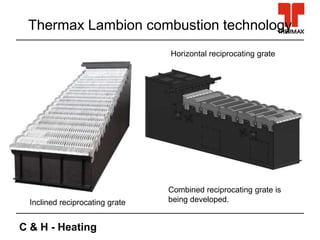
Thermax Lambion combustion technology
Inclined reciprocating grate
Horizontal reciprocating grate
Combined reciprocating grate is
being developed.
C & H - Heating
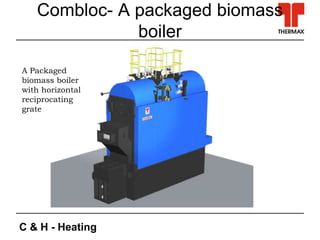
Combloc- A packaged biomass
boiler
A Packaged
biomass boiler
with horizontal
reciprocating
grate
C & H - Heating
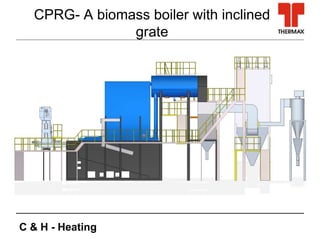
CPRG- A biomass boiler with inclined
grate
C & H - Heating
Future of combustion technology
• Gasification
• Oxyfuel combustion
• Unmixed combustion
• Chemical looping combustion
C & H - Heating
Development in the boiler design
• Boiler development- Size, fuel flexibility,
emission & efficiency
• Development in combustion technology
• Heat transfer enhancement- Tube inserts
& special tubes
C & H - Heating
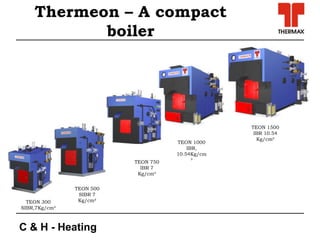
TEON 300
SIBR,7Kg/cm²
TEON 500
SIBR 7
Kg/cm²
TEON 750
IBR 7
Kg/cm²
TEON 1000
IBR,
10.54Kg/cm
²
TEON 1500
IBR 10.54
Kg/cm²
Thermeon – A compact
boiler
C & H - Heating
Fluegas heat recovery
• Conventional heat recovery technology
*Feed water preheating
*Combustion air preheating
• Challenges
*Economics of heat recovery
*Low end corrosion
C & H - Heating
Need for condensing technology.
• Flue gas still contains approximately 6-8 % heat of the net calorific value of the fuel.
• Natural gas has a significant portion of hydrogen, which gets converted in to water
vapour after the combustion. In the process of combustion, a significant portion of the
heat is lost to provide the required latent heat for the evaporation of water. If we
consider this heat, approximately 15-17 % heat is still left with the flue gas. This can
be easily explained by noting the difference of efficiency on the basis of GCV and
NCV. Even with conventional heat recovery system, the efficiency on the basis of
GCV is in the range of 83-85 %.
• If the condensation of water vapour of the flue gas is allowed, flue gas temperature
can be further reduced to maximise the boiler efficiency.
• This opens a significant opportunity for the flue gas heat recovery, as the latent heat
of condensation is recovered in the process of condensation. If the sufficient heat
sink is available and system is optimally designed, approximately 10-12 % heat can
be recovered higher than the sensible heat left with the flue gas (6-8 % of the NCV).
• If we consider efficiency on the basis of NCV, the efficiency of boiler can go beyond
100%. Using condensing technology, The latent heat of water vapour is received
back, which was considered as lost in the definition of Net calorific value.
C & H - Heating
Challenges :Condensing technology.
• Criticality of material selection- Material selection is very
critical for the design and selection of the condensing
heat exchanger. The suitable material should be anti
corrosive to deal with acidic condensate. Material should
have higher thermal conductivity and non sticky.
• Chimney corrosion- Other challenge of the condensing
heat exchanger design is the problem of chimney
corrosion.
• Higher cost- Due to poor heat transfer performance and
the special metallurgy, the cost of condensing exchanger
system is normally high.
C & H - Heating
Efficient method of steam utilisation
• Focus on system efficiency- Closed loop
system & open loop system
• Combined heat & power
• Process integration
C & H - Heating
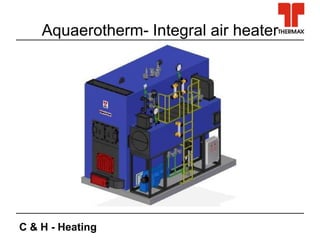
Aquaerotherm- Integral air heater
C & H - Heating
Use of computational
technology for new
development
C & H - Heating
CFD- Computational fluid dynamics
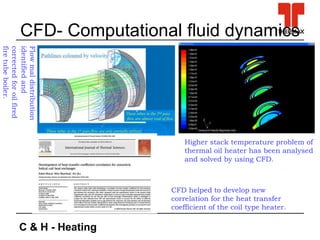
Higher stack temperature problem of
thermal oil heater has been analysed
and solved by using CFD.
Flowmaldistribution
identifiedand
correctedforoilfired
firetubeboiler.
CFD helped to develop new
correlation for the heat transfer
coefficient of the coil type heater.
C & H - Heating
FEA- Finite element analysis.
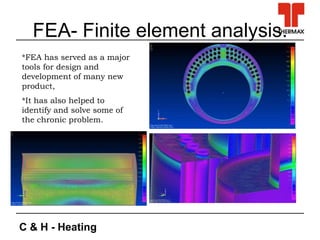
*FEA has served as a major
tools for design and
development of many new
product,
*It has also helped to
identify and solve some of
the chronic problem.
C & H - Heating
Innovation cont…

New Technologies in Process Heating

  • 1.
    C & H- Heating Process heating :New Technology . R. S. Jha
  • 2.
    C & H- Heating Key drivers for the innovation. • Efficiency • Emission • Reduction in carbon foot print • Compactness • Life cycle cost • Serviceability & maintainability
  • 3.
    C & H- Heating Fossil fuel : Combustion technology • Classification of combustion technology- *Grate combustion - Stationary grate - Travelling grate - Reciprocating grate *Fluidised bed combustion *Dust combustion
  • 4.
    C & H- Heating Biomass : An alternative fuel • Challenges in biomass combustion- *Fuel with low density, higher moisture level and low calorific value- difficulty in handling. *Inconsistent supply of fuel & seasonal variation in fuel properties – Boiler should be designed with fuel flexibility *Higher level of emission *Slagging & fouling • Need of an appropriate combustion technology
  • 5.
    C & H- Heating Thermax Lambion combustion technology Inclined reciprocating grate Horizontal reciprocating grate Combined reciprocating grate is being developed.
  • 6.
    C & H- Heating Combloc- A packaged biomass boiler A Packaged biomass boiler with horizontal reciprocating grate
  • 7.
    C & H- Heating CPRG- A biomass boiler with inclined grate
  • 8.
    C & H- Heating Future of combustion technology • Gasification • Oxyfuel combustion • Unmixed combustion • Chemical looping combustion
  • 9.
    C & H- Heating Development in the boiler design • Boiler development- Size, fuel flexibility, emission & efficiency • Development in combustion technology • Heat transfer enhancement- Tube inserts & special tubes
  • 10.
    C & H- Heating TEON 300 SIBR,7Kg/cm² TEON 500 SIBR 7 Kg/cm² TEON 750 IBR 7 Kg/cm² TEON 1000 IBR, 10.54Kg/cm ² TEON 1500 IBR 10.54 Kg/cm² Thermeon – A compact boiler
  • 11.
    C & H- Heating Fluegas heat recovery • Conventional heat recovery technology *Feed water preheating *Combustion air preheating • Challenges *Economics of heat recovery *Low end corrosion
  • 12.
    C & H- Heating Need for condensing technology. • Flue gas still contains approximately 6-8 % heat of the net calorific value of the fuel. • Natural gas has a significant portion of hydrogen, which gets converted in to water vapour after the combustion. In the process of combustion, a significant portion of the heat is lost to provide the required latent heat for the evaporation of water. If we consider this heat, approximately 15-17 % heat is still left with the flue gas. This can be easily explained by noting the difference of efficiency on the basis of GCV and NCV. Even with conventional heat recovery system, the efficiency on the basis of GCV is in the range of 83-85 %. • If the condensation of water vapour of the flue gas is allowed, flue gas temperature can be further reduced to maximise the boiler efficiency. • This opens a significant opportunity for the flue gas heat recovery, as the latent heat of condensation is recovered in the process of condensation. If the sufficient heat sink is available and system is optimally designed, approximately 10-12 % heat can be recovered higher than the sensible heat left with the flue gas (6-8 % of the NCV). • If we consider efficiency on the basis of NCV, the efficiency of boiler can go beyond 100%. Using condensing technology, The latent heat of water vapour is received back, which was considered as lost in the definition of Net calorific value.
  • 13.
    C & H- Heating Challenges :Condensing technology. • Criticality of material selection- Material selection is very critical for the design and selection of the condensing heat exchanger. The suitable material should be anti corrosive to deal with acidic condensate. Material should have higher thermal conductivity and non sticky. • Chimney corrosion- Other challenge of the condensing heat exchanger design is the problem of chimney corrosion. • Higher cost- Due to poor heat transfer performance and the special metallurgy, the cost of condensing exchanger system is normally high.
  • 14.
    C & H- Heating Efficient method of steam utilisation • Focus on system efficiency- Closed loop system & open loop system • Combined heat & power • Process integration
  • 15.
    C & H- Heating Aquaerotherm- Integral air heater
  • 16.
    C & H- Heating Use of computational technology for new development
  • 17.
    C & H- Heating CFD- Computational fluid dynamics Higher stack temperature problem of thermal oil heater has been analysed and solved by using CFD. Flowmaldistribution identifiedand correctedforoilfired firetubeboiler. CFD helped to develop new correlation for the heat transfer coefficient of the coil type heater.
  • 18.
    C & H- Heating FEA- Finite element analysis. *FEA has served as a major tools for design and development of many new product, *It has also helped to identify and solve some of the chronic problem.
  • 19.
    C & H- Heating Innovation cont…