
AIS-038(Rev. 1)
• SCOPE
• DEFINITIONS
• SPECIFICATIONS AND TESTS
• TECHNICAL PROVISIONS
Electric Power Train Vehicles-
Constructional and Functional
Safety
SCOPE
• Specifies the construction and functional safety requirements for L, M
and N categories of the electric power train vehicles as defined in rule
2(u) of CMVR ( Central Motor Vehicle Rules).
Vehicle
Category
L Category M Category N Category
Wheels < 4 ≥ 4 ≥ 4
Application Passenger &
Loads
Passenger Loads
SPECIFICATIONS AND TESTS
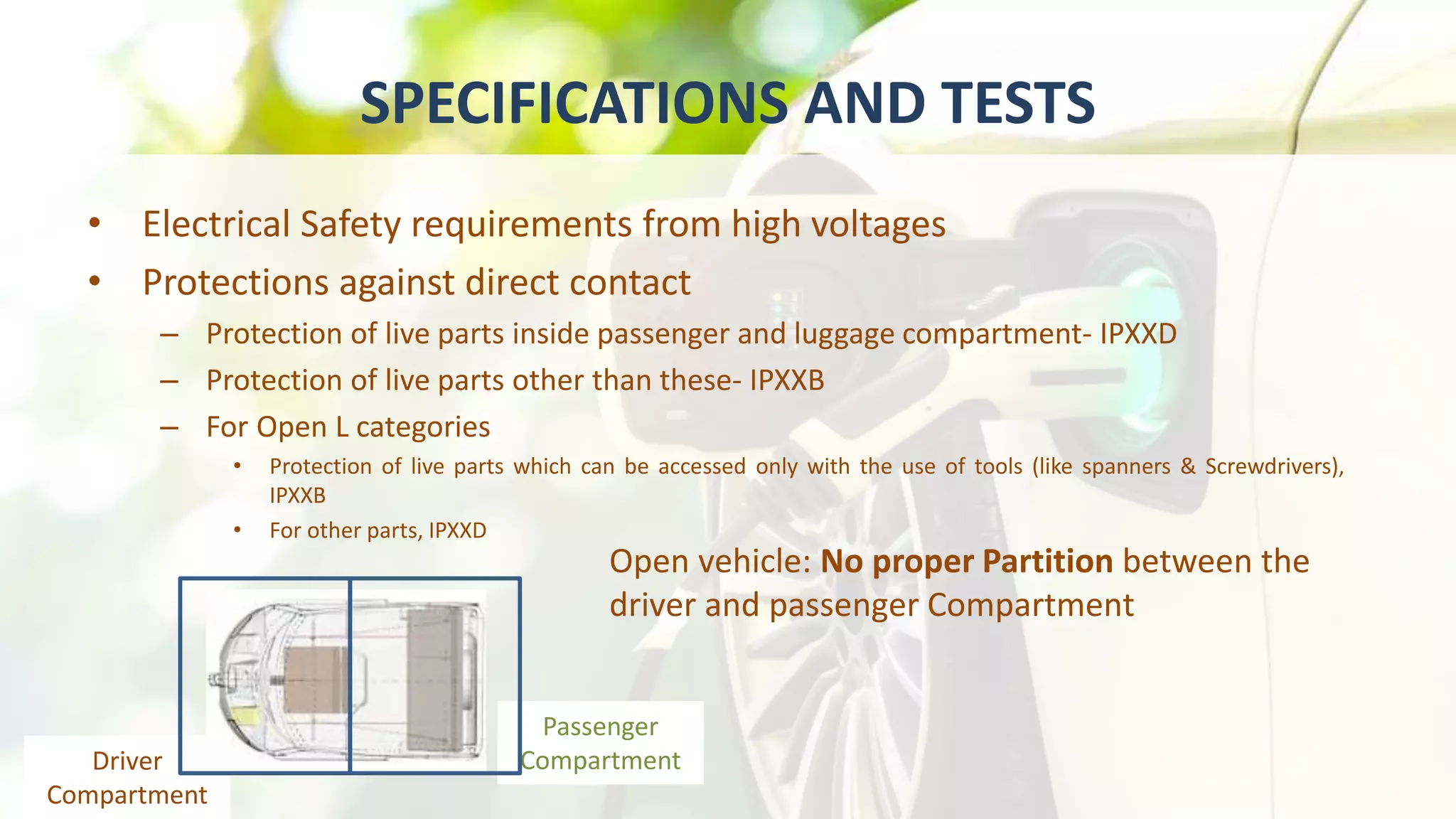
• Electrical Safety requirements from high voltages
• Protections against direct contact
– Protection of live parts inside passenger and luggage compartment- IPXXD
– Protection of live parts other than these- IPXXB
– For Open L categories
• Protection of live parts which can be accessed only with the use of tools (like spanners & Screwdrivers),
IPXXB
• For other parts, IPXXD
Open vehicle: No proper Partition between the
driver and passenger Compartment
Passenger
CompartmentDriver
Compartment
SPECIFICATIONS AND TESTS
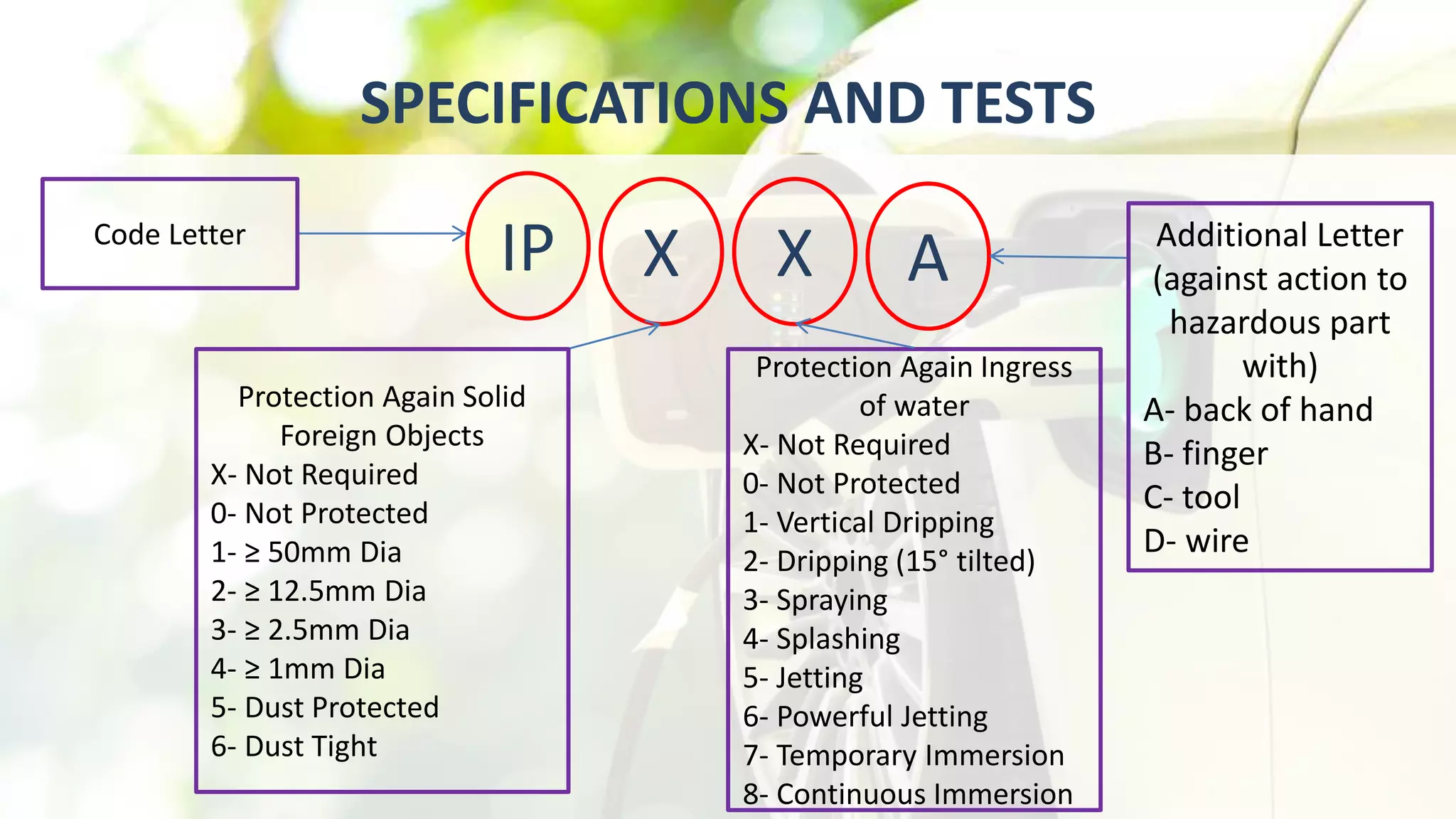
Code Letter
IP X X A
Protection Again Solid
Foreign Objects
X- Not Required
0- Not Protected
1- ≥ 50mm Dia
2- ≥ 12.5mm Dia
3- ≥ 2.5mm Dia
4- ≥ 1mm Dia
5- Dust Protected
6- Dust Tight
Additional Letter
(against action to
hazardous part
with)
A- back of hand
B- finger
C- tool
D- wire
Protection Again Ingress
of water
X- Not Required
0- Not Protected
1- Vertical Dripping
2- Dripping (15° tilted)
3- Spraying
4- Splashing
5- Jetting
6- Powerful Jetting
7- Temporary Immersion
8- Continuous Immersion
SPECIFICATIONS AND TESTS
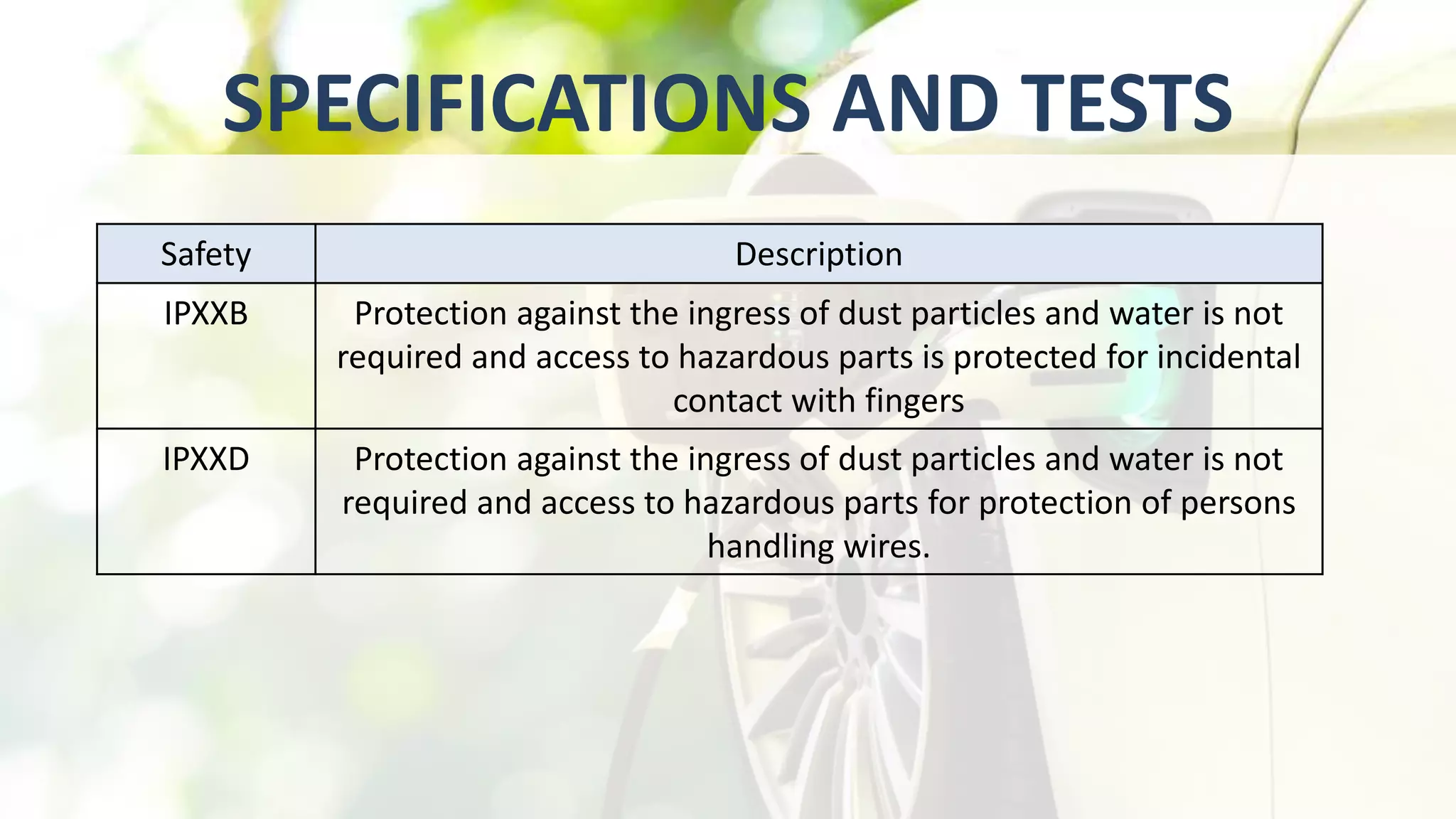
Safety Description
IPXXB Protection against the ingress of dust particles and water is not
required and access to hazardous parts is protected for incidental
contact with fingers
IPXXD Protection against the ingress of dust particles and water is not
required and access to hazardous parts for protection of persons
handling wires.
PROTECTION AGAINST INDIRECT CONTACTS
• All exposed conductive parts, such as any conductive barrier and
enclosure shall be galvanically connected securely to the electrical
chassis by connection with the electrical wire or by any other process so
that no harmful potential is produced.
• The resistance between all exposed parts and the electrical chassis shall
be lower than 0.1 Ω when there is a current of at least 0.2 A.
ISOLATION RESISTANCE
• Only valid for vehicles having any chassis connected to electrical circuit
where the maximum voltage at the live part and chassis does not exceed
30V AC (rms) or 60 V DC
• If AC high voltage buses and DC high voltage buses are galvanically
isolated from each other, isolation resistance between the high voltage
bus and the electrical chassis shall have a minimum value of 100 Ω/Volt
of the working temperature
RECHARGABLE ENERGY STORAGE SYSTEM (REESS)
• REESS Shall not Overheat.
• Should be provided with protective devices like fuses, Circuit Breakers or
main capacitors from protecting it against heating but over currents
• If any Hydrogen Gas is accumulated it should be ventilated by fan or duct
as Hydrogen is highly flammable.
CREEPING DISTANCE MEASUREMENTS
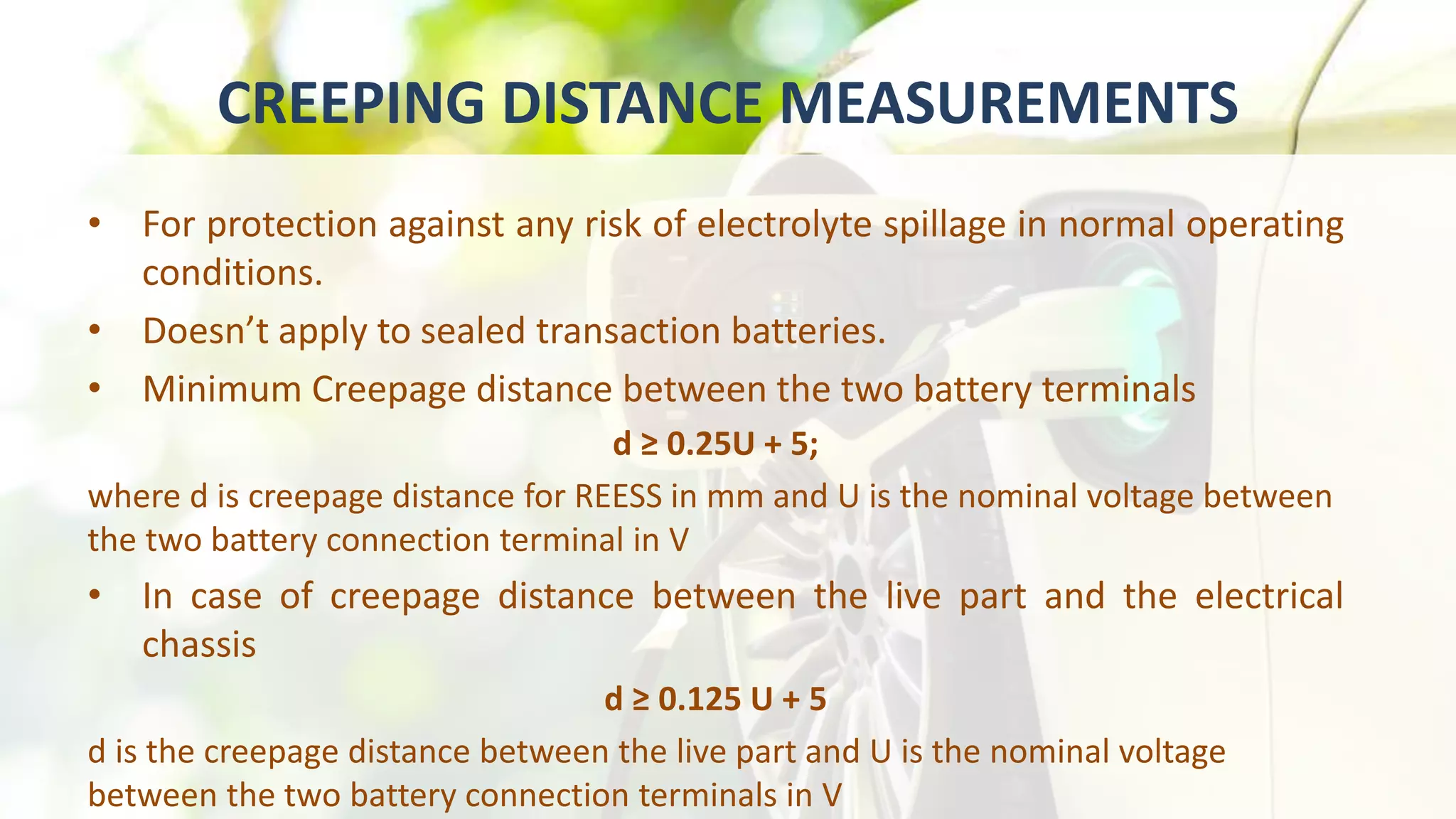
• For protection against any risk of electrolyte spillage in normal operating
conditions.
• Doesn’t apply to sealed transaction batteries.
• Minimum Creepage distance between the two battery terminals
d ≥ 0.25U + 5;
where d is creepage distance for REESS in mm and U is the nominal voltage between
the two battery connection terminal in V
• In case of creepage distance between the live part and the electrical
chassis
d ≥ 0.125 U + 5
d is the creepage distance between the live part and U is the nominal voltage
between the two battery connection terminals in V
HEAVY RAINSTORM
• The test uses nozzle according to IPX5 as specified in IEC 60529.
• Using fresh water at a flow rate 10 l/min, all surface with normally open
opening parts shall be exposed for 5 min, possibly through a regular
movement of spray nozzles.
TECHNICAL PROVISIONS
• The cable for high voltage which is located underneath the vehicle shall
be identified by having an outer covering with orange color.
PROTECTION AGAINST WATER EFFECTS
• After each exposure to water, the vehicle shall comply with at least 100
Ω/V of nominal voltage while the vehicle is wet.
WASHING
• This test is intended to simulate a normal washing on the Electric Power
Train Vehicles, but not specific cleaning using high water pressure or
underbody washing.
• The test uses nozzle according to IPX5 as specified in IEC 60529. Using
fresh water at a flow rate 12.5 l/min with a water stream speed rate of
0.1 m/s, keeping a distance of 3m between nozzle aperture and
borderline.
Ais 038(rev.1)

Ais 038(rev.1)

  • 1.
    AIS-038(Rev. 1) • SCOPE •DEFINITIONS • SPECIFICATIONS AND TESTS • TECHNICAL PROVISIONS Electric Power Train Vehicles- Constructional and Functional Safety
  • 2.
    SCOPE • Specifies theconstruction and functional safety requirements for L, M and N categories of the electric power train vehicles as defined in rule 2(u) of CMVR ( Central Motor Vehicle Rules). Vehicle Category L Category M Category N Category Wheels < 4 ≥ 4 ≥ 4 Application Passenger & Loads Passenger Loads
  • 3.
    SPECIFICATIONS AND TESTS •Electrical Safety requirements from high voltages • Protections against direct contact – Protection of live parts inside passenger and luggage compartment- IPXXD – Protection of live parts other than these- IPXXB – For Open L categories • Protection of live parts which can be accessed only with the use of tools (like spanners & Screwdrivers), IPXXB • For other parts, IPXXD Open vehicle: No proper Partition between the driver and passenger Compartment Passenger CompartmentDriver Compartment
  • 4.
    SPECIFICATIONS AND TESTS CodeLetter IP X X A Protection Again Solid Foreign Objects X- Not Required 0- Not Protected 1- ≥ 50mm Dia 2- ≥ 12.5mm Dia 3- ≥ 2.5mm Dia 4- ≥ 1mm Dia 5- Dust Protected 6- Dust Tight Additional Letter (against action to hazardous part with) A- back of hand B- finger C- tool D- wire Protection Again Ingress of water X- Not Required 0- Not Protected 1- Vertical Dripping 2- Dripping (15° tilted) 3- Spraying 4- Splashing 5- Jetting 6- Powerful Jetting 7- Temporary Immersion 8- Continuous Immersion
  • 5.
    SPECIFICATIONS AND TESTS SafetyDescription IPXXB Protection against the ingress of dust particles and water is not required and access to hazardous parts is protected for incidental contact with fingers IPXXD Protection against the ingress of dust particles and water is not required and access to hazardous parts for protection of persons handling wires.
  • 6.
    PROTECTION AGAINST INDIRECTCONTACTS • All exposed conductive parts, such as any conductive barrier and enclosure shall be galvanically connected securely to the electrical chassis by connection with the electrical wire or by any other process so that no harmful potential is produced. • The resistance between all exposed parts and the electrical chassis shall be lower than 0.1 Ω when there is a current of at least 0.2 A.
  • 7.
    ISOLATION RESISTANCE • Onlyvalid for vehicles having any chassis connected to electrical circuit where the maximum voltage at the live part and chassis does not exceed 30V AC (rms) or 60 V DC • If AC high voltage buses and DC high voltage buses are galvanically isolated from each other, isolation resistance between the high voltage bus and the electrical chassis shall have a minimum value of 100 Ω/Volt of the working temperature
  • 8.
    RECHARGABLE ENERGY STORAGESYSTEM (REESS) • REESS Shall not Overheat. • Should be provided with protective devices like fuses, Circuit Breakers or main capacitors from protecting it against heating but over currents • If any Hydrogen Gas is accumulated it should be ventilated by fan or duct as Hydrogen is highly flammable.
  • 9.
    CREEPING DISTANCE MEASUREMENTS •For protection against any risk of electrolyte spillage in normal operating conditions. • Doesn’t apply to sealed transaction batteries. • Minimum Creepage distance between the two battery terminals d ≥ 0.25U + 5; where d is creepage distance for REESS in mm and U is the nominal voltage between the two battery connection terminal in V • In case of creepage distance between the live part and the electrical chassis d ≥ 0.125 U + 5 d is the creepage distance between the live part and U is the nominal voltage between the two battery connection terminals in V
  • 10.
    HEAVY RAINSTORM • Thetest uses nozzle according to IPX5 as specified in IEC 60529. • Using fresh water at a flow rate 10 l/min, all surface with normally open opening parts shall be exposed for 5 min, possibly through a regular movement of spray nozzles. TECHNICAL PROVISIONS • The cable for high voltage which is located underneath the vehicle shall be identified by having an outer covering with orange color.
  • 11.
    PROTECTION AGAINST WATEREFFECTS • After each exposure to water, the vehicle shall comply with at least 100 Ω/V of nominal voltage while the vehicle is wet. WASHING • This test is intended to simulate a normal washing on the Electric Power Train Vehicles, but not specific cleaning using high water pressure or underbody washing. • The test uses nozzle according to IPX5 as specified in IEC 60529. Using fresh water at a flow rate 12.5 l/min with a water stream speed rate of 0.1 m/s, keeping a distance of 3m between nozzle aperture and borderline.