• Scope
• Test Conditions
• Test Procedure
• Bench Dynamometer
• Chassis Dynamometer
• Data to be recorded
• Accuracy of Measurement
• Determination of Net power
• Determination of 30 minutes power
• Test Results
 Representation of the curve as a function of motor speed and the power at full
load indicated by the vehicle/motor manufacturer for motors of the electrical
drive trains.
 Also the maximum 30 minutes power of the electric drive trains intended for
propulsion for L, M and N categories of the Electric Power train Vehicle is
recorded.
 The test for motor power may be conducted by testing the motor using a bench
dynamometer or by testing the vehicle using a chassis dynamometer as per
manufacturer’s option.
 If power measurement has been carried out on the motor alone with gear box or a
reducer mounted, then efficiency has to be taken into account.
 Bench Dynamometer Procedure
o Auxiliaries
No. Auxiliaries Fitted for net power
and maximum 30
minutes power test
1 DC Voltage Source Voltage drop during
test < 5%
2 Speed Variator and
control device
Yes: Standard
Production
equipment
3 Liquid cooling
►Motor bonnet
► Bonnet outlet
No
4 ►Radiator
►Fan
►Fan cowl
►Pump
►Thermostat
Yes: Standard
production
equipment
5 ►Air Cooling
►Air Filter
►Cowl Blower
►Temperature
adjustment system
Yes: Standard
production
equipment
6 Electric equipment Yes: Standard
production
equipment
7 Bench test auxiliary
fan
Yes, If Necessary
 The radiator, fan, fan cowl, water pump and thermostat shall be located on the test
bench in the same relative position as on the vehicle.
 The cooling-liquid circulation shall be activated by the motor liquid pump only
 The power absorbed by fan with radiator and cowl (if used), shall be determined at
the speeds used for measurement of motor power either by calculation from the
standard characteristics or by practical tests.
 All auxiliaries (like air conditioning systems, power steering compressor etc.) shall be
removed when performing the test.
 Where auxiliaries cannot be removes, the power they absorb in the unloaded
condition may be determined and added to the measured power.
 Chassis Dynamometer Procedure
 While testing on chassis dynamometer, it should be adjusted for cancelling the friction losses
from the running vehicle other than the electric power train and installed accessories.
 The power supply may be from REESS of the vehicle with voltage within the specified limits.
 If the power supply is from REESS, it shall be charged according to normal procedure for a
period not exceeding 12 hour.
 The net power determined from the test shall be carried out with speed
control setting at maximum position with full setting of the power controller
 Torque and speed data to be recorded simultaneously
 If cooling liquid is used the temperature recorded should be maintained at
±5°C of the thermostat setting specified by the manufacturer.
 If cooling liquid is used the temperature recorded should be maintained at ±5°C of
the thermostat setting specified by the manufacturer.
 If air cooling is used, the maximum temperature maintained should be ±20°C of the
maximum valuye supplied by the manufacturer
Parameter Accuracy Remarks
Torque ±1% of the measured
torque
Measurement system
must be calibrated to
take frictional losses
into account
Speed 0.5% of the measured
speed
Air inlet Temperature ± 2°C
Vehicle Speed ± 1 kmph
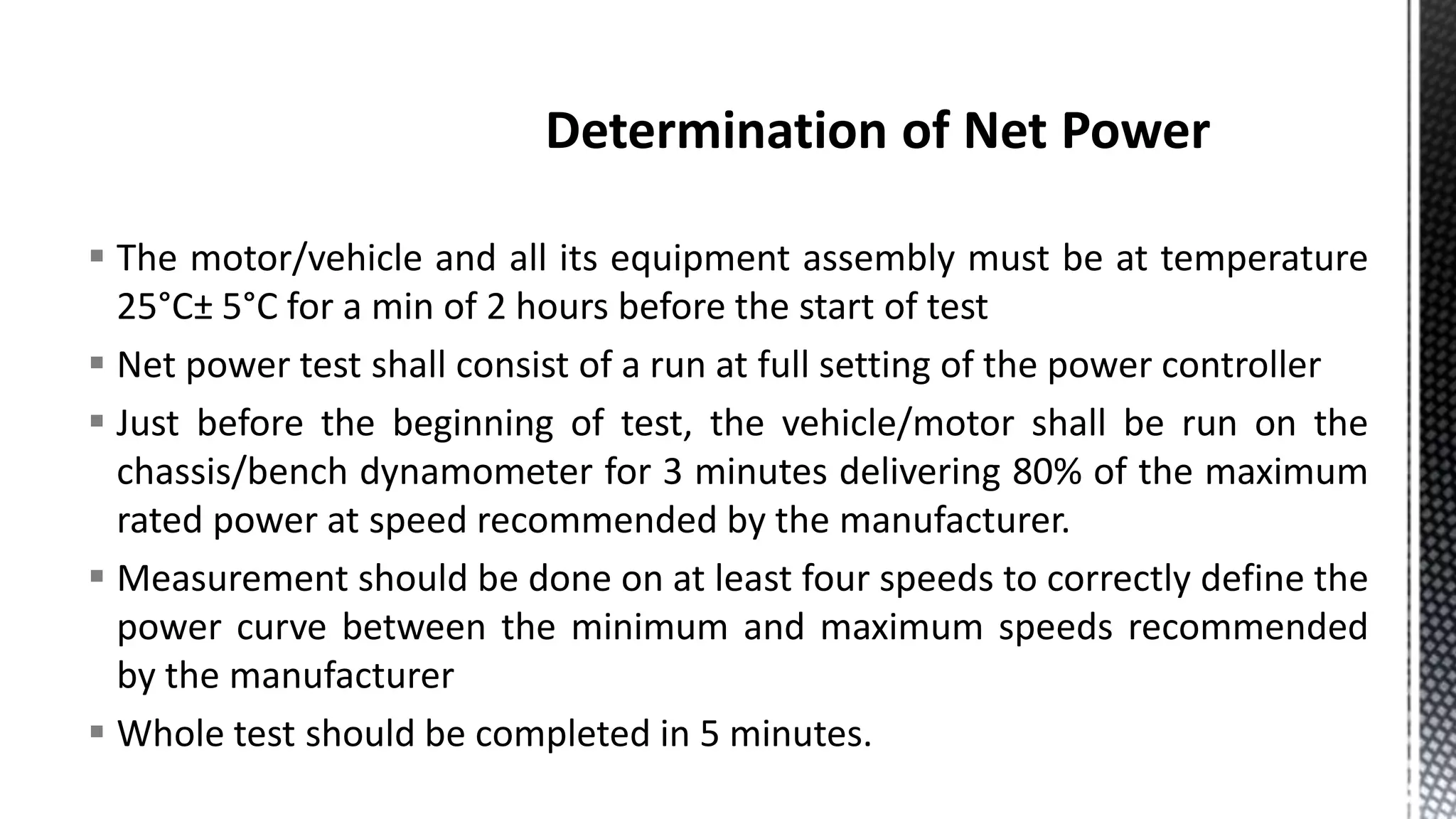
 The motor/vehicle and all its equipment assembly must be at temperature
25°C± 5°C for a min of 2 hours before the start of test
 Net power test shall consist of a run at full setting of the power controller
 Just before the beginning of test, the vehicle/motor shall be run on the
chassis/bench dynamometer for 3 minutes delivering 80% of the maximum
rated power at speed recommended by the manufacturer.
 Measurement should be done on at least four speeds to correctly define the
power curve between the minimum and maximum speeds recommended
by the manufacturer
 Whole test should be completed in 5 minutes.
 The motor/vehicle and all its equipment assembly must be at temperature
25°C± 5°C for a min of 4 hours before the start of test
 The vehicle/motor shall be run on the chassis/bench dynamometer for
maximum 30 minutes which is declared by manufacturer
 Speed is recommended to be in range at which net power is greater than
90% of the maximum power measured in the previous section.
 The power must be in the range of ±5% of the power value at the start of
test. 30 minutes power is the average power within 30 minutes period.
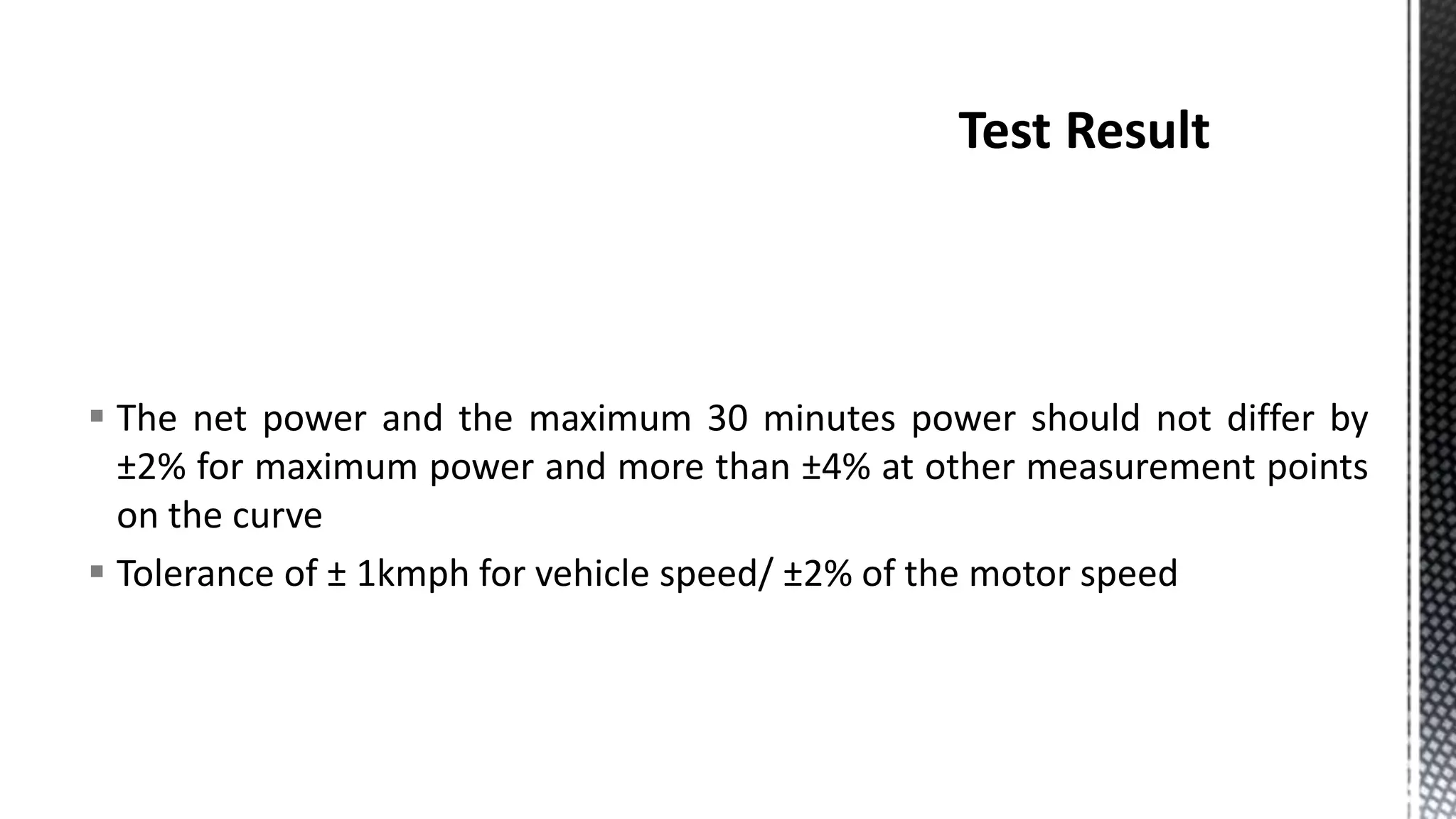
 The net power and the maximum 30 minutes power should not differ by
±2% for maximum power and more than ±4% at other measurement points
on the curve
 Tolerance of ± 1kmph for vehicle speed/ ±2% of the motor speed

Ais 041(rev.1)

  • 1.
    • Scope • TestConditions • Test Procedure • Bench Dynamometer • Chassis Dynamometer • Data to be recorded • Accuracy of Measurement • Determination of Net power • Determination of 30 minutes power • Test Results
  • 2.
     Representation ofthe curve as a function of motor speed and the power at full load indicated by the vehicle/motor manufacturer for motors of the electrical drive trains.  Also the maximum 30 minutes power of the electric drive trains intended for propulsion for L, M and N categories of the Electric Power train Vehicle is recorded.
  • 3.
     The testfor motor power may be conducted by testing the motor using a bench dynamometer or by testing the vehicle using a chassis dynamometer as per manufacturer’s option.  If power measurement has been carried out on the motor alone with gear box or a reducer mounted, then efficiency has to be taken into account.
  • 4.
     Bench DynamometerProcedure o Auxiliaries No. Auxiliaries Fitted for net power and maximum 30 minutes power test 1 DC Voltage Source Voltage drop during test < 5% 2 Speed Variator and control device Yes: Standard Production equipment 3 Liquid cooling ►Motor bonnet ► Bonnet outlet No 4 ►Radiator ►Fan ►Fan cowl ►Pump ►Thermostat Yes: Standard production equipment 5 ►Air Cooling ►Air Filter ►Cowl Blower ►Temperature adjustment system Yes: Standard production equipment 6 Electric equipment Yes: Standard production equipment 7 Bench test auxiliary fan Yes, If Necessary
  • 5.
     The radiator,fan, fan cowl, water pump and thermostat shall be located on the test bench in the same relative position as on the vehicle.  The cooling-liquid circulation shall be activated by the motor liquid pump only  The power absorbed by fan with radiator and cowl (if used), shall be determined at the speeds used for measurement of motor power either by calculation from the standard characteristics or by practical tests.  All auxiliaries (like air conditioning systems, power steering compressor etc.) shall be removed when performing the test.  Where auxiliaries cannot be removes, the power they absorb in the unloaded condition may be determined and added to the measured power.
  • 6.
     Chassis DynamometerProcedure  While testing on chassis dynamometer, it should be adjusted for cancelling the friction losses from the running vehicle other than the electric power train and installed accessories.  The power supply may be from REESS of the vehicle with voltage within the specified limits.  If the power supply is from REESS, it shall be charged according to normal procedure for a period not exceeding 12 hour.
  • 7.
     The netpower determined from the test shall be carried out with speed control setting at maximum position with full setting of the power controller  Torque and speed data to be recorded simultaneously  If cooling liquid is used the temperature recorded should be maintained at ±5°C of the thermostat setting specified by the manufacturer.  If cooling liquid is used the temperature recorded should be maintained at ±5°C of the thermostat setting specified by the manufacturer.  If air cooling is used, the maximum temperature maintained should be ±20°C of the maximum valuye supplied by the manufacturer
  • 8.
    Parameter Accuracy Remarks Torque±1% of the measured torque Measurement system must be calibrated to take frictional losses into account Speed 0.5% of the measured speed Air inlet Temperature ± 2°C Vehicle Speed ± 1 kmph
  • 9.
     The motor/vehicleand all its equipment assembly must be at temperature 25°C± 5°C for a min of 2 hours before the start of test  Net power test shall consist of a run at full setting of the power controller  Just before the beginning of test, the vehicle/motor shall be run on the chassis/bench dynamometer for 3 minutes delivering 80% of the maximum rated power at speed recommended by the manufacturer.  Measurement should be done on at least four speeds to correctly define the power curve between the minimum and maximum speeds recommended by the manufacturer  Whole test should be completed in 5 minutes.
  • 10.
     The motor/vehicleand all its equipment assembly must be at temperature 25°C± 5°C for a min of 4 hours before the start of test  The vehicle/motor shall be run on the chassis/bench dynamometer for maximum 30 minutes which is declared by manufacturer  Speed is recommended to be in range at which net power is greater than 90% of the maximum power measured in the previous section.  The power must be in the range of ±5% of the power value at the start of test. 30 minutes power is the average power within 30 minutes period.
  • 11.
     The netpower and the maximum 30 minutes power should not differ by ±2% for maximum power and more than ±4% at other measurement points on the curve  Tolerance of ± 1kmph for vehicle speed/ ±2% of the motor speed