
• Scope
• Vehicle Preparation
• Operating Mode
• Indian Driving Cycle
• Test Procedure
• Test method
• Application of the cycle and Measurement of the distance
• Electrical Energy Consumption Calculation
Electric Power Train Vehicles-
Measurement of Electrical Energy Consumption
 Specifies method for the measurement of electrical energy consumption
 Energy Consumed is expressed in Wh/km for L, M & N Categories of the electric
power train vehicles
 Vehicle tyres to be inflated at the pressure specified by the manufacturer at ambient
temperature.
 The vehicle should have undergone at least 300 km during the seven days before
test with those REESS that are installed in the test vehicle
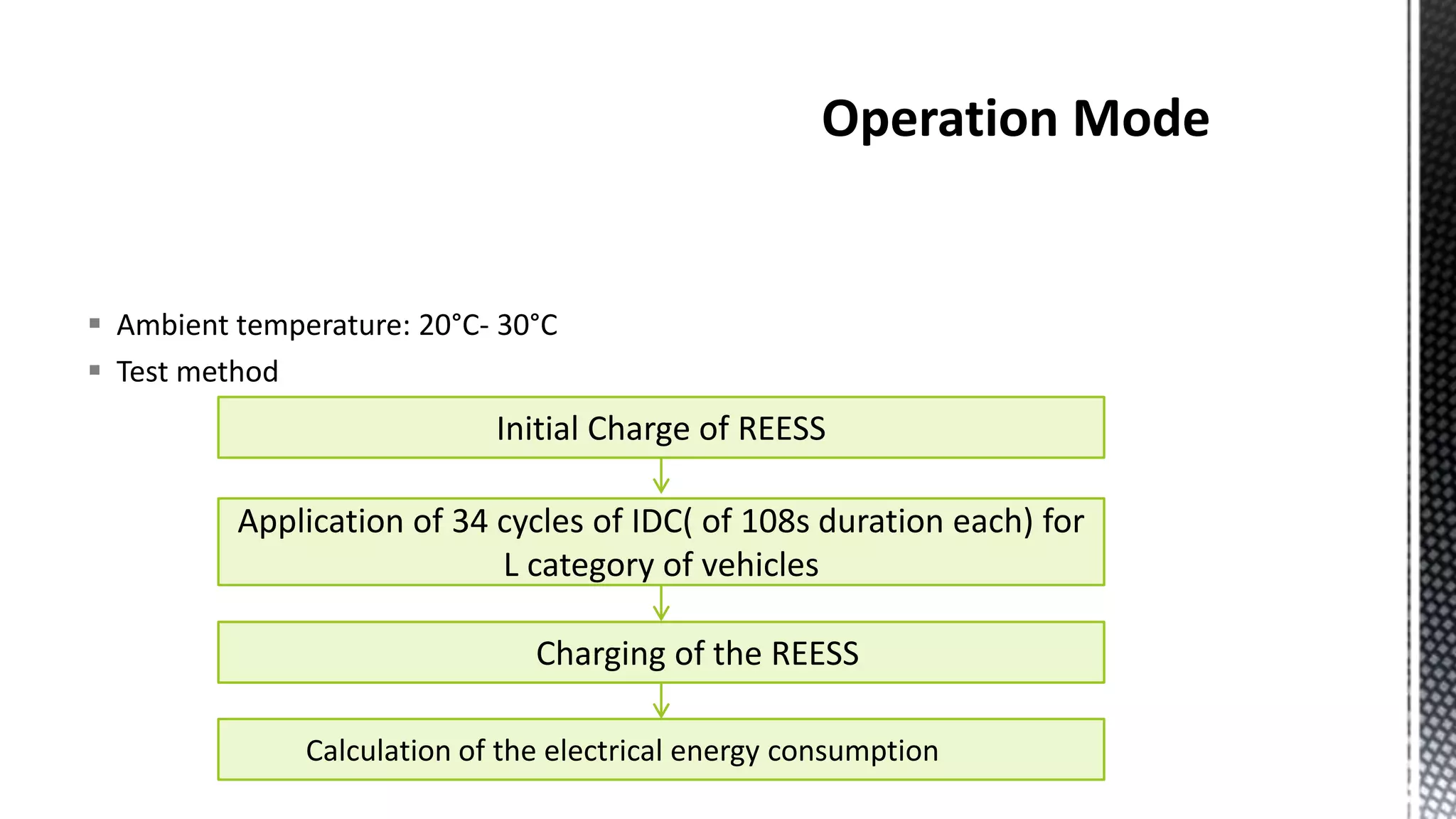
 Ambient temperature: 20°C- 30°C
 Test method
Initial Charge of REESS
Application of 34 cycles of IDC( of 108s duration each) for
L category of vehicles
Charging of the REESS
Calculation of the electrical energy consumption
0
10
20
30
40
50
0 20 40 60 80 100
TIME(sec)
SPEED(km/hr)
Time
(sec)
Distance
(km)
Avg.
Speed
(kmph)
Max.
Speed
(kmph)
Max. Acc.
(m/s²)
Max.
Dece.
(m/s²)
Idle Time
Ratio (%)
Acc. Time
Ratio (%)
Dece.
Time
Ratio (%)
Cruise
Time
Ratio (%)
IDC 108 0.658 21.93 42 0.65 0.63 14.81 38.89 34.26 12.04
No. of operation
Acceleration
(m/sec)2
Speed
(km/h)
Duration of
each
operations)
Cumulative
time(s)
(1) (2) (3) (4) (5)
01. Idling - - 16 16
02. Acceleration 0.65 0-14 6 22
03. Acceleration 0.56 14-22 4 26
04. Deceleration -0.63 22-13 4 30
05. Steady speed - 13 2 32
06. Acceleration 0.56 13-23 5 37
07. Acceleration 0.44 23-3l 5 42
08. Deceleration -0.56 31-25 3 45
09. Steady speed - 25 4 49
10. Deceleration -0.56 25-21 2 51
11. Acceleration 0.45 21-34 8 59
12. Acceleration 0.32 34-42 7 66
13. Deceleration -0.46 42-37 3 69
14. Steady speed - 37 7 76
15. Deceleration -0.46 37-34 2 78
16. Acceleration 0.32 34-42 7 85
17. Deceleration -0.46 42-47 9 94
18. Deceleration -0.52 27-14 7 101
19. Deceleration -0.56 14-00 7 103
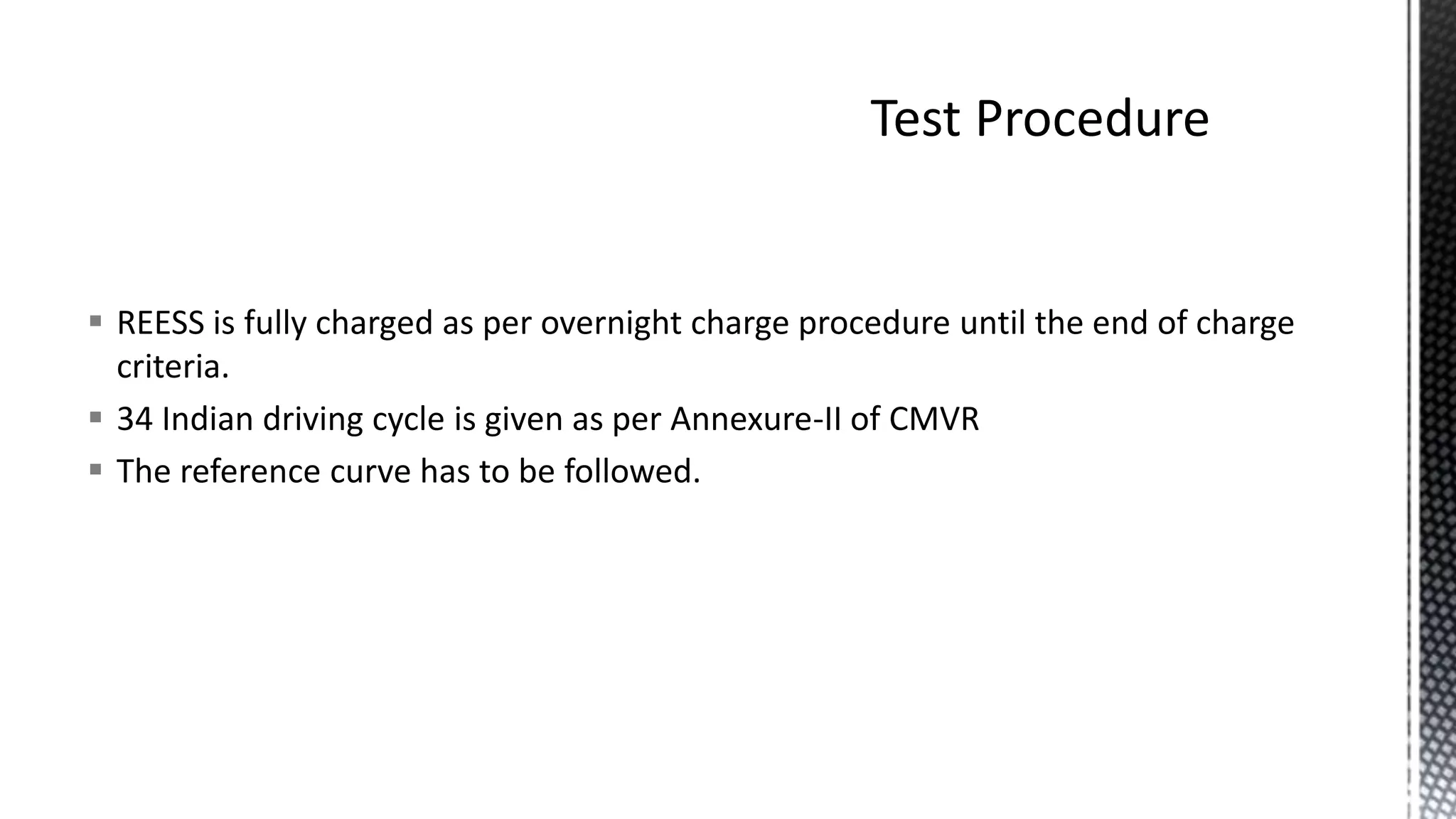
 REESS is fully charged as per overnight charge procedure until the end of charge
criteria.
 34 Indian driving cycle is given as per Annexure-II of CMVR
 The reference curve has to be followed.
 It permits to measure the electric energy consumption expressed in Wh/km.
 Parameters, units and the accuracy of measurements
PARAMETER UNIT ACCURACY RESOLUTION
TIME s ± 0.1s 0.1s
DISTANCE m ± 0.1% 1m
TEMPERATURE °C ± 1°C 1°C
SPEED km/h ± 1% 0.2km/h
MASS kg ± 0.5% 1kg
ENERGY Wh ± 0.2% Class 0.2 s according to IEC 687
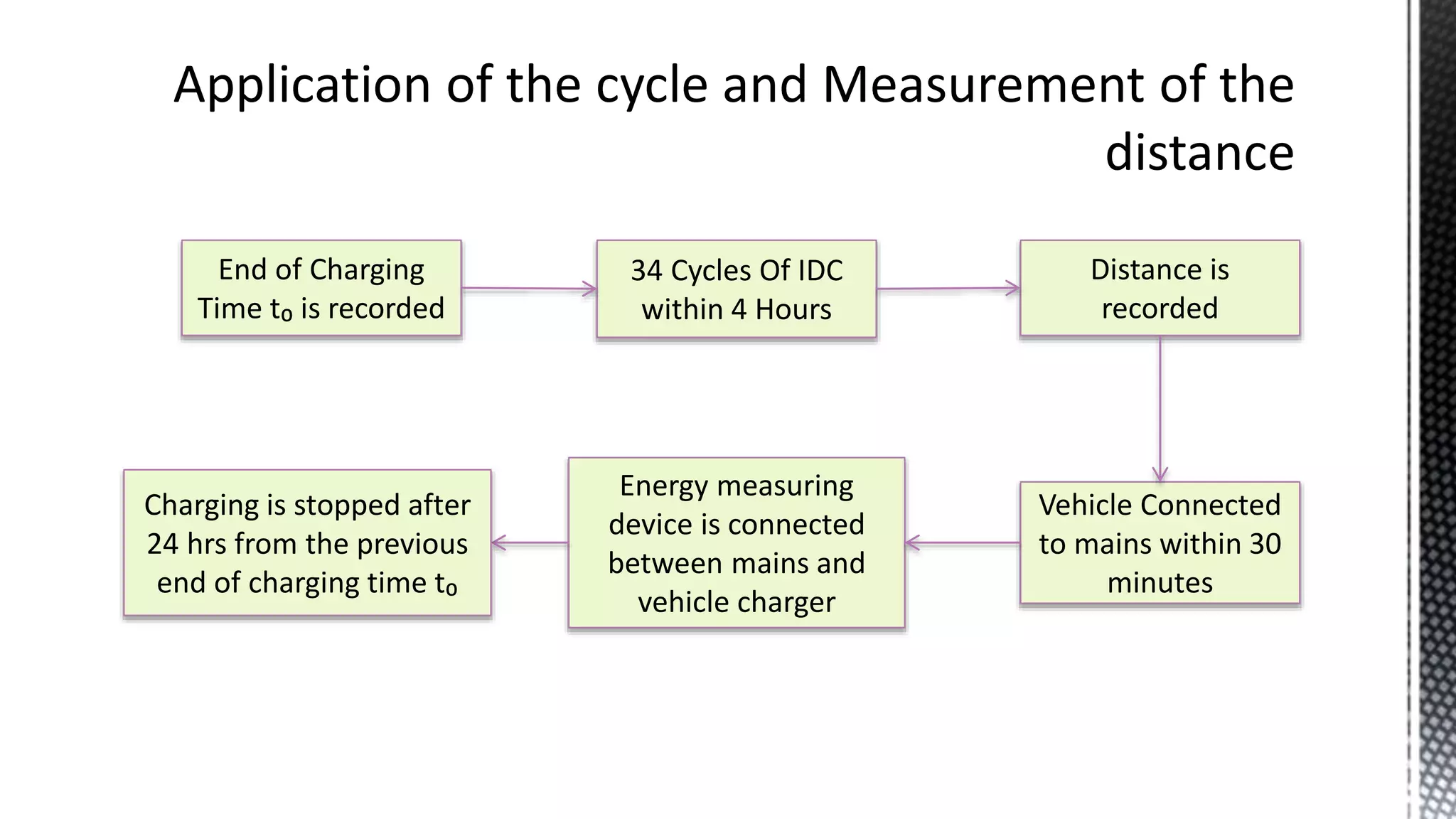
End of Charging
Time t₀ is recorded
34 Cycles Of IDC
within 4 Hours
Distance is
recorded
Vehicle Connected
to mains within 30
minutes
Energy measuring
device is connected
between mains and
vehicle charger
Charging is stopped after
24 hrs from the previous
end of charging time t₀
No
If value < 4%
specified by
manufacturer
Another Test
Average of the
two values
Energy Consumption (Ec)
Approved
Approved
If value < 4%
specified by
manufacturer
Final Test
Average of the
three values
If value < 4%
specified by
manufacturer
Approved
Rejected
No
Yes
No
Yes
Yes
Ais 039(rev.1)

Ais 039(rev.1)

  • 1.
    • Scope • VehiclePreparation • Operating Mode • Indian Driving Cycle • Test Procedure • Test method • Application of the cycle and Measurement of the distance • Electrical Energy Consumption Calculation Electric Power Train Vehicles- Measurement of Electrical Energy Consumption
  • 2.
     Specifies methodfor the measurement of electrical energy consumption  Energy Consumed is expressed in Wh/km for L, M & N Categories of the electric power train vehicles
  • 3.
     Vehicle tyresto be inflated at the pressure specified by the manufacturer at ambient temperature.  The vehicle should have undergone at least 300 km during the seven days before test with those REESS that are installed in the test vehicle
  • 4.
     Ambient temperature:20°C- 30°C  Test method Initial Charge of REESS Application of 34 cycles of IDC( of 108s duration each) for L category of vehicles Charging of the REESS Calculation of the electrical energy consumption
  • 5.
    0 10 20 30 40 50 0 20 4060 80 100 TIME(sec) SPEED(km/hr) Time (sec) Distance (km) Avg. Speed (kmph) Max. Speed (kmph) Max. Acc. (m/s²) Max. Dece. (m/s²) Idle Time Ratio (%) Acc. Time Ratio (%) Dece. Time Ratio (%) Cruise Time Ratio (%) IDC 108 0.658 21.93 42 0.65 0.63 14.81 38.89 34.26 12.04 No. of operation Acceleration (m/sec)2 Speed (km/h) Duration of each operations) Cumulative time(s) (1) (2) (3) (4) (5) 01. Idling - - 16 16 02. Acceleration 0.65 0-14 6 22 03. Acceleration 0.56 14-22 4 26 04. Deceleration -0.63 22-13 4 30 05. Steady speed - 13 2 32 06. Acceleration 0.56 13-23 5 37 07. Acceleration 0.44 23-3l 5 42 08. Deceleration -0.56 31-25 3 45 09. Steady speed - 25 4 49 10. Deceleration -0.56 25-21 2 51 11. Acceleration 0.45 21-34 8 59 12. Acceleration 0.32 34-42 7 66 13. Deceleration -0.46 42-37 3 69 14. Steady speed - 37 7 76 15. Deceleration -0.46 37-34 2 78 16. Acceleration 0.32 34-42 7 85 17. Deceleration -0.46 42-47 9 94 18. Deceleration -0.52 27-14 7 101 19. Deceleration -0.56 14-00 7 103
  • 6.
     REESS isfully charged as per overnight charge procedure until the end of charge criteria.  34 Indian driving cycle is given as per Annexure-II of CMVR  The reference curve has to be followed.
  • 7.
     It permitsto measure the electric energy consumption expressed in Wh/km.  Parameters, units and the accuracy of measurements PARAMETER UNIT ACCURACY RESOLUTION TIME s ± 0.1s 0.1s DISTANCE m ± 0.1% 1m TEMPERATURE °C ± 1°C 1°C SPEED km/h ± 1% 0.2km/h MASS kg ± 0.5% 1kg ENERGY Wh ± 0.2% Class 0.2 s according to IEC 687
  • 8.
    End of Charging Timet₀ is recorded 34 Cycles Of IDC within 4 Hours Distance is recorded Vehicle Connected to mains within 30 minutes Energy measuring device is connected between mains and vehicle charger Charging is stopped after 24 hrs from the previous end of charging time t₀
  • 9.
    No If value <4% specified by manufacturer Another Test Average of the two values Energy Consumption (Ec) Approved Approved If value < 4% specified by manufacturer Final Test Average of the three values If value < 4% specified by manufacturer Approved Rejected No Yes No Yes Yes