Photodetectors
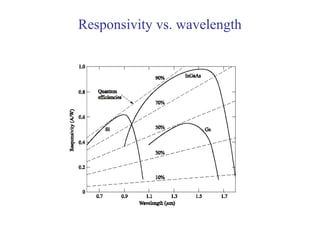
Responsivity
• The primary photocurrent resulting from absorption is:
• Quantum Efficiency:
• Responsivity:
)
1
)(
1
( )
(
0 f
w
p R
e
P
h
q
I s


  


[6-3]



h
P
q
IP
/
/
photons
incident
of
#
pairs
ated
photogener
hole
-
electron
of
#
0


[6-4]
[A/W]
0 

h
q
P
I P


 [6-5]
Responsivity vs. wavelength
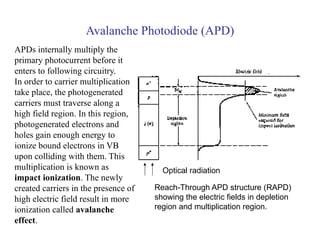
Avalanche Photodiode (APD)
APDs internally multiply the
primary photocurrent before it
enters to following circuitry.
In order to carrier multiplication
take place, the photogenerated
carriers must traverse along a
high field region. In this region,
photogenerated electrons and
holes gain enough energy to
ionize bound electrons in VB
upon colliding with them. This
multiplication is known as
impact ionization. The newly
created carriers in the presence of
high electric field result in more
ionization called avalanche
effect.
Reach-Through APD structure (RAPD)
showing the electric fields in depletion
region and multiplication region.
Optical radiation
Responsivity of APD
• The multiplication factor (current gain) M for all carriers generated in the
photodiode is defined as:
• Where is the average value of the total multiplied output current &
is the primary photocurrent.
• The responsivity of APD can be calculated by considering the current gain
as:
p
M
I
I
M  [6-6]
M
I P
I
M
M
h
q
0
APD 




 [6-7]
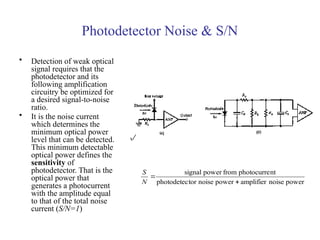
Photodetector Noise & S/N
• Detection of weak optical
signal requires that the
photodetector and its
following amplification
circuitry be optimized for
a desired signal-to-noise
ratio.
• It is the noise current
which determines the
minimum optical power
level that can be detected.
This minimum detectable
optical power defines the
sensitivity of
photodetector. That is the
optical power that
generates a photocurrent
with the amplitude equal
to that of the total noise
current (S/N=1)
power
noise
amplifier
power
noise
tor
photodetec
nt
photocurre
from
power
signal


N
S
Signal Calculation
• Consider the modulated optical power signal P(t) falls on the photodetector
with the form of:
• Where s(t) is message electrical signal and m is modulation index.
Therefore the primary photocurrent is (for pin photodiode M=1):
• The root mean square signal current is then:
)]
(
1
[
)
( 0 t
ms
P
t
P 
 [6-8]
]
current
AC
)[
(
]
value
DC
[
)
(
ph t
i
I
t
MP
h
q
i p
P 




[6-9]
signal
sinusoidal
for
2
2
2
2
2
2
2
2
2
P
p
p
s
p
s
I
m
i
M
i
i






[6-9]
[6-10]
Noise calculation (2)
• The total rms photodetector noise current is:
• The thermal noise of amplifier connected to the photodetector is:
input resistance of amplifier, and is Boltzmann
cte.
B
qI
M
F
BM
I
I
q
i
i
i
i
L
D
P
DS
DB
Q
N
N
2
)
(
)
(
2 2
2
2
2
2
2







[6-14]
L
B
T
T
R
TB
k
i
4
2
2

 [6-15]
L
R -1
23
JK
10
38
.
1 


B
k
Photodetector Response Time
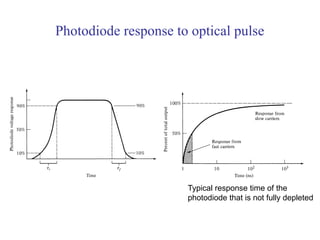
• The response time of a photodetector with its output circuit depends
mainly on the following three factors:
1- The transit time of the photocarriers in the depletion region. The transit
time depends on the carrier drift velocity and the depletion layer
width w, and is given by:
2- Diffusion time of photocarriers outside depletion region.
3- RC time constant of the circuit. The circuit after the photodetector acts
like RC low pass filter with a passband given by:
d
t d
v
d
d
v
w
t  [6-18]
T
T C
R
B

2
1
 [6-19]
d
a
T
L
s
T C
C
C
R
R
R 

 and
||
Photodiode response to optical pulse
Typical response time of the
photodiode that is not fully depleted
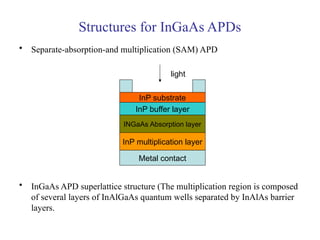
Structures for InGaAs APDs
• Separate-absorption-and multiplication (SAM) APD
• InGaAs APD superlattice structure (The multiplication region is composed
of several layers of InAlGaAs quantum wells separated by InAlAs barrier
layers.
Metal contact
InP multiplication layer
INGaAs Absorption layer
InP buffer layer
InP substrate
light

photodiode is a semiconductor device that converts

  • 1.
  • 2.
    Responsivity • The primaryphotocurrent resulting from absorption is: • Quantum Efficiency: • Responsivity: ) 1 )( 1 ( ) ( 0 f w p R e P h q I s        [6-3]    h P q IP / / photons incident of # pairs ated photogener hole - electron of # 0   [6-4] [A/W] 0   h q P I P    [6-5]
  • 3.
  • 4.
    Avalanche Photodiode (APD) APDsinternally multiply the primary photocurrent before it enters to following circuitry. In order to carrier multiplication take place, the photogenerated carriers must traverse along a high field region. In this region, photogenerated electrons and holes gain enough energy to ionize bound electrons in VB upon colliding with them. This multiplication is known as impact ionization. The newly created carriers in the presence of high electric field result in more ionization called avalanche effect. Reach-Through APD structure (RAPD) showing the electric fields in depletion region and multiplication region. Optical radiation
  • 5.
    Responsivity of APD •The multiplication factor (current gain) M for all carriers generated in the photodiode is defined as: • Where is the average value of the total multiplied output current & is the primary photocurrent. • The responsivity of APD can be calculated by considering the current gain as: p M I I M  [6-6] M I P I M M h q 0 APD       [6-7]
  • 6.
    Photodetector Noise &S/N • Detection of weak optical signal requires that the photodetector and its following amplification circuitry be optimized for a desired signal-to-noise ratio. • It is the noise current which determines the minimum optical power level that can be detected. This minimum detectable optical power defines the sensitivity of photodetector. That is the optical power that generates a photocurrent with the amplitude equal to that of the total noise current (S/N=1) power noise amplifier power noise tor photodetec nt photocurre from power signal   N S
  • 7.
    Signal Calculation • Considerthe modulated optical power signal P(t) falls on the photodetector with the form of: • Where s(t) is message electrical signal and m is modulation index. Therefore the primary photocurrent is (for pin photodiode M=1): • The root mean square signal current is then: )] ( 1 [ ) ( 0 t ms P t P   [6-8] ] current AC )[ ( ] value DC [ ) ( ph t i I t MP h q i p P      [6-9] signal sinusoidal for 2 2 2 2 2 2 2 2 2 P p p s p s I m i M i i       [6-9] [6-10]
  • 8.
    Noise calculation (2) •The total rms photodetector noise current is: • The thermal noise of amplifier connected to the photodetector is: input resistance of amplifier, and is Boltzmann cte. B qI M F BM I I q i i i i L D P DS DB Q N N 2 ) ( ) ( 2 2 2 2 2 2 2        [6-14] L B T T R TB k i 4 2 2   [6-15] L R -1 23 JK 10 38 . 1    B k
  • 9.
    Photodetector Response Time •The response time of a photodetector with its output circuit depends mainly on the following three factors: 1- The transit time of the photocarriers in the depletion region. The transit time depends on the carrier drift velocity and the depletion layer width w, and is given by: 2- Diffusion time of photocarriers outside depletion region. 3- RC time constant of the circuit. The circuit after the photodetector acts like RC low pass filter with a passband given by: d t d v d d v w t  [6-18] T T C R B  2 1  [6-19] d a T L s T C C C R R R    and ||
  • 10.
    Photodiode response tooptical pulse Typical response time of the photodiode that is not fully depleted
  • 11.
    Structures for InGaAsAPDs • Separate-absorption-and multiplication (SAM) APD • InGaAs APD superlattice structure (The multiplication region is composed of several layers of InAlGaAs quantum wells separated by InAlAs barrier layers. Metal contact InP multiplication layer INGaAs Absorption layer InP buffer layer InP substrate light