Advanced Wireless Technologies
Topic: Voice Over IP Network(VoIP)
Shashikant V. Athawale
Assistant Professor
Department of Computer Engineering, AISSMS
COE ,Pune
Agenda
• What is VoIP
• VoIP Architecture
• VoIP Applications
What is VoIP
• Voice over IP (VOIP) uses the Internet
Protocol (IP) to transmit voice as
packets over an IP network.
• Provide Many services to clients.
• VoIP use in many Browsers.
Why Use VoIP
• Cost savings.
• Open standards—h.323, sip, mgcp.
• Multi-vendor interoperability.
• Integrated ip voice and data networks.
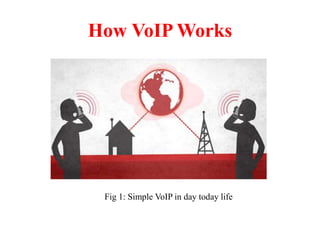
How VoIP Works
Fig 1: Simple VoIP in day today life
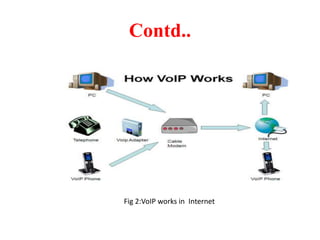
Contd..
Fig 2:VoIP works in Internet
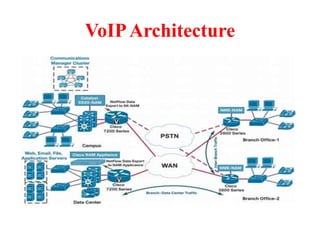
VoIPArchitecture
VoIP Protocols
• H.323
• SIP
• MGCP
• H.248
• Megaco
VoIPApplications
• Broadly Used Over Internet Browsing.
• Used in Voice Processing.
• Perceived quality of the PSTN at much
lower cost. VoIP systems.
• must be flexible and to allow a mix of
public and private services and to adapt
to local regulations.
Vehicular Network
Agenda
• What is Vehicular Network.
• Vehicular Network Communication.
• Vehicular Network Architecture.
• Features Of Vehicular Network .
• Protocols Of Vehicular Network.
• Vehicular Network Applications.
What is Vehicular Network
• Vehicular Ad Hoc Networks (VANETs)
are created by applying the principles
of MANETs.
• Vehicles Transformed into “Computers
on the Wheels” or “Networks on the
Wheel”.
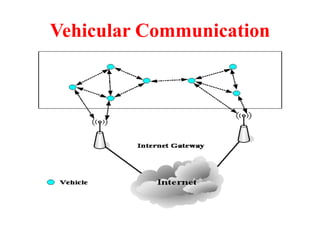
Vehicular Communication
Contd...
 Vehicular Communication System (VCS):- Two main
type of communications:
1. Vehicle to Vehicle Communication.
2. Vehicle to Infrastructure Communication.
 Communication between V2V and V2I are “ad-hoc"
in nature.
 This special kind of communication network is
known as
“Vehicular Ad-hoc Network (VANET)”
 VANET will become Worlds largest ad-hoc network
Vehicle To Vehicle Communication
High bandwidth link with vehicle and roadside
equipment.
Roadside units broadcast messages.
Vehicle to Infrastructure
communication
Uses multi-hop/multi cast technique.
 uses two type of broadcasting
1. naive broadcasting
2. intelligent broadcasting
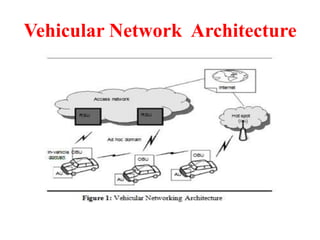
Vehicular Network Architecture
Features Of Vehicular Network
• Dynamic topology
• Mobility models
• Infinite energy supply
• Localization functionality
Protocols In Vehicular Network
• Routing Protocols:
-Position-based Routing (Unicast)
-Geocasting Routing (Multicast)
-Broadcast Routing
VoIPApplications
• Electronic brake lights.
• Platooning.
• Traffic information systems.
• Traffic safety
• Traffic management services
Delay Tolerant Network
Agenda
• What is Delay Tolerant Network.
• Key Properties Of Delay Tolerant Network.
• Characteristics Of Delay Tolerant Network.
• Delay Tolerant Network Architecture
• Delay Tolerant Network Applications
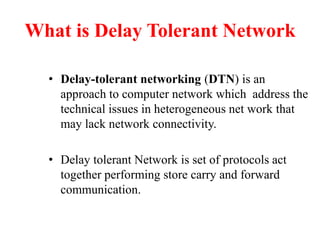
What is Delay Tolerant Network
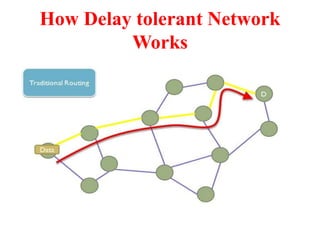
• Delay-tolerant networking (DTN) is an
approach to computer network which address the
technical issues in heterogeneous net work that
may lack network connectivity.
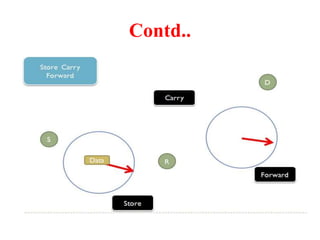
• Delay tolerant Network is set of protocols act
together performing store carry and forward
communication.
Contd..
• Communication is possible even if end-to-end
connectivity is never achievable.
• Exploiting node’s mobility.
• Using store-carry-forward fashion.
How Delay tolerant Network
Works
Contd..
Key Properties Of DTNs
• High Latency
• Low Data Rate
• Disconnection
• Long Queuing Delay
• Short Range Contact
• Dynamic Network Topology
Characteristics of DTN.
• Characteristics of DTN
– No end-to-end path
– Intermittent connectivity
– Dynamic topology
– Long delay
• DTN routing
– Flooding-based: redundancy
– Forwarding-based: require topology information
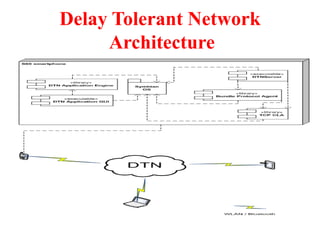
Delay Tolerant Network
Architecture
Delay Tolerant Network
Applications
• Telemedicine for Developing Regions
• DTN-based Social Network Service
• Communication in the Presence of
Oppressive Governments
• File Sharing and Bulk Data Transfer
• Share Air Minutes

Advanced Wireless Technologies

  • 1.
    Advanced Wireless Technologies Topic:Voice Over IP Network(VoIP) Shashikant V. Athawale Assistant Professor Department of Computer Engineering, AISSMS COE ,Pune
  • 2.
    Agenda • What isVoIP • VoIP Architecture • VoIP Applications
  • 3.
    What is VoIP •Voice over IP (VOIP) uses the Internet Protocol (IP) to transmit voice as packets over an IP network. • Provide Many services to clients. • VoIP use in many Browsers.
  • 4.
    Why Use VoIP •Cost savings. • Open standards—h.323, sip, mgcp. • Multi-vendor interoperability. • Integrated ip voice and data networks.
  • 5.
    How VoIP Works Fig1: Simple VoIP in day today life
  • 6.
  • 7.
  • 8.
    VoIP Protocols • H.323 •SIP • MGCP • H.248 • Megaco
  • 9.
    VoIPApplications • Broadly UsedOver Internet Browsing. • Used in Voice Processing. • Perceived quality of the PSTN at much lower cost. VoIP systems. • must be flexible and to allow a mix of public and private services and to adapt to local regulations.
  • 10.
  • 11.
    Agenda • What isVehicular Network. • Vehicular Network Communication. • Vehicular Network Architecture. • Features Of Vehicular Network . • Protocols Of Vehicular Network. • Vehicular Network Applications.
  • 12.
    What is VehicularNetwork • Vehicular Ad Hoc Networks (VANETs) are created by applying the principles of MANETs. • Vehicles Transformed into “Computers on the Wheels” or “Networks on the Wheel”.
  • 13.
  • 14.
    Contd...  Vehicular CommunicationSystem (VCS):- Two main type of communications: 1. Vehicle to Vehicle Communication. 2. Vehicle to Infrastructure Communication.  Communication between V2V and V2I are “ad-hoc" in nature.  This special kind of communication network is known as “Vehicular Ad-hoc Network (VANET)”  VANET will become Worlds largest ad-hoc network
  • 15.
    Vehicle To VehicleCommunication High bandwidth link with vehicle and roadside equipment. Roadside units broadcast messages.
  • 16.
    Vehicle to Infrastructure communication Usesmulti-hop/multi cast technique.  uses two type of broadcasting 1. naive broadcasting 2. intelligent broadcasting
  • 17.
  • 18.
    Features Of VehicularNetwork • Dynamic topology • Mobility models • Infinite energy supply • Localization functionality
  • 19.
    Protocols In VehicularNetwork • Routing Protocols: -Position-based Routing (Unicast) -Geocasting Routing (Multicast) -Broadcast Routing
  • 20.
    VoIPApplications • Electronic brakelights. • Platooning. • Traffic information systems. • Traffic safety • Traffic management services
  • 21.
  • 22.
    Agenda • What isDelay Tolerant Network. • Key Properties Of Delay Tolerant Network. • Characteristics Of Delay Tolerant Network. • Delay Tolerant Network Architecture • Delay Tolerant Network Applications
  • 23.
    What is DelayTolerant Network • Delay-tolerant networking (DTN) is an approach to computer network which address the technical issues in heterogeneous net work that may lack network connectivity. • Delay tolerant Network is set of protocols act together performing store carry and forward communication.
  • 24.
    Contd.. • Communication ispossible even if end-to-end connectivity is never achievable. • Exploiting node’s mobility. • Using store-carry-forward fashion.
  • 25.
    How Delay tolerantNetwork Works
  • 26.
  • 27.
    Key Properties OfDTNs • High Latency • Low Data Rate • Disconnection • Long Queuing Delay • Short Range Contact • Dynamic Network Topology
  • 28.
    Characteristics of DTN. •Characteristics of DTN – No end-to-end path – Intermittent connectivity – Dynamic topology – Long delay • DTN routing – Flooding-based: redundancy – Forwarding-based: require topology information
  • 29.
  • 30.
    Delay Tolerant Network Applications •Telemedicine for Developing Regions • DTN-based Social Network Service • Communication in the Presence of Oppressive Governments • File Sharing and Bulk Data Transfer • Share Air Minutes