ANDROID APP BASED SMART
GLOVE FOR DEAF AND DUMB PEOPLE
TEAM MEMBERS:
HARIPRIYA U - 510119106002
KEERTHANA D - 510119106005
RAGHUL B - 510119106009
PRABHATHARAN D
Asst professor - ECE
PROJECT
SUPERVISOR & COORDINATOR
PREMKUMAR S
Associate professor-ECE
HEAD OF DEPARTMENT - ECE
ABSTRACT
• Human being want to convey their feelings by interacting with people surrounding
them. Speech is the easiest way for communication in the world.
• It becomes difficult for speech and hearing impaired people to communicate with
normal people as they use sign language for communication.
• To bridge this gap, the proposed system act as mediator between impaired and
normal people.
• The objective of the project is to design a smart glove for sign language translation
that helps an easy way of communication for speech and hearing impaired people.
• This system uses flex sensors to capture the signs connected to the ARDUINO
board. The smart glove transforms the hand signals to text and to speech by utilizing
Arduino voice control.
• Keywords: Smart glove, Arduino, flex sensors, sign language.
LITERATURE SURVEY:
S.NO TITLE JOURNAL INFERENCE ADVANTAGE DISADVANTAGE
1) Smart glove for
hand gesture
recognition (using
cmos camera)
International
journal of
advance research,
ideasand
innovation in
technology
There are various
approaches to sign
languagedetection like
data glove approach,
vision basedapproach and
virtual button approach.
Previously few attempts
were made to identify the
gesture using various
other methods. The cmos
camera captures the image
of the gesture,edge
detection of that image,
peak detection of that
image.
● Low power
consumption.
● Low dark noise
will contribute
to higher
fidelity.
● High latency
● Expensive
● High
propagation
delays
2) Implementation
SmartGloves fordeaf
and dumb disable
International science
and technology
journal
A practical system has been
developed to allow deaf people to
use a device to talk to ordinary
people. The device consists of a
wireless glovewith a flexible
sensor and accelerometer. It
translates the movements and
produces outputin the speaker.
● Effective mean of
communication
● Cost efficient
● More usage of circuit
boards such as lcd
display and speaker,
so it isnot portable
● Not user friendly
3) Hand gesture
recognitionusing ML
with image
processing
IJRASET
A novel method for hand gesture
recognition system for two digit
classification through webcam is
proposed. In modern time sign
recognition is usually processed in
three fundamentals
● Segmentation
● Feature extraction
● classification
● It will be fast
● reliable
● Complex
computational
algorithms are
required for
detection
● Need of proper
background and
lighting condition.
4) Smart gloves for hand
gesture recognition
using sign language to
speech conversion
system using sensors
International Journal of
Pure and Applied
Mathematics
This paper presents a smart glove
system that recognizes sign language
gestures and converts them into
spoken language using flex sensors
and machine learning algorithms. The
system includes a microcontroller and
text-to-speech converter for output,
and discusses both the hardware and
software design.
Provides portable and
non-invasive sign
language recognition,
accurately recognizes sign
language gestures with
good accuracy for Indian
Sign Language, and has
the potential to improve
communication for the
deaf or hard of hearing.
Accuracy can be affected by
variations in hand gestures
and movements, cost may be a
barrier to widespread
adoption, and the system
requires further
improvements in accuracy
and a more user-friendly
interface.
5)
Hand gesture
recognition using
image processing for
visually impaired and
dumb person
International Journal of
advanced research in
computer and
communication
Engineering
In this proposed system the dumb
people motion have a separate
meaning whose message template
will be taken and kept in a
database.The gestures are taken as a
snap and that were compared to
gestures which are stored in a
database.The training signs is an
input and testing sign are present at
the outside side.First the images are
taken as a snap and compare with
gestures stored in the database and
finally for the matched gesture,the
voice will be generated.
 Usefulness in
computer vision
 Good accuracy
 Pose variation and
background variation
makes the problem
 More challenging
EXISTING SYSTEM
• In Existing system, there is no circuit used to announce their thoughts of
physically challenged people and gesture based paper or circuits are not
available in markets.
• In existing method, sign language it couldn't be understand by all people for
communication. There after a circuit is used to design predetermined postures
are captured and matching the captured image with deaf and dumb people's sign
language.
HIGH
LATENCY
NOT
PORTABLE
NOT USER-
FRIENDLY
MORE
CHALLENGING
HIGH
COST
NO
ACCURACY
PROPOSED SOLUTION:
• The proposed system presents a solution for closing or at least narrowing gap between impaired
people and normal people. This system improves the communication with deaf and dumb using "flex
sensor" technology.
• Flex sensors are placed on hand gloves for the use of deaf and dumb people. Sensors in the glove pick
up gestures and transmit that to Arduino(ATMEGA328).
• This gestures which are come from Arduino board, the bluetooth module send that sign to Android
phone only when android phones bluetooth is enable. By using the mobile app incoming message
(text) will convert to voice (audio) and send the output (as message) to a server for emergency
response of doctors or family members
ADVANTAGES:
• High level of reliability,consistency,variety of flexible or stationery for mounting
• Infinite number of resistance possibilites and bend ratios.
• It is portable
• Low cost & less weight
.
ADVANTAGES:
High level of reliability,consistency,variety of flexible or stationery
for mounting
Infinite number of resistance possibilites and bend ratios.
It is portable
Low cost & less weight
APPLICATION:
• To develop the device to convert action into speech
• To design the smart glove using flexible technology
• To design an Android app for converting the action into speech
and display
BLOCK DIAGRAM:
ARDUINO
ATMEGA
2560
HARDWARE REQUIREMENTS:
 FLEX SENSOR
 ACCELEROMETER SENSOR(MPU6050/ADXL335)
 TOUCH SENSOR
 HC-05 BLUETOOTH MODULE
 ARDUINO UNO (ATMEGA328)
SOFTWARE REQUIREMENTS
 ARDUINO UNO (ATMEGA 328)
 Arduino Bluetooth text to speech application
FLEX SENSOR
A flex sensor is basically a variable resistor that varies in resistance upon
bending. Since the resistance is directly proportional to the amount of
bending, it is often called a Flexible Potentiometer. A flex sensor consists of
a phenolic resin substrate with conductive ink deposited and a segmented
conductor is placed on top to form a flexible potentiometer in which
resistance changes upon deflection.
Accelerometer sensor (MPU6050)
The MPU6050 is a Micro Electro-Mechanical Systems (MEMS) which
consists of a 3-axis Accelerometer and 3-axis Gyroscope inside it.
This helps us to measure acceleration, velocity, orientation,
displacement and many other motions related parameter of a system
or object. The MPU-6050 measures acceleration over the X, Y, and Z-
axis. Ideally, in a static object, the acceleration over the Z-axis is equal
to the gravitational force, and it should be zero on the X and Y-axis.
Using the accelerometer’s values, it is possible to calculate the roll
and pitch angles using trigonometry.
TOUCH SENSOR
Touch sensors work similar to a switch. When they are subjected to touch, pressure or force
they get activated and acts as a closed switch. When the pressure or contact is removed,
they act as an open switch. Capacitive touch sensor contains two parallel conductors with
an insulator between them. These conductor plates act as a capacitor with a capacitance
value C0. When these conductor plates come in contact with our fingers, our finger acts as a
conductive object. Due to this, there will be an uncertain increase in the capacitance.
Touch sensor has 3 pins:
• GND pin needs to be connected to GND (0V)
• VCC pin needs to be connected to VCC (5V or 3.3v)
• SIGNAL pin is an output pin: LOW when it is NOT touched,
HIGH when it is touched.
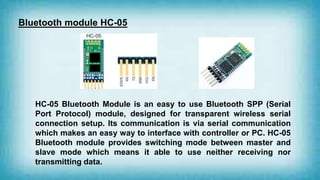
Bluetooth module HC-05
HC-05 Bluetooth Module is an easy to use Bluetooth SPP (Serial
Port Protocol) module, designed for transparent wireless serial
connection setup. Its communication is via serial communication
which makes an easy way to interface with controller or PC. HC-05
Bluetooth module provides switching mode between master and
slave mode which means it able to use neither receiving nor
transmitting data.
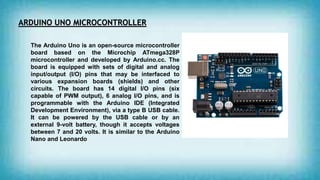
ARDUINO UNO MICROCONTROLLER
The Arduino Uno is an open-source microcontroller
board based on the Microchip ATmega328P
microcontroller and developed by Arduino.cc. The
board is equipped with sets of digital and analog
input/output (I/O) pins that may be interfaced to
various expansion boards (shields) and other
circuits. The board has 14 digital I/O pins (six
capable of PWM output), 6 analog I/O pins, and is
programmable with the Arduino IDE (Integrated
Development Environment), via a type B USB cable.
It can be powered by the USB cable or by an
external 9-volt battery, though it accepts voltages
between 7 and 20 volts. It is similar to the Arduino
Nano and Leonardo
Arduino IDE 1.8.19:
• The open-source Arduino Software (IDE) makes it easy to
write code and upload it to the board. This software can be
used with any Arduino board.
• IDE works in conjunction with the Arduino controller, which
helps to write code and upload it to various Arduino boards.
Circuit Diagram
Hardware Setup with Android App
Final Output
Help me Need water
Smart gloves for Two
Is prabhatharan sir Haripriya Keerthana raghul
CONCLUSION
• In this project, we constructed a smart glove for supporting deaf-
dumb people in communicating with normal people that are not
familiar with sign language. The smart glove is able to connect to
Android mobile and facilitate exchange of messages. Whereas the
android application is able to send sign gestures from the smart
gloves and it will be received as text and speech in android app. Also
in case of emergency it will transmit message to the family members.
This Smart glove is light, cheap, easy to use and no risk. We believe
that the project is an effective and very useful for deaf and dumb
people where they can communicate with their family and people
around them.
FUTURE SCOPE:
• Since we have used few signs in this prototype,it believes that
additional gestures might be used to detect entire sign language.The
hardware gadget with gloves has automation applications that can be
developed in the future using the wifi connection and the GSM module.
SMART GLOVES FOR.pptx

SMART GLOVES FOR.pptx

  • 1.
    ANDROID APP BASEDSMART GLOVE FOR DEAF AND DUMB PEOPLE TEAM MEMBERS: HARIPRIYA U - 510119106002 KEERTHANA D - 510119106005 RAGHUL B - 510119106009 PRABHATHARAN D Asst professor - ECE PROJECT SUPERVISOR & COORDINATOR PREMKUMAR S Associate professor-ECE HEAD OF DEPARTMENT - ECE
  • 2.
    ABSTRACT • Human beingwant to convey their feelings by interacting with people surrounding them. Speech is the easiest way for communication in the world. • It becomes difficult for speech and hearing impaired people to communicate with normal people as they use sign language for communication. • To bridge this gap, the proposed system act as mediator between impaired and normal people. • The objective of the project is to design a smart glove for sign language translation that helps an easy way of communication for speech and hearing impaired people. • This system uses flex sensors to capture the signs connected to the ARDUINO board. The smart glove transforms the hand signals to text and to speech by utilizing Arduino voice control. • Keywords: Smart glove, Arduino, flex sensors, sign language.
  • 3.
    LITERATURE SURVEY: S.NO TITLEJOURNAL INFERENCE ADVANTAGE DISADVANTAGE 1) Smart glove for hand gesture recognition (using cmos camera) International journal of advance research, ideasand innovation in technology There are various approaches to sign languagedetection like data glove approach, vision basedapproach and virtual button approach. Previously few attempts were made to identify the gesture using various other methods. The cmos camera captures the image of the gesture,edge detection of that image, peak detection of that image. ● Low power consumption. ● Low dark noise will contribute to higher fidelity. ● High latency ● Expensive ● High propagation delays
  • 4.
    2) Implementation SmartGloves fordeaf anddumb disable International science and technology journal A practical system has been developed to allow deaf people to use a device to talk to ordinary people. The device consists of a wireless glovewith a flexible sensor and accelerometer. It translates the movements and produces outputin the speaker. ● Effective mean of communication ● Cost efficient ● More usage of circuit boards such as lcd display and speaker, so it isnot portable ● Not user friendly 3) Hand gesture recognitionusing ML with image processing IJRASET A novel method for hand gesture recognition system for two digit classification through webcam is proposed. In modern time sign recognition is usually processed in three fundamentals ● Segmentation ● Feature extraction ● classification ● It will be fast ● reliable ● Complex computational algorithms are required for detection ● Need of proper background and lighting condition.
  • 5.
    4) Smart glovesfor hand gesture recognition using sign language to speech conversion system using sensors International Journal of Pure and Applied Mathematics This paper presents a smart glove system that recognizes sign language gestures and converts them into spoken language using flex sensors and machine learning algorithms. The system includes a microcontroller and text-to-speech converter for output, and discusses both the hardware and software design. Provides portable and non-invasive sign language recognition, accurately recognizes sign language gestures with good accuracy for Indian Sign Language, and has the potential to improve communication for the deaf or hard of hearing. Accuracy can be affected by variations in hand gestures and movements, cost may be a barrier to widespread adoption, and the system requires further improvements in accuracy and a more user-friendly interface. 5) Hand gesture recognition using image processing for visually impaired and dumb person International Journal of advanced research in computer and communication Engineering In this proposed system the dumb people motion have a separate meaning whose message template will be taken and kept in a database.The gestures are taken as a snap and that were compared to gestures which are stored in a database.The training signs is an input and testing sign are present at the outside side.First the images are taken as a snap and compare with gestures stored in the database and finally for the matched gesture,the voice will be generated.  Usefulness in computer vision  Good accuracy  Pose variation and background variation makes the problem  More challenging
  • 6.
    EXISTING SYSTEM • InExisting system, there is no circuit used to announce their thoughts of physically challenged people and gesture based paper or circuits are not available in markets. • In existing method, sign language it couldn't be understand by all people for communication. There after a circuit is used to design predetermined postures are captured and matching the captured image with deaf and dumb people's sign language.
  • 7.
  • 8.
    PROPOSED SOLUTION: • Theproposed system presents a solution for closing or at least narrowing gap between impaired people and normal people. This system improves the communication with deaf and dumb using "flex sensor" technology. • Flex sensors are placed on hand gloves for the use of deaf and dumb people. Sensors in the glove pick up gestures and transmit that to Arduino(ATMEGA328). • This gestures which are come from Arduino board, the bluetooth module send that sign to Android phone only when android phones bluetooth is enable. By using the mobile app incoming message (text) will convert to voice (audio) and send the output (as message) to a server for emergency response of doctors or family members ADVANTAGES: • High level of reliability,consistency,variety of flexible or stationery for mounting • Infinite number of resistance possibilites and bend ratios. • It is portable • Low cost & less weight .
  • 9.
    ADVANTAGES: High level ofreliability,consistency,variety of flexible or stationery for mounting Infinite number of resistance possibilites and bend ratios. It is portable Low cost & less weight APPLICATION: • To develop the device to convert action into speech • To design the smart glove using flexible technology • To design an Android app for converting the action into speech and display
  • 10.
  • 11.
    HARDWARE REQUIREMENTS:  FLEXSENSOR  ACCELEROMETER SENSOR(MPU6050/ADXL335)  TOUCH SENSOR  HC-05 BLUETOOTH MODULE  ARDUINO UNO (ATMEGA328)
  • 12.
    SOFTWARE REQUIREMENTS  ARDUINOUNO (ATMEGA 328)  Arduino Bluetooth text to speech application
  • 13.
    FLEX SENSOR A flexsensor is basically a variable resistor that varies in resistance upon bending. Since the resistance is directly proportional to the amount of bending, it is often called a Flexible Potentiometer. A flex sensor consists of a phenolic resin substrate with conductive ink deposited and a segmented conductor is placed on top to form a flexible potentiometer in which resistance changes upon deflection.
  • 14.
  • 15.
    The MPU6050 isa Micro Electro-Mechanical Systems (MEMS) which consists of a 3-axis Accelerometer and 3-axis Gyroscope inside it. This helps us to measure acceleration, velocity, orientation, displacement and many other motions related parameter of a system or object. The MPU-6050 measures acceleration over the X, Y, and Z- axis. Ideally, in a static object, the acceleration over the Z-axis is equal to the gravitational force, and it should be zero on the X and Y-axis. Using the accelerometer’s values, it is possible to calculate the roll and pitch angles using trigonometry.
  • 16.
    TOUCH SENSOR Touch sensorswork similar to a switch. When they are subjected to touch, pressure or force they get activated and acts as a closed switch. When the pressure or contact is removed, they act as an open switch. Capacitive touch sensor contains two parallel conductors with an insulator between them. These conductor plates act as a capacitor with a capacitance value C0. When these conductor plates come in contact with our fingers, our finger acts as a conductive object. Due to this, there will be an uncertain increase in the capacitance. Touch sensor has 3 pins: • GND pin needs to be connected to GND (0V) • VCC pin needs to be connected to VCC (5V or 3.3v) • SIGNAL pin is an output pin: LOW when it is NOT touched, HIGH when it is touched.
  • 17.
    Bluetooth module HC-05 HC-05Bluetooth Module is an easy to use Bluetooth SPP (Serial Port Protocol) module, designed for transparent wireless serial connection setup. Its communication is via serial communication which makes an easy way to interface with controller or PC. HC-05 Bluetooth module provides switching mode between master and slave mode which means it able to use neither receiving nor transmitting data.
  • 18.
    ARDUINO UNO MICROCONTROLLER TheArduino Uno is an open-source microcontroller board based on the Microchip ATmega328P microcontroller and developed by Arduino.cc. The board is equipped with sets of digital and analog input/output (I/O) pins that may be interfaced to various expansion boards (shields) and other circuits. The board has 14 digital I/O pins (six capable of PWM output), 6 analog I/O pins, and is programmable with the Arduino IDE (Integrated Development Environment), via a type B USB cable. It can be powered by the USB cable or by an external 9-volt battery, though it accepts voltages between 7 and 20 volts. It is similar to the Arduino Nano and Leonardo
  • 19.
    Arduino IDE 1.8.19: •The open-source Arduino Software (IDE) makes it easy to write code and upload it to the board. This software can be used with any Arduino board. • IDE works in conjunction with the Arduino controller, which helps to write code and upload it to various Arduino boards.
  • 20.
  • 21.
  • 22.
  • 23.
  • 24.
  • 25.
    Is prabhatharan sirHaripriya Keerthana raghul
  • 26.
    CONCLUSION • In thisproject, we constructed a smart glove for supporting deaf- dumb people in communicating with normal people that are not familiar with sign language. The smart glove is able to connect to Android mobile and facilitate exchange of messages. Whereas the android application is able to send sign gestures from the smart gloves and it will be received as text and speech in android app. Also in case of emergency it will transmit message to the family members. This Smart glove is light, cheap, easy to use and no risk. We believe that the project is an effective and very useful for deaf and dumb people where they can communicate with their family and people around them.
  • 27.
    FUTURE SCOPE: • Sincewe have used few signs in this prototype,it believes that additional gestures might be used to detect entire sign language.The hardware gadget with gloves has automation applications that can be developed in the future using the wifi connection and the GSM module.