Digital Data Transmission
ECE 457
Spring 2005
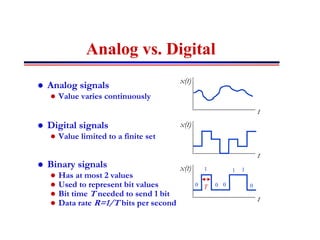
Analog vs. Digital
 Analog signals
 Value varies continuously
 Digital signals
 Value limited to a finite set
 Binary signals
 Has at most 2 values
 Used to represent bit values
 Bit time T needed to send 1 bit
 Data rate R=1/T bits per second
t
x(t)
t
x(t)
t
x(t) 1
0 0 0
1 1
0
T
Information Representation
• Communication systems convert information into
a form suitable for transmission
• Analog systemsAnalog signals are modulated
(AM, FM radio)
• Digital system generate bits and transmit digital
signals (Computers)
• Analog signals can be converted to digital signals.
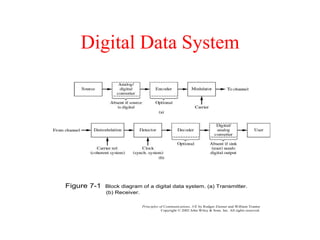
Digital Data System
Principles of Communications, 5/E by Rodger Ziemer and William Tranter
Copyright © 2002 John Wiley & Sons. Inc. All rights reserved.
Figure 7-1 Block diagram of a digital data system. (a) Transmitter.
(b) Receiver.
Components of Digital
Communication
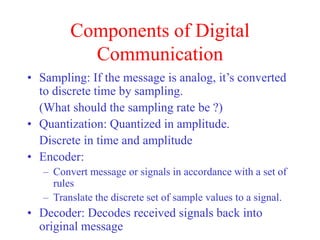
• Sampling: If the message is analog, it’s converted
to discrete time by sampling.
(What should the sampling rate be ?)
• Quantization: Quantized in amplitude.
Discrete in time and amplitude
• Encoder:
– Convert message or signals in accordance with a set of
rules
– Translate the discrete set of sample values to a signal.
• Decoder: Decodes received signals back into
original message
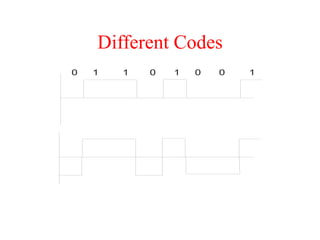
Different Codes
0 1 1 0 1 0 0 1
Performance Metrics
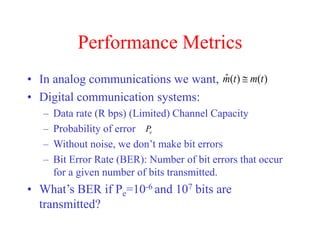
• In analog communications we want,
• Digital communication systems:
– Data rate (R bps) (Limited) Channel Capacity
– Probability of error
– Without noise, we don’t make bit errors
– Bit Error Rate (BER): Number of bit errors that occur
for a given number of bits transmitted.
• What’s BER if Pe=10-6 and 107 bits are
transmitted?
)
(
)
(
ˆ t
m
t
m 
e
P
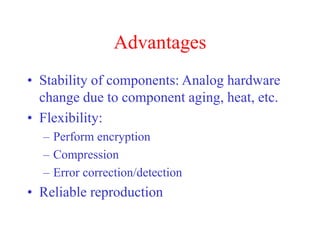
Advantages
• Stability of components: Analog hardware
change due to component aging, heat, etc.
• Flexibility:
– Perform encryption
– Compression
– Error correction/detection
• Reliable reproduction
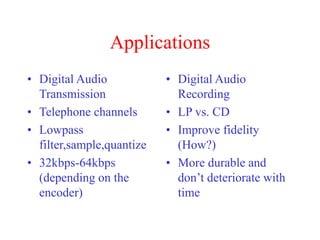
Applications
• Digital Audio
Transmission
• Telephone channels
• Lowpass
filter,sample,quantize
• 32kbps-64kbps
(depending on the
encoder)
• Digital Audio
Recording
• LP vs. CD
• Improve fidelity
(How?)
• More durable and
don’t deteriorate with
time
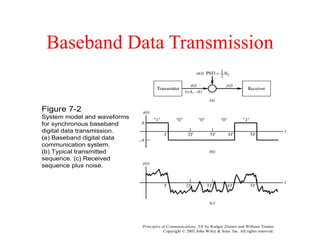
Baseband Data Transmission
Principles of Communications, 5/E by Rodger Ziemer and William Tranter
Copyright © 2002 John Wiley & Sons. Inc. All rights reserved.
Figure 7-2
System model and waveforms
for synchronous baseband
digital data transmission.
(a) Baseband digital data
communication system.
(b) Typical transmitted
sequence. (c) Received
sequence plus noise.
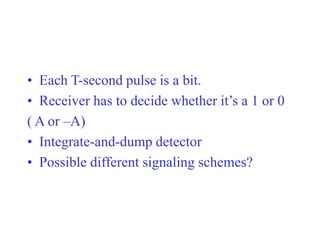
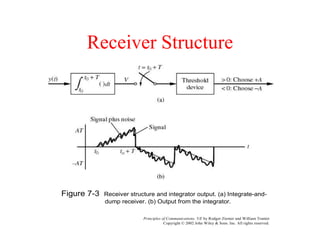
• Each T-second pulse is a bit.
• Receiver has to decide whether it’s a 1 or 0
( A or –A)
• Integrate-and-dump detector
• Possible different signaling schemes?
Receiver Structure
Principles of Communications, 5/E by Rodger Ziemer and William Tranter
Copyright © 2002 John Wiley & Sons. Inc. All rights reserved.
Figure 7-3 Receiver structure and integrator output. (a) Integrate-and-
dump receiver. (b) Output from the integrator.
Receiver Preformance
• The output of the integrator:
• is a random variable.
• N is Gaussian. Why?









 

sent
is
A
N
AT
sent
is
A
N
AT
dt
t
n
t
s
V
T
t
t
0
0
)]
(
)
(
[



T
t
t
dt
t
n
N
0
0
)
(
Analysis
• Key Point
– White noise is uncorrelated
2
)
!
?(
)
(
2
)]
(
)
(
[
)
(
?
]
[
]
[
]
[
]
[
0
)]
(
[
]
)
(
[
]
[
0
0
2
2
2
2
0
0
0
0
0
0
0
0
0
0
0
0
0
0
T
N
ed
uncorrelat
is
noise
White
Why
dtds
s
t
N
dtds
s
n
t
n
E
dt
t
n
E
Why
N
E
N
E
N
E
N
Var
dt
t
n
E
dt
t
n
E
N
E
T
t
t
T
t
t
T
t
t
T
t
t
T
t
t
T
t
t
T
t
t





























 
 

 
 
 

 

Error Analysis
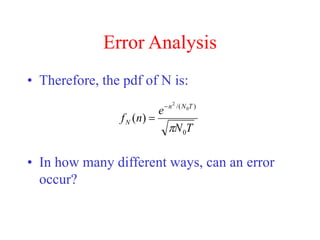
• Therefore, the pdf of N is:
• In how many different ways, can an error
occur?
T
N
e
n
f
T
N
n
N
0
)
/( 0
2
)
(



Error Analysis
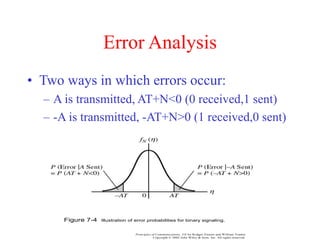
• Two ways in which errors occur:
– A is transmitted, AT+N<0 (0 received,1 sent)
– -A is transmitted, -AT+N>0 (1 received,0 sent)
Principles of Communications, 5/E by Rodger Ziemer and William Tranter
Copyright © 2002 John Wiley & Sons. Inc. All rights reserved.
Figure 7-4 Illustration of error probabilities for binary signaling.
•
• Similarly,
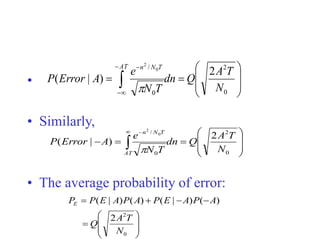
• The average probability of error:









 




0
2
0
/
2
)
|
(
0
2
N
T
A
Q
dn
T
N
e
A
Error
P
AT T
N
n











 
 
0
2
0
/
2
)
|
(
0
2
N
T
A
Q
dn
T
N
e
A
Error
P
AT
T
N
n














0
2
2
)
(
)
|
(
)
(
)
|
(
N
T
A
Q
A
P
A
E
P
A
P
A
E
P
PE
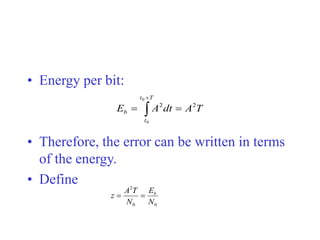
• Energy per bit:
• Therefore, the error can be written in terms
of the energy.
• Define
T
A
dt
A
E
T
t
t
b
2
2
0
0

 

0
0
2
N
E
N
T
A
z b


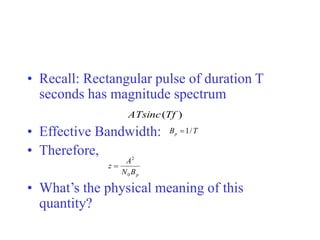
• Recall: Rectangular pulse of duration T
seconds has magnitude spectrum
• Effective Bandwidth:
• Therefore,
• What’s the physical meaning of this
quantity?
)
(Tf
sinc
AT
T
Bp /
1

p
B
N
A
z
0
2

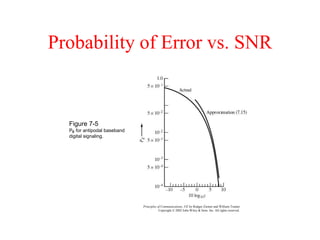
Probability of Error vs. SNR
Principles of Communications, 5/E by Rodger Ziemer and William Tranter
Copyright © 2002 John Wiley & Sons. Inc. All rights reserved.
Figure 7-5
PE for antipodal baseband
digital signaling.
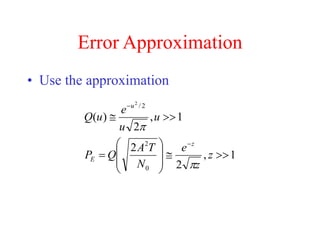
Error Approximation
• Use the approximation
1
,
2
2
1
,
2
)
(
0
2
2
/
2















z
z
e
N
T
A
Q
P
u
u
e
u
Q
z
E
u


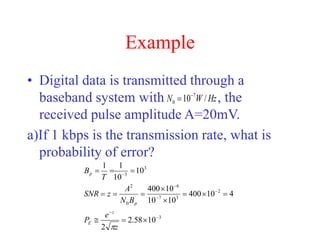
Example
• Digital data is transmitted through a
baseband system with , the
received pulse amplitude A=20mV.
a)If 1 kbps is the transmission rate, what is
probability of error?
Hz
W
N /
10 7
0


3
2
3
7
6
0
2
3
3
10
58
.
2
2
4
10
400
10
10
10
400
10
10
1
1




















z
e
P
B
N
A
z
SNR
T
B
z
E
p
p

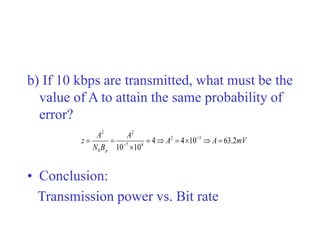
b) If 10 kbps are transmitted, what must be the
value of A to attain the same probability of
error?
• Conclusion:
Transmission power vs. Bit rate
mV
A
A
A
B
N
A
z
p
2
.
63
10
4
4
10
10
3
2
4
7
2
0
2








 

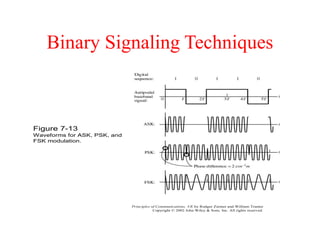
Binary Signaling Techniques
Principles of Communications, 5/E by Rodger Ziemer and William Tranter
Copyright © 2002 John Wiley & Sons. Inc. All rights reserved.
Figure 7-13
Waveforms for ASK, PSK, and
FSK modulation.
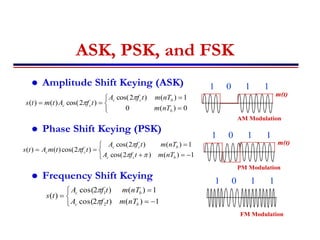
ASK, PSK, and FSK
 Amplitude Shift Keying (ASK)
 Phase Shift Keying (PSK)
 Frequency Shift Keying







0
)
(
0
1
)
(
)
2
cos(
)
2
cos(
)
(
)
(
b
b
c
c
c
c
nT
m
nT
m
t
f
A
t
f
A
t
m
t
s











1
)
(
)
2
cos(
1
)
(
)
2
cos(
)
2
cos(
)
(
)
(
b
c
c
b
c
c
c
c
nT
m
t
f
A
nT
m
t
f
A
t
f
t
m
A
t
s











1
)
(
)
2
cos(
1
)
(
)
2
cos(
)
(
2
1
b
c
b
c
nT
m
t
f
A
nT
m
t
f
A
t
s


1 0 1 1
1 0 1 1
1 0 1 1
AM Modulation
PM Modulation
FM Modulation
m(t)
m(t)
Amplitude Shift Keying (ASK)
• 00
• 1Acos(wct)
• What is the structure of the optimum
receiver?
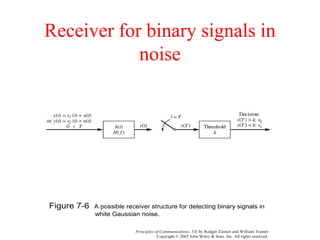
Receiver for binary signals in
noise
Principles of Communications, 5/E by Rodger Ziemer and William Tranter
Copyright © 2002 John Wiley & Sons. Inc. All rights reserved.
Figure 7-6 A possible receiver structure for detecting binary signals in
white Gaussian noise.
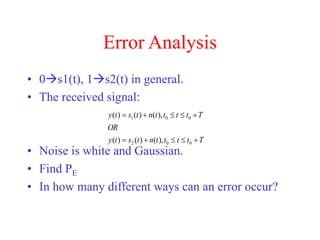
Error Analysis
• 0s1(t), 1s2(t) in general.
• The received signal:
• Noise is white and Gaussian.
• Find PE
• In how many different ways can an error occur?
T
t
t
t
t
n
t
s
t
y
OR
T
t
t
t
t
n
t
s
t
y










0
0
2
0
0
1
),
(
)
(
)
(
),
(
)
(
)
(
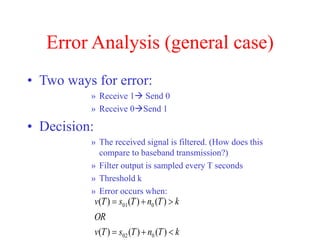
Error Analysis (general case)
• Two ways for error:
» Receive 1 Send 0
» Receive 0Send 1
• Decision:
» The received signal is filtered. (How does this
compare to baseband transmission?)
» Filter output is sampled every T seconds
» Threshold k
» Error occurs when:
k
T
n
T
s
T
v
OR
k
T
n
T
s
T
v






)
(
)
(
)
(
)
(
)
(
)
(
0
02
0
01
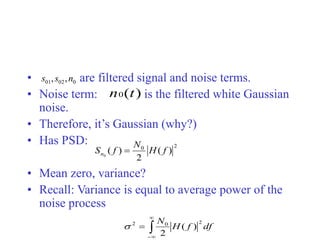
• are filtered signal and noise terms.
• Noise term: is the filtered white Gaussian
noise.
• Therefore, it’s Gaussian (why?)
• Has PSD:
• Mean zero, variance?
• Recall: Variance is equal to average power of the
noise process
0
02
01 ,
, n
s
s
)
(
0 t
n
2
0
)
(
2
)
(
0
f
H
N
f
Sn 
df
f
H
N 2
0
2
)
(
2






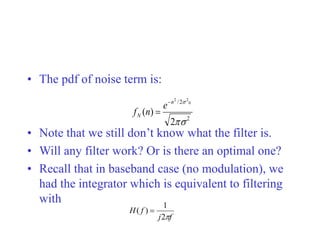
• The pdf of noise term is:
• Note that we still don’t know what the filter is.
• Will any filter work? Or is there an optimal one?
• Recall that in baseband case (no modulation), we
had the integrator which is equivalent to filtering
with
2
2
/
2
)
(
0
2
2


n
N
e
n
f


f
j
f
H

2
1
)
( 
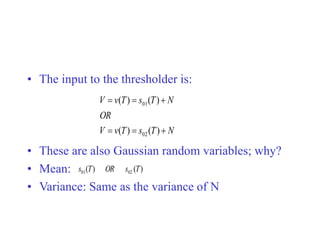
• The input to the thresholder is:
• These are also Gaussian random variables; why?
• Mean:
• Variance: Same as the variance of N
N
T
s
T
v
V
OR
N
T
s
T
v
V






)
(
)
(
)
(
)
(
02
01
)
(
)
( 02
01 T
s
OR
T
s
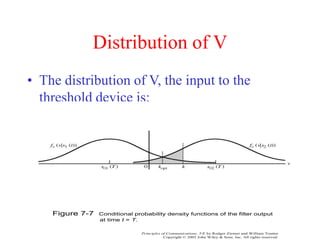
Distribution of V
• The distribution of V, the input to the
threshold device is:
Principles of Communications, 5/E by Rodger Ziemer and William Tranter
Copyright © 2002 John Wiley & Sons. Inc. All rights reserved.
Figure 7-7 Conditional probability density functions of the filter output
at time t = T.
Probability of Error
• Two types of errors:
• The average probability of error:





 








 








 







)
(
1
2
))
(
|
(
)
(
2
))
(
|
(
02
2
2
/
)]
(
[
2
01
2
2
/
)]
(
[
1
2
2
02
2
2
01
T
s
k
Q
dv
e
t
s
E
P
T
s
k
Q
dv
e
t
s
E
P
k T
s
v
k
T
s
v
)]
(
|
[
2
1
)]
(
|
[
2
1
2
1 t
s
E
P
t
s
E
P
PE 

• Goal: Minimize the average probability of
errror
• Choose the optimal threshold
• What should the optimal threshold, kopt be?
• Kopt=0.5[s01(T)+s02(T)]
•





 


2
)
(
)
( 01
02 T
s
T
s
Q
PE
Observations
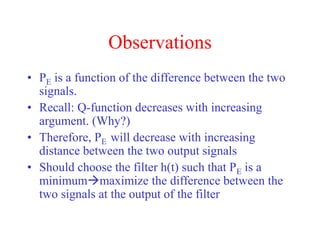
• PE is a function of the difference between the two
signals.
• Recall: Q-function decreases with increasing
argument. (Why?)
• Therefore, PE will decrease with increasing
distance between the two output signals
• Should choose the filter h(t) such that PE is a
minimummaximize the difference between the
two signals at the output of the filter
Matched Filter
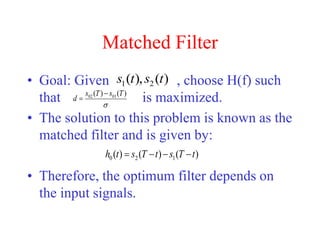
• Goal: Given , choose H(f) such
that is maximized.
• The solution to this problem is known as the
matched filter and is given by:
• Therefore, the optimum filter depends on
the input signals.
)
(
),
( 2
1 t
s
t
s

)
(
)
( 01
02 T
s
T
s
d


)
(
)
(
)
( 1
2
0 t
T
s
t
T
s
t
h 



Matched filter receiver
Principles of Communications, 5/E by Rodger Ziemer and William Tranter
Copyright © 2002 John Wiley & Sons. Inc. All rights reserved.
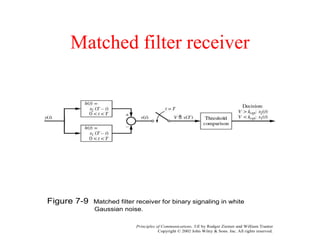
Figure 7-9 Matched filter receiver for binary signaling in white
Gaussian noise.
Error Probability for Matched
Filter Receiver
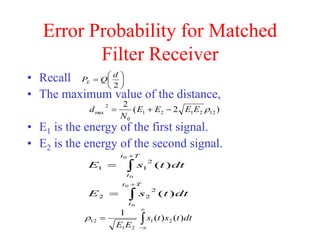
• Recall
• The maximum value of the distance,
• E1 is the energy of the first signal.
• E2 is the energy of the second signal.







2
d
Q
PE
)
2
(
2
12
2
1
2
1
0
2
max 
E
E
E
E
N
d 








T
t
t
T
t
t
dt
t
s
E
dt
t
s
E
0
0
0
0
)
(
)
(
2
2
2
2
1
1
dt
t
s
t
s
E
E
)
(
)
(
1
2
1
2
1
12 





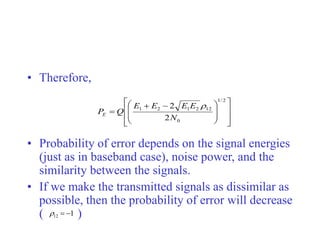
• Therefore,
• Probability of error depends on the signal energies
(just as in baseband case), noise power, and the
similarity between the signals.
• If we make the transmitted signals as dissimilar as
possible, then the probability of error will decrease
( )















 


2
/
1
0
12
2
1
2
1
2
2
N
E
E
E
E
Q
PE

1
12 


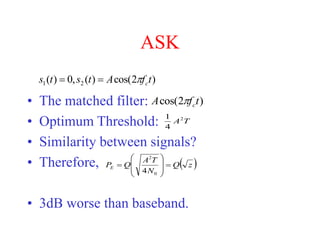
ASK
• The matched filter:
• Optimum Threshold:
• Similarity between signals?
• Therefore,
• 3dB worse than baseband.
)
2
cos(
)
(
,
0
)
( 2
1 t
f
A
t
s
t
s c



)
2
cos( t
f
A c

T
A2
4
1
 
z
Q
N
T
A
Q
PE 









0
2
4
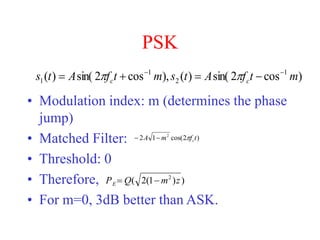
PSK
• Modulation index: m (determines the phase
jump)
• Matched Filter:
• Threshold: 0
• Therefore,
• For m=0, 3dB better than ASK.
)
cos
2
sin(
)
(
),
cos
2
sin(
)
( 1
2
1
1 m
t
f
A
t
s
m
t
f
A
t
s c
c





 

)
2
cos(
1
2 2
t
f
m
A c



)
)
1
(
2
( 2
z
m
Q
PE 

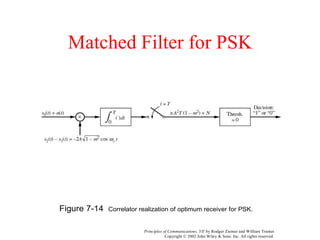
Matched Filter for PSK
Principles of Communications, 5/E by Rodger Ziemer and William Tranter
Copyright © 2002 John Wiley & Sons. Inc. All rights reserved.
Figure 7-14 Correlator realization of optimum receiver for PSK.
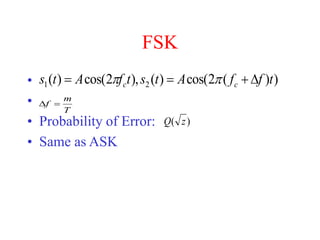
FSK
•
•
• Probability of Error:
• Same as ASK
)
)
(
2
cos(
)
(
),
2
cos(
)
( 2
1 t
f
f
A
t
s
t
f
A
t
s c
c 


 

T
m
f 

)
( z
Q
Applications
• Modems: FSK
• RF based security and access control
systems
• Cellular phones

Digital Data Transmission.ppt

  • 1.
  • 2.
    Analog vs. Digital Analog signals  Value varies continuously  Digital signals  Value limited to a finite set  Binary signals  Has at most 2 values  Used to represent bit values  Bit time T needed to send 1 bit  Data rate R=1/T bits per second t x(t) t x(t) t x(t) 1 0 0 0 1 1 0 T
  • 3.
    Information Representation • Communicationsystems convert information into a form suitable for transmission • Analog systemsAnalog signals are modulated (AM, FM radio) • Digital system generate bits and transmit digital signals (Computers) • Analog signals can be converted to digital signals.
  • 4.
    Digital Data System Principlesof Communications, 5/E by Rodger Ziemer and William Tranter Copyright © 2002 John Wiley & Sons. Inc. All rights reserved. Figure 7-1 Block diagram of a digital data system. (a) Transmitter. (b) Receiver.
  • 5.
    Components of Digital Communication •Sampling: If the message is analog, it’s converted to discrete time by sampling. (What should the sampling rate be ?) • Quantization: Quantized in amplitude. Discrete in time and amplitude • Encoder: – Convert message or signals in accordance with a set of rules – Translate the discrete set of sample values to a signal. • Decoder: Decodes received signals back into original message
  • 6.
  • 7.
    Performance Metrics • Inanalog communications we want, • Digital communication systems: – Data rate (R bps) (Limited) Channel Capacity – Probability of error – Without noise, we don’t make bit errors – Bit Error Rate (BER): Number of bit errors that occur for a given number of bits transmitted. • What’s BER if Pe=10-6 and 107 bits are transmitted? ) ( ) ( ˆ t m t m  e P
  • 8.
    Advantages • Stability ofcomponents: Analog hardware change due to component aging, heat, etc. • Flexibility: – Perform encryption – Compression – Error correction/detection • Reliable reproduction
  • 9.
    Applications • Digital Audio Transmission •Telephone channels • Lowpass filter,sample,quantize • 32kbps-64kbps (depending on the encoder) • Digital Audio Recording • LP vs. CD • Improve fidelity (How?) • More durable and don’t deteriorate with time
  • 10.
    Baseband Data Transmission Principlesof Communications, 5/E by Rodger Ziemer and William Tranter Copyright © 2002 John Wiley & Sons. Inc. All rights reserved. Figure 7-2 System model and waveforms for synchronous baseband digital data transmission. (a) Baseband digital data communication system. (b) Typical transmitted sequence. (c) Received sequence plus noise.
  • 11.
    • Each T-secondpulse is a bit. • Receiver has to decide whether it’s a 1 or 0 ( A or –A) • Integrate-and-dump detector • Possible different signaling schemes?
  • 12.
    Receiver Structure Principles ofCommunications, 5/E by Rodger Ziemer and William Tranter Copyright © 2002 John Wiley & Sons. Inc. All rights reserved. Figure 7-3 Receiver structure and integrator output. (a) Integrate-and- dump receiver. (b) Output from the integrator.
  • 13.
    Receiver Preformance • Theoutput of the integrator: • is a random variable. • N is Gaussian. Why?             sent is A N AT sent is A N AT dt t n t s V T t t 0 0 )] ( ) ( [    T t t dt t n N 0 0 ) (
  • 14.
    Analysis • Key Point –White noise is uncorrelated 2 ) ! ?( ) ( 2 )] ( ) ( [ ) ( ? ] [ ] [ ] [ ] [ 0 )] ( [ ] ) ( [ ] [ 0 0 2 2 2 2 0 0 0 0 0 0 0 0 0 0 0 0 0 0 T N ed uncorrelat is noise White Why dtds s t N dtds s n t n E dt t n E Why N E N E N E N Var dt t n E dt t n E N E T t t T t t T t t T t t T t t T t t T t t                                            
  • 15.
    Error Analysis • Therefore,the pdf of N is: • In how many different ways, can an error occur? T N e n f T N n N 0 ) /( 0 2 ) (   
  • 16.
    Error Analysis • Twoways in which errors occur: – A is transmitted, AT+N<0 (0 received,1 sent) – -A is transmitted, -AT+N>0 (1 received,0 sent) Principles of Communications, 5/E by Rodger Ziemer and William Tranter Copyright © 2002 John Wiley & Sons. Inc. All rights reserved. Figure 7-4 Illustration of error probabilities for binary signaling.
  • 17.
    • • Similarly, • Theaverage probability of error:                0 2 0 / 2 ) | ( 0 2 N T A Q dn T N e A Error P AT T N n                0 2 0 / 2 ) | ( 0 2 N T A Q dn T N e A Error P AT T N n               0 2 2 ) ( ) | ( ) ( ) | ( N T A Q A P A E P A P A E P PE
  • 18.
    • Energy perbit: • Therefore, the error can be written in terms of the energy. • Define T A dt A E T t t b 2 2 0 0     0 0 2 N E N T A z b  
  • 19.
    • Recall: Rectangularpulse of duration T seconds has magnitude spectrum • Effective Bandwidth: • Therefore, • What’s the physical meaning of this quantity? ) (Tf sinc AT T Bp / 1  p B N A z 0 2 
  • 20.
    Probability of Errorvs. SNR Principles of Communications, 5/E by Rodger Ziemer and William Tranter Copyright © 2002 John Wiley & Sons. Inc. All rights reserved. Figure 7-5 PE for antipodal baseband digital signaling.
  • 21.
    Error Approximation • Usethe approximation 1 , 2 2 1 , 2 ) ( 0 2 2 / 2                z z e N T A Q P u u e u Q z E u  
  • 22.
    Example • Digital datais transmitted through a baseband system with , the received pulse amplitude A=20mV. a)If 1 kbps is the transmission rate, what is probability of error? Hz W N / 10 7 0   3 2 3 7 6 0 2 3 3 10 58 . 2 2 4 10 400 10 10 10 400 10 10 1 1                     z e P B N A z SNR T B z E p p 
  • 23.
    b) If 10kbps are transmitted, what must be the value of A to attain the same probability of error? • Conclusion: Transmission power vs. Bit rate mV A A A B N A z p 2 . 63 10 4 4 10 10 3 2 4 7 2 0 2           
  • 24.
    Binary Signaling Techniques Principlesof Communications, 5/E by Rodger Ziemer and William Tranter Copyright © 2002 John Wiley & Sons. Inc. All rights reserved. Figure 7-13 Waveforms for ASK, PSK, and FSK modulation.
  • 25.
    ASK, PSK, andFSK  Amplitude Shift Keying (ASK)  Phase Shift Keying (PSK)  Frequency Shift Keying        0 ) ( 0 1 ) ( ) 2 cos( ) 2 cos( ) ( ) ( b b c c c c nT m nT m t f A t f A t m t s            1 ) ( ) 2 cos( 1 ) ( ) 2 cos( ) 2 cos( ) ( ) ( b c c b c c c c nT m t f A nT m t f A t f t m A t s            1 ) ( ) 2 cos( 1 ) ( ) 2 cos( ) ( 2 1 b c b c nT m t f A nT m t f A t s   1 0 1 1 1 0 1 1 1 0 1 1 AM Modulation PM Modulation FM Modulation m(t) m(t)
  • 26.
    Amplitude Shift Keying(ASK) • 00 • 1Acos(wct) • What is the structure of the optimum receiver?
  • 27.
    Receiver for binarysignals in noise Principles of Communications, 5/E by Rodger Ziemer and William Tranter Copyright © 2002 John Wiley & Sons. Inc. All rights reserved. Figure 7-6 A possible receiver structure for detecting binary signals in white Gaussian noise.
  • 28.
    Error Analysis • 0s1(t),1s2(t) in general. • The received signal: • Noise is white and Gaussian. • Find PE • In how many different ways can an error occur? T t t t t n t s t y OR T t t t t n t s t y           0 0 2 0 0 1 ), ( ) ( ) ( ), ( ) ( ) (
  • 29.
    Error Analysis (generalcase) • Two ways for error: » Receive 1 Send 0 » Receive 0Send 1 • Decision: » The received signal is filtered. (How does this compare to baseband transmission?) » Filter output is sampled every T seconds » Threshold k » Error occurs when: k T n T s T v OR k T n T s T v       ) ( ) ( ) ( ) ( ) ( ) ( 0 02 0 01
  • 30.
    • are filteredsignal and noise terms. • Noise term: is the filtered white Gaussian noise. • Therefore, it’s Gaussian (why?) • Has PSD: • Mean zero, variance? • Recall: Variance is equal to average power of the noise process 0 02 01 , , n s s ) ( 0 t n 2 0 ) ( 2 ) ( 0 f H N f Sn  df f H N 2 0 2 ) ( 2      
  • 31.
    • The pdfof noise term is: • Note that we still don’t know what the filter is. • Will any filter work? Or is there an optimal one? • Recall that in baseband case (no modulation), we had the integrator which is equivalent to filtering with 2 2 / 2 ) ( 0 2 2   n N e n f   f j f H  2 1 ) ( 
  • 32.
    • The inputto the thresholder is: • These are also Gaussian random variables; why? • Mean: • Variance: Same as the variance of N N T s T v V OR N T s T v V       ) ( ) ( ) ( ) ( 02 01 ) ( ) ( 02 01 T s OR T s
  • 33.
    Distribution of V •The distribution of V, the input to the threshold device is: Principles of Communications, 5/E by Rodger Ziemer and William Tranter Copyright © 2002 John Wiley & Sons. Inc. All rights reserved. Figure 7-7 Conditional probability density functions of the filter output at time t = T.
  • 34.
    Probability of Error •Two types of errors: • The average probability of error:                                   ) ( 1 2 )) ( | ( ) ( 2 )) ( | ( 02 2 2 / )] ( [ 2 01 2 2 / )] ( [ 1 2 2 02 2 2 01 T s k Q dv e t s E P T s k Q dv e t s E P k T s v k T s v )] ( | [ 2 1 )] ( | [ 2 1 2 1 t s E P t s E P PE  
  • 35.
    • Goal: Minimizethe average probability of errror • Choose the optimal threshold • What should the optimal threshold, kopt be? • Kopt=0.5[s01(T)+s02(T)] •          2 ) ( ) ( 01 02 T s T s Q PE
  • 36.
    Observations • PE isa function of the difference between the two signals. • Recall: Q-function decreases with increasing argument. (Why?) • Therefore, PE will decrease with increasing distance between the two output signals • Should choose the filter h(t) such that PE is a minimummaximize the difference between the two signals at the output of the filter
  • 37.
    Matched Filter • Goal:Given , choose H(f) such that is maximized. • The solution to this problem is known as the matched filter and is given by: • Therefore, the optimum filter depends on the input signals. ) ( ), ( 2 1 t s t s  ) ( ) ( 01 02 T s T s d   ) ( ) ( ) ( 1 2 0 t T s t T s t h    
  • 38.
    Matched filter receiver Principlesof Communications, 5/E by Rodger Ziemer and William Tranter Copyright © 2002 John Wiley & Sons. Inc. All rights reserved. Figure 7-9 Matched filter receiver for binary signaling in white Gaussian noise.
  • 39.
    Error Probability forMatched Filter Receiver • Recall • The maximum value of the distance, • E1 is the energy of the first signal. • E2 is the energy of the second signal.        2 d Q PE ) 2 ( 2 12 2 1 2 1 0 2 max  E E E E N d          T t t T t t dt t s E dt t s E 0 0 0 0 ) ( ) ( 2 2 2 2 1 1 dt t s t s E E ) ( ) ( 1 2 1 2 1 12      
  • 40.
    • Therefore, • Probabilityof error depends on the signal energies (just as in baseband case), noise power, and the similarity between the signals. • If we make the transmitted signals as dissimilar as possible, then the probability of error will decrease ( )                    2 / 1 0 12 2 1 2 1 2 2 N E E E E Q PE  1 12   
  • 41.
    ASK • The matchedfilter: • Optimum Threshold: • Similarity between signals? • Therefore, • 3dB worse than baseband. ) 2 cos( ) ( , 0 ) ( 2 1 t f A t s t s c    ) 2 cos( t f A c  T A2 4 1   z Q N T A Q PE           0 2 4
  • 42.
    PSK • Modulation index:m (determines the phase jump) • Matched Filter: • Threshold: 0 • Therefore, • For m=0, 3dB better than ASK. ) cos 2 sin( ) ( ), cos 2 sin( ) ( 1 2 1 1 m t f A t s m t f A t s c c         ) 2 cos( 1 2 2 t f m A c    ) ) 1 ( 2 ( 2 z m Q PE  
  • 43.
    Matched Filter forPSK Principles of Communications, 5/E by Rodger Ziemer and William Tranter Copyright © 2002 John Wiley & Sons. Inc. All rights reserved. Figure 7-14 Correlator realization of optimum receiver for PSK.
  • 44.
    FSK • • • Probability ofError: • Same as ASK ) ) ( 2 cos( ) ( ), 2 cos( ) ( 2 1 t f f A t s t f A t s c c       T m f   ) ( z Q
  • 45.
    Applications • Modems: FSK •RF based security and access control systems • Cellular phones