Evaluation of optic nerve disease
 
 
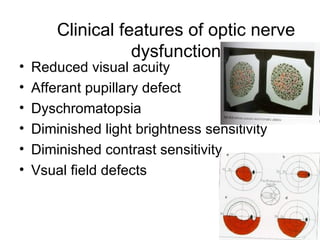
Clinical features of optic nerve dysfunction Reduced visual acuity Afferant pupillary defect Dyschromatopsia Diminished light brightness sensitivity Diminished contrast sensitivity Vsual field defects
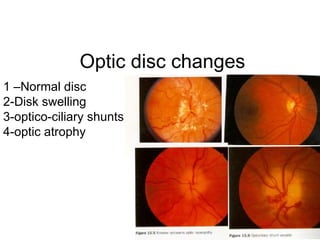
Optic disc changes 1 –Normal disc 2-Disk swelling  3-optico-ciliary shunts 4-optic atrophy
Optic atrophy primary optic atrophy A; causes  Following retrobulbar neuritis Compressive lesions such as tumors and aneurysms hereditary optic neuropathies  Toxic and nutritional optic neuropathies
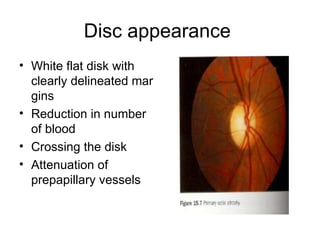
Disc appearance  White flat disk with clearly delineated mar gins  Reduction in number of blood Crossing the disk  Attenuation of prepapillary vessels
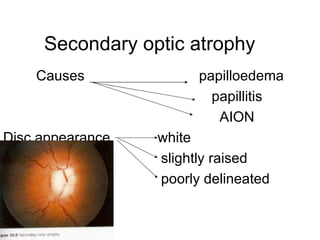
Secondary optic atrophy  Causes  papilloedema papillitis AION Disc appearance  white slightly raised poorly delineated margin
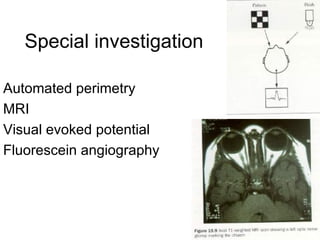
Special investigation Automated perimetry MRI Visual evoked potential Fluorescein angiography
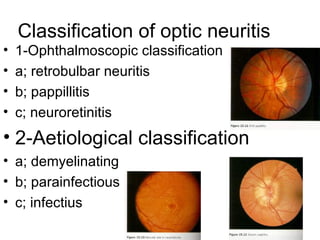
Classification of optic neuritis 1-Ophthalmoscopic classification a; retrobulbar neuritis  b; pappillitis  c; neuroretinitis  2-Aetiological classification a; demyelinating b; parainfectious c; infectius
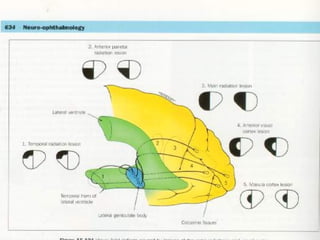
Optic neuriotis and demyelination VISUAL PATHWAY LESIONS BRAIN STEM LESION
Demyelination diseases Isolated optic neuritis  Multiple sclerosis  devic disease  Schilder disease
Systemic feature of MS Spinal cord lesion Brain stem lesion  Hemisphere lesion Transient phenomena
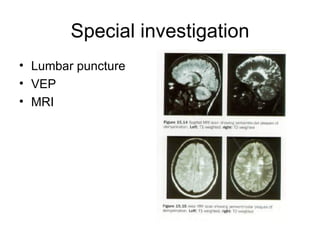
Special investigation Lumbar puncture VEP MRI
Optic neuritis  70% of women and 30% of men develop MS Evidance of optic neuritis in 70% of MS In 70% of isolated optic neuritis abnorml MRI Risk of MS winter onset HLA DR2 & uthuff
presentation Sudden onest of visul loss discomfort in or around the eye Frontal headache tenderness of globe
signs Normal disc in two-thirds (retrobulbar) Diminished visual acuity (very mild –very sever) Impairment of visual acuity & contrast sensitivity Visual field defect (central scotoma)
Clinical course  Impairment of visual acuity becomes maximum  after 1-2 weeks (6/18-6/60) Recovery takes 4-6 weeks usually
Prognosis  Excellent in 75% (V/A 6/9)
treatment In mild visual loss treatment is probably unnecessary  When visual acuity in the first week of symptom is worse than 6/12 treatment may speed up recovery Intravenous methylprednisolon sodium succinat Treatment dose not appear to have any long term benefit on final visual acuity
 
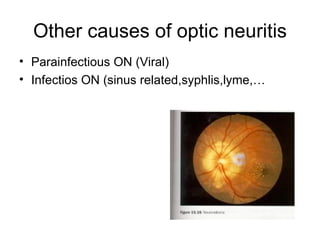
Other causes of optic neuritis Parainfectious ON (Viral) Infectios ON (sinus related,syphlis,lyme,…
 
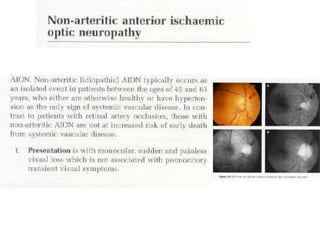
signs Pale disc Diffuse or sectoral edema Localized disc hyperfluorescence V/A in 1/3 of patient is normal in remainder have moderate to sever impairment  Visual field defect is typically altitudinal Color vision is diminished
managment Serologic study  Fasting lipid profile  Blood glucose, fibrinogen & packed cell volume
Treatment  Treatment of any underlying diseases  Stop smoking  Low-dose aspirin
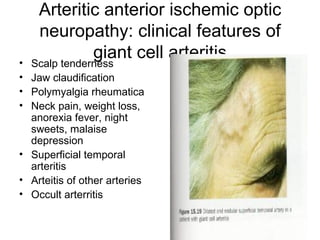
Arteritic anterior ischemic optic neuropathy: clinical features of giant cell arteritis Scalp tenderness Jaw claudification Polymyalgia rheumatica Neck pain, weight loss, anorexia fever, night sweets, malaise depression Superficial temporal arteritis  Arteitis of other arteries Occult arterritis
Arteritic anterior iscxhemic optic neuropathy Uniocular sudden and profound loss of vision Periocular pain  Transient visual obscuration Flashing lights
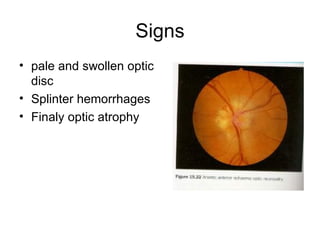
Signs pale and swollen optic disc Splinter hemorrhages Finaly optic atrophy
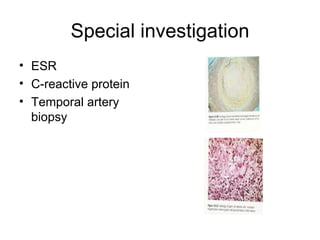
Special investigation ESR C-reactive protein  Temporal artery biopsy
treatment Intravenous methylprednisolon 1g/day for 3 day together with oral prednisolon 80 mg After 3 days 60 mg for 3 day than 40 mg/days Than daily dose reduced 5 mg weekly  Maintanance is 10 mg
 
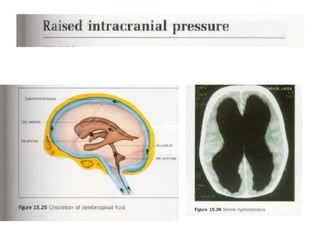
Papillodema causes Space-ocupaying lesion  Blockage of the ventricular system Obstruction of CSF absorption Benign intracranial hypertention, diffuse cerebral edema, sever hypertention Hypersecretion of CSF
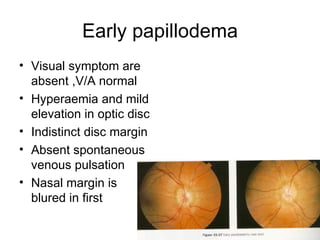
Early papillodema Visual symptom are absent ,V/A normal Hyperaemia and mild elevation in optic disc Indistinct disc margin Absent spontaneous venous pulsation Nasal margin is blured in first
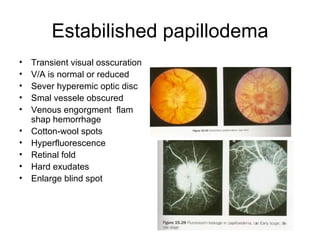
Estabilished papillodema Transient visual osscuration V/A is normal or reduced  Sever hyperemic optic disc Smal vessele obscured Venous engorgment  flam shap hemorrhage Cotton-wool spots Hyperfluorescence Retinal fold Hard exudates Enlarge blind spot
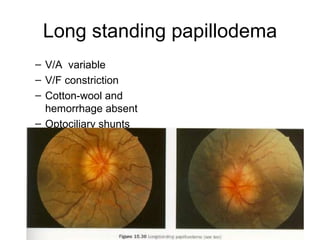
Long standing papillodema V/A  variable V/F constriction Cotton-wool and hemorrhage absent Optociliary shunts
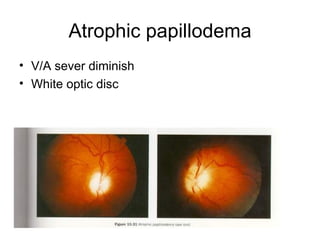
Atrophic papillodema V/A sever diminish White optic disc
Differential diagnosis Malignant hypertention Bilateral papilitis Bilateral compressive thyroid orbitopathy Bilateral simultaneousanteriorischemic optic neuropathy Bilateral compromisedvenous drainage
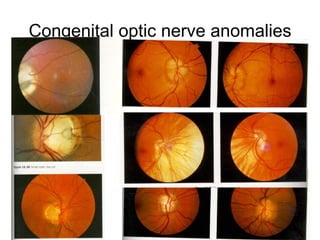
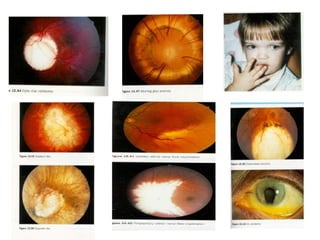
Congenital optic nerve anomalies


Optic nerve 2

  • 1.
    Evaluation of opticnerve disease
  • 2.
  • 3.
  • 4.
    Clinical features ofoptic nerve dysfunction Reduced visual acuity Afferant pupillary defect Dyschromatopsia Diminished light brightness sensitivity Diminished contrast sensitivity Vsual field defects
  • 5.
    Optic disc changes1 –Normal disc 2-Disk swelling 3-optico-ciliary shunts 4-optic atrophy
  • 6.
    Optic atrophy primaryoptic atrophy A; causes Following retrobulbar neuritis Compressive lesions such as tumors and aneurysms hereditary optic neuropathies Toxic and nutritional optic neuropathies
  • 7.
    Disc appearance White flat disk with clearly delineated mar gins Reduction in number of blood Crossing the disk Attenuation of prepapillary vessels
  • 8.
    Secondary optic atrophy Causes papilloedema papillitis AION Disc appearance white slightly raised poorly delineated margin
  • 9.
    Special investigation Automatedperimetry MRI Visual evoked potential Fluorescein angiography
  • 10.
    Classification of opticneuritis 1-Ophthalmoscopic classification a; retrobulbar neuritis b; pappillitis c; neuroretinitis 2-Aetiological classification a; demyelinating b; parainfectious c; infectius
  • 11.
    Optic neuriotis anddemyelination VISUAL PATHWAY LESIONS BRAIN STEM LESION
  • 12.
    Demyelination diseases Isolatedoptic neuritis Multiple sclerosis devic disease Schilder disease
  • 13.
    Systemic feature ofMS Spinal cord lesion Brain stem lesion Hemisphere lesion Transient phenomena
  • 14.
  • 15.
    Optic neuritis 70% of women and 30% of men develop MS Evidance of optic neuritis in 70% of MS In 70% of isolated optic neuritis abnorml MRI Risk of MS winter onset HLA DR2 & uthuff
  • 16.
    presentation Sudden onestof visul loss discomfort in or around the eye Frontal headache tenderness of globe
  • 17.
    signs Normal discin two-thirds (retrobulbar) Diminished visual acuity (very mild –very sever) Impairment of visual acuity & contrast sensitivity Visual field defect (central scotoma)
  • 18.
    Clinical course Impairment of visual acuity becomes maximum after 1-2 weeks (6/18-6/60) Recovery takes 4-6 weeks usually
  • 19.
    Prognosis Excellentin 75% (V/A 6/9)
  • 20.
    treatment In mildvisual loss treatment is probably unnecessary When visual acuity in the first week of symptom is worse than 6/12 treatment may speed up recovery Intravenous methylprednisolon sodium succinat Treatment dose not appear to have any long term benefit on final visual acuity
  • 21.
  • 22.
    Other causes ofoptic neuritis Parainfectious ON (Viral) Infectios ON (sinus related,syphlis,lyme,…
  • 23.
  • 24.
    signs Pale discDiffuse or sectoral edema Localized disc hyperfluorescence V/A in 1/3 of patient is normal in remainder have moderate to sever impairment Visual field defect is typically altitudinal Color vision is diminished
  • 25.
    managment Serologic study Fasting lipid profile Blood glucose, fibrinogen & packed cell volume
  • 26.
    Treatment Treatmentof any underlying diseases Stop smoking Low-dose aspirin
  • 27.
    Arteritic anterior ischemicoptic neuropathy: clinical features of giant cell arteritis Scalp tenderness Jaw claudification Polymyalgia rheumatica Neck pain, weight loss, anorexia fever, night sweets, malaise depression Superficial temporal arteritis Arteitis of other arteries Occult arterritis
  • 28.
    Arteritic anterior iscxhemicoptic neuropathy Uniocular sudden and profound loss of vision Periocular pain Transient visual obscuration Flashing lights
  • 29.
    Signs pale andswollen optic disc Splinter hemorrhages Finaly optic atrophy
  • 30.
    Special investigation ESRC-reactive protein Temporal artery biopsy
  • 31.
    treatment Intravenous methylprednisolon1g/day for 3 day together with oral prednisolon 80 mg After 3 days 60 mg for 3 day than 40 mg/days Than daily dose reduced 5 mg weekly Maintanance is 10 mg
  • 32.
  • 33.
    Papillodema causes Space-ocupayinglesion Blockage of the ventricular system Obstruction of CSF absorption Benign intracranial hypertention, diffuse cerebral edema, sever hypertention Hypersecretion of CSF
  • 34.
    Early papillodema Visualsymptom are absent ,V/A normal Hyperaemia and mild elevation in optic disc Indistinct disc margin Absent spontaneous venous pulsation Nasal margin is blured in first
  • 35.
    Estabilished papillodema Transientvisual osscuration V/A is normal or reduced Sever hyperemic optic disc Smal vessele obscured Venous engorgment flam shap hemorrhage Cotton-wool spots Hyperfluorescence Retinal fold Hard exudates Enlarge blind spot
  • 36.
    Long standing papillodemaV/A variable V/F constriction Cotton-wool and hemorrhage absent Optociliary shunts
  • 37.
    Atrophic papillodema V/Asever diminish White optic disc
  • 38.
    Differential diagnosis Malignanthypertention Bilateral papilitis Bilateral compressive thyroid orbitopathy Bilateral simultaneousanteriorischemic optic neuropathy Bilateral compromisedvenous drainage
  • 39.
  • 40.
  • 41.
  • 42.
  • 43.
  • 44.
  • 45.
  • 46.
  • 47.
  • 48.