Operations Research
By
Prof.P.D.Devan
Kumaraguru College of Technology
Coimbatore
Operations Research
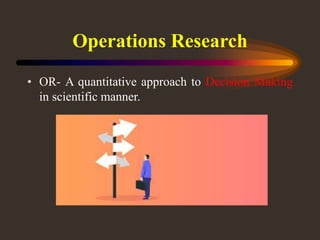
• OR- A quantitative approach to Decision Making
in scientific manner.
Quantitative Approach
• Decision maker comes to a conclusion / solution
based on the quantified / numerical results among
the alternatives.
• Eg: Stock Market, Investment on gold,
Business
Qualitative Approach
• Most of the decision makers are not considering
this approach before arriving to a solution because
of its uncertainty.
• Eg: Weather, Sudden Govt Policies, Political Situation,
New technology
Quantitative Vs Qualitative
Definition of OR
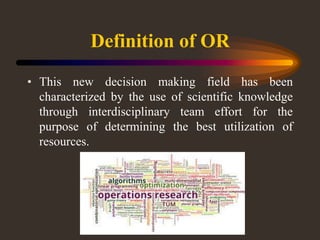
• This new decision making field has been
characterized by the use of scientific knowledge
through interdisciplinary team effort for the
purpose of determining the best utilization of
resources.
Features of OR
• Interdisciplinary Approach
• Scientific Approach
• Holistic Approach
• Objective-oriented Approach
Phases of OR
Judgment Phase
• Identification of Problem
• Identification of appropriate objective & values of variable
• Deciding the scale of measurement
• Formulation of appropriate model to solve the problem
Cont…
Research Phase
• Observation & data collection
• Formulation of hypothesis and model
• Experimentation to test the hypothesis
• Analyze the information and verify the hypothesis
• Prediction of various results from hypothesis
• Discussion results/ alternatives.
Cont…
Action Phase/ Implementation
• Every individual must be aware of the decision.
• Objective, assumptions, constraints are to be
disseminated to all the stakeholders of an
organization.
OR Models
• An approximation or abstraction of reality which
considers only the essential variables and parameters in
the system along with their relationship.
• Models cannot be represented every aspects of reality.
Because the reality consists innumerable and changing
characteristics.
Cont…
• Model should be as simple as possible.
• Oversimplifying leads to poor decision.
• Model can be enriched through
 adding variables,
 changing constants in to variables,
 relaxing linearity and assumptions.
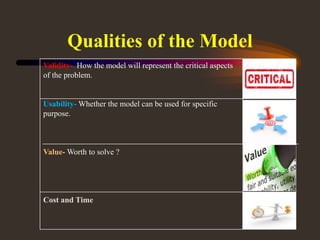
Qualities of the Model
Validity- How the model will represent the critical aspects
of the problem.
Usability- Whether the model can be used for specific
purpose.
Value- Worth to solve ?
Cost and Time
OR Methodology
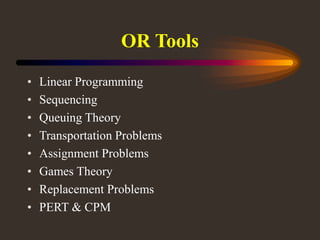
OR Tools
• Linear Programming
• Sequencing
• Queuing Theory
• Transportation Problems
• Assignment Problems
• Games Theory
• Replacement Problems
• PERT & CPM
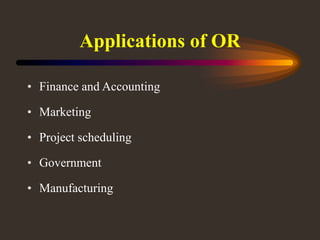
Applications of OR
• Finance and Accounting
• Marketing
• Project scheduling
• Government
• Manufacturing
Limitations of OR
• Problems are often simplified / assumptions are
incorporated
• Model may not represent the actual behavior of
the system
• Lack of decision makers awareness
• Many real world problems can not have OR
solution
Operations research

Operations research

  • 1.
  • 2.
    Operations Research • OR-A quantitative approach to Decision Making in scientific manner.
  • 3.
    Quantitative Approach • Decisionmaker comes to a conclusion / solution based on the quantified / numerical results among the alternatives. • Eg: Stock Market, Investment on gold, Business
  • 4.
    Qualitative Approach • Mostof the decision makers are not considering this approach before arriving to a solution because of its uncertainty. • Eg: Weather, Sudden Govt Policies, Political Situation, New technology
  • 5.
  • 6.
    Definition of OR •This new decision making field has been characterized by the use of scientific knowledge through interdisciplinary team effort for the purpose of determining the best utilization of resources.
  • 7.
    Features of OR •Interdisciplinary Approach • Scientific Approach • Holistic Approach • Objective-oriented Approach
  • 8.
    Phases of OR JudgmentPhase • Identification of Problem • Identification of appropriate objective & values of variable • Deciding the scale of measurement • Formulation of appropriate model to solve the problem
  • 9.
    Cont… Research Phase • Observation& data collection • Formulation of hypothesis and model • Experimentation to test the hypothesis • Analyze the information and verify the hypothesis • Prediction of various results from hypothesis • Discussion results/ alternatives.
  • 10.
    Cont… Action Phase/ Implementation •Every individual must be aware of the decision. • Objective, assumptions, constraints are to be disseminated to all the stakeholders of an organization.
  • 11.
    OR Models • Anapproximation or abstraction of reality which considers only the essential variables and parameters in the system along with their relationship. • Models cannot be represented every aspects of reality. Because the reality consists innumerable and changing characteristics.
  • 12.
    Cont… • Model shouldbe as simple as possible. • Oversimplifying leads to poor decision. • Model can be enriched through  adding variables,  changing constants in to variables,  relaxing linearity and assumptions.
  • 14.
    Qualities of theModel Validity- How the model will represent the critical aspects of the problem. Usability- Whether the model can be used for specific purpose. Value- Worth to solve ? Cost and Time
  • 16.
  • 17.
    OR Tools • LinearProgramming • Sequencing • Queuing Theory • Transportation Problems • Assignment Problems • Games Theory • Replacement Problems • PERT & CPM
  • 18.
    Applications of OR •Finance and Accounting • Marketing • Project scheduling • Government • Manufacturing
  • 19.
    Limitations of OR •Problems are often simplified / assumptions are incorporated • Model may not represent the actual behavior of the system • Lack of decision makers awareness • Many real world problems can not have OR solution