11/02/2024 1
CHAPTER ONE
INTRODUCTION TO OPERATION RESEARCH
1.1 Definition of Operations Research
1.2 The History of Operations Research
1.3. Nature and significance of Operations Research
1.4. Features of Operations Research
1.5. Model and modeling in Operations Research
1.6. Application Areas of OR
CHAPTER ONE
INTRODUCTION TO OPERATION RESEARCH
1.1 Definition of Operations Research
1.2 The History of Operations Research
1.3. Nature and significance of Operations Research
1.4. Features of Operations Research
1.5. Model and modeling in Operations Research
1.6. Application Areas of OR
7/6/2023 1
11/02/2024 2
• The subject Operations Research (OR) is a branch of
Mathematics- specially applied mathematics, used to provide
a scientific base for Management to take timely and
effective decisions to their problems.
• It tries to avoid the dangers from taking decisions merely by
guessing or by using thumb rules.
• It uses a logical approach to problem solving (uses
quantitative models to solve business problems)
11/02/2024 3
• The general OR approach is to analyze the problem in
economic terms and then implement the solution if it doesn’t
aggressive or violent to other aspects like human, social, and
political constraints
• Quantitative approach to management problems requires that
decision problems be defined, analyzed, and solved in a
conscious, rational, logical and systematic and scientific
manner- based on data, facts, information, and logic, and not
mere guess work or thumb rules
11/02/2024 4
• OR is the body of knowledge, which uses mathematical
techniques to solve management problems and make timely and
optimal solutions.
• Though common sense, experience and commitment of the
manager is essential in making decision, we can not deny the
role-played by scientific methods in making optimal decisions
• The applications of Management Science /OR/ techniques
are widespread, and they have been frequently credited with
increasing the efficiency and productivity of business firms.
11/02/2024 5
History of Operations Research
• OR is a “war baby”
• It is because the 1st
problem attempted to solve in a systematic
way was concerned with how to set the time fuse bomb to be
dropped from an aircraft onto a submarine.
• The main origin of OR was during the WWII.
• During WWII, the military management in England
invited a team of scientists to study the strategic and tactical
problems related to air and land defense of the country.
11/02/2024 6
• The problem attained importance because at that time
resources available with England was very limited and
objective was to win the war with available meager resources.
• It was necessary to decide upon the most effective utilization of
available resources to achieve the objective.
• As the name indicates:
o OPERATION is used to refer to military problem
o RESEARCH is used to refer to inventing new method
11/02/2024 7
• As this method of solving problem was invented during the war period,
the subject is given the name “OPERATIONS RESEARCH”
and is abbreviated as OR.
• After the war ended, scientists who had been active in the military
Operation groups made efforts to apply the operations research
approach to civilian problems, related to business, industry,
research and development, etc.
• After the world war, there was a scarcity of industrial material and
industrial productivity which calls for the use of OR
• OR today plays a significant role in support of management decision
making in business and non-business organizations.
11/02/2024 8
• There are three important factors behind the rapid
development in the use of operations research approach.
1. The economic and industrial boom after World War II
resulted in continuous mechanization, automation,
decentralization of operations and division of management
factors.
2. Many operation researchers continued their research after the
war ended. E.g established different OR techniques.
3. Analytic power was made available by high-speed computers.
11/02/2024 9
Definitions of Operation Research
 OR can be defined in different ways by different groups.
 Following are some of the important definitions in academic interest.
OR is the art of winning wars without actually fighting (Aurther
Clarke)
OR is the art of giving bad answers to problems where otherwise worse
answers are given (T.L. Satty)
OR is the application of scientific methods, techniques and tools, to
problems involving operations of a system so as to provide those in
control of the operations with optimum solutions to the problems.
11/02/2024 10
OR is a scientific method for providing executive
departments a quantitative basis for decisions regarding the
operations under their control (Morse and Kimball)
OR is the application of scientific methods, techniques and
tools to operations of a system with optimum solutions to the
problem (Churchman, Ackoff and Arnoff)
11/02/2024 11
OR seeks the determination of the optimum course of action
of a decision problem under the restriction of limited
resources. It is quite often associated almost exclusively with
the use of mathematical techniques to model and analyze
decision problems.
OR is the application of a scientific approach to solving
management problems in order to help managers make better
decisions.
11/02/2024 12
Nature and significance of OR
• The OR approach is particularly useful in balancing conflicting
objectives (goals or interests), where there are many alternative
courses of action available to the decision-makers.
• In a theoretical sense, the optimum decision must be one that is
best for the organization as a whole.
• It is often called global optimum. A decision that is best for
one or more sections of the organization is usually called
suboptimum decision.
11/02/2024 13
• Hence, the OR approach attempts to find global
optimum by analyzing inter-relationships among the
system components involved in the problem.
• That means, in OR, we are concerned with how to choose
optimal strategy under specified set of assumptions,
including all available strategies and their associated
payoffs.
11/02/2024 14
Features of Operations Research Approach
1. OR is an Inter-disciplinary team approach:
Interdisciplinary teamwork is essential because while attempting to solve a
complex management problem, one person may not have complete knowledge
of all its aspects such as economic, social, political, psychological, engineering,
etc.
2. Methodological Approach:
OR is the application of scientific methods, techniques and tools to problems
involving the operations of systems so as to provide those in control of
operations with optimum solutions to the problems.
11/02/2024 15
3. Holistic Approach or Systems Orientation:
While arriving at a decision, an operation research team examines the
relative importance of all conflicting and multiple objectives and the
validity of claims of various departments of the organization from the
perspective of the whole organization.
4. Objectivistic Approach:
The OR approach seeks to obtain an optimal solution to the problem
under analysis.
11/02/2024 16
5. Decision Making:
OR increases the effectiveness of management decisions. It is the
decision science which helps management to make better decisions.
6. Use of Computers:
OR often requires a computer to solve the complex mathematical
model or to perform a large number of computations that are involved.
7. Human factors
11/02/2024 17
Model and Modeling in Operations Research
• A Model is an abstraction of reality. It is a simplified, and often
idealized, representation of reality.
• Model provide a manager or analyst with an alternative to working
directly with reality.
• It is important to carefully decide which aspect of reality to include in
a model.
11/02/2024 18
Model Types
• Models can be classified in a number of ways. One way uses
these categories:
• Iconic models- are the least abstract; they are physical
models that look like reality. Eg. Model of a car
• Analog Models- are also physical models but they are
more abstract than iconic models. E.g. Graph
• Symbolic Models- are the most abstract: they incorporate
numbers and algebraic symbols to represent important aspects
of a problem, often in equation form. E.g. LP models
11/02/2024 19
Model and Modeling in Operations Research
• We can define OR Model as some sort of mathematical or
theoretical description of various variables of a system
representing some aspect of a problem on some subject of
interest or inquiry.
• The model enables to conduct a number of experiment
involving theoretical subjective manipulations to find some
optimum solution to the problem on hand.
11/02/2024 20
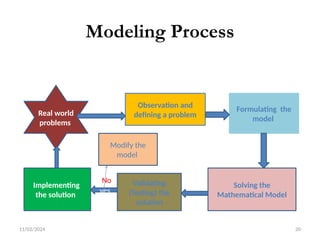
Real world
problems
Observation and
defining a problem
Formulating the
model
Solving the
Mathematical Model
Validating
(Testing) the
solution
Implementing
the solution
yes
Modify the
model
No
Modeling Process
11/02/2024 21
Step 1: Observation and defining a problem
• The first step in OR process is the identification of a problem that
exists in a system (organization).
• The system must be continuously and closely observed so that
problems can be identified as soon as they occur or anticipated.
• Problems are not always the results of crisis; but instead frequently
involve an anticipatory or planning situation.
• Once it has been determined that a problem exists, the problem must
be clearly and concisely defined.
11/02/2024 22
Step 2: Formulating a model
• Model formulation involves an analysis of the system under
study, determining objective of the decision-maker, and alternative
course of action, etc, so as to understand and describe, in precise
terms, the problem that an organization faces.
11/02/2024 23
Step 3: Solving the Mathematical Model
• This involves obtaining the numerical values of decision variables.
• Obtaining these values depends on the specific form or type of
mathematical models.
• Solving the model requires the use of various mathematical tools
and numerical procedures.
• In general, there are two categories of methods used for solving an
OR model.
1. Graphic method
2. Simplex method
11/02/2024 24
Step 4: Validating (Testing) the solution
• After solving the mathematical model, it is important to review
the solution carefully to see that values make sense and that
the resulting decisions can be implemented.
• Some of the reasons for validating the solution are:
(i) The mathematical model may not have enumerated all the
limitations of the problem under consideration.
(ii) Certain aspect of the problem may have been overlooked, omitted or
simplified,
(iii) The data may have been incorrectly estimated or recorded, perhaps
when entered in to the computer.
11/02/2024 25
Step 5: Implementing the solution
• The decision-maker has not only to identify good decision
alternatives but also to select alternatives that are capable
of being implemented.
• It is important to ensure that any solution implemented is
continually reviewed and updated in light of a changing
environment.
11/02/2024 26
Some of the points to be remembered while building a model
When we can solve the situation with a simple model, do
not try to build a complicated model.
Build a model that can be easily fit in the techniques
available. Do not try to search for a technique, which suit
your model.
In order to avoid complications while solving the problem,
the fabrication stage of modeling must be conducted
rigorously.
Before implementing the model, it should be validated /
tested properly.
Use the model for which it is deduced. Do not use the
model for the purpose for which it is not meant.
11/02/2024 27
Without having a clear idea for which the model is built
do not use it. It is better before using the model; you
consult an operations research analyst and take his
guidance.
Models cannot replace decision makers. It can guide them
but it cannot make decisions. Do not be under the
impression, that a model solves every type of problem.
The model should be as accurate as possible.
A model should be as simple as possible.
Benefits of model are always associated with the process
by which it is developed.
11/02/2024 28
Characteristics of a Good Model
i. The number of parameters considered in a model should
be less to understand the problem easily.
ii. A good model should be flexible to accommodate any
necessary information during the stages of building the
model.
iii. A model must take less time to construct.
iv. A model may be accompanied by lower and upper bounds
of parametric values.
11/02/2024 29
Operations Research Techniques
1. Linear Mathematical Programming
- Linear programming models -Graphic Analysis -
Simplex Method - Post optimality
-Transportation and assignment - Integer linear programming
-Goal Linear
2. Probabilistic Techniques
-Probability - Decision Analysis
-Game Theory -Markov Analysis
-Queuing -Simulation
-Forecasting
11/02/2024 30
Operations Research Techniques
3. Inventory Techniques
-Certain Demand
-Uncertain Demand
4. Net work Techniques
-Net work flow CPM/PERT
5. Other linear and nonlinear Techniques
• Dynamic Programming
• Break-even Analysis
• Non-linear programming
11/02/2024 31
Application Areas of Operations Research
• Agriculture: optimum allocation of land, crops, irrigation etc
• Finance: maximize income, profit, minimize cost etc
• In industries: Allocation of resources, assignment of problems to
worthy employees etc
• Personal management: To appoint best candidate, decide minimum
employees to complete job etc
• Production management: Determine number of units to produce to
maximize profit, etc
• In Traffic control: To properly timing of traffic signaling
• In Hospitals: Many a time we see very lengthy queues of patient near
hospitals and few of them get treatment and rest of them have to go
without treatment because of time factor. Some times we have
problems non-availability of essential drugs, shortage of ambulances,
shortage of beds etc. These problems can be conveniently solved by
the application of operations research techniques.

OPERATION RESEARCH CHAPTER ONE PowerPoint

  • 1.
    11/02/2024 1 CHAPTER ONE INTRODUCTIONTO OPERATION RESEARCH 1.1 Definition of Operations Research 1.2 The History of Operations Research 1.3. Nature and significance of Operations Research 1.4. Features of Operations Research 1.5. Model and modeling in Operations Research 1.6. Application Areas of OR CHAPTER ONE INTRODUCTION TO OPERATION RESEARCH 1.1 Definition of Operations Research 1.2 The History of Operations Research 1.3. Nature and significance of Operations Research 1.4. Features of Operations Research 1.5. Model and modeling in Operations Research 1.6. Application Areas of OR 7/6/2023 1
  • 2.
    11/02/2024 2 • Thesubject Operations Research (OR) is a branch of Mathematics- specially applied mathematics, used to provide a scientific base for Management to take timely and effective decisions to their problems. • It tries to avoid the dangers from taking decisions merely by guessing or by using thumb rules. • It uses a logical approach to problem solving (uses quantitative models to solve business problems)
  • 3.
    11/02/2024 3 • Thegeneral OR approach is to analyze the problem in economic terms and then implement the solution if it doesn’t aggressive or violent to other aspects like human, social, and political constraints • Quantitative approach to management problems requires that decision problems be defined, analyzed, and solved in a conscious, rational, logical and systematic and scientific manner- based on data, facts, information, and logic, and not mere guess work or thumb rules
  • 4.
    11/02/2024 4 • ORis the body of knowledge, which uses mathematical techniques to solve management problems and make timely and optimal solutions. • Though common sense, experience and commitment of the manager is essential in making decision, we can not deny the role-played by scientific methods in making optimal decisions • The applications of Management Science /OR/ techniques are widespread, and they have been frequently credited with increasing the efficiency and productivity of business firms.
  • 5.
    11/02/2024 5 History ofOperations Research • OR is a “war baby” • It is because the 1st problem attempted to solve in a systematic way was concerned with how to set the time fuse bomb to be dropped from an aircraft onto a submarine. • The main origin of OR was during the WWII. • During WWII, the military management in England invited a team of scientists to study the strategic and tactical problems related to air and land defense of the country.
  • 6.
    11/02/2024 6 • Theproblem attained importance because at that time resources available with England was very limited and objective was to win the war with available meager resources. • It was necessary to decide upon the most effective utilization of available resources to achieve the objective. • As the name indicates: o OPERATION is used to refer to military problem o RESEARCH is used to refer to inventing new method
  • 7.
    11/02/2024 7 • Asthis method of solving problem was invented during the war period, the subject is given the name “OPERATIONS RESEARCH” and is abbreviated as OR. • After the war ended, scientists who had been active in the military Operation groups made efforts to apply the operations research approach to civilian problems, related to business, industry, research and development, etc. • After the world war, there was a scarcity of industrial material and industrial productivity which calls for the use of OR • OR today plays a significant role in support of management decision making in business and non-business organizations.
  • 8.
    11/02/2024 8 • Thereare three important factors behind the rapid development in the use of operations research approach. 1. The economic and industrial boom after World War II resulted in continuous mechanization, automation, decentralization of operations and division of management factors. 2. Many operation researchers continued their research after the war ended. E.g established different OR techniques. 3. Analytic power was made available by high-speed computers.
  • 9.
    11/02/2024 9 Definitions ofOperation Research  OR can be defined in different ways by different groups.  Following are some of the important definitions in academic interest. OR is the art of winning wars without actually fighting (Aurther Clarke) OR is the art of giving bad answers to problems where otherwise worse answers are given (T.L. Satty) OR is the application of scientific methods, techniques and tools, to problems involving operations of a system so as to provide those in control of the operations with optimum solutions to the problems.
  • 10.
    11/02/2024 10 OR isa scientific method for providing executive departments a quantitative basis for decisions regarding the operations under their control (Morse and Kimball) OR is the application of scientific methods, techniques and tools to operations of a system with optimum solutions to the problem (Churchman, Ackoff and Arnoff)
  • 11.
    11/02/2024 11 OR seeksthe determination of the optimum course of action of a decision problem under the restriction of limited resources. It is quite often associated almost exclusively with the use of mathematical techniques to model and analyze decision problems. OR is the application of a scientific approach to solving management problems in order to help managers make better decisions.
  • 12.
    11/02/2024 12 Nature andsignificance of OR • The OR approach is particularly useful in balancing conflicting objectives (goals or interests), where there are many alternative courses of action available to the decision-makers. • In a theoretical sense, the optimum decision must be one that is best for the organization as a whole. • It is often called global optimum. A decision that is best for one or more sections of the organization is usually called suboptimum decision.
  • 13.
    11/02/2024 13 • Hence,the OR approach attempts to find global optimum by analyzing inter-relationships among the system components involved in the problem. • That means, in OR, we are concerned with how to choose optimal strategy under specified set of assumptions, including all available strategies and their associated payoffs.
  • 14.
    11/02/2024 14 Features ofOperations Research Approach 1. OR is an Inter-disciplinary team approach: Interdisciplinary teamwork is essential because while attempting to solve a complex management problem, one person may not have complete knowledge of all its aspects such as economic, social, political, psychological, engineering, etc. 2. Methodological Approach: OR is the application of scientific methods, techniques and tools to problems involving the operations of systems so as to provide those in control of operations with optimum solutions to the problems.
  • 15.
    11/02/2024 15 3. HolisticApproach or Systems Orientation: While arriving at a decision, an operation research team examines the relative importance of all conflicting and multiple objectives and the validity of claims of various departments of the organization from the perspective of the whole organization. 4. Objectivistic Approach: The OR approach seeks to obtain an optimal solution to the problem under analysis.
  • 16.
    11/02/2024 16 5. DecisionMaking: OR increases the effectiveness of management decisions. It is the decision science which helps management to make better decisions. 6. Use of Computers: OR often requires a computer to solve the complex mathematical model or to perform a large number of computations that are involved. 7. Human factors
  • 17.
    11/02/2024 17 Model andModeling in Operations Research • A Model is an abstraction of reality. It is a simplified, and often idealized, representation of reality. • Model provide a manager or analyst with an alternative to working directly with reality. • It is important to carefully decide which aspect of reality to include in a model.
  • 18.
    11/02/2024 18 Model Types •Models can be classified in a number of ways. One way uses these categories: • Iconic models- are the least abstract; they are physical models that look like reality. Eg. Model of a car • Analog Models- are also physical models but they are more abstract than iconic models. E.g. Graph • Symbolic Models- are the most abstract: they incorporate numbers and algebraic symbols to represent important aspects of a problem, often in equation form. E.g. LP models
  • 19.
    11/02/2024 19 Model andModeling in Operations Research • We can define OR Model as some sort of mathematical or theoretical description of various variables of a system representing some aspect of a problem on some subject of interest or inquiry. • The model enables to conduct a number of experiment involving theoretical subjective manipulations to find some optimum solution to the problem on hand.
  • 20.
    11/02/2024 20 Real world problems Observationand defining a problem Formulating the model Solving the Mathematical Model Validating (Testing) the solution Implementing the solution yes Modify the model No Modeling Process
  • 21.
    11/02/2024 21 Step 1:Observation and defining a problem • The first step in OR process is the identification of a problem that exists in a system (organization). • The system must be continuously and closely observed so that problems can be identified as soon as they occur or anticipated. • Problems are not always the results of crisis; but instead frequently involve an anticipatory or planning situation. • Once it has been determined that a problem exists, the problem must be clearly and concisely defined.
  • 22.
    11/02/2024 22 Step 2:Formulating a model • Model formulation involves an analysis of the system under study, determining objective of the decision-maker, and alternative course of action, etc, so as to understand and describe, in precise terms, the problem that an organization faces.
  • 23.
    11/02/2024 23 Step 3:Solving the Mathematical Model • This involves obtaining the numerical values of decision variables. • Obtaining these values depends on the specific form or type of mathematical models. • Solving the model requires the use of various mathematical tools and numerical procedures. • In general, there are two categories of methods used for solving an OR model. 1. Graphic method 2. Simplex method
  • 24.
    11/02/2024 24 Step 4:Validating (Testing) the solution • After solving the mathematical model, it is important to review the solution carefully to see that values make sense and that the resulting decisions can be implemented. • Some of the reasons for validating the solution are: (i) The mathematical model may not have enumerated all the limitations of the problem under consideration. (ii) Certain aspect of the problem may have been overlooked, omitted or simplified, (iii) The data may have been incorrectly estimated or recorded, perhaps when entered in to the computer.
  • 25.
    11/02/2024 25 Step 5:Implementing the solution • The decision-maker has not only to identify good decision alternatives but also to select alternatives that are capable of being implemented. • It is important to ensure that any solution implemented is continually reviewed and updated in light of a changing environment.
  • 26.
    11/02/2024 26 Some ofthe points to be remembered while building a model When we can solve the situation with a simple model, do not try to build a complicated model. Build a model that can be easily fit in the techniques available. Do not try to search for a technique, which suit your model. In order to avoid complications while solving the problem, the fabrication stage of modeling must be conducted rigorously. Before implementing the model, it should be validated / tested properly. Use the model for which it is deduced. Do not use the model for the purpose for which it is not meant.
  • 27.
    11/02/2024 27 Without havinga clear idea for which the model is built do not use it. It is better before using the model; you consult an operations research analyst and take his guidance. Models cannot replace decision makers. It can guide them but it cannot make decisions. Do not be under the impression, that a model solves every type of problem. The model should be as accurate as possible. A model should be as simple as possible. Benefits of model are always associated with the process by which it is developed.
  • 28.
    11/02/2024 28 Characteristics ofa Good Model i. The number of parameters considered in a model should be less to understand the problem easily. ii. A good model should be flexible to accommodate any necessary information during the stages of building the model. iii. A model must take less time to construct. iv. A model may be accompanied by lower and upper bounds of parametric values.
  • 29.
    11/02/2024 29 Operations ResearchTechniques 1. Linear Mathematical Programming - Linear programming models -Graphic Analysis - Simplex Method - Post optimality -Transportation and assignment - Integer linear programming -Goal Linear 2. Probabilistic Techniques -Probability - Decision Analysis -Game Theory -Markov Analysis -Queuing -Simulation -Forecasting
  • 30.
    11/02/2024 30 Operations ResearchTechniques 3. Inventory Techniques -Certain Demand -Uncertain Demand 4. Net work Techniques -Net work flow CPM/PERT 5. Other linear and nonlinear Techniques • Dynamic Programming • Break-even Analysis • Non-linear programming
  • 31.
    11/02/2024 31 Application Areasof Operations Research • Agriculture: optimum allocation of land, crops, irrigation etc • Finance: maximize income, profit, minimize cost etc • In industries: Allocation of resources, assignment of problems to worthy employees etc • Personal management: To appoint best candidate, decide minimum employees to complete job etc • Production management: Determine number of units to produce to maximize profit, etc • In Traffic control: To properly timing of traffic signaling • In Hospitals: Many a time we see very lengthy queues of patient near hospitals and few of them get treatment and rest of them have to go without treatment because of time factor. Some times we have problems non-availability of essential drugs, shortage of ambulances, shortage of beds etc. These problems can be conveniently solved by the application of operations research techniques.