This document discusses replacement theory and models for determining optimal replacement times for equipment and components. It covers different types of failure mechanisms including gradual, sudden, progressive, and retrogressive failure. Key factors in replacement decisions are purchase costs, salvage values, maintenance costs, and operating costs. Optimal replacement minimizes total average costs over the lifetime of the item. Group replacement policies can be more cost effective than individual policies for items that fail suddenly by replacing items in a group before failures occur.
Replacement Model
The problemof replacement arises when any one of the
components of productive resources, such as machinery, building and
men deteriorates due to time or usage.
Ex:
A machine, which is purchased and installed in a production system, due to usage
some of its components wear out and its efficiency is reduced.
A building in which production activities are carried out, may leave cracks in
walls, roof etc, and needs repair.
A worker, when he is young, will work efficiently, as the time passes becomes old
and his work efficiency falls down and after some time he will become unable to
work.
3.
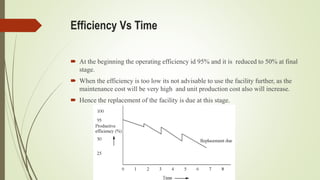
Efficiency Vs Time
At the beginning the operating efficiency id 95% and it is reduced to 50% at final
stage.
When the efficiency is too low its not advisable to use the facility further, as the
maintenance cost will be very high and unit production cost also will increase.
Hence the replacement of the facility is due at this stage.
4.
Decision Types
Wemay decide whether to wait for complete failure of the item .
The expensive item may be considered individually to decide whether we should
replace now or, if not, when it should be reconsidered for replacement.
Whether the item is to be replaced by similar type of item or by different.
The main objective of replacement is to help the organization for maximizing
its profit or to minimize the cost.
5.
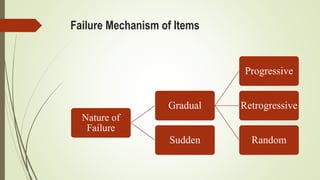
Failure Mechanism ofItems
Nature of
Failure
Gradual
Progressive
Retrogressive
RandomSudden
6.
Gradual Failure
Asthe life of the machine increases or due continuous usage, due to wear and tear of
components of the facility, its efficiency deteriorates due to which the management
can experience.
a) Progressive Increase in maintenance expenditure or operating costs,
b) Decreased productivity of the equipment
c) Decrease in the value of the equipment (resale value) of the equipment/facility
decreases.
Ex: Automobile, Machine Tool
7.
Sudden Failure
Theitems ultimately fail suddenly after a period of time.
The life of the equipment cannot be predicted and is some sort of random variable
The period between installation and failure is not constant for any particular type
of equipment but will follow some frequency distribution
8.
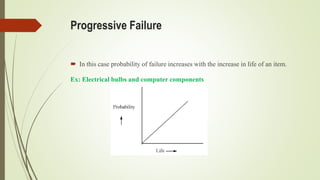
Progressive Failure
Inthis case probability of failure increases with the increase in life of an item.
Ex: Electrical bulbs and computer components
9.
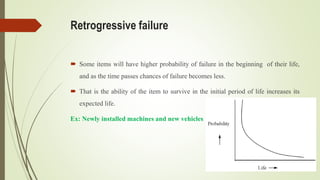
Retrogressive failure
Someitems will have higher probability of failure in the beginning of their life,
and as the time passes chances of failure becomes less.
That is the ability of the item to survive in the initial period of life increases its
expected life.
Ex: Newly installed machines and new vehicles
10.
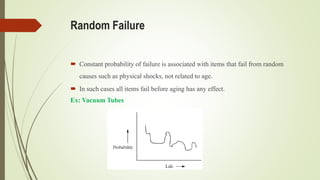
Random Failure
Constantprobability of failure is associated with items that fail from random
causes such as physical shocks, not related to age.
In such cases all items fail before aging has any effect.
Ex: Vacuum Tubes
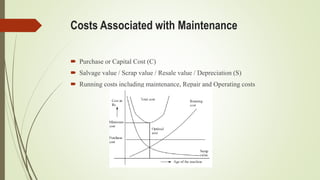
Costs Associated withMaintenance
Purchase or Capital Cost (C)
Salvage value / Scrap value / Resale value / Depreciation (S)
Running costs including maintenance, Repair and Operating costs
13.
Types of ReplacementProblems
Replacement of items that deteriorate with time (value of money not changing
with time)
Replacement of items that deteriorate with time (Value of money changing with
time)
Replacement of items that fail suddenly (individual and group replacement
policies)
Staff Replacement
14.
General Approach toReplacement Problem
The information necessary to formulate optimum replacement policy is:
(i) Objective assessment of the probability of the item failing at a particular point
of time
(ii) Assessments of the cost of replacement in terms of:
(a) Actual cost of the item,
(b) Direct costs of labour involved in replacement,
(c) Costs of disruption in terms of lost production, lost orders etc.,
15.
Replacement of itemsthat deteriorate with time
(Value of money not changing with time)
Certain equipment/parts are deteriorate gradually with respect to time.
After a certain period the efficiency of the item will reduce and maintenance cost
increases.
Then the old item must be replaced by new one.
Ex: Automobile part wear out with age and the owner needs to replace the old
part at suitable time by a new one
16.
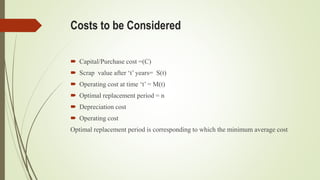
Costs to beConsidered
Capital/Purchase cost =(C)
Scrap value after ‘t’ years= S(t)
Operating cost at time ‘t’ = M(t)
Optimal replacement period = n
Depreciation cost
Operating cost
Optimal replacement period is corresponding to which the minimum average cost
17.
Replacement of itemsthat deteriorate with time
(Value of money changing with time)
This problem is complicated as the money value changes with time. This can be
dealt under two different conditions:
(a) The maintenance cost goes on increasing with usage or age or time and then
we have to find out optimum time of replacing the item. Here the value of money
decreases with a constant rate which is known as its depreciation ratio or
discounted factor.
(b) If a businessman takes a loan for a certain period at a given interest rate and
agrees to pay it in a number of instalments, then we have to find the most suitable
period during which the loan would be repaid.
18.
Replacement of itemsthat fail suddenly
There are certain items or systems or products, whose probability of failure
increases with time. They may work with designed efficiency throughout their life
and if they fail to act they fail suddenly.
The nature of these items is they are costly to replace at the same time and their
failure affect the functioning of entire system.
For example, resistors, components of air conditioning unit and certain electrical
components. If we do not replace the item immediately, then loss of production,
idle labour; idle raw materials, etc are the results. It is evident failure of such
items causes heavy losses to the organization.
19.
Individual Replacement Policy
This policy states that replace the item soon after its failure. Here the cost of
replacement will be somewhat greater as the item is to be purchased individually
from the seller as and when it fails.
From the time of failure to the replacement, the system remains idle. More than
that, as the item is purchased individually, the cost of the item may be more.
In case, the component or the item is not available in the local market, we have to
get it from other places, where the procurement cost may be higher for individual
purchase.
Ex: Bearing in a machine
20.
Group Replacement Policy
If the organization has got the statistics of failure of the item, it can calculate the
average life of the item and replace the item before it fails, so that the system can
work without break.
In this case, all the items, even they are in good working condition, are replaced at
a stipulated period as calculated by the organization by using the group
replacement policy.
In case any item fails, before the calculated group replacement period, it is
replaced individually immediately after failure. Hence this policy utilizes the
strategy of both individual replacement and group replacement.
Ex: Street Lights, Electronic Parts and etc