INTRODUCTION TO OPERATIONS RESEARCH
10/6/2022
1
CHAPTER ONE
Compiled by: Abdu Kamil (MBA)
Email: abkamilyahoo4569@gmail.com
10/6/2022
2
Contents of this Chapter
 Operations Research (OR) – Quantitative approach to decision making
 The History of Operations Research
 Definition of Operations Research
 Nature and significances of operations research
 Features of Operations Research
 Model and modeling in Operations Research
1. Introduction
10/6/2022
3
1.1. Operations Research (OR) – Quantitative approach to decision making
 Decision-making in today’s social and business environment has become a complex task.
 The uncertainty of the future and the nature of competition and social interaction greatly increase the
difficulty of managerial decision-making.
 Knowledge and technology are changing rapidly, the new problems with little problems and provide
leadership in the advancing global age, decision-makers can not afford to make decisions by simply applying
their;
 Personal experiences
 Guesswork or intuition
 Because the consequences of the wrong markets, producing the wrong products, providing inappropriate
services, etc., will have major, often disastrous consequences for organizations.
10/6/2022
4
 Operations Research as one of the quantitative aid to decision-making, offers the decision maker a
method of evaluating every possible alternative (act or course of action) by using various techniques to
know the potential outcomes.
 In general, while solving a real-life problem, the decision-maker must examine in both from
quantitative as well as qualitative perspective.
 Based on some mixes of the two sources of information (quantitative and qualitative), a decision
should be taken by the decision-maker, is extremely difficult or time consuming for two reasons;
 First, the amount and complexity of information that must be processed
 Second the number of alternative solutions could be so large that a decision maker simply can not
evaluate all of them to select an appropriate one.
 For these reasons when there is lack of qualitative information, decision makers increasingly turn to
quantitative methods and use computers to arrive at their optimal solution.
10/6/2022
5
1.2. History of Operations Research
 It is generally agreed that Operations Research (OR) came in to existence as a discipline during
WorldWar II when there was a critical need to manage scarce resources.
 The term “OR” was coined as a result of research on military operations during this war.
 Since the war involved strategic and tactical problems which were greatly complicated, to expect
adequate solutions from individual or specialists in a single discipline was unrealistic.
 Therefore, group of individuals who collectively were considered specialists from different
specialization formed as special unit within the armed forces to deal with strategic and tactical
problems of various military operations.
 The objective was the most effective utilization of most limited military resources by the use of
quantitative techniques.
10/6/2022
6
There are three important factors behind the rapid development in the use of operations research
approach.
(i) The economic and industrial boom after World War II resulted in continuous mechanization,
automation, decentralization of operations and division of management factors.
(ii) Many operation researchers continued their research after war.
(iii) Analytic power was made available by high-speed computers.
10/6/2022
7
1.3. Operation Research: Some definitions
 “ Operations research is the application of the methods of science to complex problems in the
direction and management of large systems of men, machines, materials and money in industry,
business, government and defense”. Operations Research Society, UK
 “Operations research is concerned with scientifically defining how to best design and operate man-
machine systems usually requiring the allocation of scarce resources”. Operations Research Society,
America
 Operations research is a systematic application of quantitative methods, techniques and tools to the
analysis of problems involving the operation of systems.
 Operations research is essentially a collection of mathematical techniques and tools which in
conjunction with systems approach, is applied to solve practical decision problems of an economic or
engineering nature.
10/6/2022
8
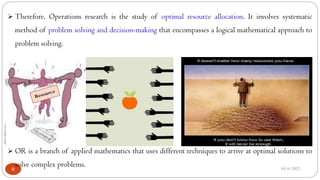
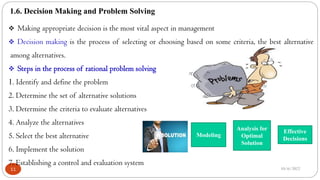
 Therefore, Operations research is the study of optimal resource allocation. It involves systematic
method of problem solving and decision-making that encompasses a logical mathematical approach to
problem solving.
 OR is a branch of applied mathematics that uses different techniques to arrive at optimal solutions to
solve complex problems.
1.4. Nature and Significances of Operations Research
10/6/2022
9
 The Operations research approach is particularly useful in balancing conflicting objectives (goals or
interests), where there are many alternative courses of action available to the decision-makers.
 In a theoretical sense, the optimum decision must be one that is best for the organization as a whole.
It is often called global optimum.
 A decision that is best for one or more sections of the organization is usually called sub-optimum
decision.
 The OR approach attempts to find global optimum by analyzing inter-relationships among the
system components involved in the problem.
1.5. Features of Operations Research
10/6/2022
10
 Inter-disciplinary approach
 Methodological Approach
 Holistic Approach or Systems Orientation
 Objectivistic Approach
 Decision Making
 Use of Computers
 Human factors
1.6. Decision Making and Problem Solving
10/6/2022
11
 Making appropriate decision is the most vital aspect in management
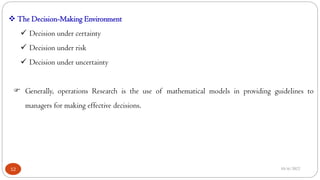
 Decision making is the process of selecting or choosing based on some criteria, the best alternative
among alternatives.
 Steps in the process of rational problem solving
1. Identify and define the problem
2. Determine the set of alternative solutions
3. Determine the criteria to evaluate alternatives
4. Analyze the alternatives
5. Select the best alternative
6. Implement the solution
7. Establishing a control and evaluation system
Modeling
Analysis for
Optimal
Solution
Effective
Decisions
10/6/2022
12
 The Decision-Making Environment
 Decision under certainty
 Decision under risk
 Decision under uncertainty
 Generally, operations Research is the use of mathematical models in providing guidelines to
managers for making effective decisions.
1.7. Models and Modeling in Operations Research
10/6/2022
13
 Both simple and complex systems can easily be studied by concentrating on some portion or key
features instead of concentrating on every detail of it.
 This approximation or abstraction, maintaining only the essential elements of the system, which
may be constructed in various forms by establishing relationships among specified variables and
parameters of the system, is called a model.
 Models do not, and cannot, represent every aspect of reality because of the innumerable and
changing characteristics of the real life problems to be represented.
 For a model to be effective, it must be representative of those aspects of reality that are being
investigated and have a major impact on the decision situation.
 A model is constructed to analyze and understand the given system for the purpose of improving
its performance.
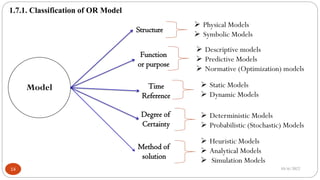
1.7.1. Classification of OR Model
10/6/2022
14
Model
Structure
 Physical Models
 Symbolic Models
Function
or purpose
 Descriptive models
 Predictive Models
 Normative (Optimization) models
Time
Reference
 Static Models
 Dynamic Models
Degree of
Certainty
 Deterministic Models
 Probabilistic (Stochastic) Models
Method of
solution
 Heuristic Models
 Analytical Models
 Simulation Models
1.7.2. Advantage of Models
10/6/2022
15
i) Models help decision makers to visualize a system so that he/she can understand the system’s
structure or operation in a better way.
ii) The problem can be viewed in its entirety.
iii) Models serve as aids to transmit ideas and visualization among people in the organization.
iv) A model allows us to analyze and experiment in a complex.
v) Models simplify the investigation considerably and provide power and flexibility for predicting the
future state of the process or system.
The End of the First Chapter
10/6/2022
16

OR-Chapter One (1).pdf

  • 1.
    INTRODUCTION TO OPERATIONSRESEARCH 10/6/2022 1 CHAPTER ONE Compiled by: Abdu Kamil (MBA) Email: abkamilyahoo4569@gmail.com
  • 2.
    10/6/2022 2 Contents of thisChapter  Operations Research (OR) – Quantitative approach to decision making  The History of Operations Research  Definition of Operations Research  Nature and significances of operations research  Features of Operations Research  Model and modeling in Operations Research
  • 3.
    1. Introduction 10/6/2022 3 1.1. OperationsResearch (OR) – Quantitative approach to decision making  Decision-making in today’s social and business environment has become a complex task.  The uncertainty of the future and the nature of competition and social interaction greatly increase the difficulty of managerial decision-making.  Knowledge and technology are changing rapidly, the new problems with little problems and provide leadership in the advancing global age, decision-makers can not afford to make decisions by simply applying their;  Personal experiences  Guesswork or intuition  Because the consequences of the wrong markets, producing the wrong products, providing inappropriate services, etc., will have major, often disastrous consequences for organizations.
  • 4.
    10/6/2022 4  Operations Researchas one of the quantitative aid to decision-making, offers the decision maker a method of evaluating every possible alternative (act or course of action) by using various techniques to know the potential outcomes.  In general, while solving a real-life problem, the decision-maker must examine in both from quantitative as well as qualitative perspective.  Based on some mixes of the two sources of information (quantitative and qualitative), a decision should be taken by the decision-maker, is extremely difficult or time consuming for two reasons;  First, the amount and complexity of information that must be processed  Second the number of alternative solutions could be so large that a decision maker simply can not evaluate all of them to select an appropriate one.  For these reasons when there is lack of qualitative information, decision makers increasingly turn to quantitative methods and use computers to arrive at their optimal solution.
  • 5.
    10/6/2022 5 1.2. History ofOperations Research  It is generally agreed that Operations Research (OR) came in to existence as a discipline during WorldWar II when there was a critical need to manage scarce resources.  The term “OR” was coined as a result of research on military operations during this war.  Since the war involved strategic and tactical problems which were greatly complicated, to expect adequate solutions from individual or specialists in a single discipline was unrealistic.  Therefore, group of individuals who collectively were considered specialists from different specialization formed as special unit within the armed forces to deal with strategic and tactical problems of various military operations.  The objective was the most effective utilization of most limited military resources by the use of quantitative techniques.
  • 6.
    10/6/2022 6 There are threeimportant factors behind the rapid development in the use of operations research approach. (i) The economic and industrial boom after World War II resulted in continuous mechanization, automation, decentralization of operations and division of management factors. (ii) Many operation researchers continued their research after war. (iii) Analytic power was made available by high-speed computers.
  • 7.
    10/6/2022 7 1.3. Operation Research:Some definitions  “ Operations research is the application of the methods of science to complex problems in the direction and management of large systems of men, machines, materials and money in industry, business, government and defense”. Operations Research Society, UK  “Operations research is concerned with scientifically defining how to best design and operate man- machine systems usually requiring the allocation of scarce resources”. Operations Research Society, America  Operations research is a systematic application of quantitative methods, techniques and tools to the analysis of problems involving the operation of systems.  Operations research is essentially a collection of mathematical techniques and tools which in conjunction with systems approach, is applied to solve practical decision problems of an economic or engineering nature.
  • 8.
    10/6/2022 8  Therefore, Operationsresearch is the study of optimal resource allocation. It involves systematic method of problem solving and decision-making that encompasses a logical mathematical approach to problem solving.  OR is a branch of applied mathematics that uses different techniques to arrive at optimal solutions to solve complex problems.
  • 9.
    1.4. Nature andSignificances of Operations Research 10/6/2022 9  The Operations research approach is particularly useful in balancing conflicting objectives (goals or interests), where there are many alternative courses of action available to the decision-makers.  In a theoretical sense, the optimum decision must be one that is best for the organization as a whole. It is often called global optimum.  A decision that is best for one or more sections of the organization is usually called sub-optimum decision.  The OR approach attempts to find global optimum by analyzing inter-relationships among the system components involved in the problem.
  • 10.
    1.5. Features ofOperations Research 10/6/2022 10  Inter-disciplinary approach  Methodological Approach  Holistic Approach or Systems Orientation  Objectivistic Approach  Decision Making  Use of Computers  Human factors
  • 11.
    1.6. Decision Makingand Problem Solving 10/6/2022 11  Making appropriate decision is the most vital aspect in management  Decision making is the process of selecting or choosing based on some criteria, the best alternative among alternatives.  Steps in the process of rational problem solving 1. Identify and define the problem 2. Determine the set of alternative solutions 3. Determine the criteria to evaluate alternatives 4. Analyze the alternatives 5. Select the best alternative 6. Implement the solution 7. Establishing a control and evaluation system Modeling Analysis for Optimal Solution Effective Decisions
  • 12.
    10/6/2022 12  The Decision-MakingEnvironment  Decision under certainty  Decision under risk  Decision under uncertainty  Generally, operations Research is the use of mathematical models in providing guidelines to managers for making effective decisions.
  • 13.
    1.7. Models andModeling in Operations Research 10/6/2022 13  Both simple and complex systems can easily be studied by concentrating on some portion or key features instead of concentrating on every detail of it.  This approximation or abstraction, maintaining only the essential elements of the system, which may be constructed in various forms by establishing relationships among specified variables and parameters of the system, is called a model.  Models do not, and cannot, represent every aspect of reality because of the innumerable and changing characteristics of the real life problems to be represented.  For a model to be effective, it must be representative of those aspects of reality that are being investigated and have a major impact on the decision situation.  A model is constructed to analyze and understand the given system for the purpose of improving its performance.
  • 14.
    1.7.1. Classification ofOR Model 10/6/2022 14 Model Structure  Physical Models  Symbolic Models Function or purpose  Descriptive models  Predictive Models  Normative (Optimization) models Time Reference  Static Models  Dynamic Models Degree of Certainty  Deterministic Models  Probabilistic (Stochastic) Models Method of solution  Heuristic Models  Analytical Models  Simulation Models
  • 15.
    1.7.2. Advantage ofModels 10/6/2022 15 i) Models help decision makers to visualize a system so that he/she can understand the system’s structure or operation in a better way. ii) The problem can be viewed in its entirety. iii) Models serve as aids to transmit ideas and visualization among people in the organization. iv) A model allows us to analyze and experiment in a complex. v) Models simplify the investigation considerably and provide power and flexibility for predicting the future state of the process or system.
  • 16.
    The End ofthe First Chapter 10/6/2022 16