Operations Research
Manish Tanwar, PhD
Watch a video lecture on this presentation at
youtube.com/AdityaClasses
Introduction to OR
 Optimization is a word that comes to mind first in operations research
 It had its early roots in World War II and is flourishing in business and industry with the aid of computer
 Operations Research is an Art and Science
 Primary applications areas of Operations Research include forecasting, production scheduling, inventory
control, capital budgeting, and transportation
 Some of the Primary Tools used by operation researchers are
 Statistics
 Game Theory
 Probability Theory, etc.
History of OR
 There is no clear history that marks the Birth of OR
 It is generally accepted that the field originated in England during the World War II
 Some say that Charles Babbage (1791-1871) is the Father of OR because his research into the cost of
transportation and sorting of mail led to England’s University Penny Post in 1840
 After The Industrial Revolution, different sections like manufacturing, marketing, financing flourished in
then developing industrial economies. Various approaches towards problems between these sections and
finding better and efficient solutions caused the evolution of OR
Characteristics of OR
 It has a systems orientation
 Makes use of interdisciplinary teams
 Applied scientific methods to problem solving
 Uncovers new problems
 Improvement in quality of decisions
 Use of computer
 Quantitative solutions
What is OR
 Operational Research is a systematic and analytical approach to decision making and problem solving,
which consists of
 The art of mathematical modeling of complex situations
 The science of the development of solution techniques used to solve these models
 The ability to effectively communicate the results to the decision maker
 OR is a Branch of applied mathematics that uses techniques and statistics to arrive at Optimal solutions to
solve complex problems
 It is typically concerned with determining
 the maximum profit, sale, output, crops yield and efficiency
 and minimum losses, risks, cost, and time of some objective function
 Attributes of OR
 Interdisciplinary Approach
 Integrated Approach
 Scientific Approach
Scope of OR
 Industrial Management
 Defence operations
 Developing and Developed Economies
 Agriculture Sector
 Hospital business and Society
Scope of OR in management of a business organisation
 Allocation and distribution
 Production and facility planning
 Procurement
 Marketing
 Finance
 Personnel
 Research and Development
Attributes of OR
 Interdisciplinary Approach: The problem must be explored by an interdisciplinary team, to take advantage
of modeling and solving problems from different perspectives
 Integrated Approach: takes into account all elements of a problem that belong to organization,
environment, and interaction between them and to achieve this all elements of the system and all kinds of
interaction between these elements is examined together
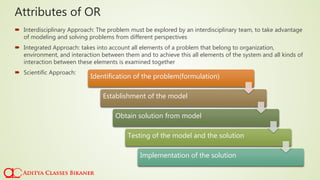
 Scientific Approach:
Identification of the problem(formulation)
Establishment of the model
Obtain solution from model
Testing of the model and the solution
Implementation of the solution
Stage 1. Identification of the problem(formulation)
 A good start is half the job done
 Right solution can not be obtained for a wrongly understood problem
 The first and most important stage of the work is defining the problem well
 This phase helps examine the problem at hand quantitatively
 This phase deals with issues like:
 Defining goals
 Determination of the system which will impact the problem
 Determination of the constraints which will affect solution of problem
 Determination of the assumptions
 Determination of an appropriate measure of effectiveness
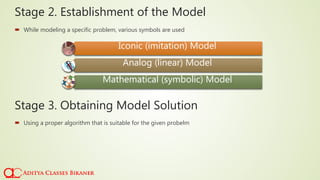
Stage 2. Establishment of the Model
 While modeling a specific problem, various symbols are used
Iconic (imitation) Model
Analog (linear) Model
Mathematical (symbolic) Model
Stage 3. Obtaining Model Solution
 Using a proper algorithm that is suitable for the given probelm
 Before the application of the model solution, the validity of model and reliability of the solution should be
tested
 Validity of the model can be decided by comparing its outputs with the results of past
 If past behavior is repeated when provided similar inputs then the model will be valid
Stage 4. Testing the Model Solution
 Implementation of the solution obtained from a validated model is a reliable solution to the real-life
problems
 Implementation of the solution is the duty of operation research team
Stage 5. Implementation Of The Solution
Models in OR(different classification schemes)
 Degree of abstraction
 Mathematical models
 Language models
 Concrete models
 Function
 Descriptive models
 Predictive models
 Normative models
 Time Horizon
 Static models
 Dynamic models
 Structure
 Iconic or physical models
 Analogue or schematic models
 Symbolic or mathematical models
 Nature of environment
 Deterministic models
 Probabilistic models
 Extent of generality
 General model
 Specific models
Characteristics of a good model
 Number of simplifying assumptions should be as few as possible
 Number of relevant variables should be as few as possible
 Should assimilate the system environmental changes without change in the framework
 Should be adaptable to parametric type of treatment
 Should be easy and economical to construct
 Mathematical techniques
 Statistical Techniques
 Inventory models
 Allocation models
 Sequencing models
 Routing models
 Competitive models
 Queuing models
 Dynamic programming models
 Simulation techniques
 Decision theory
 Replacement models
 Heuristic models
 Goal programming
 Reliability theory
 Markov analysis
 Combined methods
Types of mathematical models
Advantages of a model
 Provides a logical and systematic approach to the problem
 Indicates the scope as well as limitation of the problem
 Helps in finding avenues for new Research and improvements in a system
 Makes the overall structure of the problem more comprehensible
 Helps in dealing with the problem in its entirety
Limitations of a model
 Models are only idealized representation of reality and not to be regarded as absolute in any case
 Validity of a model for a particular situation can be ascertained only by conducting experiments on it
Types of mathematical models
 Mathematical techniques
 Statistical Techniques
 Inventory models
 Allocation models
 Sequencing models
 Routing models
 Competitive models
 Queuing models
 Dynamic programming models
 Simulation techniques
 Decision theory
 Replacement models
 Heuristic models
 Goal programming
 Reliability theory
 Markov analysis
 Combined methods
Organisations of OR
 The first operations research organization, ORSA(The Operational Research Society of America) was
founded in 1952 in the United States
 Operational Research Society, Turkey
 The International Federation of Operational Research Societies
 The Association of European Operational Research Societies
 An OR unit was set up in 1949 at the regional research laboratory in Hyderabad
 Another OR unit was set up under Professor P C Mahalanobis in 1953 in the Indian Statistical Institute,
Calcutta
 Its purpose was to apply OR methods in National planning and survey
 And finally Operation Research Society of India(ORSI) was formed in 1957
 Its first conference was held in 1959 in Delhi

Introduction to Operations Research

  • 1.
    Operations Research Manish Tanwar,PhD Watch a video lecture on this presentation at youtube.com/AdityaClasses
  • 2.
    Introduction to OR Optimization is a word that comes to mind first in operations research  It had its early roots in World War II and is flourishing in business and industry with the aid of computer  Operations Research is an Art and Science  Primary applications areas of Operations Research include forecasting, production scheduling, inventory control, capital budgeting, and transportation  Some of the Primary Tools used by operation researchers are  Statistics  Game Theory  Probability Theory, etc.
  • 3.
    History of OR There is no clear history that marks the Birth of OR  It is generally accepted that the field originated in England during the World War II  Some say that Charles Babbage (1791-1871) is the Father of OR because his research into the cost of transportation and sorting of mail led to England’s University Penny Post in 1840  After The Industrial Revolution, different sections like manufacturing, marketing, financing flourished in then developing industrial economies. Various approaches towards problems between these sections and finding better and efficient solutions caused the evolution of OR Characteristics of OR  It has a systems orientation  Makes use of interdisciplinary teams  Applied scientific methods to problem solving  Uncovers new problems  Improvement in quality of decisions  Use of computer  Quantitative solutions
  • 4.
    What is OR Operational Research is a systematic and analytical approach to decision making and problem solving, which consists of  The art of mathematical modeling of complex situations  The science of the development of solution techniques used to solve these models  The ability to effectively communicate the results to the decision maker  OR is a Branch of applied mathematics that uses techniques and statistics to arrive at Optimal solutions to solve complex problems  It is typically concerned with determining  the maximum profit, sale, output, crops yield and efficiency  and minimum losses, risks, cost, and time of some objective function  Attributes of OR  Interdisciplinary Approach  Integrated Approach  Scientific Approach
  • 5.
    Scope of OR Industrial Management  Defence operations  Developing and Developed Economies  Agriculture Sector  Hospital business and Society Scope of OR in management of a business organisation  Allocation and distribution  Production and facility planning  Procurement  Marketing  Finance  Personnel  Research and Development
  • 6.
    Attributes of OR Interdisciplinary Approach: The problem must be explored by an interdisciplinary team, to take advantage of modeling and solving problems from different perspectives  Integrated Approach: takes into account all elements of a problem that belong to organization, environment, and interaction between them and to achieve this all elements of the system and all kinds of interaction between these elements is examined together  Scientific Approach: Identification of the problem(formulation) Establishment of the model Obtain solution from model Testing of the model and the solution Implementation of the solution
  • 7.
    Stage 1. Identificationof the problem(formulation)  A good start is half the job done  Right solution can not be obtained for a wrongly understood problem  The first and most important stage of the work is defining the problem well  This phase helps examine the problem at hand quantitatively  This phase deals with issues like:  Defining goals  Determination of the system which will impact the problem  Determination of the constraints which will affect solution of problem  Determination of the assumptions  Determination of an appropriate measure of effectiveness
  • 8.
    Stage 2. Establishmentof the Model  While modeling a specific problem, various symbols are used Iconic (imitation) Model Analog (linear) Model Mathematical (symbolic) Model Stage 3. Obtaining Model Solution  Using a proper algorithm that is suitable for the given probelm
  • 9.
     Before theapplication of the model solution, the validity of model and reliability of the solution should be tested  Validity of the model can be decided by comparing its outputs with the results of past  If past behavior is repeated when provided similar inputs then the model will be valid Stage 4. Testing the Model Solution  Implementation of the solution obtained from a validated model is a reliable solution to the real-life problems  Implementation of the solution is the duty of operation research team Stage 5. Implementation Of The Solution
  • 10.
    Models in OR(differentclassification schemes)  Degree of abstraction  Mathematical models  Language models  Concrete models  Function  Descriptive models  Predictive models  Normative models  Time Horizon  Static models  Dynamic models  Structure  Iconic or physical models  Analogue or schematic models  Symbolic or mathematical models  Nature of environment  Deterministic models  Probabilistic models  Extent of generality  General model  Specific models
  • 11.
    Characteristics of agood model  Number of simplifying assumptions should be as few as possible  Number of relevant variables should be as few as possible  Should assimilate the system environmental changes without change in the framework  Should be adaptable to parametric type of treatment  Should be easy and economical to construct  Mathematical techniques  Statistical Techniques  Inventory models  Allocation models  Sequencing models  Routing models  Competitive models  Queuing models  Dynamic programming models  Simulation techniques  Decision theory  Replacement models  Heuristic models  Goal programming  Reliability theory  Markov analysis  Combined methods Types of mathematical models
  • 12.
    Advantages of amodel  Provides a logical and systematic approach to the problem  Indicates the scope as well as limitation of the problem  Helps in finding avenues for new Research and improvements in a system  Makes the overall structure of the problem more comprehensible  Helps in dealing with the problem in its entirety Limitations of a model  Models are only idealized representation of reality and not to be regarded as absolute in any case  Validity of a model for a particular situation can be ascertained only by conducting experiments on it
  • 13.
    Types of mathematicalmodels  Mathematical techniques  Statistical Techniques  Inventory models  Allocation models  Sequencing models  Routing models  Competitive models  Queuing models  Dynamic programming models  Simulation techniques  Decision theory  Replacement models  Heuristic models  Goal programming  Reliability theory  Markov analysis  Combined methods
  • 14.
    Organisations of OR The first operations research organization, ORSA(The Operational Research Society of America) was founded in 1952 in the United States  Operational Research Society, Turkey  The International Federation of Operational Research Societies  The Association of European Operational Research Societies  An OR unit was set up in 1949 at the regional research laboratory in Hyderabad  Another OR unit was set up under Professor P C Mahalanobis in 1953 in the Indian Statistical Institute, Calcutta  Its purpose was to apply OR methods in National planning and survey  And finally Operation Research Society of India(ORSI) was formed in 1957  Its first conference was held in 1959 in Delhi