Dynamics of
Machinery
Static Force Analysis
Mr.P.D.Devan
Assistant Professor
Kumaraguru College of Technology
Coimbatore
Overview of
this Lecture
• Introduction
• Inertia Force
• Inertia Torque
• Static Force Analysis
• Dynamic Force Analysis
• Problem-1
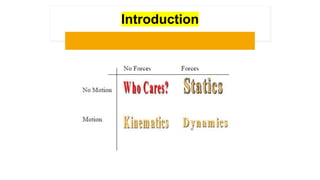
Introduction
Cont…
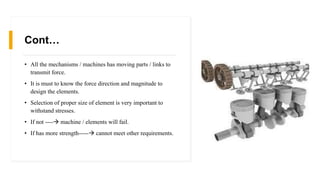
• All the mechanisms / machines has moving parts / links to
transmit force.
• It is must to know the force direction and magnitude to
design the elements.
• Selection of proper size of element is very important to
withstand stresses.
• If not ---- machine / elements will fail.
• If has more strength----- cannot meet other requirements.
Inertia Force
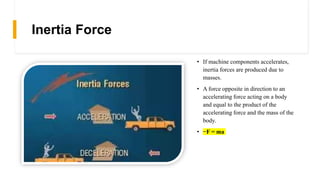
• If machine components accelerates,
inertia forces are produced due to
masses.
• A force opposite in direction to an
accelerating force acting on a body
and equal to the product of the
accelerating force and the mass of the
body.
• −F = ma
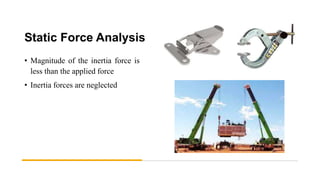
Static Force Analysis
• Magnitude of the inertia force is
less than the applied force
• Inertia forces are neglected
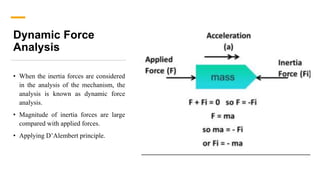
Dynamic Force
Analysis
• When the inertia forces are considered
in the analysis of the mechanism, the
analysis is known as dynamic force
analysis.
• Magnitude of inertia forces are large
compared with applied forces.
• Applying D’Alembert principle.
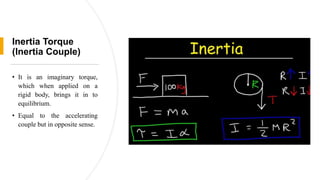
Inertia Torque
(Inertia Couple)
• It is an imaginary torque,
which when applied on a
rigid body, brings it in to
equilibrium.
• Equal to the accelerating
couple but in opposite sense.
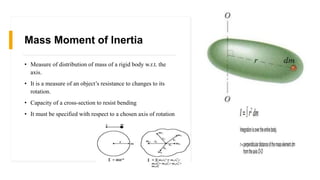
Mass Moment of Inertia
• Measure of distribution of mass of a rigid body w.r.t. the
axis.
• It is a measure of an object’s resistance to changes to its
rotation.
• Capacity of a cross-section to resist bending
• It must be specified with respect to a chosen axis of rotation
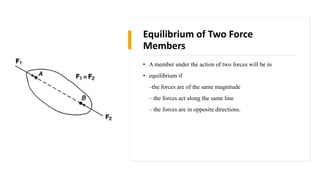
Equilibrium of Two Force
Members
• A member under the action of two forces will be in
• equilibrium if
–the forces are of the same magnitude
– the forces act along the same line
– the forces are in opposite directions.
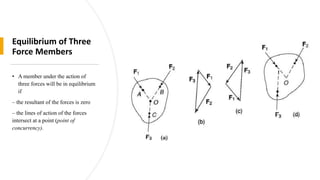
Equilibrium of Three
Force Members
• A member under the action of
three forces will be in equilibrium
if
– the resultant of the forces is zero
– the lines of action of the forces
intersect at a point (point of
concurrency).
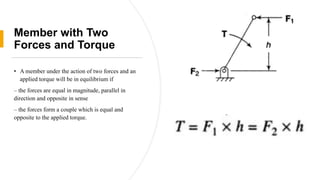
Member with Two
Forces and Torque
• A member under the action of two forces and an
applied torque will be in equilibrium if
– the forces are equal in magnitude, parallel in
direction and opposite in sense
– the forces form a couple which is equal and
opposite to the applied torque.
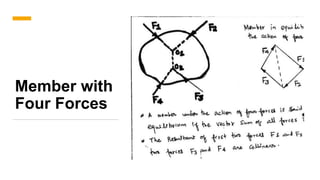
Member with
Four Forces
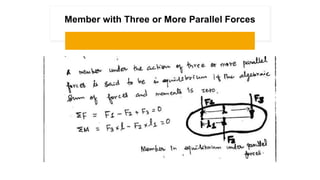
Member with Three or More Parallel Forces
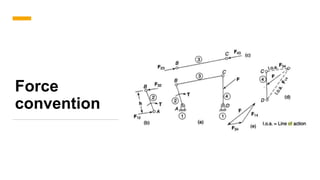
Force
convention
Free body diagrams
• A free body diagram is a sketch or diagram of a part isolated from the mechanism in order to
determine the nature of forces acting on it.
• As the mechanism is in static equilibrium, each of its members must be in equilibrium
individually.
• Member 4 is acted upon by three forces F, F34 and F14.
• Member 3 is acted upon by two forces F23 and F43.
• Member 2 is acted upon by two forces F32 and F12 and a torque T.
• Link 3 is a two-force member and for its equilibrium F23 and F43 must act along BC.
• F34 being equal and opposite to F43 also acts along BC.
Cont…
• Initially, the direction and sense of some forces are unknown.
Link 4:
• Assume that the force F is known.
• To know other two forces the direction of one or more force must be known.
• F14 passes through the intersection of F and F34 .
Link 3:
• It is a two force member (F23,F43) acts along BC.
• F43 and F34 are equal and opposite.
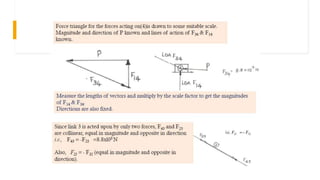
Force Triangle:
• F43 = F34 = F23 = F32
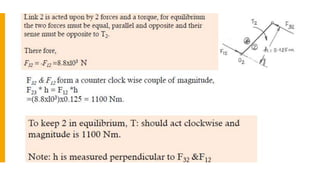
• Link 2 in equilibrium if F12 = F32
• T = F12 x h = F32 x h
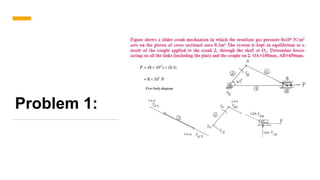
Problem 1:
Static and dynamic force analysis

Static and dynamic force analysis

  • 1.
    Dynamics of Machinery Static ForceAnalysis Mr.P.D.Devan Assistant Professor Kumaraguru College of Technology Coimbatore
  • 2.
    Overview of this Lecture •Introduction • Inertia Force • Inertia Torque • Static Force Analysis • Dynamic Force Analysis • Problem-1
  • 3.
  • 4.
    Cont… • All themechanisms / machines has moving parts / links to transmit force. • It is must to know the force direction and magnitude to design the elements. • Selection of proper size of element is very important to withstand stresses. • If not ---- machine / elements will fail. • If has more strength----- cannot meet other requirements.
  • 5.
    Inertia Force • Ifmachine components accelerates, inertia forces are produced due to masses. • A force opposite in direction to an accelerating force acting on a body and equal to the product of the accelerating force and the mass of the body. • −F = ma
  • 6.
    Static Force Analysis •Magnitude of the inertia force is less than the applied force • Inertia forces are neglected
  • 7.
    Dynamic Force Analysis • Whenthe inertia forces are considered in the analysis of the mechanism, the analysis is known as dynamic force analysis. • Magnitude of inertia forces are large compared with applied forces. • Applying D’Alembert principle.
  • 8.
    Inertia Torque (Inertia Couple) •It is an imaginary torque, which when applied on a rigid body, brings it in to equilibrium. • Equal to the accelerating couple but in opposite sense.
  • 9.
    Mass Moment ofInertia • Measure of distribution of mass of a rigid body w.r.t. the axis. • It is a measure of an object’s resistance to changes to its rotation. • Capacity of a cross-section to resist bending • It must be specified with respect to a chosen axis of rotation
  • 11.
    Equilibrium of TwoForce Members • A member under the action of two forces will be in • equilibrium if –the forces are of the same magnitude – the forces act along the same line – the forces are in opposite directions.
  • 12.
    Equilibrium of Three ForceMembers • A member under the action of three forces will be in equilibrium if – the resultant of the forces is zero – the lines of action of the forces intersect at a point (point of concurrency).
  • 13.
    Member with Two Forcesand Torque • A member under the action of two forces and an applied torque will be in equilibrium if – the forces are equal in magnitude, parallel in direction and opposite in sense – the forces form a couple which is equal and opposite to the applied torque.
  • 14.
  • 15.
    Member with Threeor More Parallel Forces
  • 16.
  • 17.
    Free body diagrams •A free body diagram is a sketch or diagram of a part isolated from the mechanism in order to determine the nature of forces acting on it. • As the mechanism is in static equilibrium, each of its members must be in equilibrium individually. • Member 4 is acted upon by three forces F, F34 and F14. • Member 3 is acted upon by two forces F23 and F43. • Member 2 is acted upon by two forces F32 and F12 and a torque T. • Link 3 is a two-force member and for its equilibrium F23 and F43 must act along BC. • F34 being equal and opposite to F43 also acts along BC.
  • 18.
    Cont… • Initially, thedirection and sense of some forces are unknown. Link 4: • Assume that the force F is known. • To know other two forces the direction of one or more force must be known. • F14 passes through the intersection of F and F34 . Link 3: • It is a two force member (F23,F43) acts along BC. • F43 and F34 are equal and opposite. Force Triangle: • F43 = F34 = F23 = F32 • Link 2 in equilibrium if F12 = F32 • T = F12 x h = F32 x h
  • 19.