Jimma University
College of Business and Economics
Department of Management
Tesfaye H. (MBA)
2013
Operations Research (OR)
Chapter One: Introduction
Chapter objectives
After completing this unit, you will be able to:
• Understand the history of operations
research.
• Meaning and definition of OR
• Features of OR
• Identify application areas of
operations research
• Significance of operations research.
• OR techniques
• Quantitative Analysis and Decision Making
• Models and Model Building
• Limitations of OR
2
Introduction To OR/MS
• Operations Research (OR): is a science which deals with problem,
formulation, solution and finally appreciate decision making.
• This science is basically concerned with optimizing maxima and minima of
objective functions involved.
• E.g. maxima could be profit, performance and yield
minima could be loss and risk
3
History of OR
• Started in Great Britain during WWII
• Failure of mission was very high.
• scientists and technocrats formed a team to study the problems arising out of
different situations.
• 1940s: the term of OR get more prominence when research was carried out on the
design and analysis of mathematical models for military operations.
4
Contd…
• Till 1950s OR confined to military operations,
• 1950: OR began to develop in Industrial filed in USA.
• 1951: the first book “Methods of Operations Research” published.
• 1952: the Operations Research Society of America came into being.
• 1957: IFORS established at Oxford
• Since then the OR/MS/DS/SS has become more applicable in all
management aspects of a system, product and service.
5
What is OR?
6
Operations
• The activities carried out in an organization.
Research
• The process of observation and testing characterized by the scientific method.
Situation, problem statement, model construction, validation, experimentation,
candidate solutions.
Model
• An abstract representation of reality. Mathematical, physical, narrative, set of
rules in computer program.
Meaning and Definition of OR
• OR is the application of a scientific approach to solving management problems
in order to help managers make better decision (Bernard W. Taylor III, 2006).
• OR: is the application of scientific methods by inter-disciplinary teams to solve
problems involving the control of organized (man-machine systems) so as to
provide solutions which best serve the purposes of the organization as a whole
(Ackoff and Sasieni 1968).
7
• From the concepts and definition given above, Operations Research is:
1. The application of scientific methods, techniques and tools to solve a problem
2. A management tool in the hands of a manager to take a decision.
3. A scientific approach to decision-making process.
4. An “applied research” aiming at finding a solution for an immediate problem facing a
society, industry or a business enterprise. This is not “fundamental research”.
5. A decision-oriented research, using scientific methods, for providing management a
quantitative basis for taking decision regarding operations under his/her control.
8
FEATURES OF OR
(i) Decision-making
(ii) Scientific Approach
(iii) Inter-disciplinary Team Approach
(iv) System Approach
(v) Reduces complexity by use of computers
(vi) Helpful in improving the quality of solution
(vii) Use of models
(viii) Require willing executives
9
10
The procedure to be followed in the study of OR, generally involves the following
major phases.
1. Formulating the problem
2. Constructing a mathematical model
3. Deriving the solution from the model
4. Testing the model and its solution ( updating the model)
5. Controlling the solution
6. Implementation
Application Areas of Operations Research
• Forecasting
• Production Scheduling
• Inventory Control
• Capital Budgeting
• Transportation
• Plant location
• Human Resource Management
• Advertising and sales research
• Maintenance and Repair
• Accounting procedures
• Packaging
• Natural Resource Management
• Research and Development
• Health Care
• Quality Control
• Equipment Replacement, etc.
11
There are so many application areas of operations research; to mention some of the
most widely known areas:
Significance of Operations Research
• Provides a tool for scientific analysis
• Provides solution for various business problems
• Enables proper deployment of resources
• Helps in minimizing waiting and servicing costs
• Enables the management to decide when to buy and how much to buy?
• Assists in choosing an optimum strategy
• Renders great help in optimum resource allocation
• Facilitates the process of decision making
• Helps a lot in the preparation of future managers
• Optimizing plant revenues
• Improving the efficiency of a production line
12
The commonly used techniques include
1. Allocation models :
• Linear programming
• Non-linear programming
• Transportation models
• Assignment models
• Integer programming
• Goal programming
• Dynamic programming
2. Inventory models
3. Replacement models
4. Network models
5. Waiting- line models(Queuing theory)
6. Simulation
7. Sequencing models
8. Decision theory
9. Game theory
10. Markov models
11. Regression and correlation 13
Techniques of OR
Quantitative Analysis & the Decision Making Process
• In order to understand the role of quantitative analysis in managerial type of
problems, it is better to have a look at the decision making process.
• Decision Making: is the process of selecting a feasible course of action from a set
of alternative, so as to solve problems.
• The decision making process is initiated by a problem.
• The intention of the manager, when making a decision, is to solve that problem.
• In doing so, the manager first makes an analysis of the alternatives.
• There are two forms of analysis— qualitative and quantitative.
14
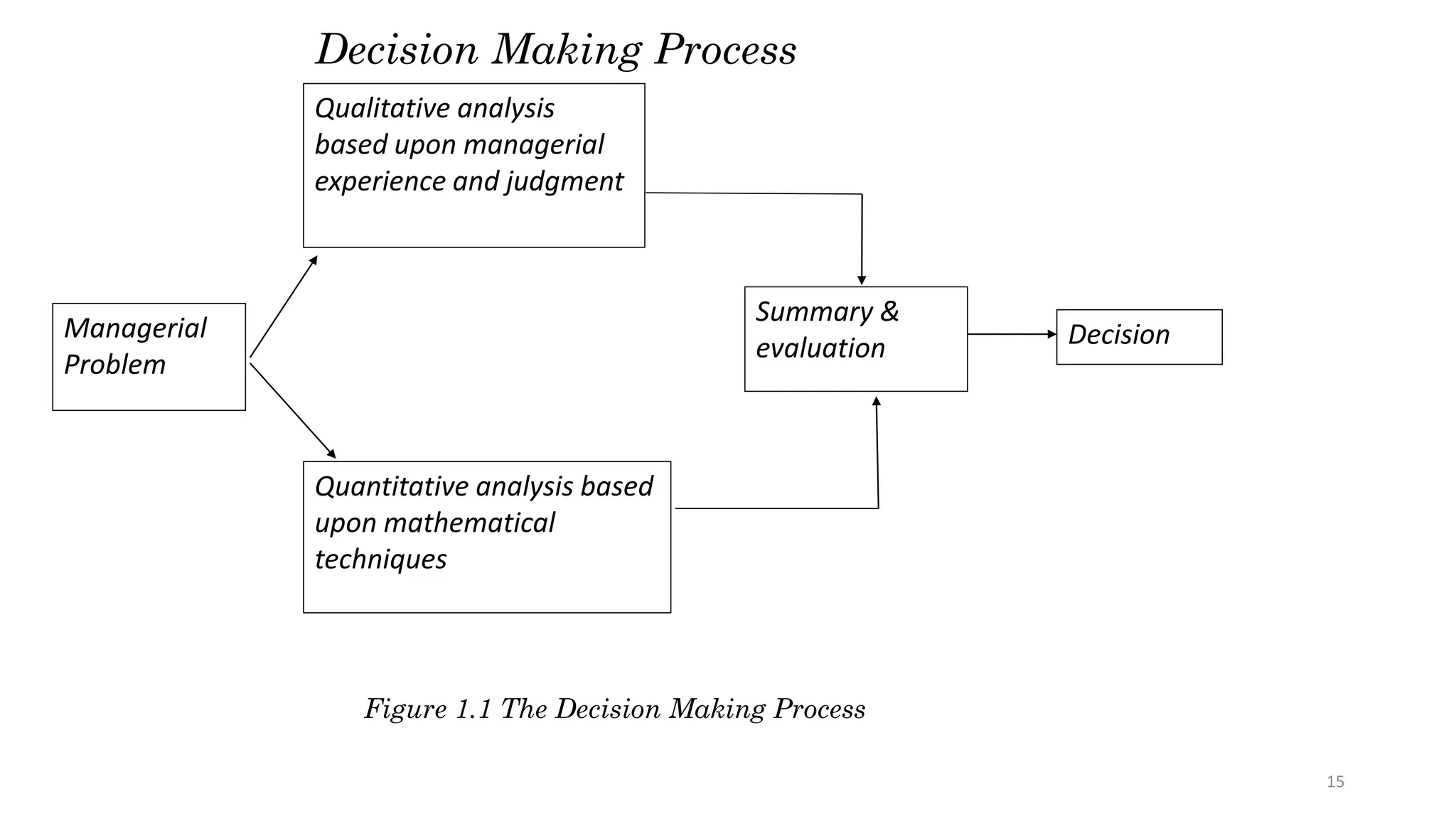
Managerial
Problem
Quantitative analysis based
upon mathematical
techniques
Summary &
evaluation Decision
Qualitative analysis
based upon managerial
experience and judgment
Figure 1.1 The Decision Making Process
15
Decision Making Process
Steps of decision making
1. Identify and define the problem;
2. Determine the set of alternative solutions;
3. Determine the criteria to evaluate alternatives;
4. Analyze the alternatives;
5. Select the best alternative/make the decision;
6. Implementing the solution;
7. Establishing a control, follow up and evaluation system;
16
Cont…
• In qualitative analysis, intuition and the manager’s subjective judgment and
experience are used.
• This type of problem solving is more an art than a science.
The qualitative approach is usually used when:
• The problem is simple
• The problem is familiar
• The costs involved are not so great
• Immediate decisions are needed 17
Cont…
The quantitative approach is used when:
• The problem is complex
• The problem is not familiar
• The costs involved are substantial
• Enough time is available to analyze the problem
18
Cont….
 Both the quantitative and qualitative analyses of a problem provide
important information for the decision maker.
 quantitative analysis tend to be more objective than those based on
a purely qualitative analysis.
 For this reason OR makes use of quantitative models.
19
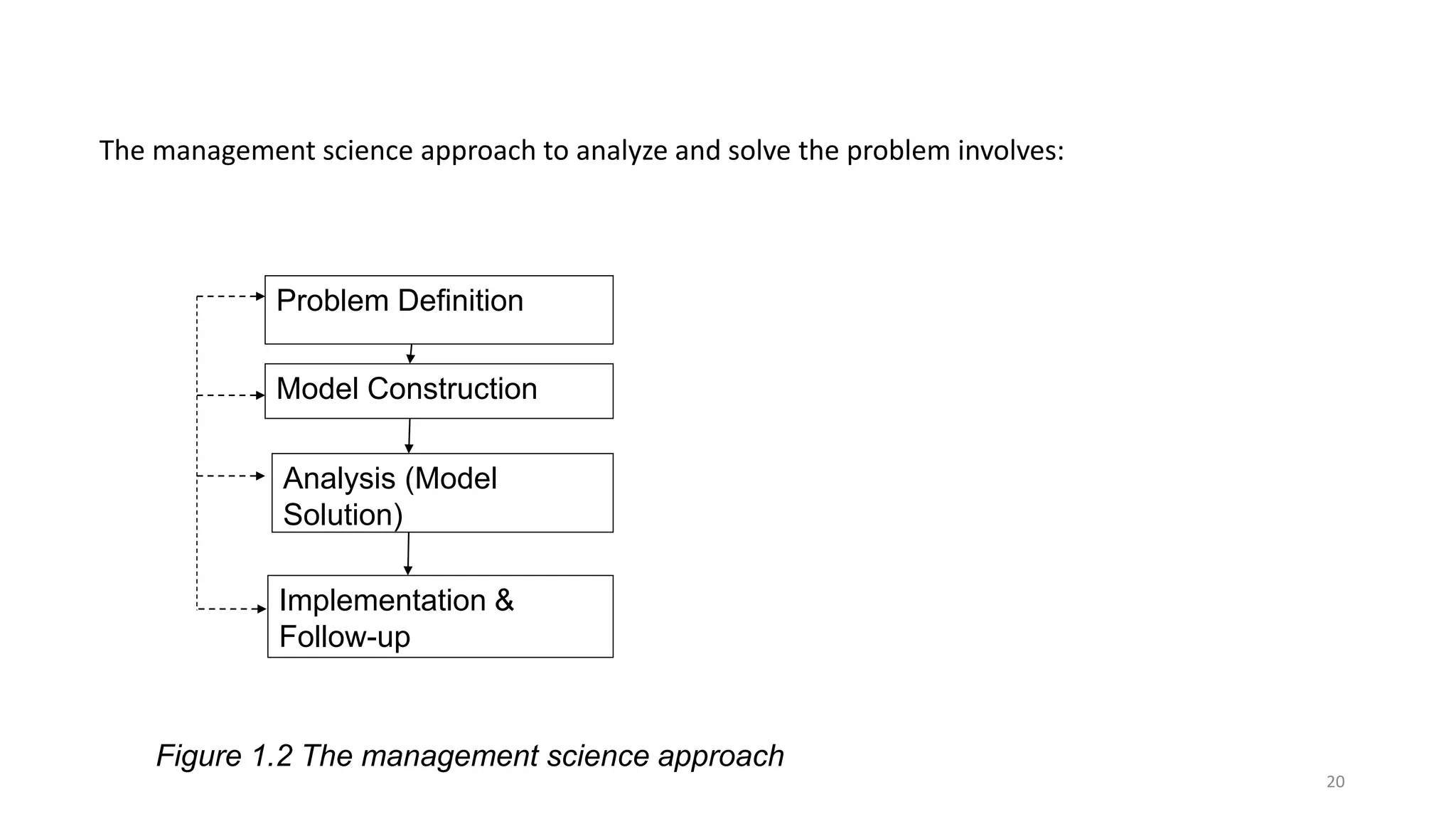
Problem Definition
Model Construction
Analysis (Model
Solution)
Implementation &
Follow-up
The management science approach to analyze and solve the problem involves:
Figure 1.2 The management science approach
20
Models and model building
• Model is a theoretical abstraction(approximation) of a real-life problem.
• In OR, the problem is expressed in the form of a model.
• A management science model is an abstract representation of an
existing problem situation.
• It can be in the form of a graph or chart, but most frequently a
management science model consists of a set of mathematical
relationships.
21
Cont…..
There are certain significant advantages gained when using a model.
 Problems under consideration become controllable through a model
It provides a logical and systematic approach to the problem
It provides the limitations and scope of an activity
It helps to eliminate duplications
It helps in finding solutions for research and improvements in a system.
22
Classification of Models
• The classification of models is a subjective problem. They may be
distinguished as follows:
Models by function
Models by degree of abstraction
Models by structure
Models by nature of an environment
Models by the extent of generality
23
1. Models based on Function/purpose:
A. Descriptive Models: These models use surveys , questionnaire results, inference of
observations to describe the situation. Ex. Plant Layout diagram. Block diagram of an
algorithm.
B. Predictive Models: These models are the results of query: “ What will follow if
this occurs or does not occur?”. Ex. Preventive Maintenance Trouble Shooting chart or
procedures.
C. Normative or Optimization Models: These models are designed to provide optimal
solution to the problem subject to a certain limitations or constraints on use of
resources. Ex. LP Problem
24
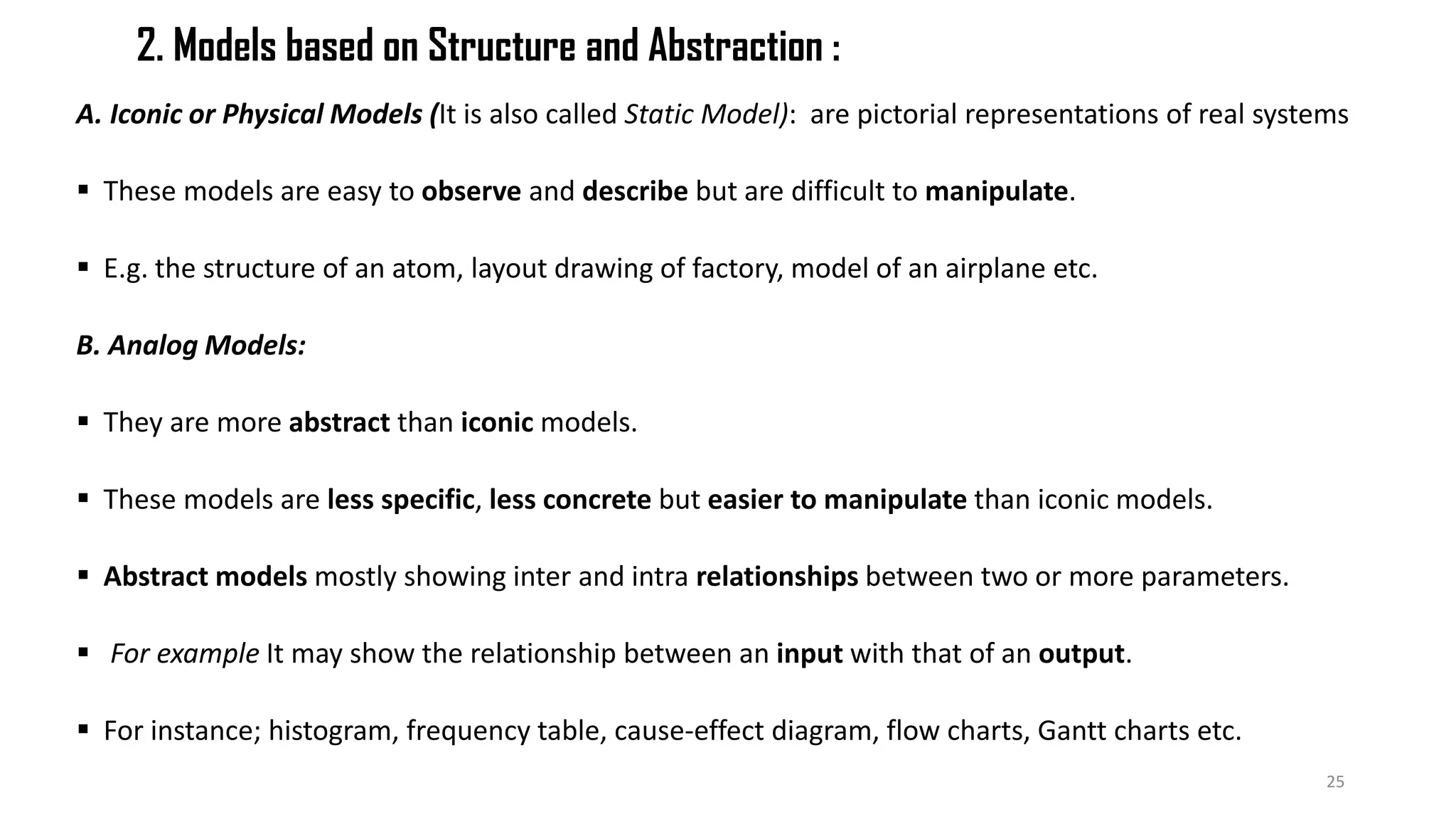
2. Models based on Structure and Abstraction :
A. Iconic or Physical Models (It is also called Static Model): are pictorial representations of real systems
 These models are easy to observe and describe but are difficult to manipulate.
 E.g. the structure of an atom, layout drawing of factory, model of an airplane etc.
B. Analog Models:
 They are more abstract than iconic models.
 These models are less specific, less concrete but easier to manipulate than iconic models.
 Abstract models mostly showing inter and intra relationships between two or more parameters.
 For example It may show the relationship between an input with that of an output.
 For instance; histogram, frequency table, cause-effect diagram, flow charts, Gantt charts etc.
25
Cont…..
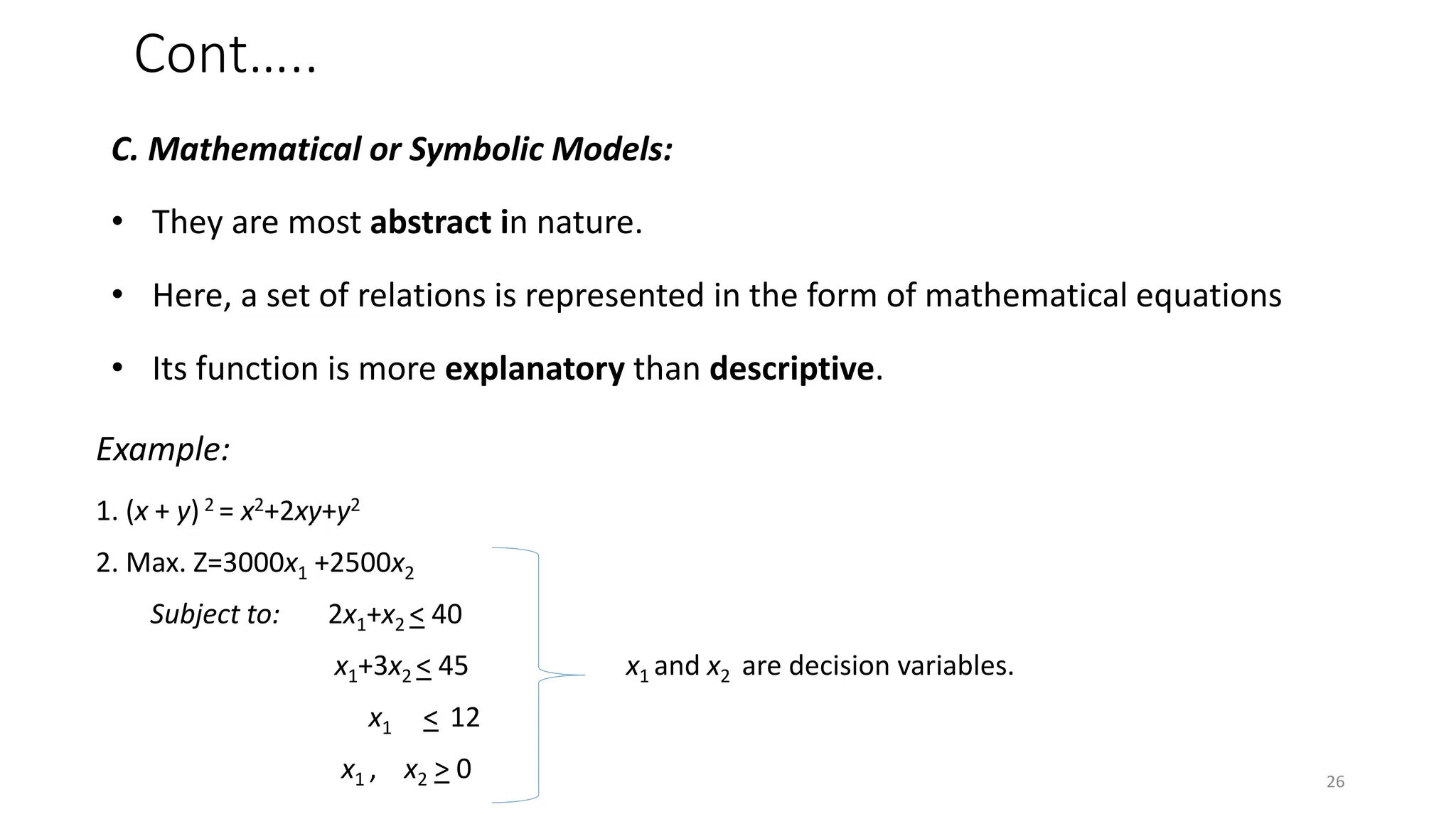
C. Mathematical or Symbolic Models:
• They are most abstract in nature.
• Here, a set of relations is represented in the form of mathematical equations
• Its function is more explanatory than descriptive.
Example:
1. (x + y) 2 = x2+2xy+y2
2. Max. Z=3000x1 +2500x2
Subject to: 2x1+x2 < 40
x1+3x2 < 45 x1 and x2 are decision variables.
x1 < 12
x1 , x2 > 0 26
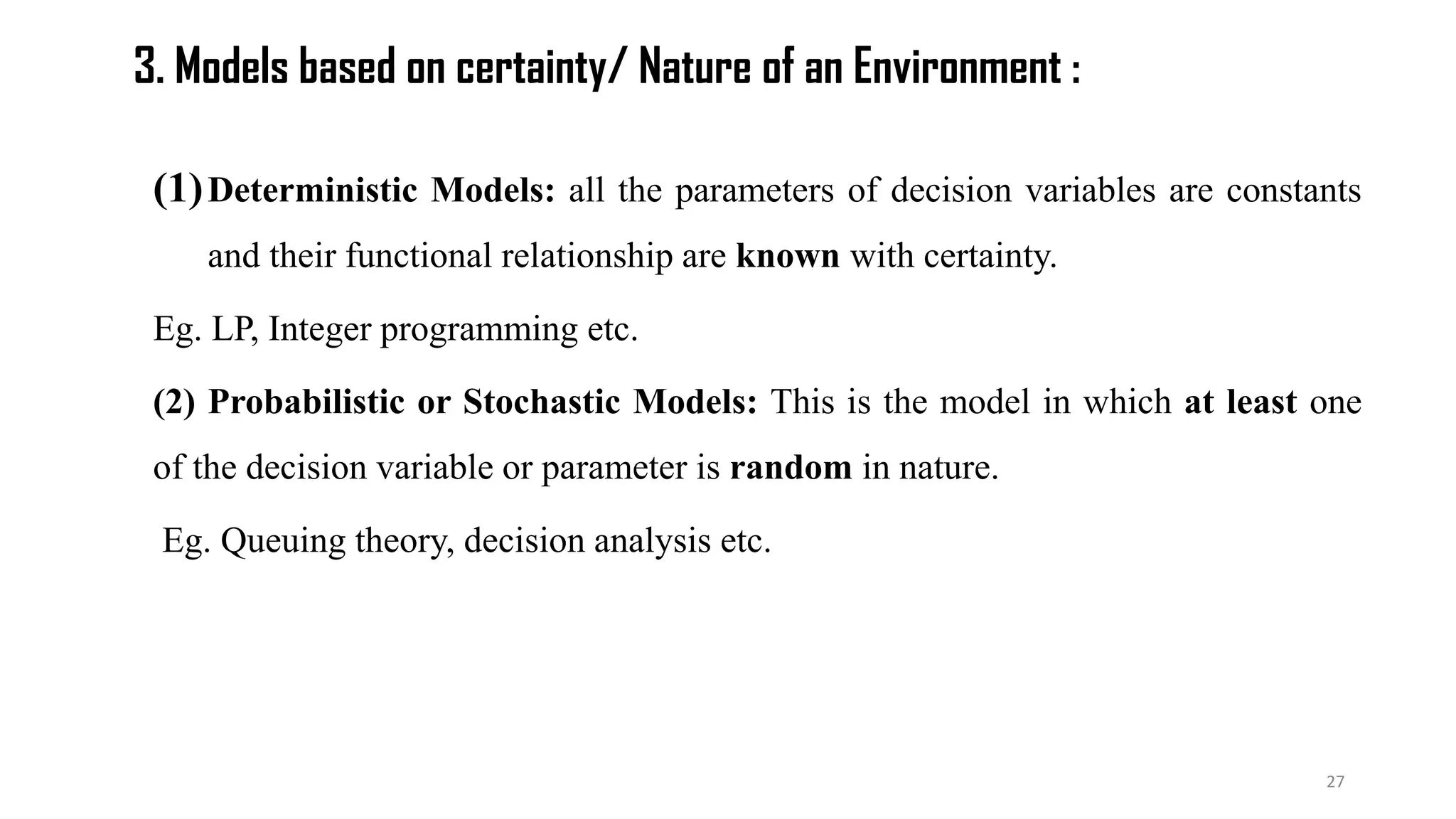
3. Models based on certainty/ Nature of an Environment :
(1)Deterministic Models: all the parameters of decision variables are constants
and their functional relationship are known with certainty.
Eg. LP, Integer programming etc.
(2) Probabilistic or Stochastic Models: This is the model in which at least one
of the decision variable or parameter is random in nature.
Eg. Queuing theory, decision analysis etc.
27
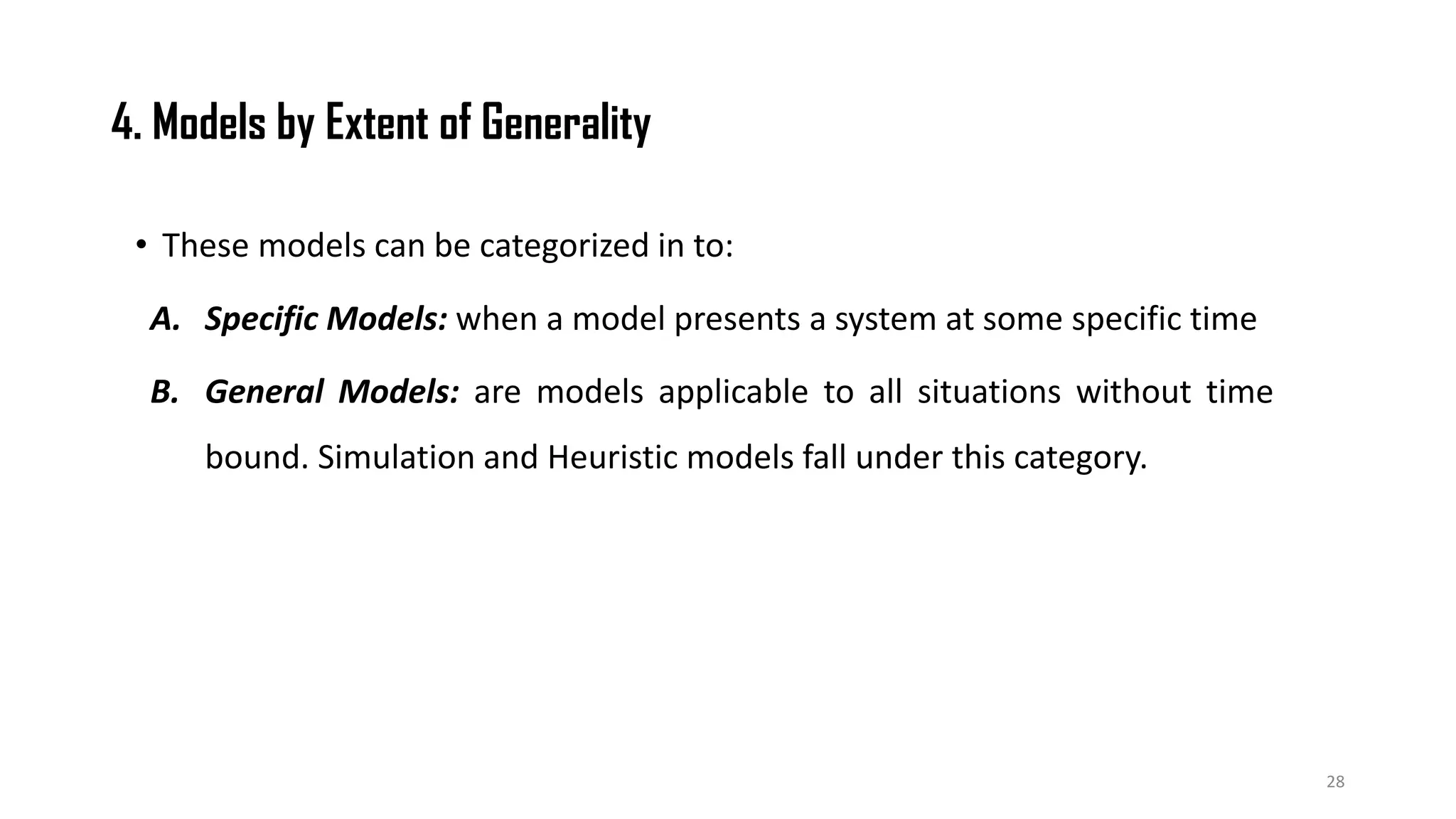
4. Models by Extent of Generality
• These models can be categorized in to:
A. Specific Models: when a model presents a system at some specific time
B. General Models: are models applicable to all situations without time
bound. Simulation and Heuristic models fall under this category.
28
Limitations of OR
• The inherent limitations concerning mathematical expressions
• High costs are involved in the use of OR techniques
• OR does not take into consideration the intangible factors
• OR is only a tool of analysis and not the complete decision-making process
• Other limitations
– Bias
– Internal resistance
– Competence
29
Thank you for you
Attention!!!!!!!!!!!!
?
30

OR chapter 1 an introduction materia.pdf

  • 1.
    Jimma University College ofBusiness and Economics Department of Management Tesfaye H. (MBA) 2013 Operations Research (OR)
  • 2.
    Chapter One: Introduction Chapterobjectives After completing this unit, you will be able to: • Understand the history of operations research. • Meaning and definition of OR • Features of OR • Identify application areas of operations research • Significance of operations research. • OR techniques • Quantitative Analysis and Decision Making • Models and Model Building • Limitations of OR 2
  • 3.
    Introduction To OR/MS •Operations Research (OR): is a science which deals with problem, formulation, solution and finally appreciate decision making. • This science is basically concerned with optimizing maxima and minima of objective functions involved. • E.g. maxima could be profit, performance and yield minima could be loss and risk 3
  • 4.
    History of OR •Started in Great Britain during WWII • Failure of mission was very high. • scientists and technocrats formed a team to study the problems arising out of different situations. • 1940s: the term of OR get more prominence when research was carried out on the design and analysis of mathematical models for military operations. 4
  • 5.
    Contd… • Till 1950sOR confined to military operations, • 1950: OR began to develop in Industrial filed in USA. • 1951: the first book “Methods of Operations Research” published. • 1952: the Operations Research Society of America came into being. • 1957: IFORS established at Oxford • Since then the OR/MS/DS/SS has become more applicable in all management aspects of a system, product and service. 5
  • 6.
    What is OR? 6 Operations •The activities carried out in an organization. Research • The process of observation and testing characterized by the scientific method. Situation, problem statement, model construction, validation, experimentation, candidate solutions. Model • An abstract representation of reality. Mathematical, physical, narrative, set of rules in computer program.
  • 7.
    Meaning and Definitionof OR • OR is the application of a scientific approach to solving management problems in order to help managers make better decision (Bernard W. Taylor III, 2006). • OR: is the application of scientific methods by inter-disciplinary teams to solve problems involving the control of organized (man-machine systems) so as to provide solutions which best serve the purposes of the organization as a whole (Ackoff and Sasieni 1968). 7
  • 8.
    • From theconcepts and definition given above, Operations Research is: 1. The application of scientific methods, techniques and tools to solve a problem 2. A management tool in the hands of a manager to take a decision. 3. A scientific approach to decision-making process. 4. An “applied research” aiming at finding a solution for an immediate problem facing a society, industry or a business enterprise. This is not “fundamental research”. 5. A decision-oriented research, using scientific methods, for providing management a quantitative basis for taking decision regarding operations under his/her control. 8
  • 9.
    FEATURES OF OR (i)Decision-making (ii) Scientific Approach (iii) Inter-disciplinary Team Approach (iv) System Approach (v) Reduces complexity by use of computers (vi) Helpful in improving the quality of solution (vii) Use of models (viii) Require willing executives 9
  • 10.
    10 The procedure tobe followed in the study of OR, generally involves the following major phases. 1. Formulating the problem 2. Constructing a mathematical model 3. Deriving the solution from the model 4. Testing the model and its solution ( updating the model) 5. Controlling the solution 6. Implementation
  • 11.
    Application Areas ofOperations Research • Forecasting • Production Scheduling • Inventory Control • Capital Budgeting • Transportation • Plant location • Human Resource Management • Advertising and sales research • Maintenance and Repair • Accounting procedures • Packaging • Natural Resource Management • Research and Development • Health Care • Quality Control • Equipment Replacement, etc. 11 There are so many application areas of operations research; to mention some of the most widely known areas:
  • 12.
    Significance of OperationsResearch • Provides a tool for scientific analysis • Provides solution for various business problems • Enables proper deployment of resources • Helps in minimizing waiting and servicing costs • Enables the management to decide when to buy and how much to buy? • Assists in choosing an optimum strategy • Renders great help in optimum resource allocation • Facilitates the process of decision making • Helps a lot in the preparation of future managers • Optimizing plant revenues • Improving the efficiency of a production line 12
  • 13.
    The commonly usedtechniques include 1. Allocation models : • Linear programming • Non-linear programming • Transportation models • Assignment models • Integer programming • Goal programming • Dynamic programming 2. Inventory models 3. Replacement models 4. Network models 5. Waiting- line models(Queuing theory) 6. Simulation 7. Sequencing models 8. Decision theory 9. Game theory 10. Markov models 11. Regression and correlation 13 Techniques of OR
  • 14.
    Quantitative Analysis &the Decision Making Process • In order to understand the role of quantitative analysis in managerial type of problems, it is better to have a look at the decision making process. • Decision Making: is the process of selecting a feasible course of action from a set of alternative, so as to solve problems. • The decision making process is initiated by a problem. • The intention of the manager, when making a decision, is to solve that problem. • In doing so, the manager first makes an analysis of the alternatives. • There are two forms of analysis— qualitative and quantitative. 14
  • 15.
    Managerial Problem Quantitative analysis based uponmathematical techniques Summary & evaluation Decision Qualitative analysis based upon managerial experience and judgment Figure 1.1 The Decision Making Process 15 Decision Making Process
  • 16.
    Steps of decisionmaking 1. Identify and define the problem; 2. Determine the set of alternative solutions; 3. Determine the criteria to evaluate alternatives; 4. Analyze the alternatives; 5. Select the best alternative/make the decision; 6. Implementing the solution; 7. Establishing a control, follow up and evaluation system; 16
  • 17.
    Cont… • In qualitativeanalysis, intuition and the manager’s subjective judgment and experience are used. • This type of problem solving is more an art than a science. The qualitative approach is usually used when: • The problem is simple • The problem is familiar • The costs involved are not so great • Immediate decisions are needed 17
  • 18.
    Cont… The quantitative approachis used when: • The problem is complex • The problem is not familiar • The costs involved are substantial • Enough time is available to analyze the problem 18
  • 19.
    Cont….  Both thequantitative and qualitative analyses of a problem provide important information for the decision maker.  quantitative analysis tend to be more objective than those based on a purely qualitative analysis.  For this reason OR makes use of quantitative models. 19
  • 20.
    Problem Definition Model Construction Analysis(Model Solution) Implementation & Follow-up The management science approach to analyze and solve the problem involves: Figure 1.2 The management science approach 20
  • 21.
    Models and modelbuilding • Model is a theoretical abstraction(approximation) of a real-life problem. • In OR, the problem is expressed in the form of a model. • A management science model is an abstract representation of an existing problem situation. • It can be in the form of a graph or chart, but most frequently a management science model consists of a set of mathematical relationships. 21
  • 22.
    Cont….. There are certainsignificant advantages gained when using a model.  Problems under consideration become controllable through a model It provides a logical and systematic approach to the problem It provides the limitations and scope of an activity It helps to eliminate duplications It helps in finding solutions for research and improvements in a system. 22
  • 23.
    Classification of Models •The classification of models is a subjective problem. They may be distinguished as follows: Models by function Models by degree of abstraction Models by structure Models by nature of an environment Models by the extent of generality 23
  • 24.
    1. Models basedon Function/purpose: A. Descriptive Models: These models use surveys , questionnaire results, inference of observations to describe the situation. Ex. Plant Layout diagram. Block diagram of an algorithm. B. Predictive Models: These models are the results of query: “ What will follow if this occurs or does not occur?”. Ex. Preventive Maintenance Trouble Shooting chart or procedures. C. Normative or Optimization Models: These models are designed to provide optimal solution to the problem subject to a certain limitations or constraints on use of resources. Ex. LP Problem 24
  • 25.
    2. Models basedon Structure and Abstraction : A. Iconic or Physical Models (It is also called Static Model): are pictorial representations of real systems  These models are easy to observe and describe but are difficult to manipulate.  E.g. the structure of an atom, layout drawing of factory, model of an airplane etc. B. Analog Models:  They are more abstract than iconic models.  These models are less specific, less concrete but easier to manipulate than iconic models.  Abstract models mostly showing inter and intra relationships between two or more parameters.  For example It may show the relationship between an input with that of an output.  For instance; histogram, frequency table, cause-effect diagram, flow charts, Gantt charts etc. 25
  • 26.
    Cont….. C. Mathematical orSymbolic Models: • They are most abstract in nature. • Here, a set of relations is represented in the form of mathematical equations • Its function is more explanatory than descriptive. Example: 1. (x + y) 2 = x2+2xy+y2 2. Max. Z=3000x1 +2500x2 Subject to: 2x1+x2 < 40 x1+3x2 < 45 x1 and x2 are decision variables. x1 < 12 x1 , x2 > 0 26
  • 27.
    3. Models basedon certainty/ Nature of an Environment : (1)Deterministic Models: all the parameters of decision variables are constants and their functional relationship are known with certainty. Eg. LP, Integer programming etc. (2) Probabilistic or Stochastic Models: This is the model in which at least one of the decision variable or parameter is random in nature. Eg. Queuing theory, decision analysis etc. 27
  • 28.
    4. Models byExtent of Generality • These models can be categorized in to: A. Specific Models: when a model presents a system at some specific time B. General Models: are models applicable to all situations without time bound. Simulation and Heuristic models fall under this category. 28
  • 29.
    Limitations of OR •The inherent limitations concerning mathematical expressions • High costs are involved in the use of OR techniques • OR does not take into consideration the intangible factors • OR is only a tool of analysis and not the complete decision-making process • Other limitations – Bias – Internal resistance – Competence 29
  • 30.
    Thank you foryou Attention!!!!!!!!!!!! ? 30