

SEQUENCING MODEL
Prof.P.D.Devan
Asst Professor
Department of Mechanical Engineering
Kumaraguru College ofTechnology
Coimbatore
SEQUENCING
Sequencing can be viewed as a special kind of problem commonly
encountered in production shops where various types of products are to
be processed over various combinations of machines.
Ex: Let there are m jobs, each of which has to be processed one at a
time, on each of n different machines. Also the time required for different
machines and different jobs are given. The main objective is, to find the
optimal sequence of jobs to be done using different machines in such
way that the over all time required for completion of all job must be
minimum. Also the idle time of the machines must be minimized.
SEQUENCING MODEL
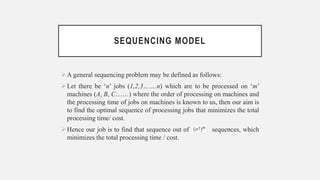
A general sequencing problem may be defined as follows:
Let there be ‘n’ jobs (1,2,3…….n) which are to be processed on ‘m’
machines (A, B, C……) where the order of processing on machines and
the processing time of jobs on machines is known to us, then our aim is
to find the optimal sequence of processing jobs that minimizes the total
processing time/ cost.
Hence our job is to find that sequence out of sequences, which
minimizes the total processing time / cost.
ASSUMPTIONS IN SEQUENCING PROBLEMS
The processing times Ai and Bi etc. are exactly known to us and they
are independent of order of processing the job on the machine. (i.e) the
time taken to process the job will not vary it remains constant.
The given processing time includes the transfer time and setup time.
Each job once started on the machine, the processing shouldn’t stop in
the middle. It is to be processed completely before loading the next job.
The job starts on the machine as soon as the job and the machine both
become idle.
CONT…
The cost of keeping the semi-finished job is assumed that it is too small
and is negligible (Zero inventory cost).
There is only one machine of each type.
While processing, no job is given priority(i.e. the order of completion
of jobs has no significance. The processing times are independent of
sequence of jobs).
No machine may process more than one job simultaneously (This
means to say that the job once started on a machine, it should be done
until completion of the processing on that machine)..
TYPES OF SEQUENCING PROBLEMS
 ‘n’ jobs are to be processed on two machines say machine A and
machine B in the order AB. This means that the job is to be processed
first on machine A and then on machine B.
‘n’ jobs are to be processed on three machines A,B and C in the order
ABC i.e. first on machine A, second on machine B and third on machine
C.
‘n’ jobs are to be processed on ‘m’ machines in the given order
Two jobs are to be processed on ‘m’ machines in the given order.
‘N’ JOBS AND TWO MACHINES
If the problem given has two machines and two or three jobs, then it
can be solved by using the Gantt chart.
But if the numbers of jobs are more, then this method becomes less
practical.
Gantt chart consists of X -axis on which the time is noted and Y-axis on
which jobs or machines are shown.
For each machine a horizontal bar is drawn. On these bars the
processing of jobs in given sequence is marked.
Sequence problems can also be solved by Johnson Bellman rule
‘N’ JOBS ON THREE MACHINES
• When there are ‘n’ jobs, which are to be processed on three machines
say A, B, and C in the order ABC.
• Processing times in time units. As such there is no direct method of
sequencing of ‘n‘ jobs on three machines. Before solving, a three-
machine problem is to be converted into a two-machine problem.
PROCEDURE
Identify the smallest time element in the first column.
Identify the smallest time element in the third column
Identify the highest time element in the second column
Now minimum time on machine 1(Ar ≥ maximum time element on
machine 2,Bi)
(OR)
Minimum time on third machine (Cs ≥ maximum time element on
machine 2, Bi)
(OR)
Both Ar and Cs ≥ Bi
CONT…
• If the above condition satisfies, then we have to workout the time
elements for two hypothetical machines, namely machine G and
machine H. The time elements for machine G, Gi = Ai + Bi.
• The time element for machine H, is Hi = Bi + Ci
• Now the three-machine problem is converted into two-machine
problem..
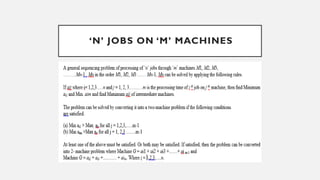
‘N’ JOBS ON ‘M’ MACHINES

Sequencing model

  • 1.
    SEQUENCING MODEL Prof.P.D.Devan Asst Professor Departmentof Mechanical Engineering Kumaraguru College ofTechnology Coimbatore
  • 2.
    SEQUENCING Sequencing can beviewed as a special kind of problem commonly encountered in production shops where various types of products are to be processed over various combinations of machines. Ex: Let there are m jobs, each of which has to be processed one at a time, on each of n different machines. Also the time required for different machines and different jobs are given. The main objective is, to find the optimal sequence of jobs to be done using different machines in such way that the over all time required for completion of all job must be minimum. Also the idle time of the machines must be minimized.
  • 3.
    SEQUENCING MODEL A generalsequencing problem may be defined as follows: Let there be ‘n’ jobs (1,2,3…….n) which are to be processed on ‘m’ machines (A, B, C……) where the order of processing on machines and the processing time of jobs on machines is known to us, then our aim is to find the optimal sequence of processing jobs that minimizes the total processing time/ cost. Hence our job is to find that sequence out of sequences, which minimizes the total processing time / cost.
  • 4.
    ASSUMPTIONS IN SEQUENCINGPROBLEMS The processing times Ai and Bi etc. are exactly known to us and they are independent of order of processing the job on the machine. (i.e) the time taken to process the job will not vary it remains constant. The given processing time includes the transfer time and setup time. Each job once started on the machine, the processing shouldn’t stop in the middle. It is to be processed completely before loading the next job. The job starts on the machine as soon as the job and the machine both become idle.
  • 5.
    CONT… The cost ofkeeping the semi-finished job is assumed that it is too small and is negligible (Zero inventory cost). There is only one machine of each type. While processing, no job is given priority(i.e. the order of completion of jobs has no significance. The processing times are independent of sequence of jobs). No machine may process more than one job simultaneously (This means to say that the job once started on a machine, it should be done until completion of the processing on that machine)..
  • 6.
    TYPES OF SEQUENCINGPROBLEMS  ‘n’ jobs are to be processed on two machines say machine A and machine B in the order AB. This means that the job is to be processed first on machine A and then on machine B. ‘n’ jobs are to be processed on three machines A,B and C in the order ABC i.e. first on machine A, second on machine B and third on machine C. ‘n’ jobs are to be processed on ‘m’ machines in the given order Two jobs are to be processed on ‘m’ machines in the given order.
  • 7.
    ‘N’ JOBS ANDTWO MACHINES If the problem given has two machines and two or three jobs, then it can be solved by using the Gantt chart. But if the numbers of jobs are more, then this method becomes less practical. Gantt chart consists of X -axis on which the time is noted and Y-axis on which jobs or machines are shown. For each machine a horizontal bar is drawn. On these bars the processing of jobs in given sequence is marked. Sequence problems can also be solved by Johnson Bellman rule
  • 8.
    ‘N’ JOBS ONTHREE MACHINES • When there are ‘n’ jobs, which are to be processed on three machines say A, B, and C in the order ABC. • Processing times in time units. As such there is no direct method of sequencing of ‘n‘ jobs on three machines. Before solving, a three- machine problem is to be converted into a two-machine problem.
  • 9.
    PROCEDURE Identify the smallesttime element in the first column. Identify the smallest time element in the third column Identify the highest time element in the second column Now minimum time on machine 1(Ar ≥ maximum time element on machine 2,Bi) (OR) Minimum time on third machine (Cs ≥ maximum time element on machine 2, Bi) (OR) Both Ar and Cs ≥ Bi
  • 10.
    CONT… • If theabove condition satisfies, then we have to workout the time elements for two hypothetical machines, namely machine G and machine H. The time elements for machine G, Gi = Ai + Bi. • The time element for machine H, is Hi = Bi + Ci • Now the three-machine problem is converted into two-machine problem..
  • 11.
    ‘N’ JOBS ON‘M’ MACHINES