Interfacing Methods and
Circuits
Chapter 11
Introduction
 A sensor/actuator can rarely operate on its own.
 Exceptions exist (bimetal sensors)
 Often a circuit of some sort is involved.
 can be as simple as adding a power source or a
transformer
 can involve amplification, impedance matching, signal
conditioning and other such functions.
 often, a digital output is required or desirable so that
an A/D may be needed
 The same considerations apply to actuators
Introduction
 The considerations of interfacing should be part of the
process of selecting a device for a particular application
since this can simplify the process considerably.
 Example: if a digital device exists it would be wasteful to
select an equivalent analog device and add the required
circuitry to convert its output to a digital format.
 The likely outcome is a more cumbersome, expensive
system which may take more time to produce.
 Alternative sensing strategies and alternative sensors
should always be considered before settling on a
particular solution
Introduction
 Many types of sensors and actuators based on
very different principles
 There are commonalities between them in terms of
interfacing requirements
 Most sensors’ outputs are electric (voltage, current,
resistance)
 These can be measured directly after proper signal
conditioning and, perhaps, amplification.
 If the output is a capacitance or an inductance -
require additional circuitry such as oscillators
Introduction
 There is a large range of signal levels in sensors.
 A thermocouple’s output is of the order of
microvolts
 An LVDT may easily produce 5V AC.
 A piezoelectric actuator may require a few
hundred volts to operate (very little current)
 A solenoid valve operates at perhaps 12-24V
with currents that may exceed a few amperes.
 How does one measure these signals?
Introduction
 The circuitry required to drive and to interface
them to, say a microprocessor are vastly different
 Require special attention on the part of the
engineer.
 Must consider such issues as response (electrical
and mechanical), spans and power dissipation as
well as power quality and availability.
 Example: Systems connected to the grid and
cordless systems have different requirements and
considerations in terms of operation and safety.
Purpose
 Discuss general issues associated with
interfacing
 Outline general interfacing circuits the engineer
is likely to be exposed to.
 No general discussion however can prepare one
for all eventualities
 It should be recognized that there are both
exceptions to the rules and extensions to the
methods discussed here.
Purpose
 Example: an A/D is a simple – if not inexpensive – method of
digitizing a signal for the purpose of interfacing
 This approach however may not be necessary and too
expensive in some cases.
 Suppose the hall element senses the teeth on a gear.
 The signal from the hall element is an ac voltage - only the
peaks are necessary to sense the teeth.
 In this case a simple peak detector may be adequate.
 An A/D converted will not provide any additional benefit and is
a much more complex and expensive solution.
 On the other hand, if a microprocessor is used and an A/D is
available it may be acceptable to use it for this purpose
Content
 Operational amplifiers and power
amplifiers
 A/D and D/A conversion circuits
 Bridge circuits
 Data transmission
 Excitation circuits
 Noise and interference
Amplifiers
 An amplifier is a device that amplifies a signal –
almost always a voltage
 The low voltage output of a sensor, say of a
thermocouple, may be amplified to a level
required by a controller or a display.
 Amplification may be quite large – sometimes of
the order of 106
or it may be quite small or even
smaller than one, depending on the need of the
sensor.
Amplifiers
 Amplifiers can also be used for impedance matching
purposes even when no amplification is needed
 May be used for the sole purpose of signal conditioning,
signal translation or for isolation
 Power amplifiers, which usually connect to actuators,
serve similar purposes beyond providing the power
necessary to drive the actuator.
 Amplifiers can be very simple – a transistor with its
associated biasing network or may involve many
amplification stages of varying complexity.
 Amplifiers are sometimes incorporated in the sensor
Amplifiers
 We will use the operational amplifier as the basic
building block for amplification.
 Operational amplifiers are basic devices and may be
viewed as components.
 An engineer, especially when interfacing sensor is not
likely to dwell into the design of electronic circuits below
the level of operational amplifiers.
 Although there are instances where this may be done to
great advantage, op-amps are almost always a better,
less expensive and higher performance choice.
 Same idea for power amplifiers
Operational Amplifiers
 Operational amplifier is a fairly complex electronic
circuit but:
 It is based on the idea of the differential voltage
amplifier shown in Figure 11.1.
 Based on simple transistors,
 The output is a function of the difference between
the two inputs.
 Assuming the output to be zero when both inputs
are at zero potential, the operation is as follows:
Differential amplifier
Operational amplifier
 When the voltage on the base of Q1 increases,
its bias increases while that on Q2 decreases
because of the common emitter resistance.
 Q1 conducts more than Q2 and the output is
positive with respect to ground.
 If the sequence is inverted, the opposite occurs.
 If, both inputs increase or decrease equally,
there will be no change in output.
Operational amplifier
 An operational amplifier is much more complex
than this but operates on the same principle.
 It contains additional circuitry (such as
temperature and drift compensation, output
amplifiers, etc.)
 These are of no interest to us other than the fact
that they affect the specifications of the op-amp.
 There are also various modifications to op-amps
that allow them to operate under certain
conditions or to perform specific functions.
Operational amplifier
 Some are “low noise” devices
 Others can operate from a single polarity source.
 If the input transistors are replaced with FETs, the
input impedance increases considerably requiring
even lower input currents from sensors
 These are important but are variations of the basic
circuit.
 We will consider it as a simple block shown in
Figure 11.2 and discuss its general properties
based on this diagram
The operational amplifier
Op-Amps - properties
 Differential voltage gain: the amplification of
the op-amp of the difference between the two
inputs:
 Also called the open loop gain
 in a good amplifier it should be as high as
possible.
 Gains of 106
or higher are common.
 An ideal amplifier is said to have infinite gain.
Op-Amps - properties
 Common-mode voltage gain.
 By virtue of the differential nature of the
amplifier, this gain should be zero.
 Practical amplifiers may have a small common
mode gain because of the mismatch between
the two channels but this should be small.
 Common mode voltage gain is indicated as Acm.
 The concept is shown in Figure 11.3.
Common mode signal an output
Op-amps - properties
 More common to specify the term Common
Mode Rejection Ratio (CMRR)
 CMRR is the ratio between Ad and Acm:
CMRR =
A
d
A
cm
In an ideal amplifier this is infinite.
A good amplifier will have a CMRR that is very high
Op-amps - properties
 Bandwidth: the range of frequencies that can be
amplified.
 Usually the amplifier operates down to dc and
has a flat response up to a maximum frequency
at which output power is down by 3dB.
 An ideal amplifier will have an infinite bandwidth.
 The open gain bandwidth of a practical amplifier
is fairly low
 A more important quantity is the bandwidth at the
actual gain.
Op-amps - properties
 This may be seen in Figure 11.4
 The lower the gain, the higher the bandwidth.
 Data sheets therefore cite what is called the
gain-bandwidth product.
 This indicates the frequency at which the gain
drops to one and is also called the unity gain
frequency.
 In Figure 11.4:
 BW (open loop) is 2.5 kHz
 Unity Gain Frequency is 5 MHz
Bandwidth of op-amp
Op-amps - properties
 Slew Rate: the rate of change of the output in
response to a change in input, given in V/s.
 If a signal at the input changes faster than the
slew rate, the output will lag behind it and a
distorted signal will be obtained.
 This limits the usable frequency range of the
amplifier.
 For example, an ideal square wave will have a
rising and dropping slope at the output defined by
the slew rate.
Op-amps - properties
 Input impedance: the impedance seen by the
sensor when connected to the op-amp.
 Typically this impedance is high (ideally infinite)
 It varies with frequency.
 Typical impedances for conventional amplifiers is
at least 1 M but it can be of the order of hundreds
of M for FET input amplifiers.
 This impedance defines the current needed to
drive the amplifier and hence the load it represents
to the sensor.
Op-amps - properties
 Output impedance: the impedance seen by the
load.
 Ideally this should be zero since then the output
voltage of the amplifier does not vary with the load
 In practice it is finite and depends on gain.
 Usually, output impedance is given for open loop
whereas at lower gains the impedance is lower.
 A good amplifier will have an output resistance
lower than 1.
Op-amps - properties
 Temperature and noise refer to variations of
output with temperature and noise
characteristics of the device respectively.
 These are provided by the data sheet for the op-
amp and are usually very small.
 For low signals, noise can be important while
temperature drift, if unacceptable must be
compensated for through external circuits.
Op-amps - properties
 Power requirements. The classical op-amp is
built so that its output can swing between ±Vcc
 Dual supply operation is common in op-amps
 The limits can be as low as ±3V (or lower) and
as high as ±35V (sometimes higher).
 Many op-amps are designed for single supply
operation of less than 3V and some can be used
in single supply or dual supply modes.
Op-amps - properties
 Current through the amplifier is an important consideration,
especially the quiescent current (no load)
 Gives a good indication of power needed to drive it.
 Particularly important in battery operated devices. The
current under load will depend on the application but it is
usually fairly small – a few mA.
 In selection of a power supply for op-amps, care should be
taken with the noise that the power supply can inject into the
amplifier.
 The effect of the power supply on the amplifier is specified
through the power supply rejection ratio (PSRR) of the
specific amplifier.
Op-amps - data sheets
 The 741 op-amp is an older, general
purpose amplifier.
 It is a fairly low performance device but is
characteristic of the low-end amplifiers.
 Very common and quite suitable for many
applications. LM741.PDF
Op-amps - data sheets
 The TLC27L2C is a dual, low power op-
amp, suited for battery operated devices
 Part of a series of amplifiers using FETs
as input transistors TLC27L2C
Inverting and noninverting
amplifiers
 Performance of the amplifier depends on how it is used
and, in particular on the gain of the amplifier.
 In practical circuits, the open loop gain is not useful
and a specific gain must be established.
 For example, we might have a 50mV output
(maximum) from a sensor and require this output to be
amplified, say by 100 to obtain 5V (maximum) for
connection to an A/D.
 This can be done with one of the two basic circuits
shown in Figure 11.5, establish a means of negative
feedback to reduce the gain
Inverting op-amp
Non-inverting op-amp
Inverting op-amp
 The output is inverted with respect to the input
(180 out of phase).
 The feedback resistor, Rf, feeds back some of
this output to the input, effectively reducing the
gain.
 The gain of the amplifier is now given as:
A
v
= −
R
f
R
I
In the case shown here this is exactly –10
Inverting op-amp
 The input impedance of the amplifier is given as
Here it is equal to 1 k.
If a higher resistance is needed, larger resistances might be
needed
Or, perhaps, a different amplifier will be needed
(noninverting amplifier)
R
i
= R
I
Inverting op-amp
 The output impedance of the amplifier is given
as
AOL is the open loop gain as listed on the data sheet
Open loop gain is the open loop gain at the frequency at
which the device is operated
R
o
=
R
I
+ R
f
Open loop output impedance
R
I
A
OL
Inverting op-amp
 Example, for the LM741 amplifier, the open loop
output impedance is 75 and the open loop gain at
1 kHz is 1000. This gives an output impedance of:
R
o
=
1000 + 10000 75
1000 × 1000
= 0.825 Ω
The bandwidth is also influenced by the feedback:
BW =
unity gain frequency R
I
R
I
+ R
f
Non-inverting amplifier
 The non-inverting amplifier gain is:
A
v
= 1 +
R
f
R
I
For the circuit shown, this is 11
The gain is slightly larger than for the noninverting
amplifier for the same values of R.
The main difference however is in input impedance.
Non-inverting amplifier
 Input impedance is:
Rop is the input impedance of the op-amp as given in the
spec sheet
Aol is the open loop gain of the amplifier.
Assuming an open loop impedance of 1 M (modest
value) and an open loop gain of 106
, we get an input
impedance of 1011
. (almost ideal)
R
i
= R
op
A
ol
R
I
R
I
+ R
f
Non-inverting amplifier
 The output impedance and bandwidth are the
same as for the inverting amplifier.
 The main reason to use a noninverting amplifier
is that its input impedance is very large making it
almost ideal for many sensors.
 There are other properties that need to be
considered for proper design such as output
current and load resistance but these will be
omitted here for the sake of brevity.
The voltage follower
 The feedback resistor in the noninverting
amplifier is set to zero
 The circuit in Figure 11.6 is obtained.
 The gain is one.
 This circuit does not amplify.
 Why use it?
The voltage follower
Voltage follower
The input impedance now is very large and equal to:
R
i
= R
op
A
ol
The output impedance is very small and equal to:
R
o
=
Open loop output impedance
A
OL
Voltage follower
 The value of the voltage follower is to
serve in impedance matching.
 One can use this circuit to connect, say, a
capacitive sensor or, an electret
microphone.
 If amplification is necessary, the voltage
follower may be followed by an inverting or
noninverting amplifier
Instrumentation amplifier
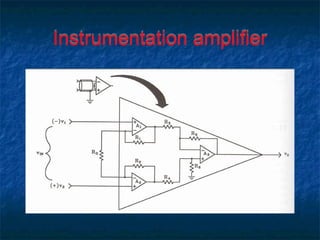
 The instrumentation amplifier is a modified op-
amp
 Its gain is finite and both inputs are available to
signals.
 These amplifiers are available as single devices
 To understand how they operate, one should
view them as being made of three op-amps (it is
possible to make them with two op-amps or even
with a single op-amp), as shown in Figure 11.7.
Instrumentation amplifier
 The gain of an amplifier of this type is:
A
v
= 1 +
2 R
R
a
R
3
R
2
In a commercial instrumentation amplifier all
resistances are internal and produce a gain usually
around 100.
Ra is external and can be set by the user to obtain the
gain required.
Instrumentation amplifier
 The output of the instrumentation amplifier is
The main use of this amplifier is to obtain an output
proportional to difference between inputs.
Important in differential sensors, especially when
one sensor is used to sense the stimulus and an
identical sensor is used for reference (such as when
temperature compensation is needed)
V
o
= A
v
V
+
− V
−
Instrumentation amplifier
 Each of the inputs has the high impedance of the
amplifier used
 The output impedance is low (inverting amp.)
 The main problem in a circuit of this type is that the
CMRR depends on the matching of the resistances
(R, R2 and R3) in each section of the circuit.
 These are internal and are adjusted during
production to obtain the required CMRR.
Charge amplifier
 The so-called charge amplifier is shown in Figure 11.8.
 Charge cannot be amplified but the output voltage can
be made proportional to charge as follows:
 The output of the inverting amplifier is:
A
v
= −
R
f
R
I
= −
1/ j ω C
1/ j ω C
0
= −
C
0
C
C0 is the capacitance connected across the inverting input.
Charge amplifier
 Assuming that a change in charge occurs on the
capacitor, equal to Q = C0V, the output voltage may
be written as
In effect the charge generated at the input is amplified
V
o
= − Δ V
C
0
C
= −
Δ Q
C
Charge amplifier
 If C is small, a small change in charge at the input can
generate a large voltage swing in the output.
 The main method of connecting capacitive sensors
such as pyroelectric sensors whose output is low
(piezoelectric sensors, on the other hand produce a
higher voltage).
 It is necessary for the input impedance to be very high
and care must be taken in connections (such as the use
of very good capacitors).
 Commercial charge amplifiers use FET transistors to
ensure the necessary high input impedance.
Charge amplifier
Current amplifier
 Another example of the use of an amplifier
to a specific end is the current amplifier
Current amplifier
 The input voltage is Vi=ir.
 Just like the inverting amplifier, the output now is
V
o
= − V
i
R
r
= − iR
Useful with very low impedance sensors.
May be used with thermocouples whose impedance
can be trivially low.
They may be connected directly (r then represents
the resistance of the thermocouple).
The output is a direct function of the current the
thermocouple produces which can be fairly large
The comparator
 An op-amp operated in open loop mode
 Because its gain is so high, a very small signal at the
input will saturate the output.
 For practically any input, the output will be either
+Vcc or –Vcc. Consider Figure 11.10.
 The negative input is set at a voltage V
and V+
=0.
Therefore the output is AolV
=Vcc.
 Suppose we increase V+
. Output is (V+
V
)Aol. As long
as V+
<V-
, the output remains –Vcc. If V+
>V
, the output
changes to + Vcc.
The comparator
The comparator
 The function of this device is to compare
the two inputs and to indicate which one is
higher.
 The comparator is useful beyond simple
comparison.
 It will be used extensively in A/D and D/A
conversion of signals and in many other
aspects of sensing and actuation
Power amplifiers
 A power amplifier is a device or circuit whose
power output is the input power multiplied by a
power gain:
P
o
= P
i
A
p
That is, the amplifier is capable of boosting the
power level of a signal to match the needs of an
actuator.
Power amplifiers
 The obvious use of power amplifiers is in driving
actuators, (speakers, voice coil actuators and
solenoid actuators and motors).
 The power amplifier is really either a voltage
amplifier or a current amplifier (also called
transconductance amplifier).
 In a voltage amplifier, the input signal is a voltage.
 This voltage is amplifier and in the final stage a
sufficiently high current provided so that the
required power is met.
Power amplifiers
 In a current amplifier the opposite occurs.
 Power amplifiers are divided into linear and PWM
(pulse width modulated) amplifiers.
 In a linear amplifier, the output (voltage) is a linear
function of the input and can be anything between
±Vcc.
 In a PWM amplifier the output is either Vcc or
zero and the power delivered is set by the time
the output is on. The latter is controlled by the
width of the pulse that controls the output.
Linear power amplifiers
 First step is to amplify the signal to the required
output.
 Can be done using any amplifier
 We shall assume an op-amp was used for this
purpose.
 Then this voltage is applied to an “output stage”
 It does not need to amplify but, rather, supplies
the necessary current.
 A simple example is shown in Figure 11.11.
Linear power amplifier
Class A linear amplifier
 This is the so called Class A power amplifier.
 Set for a gain of 101 (noninverting amplifier).
 The output then drives the transistor whose output
will swing, at most between 0 and V
 Will supply a current which is V/RL
 Class A designation indicates amplifiers for which the
output stage is always conducting as in the case
above. Also assumes output does not saturate.
 The BJT can be replaced with a MOSFET for higher
currents.
Class A linear amplifier
 This type of amplifier is sometimes used to drive
relatively small loads such as light indicators,
small dc motors and some solenoid valves.
 In some cases the amplification is set high
enough to saturate the amplifier in which case
the amplifier operates as an on/off circuit rather
than a class A amplifier
 Typically used to turn on/off relays, lights,
motors, etc.
Class B amplifier
 A Class B or push-pull amplifier is shown in Figure
11.12.
 It is usually a better choice.
 It operates exactly as in the previous case except
that under no input, the output is zero and there is
no conduction in the transistors (or MOSFETs).
 When the input is positive, the upper transistor
conducts supplying the load and when the input is
negative, the lower transistor supplies the load.
Class-B (push-pull) power
amplifier
Class B amplifier
 The voltage in the load can swing between +Vcc and –
Vcc
 The current is again defined by the load.
 The output stage is made of a pair of power transistors,
one PNP and one NPN (or of a P and an N type
MOSFET).
 There are many variations of the basic amplifiers.
 For example, feedback may be added and it is common
to protect the output stage from short circuits as well as
from spikes due to inductive and capacitive loads.
Class B amplifier
 In terms of performance, the obvious are the power output
and the type and level of input.
 For example, an amplifier may be specified as supplying
100W for a 1V input.
 Next is the distortion level.
 Distortions are specified as a percentage of output.
 The most common specification is the THD (total
harmonic distortions) as % of output.
 A good amplifier will have less than, say, 0.1% THD.
 Other specifications are temperature rise and output
impedance of the amplifier (must match load).
Class B amplifier
 Power amplifiers of various power level exist
either as integrated circuits or as discrete
components circuits.
 Usually the discrete circuits can supply higher
powers.
 An example of an integrated amplifier is the
TDA2040 which can supply 20W and is designed
for use as an audio amplifier.
 Nevertheless it can drive other loads such as light
bulbs, small motors, etc.
PWM amplifiers
 The PWM approach is shown schematically in
Figure 11.13.
 The power transistors are driven on and off so
that the voltage on the load can only be zero or
Vcc.
 The time the power is on is controlled by the
timing circuit.
 This defines the average power at the load.
The PWM principle
PWM amplifiers
 The pulse width modulator is an oscillator which
generates a square wave whose duty cycle can
be controlled based on the required power.
 For example, in Figure 11.14, the timing circuit
defines for how long the input signal is
connected to the transistor, hence for how long it
conducts.
 The power in the load is a function of this timing.
This circuit is not particularly useful but others
are.
PWM driving of a load
PWM driving
 Figure 11.15 shows an example often used to
control speed and direction of small dc motors.
 It is called an H-bridge for obvious reasons.
 A pulse of constant amplitude but varying duty
cycle connected to point A, will drive MOSFETs 1
and 4, turning the motor into one direction.
 The duty cycle defines the average current in the
motor and hence its speed.
 Connecting to point B, turns on MOSFETs 2 and 3
reversing the process.
H-Bridge driven from a PWM
source
H-bridge PWM driver
 Some precautions must be taken to ensure that
only opposite transistors conduct
 This is one of the most common circuits used for
bidirectional control of motors and other
actuators.
 The controllers for these devices can be a small
microprocessor
 Integrated PWM circuits and controllers are
available commercially
A/D and D/A converters
 These are the means by which a signal can be
converted from analog to digital or from digital to analog
as necessary.
 The idea is obvious but implementation can be
complex.
 There are certain types of D/A and A/D that are trivially
simple.
 We will start with these and only then discuss some of
the more complex schemes.
 In certain cases one of these simple methods is
sufficient.
A/D and D/A converters
 Analog to digital and, to a lesser extent, digital to analog
conversion are common in sensing systems since most
sensors and actuators are analog devices and most
controllers are digital.
 Most A/Ds required voltages much above the output of
some sensors.
 Often the output from the sensor must be amplified first
and only then converted.
 This leads to errors and noise and has resulted in the
development of direct digitization methods based on
oscillators (to be discussed below).
Threshold digitization
 In some cases, an analog signal represents
simple data such as the presence of something.
 For example, in chapter 5 we discussed the
detection of teeth on a gear using a hall element.
 The signal obtained is quite small and looks more
or less sinusoidal with the peaks representing the
presence of the teeth.
 In such a case it is sufficient to use a threshold
amplifier which will then produce a digital output.
An example is shown in Figure 11.16a.
Threshold digitization
 The output from the the hall element varies from
100mV to 150mV. This signal can be fed into a
comparator as shown in Figure 11.17
 The negative input is set by the resistors to 0.13V.
 Normally the output is zero until the voltage on the
positive input rises above the threshold.
 When the input dips below 0.13V the output goes
back to zero.
 The output in Figure 11.16b is obtained and now,
each pulse represents a tooth on the gear.
Comparator threshold
digitization
Threshold digitization
 Counting the teeth in a given time can give the
speed of rotation of the gear or other data.
 A missing tooth, the corresponding pulse will be
represented by a missing pulse
 This method is very effective when voltages at the
input change across the comparison point
 At the comparison point itself, the output of the
comparator is not properly defined and the output
can change states back and forth creating pulses
which are spurious.
Threshold digitization
 To avoid this a hysteresis is added to the
comparator so that the transition from low to high
occurs say, at V0 and the transition from high to low
occurs at V0-V.
 Hysteresis can be added to comparators through
external components.
 Another approach is to use of a Schmitt trigger.
 The Schmitt trigger is essentially a digital
comparator with a built in hysteresis as described
above whose transition is around Vcc/2.
Threshold digitization
 Threshold digitization is a very simple method of
digitization and is sufficient for many applications.
 It is commonly used for the purpose above but also
in flow meters in which a rotating paddle operates a
hall element or another magnetic sensor
 It is also useful for optical sensors which use the
idea of interruption of the beam.
 It is not however suitable for measuring the level of
a signal such as voltage from a thermocouple.
Direct voltage to frequency
conversion
 In many sensors, the output is too small to use
the method above or to be sent over normal
lines for any distance.
 In such cases a voltage to frequency conversion
can be performed at the location of the sensor
and the digital signal then transferred over the
line to the controller.
 The output now is not voltage but rather a
frequency which is directly proportional to
voltage (or current).
Direct voltage to frequency
conversion
 These voltage-to-frequency converters or voltage
controlled oscillators are relatively simple and accurate
circuits and have been used for other purposes.
 Their main advantage over the threshold method above
is that lower levels of signals may be involved and the
problems with noisy transitions around the comparison
voltage are eliminated.
 A circuit of this type is shown in Figure 11.18, as used
with a light sensor.
 The circuit is an op-amp integrator.
Direct voltage to frequency
conversion
Direct voltage to frequency
conversion
 The voltage across the capacitor is the integral of the current
in the noninverting leg of the amplifier.
 This current is proportional to the voltage across R2.
 As the voltage on the capacitor rises, a threshold circuit
checks this voltage
 When the threshold has been reached, an electronic switch
shorts the capacitor and discharges it.
 The switch then opens and allows the capacitor to recharge.
 The voltage on the capacitor is a triangular shape whose
width (i.e. the integration time) depends on the voltage at the
noninverting input.
Direct voltage to frequency
conversion
 If no light is present on the sensor, it has a dark resistance and
the voltage at the noninverting input will have a certain value.
 The output of the amplifier changes at a frequency f1.
 If now light falls on the sensor, its resistance goes down and the
total resistance at the noninverting input falls.
 This reduces the input voltage and hence the integration time
until the capacitor reaches the threshold increases.
 The result is that the amplifier changes state slower and the
output is a lower frequency f2.
 Since small changes in frequency can be easily detected, this is
a very sensitive method of digitization for small signal sensors.
Voltage to frequency conversion
 Other V/F converters require a much higher
voltage and they are more suitable for A/D
conversion after amplification of the lower
signals or for sensors whose output is high to
begin with. There are two basic methods.
 One type is essentially a free running oscillator
whose frequency can be controlled by the input
voltage.
 The second is a modification of Figure 11.18
and is called a charge-balance V/F converter.
Voltage to frequency conversion
 A simple V/F method is shown in Figure 11.19.
 It consists of a square wave oscillator (called a multivibrator)
and a control circuit.
 The multivibrator operates by charging and discharging a
capacitor.
 The on/off times of the waveform (hence frequency) are
controlled by charging/discharging times of the capacitor.
 To control frequency voltage to be converted is amplified and
fed as currents to the bases of the two transistors.
 The larger the base current, the larger the collector current
and the faster the charge/discharge and hence the higher the
frequency of the multivibrator.
Simple voltage to frequency
conversion - multivibrator
V/F conversion
 A different approach is shown in Figure 11.20.
 The amplifier acts as an integrator and the FET across the
capacitor is the switch.
 The capacitor charges at a rate proportional to the current
I=V0/R which is proportional to the voltage to be converted.
 When the output has reached the threshold voltage of the
schmitt trigger it changes state, turning on and this turns on
the FET switch.
 Discharging of the capacitor occurs and the output resets
to restart the process. Again, as before, only relatively large
level voltages can be converted.
Simple voltage to frequency
conversion - integrator
Dual slope A/D converter
 The simpler (and slower) of the true A/D
converters
 Based on the following principle: a
capacitor is charged from the voltage to be
converted through a resistor, for a fixed,
predetermined time T. The capacitor
reaches a voltage VT which is:
V
T
= V
in
T
RC
Dual slope A/D converter
 At time T, Vin is disconnected
 A negative reference voltage of known magnitude
is connected to the capacitor through the same
resistor.
 This discharges the capacitor down to zero in a
time T
− V
T
= − V
ref
Δ T
RC
Dual slope A/D converter
 Since these are equal in magnitude we have:
V
in
T
RC
= V
ref
Δ T
RC
→
V
in
V
ref
=
Δ T
T
In addition, a fixed frequency clock is turned on at the
beginning of the discharge cycle and off at the end of the
discharge cycle. Since T and T are known and the counter
knows exactly how many pulses have been counted, this
count is the digital representation of the input voltage.
A schematic diagram of a dual slope converter based on these
principles is shown in Figure 11.21.
Dual slope A/D conversion
Dual slope A/D converter
 The method is rather slow with approximately
1/2T conversions per second.
 It is also limited in accuracy by the timing
measurements, accuracy of the analog devices
and, of course, by noise.
 High frequency noise is reduced by the
integration process and low frequency noise is
proportional to T (the smaller T the less low
frequency noise).
Dual slope A/D converter
 The dual slope A/D is the method of choice for many
sensing applications in spite of its rather slow response
because it is simple and readily built from standard
components.
 For most sensors its performance and noise
characteristics is quite sufficient
 Because of the integration involved, it tends to smooth
variations in the signal during the integration.
 The method is also used in digital voltmeters and other
digital instruments.
Successive approximation
A/D
 This is the method of choice in A/D converter
components and in many microprocessors.
 It is available in many off the shelf components
with varying degrees of accuracy
 Depending on the number of bits of resolution it
may resolve down to a few microvolt.
 The basic structure is shown in Figure 11.22. It
consists of a precision comparator, a shift register
a digital to analog converter and a precision
reference voltage Vref.
Successive approximation A/D
conversion
Successive approximation A/D
 The operation is as follows:
 First, all registers are cleared, which forces the
comparator to HIGH.
 This forces a 1 into the MSB of the register.
 The D/A generates an analog voltage Va which
for MSB=1 is half the full scale input.
 This is compared to Vin. If Vin is larger than Va,
the output stays high and the clock shifts this
into the next bit into the register.
Successive approximation A/D
 The register now shows 1100000000.
 If it is smaller than Vin, the output goes low and the register
shows 010000000.
 Assuming that the input is still higher, the D/A generates a
voltage Va=(1/2+1/4)Vfs.
 If this is higher than the input, the register will show
011000000 but if it is lower, it will show 11100000 and so on,
until, after n steps the final result will be obtained.
 The data is read from the shift register and represents the
voltage digitally.
 This digital value can now be shifted out and used by the
controller.
Successive approximation A/D
 A/D of this type exists with resolution of up to 14 bits with
8 and 10 bits being quite common.
 An 8 bit A/D has a resolution of: Vin/28
=0.004Vin.
 For a 5V full scale, the resolution is 20 mV.
 This may not be sufficient for low level signals in which
case a 10, 12 or 12 bit A/D may be used (a 14 bit A/D
has a resolution of 0.3mV).
 There are also techniques of extending this resolution
but it is almost always necessary to amplify signals from
devices such as thermocouples if they must be digitized.
Successive approximation A/D
 The advantage of the successive approximation A/D is
that the conversion is done in n steps (fixed)
 It is much faster than other methods.
 On the other hand the accuracy of the device depends
heavily on the comparator and the D/A converter.
 Commercial devices are fairly expensive, especially if
more than 10 bits are needed.
 This type of A/D has been incorporated directly into
microprocessors and can sometimes be used for
sensing as part of the overall circuitry.
 Some microprocessors have multiple A/D channels.
Digital to Analog Conversion
 Digital to analog conversion is less often used
with sensors but is sometimes used with
actuators.
 This occurs when a digital device, such as a
microprocessor must provide an analog output.
 This should be avoided if possible by use of
digital actuators (such as brushless dc motors
and stepper motors) but there will be cases in
which D/A will be necessary.
 It is often a part of A/D conversion
Digital to Analog Conversion
 There are different ways of accomplishing D/A
conversion.
 The most common method used in simple
converters is based on the ladder network shown
in Figure 11.23.
 It consists of a voltage follower. Its input
impedance is high and the output of the follower
equals the voltage at its noninverting input.
 The voltage is generated by the resistance
network.
Ladder network D/A conversion
 The ladder network is chosen so that the
combination of series and parallel resistances
represent the digital input as a unique voltage
which is then passed to the output.
 The switches are digitally controlled analog
switches (MOSFETs).
 Depending on the digital input, various switches
will connect resistors in series or in parallel.
Ladder network D/A conversion
 For example, suppose that the digital value 100
is to be converted.
 The switches will be as in Figure 11.23.
 The voltage at the amplifier’s input is exactly 5V.
 The ladder can be extended as necessary for
any number of bits.
 The accuracy and usefulness of a D/A depends
on the quality and accuracy of the ladder
network and the reference voltage used.
Bridge circuits
 Bridge circuits are some of the oldest circuits
used in sensors as well as other applications.
 The bridge is known as the Wheatstone bridge
(variations of the bridge exist with different
names.)
 The basic Wheatstone bridge is shown in Figure
11.24.
 It consists of 4 impedances Zi=Ri+jXi.
The impedance bridge
 The output voltage of the bridge is
V
o
= V
i
Z
1
Z
1
+ Z
2
−
Z
3
Z
3
+ Z
4
The bridge is said to be balanced if
Z
1
Z
2
=
Z
3
Z
4
Under this condition, the output voltage is zero.
The impedance bridge
 If, for example, Z1 represents the impedance of a
sensor, by proper choice of the other impedances
the output can be set to zero at a given value of Z1.
 Any change in Z1 will change the value of Vo
indicating the change in stimulus.
 Of course, one can do much more than that and
bridges can be used for signal translation and for
temperature compensation among other things.
 One important property of bridges is their sensitivity
to change in stimuli
The impedance bridge
The sensitivity of the output voltage to change in any
of the impedances can be calculated as:
d V
o
d Z
1
= V
i
Z
2
Z
1
+ Z
2
2
,
d V
o
d Z
2
= − V
i
Z
1
Z
1
+ Z
2
2
d V
o
d Z
3
= − V
i
Z
4
Z
3
+ Z
4
2
,
d V
o
d Z
4
= V
i
Z
3
Z
3
+ Z
4
2
Summing up gives the bridge sensitivity
d V
o
V
i
=
Z
2
d Z
1
− Z
1
d Z
2
Z
1
+ Z
2
2
−
Z
4
d Z
3
− Z
3
d Z
4
Z
3
+ Z
4
2
The impedance bridge
 This relation reveals that if Z1=Z2 and Z3=Z4 the
bridge is balanced
 If the change, is such that dZ1=dZ2 and dZ3=dZ4, the
change in output is zero.
 This is the basic idea used in compensating a sensor
for temperature variation and any other common
mode effects.
 For examples, suppose that a pressure sensor has
impedance Z1=100  and a sensitivity to
temperature dZ1= 0.5 /C.
The impedance bridge
 We use two identical sensors as Z1 and as Z2
 Sensor Z2 is not exposed to pressure (only exposed to
the same temperature as Z1).
 Z3 and Z4 are equal and are made of the same
material – these are simple resistors.
 Under these conditions, there will be no output due to
temperature changes
 The sensor is properly compensated for temperature
variations.
 If however pressure changes, the output changes
The impedance bridge
 If all impedances in the bridge are fixed and only
Z1 varies (this is the sensor), then dZ2=0, dZ3=0,
dZ4=0 and the bridge sensitivity becomes
d V
o
V
i
=
Z
2
d Z
1
Z
1
+ Z
2
2
d V
o
V
i
=
d Z
1
4 Z
1
, if Z
2
= Z
1
Or:
The impedance bridge
 This bridge, especially with resistive branches is
the common method of sensing with:
 strain gauges, piezoresistive sensors,
 hall elements, thermistors
 force sensors and many others.
 Use of bridges allows a convenient reference
voltage (nulling), temperature compensation and
other sources of common mode noise.
 It is very simple and it can be easily connected to
amplifiers for further processing
Temperature compensation of
bridges
 Temperature compensation in sensors eliminates
the errors due to temperature or any other common
mode effect.
 It does not eliminate errors external to the sensors
such as variations of Vi with temperature.
 These have to be compensated for in the
construction of the bridge itself.
 There are many techniques by which this can be
accomplished but this is beyond the scope of this
course.
Bridge output
 The output from the bridge is likely to be relatively
small.
 For example, suppose that the bridge is fed with a
5V source and a thermistor, Z4=500 (at 0C) is
used to sense temperature.
 Assuming the bridge is balanced at 0C, the other
three resistances are also 500.
 This gives an output voltage zero.
 Now, suppose that at 100C the resistance of the
thermistor goes down to 400.
Bridge output
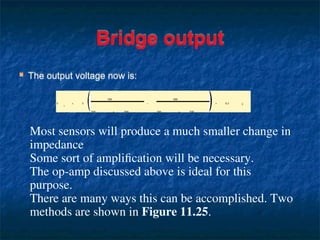
 The output voltage now is:
V
o
= 5
500
500 + 500
−
400
500 + 500
= 0.5 V
Most sensors will produce a much smaller change in
impedance
Some sort of amplification will be necessary.
The op-amp discussed above is ideal for this
purpose.
There are many ways this can be accomplished. Two
methods are shown in Figure 11.25.
Amplified bridge
Active bridge
Amplified bridge
 In Figure 11.25a, the bridge is connected directly
between the inverting and noninverting inputs.
 If we assume that the resistance of the resistance of
the sensor changes as Rx=R0(1+), the voltage
output of the bridge is:
V
out
≈ V
i
(1 + n ) V α
4
This circuit provides an amplification of (1+n) but
requires that the voltage on the bridge be floating
Active bridge
 Circuit in Figure 11.25b does not provide
amplification but rather places the sensor in the
feedback loop. This is called an active bridge and its
output is:
This circuit provides buffering (higher input
impedance, lower output impedance).
V
out
= − V
i
α
2
Data transmission
 Transmission of data from a sensor to the controller
may take many forms.
 If the sensor is passive, it already has an output in a
usable form such as voltage or current.
 It would seem that it is sufficient to simply measure
this output directly to obtain a reading.
 In other cases, such as with capacitive or inductive
sensors, indirect measuring is often used.
 The sensor is often likely to be in a remote location.
Data transmission
 Neither direct measurement of voltage and
current or using the sensor as part of the circuit
(in an oscillator) may be an option in such a
case
 In such cases, it is often necessary to process
the sensor’s output locally and to transmit the
result to the controller.
 The controller then interprets the data and
places it in a suitable form.
Data transmission
 The ideal method of transmission is digital.
 Often employed in “smart sensors” since they
have the necessary processing power locally.
 In most cases a sensor of this type will have a
local microprocessor supplied with power from the
controller or have its own source of power
 The digital data may then be transmitted over
regular lines or even through a wireless link.
 Since digital data is much less prone to corruption,
the method is both obvious and very useful.
Data transmission
 Many sensors are analog and,
 Their output may eventually be converted
into digital form but:
 It is not always possible to incorporate the
electronics locally.
 This may be because of cost or because
of operating conditions such as elevated
temperatures.
Data transmission
 Example, in a car there may be a half dozen sensors
that control ignition, air intake and fuel, all of which are
needed for control of the engine and are processed by a
central processor.
 It is not practical to supply each sensor with power and
electronics to digitize their data when the processor can
do that for all of them.
 In other cases, such as, for example, the oxygen sensor,
the sensor operates at elevated temperatures, beyond
the temperature range of semiconductors making it
impossible to incorporate electronics in them.
Data transmission
In such cases the analog signal must be
transferred to the controller.
A number of methods have been developed for
this purpose.
Three of these methods, suitable for use with
resistive sensors, or with passive sensors are
discussed next
Four wire sensing
 In sensors that change their resistance, such as
thermistors, and piezoresistive sensors, one
must supply an external source and measure the
voltage across the sensor.
 If done remotely, the current may vary with the
resistance of the connecting wires and produce
an erroneous reading.
 To avoid this the method in Figure 11.26 may
be used.
Four wire sensing
Four wire sensing
 The sensor is supplied from a current source, i0.
 This current is constant since the internal impedance of a
current source is very high.
 The voltage on the sensor is independent of the length of the
wires and their impedance.
 A second pair of wires measures the voltage across the
sensor
 Since a voltmeter has very high impedance there is no current
(ideally) in this second pair of wires, producing accurate
reading.
 This is a common method of data transmission when
applicable.
Two wire sensing for passive
sensors
 Passive sensors produce a voltage. It is sometimes
possible to measure the voltage remotely (no
current is involved in the measurement).
 Especially true for dc outputs such as in
thermocouples.
 In sensors with high impedance it is much more
risky to do so because of the noise the lines can
introduce.
 In most cases a twisted pair line is used because it
reduces the noised picked up by the line.
Two wire transmission for
active sensors
 A common method of data transmission for
sensors, and a method that has been
standardized is the 4-20 mA current loop.
 The output of the sensor is modified to modulate
the current in the loop
 4 mA corresponds to minimum stimulus
 20 mA corresponds to maximum stimulus
 The configuration is shown in Figure 11.27.
4-20 mA current loop data
transmission
4-20 mA current loop data
transmission
 The sensor’s output must be modified to
conform to this industry standard and this may
require additional components.
 Many sensors are made to conform to this
standard so that the user only has to connect
them to the two-wire line.
 The power supply depends on the load
resistance and the transmitter’s resistance but it
is between 12 and 48V.
4-20 mA current loop data
transmission
 Usually the sensor’s network allows for setting
the range (minimum and maximum value of the
stimulus) to the 4 mA and 20 mA range as
shown.
 The current transmitted on the line is then
independent of the length of the line and its
resistance.
 The voltage measured across the load
resistance is then processed at the controller to
provide the necessary reading.
Other methods of transmission
 There are other methods of transmission that may be
incorporated.
 6-wire transmission is used with bridge circuits in which
the 4 wire method above is supplemented by two
additional wires which measure the voltage on the bridge
itself.
 A new 1-wire protocol has become very popular for
many devices including sensors.
 In this protocol both power to the device and data
to/from it are passed on a single pair of wires,
 An effective and economical method for sensing.
Transmission to actuators
 There are only two ways the power can be
transmitted to the actuator.
 One is to get the actuator close to the source that
provides the power.
 This implies that lines must be very short.
 Possible in some cases (audio speakers, control
motors in a printer, etc.).
 In some cases this is not practical and the
controller and the actuator must be at considerable
distance (robots on the factory floor, etc.).
Transmission to actuators
 In such cases one of the methods above may be
used to transfer data but the power must then be
generated locally at the actuator site.
 The controller now issues commands as to
power levels, timings, etc. and these are then
executed locally to deliver the power necessary.
 Much of this is done digitally through use of
microprocessors on both ends.
Excitation methods and
circuits
 Sensors and actuators must often be supplied with
voltages or currents
 Either ac or dc.
 These are the excitation sources for the sensors
and actuators.
 First and foremost is the power supply circuit.
 In many sensors the power is supplied by batteries
 Many others rely on line power through use of
regulated or unregulated power supplies.
Excitation methods and
circuits
 Other sensors require current sources (for
example - Hall elements)
 Still others require ac sources (LVDTs)
 These circuits affect the output of the
sensor and its performance (accuracy,
sensitivity, noise, etc.)
 Are an integral part of the overall sensor’s
performance.
Power supplies
 There are two types of power supplies
 Linear power supply
 Switching power supply.
 There are also so called dc to dc
converters which are used to convert
power from one level to another,
sometimes as part of the circuit that uses
the power.
Power supplies
 A linear power supply is shown in Fig. 11.28.
 Consists of a source, (line voltage) and a means of reducing this
voltage to the required level ( a transformer).
 The transformer is followed by a rectifier which produces dc voltage
from the ac source.
 This voltage is filtered and then regulated to the final required dc
voltage. A final filter is usually provided.
 This regulated power supply is very common in circuits especially
where the power requirements are low.
 Some of the blocks may be eliminated depending on the application.
If, for example the source is a battery the transformer and the
rectifier are not needed and the filtering may be less important.
Linear regulated power supply
Linear power supply
 Consider the circuit in Figure 11.29.
 This is a regulated power supply capable of
supplying 5V at up to 1A.
 Transformer reduces the input voltage to 16V rms.
 This is rectified through the bridge rectifier and
produces 22V (16x1.4) across C1, C2.
 These two capacitors serve as filters – the large
capacitor reducing low frequency fluctuations on the
line, the smaller capacitor is better suited for high
frequency filtering.
Fixed voltage regulated power
supply
Linear power supply
 The LM05 is a 5V regulator which essentially
drops across itself 19V to keep the output
constant.
 Does so for any input voltage down to about 8V.
 The capacitors at the output are again filters.
 The current is limited by the capacity of the
regulator to dissipate power due to the current
through it and the voltage across it.
 Other regulators are available that will dissipate
more or less power.
Linear power supply
 These regulator exist at standard voltages,
either positive or negative as well as adjustable
variable voltage regulators.
 Discrete components regulators can be built for
almost any voltage and current requirements.
 This circuit or similar circuits are the most
common way of providing regulated dc power to
most sensor and actuator circuits.
Linear power supply
 The advantage is that they are simple and
inexpensive but they have serious drawbacks.
 The most obvious is that they are big and heavy,
mostly because of the need for a transformer
which must handle the output power.
 In addition, the power dissipated on the regulator is
not only lost but it generates heat and this heat
must be dissipated through heat exchangers.
Switching power supply
 An alternative method of providing dc power is
through use of a switching power supply.
 Switching power supplies rely on two basic
principle to eliminate the drawbacks of the linear
power supply.
 The principle is shown in Figure 10.30.
 First, the transformer is eliminated and the line
voltage is rectified.
 This high voltage dc is filtered as before.
Regulated switching power
supply
Switching power supply
 The switching transistor is driven with a square wave
 It turns on for a time ton and off for a time toff
 When on, a current flows through the inductor charging the
capacitor to a voltage which depends on ton
 When the switch is off, the current in L1 is discharged
through the load supplying it with power for the off-time
 The voltage is stabilized by sampling the output and
changing the duty cycle (ratio between ton and toff) to
increase or decrease the output to its required value
 This change in duty cycle is done by use of a PWM (pulse
width modulation) generator
Switching power supply
 In a practical power supply additional
considerations must apply.
 First, it is necessary to separate or isolate the input
(which is connected to the line) and output.
 In the linear PS this was accomplished by the
transformer.
 Second, the switching, which must necessarily be
done at relatively high frequencies, introduces
noise into the system.
 This noise must be filtered for the PS to be usable
DC to DC converters
 DC to DC converters are a different type of switching power
supply.
 They take the dc source and convert it into an ac voltage
 This is then converted through a transformer to any required
level and then rectified back to dc and regulated.
 The advantage of this approach is that now the transformer
provides the isolation required for safety
 because the operation is at high frequencies, the
transformer is much smaller than the power transformer in
linear power supplies
 Transformerless DC-DC converters also common
Current sources
The generation of constant current can take
various levels of complexity.
 One can resort to something as simple as a
large resistor in series with a power supply
 In this configuration the current is not constant
but rather varies because the resistance of the
sensor
 More accurate methods of current generation
are needed for higher accuracy requirements.
Current sources
A simple constant current source can be built
based on the properties of FETs
Shown in Figure 11.31.
As long as the voltage across the FET is
above its pinch-off voltage (Vp), the current
is constant and equals (Vcc-Vp)/R
Vp is constant for any given FET
FET constant current generator
+4 V - 12 V
2N5458 JFET
R
33 μ F
0.001 μ F
Current sources
 Another simple way of supplying constant
current to a load is shown in Figure 11.32.
 The Zener diode voltage Vz produces a
current in the load equal to (Vz-0.7)/R3
 (the voltage across the base-emitter
junction is fixed at 0.7V and the zener
voltage is fixed to Vz).
Zener controlled constant
current generator
R
L
+
−
R
2
3
R
Current sources
 A stable circuit is the so-called current
mirror
Current sources
 A current iin is generated as V1/R1 and is kept
constant.
 The collector current in the lower left transistor is
virtually equal to iin.
 The voltage across the base of Q1 keeps the
current through the load equal to iin, hence the
name current mirror.
 As long as iin is constant, so will the current in
the load.
Current sources
 The properties of the voltage follower based on
an op-amp can be used to generate a constant
current as shown in Figure 11.34.
 The output of the voltage follower is V1 and the
current is V1/R1.
 The transistor is necessary to provide currents
larger than those possible with an op-amp
Voltage follower based constant
current generator
Voltage references
 Many applications call for a constant voltage
reference.
 A regulated power supply is a voltage reference
but what is meant here is a constant voltage,
usually of the order of 0.5-2V that supplies very
little current, if any, and is used as reference to
other circuits.
 These reference voltages must be constant
under expected fluctuations in power supplies.
Voltage references
 The simplest voltage reference is the Zener diode
 Reversed biased diode, biased at the breakdown
voltage for the junction.
 The resistor limits this current so that the diode does
not overheat.
 As long as the maximum current of the Zener diode
is not exceeded the voltage across the diode is kept
at the breakdown voltage.
 These diodes are very commonly used for voltage
regulation and other purposes.
The Zener diode
Reference zener diode
 A Zener diode specifically designed for voltage
reference (called reference Zener diode)
 The breakdown voltage is kept constant and
 Temperature compensated using two diodes in
series, one forward and one reversed biased
 In the forward biased diode, an increase in
temperature decreases the forward voltage (by V
or about 2mV/C)
 In the reversed biased diode it decreases it by
roughly the same amount.
The reference Zener diode
Reference zener diode
 The total voltage is constant (or nearly so).
 Reference diodes are available in voltages down
to about 3V.
 Another device that is used for this purpose is
the band-gap reference.
 It is superior to Zener diodes and is available in
voltages that go down to 1.2V.
 Reference diodes are available commercially in
standard voltages from about 1.2V to over 100V.
Oscillators
 Many sensors and actuators require voltages or
currents that are variable in time.
 Example: the LVDT requires a sinusoidal sources,
often at a few kHz in frequency.
 Magnetic proximity sensors use ac currents of
constant amplitude and frequency to produce an
output voltage which is proportional to position.
 Transformer based sensors must use an ac source.
 Other sensors require special waveforms such as
square waves.
Oscillators
 Some sensors/actuators use line power (60 or
50Hz),
 All other sources must be generated at the
correct frequency and at the required waveform.
 Often must be frequency stabilized and
amplitude regulated to make useful sources.
 There are virtually hundreds of different ways of
generating as signals but there are a few basic
principles involved.
Oscillators
1. An oscillator is an unstable amplifier.
Starting with an amplifier of some sort, one can
provide a positive feedback to make it unstable
and hence to set it into oscillation.
2 The unstable circuit must be forced to oscillate
at a specific frequency by means of:
an LC tank circuit (or equivalent) or
a delay in the feedback
The circuit must be made to oscillate with a required
waveform through use of these or additional
components.
Crystal oscillators
 Based on a quartz crystal or other piezoelectric
materials
 Cut and placed between two electrodes
 The equivalent circuit is an RLC circuit
 Can oscillate in one of two modes.
 One is a series oscillation mode,
 The other is parallel mode oscillation
 When connected in a circuit that can provide the
proper positive feedback, it will oscillate at the
resonant frequency of the crystal
Structure of a crystal
Equivalent circuit of a crystal
A 1 MHz crystal
Sinusoidal crystal oscillator
 Simple sinusoidal oscillator
 The feedback from output to input (collector to
base) is supplied by the crystal.
 The output is entirely defined by the crystal and
is taken at the collector.
 The trimmer capacitor modifies the equivalent
circuit.
Sinusoidal crystal oscillator
Square wave crystal oscillator
 Based on two inverting gates
 Because the gate can only take two states, the
output will swing between Vcc and ground.
 The positive feedback is delayed due to the
delay of the gate and the frequency is controlled
by the crystal.
 These oscillators can be used, for example, in
mass humidity sensors in which the frequency
will change with humidity (mass of the crystal).
TTl based square wave crystal
oscillator
RC Oscillators
 Oscillators can easily
be built from discrete
as well as integrated
components without a
crystal.
 A simple square wave
oscillators based on the
delay of the feedback
signal (RC) is shown
next
RC oscillators
 The inverters are triggered when the input voltage
rises above about Vcc/2.
 Resistor R and capacitor C form a charging circuit.
 Suppose left gate is on (zero input, Vcc output).
 The second gate must be off (its output is zero)
 Lower capacitor charges (time constant RC) and after
a time t0 triggers left gate to change state.
 Now its output is zero and the capacitor discharges
through R. The upper capacitor is only needed for
stability of the circuit.
RC oscillators
 The following circuit is somewhat similar.
RC oscillator
 Positive feedback through R3 sets the level at which the
amplifier changes state.
 R4 and C1 form the charging/discharging circuit.
 Suppose that Vout is high. The positive input will be set at
a value that depends on R3, R2 and R1.
 C1 charges through R4.
 When the voltage at the negative input exceeds that at
the positive input the output goes negative
 Now the capacitor discharges through R4, repeating the
process.
LC oscillator
 Examples of sinusoidal oscillators
 An LC circuit is provided which oscillates
at the required frequency
 A feedback is provided from output to
input
 The feedback is through the lower part of
L1 or through the lower half of the LVDT
coil (figures)
Sinusoidal LC oscillator
Noise and interference
 Noise is understood as anything that is not
part of the required signal.
 Many sources and many types of noise.
 We will distinguish between two broad
types
 Inherent noise to the sensor (internal).
 Interference noise (external).
Inherent noise
 Noise must be reduced as much as possible
 elimination is not an option since noise cannot
be entirely eliminated
 More important is to properly consider it in the
design and in the specification of the sensor.
 Example: a temperature sensor generates 10
V/C and a good microvolt meter is capable of
reliably measuring 1 V.
 This, would imply a resolution of 0.1C.
Inherent noise
 Suppose noise (from all sources) is, say, 2 V
 Only signals above the noise levels are useful
 Any signal below 2 V is useless.
 The resolution cannot be more than 0.2 C.
 In many cases, things are worse than this since the
noise can only be estimated.
 When amplification occurs, noise is also amplified
and the amplifier itself can add its own noise.
 Clearly then noise cannot be ignored even when it is
small.
Inherent noise
 Inherent noise is due to many effects in the sensor
 Some of the sources are avoidable,
 Some of the sources are intrinsic.
 One of the main sources in sensors is the thermal noise or
Johnson noise in resistive devices.
 The noise power density is usually written as:
e
n
2
= 4 kTR Δ f
V
2
Hz
k is the Boltzman constant (k=1.38x10⁻²³ J/K),
T is the temperature in K,
R is the resistance in 
f is the bandwidth in Hz.
Inherent noise
 This noise exists, in resistive sensors and
in simple resistors
 Ff the resistance is high, the noise can be
very high.
 The Johnson noise is fairly constant over a
wide range of frequencies
 Hence it is called a white noise
Inherent noise
 Shot noise:
 Produced in semiconductors when dc current flows by
random collisions of electrons and atoms:
i
sn
= 5.7 × 10
− 4
I Δ f
Preference is for lower currents in as much as this
noise is concerned.
Inherent noise
 Pink noise:
 Unlike white noise has higher energy at low
frequencies.
 A particular problem with sensors which tend to
operate at low frequencies (slowly varying
signals).
 The noise spectral density is 1/f and at low
frequencies it may be larger than all other
sources of noise.
Inherent noise
 Noise levels are very difficult to measure even
when the noise is constant.
 Because it is not generally harmonic in nature,
its rms or even peak to peak values are difficult
to ascertain.
 The noise distribution is not constant (usually
Gaussian) so that at best we can estimate the
noise level.
 Usually maximum expected levels are indicated.
Interference
 By far the largest source of noise in a sensor or
actuator
 Originates outside the sensor and is coupled to it.
 Sources of interference can be many:
 Best known perhaps are the electric sources:
 coupling of transients from power supplies,
 electrostatic discharges
 radio frequency noise from all electromagnetic radiative
systems (transmitters, power lines, almost all devices and
instruments that carry ac currents, lightning and even from
extraterrestrial sources).
Interference
 Interference can be mechanical
 Vibrations
 gravitational forces
 acceleration and others,
 Thermal sources (
 temperature variations
 Seebeck effect in conductors
 Also: ionization sources, errors due to changes
in humidity and even chemical sources.
Interference
 Some errors are introduced in the layout of the
sensors components or in the circuits connected
to them through improper circuit design and
improper use of materials.
 Electrical sources of noise are called
electromagnetic sources (including static
discharges and lightning)
 Are bundled together under the umbrella of
electromagnetic interference or electromagnetic
compatibility issues.
Interference
 In some cases, a noise is easily identifiable.
 Example: a common noise in electrical system,
especially those that contain long wires, is a
120Hz noise (100 Hz in 50Hz power systems)
and is due power lines.
 This type of noise is also a good example of a
time-periodic noise.
 Other sources, especially when transient or
random are almost impossible to identify and
hence to correct.
Interference
 Interference noise may affect different sensors
differently.
 The simplest is an additive influence.
 That is, the noise is added to the signal.
 Additive noise is independent of the signal.
 Additive noise is more critical at low signal levels
 Example: drift due temperature variations depends on
temperature but not on the signal level.
 This type of noise can be minimized by using a
differential sensor
Interference
 A second type of noise is multiplicative.
 That is, it grows with the signal and is due to a
modulation effect of the noise on the signal.
 More pronounced at higher signal levels.
 The noise may be minimized by using two sensors
as previously the output is divided by the reference
sensors’ output.
 Example: a stimulus is measured (say, pressure)
and a noise due to change in temperature T is
present and multiplicative.
Interference
 Assume the transfer function is V=(1 + N)Vs
 One sensor senses both the stimulus and the
noise and produces an output V1 which is:
V
1
= [1 + αΔ T ] V
s
The second sensor senses only the temperature and
produces a voltage V2
V
2
= [1 + αΔ T ] V
0
V0 can be assumed constant (i.e. it is only
dependent on temperature change)
Interference
 The ratio between the two is:
Since V0 is independent of the sensed stimulus, the
ratio is also independent of the noise.
This is called a ratiometric method and is most
suitable for this type of noise
V
1
V
2
=
V
s
V
0
Interference
 Reduction of noise before it reaches the sensor.
 Most important is electrical noise
 Electrical noise can reach the sensor in four
ways
 through direct resistive coupling
 Through capacitive coupling
 Through inductive coupling
 By radiation from outside the sensor
Interference - Resistive coupling
 Source of noise and the sensor share a common
resistive path.
 May be the resistance between the connection
of a sensor, through the sensor’s body.
 That is, the sensor is not electrically insulated
from the source of noise.
 Solution: isolation of the sources of noise
(usually current carrying conductors such as
power lines) from the sensor.
 Often this will require that the sensor be floating.
Interference - capacitive
coupling
 Capacitance exists between any two conductors,
 Any two wires, any two connectors will produce a
stray capacitance that can cause coupling.
 Capacitances are small - impedances are high.
 Capacitive coupling is a problem at higher
frequencies.
 There are however sensors, especially capacitive
sensors which use small capacitances
 Any capacitive coupling may be too high for
accurate sensing.
Interference - capacitive
coupling
 Solution: the sensor must be electrostatically
shielded from the sources that might couple
noise.
 An electrostatic shield is usually a thin
conducting sheet, sometimes a conducting
mesh, which envelopes the protected area and
is grounded (connected to the reference
potential.
 In effect this shorts the noise source to ground.
An example is shown in Figure 11.45.
Electrostatic shielding
Interference - capacitive
coupling
 The coupling capacitance is shorted
 This also creates a new capacitance between the
protected device and ground.
 But, the noise signal is zero.
 Cables leading to the sensor must also be shielded
 The shield must be at a constant potential.
 Example: shielding a cable and then grounding it at
both ends, will immediately produce a loop which
may itself generate noise.
Interference - inductive coupling
 A particular problem between current carrying
conductors
 Example: between power lines and sensors’
conductors and in particular the wires leading to
the sensor.
 120 Hz noise from power liner usually links to
sensors through inductive coupling
 Actuators may induce currents in sensors
 Sensors may interfere with each other
Interference - inductive coupling
 At high frequencies, a conducting shield just like the
electrostatic shield should envelope the source.
 The use of coaxial cables is such an example.
 Based on the idea of skin depth (Chapter 9) and simply takes
advantage of attenuation of high frequency fields in conductors.
 If the noise signal is very low in frequency, a magnetic
shield is necessary.
 Usually a thick ferromagnetic shield (box) that envelopes the
protected device to guide low frequency (or DC) fields away
from the sensor. Proximity sensors often use this type of shield.
Interference
 Together, conduction, capacitance and
inductance form a class of coupling called
conductive coupling and is part of the common
problem of conducted emission and
conducted interference in electromagnetic
compatibility.
Interference - radiated emission
 Any conductor carrying an ac current is in effect a
transmitting antenna.
 Any other conductor becomes a receiving antenna.
 If that conductor is part of a loop, a current will be
induced in the loop.
 This noise is particularly large from sources of
intentional emissions such as transmitters
 Can occur with any current, internal or external to
the sensor.
Interference - radiated emission
 Reduction of this source relies extensively on
reduction of lengths of wires and on reduction of
size (area) of loops.
 Shielding is very effective in reducing radiated
interference.
 Other precautions: use of decoupling capacitors
in circuits and power supplies
 Twisting of the two wires leading to a device
together to reduce the area of the loop they
form.
Interference - radiated emission
 Coaxial cables can reduce or eliminate most
radiated interference.
 One common cure for many ills is the
introduction of a ground plane – a sheet of metal
under the circuit (such as a conducting sheet
under a printed circuit board).
 This helps in reducing the inductance of the
circuit and hence will be effective in reducing
both inductive coupling and radiated
interference.
Mechanical noise
 Mechanical noise, especially from vibrations can
often be eliminated or reduced through isolation
 Some sensors, such as piezoelectric sensors,
any force (due to acceleration) will produce
errors
 These errors can be compensated either
through use of the differential or ratiometric
methods
 Many other sources of noise
Other sources of noise
 Example: any junction between different metals
becomes a thermocouple and introduces a signal
in the path.
 This may affect the reading of the sensor and is
called Seebeck noise.
 It may not be a big problem in most cases but it is
when sensing temperature.
 The issue of noise is both difficult and ill-defined.
 Often finding the source of noise will depend on
sleuthing work and on experimentation.

chapter11-Interfacing Methods and Circuits.ppt

  • 1.
  • 2.
    Introduction  A sensor/actuatorcan rarely operate on its own.  Exceptions exist (bimetal sensors)  Often a circuit of some sort is involved.  can be as simple as adding a power source or a transformer  can involve amplification, impedance matching, signal conditioning and other such functions.  often, a digital output is required or desirable so that an A/D may be needed  The same considerations apply to actuators
  • 3.
    Introduction  The considerationsof interfacing should be part of the process of selecting a device for a particular application since this can simplify the process considerably.  Example: if a digital device exists it would be wasteful to select an equivalent analog device and add the required circuitry to convert its output to a digital format.  The likely outcome is a more cumbersome, expensive system which may take more time to produce.  Alternative sensing strategies and alternative sensors should always be considered before settling on a particular solution
  • 4.
    Introduction  Many typesof sensors and actuators based on very different principles  There are commonalities between them in terms of interfacing requirements  Most sensors’ outputs are electric (voltage, current, resistance)  These can be measured directly after proper signal conditioning and, perhaps, amplification.  If the output is a capacitance or an inductance - require additional circuitry such as oscillators
  • 5.
    Introduction  There isa large range of signal levels in sensors.  A thermocouple’s output is of the order of microvolts  An LVDT may easily produce 5V AC.  A piezoelectric actuator may require a few hundred volts to operate (very little current)  A solenoid valve operates at perhaps 12-24V with currents that may exceed a few amperes.  How does one measure these signals?
  • 6.
    Introduction  The circuitryrequired to drive and to interface them to, say a microprocessor are vastly different  Require special attention on the part of the engineer.  Must consider such issues as response (electrical and mechanical), spans and power dissipation as well as power quality and availability.  Example: Systems connected to the grid and cordless systems have different requirements and considerations in terms of operation and safety.
  • 7.
    Purpose  Discuss generalissues associated with interfacing  Outline general interfacing circuits the engineer is likely to be exposed to.  No general discussion however can prepare one for all eventualities  It should be recognized that there are both exceptions to the rules and extensions to the methods discussed here.
  • 8.
    Purpose  Example: anA/D is a simple – if not inexpensive – method of digitizing a signal for the purpose of interfacing  This approach however may not be necessary and too expensive in some cases.  Suppose the hall element senses the teeth on a gear.  The signal from the hall element is an ac voltage - only the peaks are necessary to sense the teeth.  In this case a simple peak detector may be adequate.  An A/D converted will not provide any additional benefit and is a much more complex and expensive solution.  On the other hand, if a microprocessor is used and an A/D is available it may be acceptable to use it for this purpose
  • 9.
    Content  Operational amplifiersand power amplifiers  A/D and D/A conversion circuits  Bridge circuits  Data transmission  Excitation circuits  Noise and interference
  • 10.
    Amplifiers  An amplifieris a device that amplifies a signal – almost always a voltage  The low voltage output of a sensor, say of a thermocouple, may be amplified to a level required by a controller or a display.  Amplification may be quite large – sometimes of the order of 106 or it may be quite small or even smaller than one, depending on the need of the sensor.
  • 11.
    Amplifiers  Amplifiers canalso be used for impedance matching purposes even when no amplification is needed  May be used for the sole purpose of signal conditioning, signal translation or for isolation  Power amplifiers, which usually connect to actuators, serve similar purposes beyond providing the power necessary to drive the actuator.  Amplifiers can be very simple – a transistor with its associated biasing network or may involve many amplification stages of varying complexity.  Amplifiers are sometimes incorporated in the sensor
  • 12.
    Amplifiers  We willuse the operational amplifier as the basic building block for amplification.  Operational amplifiers are basic devices and may be viewed as components.  An engineer, especially when interfacing sensor is not likely to dwell into the design of electronic circuits below the level of operational amplifiers.  Although there are instances where this may be done to great advantage, op-amps are almost always a better, less expensive and higher performance choice.  Same idea for power amplifiers
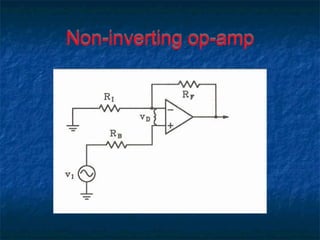
  • 13.
    Operational Amplifiers  Operationalamplifier is a fairly complex electronic circuit but:  It is based on the idea of the differential voltage amplifier shown in Figure 11.1.  Based on simple transistors,  The output is a function of the difference between the two inputs.  Assuming the output to be zero when both inputs are at zero potential, the operation is as follows:
  • 14.
  • 15.
    Operational amplifier  Whenthe voltage on the base of Q1 increases, its bias increases while that on Q2 decreases because of the common emitter resistance.  Q1 conducts more than Q2 and the output is positive with respect to ground.  If the sequence is inverted, the opposite occurs.  If, both inputs increase or decrease equally, there will be no change in output.
  • 16.
    Operational amplifier  Anoperational amplifier is much more complex than this but operates on the same principle.  It contains additional circuitry (such as temperature and drift compensation, output amplifiers, etc.)  These are of no interest to us other than the fact that they affect the specifications of the op-amp.  There are also various modifications to op-amps that allow them to operate under certain conditions or to perform specific functions.
  • 17.
    Operational amplifier  Someare “low noise” devices  Others can operate from a single polarity source.  If the input transistors are replaced with FETs, the input impedance increases considerably requiring even lower input currents from sensors  These are important but are variations of the basic circuit.  We will consider it as a simple block shown in Figure 11.2 and discuss its general properties based on this diagram
  • 18.
  • 19.
    Op-Amps - properties Differential voltage gain: the amplification of the op-amp of the difference between the two inputs:  Also called the open loop gain  in a good amplifier it should be as high as possible.  Gains of 106 or higher are common.  An ideal amplifier is said to have infinite gain.
  • 20.
    Op-Amps - properties Common-mode voltage gain.  By virtue of the differential nature of the amplifier, this gain should be zero.  Practical amplifiers may have a small common mode gain because of the mismatch between the two channels but this should be small.  Common mode voltage gain is indicated as Acm.  The concept is shown in Figure 11.3.
  • 21.
  • 22.
    Op-amps - properties More common to specify the term Common Mode Rejection Ratio (CMRR)  CMRR is the ratio between Ad and Acm: CMRR = A d A cm In an ideal amplifier this is infinite. A good amplifier will have a CMRR that is very high
  • 23.
    Op-amps - properties Bandwidth: the range of frequencies that can be amplified.  Usually the amplifier operates down to dc and has a flat response up to a maximum frequency at which output power is down by 3dB.  An ideal amplifier will have an infinite bandwidth.  The open gain bandwidth of a practical amplifier is fairly low  A more important quantity is the bandwidth at the actual gain.
  • 24.
    Op-amps - properties This may be seen in Figure 11.4  The lower the gain, the higher the bandwidth.  Data sheets therefore cite what is called the gain-bandwidth product.  This indicates the frequency at which the gain drops to one and is also called the unity gain frequency.  In Figure 11.4:  BW (open loop) is 2.5 kHz  Unity Gain Frequency is 5 MHz
  • 25.
  • 26.
    Op-amps - properties Slew Rate: the rate of change of the output in response to a change in input, given in V/s.  If a signal at the input changes faster than the slew rate, the output will lag behind it and a distorted signal will be obtained.  This limits the usable frequency range of the amplifier.  For example, an ideal square wave will have a rising and dropping slope at the output defined by the slew rate.
  • 27.
    Op-amps - properties Input impedance: the impedance seen by the sensor when connected to the op-amp.  Typically this impedance is high (ideally infinite)  It varies with frequency.  Typical impedances for conventional amplifiers is at least 1 M but it can be of the order of hundreds of M for FET input amplifiers.  This impedance defines the current needed to drive the amplifier and hence the load it represents to the sensor.
  • 28.
    Op-amps - properties Output impedance: the impedance seen by the load.  Ideally this should be zero since then the output voltage of the amplifier does not vary with the load  In practice it is finite and depends on gain.  Usually, output impedance is given for open loop whereas at lower gains the impedance is lower.  A good amplifier will have an output resistance lower than 1.
  • 29.
    Op-amps - properties Temperature and noise refer to variations of output with temperature and noise characteristics of the device respectively.  These are provided by the data sheet for the op- amp and are usually very small.  For low signals, noise can be important while temperature drift, if unacceptable must be compensated for through external circuits.
  • 30.
    Op-amps - properties Power requirements. The classical op-amp is built so that its output can swing between ±Vcc  Dual supply operation is common in op-amps  The limits can be as low as ±3V (or lower) and as high as ±35V (sometimes higher).  Many op-amps are designed for single supply operation of less than 3V and some can be used in single supply or dual supply modes.
  • 31.
    Op-amps - properties Current through the amplifier is an important consideration, especially the quiescent current (no load)  Gives a good indication of power needed to drive it.  Particularly important in battery operated devices. The current under load will depend on the application but it is usually fairly small – a few mA.  In selection of a power supply for op-amps, care should be taken with the noise that the power supply can inject into the amplifier.  The effect of the power supply on the amplifier is specified through the power supply rejection ratio (PSRR) of the specific amplifier.
  • 32.
    Op-amps - datasheets  The 741 op-amp is an older, general purpose amplifier.  It is a fairly low performance device but is characteristic of the low-end amplifiers.  Very common and quite suitable for many applications. LM741.PDF
  • 33.
    Op-amps - datasheets  The TLC27L2C is a dual, low power op- amp, suited for battery operated devices  Part of a series of amplifiers using FETs as input transistors TLC27L2C
  • 34.
    Inverting and noninverting amplifiers Performance of the amplifier depends on how it is used and, in particular on the gain of the amplifier.  In practical circuits, the open loop gain is not useful and a specific gain must be established.  For example, we might have a 50mV output (maximum) from a sensor and require this output to be amplified, say by 100 to obtain 5V (maximum) for connection to an A/D.  This can be done with one of the two basic circuits shown in Figure 11.5, establish a means of negative feedback to reduce the gain
  • 35.
  • 36.
  • 37.
    Inverting op-amp  Theoutput is inverted with respect to the input (180 out of phase).  The feedback resistor, Rf, feeds back some of this output to the input, effectively reducing the gain.  The gain of the amplifier is now given as: A v = − R f R I In the case shown here this is exactly –10
  • 38.
    Inverting op-amp  Theinput impedance of the amplifier is given as Here it is equal to 1 k. If a higher resistance is needed, larger resistances might be needed Or, perhaps, a different amplifier will be needed (noninverting amplifier) R i = R I
  • 39.
    Inverting op-amp  Theoutput impedance of the amplifier is given as AOL is the open loop gain as listed on the data sheet Open loop gain is the open loop gain at the frequency at which the device is operated R o = R I + R f Open loop output impedance R I A OL
  • 40.
    Inverting op-amp  Example,for the LM741 amplifier, the open loop output impedance is 75 and the open loop gain at 1 kHz is 1000. This gives an output impedance of: R o = 1000 + 10000 75 1000 × 1000 = 0.825 Ω The bandwidth is also influenced by the feedback: BW = unity gain frequency R I R I + R f
  • 41.
    Non-inverting amplifier  Thenon-inverting amplifier gain is: A v = 1 + R f R I For the circuit shown, this is 11 The gain is slightly larger than for the noninverting amplifier for the same values of R. The main difference however is in input impedance.
  • 42.
    Non-inverting amplifier  Inputimpedance is: Rop is the input impedance of the op-amp as given in the spec sheet Aol is the open loop gain of the amplifier. Assuming an open loop impedance of 1 M (modest value) and an open loop gain of 106 , we get an input impedance of 1011 . (almost ideal) R i = R op A ol R I R I + R f
  • 43.
    Non-inverting amplifier  Theoutput impedance and bandwidth are the same as for the inverting amplifier.  The main reason to use a noninverting amplifier is that its input impedance is very large making it almost ideal for many sensors.  There are other properties that need to be considered for proper design such as output current and load resistance but these will be omitted here for the sake of brevity.
  • 44.
    The voltage follower The feedback resistor in the noninverting amplifier is set to zero  The circuit in Figure 11.6 is obtained.  The gain is one.  This circuit does not amplify.  Why use it?
  • 45.
  • 46.
    Voltage follower The inputimpedance now is very large and equal to: R i = R op A ol The output impedance is very small and equal to: R o = Open loop output impedance A OL
  • 47.
    Voltage follower  Thevalue of the voltage follower is to serve in impedance matching.  One can use this circuit to connect, say, a capacitive sensor or, an electret microphone.  If amplification is necessary, the voltage follower may be followed by an inverting or noninverting amplifier
  • 48.
    Instrumentation amplifier  Theinstrumentation amplifier is a modified op- amp  Its gain is finite and both inputs are available to signals.  These amplifiers are available as single devices  To understand how they operate, one should view them as being made of three op-amps (it is possible to make them with two op-amps or even with a single op-amp), as shown in Figure 11.7.
  • 49.
  • 50.
    Instrumentation amplifier  Thegain of an amplifier of this type is: A v = 1 + 2 R R a R 3 R 2 In a commercial instrumentation amplifier all resistances are internal and produce a gain usually around 100. Ra is external and can be set by the user to obtain the gain required.
  • 51.
    Instrumentation amplifier  Theoutput of the instrumentation amplifier is The main use of this amplifier is to obtain an output proportional to difference between inputs. Important in differential sensors, especially when one sensor is used to sense the stimulus and an identical sensor is used for reference (such as when temperature compensation is needed) V o = A v V + − V −
  • 52.
    Instrumentation amplifier  Eachof the inputs has the high impedance of the amplifier used  The output impedance is low (inverting amp.)  The main problem in a circuit of this type is that the CMRR depends on the matching of the resistances (R, R2 and R3) in each section of the circuit.  These are internal and are adjusted during production to obtain the required CMRR.
  • 53.
    Charge amplifier  Theso-called charge amplifier is shown in Figure 11.8.  Charge cannot be amplified but the output voltage can be made proportional to charge as follows:  The output of the inverting amplifier is: A v = − R f R I = − 1/ j ω C 1/ j ω C 0 = − C 0 C C0 is the capacitance connected across the inverting input.
  • 54.
    Charge amplifier  Assumingthat a change in charge occurs on the capacitor, equal to Q = C0V, the output voltage may be written as In effect the charge generated at the input is amplified V o = − Δ V C 0 C = − Δ Q C
  • 55.
    Charge amplifier  IfC is small, a small change in charge at the input can generate a large voltage swing in the output.  The main method of connecting capacitive sensors such as pyroelectric sensors whose output is low (piezoelectric sensors, on the other hand produce a higher voltage).  It is necessary for the input impedance to be very high and care must be taken in connections (such as the use of very good capacitors).  Commercial charge amplifiers use FET transistors to ensure the necessary high input impedance.
  • 56.
  • 57.
    Current amplifier  Anotherexample of the use of an amplifier to a specific end is the current amplifier
  • 58.
    Current amplifier  Theinput voltage is Vi=ir.  Just like the inverting amplifier, the output now is V o = − V i R r = − iR Useful with very low impedance sensors. May be used with thermocouples whose impedance can be trivially low. They may be connected directly (r then represents the resistance of the thermocouple). The output is a direct function of the current the thermocouple produces which can be fairly large
  • 59.
    The comparator  Anop-amp operated in open loop mode  Because its gain is so high, a very small signal at the input will saturate the output.  For practically any input, the output will be either +Vcc or –Vcc. Consider Figure 11.10.  The negative input is set at a voltage V and V+ =0. Therefore the output is AolV =Vcc.  Suppose we increase V+ . Output is (V+ V )Aol. As long as V+ <V- , the output remains –Vcc. If V+ >V , the output changes to + Vcc.
  • 60.
  • 61.
    The comparator  Thefunction of this device is to compare the two inputs and to indicate which one is higher.  The comparator is useful beyond simple comparison.  It will be used extensively in A/D and D/A conversion of signals and in many other aspects of sensing and actuation
  • 62.
    Power amplifiers  Apower amplifier is a device or circuit whose power output is the input power multiplied by a power gain: P o = P i A p That is, the amplifier is capable of boosting the power level of a signal to match the needs of an actuator.
  • 63.
    Power amplifiers  Theobvious use of power amplifiers is in driving actuators, (speakers, voice coil actuators and solenoid actuators and motors).  The power amplifier is really either a voltage amplifier or a current amplifier (also called transconductance amplifier).  In a voltage amplifier, the input signal is a voltage.  This voltage is amplifier and in the final stage a sufficiently high current provided so that the required power is met.
  • 64.
    Power amplifiers  Ina current amplifier the opposite occurs.  Power amplifiers are divided into linear and PWM (pulse width modulated) amplifiers.  In a linear amplifier, the output (voltage) is a linear function of the input and can be anything between ±Vcc.  In a PWM amplifier the output is either Vcc or zero and the power delivered is set by the time the output is on. The latter is controlled by the width of the pulse that controls the output.
  • 65.
    Linear power amplifiers First step is to amplify the signal to the required output.  Can be done using any amplifier  We shall assume an op-amp was used for this purpose.  Then this voltage is applied to an “output stage”  It does not need to amplify but, rather, supplies the necessary current.  A simple example is shown in Figure 11.11.
  • 66.
  • 67.
    Class A linearamplifier  This is the so called Class A power amplifier.  Set for a gain of 101 (noninverting amplifier).  The output then drives the transistor whose output will swing, at most between 0 and V  Will supply a current which is V/RL  Class A designation indicates amplifiers for which the output stage is always conducting as in the case above. Also assumes output does not saturate.  The BJT can be replaced with a MOSFET for higher currents.
  • 68.
    Class A linearamplifier  This type of amplifier is sometimes used to drive relatively small loads such as light indicators, small dc motors and some solenoid valves.  In some cases the amplification is set high enough to saturate the amplifier in which case the amplifier operates as an on/off circuit rather than a class A amplifier  Typically used to turn on/off relays, lights, motors, etc.
  • 69.
    Class B amplifier A Class B or push-pull amplifier is shown in Figure 11.12.  It is usually a better choice.  It operates exactly as in the previous case except that under no input, the output is zero and there is no conduction in the transistors (or MOSFETs).  When the input is positive, the upper transistor conducts supplying the load and when the input is negative, the lower transistor supplies the load.
  • 70.
  • 71.
    Class B amplifier The voltage in the load can swing between +Vcc and – Vcc  The current is again defined by the load.  The output stage is made of a pair of power transistors, one PNP and one NPN (or of a P and an N type MOSFET).  There are many variations of the basic amplifiers.  For example, feedback may be added and it is common to protect the output stage from short circuits as well as from spikes due to inductive and capacitive loads.
  • 72.
    Class B amplifier In terms of performance, the obvious are the power output and the type and level of input.  For example, an amplifier may be specified as supplying 100W for a 1V input.  Next is the distortion level.  Distortions are specified as a percentage of output.  The most common specification is the THD (total harmonic distortions) as % of output.  A good amplifier will have less than, say, 0.1% THD.  Other specifications are temperature rise and output impedance of the amplifier (must match load).
  • 73.
    Class B amplifier Power amplifiers of various power level exist either as integrated circuits or as discrete components circuits.  Usually the discrete circuits can supply higher powers.  An example of an integrated amplifier is the TDA2040 which can supply 20W and is designed for use as an audio amplifier.  Nevertheless it can drive other loads such as light bulbs, small motors, etc.
  • 74.
    PWM amplifiers  ThePWM approach is shown schematically in Figure 11.13.  The power transistors are driven on and off so that the voltage on the load can only be zero or Vcc.  The time the power is on is controlled by the timing circuit.  This defines the average power at the load.
  • 75.
  • 76.
    PWM amplifiers  Thepulse width modulator is an oscillator which generates a square wave whose duty cycle can be controlled based on the required power.  For example, in Figure 11.14, the timing circuit defines for how long the input signal is connected to the transistor, hence for how long it conducts.  The power in the load is a function of this timing. This circuit is not particularly useful but others are.
  • 77.
  • 78.
    PWM driving  Figure11.15 shows an example often used to control speed and direction of small dc motors.  It is called an H-bridge for obvious reasons.  A pulse of constant amplitude but varying duty cycle connected to point A, will drive MOSFETs 1 and 4, turning the motor into one direction.  The duty cycle defines the average current in the motor and hence its speed.  Connecting to point B, turns on MOSFETs 2 and 3 reversing the process.
  • 79.
  • 80.
    H-bridge PWM driver Some precautions must be taken to ensure that only opposite transistors conduct  This is one of the most common circuits used for bidirectional control of motors and other actuators.  The controllers for these devices can be a small microprocessor  Integrated PWM circuits and controllers are available commercially
  • 81.
    A/D and D/Aconverters  These are the means by which a signal can be converted from analog to digital or from digital to analog as necessary.  The idea is obvious but implementation can be complex.  There are certain types of D/A and A/D that are trivially simple.  We will start with these and only then discuss some of the more complex schemes.  In certain cases one of these simple methods is sufficient.
  • 82.
    A/D and D/Aconverters  Analog to digital and, to a lesser extent, digital to analog conversion are common in sensing systems since most sensors and actuators are analog devices and most controllers are digital.  Most A/Ds required voltages much above the output of some sensors.  Often the output from the sensor must be amplified first and only then converted.  This leads to errors and noise and has resulted in the development of direct digitization methods based on oscillators (to be discussed below).
  • 83.
    Threshold digitization  Insome cases, an analog signal represents simple data such as the presence of something.  For example, in chapter 5 we discussed the detection of teeth on a gear using a hall element.  The signal obtained is quite small and looks more or less sinusoidal with the peaks representing the presence of the teeth.  In such a case it is sufficient to use a threshold amplifier which will then produce a digital output. An example is shown in Figure 11.16a.
  • 84.
  • 85.
    Threshold digitization  Theoutput from the the hall element varies from 100mV to 150mV. This signal can be fed into a comparator as shown in Figure 11.17  The negative input is set by the resistors to 0.13V.  Normally the output is zero until the voltage on the positive input rises above the threshold.  When the input dips below 0.13V the output goes back to zero.  The output in Figure 11.16b is obtained and now, each pulse represents a tooth on the gear.
  • 86.
  • 87.
    Threshold digitization  Countingthe teeth in a given time can give the speed of rotation of the gear or other data.  A missing tooth, the corresponding pulse will be represented by a missing pulse  This method is very effective when voltages at the input change across the comparison point  At the comparison point itself, the output of the comparator is not properly defined and the output can change states back and forth creating pulses which are spurious.
  • 88.
    Threshold digitization  Toavoid this a hysteresis is added to the comparator so that the transition from low to high occurs say, at V0 and the transition from high to low occurs at V0-V.  Hysteresis can be added to comparators through external components.  Another approach is to use of a Schmitt trigger.  The Schmitt trigger is essentially a digital comparator with a built in hysteresis as described above whose transition is around Vcc/2.
  • 89.
    Threshold digitization  Thresholddigitization is a very simple method of digitization and is sufficient for many applications.  It is commonly used for the purpose above but also in flow meters in which a rotating paddle operates a hall element or another magnetic sensor  It is also useful for optical sensors which use the idea of interruption of the beam.  It is not however suitable for measuring the level of a signal such as voltage from a thermocouple.
  • 90.
    Direct voltage tofrequency conversion  In many sensors, the output is too small to use the method above or to be sent over normal lines for any distance.  In such cases a voltage to frequency conversion can be performed at the location of the sensor and the digital signal then transferred over the line to the controller.  The output now is not voltage but rather a frequency which is directly proportional to voltage (or current).
  • 91.
    Direct voltage tofrequency conversion  These voltage-to-frequency converters or voltage controlled oscillators are relatively simple and accurate circuits and have been used for other purposes.  Their main advantage over the threshold method above is that lower levels of signals may be involved and the problems with noisy transitions around the comparison voltage are eliminated.  A circuit of this type is shown in Figure 11.18, as used with a light sensor.  The circuit is an op-amp integrator.
  • 92.
    Direct voltage tofrequency conversion
  • 93.
    Direct voltage tofrequency conversion  The voltage across the capacitor is the integral of the current in the noninverting leg of the amplifier.  This current is proportional to the voltage across R2.  As the voltage on the capacitor rises, a threshold circuit checks this voltage  When the threshold has been reached, an electronic switch shorts the capacitor and discharges it.  The switch then opens and allows the capacitor to recharge.  The voltage on the capacitor is a triangular shape whose width (i.e. the integration time) depends on the voltage at the noninverting input.
  • 94.
    Direct voltage tofrequency conversion  If no light is present on the sensor, it has a dark resistance and the voltage at the noninverting input will have a certain value.  The output of the amplifier changes at a frequency f1.  If now light falls on the sensor, its resistance goes down and the total resistance at the noninverting input falls.  This reduces the input voltage and hence the integration time until the capacitor reaches the threshold increases.  The result is that the amplifier changes state slower and the output is a lower frequency f2.  Since small changes in frequency can be easily detected, this is a very sensitive method of digitization for small signal sensors.
  • 95.
    Voltage to frequencyconversion  Other V/F converters require a much higher voltage and they are more suitable for A/D conversion after amplification of the lower signals or for sensors whose output is high to begin with. There are two basic methods.  One type is essentially a free running oscillator whose frequency can be controlled by the input voltage.  The second is a modification of Figure 11.18 and is called a charge-balance V/F converter.
  • 96.
    Voltage to frequencyconversion  A simple V/F method is shown in Figure 11.19.  It consists of a square wave oscillator (called a multivibrator) and a control circuit.  The multivibrator operates by charging and discharging a capacitor.  The on/off times of the waveform (hence frequency) are controlled by charging/discharging times of the capacitor.  To control frequency voltage to be converted is amplified and fed as currents to the bases of the two transistors.  The larger the base current, the larger the collector current and the faster the charge/discharge and hence the higher the frequency of the multivibrator.
  • 97.
    Simple voltage tofrequency conversion - multivibrator
  • 98.
    V/F conversion  Adifferent approach is shown in Figure 11.20.  The amplifier acts as an integrator and the FET across the capacitor is the switch.  The capacitor charges at a rate proportional to the current I=V0/R which is proportional to the voltage to be converted.  When the output has reached the threshold voltage of the schmitt trigger it changes state, turning on and this turns on the FET switch.  Discharging of the capacitor occurs and the output resets to restart the process. Again, as before, only relatively large level voltages can be converted.
  • 99.
    Simple voltage tofrequency conversion - integrator
  • 100.
    Dual slope A/Dconverter  The simpler (and slower) of the true A/D converters  Based on the following principle: a capacitor is charged from the voltage to be converted through a resistor, for a fixed, predetermined time T. The capacitor reaches a voltage VT which is: V T = V in T RC
  • 101.
    Dual slope A/Dconverter  At time T, Vin is disconnected  A negative reference voltage of known magnitude is connected to the capacitor through the same resistor.  This discharges the capacitor down to zero in a time T − V T = − V ref Δ T RC
  • 102.
    Dual slope A/Dconverter  Since these are equal in magnitude we have: V in T RC = V ref Δ T RC → V in V ref = Δ T T In addition, a fixed frequency clock is turned on at the beginning of the discharge cycle and off at the end of the discharge cycle. Since T and T are known and the counter knows exactly how many pulses have been counted, this count is the digital representation of the input voltage. A schematic diagram of a dual slope converter based on these principles is shown in Figure 11.21.
  • 103.
    Dual slope A/Dconversion
  • 104.
    Dual slope A/Dconverter  The method is rather slow with approximately 1/2T conversions per second.  It is also limited in accuracy by the timing measurements, accuracy of the analog devices and, of course, by noise.  High frequency noise is reduced by the integration process and low frequency noise is proportional to T (the smaller T the less low frequency noise).
  • 105.
    Dual slope A/Dconverter  The dual slope A/D is the method of choice for many sensing applications in spite of its rather slow response because it is simple and readily built from standard components.  For most sensors its performance and noise characteristics is quite sufficient  Because of the integration involved, it tends to smooth variations in the signal during the integration.  The method is also used in digital voltmeters and other digital instruments.
  • 106.
    Successive approximation A/D  Thisis the method of choice in A/D converter components and in many microprocessors.  It is available in many off the shelf components with varying degrees of accuracy  Depending on the number of bits of resolution it may resolve down to a few microvolt.  The basic structure is shown in Figure 11.22. It consists of a precision comparator, a shift register a digital to analog converter and a precision reference voltage Vref.
  • 107.
  • 108.
    Successive approximation A/D The operation is as follows:  First, all registers are cleared, which forces the comparator to HIGH.  This forces a 1 into the MSB of the register.  The D/A generates an analog voltage Va which for MSB=1 is half the full scale input.  This is compared to Vin. If Vin is larger than Va, the output stays high and the clock shifts this into the next bit into the register.
  • 109.
    Successive approximation A/D The register now shows 1100000000.  If it is smaller than Vin, the output goes low and the register shows 010000000.  Assuming that the input is still higher, the D/A generates a voltage Va=(1/2+1/4)Vfs.  If this is higher than the input, the register will show 011000000 but if it is lower, it will show 11100000 and so on, until, after n steps the final result will be obtained.  The data is read from the shift register and represents the voltage digitally.  This digital value can now be shifted out and used by the controller.
  • 110.
    Successive approximation A/D A/D of this type exists with resolution of up to 14 bits with 8 and 10 bits being quite common.  An 8 bit A/D has a resolution of: Vin/28 =0.004Vin.  For a 5V full scale, the resolution is 20 mV.  This may not be sufficient for low level signals in which case a 10, 12 or 12 bit A/D may be used (a 14 bit A/D has a resolution of 0.3mV).  There are also techniques of extending this resolution but it is almost always necessary to amplify signals from devices such as thermocouples if they must be digitized.
  • 111.
    Successive approximation A/D The advantage of the successive approximation A/D is that the conversion is done in n steps (fixed)  It is much faster than other methods.  On the other hand the accuracy of the device depends heavily on the comparator and the D/A converter.  Commercial devices are fairly expensive, especially if more than 10 bits are needed.  This type of A/D has been incorporated directly into microprocessors and can sometimes be used for sensing as part of the overall circuitry.  Some microprocessors have multiple A/D channels.
  • 112.
    Digital to AnalogConversion  Digital to analog conversion is less often used with sensors but is sometimes used with actuators.  This occurs when a digital device, such as a microprocessor must provide an analog output.  This should be avoided if possible by use of digital actuators (such as brushless dc motors and stepper motors) but there will be cases in which D/A will be necessary.  It is often a part of A/D conversion
  • 113.
    Digital to AnalogConversion  There are different ways of accomplishing D/A conversion.  The most common method used in simple converters is based on the ladder network shown in Figure 11.23.  It consists of a voltage follower. Its input impedance is high and the output of the follower equals the voltage at its noninverting input.  The voltage is generated by the resistance network.
  • 114.
  • 115.
    Ladder network D/Aconversion  The ladder network is chosen so that the combination of series and parallel resistances represent the digital input as a unique voltage which is then passed to the output.  The switches are digitally controlled analog switches (MOSFETs).  Depending on the digital input, various switches will connect resistors in series or in parallel.
  • 116.
    Ladder network D/Aconversion  For example, suppose that the digital value 100 is to be converted.  The switches will be as in Figure 11.23.  The voltage at the amplifier’s input is exactly 5V.  The ladder can be extended as necessary for any number of bits.  The accuracy and usefulness of a D/A depends on the quality and accuracy of the ladder network and the reference voltage used.
  • 117.
    Bridge circuits  Bridgecircuits are some of the oldest circuits used in sensors as well as other applications.  The bridge is known as the Wheatstone bridge (variations of the bridge exist with different names.)  The basic Wheatstone bridge is shown in Figure 11.24.  It consists of 4 impedances Zi=Ri+jXi.
  • 118.
  • 119.
    The impedance bridge The output voltage of the bridge is V o = V i Z 1 Z 1 + Z 2 − Z 3 Z 3 + Z 4 The bridge is said to be balanced if Z 1 Z 2 = Z 3 Z 4 Under this condition, the output voltage is zero.
  • 120.
    The impedance bridge If, for example, Z1 represents the impedance of a sensor, by proper choice of the other impedances the output can be set to zero at a given value of Z1.  Any change in Z1 will change the value of Vo indicating the change in stimulus.  Of course, one can do much more than that and bridges can be used for signal translation and for temperature compensation among other things.  One important property of bridges is their sensitivity to change in stimuli
  • 121.
    The impedance bridge Thesensitivity of the output voltage to change in any of the impedances can be calculated as: d V o d Z 1 = V i Z 2 Z 1 + Z 2 2 , d V o d Z 2 = − V i Z 1 Z 1 + Z 2 2 d V o d Z 3 = − V i Z 4 Z 3 + Z 4 2 , d V o d Z 4 = V i Z 3 Z 3 + Z 4 2 Summing up gives the bridge sensitivity d V o V i = Z 2 d Z 1 − Z 1 d Z 2 Z 1 + Z 2 2 − Z 4 d Z 3 − Z 3 d Z 4 Z 3 + Z 4 2
  • 122.
    The impedance bridge This relation reveals that if Z1=Z2 and Z3=Z4 the bridge is balanced  If the change, is such that dZ1=dZ2 and dZ3=dZ4, the change in output is zero.  This is the basic idea used in compensating a sensor for temperature variation and any other common mode effects.  For examples, suppose that a pressure sensor has impedance Z1=100  and a sensitivity to temperature dZ1= 0.5 /C.
  • 123.
    The impedance bridge We use two identical sensors as Z1 and as Z2  Sensor Z2 is not exposed to pressure (only exposed to the same temperature as Z1).  Z3 and Z4 are equal and are made of the same material – these are simple resistors.  Under these conditions, there will be no output due to temperature changes  The sensor is properly compensated for temperature variations.  If however pressure changes, the output changes
  • 124.
    The impedance bridge If all impedances in the bridge are fixed and only Z1 varies (this is the sensor), then dZ2=0, dZ3=0, dZ4=0 and the bridge sensitivity becomes d V o V i = Z 2 d Z 1 Z 1 + Z 2 2 d V o V i = d Z 1 4 Z 1 , if Z 2 = Z 1 Or:
  • 125.
    The impedance bridge This bridge, especially with resistive branches is the common method of sensing with:  strain gauges, piezoresistive sensors,  hall elements, thermistors  force sensors and many others.  Use of bridges allows a convenient reference voltage (nulling), temperature compensation and other sources of common mode noise.  It is very simple and it can be easily connected to amplifiers for further processing
  • 126.
    Temperature compensation of bridges Temperature compensation in sensors eliminates the errors due to temperature or any other common mode effect.  It does not eliminate errors external to the sensors such as variations of Vi with temperature.  These have to be compensated for in the construction of the bridge itself.  There are many techniques by which this can be accomplished but this is beyond the scope of this course.
  • 127.
    Bridge output  Theoutput from the bridge is likely to be relatively small.  For example, suppose that the bridge is fed with a 5V source and a thermistor, Z4=500 (at 0C) is used to sense temperature.  Assuming the bridge is balanced at 0C, the other three resistances are also 500.  This gives an output voltage zero.  Now, suppose that at 100C the resistance of the thermistor goes down to 400.
  • 128.
    Bridge output  Theoutput voltage now is: V o = 5 500 500 + 500 − 400 500 + 500 = 0.5 V Most sensors will produce a much smaller change in impedance Some sort of amplification will be necessary. The op-amp discussed above is ideal for this purpose. There are many ways this can be accomplished. Two methods are shown in Figure 11.25.
  • 129.
  • 130.
  • 131.
    Amplified bridge  InFigure 11.25a, the bridge is connected directly between the inverting and noninverting inputs.  If we assume that the resistance of the resistance of the sensor changes as Rx=R0(1+), the voltage output of the bridge is: V out ≈ V i (1 + n ) V α 4 This circuit provides an amplification of (1+n) but requires that the voltage on the bridge be floating
  • 132.
    Active bridge  Circuitin Figure 11.25b does not provide amplification but rather places the sensor in the feedback loop. This is called an active bridge and its output is: This circuit provides buffering (higher input impedance, lower output impedance). V out = − V i α 2
  • 133.
    Data transmission  Transmissionof data from a sensor to the controller may take many forms.  If the sensor is passive, it already has an output in a usable form such as voltage or current.  It would seem that it is sufficient to simply measure this output directly to obtain a reading.  In other cases, such as with capacitive or inductive sensors, indirect measuring is often used.  The sensor is often likely to be in a remote location.
  • 134.
    Data transmission  Neitherdirect measurement of voltage and current or using the sensor as part of the circuit (in an oscillator) may be an option in such a case  In such cases, it is often necessary to process the sensor’s output locally and to transmit the result to the controller.  The controller then interprets the data and places it in a suitable form.
  • 135.
    Data transmission  Theideal method of transmission is digital.  Often employed in “smart sensors” since they have the necessary processing power locally.  In most cases a sensor of this type will have a local microprocessor supplied with power from the controller or have its own source of power  The digital data may then be transmitted over regular lines or even through a wireless link.  Since digital data is much less prone to corruption, the method is both obvious and very useful.
  • 136.
    Data transmission  Manysensors are analog and,  Their output may eventually be converted into digital form but:  It is not always possible to incorporate the electronics locally.  This may be because of cost or because of operating conditions such as elevated temperatures.
  • 137.
    Data transmission  Example,in a car there may be a half dozen sensors that control ignition, air intake and fuel, all of which are needed for control of the engine and are processed by a central processor.  It is not practical to supply each sensor with power and electronics to digitize their data when the processor can do that for all of them.  In other cases, such as, for example, the oxygen sensor, the sensor operates at elevated temperatures, beyond the temperature range of semiconductors making it impossible to incorporate electronics in them.
  • 138.
    Data transmission In suchcases the analog signal must be transferred to the controller. A number of methods have been developed for this purpose. Three of these methods, suitable for use with resistive sensors, or with passive sensors are discussed next
  • 139.
    Four wire sensing In sensors that change their resistance, such as thermistors, and piezoresistive sensors, one must supply an external source and measure the voltage across the sensor.  If done remotely, the current may vary with the resistance of the connecting wires and produce an erroneous reading.  To avoid this the method in Figure 11.26 may be used.
  • 140.
  • 141.
    Four wire sensing The sensor is supplied from a current source, i0.  This current is constant since the internal impedance of a current source is very high.  The voltage on the sensor is independent of the length of the wires and their impedance.  A second pair of wires measures the voltage across the sensor  Since a voltmeter has very high impedance there is no current (ideally) in this second pair of wires, producing accurate reading.  This is a common method of data transmission when applicable.
  • 142.
    Two wire sensingfor passive sensors  Passive sensors produce a voltage. It is sometimes possible to measure the voltage remotely (no current is involved in the measurement).  Especially true for dc outputs such as in thermocouples.  In sensors with high impedance it is much more risky to do so because of the noise the lines can introduce.  In most cases a twisted pair line is used because it reduces the noised picked up by the line.
  • 143.
    Two wire transmissionfor active sensors  A common method of data transmission for sensors, and a method that has been standardized is the 4-20 mA current loop.  The output of the sensor is modified to modulate the current in the loop  4 mA corresponds to minimum stimulus  20 mA corresponds to maximum stimulus  The configuration is shown in Figure 11.27.
  • 144.
    4-20 mA currentloop data transmission
  • 145.
    4-20 mA currentloop data transmission  The sensor’s output must be modified to conform to this industry standard and this may require additional components.  Many sensors are made to conform to this standard so that the user only has to connect them to the two-wire line.  The power supply depends on the load resistance and the transmitter’s resistance but it is between 12 and 48V.
  • 146.
    4-20 mA currentloop data transmission  Usually the sensor’s network allows for setting the range (minimum and maximum value of the stimulus) to the 4 mA and 20 mA range as shown.  The current transmitted on the line is then independent of the length of the line and its resistance.  The voltage measured across the load resistance is then processed at the controller to provide the necessary reading.
  • 147.
    Other methods oftransmission  There are other methods of transmission that may be incorporated.  6-wire transmission is used with bridge circuits in which the 4 wire method above is supplemented by two additional wires which measure the voltage on the bridge itself.  A new 1-wire protocol has become very popular for many devices including sensors.  In this protocol both power to the device and data to/from it are passed on a single pair of wires,  An effective and economical method for sensing.
  • 148.
    Transmission to actuators There are only two ways the power can be transmitted to the actuator.  One is to get the actuator close to the source that provides the power.  This implies that lines must be very short.  Possible in some cases (audio speakers, control motors in a printer, etc.).  In some cases this is not practical and the controller and the actuator must be at considerable distance (robots on the factory floor, etc.).
  • 149.
    Transmission to actuators In such cases one of the methods above may be used to transfer data but the power must then be generated locally at the actuator site.  The controller now issues commands as to power levels, timings, etc. and these are then executed locally to deliver the power necessary.  Much of this is done digitally through use of microprocessors on both ends.
  • 150.
    Excitation methods and circuits Sensors and actuators must often be supplied with voltages or currents  Either ac or dc.  These are the excitation sources for the sensors and actuators.  First and foremost is the power supply circuit.  In many sensors the power is supplied by batteries  Many others rely on line power through use of regulated or unregulated power supplies.
  • 151.
    Excitation methods and circuits Other sensors require current sources (for example - Hall elements)  Still others require ac sources (LVDTs)  These circuits affect the output of the sensor and its performance (accuracy, sensitivity, noise, etc.)  Are an integral part of the overall sensor’s performance.
  • 152.
    Power supplies  Thereare two types of power supplies  Linear power supply  Switching power supply.  There are also so called dc to dc converters which are used to convert power from one level to another, sometimes as part of the circuit that uses the power.
  • 153.
    Power supplies  Alinear power supply is shown in Fig. 11.28.  Consists of a source, (line voltage) and a means of reducing this voltage to the required level ( a transformer).  The transformer is followed by a rectifier which produces dc voltage from the ac source.  This voltage is filtered and then regulated to the final required dc voltage. A final filter is usually provided.  This regulated power supply is very common in circuits especially where the power requirements are low.  Some of the blocks may be eliminated depending on the application. If, for example the source is a battery the transformer and the rectifier are not needed and the filtering may be less important.
  • 154.
  • 155.
    Linear power supply Consider the circuit in Figure 11.29.  This is a regulated power supply capable of supplying 5V at up to 1A.  Transformer reduces the input voltage to 16V rms.  This is rectified through the bridge rectifier and produces 22V (16x1.4) across C1, C2.  These two capacitors serve as filters – the large capacitor reducing low frequency fluctuations on the line, the smaller capacitor is better suited for high frequency filtering.
  • 156.
  • 157.
    Linear power supply The LM05 is a 5V regulator which essentially drops across itself 19V to keep the output constant.  Does so for any input voltage down to about 8V.  The capacitors at the output are again filters.  The current is limited by the capacity of the regulator to dissipate power due to the current through it and the voltage across it.  Other regulators are available that will dissipate more or less power.
  • 158.
    Linear power supply These regulator exist at standard voltages, either positive or negative as well as adjustable variable voltage regulators.  Discrete components regulators can be built for almost any voltage and current requirements.  This circuit or similar circuits are the most common way of providing regulated dc power to most sensor and actuator circuits.
  • 159.
    Linear power supply The advantage is that they are simple and inexpensive but they have serious drawbacks.  The most obvious is that they are big and heavy, mostly because of the need for a transformer which must handle the output power.  In addition, the power dissipated on the regulator is not only lost but it generates heat and this heat must be dissipated through heat exchangers.
  • 160.
    Switching power supply An alternative method of providing dc power is through use of a switching power supply.  Switching power supplies rely on two basic principle to eliminate the drawbacks of the linear power supply.  The principle is shown in Figure 10.30.  First, the transformer is eliminated and the line voltage is rectified.  This high voltage dc is filtered as before.
  • 161.
  • 162.
    Switching power supply The switching transistor is driven with a square wave  It turns on for a time ton and off for a time toff  When on, a current flows through the inductor charging the capacitor to a voltage which depends on ton  When the switch is off, the current in L1 is discharged through the load supplying it with power for the off-time  The voltage is stabilized by sampling the output and changing the duty cycle (ratio between ton and toff) to increase or decrease the output to its required value  This change in duty cycle is done by use of a PWM (pulse width modulation) generator
  • 163.
    Switching power supply In a practical power supply additional considerations must apply.  First, it is necessary to separate or isolate the input (which is connected to the line) and output.  In the linear PS this was accomplished by the transformer.  Second, the switching, which must necessarily be done at relatively high frequencies, introduces noise into the system.  This noise must be filtered for the PS to be usable
  • 164.
    DC to DCconverters  DC to DC converters are a different type of switching power supply.  They take the dc source and convert it into an ac voltage  This is then converted through a transformer to any required level and then rectified back to dc and regulated.  The advantage of this approach is that now the transformer provides the isolation required for safety  because the operation is at high frequencies, the transformer is much smaller than the power transformer in linear power supplies  Transformerless DC-DC converters also common
  • 165.
    Current sources The generationof constant current can take various levels of complexity.  One can resort to something as simple as a large resistor in series with a power supply  In this configuration the current is not constant but rather varies because the resistance of the sensor  More accurate methods of current generation are needed for higher accuracy requirements.
  • 166.
    Current sources A simpleconstant current source can be built based on the properties of FETs Shown in Figure 11.31. As long as the voltage across the FET is above its pinch-off voltage (Vp), the current is constant and equals (Vcc-Vp)/R Vp is constant for any given FET
  • 167.
    FET constant currentgenerator +4 V - 12 V 2N5458 JFET R 33 μ F 0.001 μ F
  • 168.
    Current sources  Anothersimple way of supplying constant current to a load is shown in Figure 11.32.  The Zener diode voltage Vz produces a current in the load equal to (Vz-0.7)/R3  (the voltage across the base-emitter junction is fixed at 0.7V and the zener voltage is fixed to Vz).
  • 169.
    Zener controlled constant currentgenerator R L + − R 2 3 R
  • 170.
    Current sources  Astable circuit is the so-called current mirror
  • 171.
    Current sources  Acurrent iin is generated as V1/R1 and is kept constant.  The collector current in the lower left transistor is virtually equal to iin.  The voltage across the base of Q1 keeps the current through the load equal to iin, hence the name current mirror.  As long as iin is constant, so will the current in the load.
  • 172.
    Current sources  Theproperties of the voltage follower based on an op-amp can be used to generate a constant current as shown in Figure 11.34.  The output of the voltage follower is V1 and the current is V1/R1.  The transistor is necessary to provide currents larger than those possible with an op-amp
  • 173.
    Voltage follower basedconstant current generator
  • 174.
    Voltage references  Manyapplications call for a constant voltage reference.  A regulated power supply is a voltage reference but what is meant here is a constant voltage, usually of the order of 0.5-2V that supplies very little current, if any, and is used as reference to other circuits.  These reference voltages must be constant under expected fluctuations in power supplies.
  • 175.
    Voltage references  Thesimplest voltage reference is the Zener diode  Reversed biased diode, biased at the breakdown voltage for the junction.  The resistor limits this current so that the diode does not overheat.  As long as the maximum current of the Zener diode is not exceeded the voltage across the diode is kept at the breakdown voltage.  These diodes are very commonly used for voltage regulation and other purposes.
  • 176.
  • 177.
    Reference zener diode A Zener diode specifically designed for voltage reference (called reference Zener diode)  The breakdown voltage is kept constant and  Temperature compensated using two diodes in series, one forward and one reversed biased  In the forward biased diode, an increase in temperature decreases the forward voltage (by V or about 2mV/C)  In the reversed biased diode it decreases it by roughly the same amount.
  • 178.
  • 179.
    Reference zener diode The total voltage is constant (or nearly so).  Reference diodes are available in voltages down to about 3V.  Another device that is used for this purpose is the band-gap reference.  It is superior to Zener diodes and is available in voltages that go down to 1.2V.  Reference diodes are available commercially in standard voltages from about 1.2V to over 100V.
  • 180.
    Oscillators  Many sensorsand actuators require voltages or currents that are variable in time.  Example: the LVDT requires a sinusoidal sources, often at a few kHz in frequency.  Magnetic proximity sensors use ac currents of constant amplitude and frequency to produce an output voltage which is proportional to position.  Transformer based sensors must use an ac source.  Other sensors require special waveforms such as square waves.
  • 181.
    Oscillators  Some sensors/actuatorsuse line power (60 or 50Hz),  All other sources must be generated at the correct frequency and at the required waveform.  Often must be frequency stabilized and amplitude regulated to make useful sources.  There are virtually hundreds of different ways of generating as signals but there are a few basic principles involved.
  • 182.
    Oscillators 1. An oscillatoris an unstable amplifier. Starting with an amplifier of some sort, one can provide a positive feedback to make it unstable and hence to set it into oscillation. 2 The unstable circuit must be forced to oscillate at a specific frequency by means of: an LC tank circuit (or equivalent) or a delay in the feedback The circuit must be made to oscillate with a required waveform through use of these or additional components.
  • 183.
    Crystal oscillators  Basedon a quartz crystal or other piezoelectric materials  Cut and placed between two electrodes  The equivalent circuit is an RLC circuit  Can oscillate in one of two modes.  One is a series oscillation mode,  The other is parallel mode oscillation  When connected in a circuit that can provide the proper positive feedback, it will oscillate at the resonant frequency of the crystal
  • 184.
  • 185.
  • 186.
    A 1 MHzcrystal
  • 187.
    Sinusoidal crystal oscillator Simple sinusoidal oscillator  The feedback from output to input (collector to base) is supplied by the crystal.  The output is entirely defined by the crystal and is taken at the collector.  The trimmer capacitor modifies the equivalent circuit.
  • 188.
  • 189.
    Square wave crystaloscillator  Based on two inverting gates  Because the gate can only take two states, the output will swing between Vcc and ground.  The positive feedback is delayed due to the delay of the gate and the frequency is controlled by the crystal.  These oscillators can be used, for example, in mass humidity sensors in which the frequency will change with humidity (mass of the crystal).
  • 190.
    TTl based squarewave crystal oscillator
  • 191.
    RC Oscillators  Oscillatorscan easily be built from discrete as well as integrated components without a crystal.  A simple square wave oscillators based on the delay of the feedback signal (RC) is shown next
  • 192.
    RC oscillators  Theinverters are triggered when the input voltage rises above about Vcc/2.  Resistor R and capacitor C form a charging circuit.  Suppose left gate is on (zero input, Vcc output).  The second gate must be off (its output is zero)  Lower capacitor charges (time constant RC) and after a time t0 triggers left gate to change state.  Now its output is zero and the capacitor discharges through R. The upper capacitor is only needed for stability of the circuit.
  • 193.
    RC oscillators  Thefollowing circuit is somewhat similar.
  • 194.
    RC oscillator  Positivefeedback through R3 sets the level at which the amplifier changes state.  R4 and C1 form the charging/discharging circuit.  Suppose that Vout is high. The positive input will be set at a value that depends on R3, R2 and R1.  C1 charges through R4.  When the voltage at the negative input exceeds that at the positive input the output goes negative  Now the capacitor discharges through R4, repeating the process.
  • 195.
    LC oscillator  Examplesof sinusoidal oscillators  An LC circuit is provided which oscillates at the required frequency  A feedback is provided from output to input  The feedback is through the lower part of L1 or through the lower half of the LVDT coil (figures)
  • 196.
  • 197.
  • 198.
    Noise and interference Noise is understood as anything that is not part of the required signal.  Many sources and many types of noise.  We will distinguish between two broad types  Inherent noise to the sensor (internal).  Interference noise (external).
  • 199.
    Inherent noise  Noisemust be reduced as much as possible  elimination is not an option since noise cannot be entirely eliminated  More important is to properly consider it in the design and in the specification of the sensor.  Example: a temperature sensor generates 10 V/C and a good microvolt meter is capable of reliably measuring 1 V.  This, would imply a resolution of 0.1C.
  • 200.
    Inherent noise  Supposenoise (from all sources) is, say, 2 V  Only signals above the noise levels are useful  Any signal below 2 V is useless.  The resolution cannot be more than 0.2 C.  In many cases, things are worse than this since the noise can only be estimated.  When amplification occurs, noise is also amplified and the amplifier itself can add its own noise.  Clearly then noise cannot be ignored even when it is small.
  • 201.
    Inherent noise  Inherentnoise is due to many effects in the sensor  Some of the sources are avoidable,  Some of the sources are intrinsic.  One of the main sources in sensors is the thermal noise or Johnson noise in resistive devices.  The noise power density is usually written as: e n 2 = 4 kTR Δ f V 2 Hz k is the Boltzman constant (k=1.38x10⁻²³ J/K), T is the temperature in K, R is the resistance in  f is the bandwidth in Hz.
  • 202.
    Inherent noise  Thisnoise exists, in resistive sensors and in simple resistors  Ff the resistance is high, the noise can be very high.  The Johnson noise is fairly constant over a wide range of frequencies  Hence it is called a white noise
  • 203.
    Inherent noise  Shotnoise:  Produced in semiconductors when dc current flows by random collisions of electrons and atoms: i sn = 5.7 × 10 − 4 I Δ f Preference is for lower currents in as much as this noise is concerned.
  • 204.
    Inherent noise  Pinknoise:  Unlike white noise has higher energy at low frequencies.  A particular problem with sensors which tend to operate at low frequencies (slowly varying signals).  The noise spectral density is 1/f and at low frequencies it may be larger than all other sources of noise.
  • 205.
    Inherent noise  Noiselevels are very difficult to measure even when the noise is constant.  Because it is not generally harmonic in nature, its rms or even peak to peak values are difficult to ascertain.  The noise distribution is not constant (usually Gaussian) so that at best we can estimate the noise level.  Usually maximum expected levels are indicated.
  • 206.
    Interference  By farthe largest source of noise in a sensor or actuator  Originates outside the sensor and is coupled to it.  Sources of interference can be many:  Best known perhaps are the electric sources:  coupling of transients from power supplies,  electrostatic discharges  radio frequency noise from all electromagnetic radiative systems (transmitters, power lines, almost all devices and instruments that carry ac currents, lightning and even from extraterrestrial sources).
  • 207.
    Interference  Interference canbe mechanical  Vibrations  gravitational forces  acceleration and others,  Thermal sources (  temperature variations  Seebeck effect in conductors  Also: ionization sources, errors due to changes in humidity and even chemical sources.
  • 208.
    Interference  Some errorsare introduced in the layout of the sensors components or in the circuits connected to them through improper circuit design and improper use of materials.  Electrical sources of noise are called electromagnetic sources (including static discharges and lightning)  Are bundled together under the umbrella of electromagnetic interference or electromagnetic compatibility issues.
  • 209.
    Interference  In somecases, a noise is easily identifiable.  Example: a common noise in electrical system, especially those that contain long wires, is a 120Hz noise (100 Hz in 50Hz power systems) and is due power lines.  This type of noise is also a good example of a time-periodic noise.  Other sources, especially when transient or random are almost impossible to identify and hence to correct.
  • 210.
    Interference  Interference noisemay affect different sensors differently.  The simplest is an additive influence.  That is, the noise is added to the signal.  Additive noise is independent of the signal.  Additive noise is more critical at low signal levels  Example: drift due temperature variations depends on temperature but not on the signal level.  This type of noise can be minimized by using a differential sensor
  • 211.
    Interference  A secondtype of noise is multiplicative.  That is, it grows with the signal and is due to a modulation effect of the noise on the signal.  More pronounced at higher signal levels.  The noise may be minimized by using two sensors as previously the output is divided by the reference sensors’ output.  Example: a stimulus is measured (say, pressure) and a noise due to change in temperature T is present and multiplicative.
  • 212.
    Interference  Assume thetransfer function is V=(1 + N)Vs  One sensor senses both the stimulus and the noise and produces an output V1 which is: V 1 = [1 + αΔ T ] V s The second sensor senses only the temperature and produces a voltage V2 V 2 = [1 + αΔ T ] V 0 V0 can be assumed constant (i.e. it is only dependent on temperature change)
  • 213.
    Interference  The ratiobetween the two is: Since V0 is independent of the sensed stimulus, the ratio is also independent of the noise. This is called a ratiometric method and is most suitable for this type of noise V 1 V 2 = V s V 0
  • 214.
    Interference  Reduction ofnoise before it reaches the sensor.  Most important is electrical noise  Electrical noise can reach the sensor in four ways  through direct resistive coupling  Through capacitive coupling  Through inductive coupling  By radiation from outside the sensor
  • 215.
    Interference - Resistivecoupling  Source of noise and the sensor share a common resistive path.  May be the resistance between the connection of a sensor, through the sensor’s body.  That is, the sensor is not electrically insulated from the source of noise.  Solution: isolation of the sources of noise (usually current carrying conductors such as power lines) from the sensor.  Often this will require that the sensor be floating.
  • 216.
    Interference - capacitive coupling Capacitance exists between any two conductors,  Any two wires, any two connectors will produce a stray capacitance that can cause coupling.  Capacitances are small - impedances are high.  Capacitive coupling is a problem at higher frequencies.  There are however sensors, especially capacitive sensors which use small capacitances  Any capacitive coupling may be too high for accurate sensing.
  • 217.
    Interference - capacitive coupling Solution: the sensor must be electrostatically shielded from the sources that might couple noise.  An electrostatic shield is usually a thin conducting sheet, sometimes a conducting mesh, which envelopes the protected area and is grounded (connected to the reference potential.  In effect this shorts the noise source to ground. An example is shown in Figure 11.45.
  • 218.
  • 219.
    Interference - capacitive coupling The coupling capacitance is shorted  This also creates a new capacitance between the protected device and ground.  But, the noise signal is zero.  Cables leading to the sensor must also be shielded  The shield must be at a constant potential.  Example: shielding a cable and then grounding it at both ends, will immediately produce a loop which may itself generate noise.
  • 220.
    Interference - inductivecoupling  A particular problem between current carrying conductors  Example: between power lines and sensors’ conductors and in particular the wires leading to the sensor.  120 Hz noise from power liner usually links to sensors through inductive coupling  Actuators may induce currents in sensors  Sensors may interfere with each other
  • 221.
    Interference - inductivecoupling  At high frequencies, a conducting shield just like the electrostatic shield should envelope the source.  The use of coaxial cables is such an example.  Based on the idea of skin depth (Chapter 9) and simply takes advantage of attenuation of high frequency fields in conductors.  If the noise signal is very low in frequency, a magnetic shield is necessary.  Usually a thick ferromagnetic shield (box) that envelopes the protected device to guide low frequency (or DC) fields away from the sensor. Proximity sensors often use this type of shield.
  • 222.
    Interference  Together, conduction,capacitance and inductance form a class of coupling called conductive coupling and is part of the common problem of conducted emission and conducted interference in electromagnetic compatibility.
  • 223.
    Interference - radiatedemission  Any conductor carrying an ac current is in effect a transmitting antenna.  Any other conductor becomes a receiving antenna.  If that conductor is part of a loop, a current will be induced in the loop.  This noise is particularly large from sources of intentional emissions such as transmitters  Can occur with any current, internal or external to the sensor.
  • 224.
    Interference - radiatedemission  Reduction of this source relies extensively on reduction of lengths of wires and on reduction of size (area) of loops.  Shielding is very effective in reducing radiated interference.  Other precautions: use of decoupling capacitors in circuits and power supplies  Twisting of the two wires leading to a device together to reduce the area of the loop they form.
  • 225.
    Interference - radiatedemission  Coaxial cables can reduce or eliminate most radiated interference.  One common cure for many ills is the introduction of a ground plane – a sheet of metal under the circuit (such as a conducting sheet under a printed circuit board).  This helps in reducing the inductance of the circuit and hence will be effective in reducing both inductive coupling and radiated interference.
  • 226.
    Mechanical noise  Mechanicalnoise, especially from vibrations can often be eliminated or reduced through isolation  Some sensors, such as piezoelectric sensors, any force (due to acceleration) will produce errors  These errors can be compensated either through use of the differential or ratiometric methods  Many other sources of noise
  • 227.
    Other sources ofnoise  Example: any junction between different metals becomes a thermocouple and introduces a signal in the path.  This may affect the reading of the sensor and is called Seebeck noise.  It may not be a big problem in most cases but it is when sensing temperature.  The issue of noise is both difficult and ill-defined.  Often finding the source of noise will depend on sleuthing work and on experimentation.