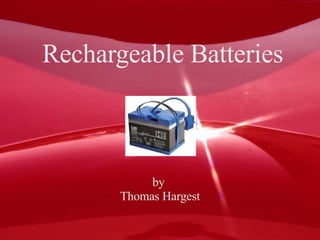
Rechargeable Batteries by  Thomas Hargest
What Are Rechargeable Batteries? Rechargeable batteries are batteries that can be restored to full charge by the application of electrical energy.   Rechargeable batteries come in different designs using different chemical reactions.  Rechargeable batteries are also called storage batteries or secondary cells.
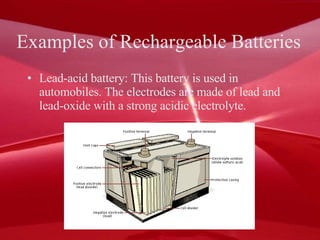
Examples of Rechargeable Batteries Lead-acid battery: This battery is used in automobiles. The electrodes are made of lead and lead-oxide with a strong acidic electrolyte.
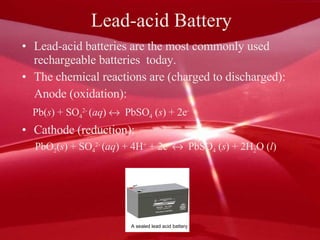
Lead-acid Battery Lead-acid batteries are the most commonly used rechargeable batteries  today. The chemical reactions are (charged to discharged): Anode (oxidation):  Pb( s ) + SO 4 2-  ( aq )     PbSO 4  ( s ) + 2e - Cathode (reduction):  PbO 2 ( s ) + SO 4 2-  ( aq ) + 4H +  + 2e -      PbSO 4  ( s ) + 2H 2 O ( l ) A sealed lead acid battery
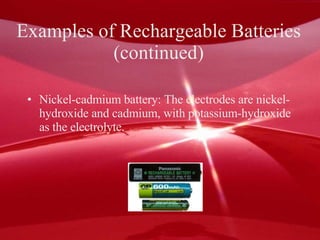
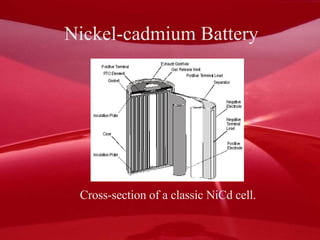
Examples of Rechargeable Batteries  (continued)  Nickel-cadmium battery: The electrodes are nickel-hydroxide and cadmium, with potassium-hydroxide as the electrolyte.
Nickel-cadmium Battery Cross-section of a classic NiCd cell.
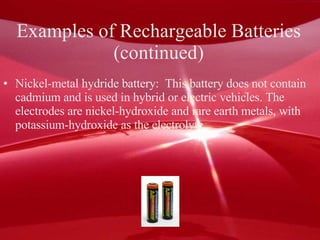
Examples of Rechargeable Batteries  (continued)  Nickel-metal hydride battery:  This battery does not contain cadmium and is used in hybrid or electric vehicles. The electrodes are nickel-hydroxide and rare earth metals, with potassium-hydroxide as the electrolyte.
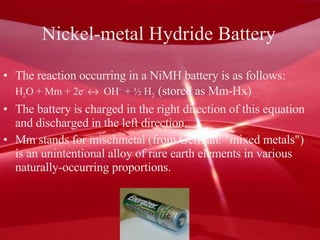
Nickel-metal Hydride Battery The reaction occurring in a NiMH battery is as follows:  H 2 O + Mm + 2e -      OH −  + ½ H 2   (stored as Mm-Hx)  The battery is charged in the right direction of this equation and discharged in the left direction.  Mm stands for mischmetal (from German: "mixed metals") is an unintentional alloy of rare earth elements in various naturally-occurring proportions.
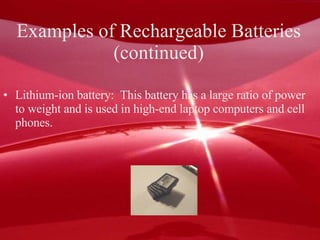
Examples of Rechargeable Batteries  (continued)  Lithium-ion battery:  This battery has a large ratio of power to weight and is used in high-end laptop computers and cell phones.
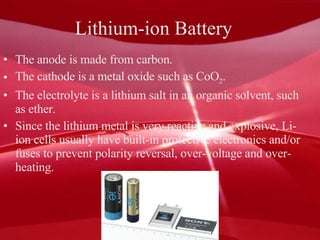
Lithium-ion Battery  The anode is made from carbon.  The cathode is a metal oxide such as CoO 2 .  The electrolyte is a lithium salt in an organic solvent, such as ether.  Since the lithium metal is very reactive and explosive, Li-ion cells usually have built-in protective electronics and/or fuses to prevent polarity reversal, over-voltage and over-heating.
Non-rechargeable  vs  Rechargeable Non-rechargeable (primary) batteries, such as zinc-carbon batteries, are based on irreversible chemical changes that use up the materials in one or both of their electrodes.
Non-rechargeable Batteries Cross-section of a zinc-carbon battery
Non-rechargeable  vs  Rechargeable  (continued)  Rechargeable batteries are able to undergo the reverse chemical reaction changes efficiently to allow them to be restored to almost the same fully charged condition on each recharging.
http://science.howstuffworks.com/battery.htm http://en.wikipedia.org/wiki/Rechargeable_ battery http://www.sciam.com/askexpert_question http://www.buchmann.ca http://www.batteryuniversity.com/index.htm

Rechargeable Batteries

  • 1.
  • 2.
    What Are RechargeableBatteries? Rechargeable batteries are batteries that can be restored to full charge by the application of electrical energy. Rechargeable batteries come in different designs using different chemical reactions. Rechargeable batteries are also called storage batteries or secondary cells.
  • 3.
    Examples of RechargeableBatteries Lead-acid battery: This battery is used in automobiles. The electrodes are made of lead and lead-oxide with a strong acidic electrolyte.
  • 4.
    Lead-acid Battery Lead-acidbatteries are the most commonly used rechargeable batteries today. The chemical reactions are (charged to discharged): Anode (oxidation): Pb( s ) + SO 4 2- ( aq )  PbSO 4 ( s ) + 2e - Cathode (reduction): PbO 2 ( s ) + SO 4 2- ( aq ) + 4H + + 2e -  PbSO 4 ( s ) + 2H 2 O ( l ) A sealed lead acid battery
  • 5.
    Examples of RechargeableBatteries (continued) Nickel-cadmium battery: The electrodes are nickel-hydroxide and cadmium, with potassium-hydroxide as the electrolyte.
  • 6.
    Nickel-cadmium Battery Cross-sectionof a classic NiCd cell.
  • 7.
    Examples of RechargeableBatteries (continued) Nickel-metal hydride battery: This battery does not contain cadmium and is used in hybrid or electric vehicles. The electrodes are nickel-hydroxide and rare earth metals, with potassium-hydroxide as the electrolyte.
  • 8.
    Nickel-metal Hydride BatteryThe reaction occurring in a NiMH battery is as follows: H 2 O + Mm + 2e -  OH − + ½ H 2 (stored as Mm-Hx) The battery is charged in the right direction of this equation and discharged in the left direction. Mm stands for mischmetal (from German: "mixed metals") is an unintentional alloy of rare earth elements in various naturally-occurring proportions.
  • 9.
    Examples of RechargeableBatteries (continued) Lithium-ion battery: This battery has a large ratio of power to weight and is used in high-end laptop computers and cell phones.
  • 10.
    Lithium-ion Battery The anode is made from carbon. The cathode is a metal oxide such as CoO 2 . The electrolyte is a lithium salt in an organic solvent, such as ether. Since the lithium metal is very reactive and explosive, Li-ion cells usually have built-in protective electronics and/or fuses to prevent polarity reversal, over-voltage and over-heating.
  • 11.
    Non-rechargeable vs Rechargeable Non-rechargeable (primary) batteries, such as zinc-carbon batteries, are based on irreversible chemical changes that use up the materials in one or both of their electrodes.
  • 12.
  • 13.
    Non-rechargeable vs Rechargeable (continued) Rechargeable batteries are able to undergo the reverse chemical reaction changes efficiently to allow them to be restored to almost the same fully charged condition on each recharging.
  • 14.
    http://science.howstuffworks.com/battery.htm http://en.wikipedia.org/wiki/Rechargeable_ batteryhttp://www.sciam.com/askexpert_question http://www.buchmann.ca http://www.batteryuniversity.com/index.htm