BUSINES
S&MANA
GEMENTby: Shadi A. Razak 1
Production
Planning
Objectives
• Understand why business hold stocks and its
cost
• Recognize the need for optimum stock levels
• Explain different stock control methods
• Differentiate between just-in-case (JIC) and
just-in-time (JIT) stock control
• Make appropriate calculations to support
decisions to make or buy
by: Shadi A. Razak 2
Structure
• Introduction
• Stock Cost
• Stock Control Methods
• Outsourcing
by: Shadi A. Razak 3
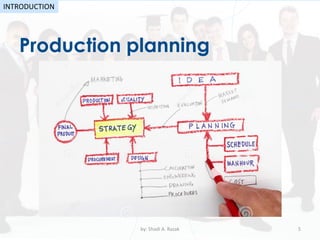
Production planning
by: Shadi A. Razak 4
INTRODUCTION
Production planning
by: Shadi A. Razak 5
INTRODUCTION
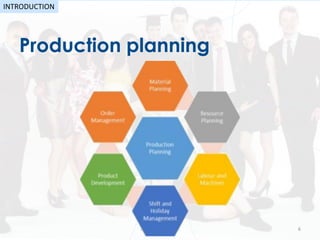
Production planning
by: Shadi A. Razak 6
INTRODUCTION
Production planning
• Usually cover:
– Stock control
– Quality control
– Quality Assurance
– Man power and resources management
– Cost management
by: Shadi A. Razak 7
INTRODUCTION
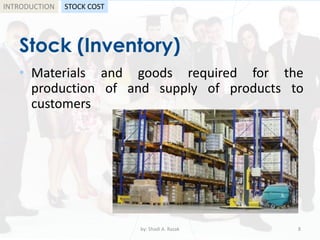
Stock (Inventory)
• Materials and goods required for the
production of and supply of products to
customers
by: Shadi A. Razak 8
INTRODUCTION STOCK COST
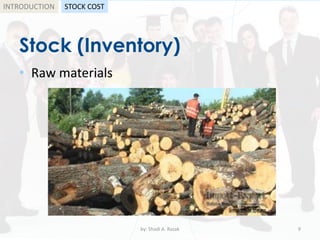
Stock (Inventory)
• Raw materials
by: Shadi A. Razak 9
INTRODUCTION STOCK COST
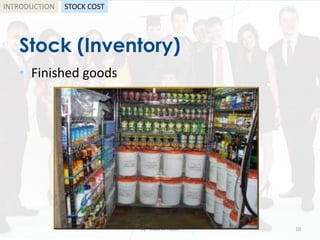
Stock (Inventory)
• Finished goods
by: Shadi A. Razak 10
INTRODUCTION STOCK COST
Stock cost
• Major element of the production cost:
– Storage cost: Warehouse, security, etc..
– Deprecation (Obsolescence) cost: Wear and tear,
shelf-life, etc..
– Opportunity cost: zero revenue earned on stocks
sitting around!
– Administration costs: monitoring stock levels,
ordering and processing, etc..
by: Shadi A. Razak 11
INTRODUCTION STOCK COST
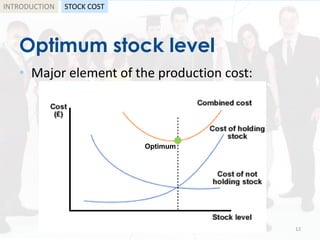
Optimum stock level
• Major element of the production cost:
by: Shadi A. Razak 12
INTRODUCTION STOCK COST
Optimum
Optimum stock level
• Factors affect the optimum stock level:
– Market
– Final product
– Stock
– Finance
– Infrastructure
– Human resources
by: Shadi A. Razak 13
INTRODUCTION STOCK COST
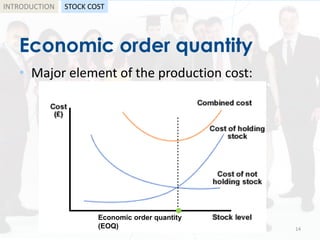
Economic order quantity
• Major element of the production cost:
by: Shadi A. Razak 14
INTRODUCTION STOCK COST
Economic order quantity
(EOQ)
Stock cost
• Business avoid acquiring high stock cost by:
– Stock rotation: The movement of older stock
ahead of new stocks
– Stock-out: Minimising the level of stock without
ever disrupting the production process.
by: Shadi A. Razak 15
INTRODUCTION STOCK COST
Stock control
by: Shadi A. Razak 16
INTRODUCTION STOCK COST STOCK CONTROL METHODS
Stock Level
Time
Maximum Stock Level
Minimum Stock Level
Re-order level
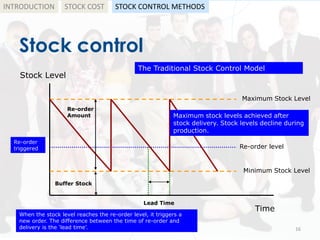
The Traditional Stock Control Model
Maximum stock levels achieved after
stock delivery. Stock levels decline during
production.
When the stock level reaches the re-order level, it triggers a
new order. The difference between the time of re-order and
delivery is the ‘lead time’.
Lead Time
Re-order
triggered
Buffer Stock
Re-order
Amount
Stock control
• Benefit businesses:
– Ensure stock availability to meet customer needs
– Help to cope with unplanned changes in demand
– Smoothens out the volatility of lead times
by: Shadi A. Razak 17
INTRODUCTION STOCK COST STOCK CONTROL METHODS
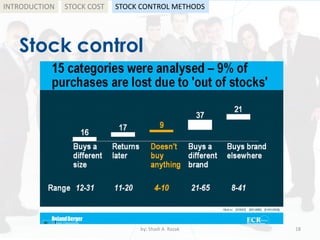
Stock control
by: Shadi A. Razak 18
INTRODUCTION STOCK COST STOCK CONTROL METHODS
Just-in-case (JIC)
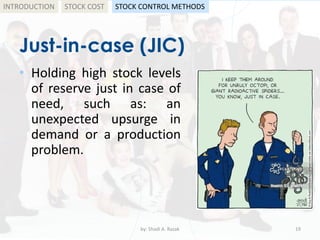
• Holding high stock levels
of reserve just in case of
need, such as: an
unexpected upsurge in
demand or a production
problem.
by: Shadi A. Razak 19
INTRODUCTION STOCK COST STOCK CONTROL METHODS
Just-in-case (JIC)
• Advantages:
– Economies of scale
– Reduce pressure on cash flow
– Ability to meet sudden demand
– Provides spare parts when needed
– No delivery issues
by: Shadi A. Razak 20
INTRODUCTION STOCK COST STOCK CONTROL METHODS
Just-in-case (JIC)
• Disadvantages:
– High opportunity cost
– High storage cost
– Risk of damage or outdated products
– Space used for storage cannot be used for other
functions
by: Shadi A. Razak 21
INTRODUCTION STOCK COST STOCK CONTROL METHODS
Just-in-time (JIT)
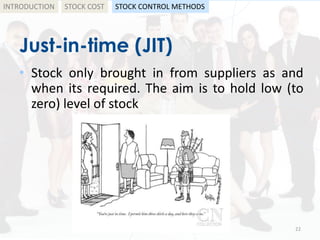
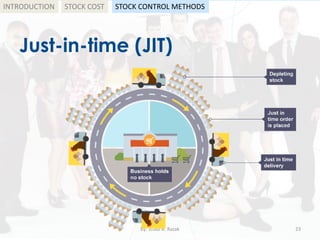
• Stock only brought in from suppliers as and
when its required. The aim is to hold low (to
zero) level of stock
by: Shadi A. Razak 22
INTRODUCTION STOCK COST STOCK CONTROL METHODS
Just-in-time (JIT)
by: Shadi A. Razak 23
INTRODUCTION STOCK COST STOCK CONTROL METHODS
Just-in-time (JIT)
• Advantages:
– Reduce costs (storage and opportunity)
– Reduce capital invested
– Improve the business working capital
– Creates more space for other business functions
– Creates closer relationship with suppliers
by: Shadi A. Razak 24
INTRODUCTION STOCK COST STOCK CONTROL METHODS
Just-in-time (JIT)
• Disadvantages:
– Increase in delivery cost
– Decrease economies of scale opportunities
– Risk of production delay
– Business depends on its suppliers
by: Shadi A. Razak 25
INTRODUCTION STOCK COST STOCK CONTROL METHODS
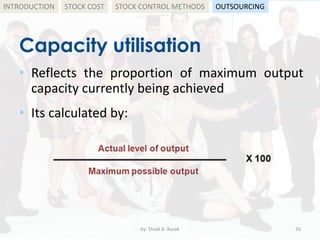
Capacity utilisation
• Reflects the proportion of maximum output
capacity currently being achieved
• Its calculated by:
by: Shadi A. Razak 26
INTRODUCTION STOCK COST STOCK CONTROL METHODS OUTSOURCING
Capacity shortage
• The demand for a business’s products exceeds
production capacity.
• In case the business is working at full capacity,
yet it have capacity shortage, they:
– Outsource production
– Offshore production
by: Shadi A. Razak 27
INTRODUCTION STOCK COST STOCK CONTROL METHODS OUTSOURCING
Outsourcing (Sub-contracting)
• When using another business ‘Third party’ to
undertake part of the operation rather than
doing it.
• When the third party is in another country, we
call it ‘Offshoring’.
by: Shadi A. Razak 28
INTRODUCTION STOCK COST STOCK CONTROL METHODS OUTSOURCING
Outsourcing (Sub-contracting)
• Advantages:
– Improve capacity utilisation
– Allow business to focus on its core activities
– No major capital investment is required
– Possible reduce in cost by cost restructuring
– Possible improve in quality
by: Shadi A. Razak 29
INTRODUCTION STOCK COST STOCK CONTROL METHODS OUTSOURCING
Outsourcing (Sub-contracting)
• Disadvantages:
– Business dependent on supplier
– Lose of control over quality of output
– Communication barriers and Synergy difficulties
– Possible increase in costs (administration and
transport)
by: Shadi A. Razak 30
INTRODUCTION STOCK COST STOCK CONTROL METHODS OUTSOURCING
Outsourcing (Sub-contracting)
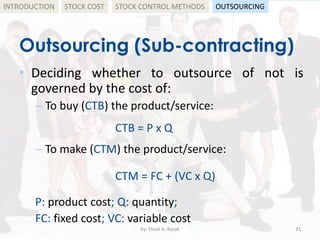
• Deciding whether to outsource of not is
governed by the cost of:
– To buy (CTB) the product/service:
CTB = P x Q
– To make (CTM) the product/service:
CTM = FC + (VC x Q)
P: product cost; Q: quantity;
FC: fixed cost; VC: variable cost
by: Shadi A. Razak 31
INTRODUCTION STOCK COST STOCK CONTROL METHODS OUTSOURCING
Summary
• Explained why business hold stocks
• Discussed advantages and disadvantages of
different stock control methods
• Explained the importance of optimum stock
level and stock handling cost in business
• Discussed the appropriate calculations to
support decisions to make or buy
products/services
by: Shadi A. Razak 32
INTRODUCTION STOCK COST STOCK CONTROL METHODS OUTSOURCING

Operation Management: Production planning

  • 1.
    BUSINES S&MANA GEMENTby: Shadi A.Razak 1 Production Planning
  • 2.
    Objectives • Understand whybusiness hold stocks and its cost • Recognize the need for optimum stock levels • Explain different stock control methods • Differentiate between just-in-case (JIC) and just-in-time (JIT) stock control • Make appropriate calculations to support decisions to make or buy by: Shadi A. Razak 2
  • 3.
    Structure • Introduction • StockCost • Stock Control Methods • Outsourcing by: Shadi A. Razak 3
  • 4.
    Production planning by: ShadiA. Razak 4 INTRODUCTION
  • 5.
    Production planning by: ShadiA. Razak 5 INTRODUCTION
  • 6.
    Production planning by: ShadiA. Razak 6 INTRODUCTION
  • 7.
    Production planning • Usuallycover: – Stock control – Quality control – Quality Assurance – Man power and resources management – Cost management by: Shadi A. Razak 7 INTRODUCTION
  • 8.
    Stock (Inventory) • Materialsand goods required for the production of and supply of products to customers by: Shadi A. Razak 8 INTRODUCTION STOCK COST
  • 9.
    Stock (Inventory) • Rawmaterials by: Shadi A. Razak 9 INTRODUCTION STOCK COST
  • 10.
    Stock (Inventory) • Finishedgoods by: Shadi A. Razak 10 INTRODUCTION STOCK COST
  • 11.
    Stock cost • Majorelement of the production cost: – Storage cost: Warehouse, security, etc.. – Deprecation (Obsolescence) cost: Wear and tear, shelf-life, etc.. – Opportunity cost: zero revenue earned on stocks sitting around! – Administration costs: monitoring stock levels, ordering and processing, etc.. by: Shadi A. Razak 11 INTRODUCTION STOCK COST
  • 12.
    Optimum stock level •Major element of the production cost: by: Shadi A. Razak 12 INTRODUCTION STOCK COST Optimum
  • 13.
    Optimum stock level •Factors affect the optimum stock level: – Market – Final product – Stock – Finance – Infrastructure – Human resources by: Shadi A. Razak 13 INTRODUCTION STOCK COST
  • 14.
    Economic order quantity •Major element of the production cost: by: Shadi A. Razak 14 INTRODUCTION STOCK COST Economic order quantity (EOQ)
  • 15.
    Stock cost • Businessavoid acquiring high stock cost by: – Stock rotation: The movement of older stock ahead of new stocks – Stock-out: Minimising the level of stock without ever disrupting the production process. by: Shadi A. Razak 15 INTRODUCTION STOCK COST
  • 16.
    Stock control by: ShadiA. Razak 16 INTRODUCTION STOCK COST STOCK CONTROL METHODS Stock Level Time Maximum Stock Level Minimum Stock Level Re-order level The Traditional Stock Control Model Maximum stock levels achieved after stock delivery. Stock levels decline during production. When the stock level reaches the re-order level, it triggers a new order. The difference between the time of re-order and delivery is the ‘lead time’. Lead Time Re-order triggered Buffer Stock Re-order Amount
  • 17.
    Stock control • Benefitbusinesses: – Ensure stock availability to meet customer needs – Help to cope with unplanned changes in demand – Smoothens out the volatility of lead times by: Shadi A. Razak 17 INTRODUCTION STOCK COST STOCK CONTROL METHODS
  • 18.
    Stock control by: ShadiA. Razak 18 INTRODUCTION STOCK COST STOCK CONTROL METHODS
  • 19.
    Just-in-case (JIC) • Holdinghigh stock levels of reserve just in case of need, such as: an unexpected upsurge in demand or a production problem. by: Shadi A. Razak 19 INTRODUCTION STOCK COST STOCK CONTROL METHODS
  • 20.
    Just-in-case (JIC) • Advantages: –Economies of scale – Reduce pressure on cash flow – Ability to meet sudden demand – Provides spare parts when needed – No delivery issues by: Shadi A. Razak 20 INTRODUCTION STOCK COST STOCK CONTROL METHODS
  • 21.
    Just-in-case (JIC) • Disadvantages: –High opportunity cost – High storage cost – Risk of damage or outdated products – Space used for storage cannot be used for other functions by: Shadi A. Razak 21 INTRODUCTION STOCK COST STOCK CONTROL METHODS
  • 22.
    Just-in-time (JIT) • Stockonly brought in from suppliers as and when its required. The aim is to hold low (to zero) level of stock by: Shadi A. Razak 22 INTRODUCTION STOCK COST STOCK CONTROL METHODS
  • 23.
    Just-in-time (JIT) by: ShadiA. Razak 23 INTRODUCTION STOCK COST STOCK CONTROL METHODS
  • 24.
    Just-in-time (JIT) • Advantages: –Reduce costs (storage and opportunity) – Reduce capital invested – Improve the business working capital – Creates more space for other business functions – Creates closer relationship with suppliers by: Shadi A. Razak 24 INTRODUCTION STOCK COST STOCK CONTROL METHODS
  • 25.
    Just-in-time (JIT) • Disadvantages: –Increase in delivery cost – Decrease economies of scale opportunities – Risk of production delay – Business depends on its suppliers by: Shadi A. Razak 25 INTRODUCTION STOCK COST STOCK CONTROL METHODS
  • 26.
    Capacity utilisation • Reflectsthe proportion of maximum output capacity currently being achieved • Its calculated by: by: Shadi A. Razak 26 INTRODUCTION STOCK COST STOCK CONTROL METHODS OUTSOURCING
  • 27.
    Capacity shortage • Thedemand for a business’s products exceeds production capacity. • In case the business is working at full capacity, yet it have capacity shortage, they: – Outsource production – Offshore production by: Shadi A. Razak 27 INTRODUCTION STOCK COST STOCK CONTROL METHODS OUTSOURCING
  • 28.
    Outsourcing (Sub-contracting) • Whenusing another business ‘Third party’ to undertake part of the operation rather than doing it. • When the third party is in another country, we call it ‘Offshoring’. by: Shadi A. Razak 28 INTRODUCTION STOCK COST STOCK CONTROL METHODS OUTSOURCING
  • 29.
    Outsourcing (Sub-contracting) • Advantages: –Improve capacity utilisation – Allow business to focus on its core activities – No major capital investment is required – Possible reduce in cost by cost restructuring – Possible improve in quality by: Shadi A. Razak 29 INTRODUCTION STOCK COST STOCK CONTROL METHODS OUTSOURCING
  • 30.
    Outsourcing (Sub-contracting) • Disadvantages: –Business dependent on supplier – Lose of control over quality of output – Communication barriers and Synergy difficulties – Possible increase in costs (administration and transport) by: Shadi A. Razak 30 INTRODUCTION STOCK COST STOCK CONTROL METHODS OUTSOURCING
  • 31.
    Outsourcing (Sub-contracting) • Decidingwhether to outsource of not is governed by the cost of: – To buy (CTB) the product/service: CTB = P x Q – To make (CTM) the product/service: CTM = FC + (VC x Q) P: product cost; Q: quantity; FC: fixed cost; VC: variable cost by: Shadi A. Razak 31 INTRODUCTION STOCK COST STOCK CONTROL METHODS OUTSOURCING
  • 32.
    Summary • Explained whybusiness hold stocks • Discussed advantages and disadvantages of different stock control methods • Explained the importance of optimum stock level and stock handling cost in business • Discussed the appropriate calculations to support decisions to make or buy products/services by: Shadi A. Razak 32 INTRODUCTION STOCK COST STOCK CONTROL METHODS OUTSOURCING