Absolute & Comparative advantage
by: Shadi A. Razak 1
International Trade
Objectives
• Understand International and free trade
• Explain the theory of absolute advantage
• Explain the theory of comparative advantage
• Understand the sources of comparative
advantage
• Discuss the real-world relevance and
limitations of comparative advantage theory
by: Shadi A. Razak 2
Structure
• Introduction
• Free Trade
• Absolute Advantage
• Comparative Advantage
• Real Life Limitations
by: Shadi A. Razak 3
by: Shadi A. Razak 4
INTRODUCTION
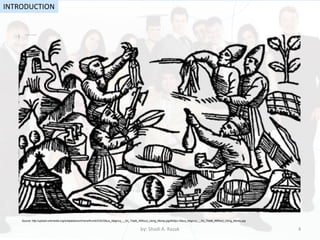
Source: http://upload.wikimedia.org/wikipedia/commons/thumb/2/2b/Olaus_Magnus_-_On_Trade_Without_Using_Money.jpg/640px-Olaus_Magnus_-_On_Trade_Without_Using_Money.jpg
Trade
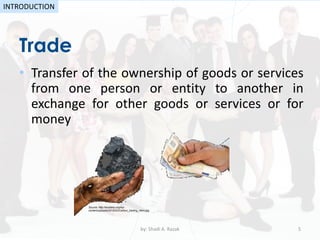
• Transfer of the ownership of goods or services
from one person or entity to another in
exchange for other goods or services or for
money
by: Shadi A. Razak 5
INTRODUCTION
Source: http://ecodaily.org/wp-
content/uploads/2015/02/Carbon_trading_Hero.jpg
Trade
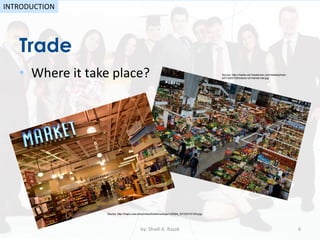
• Where it take place?
by: Shadi A. Razak 6
INTRODUCTION
Source: http://media-cdn.tripadvisor.com/media/photo-
s/01/2d/01/35/interior-of-market-hall.jpg
Source: http://maps.ucla.edu/photos/locations/large/L83994_201203151334.jpg
Trade
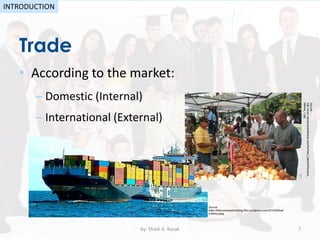
• According to the market:
– Domestic (Internal)
– International (External)
by: Shadi A. Razak 7
INTRODUCTION
Source:
http://www.sacramentolifestyle.com/Farmers_Market/Farmers_
Market_1.jpg
Source:
https://thebusinessethicsblog.files.wordpress.com/2010/06/trad
e-ethics.jpeg
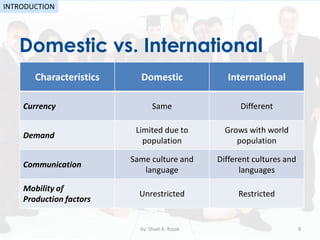
Domestic vs. International
by: Shadi A. Razak 8
INTRODUCTION
Characteristics Domestic International
Currency Same Different
Demand
Limited due to
population
Grows with world
population
Communication
Same culture and
language
Different cultures and
languages
Mobility of
Production factors
Unrestricted Restricted
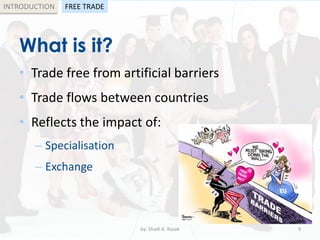
What is it?
• Trade free from artificial barriers
• Trade flows between countries
• Reflects the impact of:
– Specialisation
– Exchange
by: Shadi A. Razak 9
INTRODUCTION FREE TRADE
Specialisation
• A country specialised in using it’s scarce
resources and production factors efficiently
• Country concentration to produce one or few
goods and services efficiently (at a low cost)
• Example
by: Shadi A. Razak 10
INTRODUCTION FREE TRADE
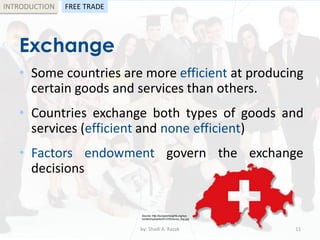
Exchange
• Some countries are more efficient at producing
certain goods and services than others.
• Countries exchange both types of goods and
services (efficient and none efficient)
• Factors endowment govern the exchange
decisions
by: Shadi A. Razak 11
INTRODUCTION FREE TRADE
Source: http://europedraughts.org/wp-
content/uploads/2012/05/swiss_flag.jpg
Potential advantages
• Increase in production and consumption
• Economies of Scale
• Improve allocative and productive efficiency
• More options to consumers
• Increase market competition
• Access to advance technology
• Inflow of Knowledge
• Reduce possibility of hostility and violence
by: Shadi A. Razak 12
INTRODUCTION FREE TRADE
Economic growth
• Trade can be seen as the engine of economic
growth:
– Source of foreign exchange
– Method of financing the import of capital
equipment or technology and energy
– An injection of demand into the circular flow of
income and spending
– Raise per captia income and improve development
outcomes
by: Shadi A. Razak 13
INTRODUCTION FREE TRADE
Economic growth
• International trade has risks:
– Volatile global prices affecting export revenues and
profits
– Geo-political uncertainty and cyclical shift in
demand
– Raise of structural unemployment as patterns of
demand changes over time in some industries
by: Shadi A. Razak 14
INTRODUCTION FREE TRADE
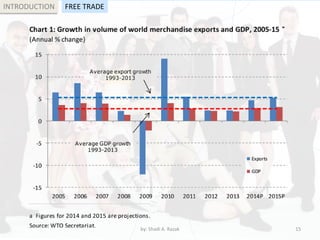
by: Shadi A. Razak 15
INTRODUCTION FREE TRADE
by: Shadi A. Razak 16
INTRODUCTION FREE TRADE
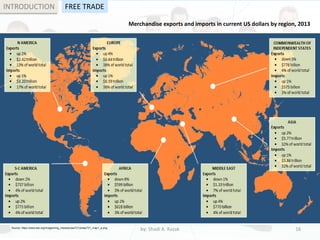
Source: https://www.wto.org/images/img_mews/press721/press721_map1_e.png
Merchandise exports and imports in current US dollars by region, 2013
The Theory
• Refer to the ability of one country to produce a
good using fewer resources than another
country.
• Accordingly:
– Country specialise in and export the goods which
have an absolute advantage
– Their will be an increase in production and
consumption in each country
by: Shadi A. Razak 17
INTRODUCTION FREE TRADE ABSOLUTE ADVANTAGE
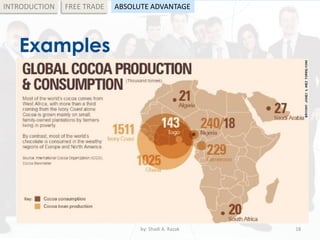
Examples
by: Shadi A. Razak 18
INTRODUCTION FREE TRADE ABSOLUTE ADVANTAGE
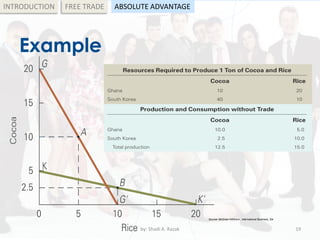
Example
by: Shadi A. Razak 19
INTRODUCTION FREE TRADE ABSOLUTE ADVANTAGE
Source: McGraw-Hill/Irwin , International Business, 5/e
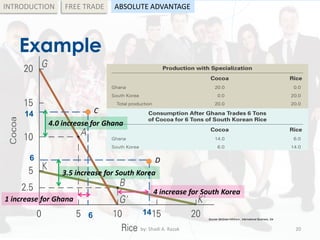
Example
by: Shadi A. Razak 20
INTRODUCTION FREE TRADE ABSOLUTE ADVANTAGE
Source: McGraw-Hill/Irwin , International Business, 5/e
C
D
4.0 increase for Ghana
3.5 increase for South Korea
4 increase for South Korea
1 increase for Ghana
14
6
6 14
The Theory
• Refer to the a country that has a margin of
superiority in supplying a good in compression
to other countries
• In other words, when the country has a lower
opportunity cost in supplying of a good than
another country.
by: Shadi A. Razak 21
INTRODUCTION FREE TRADE ABSOLUTE ADVANTAGE COMPARATIVE ADVANTAGE
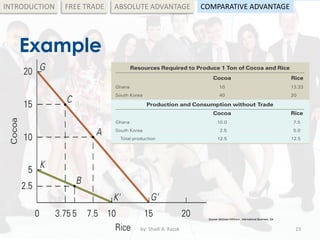
Example
by: Shadi A. Razak 22
INTRODUCTION FREE TRADE ABSOLUTE ADVANTAGE COMPARATIVE ADVANTAGE
Source: http://pentagist.com/wp-content/uploads/2014/03/banner-hollywood.jpg Source: http://www.shermanreport.com/wp-content/uploads/2012/10/English-
Premier-League.gif
Example
by: Shadi A. Razak 23
INTRODUCTION FREE TRADE ABSOLUTE ADVANTAGE COMPARATIVE ADVANTAGE
Source: McGraw-Hill/Irwin , International Business, 5/e
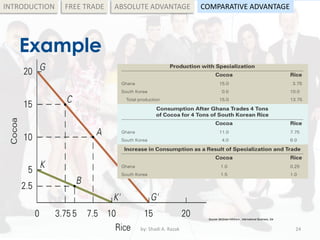
Example
by: Shadi A. Razak 24
INTRODUCTION FREE TRADE ABSOLUTE ADVANTAGE COMPARATIVE ADVANTAGE
Source: McGraw-Hill/Irwin , International Business, 5/e
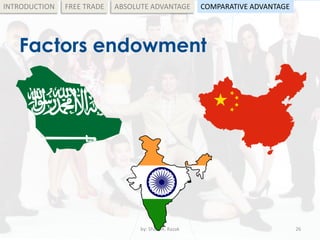
Factors endowment
• Help countries to determine their trade
pattern:
– Countries with a relative factor abundance can
specialise and trade
– Exports embody the abundant factor
– Imports embody the scarce factor
– Example
by: Shadi A. Razak 25
INTRODUCTION FREE TRADE ABSOLUTE ADVANTAGE COMPARATIVE ADVANTAGE
Factors endowment
by: Shadi A. Razak 26
INTRODUCTION FREE TRADE ABSOLUTE ADVANTAGE COMPARATIVE ADVANTAGE
Factors endowment
• Basic factor endowments :
– Natural resources
– Climate
– Geographic location
– Demographics
by: Shadi A. Razak 27
INTRODUCTION FREE TRADE ABSOLUTE ADVANTAGE COMPARATIVE ADVANTAGE
Factors endowment
• Advanced factor endowments :
– Communications
– Skilled labor
– Technology
– Education
– Research
by: Shadi A. Razak 28
INTRODUCTION FREE TRADE ABSOLUTE ADVANTAGE COMPARATIVE ADVANTAGE
Assumptions and limitations
• Immobility of factors of production
• No fixed technology
• Barriers to trade are small
• No externalities
• Ignore transportation of goods
• Apply only during free trade
• Market is perfect competation
by: Shadi A. Razak 29
INTRODUCTION FREE TRADE ABSOLUTE ADVANTAGE COMPARATIVE ADVANTAGE
Summary
• Explained what is meant by International and
free trade
• Differentiated between absolute and
comparative advantage
• Discuss the real-world relevance and
limitations of comparative advantage theory
by: Shadi A. Razak 30
INTRODUCTION FREE TRADE ABSOLUTE ADVANTAGE COMPARATIVE ADVANTAGE

International Trade

  • 1.
    Absolute & Comparativeadvantage by: Shadi A. Razak 1 International Trade
  • 2.
    Objectives • Understand Internationaland free trade • Explain the theory of absolute advantage • Explain the theory of comparative advantage • Understand the sources of comparative advantage • Discuss the real-world relevance and limitations of comparative advantage theory by: Shadi A. Razak 2
  • 3.
    Structure • Introduction • FreeTrade • Absolute Advantage • Comparative Advantage • Real Life Limitations by: Shadi A. Razak 3
  • 4.
    by: Shadi A.Razak 4 INTRODUCTION Source: http://upload.wikimedia.org/wikipedia/commons/thumb/2/2b/Olaus_Magnus_-_On_Trade_Without_Using_Money.jpg/640px-Olaus_Magnus_-_On_Trade_Without_Using_Money.jpg
  • 5.
    Trade • Transfer ofthe ownership of goods or services from one person or entity to another in exchange for other goods or services or for money by: Shadi A. Razak 5 INTRODUCTION Source: http://ecodaily.org/wp- content/uploads/2015/02/Carbon_trading_Hero.jpg
  • 6.
    Trade • Where ittake place? by: Shadi A. Razak 6 INTRODUCTION Source: http://media-cdn.tripadvisor.com/media/photo- s/01/2d/01/35/interior-of-market-hall.jpg Source: http://maps.ucla.edu/photos/locations/large/L83994_201203151334.jpg
  • 7.
    Trade • According tothe market: – Domestic (Internal) – International (External) by: Shadi A. Razak 7 INTRODUCTION Source: http://www.sacramentolifestyle.com/Farmers_Market/Farmers_ Market_1.jpg Source: https://thebusinessethicsblog.files.wordpress.com/2010/06/trad e-ethics.jpeg
  • 8.
    Domestic vs. International by:Shadi A. Razak 8 INTRODUCTION Characteristics Domestic International Currency Same Different Demand Limited due to population Grows with world population Communication Same culture and language Different cultures and languages Mobility of Production factors Unrestricted Restricted
  • 9.
    What is it? •Trade free from artificial barriers • Trade flows between countries • Reflects the impact of: – Specialisation – Exchange by: Shadi A. Razak 9 INTRODUCTION FREE TRADE
  • 10.
    Specialisation • A countryspecialised in using it’s scarce resources and production factors efficiently • Country concentration to produce one or few goods and services efficiently (at a low cost) • Example by: Shadi A. Razak 10 INTRODUCTION FREE TRADE
  • 11.
    Exchange • Some countriesare more efficient at producing certain goods and services than others. • Countries exchange both types of goods and services (efficient and none efficient) • Factors endowment govern the exchange decisions by: Shadi A. Razak 11 INTRODUCTION FREE TRADE Source: http://europedraughts.org/wp- content/uploads/2012/05/swiss_flag.jpg
  • 12.
    Potential advantages • Increasein production and consumption • Economies of Scale • Improve allocative and productive efficiency • More options to consumers • Increase market competition • Access to advance technology • Inflow of Knowledge • Reduce possibility of hostility and violence by: Shadi A. Razak 12 INTRODUCTION FREE TRADE
  • 13.
    Economic growth • Tradecan be seen as the engine of economic growth: – Source of foreign exchange – Method of financing the import of capital equipment or technology and energy – An injection of demand into the circular flow of income and spending – Raise per captia income and improve development outcomes by: Shadi A. Razak 13 INTRODUCTION FREE TRADE
  • 14.
    Economic growth • Internationaltrade has risks: – Volatile global prices affecting export revenues and profits – Geo-political uncertainty and cyclical shift in demand – Raise of structural unemployment as patterns of demand changes over time in some industries by: Shadi A. Razak 14 INTRODUCTION FREE TRADE
  • 15.
    by: Shadi A.Razak 15 INTRODUCTION FREE TRADE
  • 16.
    by: Shadi A.Razak 16 INTRODUCTION FREE TRADE Source: https://www.wto.org/images/img_mews/press721/press721_map1_e.png Merchandise exports and imports in current US dollars by region, 2013
  • 17.
    The Theory • Referto the ability of one country to produce a good using fewer resources than another country. • Accordingly: – Country specialise in and export the goods which have an absolute advantage – Their will be an increase in production and consumption in each country by: Shadi A. Razak 17 INTRODUCTION FREE TRADE ABSOLUTE ADVANTAGE
  • 18.
    Examples by: Shadi A.Razak 18 INTRODUCTION FREE TRADE ABSOLUTE ADVANTAGE
  • 19.
    Example by: Shadi A.Razak 19 INTRODUCTION FREE TRADE ABSOLUTE ADVANTAGE Source: McGraw-Hill/Irwin , International Business, 5/e
  • 20.
    Example by: Shadi A.Razak 20 INTRODUCTION FREE TRADE ABSOLUTE ADVANTAGE Source: McGraw-Hill/Irwin , International Business, 5/e C D 4.0 increase for Ghana 3.5 increase for South Korea 4 increase for South Korea 1 increase for Ghana 14 6 6 14
  • 21.
    The Theory • Referto the a country that has a margin of superiority in supplying a good in compression to other countries • In other words, when the country has a lower opportunity cost in supplying of a good than another country. by: Shadi A. Razak 21 INTRODUCTION FREE TRADE ABSOLUTE ADVANTAGE COMPARATIVE ADVANTAGE
  • 22.
    Example by: Shadi A.Razak 22 INTRODUCTION FREE TRADE ABSOLUTE ADVANTAGE COMPARATIVE ADVANTAGE Source: http://pentagist.com/wp-content/uploads/2014/03/banner-hollywood.jpg Source: http://www.shermanreport.com/wp-content/uploads/2012/10/English- Premier-League.gif
  • 23.
    Example by: Shadi A.Razak 23 INTRODUCTION FREE TRADE ABSOLUTE ADVANTAGE COMPARATIVE ADVANTAGE Source: McGraw-Hill/Irwin , International Business, 5/e
  • 24.
    Example by: Shadi A.Razak 24 INTRODUCTION FREE TRADE ABSOLUTE ADVANTAGE COMPARATIVE ADVANTAGE Source: McGraw-Hill/Irwin , International Business, 5/e
  • 25.
    Factors endowment • Helpcountries to determine their trade pattern: – Countries with a relative factor abundance can specialise and trade – Exports embody the abundant factor – Imports embody the scarce factor – Example by: Shadi A. Razak 25 INTRODUCTION FREE TRADE ABSOLUTE ADVANTAGE COMPARATIVE ADVANTAGE
  • 26.
    Factors endowment by: ShadiA. Razak 26 INTRODUCTION FREE TRADE ABSOLUTE ADVANTAGE COMPARATIVE ADVANTAGE
  • 27.
    Factors endowment • Basicfactor endowments : – Natural resources – Climate – Geographic location – Demographics by: Shadi A. Razak 27 INTRODUCTION FREE TRADE ABSOLUTE ADVANTAGE COMPARATIVE ADVANTAGE
  • 28.
    Factors endowment • Advancedfactor endowments : – Communications – Skilled labor – Technology – Education – Research by: Shadi A. Razak 28 INTRODUCTION FREE TRADE ABSOLUTE ADVANTAGE COMPARATIVE ADVANTAGE
  • 29.
    Assumptions and limitations •Immobility of factors of production • No fixed technology • Barriers to trade are small • No externalities • Ignore transportation of goods • Apply only during free trade • Market is perfect competation by: Shadi A. Razak 29 INTRODUCTION FREE TRADE ABSOLUTE ADVANTAGE COMPARATIVE ADVANTAGE
  • 30.
    Summary • Explained whatis meant by International and free trade • Differentiated between absolute and comparative advantage • Discuss the real-world relevance and limitations of comparative advantage theory by: Shadi A. Razak 30 INTRODUCTION FREE TRADE ABSOLUTE ADVANTAGE COMPARATIVE ADVANTAGE