BUSINES
S&MANA
GEMENTby: Shadi A. Razak 1
Business Growth
Objectives
• Apply the concept of economies & diseconomies
of scale to business decisions.
• Evaluate the merits between small and large
organisations
• Identify the appropriate scale of operation
• Explain the differences between internal and
external growth options
by: Shadi A. Razak 2
Structure
• Scale of Operation
• Economies of Scale
• Small vs. Large
• Business Growth
by: Shadi A. Razak 3
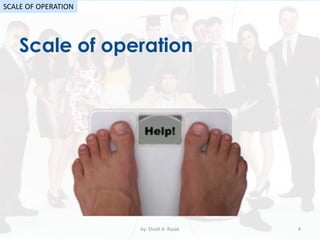
Scale of operation
by: Shadi A. Razak 4
SCALE OF OPERATION
Scale of operation
by: Shadi A. Razak 5
SCALE OF OPERATION
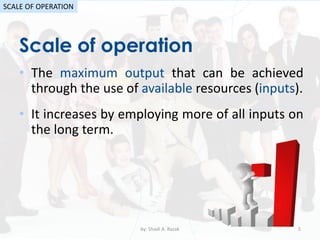
• The maximum output that can be achieved
through the use of available resources (inputs).
• It increases by employing more of all inputs on
the long term.
Scale of operation
by: Shadi A. Razak 6
SCALE OF OPERATION
• Think of SCOPE:
– Size of the market
– Capital available
– Ownership Objectives
– ComPetitors market share
– Economy scale
Economies of scale
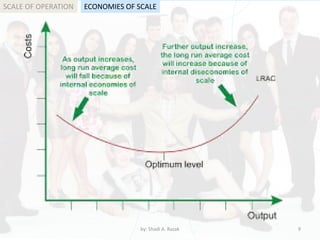
• When business grow in size they benefits from:
by: Shadi A. Razak 7
SCALE OF OPERATION
– Decrease in average cost
– Cost spread over more units/customers
– Develop more specialised work force
– Low interest rate loans
– Decrease in Agency cost
– Decrease in Transaction cost
ECONOMIES OF SCALE
Diseconomies of scale
• When business grow in size its average cost
might rise and inefficiency begins to appear :
by: Shadi A. Razak 8
– Communication breaks down
– Decision making slows down
– Motivation Falls
– Productivity drops
SCALE OF OPERATION ECONOMIES OF SCALE
by: Shadi A. Razak 9
SCALE OF OPERATION ECONOMIES OF SCALE
Small organisations
by: Shadi A. Razak 10
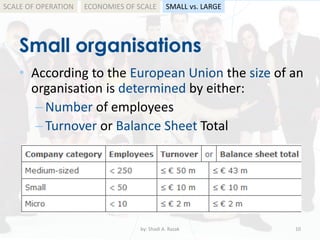
• According to the European Union the size of an
organisation is determined by either:
–Number of employees
–Turnover or Balance Sheet Total
SCALE OF OPERATION SMALL vs. LARGEECONOMIES OF SCALE
Small vs. Large
• Managed & controlled
by owner
• Adapt quickly to market
changes
• Personal service
• Human business
• No diseconomies of
scale
• Easy communication
• Specialist experienced
managers
• Economies of scale
• Set market benchmark
• Access to several source
of finance
• Spread risk by
diversification
• Utilise and deploy R&D
by: Shadi A. Razak 11
SCALE OF OPERATION SMALL vs. LARGEECONOMIES OF SCALE
Small vs. Large
• Limited access to source
of finance
• Employees bottle
necked with workload
• High risk of negative
impact of external
changes
• Unlikely to benefit from
economies of scale
• Can be difficult to
manage - globalised
• Can suffer from
diseconomies of scale
• High risk of conflicts
arise between
stakeholders
• Slow decision making
• Break down in
communications
by: Shadi A. Razak 12
SCALE OF OPERATION SMALL vs. LARGEECONOMIES OF SCALE
Business growth
by: Shadi A. Razak 13
• Examples of drivers to grow the business
include:
– Increased profit
– Increased market share
– Increased economies of scale
– Increased power & status of owners
– Reduce risk of takeover
SCALE OF OPERATION BUSINESS GROWTHSMALL vs. LARGEECONOMIES OF SCALE
Business growth
by: Shadi A. Razak 14
SCALE OF OPERATION
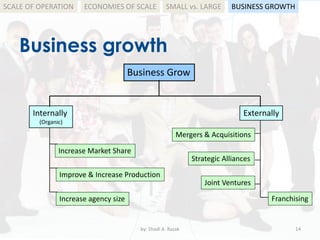
Business Grow
Internally
(Organic)
Externally
Mergers & Acquisitions
Joint Ventures
Strategic Alliances
Franchising
Increase Market Share
Improve & Increase Production
Increase agency size
BUSINESS GROWTHSMALL vs. LARGEECONOMIES OF SCALE
Internal growth
by: Shadi A. Razak 15
SCALE OF OPERATION
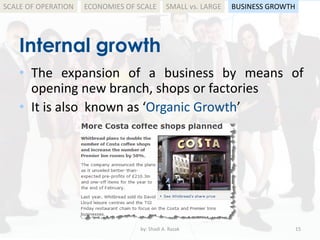
• The expansion of a business by means of
opening new branch, shops or factories
• It is also known as ‘Organic Growth’
BUSINESS GROWTHSMALL vs. LARGEECONOMIES OF SCALE
Internal growth
by: Shadi A. Razak 16
SCALE OF OPERATION BUSINESS GROWTHSMALL vs. LARGEECONOMIES OF SCALE
• Business internal growth can be achieved in
number of ways:
– Increase sales
– Develop better production techniques
– Increase the organisation size:
o Hiring more employees
o Opening more shops, offices or factories
External growth
by: Shadi A. Razak 17
SCALE OF OPERATION BUSINESS GROWTHSMALL vs. LARGEECONOMIES OF SCALE
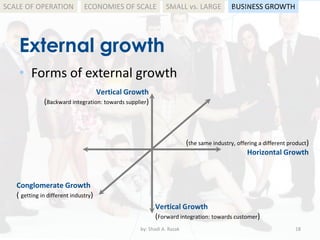
• The expansion of a business by means of
merging with or taking over another business
from either the same or different industry
• The different forms of external growth:
–Horizontal growth
–Vertical growth
–Conglomerate growth
External growth
by: Shadi A. Razak 18
SCALE OF OPERATION
Vertical Growth
(Forward integration: towards customer)
Conglomerate Growth
( getting in different industry)
BUSINESS GROWTHSMALL vs. LARGEECONOMIES OF SCALE
Vertical Growth
(Backward integration: towards supplier)
(the same industry, offering a different product)
Horizontal Growth
• Forms of external growth
External growth
by: Shadi A. Razak 19
SCALE OF OPERATION BUSINESS GROWTHSMALL vs. LARGEECONOMIES OF SCALE
• Business external growth can be achieved in
number of ways :
–Merges and acquisitions
–Joint ventures
–Strategic alliances
–Franchising
Summary
by: Shadi A. Razak 20
BUSINESS GROWTHSMALL vs. LARGEECONOMIES OF SCALESCALE OF OPERATION
• Explained what is meant by ‘Scale of
Operation’
• Differentiated between economics and
diseconomies of Scale
• Discussed business growth and its various
forms and options
• Discussed the merits between small and large
businesses

Business Growth

  • 1.
    BUSINES S&MANA GEMENTby: Shadi A.Razak 1 Business Growth
  • 2.
    Objectives • Apply theconcept of economies & diseconomies of scale to business decisions. • Evaluate the merits between small and large organisations • Identify the appropriate scale of operation • Explain the differences between internal and external growth options by: Shadi A. Razak 2
  • 3.
    Structure • Scale ofOperation • Economies of Scale • Small vs. Large • Business Growth by: Shadi A. Razak 3
  • 4.
    Scale of operation by:Shadi A. Razak 4 SCALE OF OPERATION
  • 5.
    Scale of operation by:Shadi A. Razak 5 SCALE OF OPERATION • The maximum output that can be achieved through the use of available resources (inputs). • It increases by employing more of all inputs on the long term.
  • 6.
    Scale of operation by:Shadi A. Razak 6 SCALE OF OPERATION • Think of SCOPE: – Size of the market – Capital available – Ownership Objectives – ComPetitors market share – Economy scale
  • 7.
    Economies of scale •When business grow in size they benefits from: by: Shadi A. Razak 7 SCALE OF OPERATION – Decrease in average cost – Cost spread over more units/customers – Develop more specialised work force – Low interest rate loans – Decrease in Agency cost – Decrease in Transaction cost ECONOMIES OF SCALE
  • 8.
    Diseconomies of scale •When business grow in size its average cost might rise and inefficiency begins to appear : by: Shadi A. Razak 8 – Communication breaks down – Decision making slows down – Motivation Falls – Productivity drops SCALE OF OPERATION ECONOMIES OF SCALE
  • 9.
    by: Shadi A.Razak 9 SCALE OF OPERATION ECONOMIES OF SCALE
  • 10.
    Small organisations by: ShadiA. Razak 10 • According to the European Union the size of an organisation is determined by either: –Number of employees –Turnover or Balance Sheet Total SCALE OF OPERATION SMALL vs. LARGEECONOMIES OF SCALE
  • 11.
    Small vs. Large •Managed & controlled by owner • Adapt quickly to market changes • Personal service • Human business • No diseconomies of scale • Easy communication • Specialist experienced managers • Economies of scale • Set market benchmark • Access to several source of finance • Spread risk by diversification • Utilise and deploy R&D by: Shadi A. Razak 11 SCALE OF OPERATION SMALL vs. LARGEECONOMIES OF SCALE
  • 12.
    Small vs. Large •Limited access to source of finance • Employees bottle necked with workload • High risk of negative impact of external changes • Unlikely to benefit from economies of scale • Can be difficult to manage - globalised • Can suffer from diseconomies of scale • High risk of conflicts arise between stakeholders • Slow decision making • Break down in communications by: Shadi A. Razak 12 SCALE OF OPERATION SMALL vs. LARGEECONOMIES OF SCALE
  • 13.
    Business growth by: ShadiA. Razak 13 • Examples of drivers to grow the business include: – Increased profit – Increased market share – Increased economies of scale – Increased power & status of owners – Reduce risk of takeover SCALE OF OPERATION BUSINESS GROWTHSMALL vs. LARGEECONOMIES OF SCALE
  • 14.
    Business growth by: ShadiA. Razak 14 SCALE OF OPERATION Business Grow Internally (Organic) Externally Mergers & Acquisitions Joint Ventures Strategic Alliances Franchising Increase Market Share Improve & Increase Production Increase agency size BUSINESS GROWTHSMALL vs. LARGEECONOMIES OF SCALE
  • 15.
    Internal growth by: ShadiA. Razak 15 SCALE OF OPERATION • The expansion of a business by means of opening new branch, shops or factories • It is also known as ‘Organic Growth’ BUSINESS GROWTHSMALL vs. LARGEECONOMIES OF SCALE
  • 16.
    Internal growth by: ShadiA. Razak 16 SCALE OF OPERATION BUSINESS GROWTHSMALL vs. LARGEECONOMIES OF SCALE • Business internal growth can be achieved in number of ways: – Increase sales – Develop better production techniques – Increase the organisation size: o Hiring more employees o Opening more shops, offices or factories
  • 17.
    External growth by: ShadiA. Razak 17 SCALE OF OPERATION BUSINESS GROWTHSMALL vs. LARGEECONOMIES OF SCALE • The expansion of a business by means of merging with or taking over another business from either the same or different industry • The different forms of external growth: –Horizontal growth –Vertical growth –Conglomerate growth
  • 18.
    External growth by: ShadiA. Razak 18 SCALE OF OPERATION Vertical Growth (Forward integration: towards customer) Conglomerate Growth ( getting in different industry) BUSINESS GROWTHSMALL vs. LARGEECONOMIES OF SCALE Vertical Growth (Backward integration: towards supplier) (the same industry, offering a different product) Horizontal Growth • Forms of external growth
  • 19.
    External growth by: ShadiA. Razak 19 SCALE OF OPERATION BUSINESS GROWTHSMALL vs. LARGEECONOMIES OF SCALE • Business external growth can be achieved in number of ways : –Merges and acquisitions –Joint ventures –Strategic alliances –Franchising
  • 20.
    Summary by: Shadi A.Razak 20 BUSINESS GROWTHSMALL vs. LARGEECONOMIES OF SCALESCALE OF OPERATION • Explained what is meant by ‘Scale of Operation’ • Differentiated between economics and diseconomies of Scale • Discussed business growth and its various forms and options • Discussed the merits between small and large businesses