BUSINES
S&MANA
GEMENTby: Shadi A. Razak 1
Human
Resources
Objectives
• Discuss the constraint and opportunities
presented by labour mobility and demographics
• Analyse the workforce planning process
• Discuss different methods of recruitment,
training, appraisal and dismissal
• Discuss the reasons for work pattern changes and
the change consequences
by: Shadi A. Razak 2
Structure
• Introduction
• Workforce Planning
• Recruitment
• Training and Appraisal
• Work Patterns
by: Shadi A. Razak 3
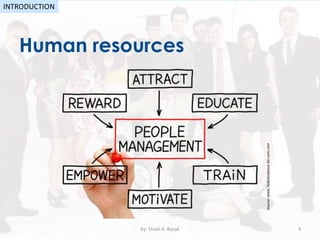
Human resources
by: Shadi A. Razak 4
INTRODUCTION
Source:www.hrdailyadvisor.blr.com.com
Human resources
by: Shadi A. Razak 5
INTRODUCTION
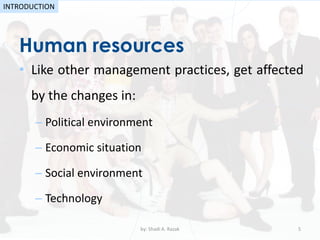
• Like other management practices, get affected
by the changes in:
– Political environment
– Economic situation
– Social environment
– Technology
by: Shadi A. Razak 6
INTRODUCTION
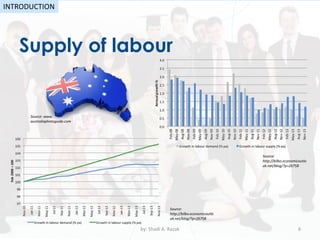
Supply of labour
Source:
http://bilbo.economicoutlo
ok.net/blog/?p=26758
Source: www.
australiaphotoguide.com
Source:
http://bilbo.economicoutlo
ok.net/blog/?p=26758
Supply of labour
by: Shadi A. Razak 7
INTRODUCTION
• The potential supply of labour to any
organisation is affected by:
– Demographics
– Labour mobility
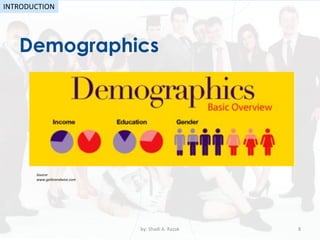
Demographics
by: Shadi A. Razak 8
INTRODUCTION
Source:
www.getbrandwise.com
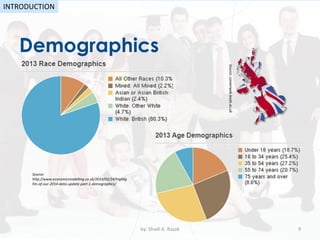
Demographics
by: Shadi A. Razak 9
INTRODUCTION
Source:
http://www.economicmodelling.co.uk/2014/02/24/highlig
hts-of-our-2014-data-update-part-1-demographics/
Source:careerweb.leeds.ac.uk
Labour mobility
by: Shadi A. Razak 10
INTRODUCTION
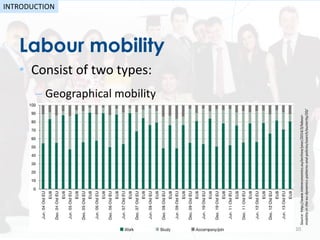
• Consist of two types:
– Geographical mobility
Source:http://www.intereconomics.eu/archive/year/2014/3/labour-
mobility-in-the-eu-dynamics-patterns-and-policies/search/austerity/20/
Labour mobility
by: Shadi A. Razak 11
INTRODUCTION
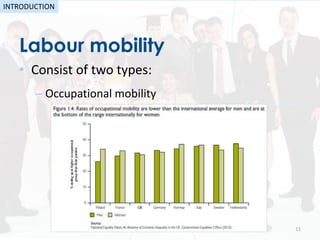
• Consist of two types:
– Occupational mobility
by: Shadi A. Razak 12
INTRODUCTION
Definition
WORKFORCE PLANNING
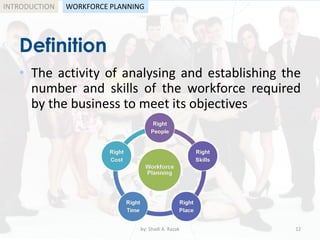
• The activity of analysing and establishing the
number and skills of the workforce required
by the business to meet its objectives
by: Shadi A. Razak 13
INTRODUCTION
Process
WORKFORCE PLANNING
• Workforce planning involves two main stages:
– Forecast number of workforce
– Forecast skills of workforce
by: Shadi A. Razak 14
INTRODUCTION
Forecasting the numbers
WORKFORCE PLANNING
• This depends on several factors:
– Forecasting demand for the firm product
– The productivity levels of staff
– The business objectives
– Employment law
– Labour turnover
– Work pattern
by: Shadi A. Razak 15
INTRODUCTION
Forecasting the skills
WORKFORCE PLANNING
• This depends on several factors:
– Demographics
– Pace of technological changes
– Work pattern
by: Shadi A. Razak 16
INTRODUCTION
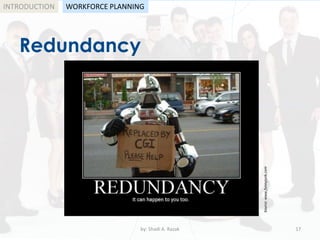
Redundancy
WORKFORCE PLANNING
• Usually a result of workforce audit and
planning.
• Is when a job is no longer required so the
employee whose doing this job becomes
redundant.
by: Shadi A. Razak 17
INTRODUCTION
Redundancy
WORKFORCE PLANNING
Source:www.funnyjunk.com
by: Shadi A. Razak 18
INTRODUCTION
Definition
WORKFORCE PLANNING
• The process of
identifying the need for
a new employee,
defining the job to be
filled and the type of
person needed to fill it,
attracting suitable
candidate and selecting
the best one
RECRUITMENT
Source: http://www.clker.com/clipart-249036.html
by: Shadi A. Razak 19
INTRODUCTION
Process
WORKFORCE PLANNING
• The recruiting process involves the following
steps:
– Job description
– Person specification
– Advertising (Internal / External)
– Selection:
• Shortlisting
• Interview & Assessment center
RECRUITMENT
Source: http://www.clker.com/clipart-249036.html
by: Shadi A. Razak 20
INTRODUCTION
Benefits
WORKFORCE PLANNING
• Professional development by training help
business to:
– Develop junior staff
– Help staff to adopt to changes
– Motivate workforce
RECRUITMENT DEV. & APPRISAL
Source:
http://blog.fundinggate
s.com/2012/10/manage
ment-training-improv-
workplace/
by: Shadi A. Razak 21
INTRODUCTION
Types of training
WORKFORCE PLANNING
• There are three main types of professional
training in business:
– Orientation
– On-the-job training
– Off-the-job training
RECRUITMENT DEV. & APPRISAL
Source:
http://blog.fundinggate
s.com/2012/10/manage
ment-training-improv-
workplace/
by: Shadi A. Razak 22
INTRODUCTION
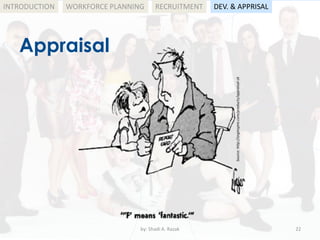
Appraisal
WORKFORCE PLANNING RECRUITMENT DEV. & APPRISAL
Source:http://orginspire.com/products/appraisal-sk
by: Shadi A. Razak 23
INTRODUCTION
Appraisal
WORKFORCE PLANNING
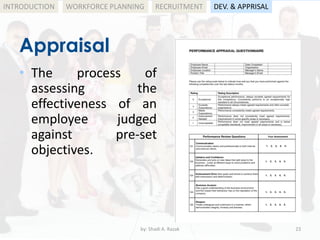
• The process of
assessing the
effectiveness of an
employee judged
against pre-set
objectives.
RECRUITMENT DEV. & APPRISAL
by: Shadi A. Razak 24
INTRODUCTION
Appraisal
WORKFORCE PLANNING
• After their appraisal, some employees may be
recommended:
– A promotion
– Training
– Warning to improve by a given deadline
– Disciplinary
– Employment termination
RECRUITMENT DEV. & APPRISAL
by: Shadi A. Razak 25
INTRODUCTION
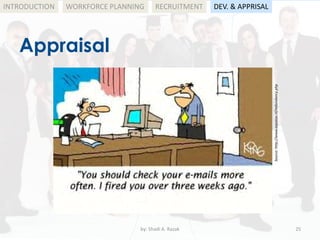
Appraisal
WORKFORCE PLANNING RECRUITMENT DEV. & APPRISAL
Source:http://www.expatax.nl/redundancy.php
by: Shadi A. Razak 26
INTRODUCTION
Work patterns
WORKFORCE PLANNING
• Traditional work patterns:
– Permanent work
– Regular working hours
– Manufacturing employment
– Office employment
RECRUITMENT DEV. & APPRISAL W. PATTERN
D
E
C
L
I
N
E
by: Shadi A. Razak 27
INTRODUCTION
Work patterns
WORKFORCE PLANNING
• Rising work patterns:
– Part-time / Temporary work
– Self-employed
– Flexible working hours
– Teleworking
– Outsourcing and offshoring
RECRUITMENT DEV. & APPRISAL W. PATTERN
G
R
O
W
T
H
by: Shadi A. Razak 28
INTRODUCTION
Work patterns
WORKFORCE PLANNING
• The reasons for these changes:
– Focus on competitiveness
– Globalisation
– Changing social and demographic patterns
– Rapid advance in technology
RECRUITMENT DEV. & APPRISAL W. PATTERN
by: Shadi A. Razak 29
INTRODUCTION
Work patterns
WORKFORCE PLANNING
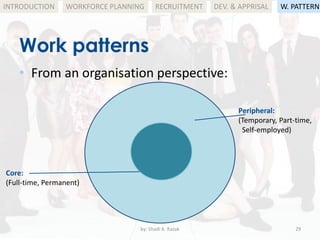
• From an organisation perspective:
RECRUITMENT DEV. & APPRISAL W. PATTERN
Peripheral:
(Temporary, Part-time,
Self-employed)
Core:
(Full-time, Permanent)
by: Shadi A. Razak 30
INTRODUCTION
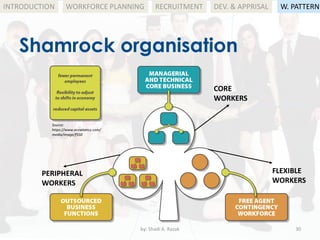
Shamrock organisation
WORKFORCE PLANNING RECRUITMENT DEV. & APPRISAL W. PATTERN
CORE
WORKERS
FLEXIBLE
WORKERS
PERIPHERAL
WORKERS
Source:
https://www.acowtancy.com/
media/image/f550
Summary
by: Shadi A. Razak 31
• Explained the importance of labour mobility
and demographics in workforce planning
• Discussed the process of influence of
workforce planning
• Discussed human resources department
different functions
• Discussed the consequences of changing work
patter
INTRODUCTION WORKFORCE PLANNING RECRUITMENT DEV. & APPRISAL W. PATTERN

Human Resources

  • 1.
    BUSINES S&MANA GEMENTby: Shadi A.Razak 1 Human Resources
  • 2.
    Objectives • Discuss theconstraint and opportunities presented by labour mobility and demographics • Analyse the workforce planning process • Discuss different methods of recruitment, training, appraisal and dismissal • Discuss the reasons for work pattern changes and the change consequences by: Shadi A. Razak 2
  • 3.
    Structure • Introduction • WorkforcePlanning • Recruitment • Training and Appraisal • Work Patterns by: Shadi A. Razak 3
  • 4.
    Human resources by: ShadiA. Razak 4 INTRODUCTION Source:www.hrdailyadvisor.blr.com.com
  • 5.
    Human resources by: ShadiA. Razak 5 INTRODUCTION • Like other management practices, get affected by the changes in: – Political environment – Economic situation – Social environment – Technology
  • 6.
    by: Shadi A.Razak 6 INTRODUCTION Supply of labour Source: http://bilbo.economicoutlo ok.net/blog/?p=26758 Source: www. australiaphotoguide.com Source: http://bilbo.economicoutlo ok.net/blog/?p=26758
  • 7.
    Supply of labour by:Shadi A. Razak 7 INTRODUCTION • The potential supply of labour to any organisation is affected by: – Demographics – Labour mobility
  • 8.
    Demographics by: Shadi A.Razak 8 INTRODUCTION Source: www.getbrandwise.com
  • 9.
    Demographics by: Shadi A.Razak 9 INTRODUCTION Source: http://www.economicmodelling.co.uk/2014/02/24/highlig hts-of-our-2014-data-update-part-1-demographics/ Source:careerweb.leeds.ac.uk
  • 10.
    Labour mobility by: ShadiA. Razak 10 INTRODUCTION • Consist of two types: – Geographical mobility Source:http://www.intereconomics.eu/archive/year/2014/3/labour- mobility-in-the-eu-dynamics-patterns-and-policies/search/austerity/20/
  • 11.
    Labour mobility by: ShadiA. Razak 11 INTRODUCTION • Consist of two types: – Occupational mobility
  • 12.
    by: Shadi A.Razak 12 INTRODUCTION Definition WORKFORCE PLANNING • The activity of analysing and establishing the number and skills of the workforce required by the business to meet its objectives
  • 13.
    by: Shadi A.Razak 13 INTRODUCTION Process WORKFORCE PLANNING • Workforce planning involves two main stages: – Forecast number of workforce – Forecast skills of workforce
  • 14.
    by: Shadi A.Razak 14 INTRODUCTION Forecasting the numbers WORKFORCE PLANNING • This depends on several factors: – Forecasting demand for the firm product – The productivity levels of staff – The business objectives – Employment law – Labour turnover – Work pattern
  • 15.
    by: Shadi A.Razak 15 INTRODUCTION Forecasting the skills WORKFORCE PLANNING • This depends on several factors: – Demographics – Pace of technological changes – Work pattern
  • 16.
    by: Shadi A.Razak 16 INTRODUCTION Redundancy WORKFORCE PLANNING • Usually a result of workforce audit and planning. • Is when a job is no longer required so the employee whose doing this job becomes redundant.
  • 17.
    by: Shadi A.Razak 17 INTRODUCTION Redundancy WORKFORCE PLANNING Source:www.funnyjunk.com
  • 18.
    by: Shadi A.Razak 18 INTRODUCTION Definition WORKFORCE PLANNING • The process of identifying the need for a new employee, defining the job to be filled and the type of person needed to fill it, attracting suitable candidate and selecting the best one RECRUITMENT Source: http://www.clker.com/clipart-249036.html
  • 19.
    by: Shadi A.Razak 19 INTRODUCTION Process WORKFORCE PLANNING • The recruiting process involves the following steps: – Job description – Person specification – Advertising (Internal / External) – Selection: • Shortlisting • Interview & Assessment center RECRUITMENT Source: http://www.clker.com/clipart-249036.html
  • 20.
    by: Shadi A.Razak 20 INTRODUCTION Benefits WORKFORCE PLANNING • Professional development by training help business to: – Develop junior staff – Help staff to adopt to changes – Motivate workforce RECRUITMENT DEV. & APPRISAL Source: http://blog.fundinggate s.com/2012/10/manage ment-training-improv- workplace/
  • 21.
    by: Shadi A.Razak 21 INTRODUCTION Types of training WORKFORCE PLANNING • There are three main types of professional training in business: – Orientation – On-the-job training – Off-the-job training RECRUITMENT DEV. & APPRISAL Source: http://blog.fundinggate s.com/2012/10/manage ment-training-improv- workplace/
  • 22.
    by: Shadi A.Razak 22 INTRODUCTION Appraisal WORKFORCE PLANNING RECRUITMENT DEV. & APPRISAL Source:http://orginspire.com/products/appraisal-sk
  • 23.
    by: Shadi A.Razak 23 INTRODUCTION Appraisal WORKFORCE PLANNING • The process of assessing the effectiveness of an employee judged against pre-set objectives. RECRUITMENT DEV. & APPRISAL
  • 24.
    by: Shadi A.Razak 24 INTRODUCTION Appraisal WORKFORCE PLANNING • After their appraisal, some employees may be recommended: – A promotion – Training – Warning to improve by a given deadline – Disciplinary – Employment termination RECRUITMENT DEV. & APPRISAL
  • 25.
    by: Shadi A.Razak 25 INTRODUCTION Appraisal WORKFORCE PLANNING RECRUITMENT DEV. & APPRISAL Source:http://www.expatax.nl/redundancy.php
  • 26.
    by: Shadi A.Razak 26 INTRODUCTION Work patterns WORKFORCE PLANNING • Traditional work patterns: – Permanent work – Regular working hours – Manufacturing employment – Office employment RECRUITMENT DEV. & APPRISAL W. PATTERN D E C L I N E
  • 27.
    by: Shadi A.Razak 27 INTRODUCTION Work patterns WORKFORCE PLANNING • Rising work patterns: – Part-time / Temporary work – Self-employed – Flexible working hours – Teleworking – Outsourcing and offshoring RECRUITMENT DEV. & APPRISAL W. PATTERN G R O W T H
  • 28.
    by: Shadi A.Razak 28 INTRODUCTION Work patterns WORKFORCE PLANNING • The reasons for these changes: – Focus on competitiveness – Globalisation – Changing social and demographic patterns – Rapid advance in technology RECRUITMENT DEV. & APPRISAL W. PATTERN
  • 29.
    by: Shadi A.Razak 29 INTRODUCTION Work patterns WORKFORCE PLANNING • From an organisation perspective: RECRUITMENT DEV. & APPRISAL W. PATTERN Peripheral: (Temporary, Part-time, Self-employed) Core: (Full-time, Permanent)
  • 30.
    by: Shadi A.Razak 30 INTRODUCTION Shamrock organisation WORKFORCE PLANNING RECRUITMENT DEV. & APPRISAL W. PATTERN CORE WORKERS FLEXIBLE WORKERS PERIPHERAL WORKERS Source: https://www.acowtancy.com/ media/image/f550
  • 31.
    Summary by: Shadi A.Razak 31 • Explained the importance of labour mobility and demographics in workforce planning • Discussed the process of influence of workforce planning • Discussed human resources department different functions • Discussed the consequences of changing work patter INTRODUCTION WORKFORCE PLANNING RECRUITMENT DEV. & APPRISAL W. PATTERN